How to Collect Feedback from Customers: A Practical Guide
Discover how to collect feedback from customers with practical SaaS strategies. Learn channels, questions, and tools to reduce churn and boost growth.

When we talk about collecting customer feedback, we're really talking about building a systematic program. It’s a machine that captures insights, stacks them up based on their potential impact, and then directly feeds them into your product development cycle. The goal is to stop just passively solving tickets and start proactively hunting for insights that spark growth and kill churn.
Building a Modern Customer Feedback Program
It's time to ditch the random annual surveys and the chaotic spreadsheets of feature requests. Let's build a feedback program that actually fuels growth, not just bloats your backlog. For any SaaS team, the biggest mental shift is moving from a reactive, problem-solving mindset to proactively seeking out opportunities hidden in everyday customer conversations.
So, what does a modern feedback framework actually look like? It’s built on a few core ideas. It has to be:
- Proactive: You don’t just sit back and wait for the complaints to roll in. You’re actively seeking input at the most critical moments of the customer journey.
- Multichannel: You’re pulling insights from everywhere—support tickets, sales calls, in-app surveys, even social media chatter. Every touchpoint is a goldmine.
- Integrated: The feedback loop isn’t an island. It’s plugged directly into your product development lifecycle, making sure what you learn turns into what you build.
The Foundation of a Feedback-Driven Culture
Having a structured system for listening does more than just gather comments; it turns raw data into a genuine strategic asset. When you systematically capture what your users are saying—and just as importantly, what they’re doing—you can build your roadmap with confidence. This is how you uncover those hidden expansion opportunities and, ultimately, create a product people can't imagine leaving.
This simple three-step flow gets to the heart of it: Listen, Prioritize, and Build.
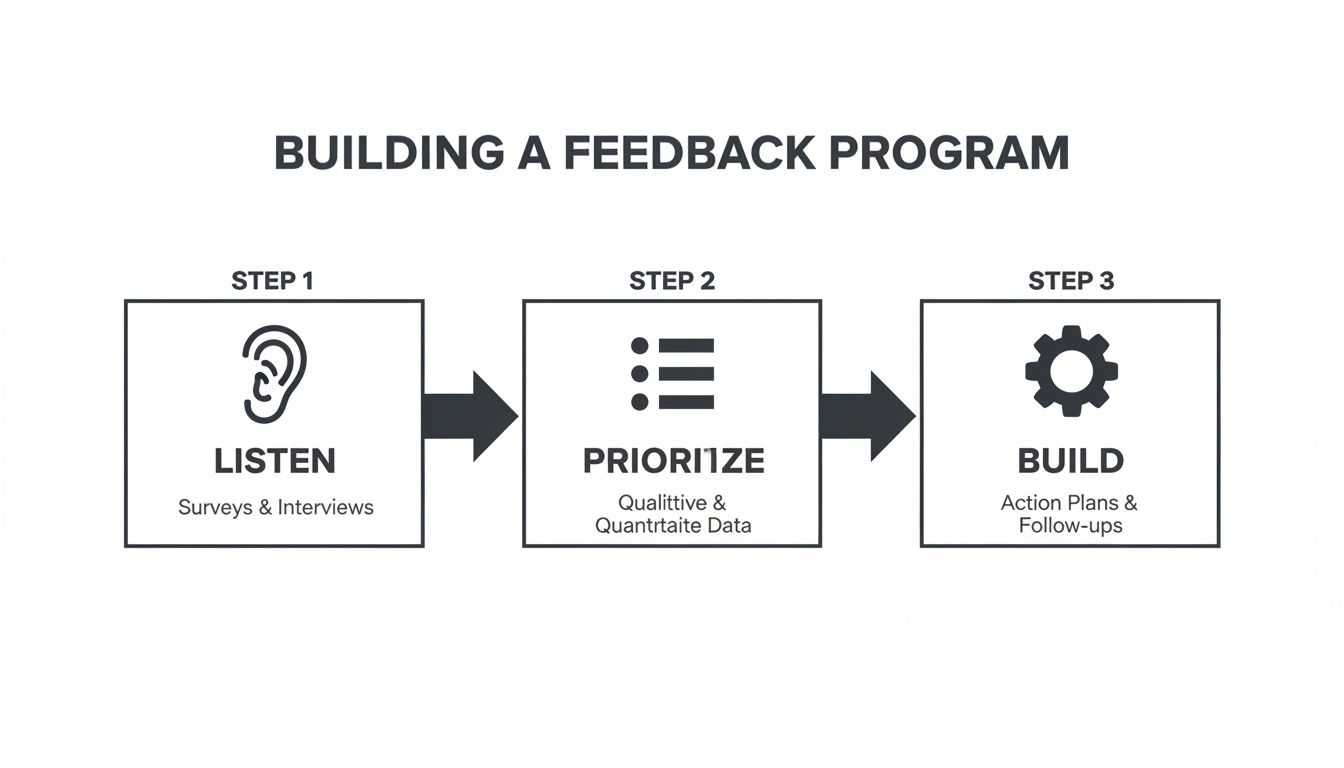
This isn't a one-off project. Think of it as a continuous cycle that should be the engine powering your product’s evolution.
From Noise to Signal
Let's be honest, the problem is rarely a lack of feedback. It's the overwhelming volume of it. The real trick is learning how to pick out the valuable signals from all the distracting noise.
A well-designed program helps you zero in on the insights that will actually move the needle on key business goals, like retention and revenue. This goes way beyond simply counting up feature requests. A truly effective approach requires a structured understanding of Voice of the Customer analysis (https://www.sigos.io/blog/voice-of-customer-analysis) to spot the underlying trends and root causes.
For a deeper dive into practical implementation, check out these strategies for collecting customer feedback that actually works. It definitely takes time to build a solid system, but the payoff is huge: a product that truly connects with your market.
Choosing Your SaaS Feedback Channels Wisely

Here's the thing: your customers are already talking. Every day, they're dropping clues about what they love, what drives them crazy, and what they wish your product could do. The real work isn't about generating more feedback—it's about knowing where to listen.
Building a solid feedback system means picking your channels strategically. You need a mix that captures both the insights you ask for and the candid truths you don't. This isn't about opening every possible floodgate; it's about focusing on the few high-signal channels that bring real clarity without overwhelming your team.
Direct vs. Indirect Feedback: The Two Sides of the Coin
First, let's break down the two main ways feedback will come at you. Both are incredibly valuable, but they tell you different things and require different approaches.
Direct feedback channels are the ones you own and operate. You're proactively asking for input at specific moments in the customer journey.
- Surveys: These are your go-tos for quantitative benchmarks. Think NPS, CSAT, and Customer Effort Score (CES). They give you a high-level pulse on satisfaction and loyalty.
- In-App Widgets: Perfect for catching feedback in the wild. A simple pop-up asking, "Was this helpful?" right after a user completes a task delivers immediate, highly contextual data.
- Email Outreach: Want to go deeper? Targeted emails to specific user segments (like new users or power users) are fantastic for getting qualitative insights, especially for beta tests or post-onboarding check-ins.
Indirect feedback channels are where customers talk about you when they think you're not looking. This is often where the most honest, unfiltered opinions live.
"The most honest feedback often comes when customers don't know you're listening. Support tickets and sales call recordings aren't just for resolving issues or closing deals; they are a direct line to your user's unfiltered thoughts and frustrations."
Some of the richest indirect sources are already flowing into your business:
- Support Tickets: Every conversation in tools like Zendesk or Intercom is a potential goldmine. They pinpoint bugs, confusing UI, and gaps in your documentation.
- Sales Call Transcripts: Platforms like Gong or Chorus capture the exact language prospects use to describe their problems. This is pure gold for understanding what features they really value.
- Social Media and Review Sites: Public forums on Reddit, review sites like G2 and Capterra, and social media give you raw, public sentiment about your product and how it stacks up against the competition.
Tailor Your Channels to Your Business Model
There's no magic formula here. The right mix of channels depends entirely on your product and who you sell to.
A B2B enterprise platform, for instance, will get massive value from dissecting sales call transcripts. A single feature request mentioned on a call could be the key to unlocking a six-figure deal. For them, high-touch, consultative conversations are the primary channel.
On the other hand, a B2C mobile app with millions of users can't rely on individual calls. They need to lean on App Store reviews and in-app prompts to spot trends across a massive user base. Their scale demands aggregated, quantitative data.
It's also worth noting how customer preferences are shifting. A 2025 global study found that only 32% of consumers give direct feedback after a bad experience. Among those who do, 49% now prefer email, and 40% turn to website feedback forms, showing a clear trend toward digital, asynchronous communication.
Comparison of Customer Feedback Channels
Choosing the right channels can feel overwhelming. This table breaks down the most common options for SaaS teams to help you decide where to focus your energy.
| Channel | Type of Feedback | Pros | Cons |
|---|---|---|---|
| NPS/CSAT Surveys | Quantitative, Direct | Easy to benchmark; tracks high-level satisfaction over time. | Lacks context; "why" is often missing. |
| In-App Widgets | Qualitative, Direct | Highly contextual; captures feedback at the moment of experience. | Can be disruptive if overused; may create survey fatigue. |
| Support Tickets | Qualitative, Indirect | Unfiltered pain points; highlights bugs and usability issues. | Reactive, not proactive; represents only users who seek help. |
| Sales Calls | Qualitative, Indirect | Reveals purchase drivers and high-value feature requests. | Represents prospects, not necessarily long-term users. |
| Review Sites (G2/Capterra) | Qualitative, Indirect | Public and candid; great for competitive analysis. | Can be biased; often reflects extreme (very happy/unhappy) views. |
| User Interviews | Qualitative, Direct | Deep, nuanced insights; allows for follow-up questions. | Time-intensive; small sample size may not be representative. |
Ultimately, no single channel tells the whole story. Your goal is to build a balanced portfolio. Combine a few key direct channels to track metrics with a process for systematically mining your most valuable indirect ones. This focused approach gives you a complete picture of the customer experience without drowning your team in data.
To bring all these sources together, many teams rely on customer feedback management software. These platforms can centralize inputs, making it much easier to spot trends and act on what you're hearing.
Crafting Questions That Get You Real Insights
Collecting feedback is one thing. Collecting feedback that actually sparks a breakthrough is something else entirely. If you're just asking generic questions like "How are we doing?", you're going to get vague, uninspired answers. It's a missed opportunity.
To really get to the "why" behind what your customers are doing, you have to master the art of asking questions that invite stories, not just scores.
The real trick is to build a questioning strategy that balances two critical needs. You absolutely need clean, quantitative data from closed-ended questions for tracking and reporting. But you also need the rich, qualitative context that only comes from thoughtful, open-ended prompts. Nailing this balance is what separates a feedback program that just fills a dashboard from one that fills your roadmap with confident, customer-backed decisions.
Open-Ended vs. Closed-Ended Questions
Let's start with the basics, because the type of question you ask directly shapes the answer you get.
Closed-ended questions are your go-to for gathering structured, measurable data. They're quick for customers to answer and a breeze for you to analyze at scale.
- Binary: "Did you find what you were looking for?" (Yes/No)
- Multiple Choice: "Which of these features do you use most often?" (Option A, B, C)
- Rating Scale: "On a scale of 1-5, how easy was it to complete your onboarding?"
These questions are the backbone of key metrics like CSAT and CES. They're fantastic for telling you what is happening across your user base.
Open-ended questions, on the other hand, are all about uncovering the why. They can’t be answered with a simple "yes" or "no," and they push customers to explain things in their own words. This is where you find the emotional context, the hidden frustrations, and the brilliant, unexpected ways people are using your product.
A well-crafted open-ended question is like handing your customer a microphone. It shows them you're not just looking for a score; you're genuinely interested in their story.
Avoiding Common Questioning Traps
Even with the best intentions, it's surprisingly easy to write questions that poison your own data. Biased questions can steer customers to the answer you want to hear, not the one you need to hear, while poorly worded surveys just lead to fatigue and low response rates.
Here are a few common mistakes I've seen teams make time and time again:
- Leading Questions: These subtly nudge the user toward a specific answer. Instead of asking, "How much did you enjoy our new, streamlined checkout process?"—which assumes they enjoyed it—try a neutral version like, "What was your experience with our checkout process like?"
- Double-Barreled Questions: This classic mistake is when you cram two questions into one, making it impossible for someone to answer accurately. For example, "Was our support team fast and knowledgeable?" What if they were knowledgeable but incredibly slow? They can't answer that honestly. Just split it into two separate questions.
- Ambiguous Language: Drop the jargon and internal acronyms. A question like, "How would you rate the efficacy of our CRM integration sync?" might leave a user scratching their head. A much clearer version is, "How well does our tool sync contacts with your CRM?" Always speak their language, not yours.
Battle-Tested Questions for Key SaaS Touchpoints
Knowing what to ask is only half the battle; knowing when is just as important. By deploying specific questions at crucial moments in the customer journey, you get feedback that's fresh, highly contextual, and immediately actionable.
Post-Onboarding (7-14 days in)
Right after they've kicked the tires, you want to understand their initial experience and spot any early roadblocks.
- "What was one thing you hoped to accomplish in your first week that you couldn't?"
- "If you could wave a magic wand, what's one thing you would change about the setup process?"
Feature Discovery & Adoption
These help you figure out if people are actually finding and getting value from specific parts of your product.
- "Tell us about the last time you used [Feature Name]. What were you trying to get done?"
- "In your own words, what's the main benefit you get from using our [Feature Name]?"
Churn & Cancellation Surveys
This is your last, best chance to learn from a customer who is walking away. Don't waste it with a generic multiple-choice list of reasons.
- "What was the primary reason that led you to cancel your subscription today?"
- "What specific problem were you hoping our product would solve that it didn't?"
- "Which competitor, if any, did you decide to switch to?"
By tailoring your questions like this, you move past bland satisfaction scores and start gathering the precise, contextual insights your product team can actually use. This turns feedback collection from a box-ticking exercise into a powerful engine for discovery.
Automating Feedback Collection and Analysis
Manually sifting through hundreds of customer comments is a recipe for disaster. Important insights get lost, trends are missed, and your team ends up reacting to fires instead of preventing them. The real skill in collecting customer feedback isn't just getting it—it's building an engine to automatically centralize, analyze, and act on it.
This means finally getting out of spreadsheets and creating a single, reliable source of truth for every customer conversation, no matter where it happens. The idea is to pull everything together: Zendesk tickets, Intercom chats, notes in Salesforce, and even call transcripts from Gong. When you unify this data, you start to see the bigger picture—the patterns that are completely invisible when you're looking at one channel at a time.
Letting AI Find the Signal in the Noise
Let's be honest: manually tagging every support ticket or reading every single survey response just isn't scalable. As you grow, it becomes impossible. This is where modern AI tools really shine. They can automatically analyze and quantify all that messy qualitative feedback, turning unstructured text into clean, actionable data.
Here’s what that looks like in the real world:
- A customer offhandedly mentions a frustrating bug deep within a long support chat. It wasn't their main issue, so a human agent might easily overlook it.
- An AI tool like SigOS ingests that transcript. Its natural language processing immediately spots the bug report and the negative sentiment around it.
- The system instantly connects this user to their account in your CRM, flagging them as part of a high-value enterprise plan.
- It then calculates the potential revenue impact tied to this bug and automatically creates a Jira ticket, complete with all the context, and assigns it to the right engineering team.
This whole process can happen in minutes, with zero human effort. It's a workflow that not only saves your team hundreds of hours but also guarantees that high-impact problems get the immediate attention they deserve.
The real magic of automation isn't just about speed. It’s about elevating the quality of your insights. It frees up your team from mind-numbing manual work so they can focus on the strategic decisions that actually move the needle.
Plenty of companies are catching on. While 88% of contact centers have adopted AI in some form, many are still struggling to integrate it fully. But the results speak for themselves: 80% of executives see real, measurable improvements in customer satisfaction after implementing conversational AI. The upside for teams who get this right is massive.
Building Your Automated Feedback Workflow
Setting up a truly automated system is all about connecting your existing tools into a single, cohesive workflow. The core pieces you'll need are your customer support platform, your CRM, and your product management software.

The goal is to quantify qualitative feedback, linking specific issues and feature requests directly to the revenue they impact. This gives your teams the hard data they need to prioritize with confidence.
Your first step is integrating your primary feedback sources. Start where your customers are already talking the most.
- Customer Support Platforms: Hook up your Zendesk, Intercom, or Help Scout to capture every ticket, chat, and email.
- CRM Systems: Integrate with Salesforce or HubSpot to connect feedback directly to customer accounts, revenue data, and contract size. This context is gold.
- Communication Tools: Don't forget to pull data from internal Slack channels where sales or success teams are constantly sharing customer anecdotes and quick wins.
Once your data is flowing in, you need an analysis engine. This is where AI-driven customer feedback analysis tools are essential. They don't just count keywords; they understand intent, sentiment, and urgency.
From Analysis to Action
The final, and most important, piece of the puzzle is routing those insights to the right people so they can actually do something about them. The best systems create a seamless handoff from analysis to execution by integrating with your project management tools.
- For Product Teams: Automatically create detailed tickets in Jira or Linear when a new bug or a high-impact feature request pops up. The ticket should be pre-filled with original customer quotes, revenue impact, and a link back to the source conversation.
- For Success Teams: Trigger an alert in your CRM or a dedicated Slack channel when a high-value customer expresses frustration or shows signs of potential churn.
- For Marketing Teams: Surface recurring positive themes or powerful customer quotes that can be turned into compelling case studies and testimonials.
By creating these automated loops, you transform feedback from a passive dataset into an active, intelligent system that continuously informs every part of your organization. It’s how you make sure every critical customer insight gets captured, quantified, and delivered directly to the person who can act on it.
Closing the Loop to Build Customer Loyalty
Here's a hard truth for SaaS teams: collecting customer feedback and letting it vanish into a black hole is a cardinal sin. It's often worse than not asking for feedback at all. When customers take the time to share their thoughts and hear nothing back, it sends a clear message: "We don't actually value your opinion." This actively erodes trust.
The final, and frankly most crucial, step in any feedback program is closing the loop. This is where you turn all those hard-won insights into a powerful engine for customer loyalty and real business growth. It's a two-sided coin: one side faces your customers, the other faces your internal stakeholders. You have to get both right.
Communicating Changes to Your Customers
Imagine you suggest an improvement to a product you love, and a few weeks later, you get a personal note saying they built it because of you. That's an incredibly powerful retention play. It transforms a passive user into a valued contributor—a partner in your product's journey.
Luckily, this doesn't have to be a complicated, manual process. You can easily segment users who provided specific feedback and send them targeted updates.
- Personalized Emails: For a high-value suggestion, a quick, personal email from a product manager is gold. Think: "Hi Jane, remember that idea you shared about improving our reporting dashboard? We just shipped it. Thanks to you, it's now live for everyone."
- In-App Notifications: A simple, well-timed notification that says, "You asked, we listened!" can show users you're actively building the product they want.
- Public Changelogs: In your release notes or changelog, specifically call out features that were "inspired by customer feedback." This public acknowledgment shows your entire user base that you're listening.
The goal is to make your customers feel like co-creators. When they see their voice directly influencing the product roadmap, their loyalty deepens, and they become far more likely to offer valuable insights in the future.
Telling the Story Internally
Let’s be honest: raw feedback data rarely gets the attention it deserves in a busy company. A spreadsheet full of comments just doesn't move the needle for leadership. Your job is to become a storyteller—to translate those scattered comments and survey scores into a compelling narrative that connects directly to the metrics your executive team actually cares about.
Stop presenting simple lists of feature requests. Instead, frame your insights around business impact.
Instead of saying, "Customers are confused by our onboarding," try this: "I’ve identified a major friction point in our onboarding that’s contributing to a 15% drop-off in the first week. By streamlining this flow, we project a 5% reduction in early-stage churn, which translates to an estimated $50,000 in ARR."
See the difference? This approach reframes feedback from a cost center (engineering time) into a revenue driver. To make this narrative even stronger, it helps to have a structured process for managing these ideas. Our guide on how to build a powerful request a feature system provides a great framework for doing just that.
Measuring the ROI of Your Feedback Program
To justify continued investment in your feedback initiatives, you need to prove their value with cold, hard data. The key is to tie your efforts back to core business metrics. This isn’t about vanity metrics like "number of surveys sent." It's about measuring real-world outcomes.
Here is a simple framework to connect your feedback initiatives to their financial impact:
| Metric | How to Measure | Example Impact |
|---|---|---|
| Churn Reduction | Track the churn rate of users whose feedback was implemented vs. those whose feedback was not. | Customers who see their feedback acted upon are 2x less likely to churn in the following quarter. |
| Increased LTV | Measure the Lifetime Value of highly engaged feedback contributors. | Power users who submit regular feedback have a 30% higher LTV over two years. |
| Expansion Revenue | Link feature releases driven by feedback to upsell and cross-sell conversions. | A new feature built from customer requests led to $100k in expansion MRR last quarter. |
When you can quantify the impact like this, you're no longer just "collecting comments." You're running a strategic program with a clear and defensible ROI. You’re proving that listening to customers isn’t just a nice-to-have—it's good business. This completes the cycle, turning customer feedback into a sustainable, growth-driving force for your entire organization.
Your Top Customer Feedback Questions, Answered
Even with the best framework in place, collecting customer feedback is never a simple plug-and-play process. SaaS teams often run into the same roadblocks: timing your requests, dealing with criticism, and just getting people to respond in the first place.
Getting these details right can be the difference between a feedback program that truly moves the needle and one that just fizzles out. Let's tackle some of the most common questions we hear from teams who are ready to get serious about customer insights.
How Often Should We Be Asking for Feedback?
The biggest mistake I see teams make is thinking in terms of time. Ditch the idea of a generic quarterly survey—it’s a recipe for low response rates and stale insights. The best cadence isn't time-based; it's event-triggered.
You want to ask for input at specific, high-stakes moments in the customer journey. This keeps your requests hyper-relevant and catches users when the experience is still fresh in their minds.
Think about it this way:
- After Onboarding: Don't just ask if they liked the setup. Wait about 14 days, then ask something specific: "What's one thing you hoped to do in your first two weeks that you couldn't?" The answers will be gold.
- Following Feature Use: The third time a customer uses a new feature is a magic moment. Trigger a quick, one-question prompt to capture their gut reaction to its value.
- Transactional Moments: The second a support ticket is closed is the perfect time to ask for feedback. The context is immediate, and you’ll get incredibly specific, actionable comments.
When you link feedback requests to actual user behavior, you’re sending a powerful message. You're not just blasting out a survey; you're showing the customer you understand their journey and care about that specific experience. That alone can dramatically improve the quality of the insights you get back.
What's the Best Way to Handle Negative Feedback?
Okay, first rule: don't panic. Take a deep breath and reframe your thinking. Negative feedback isn't an attack. It's a free consultation from a customer who cares enough about your product to tell you what's broken. It's a gift, but only if you know how to unwrap it.
Start by responding quickly and with genuine empathy. Drop the corporate-speak and just be human. A simple, "Thanks for pointing this out. I can absolutely see why that's frustrating," can completely de-escalate a tense situation. It shows you're actually listening.
Next, you need to play detective and get to the root cause.
- Is this a one-off bug, or are other users hitting the same wall?
- Is the user confused because of a clunky UI?
- Is a missing feature the real source of their pain?
Log this feedback in a centralized system so you can start connecting the dots. What looks like an isolated complaint might actually be part of a much larger trend. This is how you bridge the gap between an angry email and smart product strategy.
And the final, most crucial step? Always, always close the loop. Even if you can't ship a fix tomorrow, letting the customer know they were heard can turn a detractor into a fan. A simple follow-up note—"Just wanted to let you know we've added your feedback to our product discussion for next quarter"—is incredibly powerful. It shows you value their time and their opinion.
How Can We Get More Customers to Actually Give Feedback?
Getting more people to respond boils down to two things: reduce the friction and prove it matters. If you make it dead simple to share thoughts and then show that you're acting on them, you'll create a feedback engine that practically runs itself.
Reducing friction means getting rid of every unnecessary click. Nobody has time for a ten-question survey.
- Use in-app widgets: A simple thumbs-up/down or an emoji rating right after an action is completed is effortless for the user.
- Embed questions in emails: Put the first question directly in the email body. A user can click their answer without ever leaving their inbox, drastically increasing engagement.
But making it easy is only half the battle. You have to prove their input isn't just going into a black hole. When you release a feature that came from user requests, shout it from the rooftops. In your release notes, add a line that says, "Based on your feedback, we've now added the ability to export reports to PDF."
This public acknowledgment is what creates a virtuous cycle. Customers feel heard, so they provide more thoughtful feedback, which helps you build a better product.
Stop drowning in feedback and start finding the insights that drive revenue. SigOS is an AI-driven intelligence platform that automatically analyzes your support tickets, sales calls, and usage data to pinpoint the issues costing you money and the feature requests that will unlock growth. Learn how SigOS can help you prioritize your roadmap with confidence.
Keep Reading
More insights from our blog
Ready to find your hidden revenue leaks?
Start analyzing your customer feedback and discover insights that drive revenue.
Start Free Trial →