How to Improve NPS for Lasting Customer Loyalty
Discover how to improve NPS with actionable strategies. Learn to close feedback loops, leverage promoters, and turn customer insights into sustainable growth.
Improving your Net Promoter Score really boils down to two things: systematically fixing what your Detractors are telling you is broken, and giving your Promoters a megaphone. It’s about taking that single number and turning it into a powerful engine for real, sustainable business growth.
Going Beyond the Score to Understand Your NPS
One of the biggest mistakes I see companies make is treating their NPS like a final grade on a report card. It's not. Think of it as a vital sign, a starting point for a much deeper conversation about the health of your customer relationships. The number itself is just the headline; the real story is in the "why" behind it.
Every customer who responds to your survey falls into one of three camps:
- Detractors (score 0-6): These folks are unhappy and at a high risk of leaving. Their feedback isn't just criticism; it's a treasure map pointing directly to the most urgent problems in your product or service.
- Passives (score 7-8): These customers are content, but not thrilled. They're on the fence, which makes them prime targets for your competitors. They see you as a utility, not a partner.
- Promoters (score 9-10): Your champions. These are the loyal, enthusiastic customers who will sing your praises, refer their friends, and tell you exactly what you’re getting right.
The Two Foundational Strategies
Chasing a higher NPS just for the sake of the number is a waste of time. The real goal is to build a stronger business from the inside out. This means tackling the problem from both ends of the spectrum. You have to listen to your Detractors to stop the bleeding, while at the same time, you need to empower your Promoters to fuel your growth. It’s a delicate but crucial balance.
This guide is your roadmap for turning those survey insights into meaningful action. We're moving past the theory and into practical strategies that build a system for consistently improving customer loyalty. Getting these fundamentals right is just as important as understanding how NPS differs from other client satisfaction metrics that give you a full view of customer health.
Let's dive into the two core strategies that will actually move the needle on your NPS.
Core NPS Improvement Strategies at a Glance
To put it simply, your NPS improvement efforts should be a two-pronged attack. The table below breaks down these foundational approaches, showing you who to target, what to do, and the business impact you can expect.
| Strategy Focus | Target Group | Key Action | Primary Business Outcome |
|---|---|---|---|
| Problem Resolution | Detractors | Implement a closed-loop feedback system to resolve issues quickly. | Reduce customer churn and build trust. |
| Advocacy Activation | Promoters | Create programs for reviews, testimonials, and referrals. | Drive word-of-mouth growth and brand loyalty. |
By focusing on both fixing problems for your critics and amplifying the voices of your fans, you create a powerful, self-reinforcing cycle of improvement and growth.
Building a Closed-Loop Feedback System
Collecting NPS data is a great start, but the real value comes from what you do with it. This is where a closed-loop feedback system comes into play. It’s essentially a structured process for responding directly to customer feedback, ensuring no comment—especially a negative one—is left floating in the void.
You’re basically turning a monologue into a dialogue. When you do this, you prove to customers that you’re actually listening and their opinion matters. It transforms feedback from a passive number on a dashboard into an active tool for saving relationships and building loyalty.
Think about it: when a customer gives you a low score, they're often giving you one last chance to make things right. How you respond in that moment is everything.
The Core Components of an Effective Loop
Setting up a system like this doesn't need to be a massive, complicated project. It really boils down to three key actions: acknowledge the feedback, act to fix the problem, and analyze the trends to stop similar issues from happening again.
A solid closed-loop process usually includes:
- Real-Time Alerts: The right person (like a customer success manager or support lead) gets an instant notification when a Detractor leaves a score.
- Defined Ownership: Everyone knows exactly who is responsible for following up with Detractors, Passives, and even Promoters. No more finger-pointing.
- Follow-Up Protocols: Simple scripts or guidelines help your team have empathetic and consistent conversations focused on a resolution, not just a hollow apology.
- Root Cause Tracking: You need a way to tag feedback with themes like "bug," "pricing," or "support issue." This is how you spot the recurring problems that need a bigger fix.
This infographic gives a great overview of how to think about each customer group—Detractors, Passives, and Promoters—within your feedback strategy.
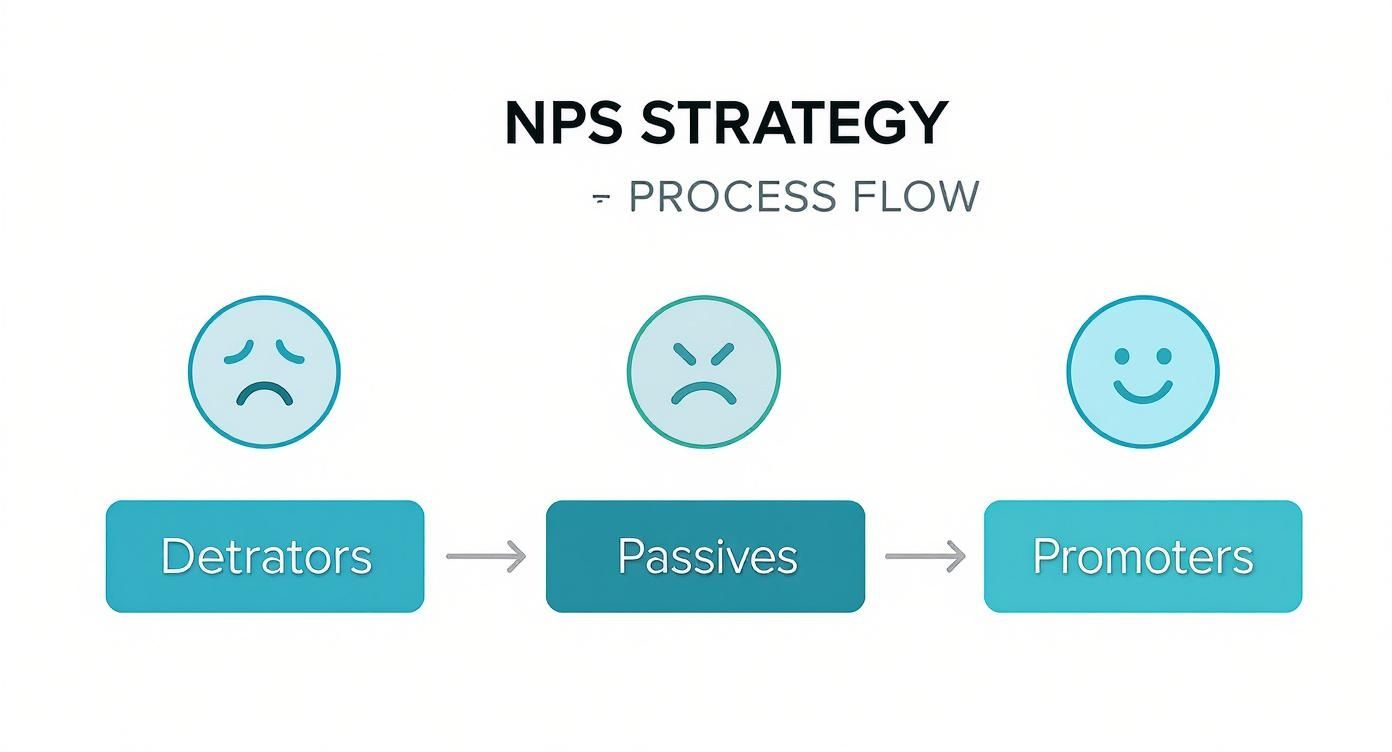
As you can see, each group needs a different touch. You rush to solve problems for Detractors while you work on activating Promoters as advocates. It all works together.
Empowering Your Frontline Teams to Act
I've seen firsthand that the best closed-loop systems empower the people on the front lines. Your support agents, account managers, and anyone else talking to customers daily should have the authority to resolve issues directly.
When a support agent can personally reach out to a Detractor within hours of their bad review, it sends a powerful message: "We hear you, and we care." This direct line of communication builds incredible trust and can absolutely salvage a relationship that was on the brink of churn.
The data backs this up. One analysis of global companies found that businesses with a structured closed-loop process saw their NPS jump by an average of 10 to 15 points in the first year alone. Direct, timely action on feedback is a proven way to move the needle.
A Practical Workflow for Handling Detractors
Let’s walk through a real-world scenario. A SaaS company gets a 3 from a long-time customer. The comment attached says, "Your new reporting feature is confusing and broke my old workflow. I'm wasting hours every week."
Here’s how a good closed-loop system kicks in:
- Immediate Alert: That low score automatically triggers a notification in Slack and creates a high-priority ticket assigned directly to the customer's dedicated account manager.
- Personal Outreach: Within two hours, the account manager sends a personalized email. Something like: "Hi [Customer Name], I saw your feedback about the new reporting feature, and I’m so sorry for the frustration it's causing. I'd love to jump on a quick 15-minute call to understand the issue and see how we can help."
- Problem Solving: On the call, the manager listens, documents the specific pain points, and offers an immediate workaround. They also schedule a follow-up with a product specialist to help rebuild the customer’s workflow properly.
- Closing the Loop: The manager logs the feedback in a central system, tagging it "UI/UX issue" and "reporting feature." A week later, they check in with the customer to make sure the solution is working.
This structured response is fundamental. To dig deeper into categorizing and understanding this kind of qualitative data, check out our guide on Voice of Customer analysis. Ultimately, a closed-loop system is your operational commitment to being customer-centric, turning raw scores into meaningful, loyalty-building actions.
Turning Promoters Into Your Growth Engine
It’s easy to focus all your energy on putting out fires with Detractors. But if you do that, you're leaving your best players on the bench. Your Promoters—the customers who give you a 9 or 10—aren't just happy clients; they're a powerful, often untapped, engine for growth.
The real goal isn't just to say "thanks." It's about building a system to turn that goodwill into genuine advocacy. Your fans want to help you grow. Your job is to make it incredibly easy for them.

Find and Segment Your Biggest Fans
Let's be real: not all Promoters are the same. Some are social media superstars, while others hold serious sway within their company. The first step is to figure out who your biggest champions are and what makes them tick.
Start by connecting your NPS data directly to your CRM. This simple step unlocks a ton of insight. You can see which Promoters are your highest-value customers, who has been with you the longest, or which ones are power users of a specific feature. This kind of segmentation is what lets you personalize your outreach and make the right ask.
For instance, a C-level executive who's a Promoter is probably the perfect person for a case study. On the other hand, a power user on a smaller team could be your go-to source for a detailed review on a site like G2. Stop treating them like a monolith and start understanding their individual context.
Create Simple, Clear Paths for Advocacy
Once you know who your champions are, you have to give them straightforward ways to share their positive experiences. Friction is the mortal enemy of advocacy. If it takes more than two clicks for a Promoter to leave a review, they’ll probably give up.
You can design automated workflows that kick in the moment a 9 or 10 score comes through. Imagine sending a follow-up email that says, "So glad to hear you're finding value! Would you be willing to share your experience on [Review Site]?" The key is providing a direct link that takes them right to the review page. No friction.
Here are a few structured ways to channel that Promoter enthusiasm:
- Online Reviews: Send them to key review sites like G2, Capterra, or Trustpilot. A steady stream of positive reviews is powerful social proof for new prospects doing their research.
- Testimonials and Case Studies: Invite high-profile Promoters to be featured in a case study. It gives them great exposure and provides you with a killer marketing asset.
- Video Testimonials: For your most passionate fans, a short, authentic video testimonial can be incredibly persuasive. You can make it easy by sending them a simple recording link through a tool like Vocal Video.
Build a Referral Program That Actually Works
The most direct way Promoters can fuel your growth? Sending new customers straight to your door. A well-designed referral program formalizes this process and rewards them for making the introduction. The trick is to make the reward valuable for both the person referring and the new customer they bring in.
This doesn't always have to be cash. You could offer account credits, exclusive early access to new features, or even a bump up to premium support. The incentive should align with your product and what your customers actually find valuable.
True advocacy is built on a foundation of great service. To get ideas, check out these strategies for building brand loyalty through exceptional customer support.
Bring Your Promoters Into the Fold
One of the best ways to deepen your relationship with Promoters is to make them feel like insiders. These are your most engaged users, and their feedback on new ideas is pure gold. This approach is a cornerstone of a customer-centric mindset and aligns perfectly with a product-led growth strategy.
Try creating an exclusive group or a "customer advisory board" for your top Promoters. This could be a private Slack channel or a dedicated online forum where they get a sneak peek at what you're building next.
Think about involving them in a few key ways:
- Beta Testing: Invite them to private betas for new features. Their feedback will be sharp and can help you work out the kinks before a public launch.
- Roadmap Feedback: Share parts of your product roadmap and ask for their input on what you should prioritize. This shows you genuinely trust their judgment.
- Ideation Sessions: Host brainstorming sessions where they can share new ideas directly with your product team.
When you make Promoters part of your story, you turn them from passive fans into active co-creators. This builds unbreakable loyalty and ensures they'll remain your strongest advocates for years, creating a powerful cycle of positive feedback and growth.
Diagnosing the Root Causes of Feedback
Getting a low NPS score is just the first clue. It tells you something’s wrong, but it doesn't tell you what. To really move the needle, you have to dig past the number and diagnose the root cause of what your customers are feeling.
Think of the open-ended feedback as a treasure map. It points directly to the friction in your customer's experience. While the score tells you what they feel, their comments tell you why. Ignoring that qualitative data is like a doctor seeing a high temperature but never asking about other symptoms. You know there's a problem, but you're just guessing at the cause and the cure.
Slice Your Data for Deeper Insights
One of the most powerful things you can do is segment your data. Your overall NPS score is a decent high-level snapshot, but the real "aha!" moments come when you slice that data into meaningful groups. This is where you connect feedback to specific business contexts and find your most actionable insights.
Try breaking down your NPS data by a few key attributes to get started:
- Customer Demographics: Are customers in a certain industry, region, or company size consistently scoring you lower? This could point to a market-fit problem or a feature gap for a vital segment.
- Product Usage: Do power users of a specific feature have a much higher NPS than those who don't touch it? Are new users struggling more than established ones? This helps you pinpoint what parts of your product create fans and what parts create friction.
- Customer Journey Stage: Is your NPS taking a nosedive right after onboarding? Or maybe scores dip after an interaction with your support team? Mapping scores to journey stages reveals the make-or-break moments that need your attention.
For instance, a B2B SaaS company might discover its Detractors are almost all from enterprise-level accounts that recently struggled with a new, complex integration. That’s a specific, solvable problem—far more useful than just knowing your overall score is a 25.
Uncovering Themes in Qualitative Feedback
Once you've segmented your quantitative data, it's time to dive into the comments. This is where you'll find the rich, contextual stories behind the scores. The goal here is to move beyond individual comments and spot the overarching themes.
Of course, manually sifting through thousands of comments just isn't practical. This is where text analytics tools become incredibly helpful. These platforms can automatically tag feedback with common themes like "bug," "pricing," "usability," or "customer support," letting you quickly see which issues are driving the most negative (and positive!) sentiment.
After collecting feedback, the next step is mastering qualitative data analysis techniques to truly understand the stories your customers are telling you. This helps you quantify the qualitative data, making it much easier to prioritize what to fix first.
Connect Feedback to Specific Events
Sometimes, a sudden dip in your NPS isn't about a long-standing issue but a specific, recent event. To catch these, you need to correlate your NPS trends with your company's own timeline. A little detective work here can pay off big time.
I recommend keeping an "event log" to map against your NPS data. Track things like:
- Product Releases: Did your score drop the week after a major feature update? That’s a huge red flag that the release may have introduced bugs or a clunky user experience.
- Pricing Changes: If you see a spike in Detractors mentioning "cost" or "value" right after a price hike, you have clear evidence of its impact on customer perception.
- Service Outages: A sudden nosedive in your score can often be traced directly to a recent server outage or performance problem, driving home just how much reliability matters.
By diagnosing feedback with this level of detail, you stop guessing and start knowing. You can walk into a meeting and confidently say, "Our NPS dropped by 10 points among enterprise users last month, and the top complaint was the performance of the new reporting dashboard." Now that is a problem your team can solve.
Operationalizing NPS Across Your Organization

Let's be honest: real, lasting improvements to your NPS don't happen in a vacuum. If you treat it like a problem for the customer support team to solve, you'll get a temporary fix at best. It’s a classic mistake.
To create real change, customer feedback needs to become the common language spoken across your entire company. This means weaving NPS data and customer stories into the daily fabric of every team—from product and engineering to sales and marketing. When you do this, NPS stops being a vanity metric and starts being a compass that guides company-wide decisions.
Make the Feedback Impossible to Ignore
The first move is to tear down the data silos. If your NPS insights are collecting dust in a report that only a few people see, they're completely useless. For anyone who's serious about how to improve NPS, making feedback highly visible and accessible isn't just a good idea; it's non-negotiable.
Get that data out in the open. Create centralized dashboards and put them on monitors around the office or pin them in a company-wide communication channel. Don’t just show the overall score. Show the trends, the most common complaints from Detractors, and—just as importantly—celebrate the glowing reviews from your Promoters. This keeps the customer's voice in everyone's head, every single day.
Here are a few practical ways to boost visibility:
- Live Feedback Feeds: Use an integration to pipe NPS responses directly into a public channel on Slack or Microsoft Teams. This creates a real-time stream of the customer's voice.
- Weekly Email Summaries: Send out a quick, scannable email digest every week. Highlight the NPS trends and the top reasons for both low and high scores.
- Customized Team Dashboards: Build different dashboard views for each department. The product team needs to see scores broken down by feature usage, while marketing might want to see feedback related to brand messaging.
Tie NPS to What Each Department Cares About
For feedback to actually drive action, it has to matter to the teams you want to influence. Connect NPS improvement directly to the goals and KPIs that each department is already measured on. Suddenly, it gets the attention it deserves.
Every team touches the customer experience in a different way, and their goals should reflect that. This approach turns a lofty company objective into concrete, team-level actions. It makes it crystal clear how every person’s daily work contributes to creating happier, more loyal customers.
By connecting NPS improvements to departmental KPIs, you transform customer feedback from a "nice-to-have" metric into a core driver of performance. The product team's success is no longer just about shipping features; it's about shipping features that delight customers and reduce Detractor-generating friction.
Get Everyone in the Same Room
With visibility and shared goals handled, the final piece of the puzzle is collaboration. You need a regular time and place for different teams to get together, look at the data, and agree on what to do next. A monthly or quarterly "Voice of the Customer" meeting works wonders for this.
Imagine what these meetings could look like:
- The Product Team shows how specific Detractor feedback about a clunky workflow has prompted them to prioritize a UI redesign in the next sprint.
- The Marketing Team presents a new testimonial campaign built entirely from powerful Promoter quotes, turning that positive feedback into a killer marketing asset.
- The Sales Team talks about insights from Detractors who felt the product was oversold, sparking a conversation about refining their pitch to set better expectations.
This kind of collaborative review process creates natural accountability. It ensures that customer insights don't just get discussed—they get acted on. When you truly operationalize NPS across every department, you build a resilient, customer-obsessed culture where everyone knows their role in turning feedback into your company's most valuable asset.
Frequently Asked Questions About Improving NPS
When you start digging into your Net Promoter Score, a few key questions always pop up. Getting these right is the difference between a program that just spits out numbers and one that actually drives meaningful change. Let's walk through some of the most common ones I hear from teams.
How Often Should We Survey Our Customers for NPS?
The right timing really hinges on your business model. There's no one-size-fits-all answer.
If you're in a transactional business, like e-commerce, it makes the most sense to send a survey right after a key moment—think a completed purchase or a successful delivery. The feedback is fresh, specific, and helps you immediately connect the dots between an event and the customer's experience.
For subscription businesses, like most SaaS companies, a relationship-focused survey every three to six months is a solid approach. This gives you a consistent read on overall customer health without bugging them too often. You're looking for a steady pulse on sentiment, not a constant barrage of questions.
A good rule of thumb is to avoid surveying the same individual more than once a quarter. This respects their time and prevents "survey fatigue," while still giving you a reliable stream of data to track trends and see if your improvements are actually working.
What Is a Good NPS Score?
Ah, the million-dollar question. The honest answer? It depends. While a score above 0 is good (you have more fans than critics), above 50 is considered excellent, and anything over 80 is truly world-class, these are just general signposts.
The most important benchmark is your own score, tracked over time. The real goal is steady, consistent improvement. That's the sign of a healthy, customer-focused business.
If you absolutely need to compare, look for benchmarks within your specific industry. It’s pointless for a SaaS startup to compare its NPS to a well-established airline. You'll just be comparing apples to oranges, and the "insights" you get won't be actionable.
Should We Focus on Detractors or Promoters?
Both groups are incredibly important, but where you put your energy often depends on where your business is in its journey.
Early on, it's almost always about the Detractors. Your top priority is stopping the bleeding—reducing churn, fixing glaring product gaps, and shoring up a shaky customer experience. Listening to their feedback is a defensive strategy that keeps your business from leaking customers.
Once you've stabilized and churn is under control, you can get a ton of mileage out of activating your Promoters. This is when you start shifting from defense to offense, building out advocacy programs and turning your happiest customers into a powerful growth channel. A balanced strategy is best: have a rock-solid process for closing the loop with Detractors, while also systematically engaging your Promoters.
How Do We Get More Customers to Respond?
Getting people to actually fill out your survey comes down to one thing: showing them it's worth their time.
First, make it ridiculously easy. Keep the survey short and make sure it works perfectly on a phone. The classic NPS question followed by a single open-ended "why?" is all you really need.
Next, personalize the invitation and tell them exactly how you use their feedback. The most powerful move you can make is to follow up later and share a story about a change you made because of what customers told you. When people see their feedback isn't just going into a black hole, they're far more likely to share their thoughts next time.
Ready to stop guessing what your customers want? SigOS uses AI to analyze all your customer feedback—from support tickets to sales calls—and tells you exactly which issues are costing you money and which feature requests will drive the most revenue. Prioritize your product roadmap with confidence.
Keep Reading
More insights from our blog

Ready to find your hidden revenue leaks?
Start analyzing your customer feedback and discover insights that drive revenue.
Start Free Trial →