Build a Business IT Roadmap That Actually Drives Growth
Stop creating IT roadmaps that collect dust. Learn how to build a business IT roadmap that aligns teams, prioritizes revenue, and drives real growth.
A business IT roadmap is the strategic plan that connects your company's technology initiatives directly to its long-term business goals. It’s far more than a simple checklist of software updates; it's the blueprint for how technology will fuel growth, increase revenue, and improve customer retention.
Why Your IT Roadmap Is More Than Just a Tech To-Do List
Let's be honest. For too long, many IT roadmaps have been little more than glorified to-do lists. They get siloed in the IT department, filled with server upgrades, license renewals, and routine maintenance. While those tasks are essential, this approach frames IT as a reactive cost center—not the proactive partner it needs to be.
This old-school, reactive mindset is a recipe for falling behind. When you’re constantly just putting out fires, you leave the door wide open to security risks, operational bottlenecks, and competitors who are using technology to innovate and pull ahead.
From Cost Center to Growth Engine
A modern business IT roadmap completely flips the script. Think of it as a communication tool that translates high-level company vision into a clear, actionable technology plan. It ensures that every single project, from a CRM migration to a cloud infrastructure overhaul, serves a measurable business purpose.
This strategic shift elevates IT from a "keep the lights on" function to a core driver of business outcomes. It’s about moving from managing expenses to enabling—and even accelerating—growth.
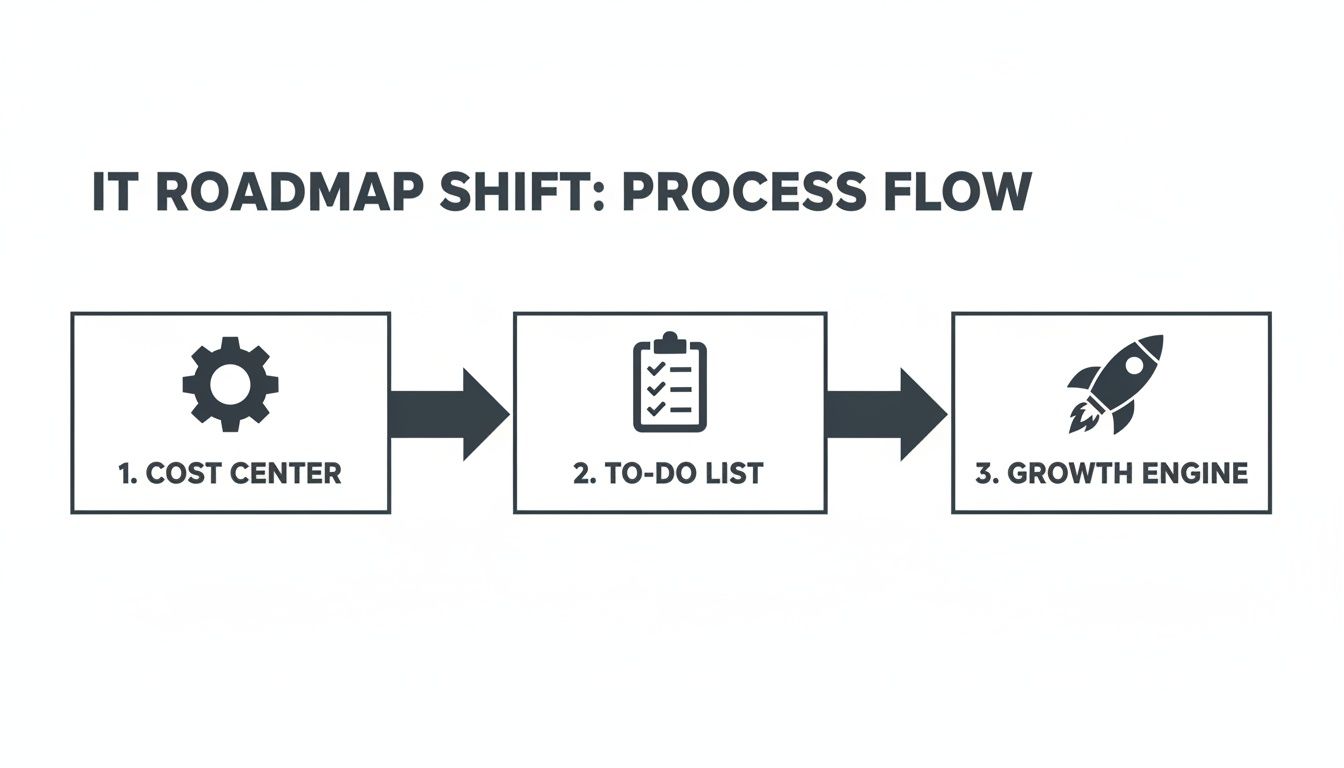
As you can see, a mature strategy doesn't just manage costs; it uses technology as a powerful investment to secure the company’s future.
A great roadmap doesn't just list projects; it tells a story about where the business is going and how technology will help it get there. It connects every technical decision back to a tangible business outcome.
Building a Forward-Thinking Plan
Getting this right requires a real team effort. This isn't just an IT document; it demands collaboration across every department to truly understand the company's biggest challenges and opportunities. For example, a forward-thinking IT roadmap almost always includes big-ticket items like legacy systems modernization to replace clunky, outdated infrastructure with agile solutions built for growth.
This approach means you're managing your entire technology ecosystem like a strategic portfolio. You can dig deeper into this mindset in our guide on product portfolio management. By adopting this perspective, your roadmap becomes a dynamic plan that helps you:
- Align Investments with Goals: Make sure every dollar spent on tech pushes a specific business objective forward.
- Improve Decision-Making: Create a clear framework for prioritizing what truly matters and allocating resources where they'll have the most impact.
- Enhance Communication: Get technical teams and business stakeholders speaking the same language and working toward the same north star.
Ultimately, a well-crafted business IT roadmap ensures your technology strategy isn't just supporting the business—it's actively driving it forward.
Get Everyone on the Same Page with a Unified Tech Vision
An IT roadmap cooked up in an engineering vacuum is pretty much guaranteed to fail. For it to have any real impact, you have to get every department—from product and sales to customer success and marketing—rowing in the same direction. When teams are siloed, you get friction. But when they're aligned, that roadmap becomes a serious engine for company-wide momentum.
This kind of alignment doesn’t just happen. It’s the result of carefully planned, collaborative workshops where you translate big-picture business goals into specific, concrete technical requirements. The whole point is to create a shared language, one where a customer complaint in a Zendesk ticket and a feature request from a sales call can be understood, and prioritized, by the developers working in Jira.
Run Discovery Workshops That Actually Work
We've all been in those endless meetings that go nowhere. A successful discovery workshop is different. It's a highly structured session with a clear agenda and, most importantly, the right people in the room. Your mission is to get from vague hopes to tangible needs.
I've found the best way to do this is by asking each department head the same three powerful questions:
- What is your team’s single biggest goal for the next six months?
- What operational friction or technical bottleneck is slowing you down the most?
- If you had a magic wand, what one tech change would have the biggest impact on your team's performance?
These questions are designed to cut through the fluff and get straight to the real pain points. For example, the VP of Sales might say, "Our CRM doesn't sync with our marketing tool, and my reps are wasting hours every week on manual data entry." Bingo. That's a specific, actionable problem your IT roadmap can solve.
For this to work, everyone needs a shared grasp of the company’s main goals and how tech initiatives ladder up to them. You can learn more about understanding strategic alignment in this context. This shared perspective is what elevates your roadmap from a simple tech to-do list to a truly strategic asset.
Translate Stakeholder Needs into Roadmap Actions
Once you've collected all this great input, the next move is to map it out visually. This is where you connect the dots between what different teams need and start uncovering those critical dependencies that can derail a project if you miss them.
The following table shows how to turn those high-level requests into something concrete. It helps you see how a single request can ripple across the organization and what you actually need to build and measure.
Translating Stakeholder Needs into Roadmap Actions
| Stakeholder Role | Primary Goal or Input | Corresponding Roadmap Initiative | How to Measure Success |
|---|---|---|---|
| VP of Sales | "Reps waste too much time on manual data entry between systems." | Phase 1: Native CRM & Marketing Automation Integration | 20% reduction in time spent on manual data tasks per rep. |
| Head of Marketing | "We can't accurately track campaign ROI or lead source attribution." | Phase 2: Implement a Centralized Analytics Platform | Track lead-to-close conversion rates by campaign; achieve 95% data accuracy. |
| Customer Success Lead | "Support agents lack a unified view of the customer's history." | Phase 1: Integrate Support Ticketing with CRM | 30% decrease in average ticket resolution time. |
| Head of Product | "We need faster, more reliable deployment cycles for new features." | Ongoing: CI/CD Pipeline Optimization & Automation | Increase deployment frequency from weekly to 3x per week; reduce rollback rate by 50%. |
This exercise isn't just about listing tasks. It's about seeing the bigger picture. For instance, Marketing's request for a new analytics platform is completely dependent on Engineering's plan to upgrade the database. Mapping this relationship from the start ensures both teams are in sync and the projects are sequenced logically, preventing a major headache down the road.
At its core, a business IT roadmap is a communication tool. It’s not just about what you're building, but why you're building it and for whom. When that "why" is clear, you prevent surprises and build trust across the company.
By translating each department's goals into tangible items on a shared roadmap, you create a powerful sense of collective ownership. People can finally see how their specific needs fit into the larger company mission. This clarity is what keeps everyone focused and ensures you’re always putting resources behind the initiatives that will deliver the biggest possible impact.
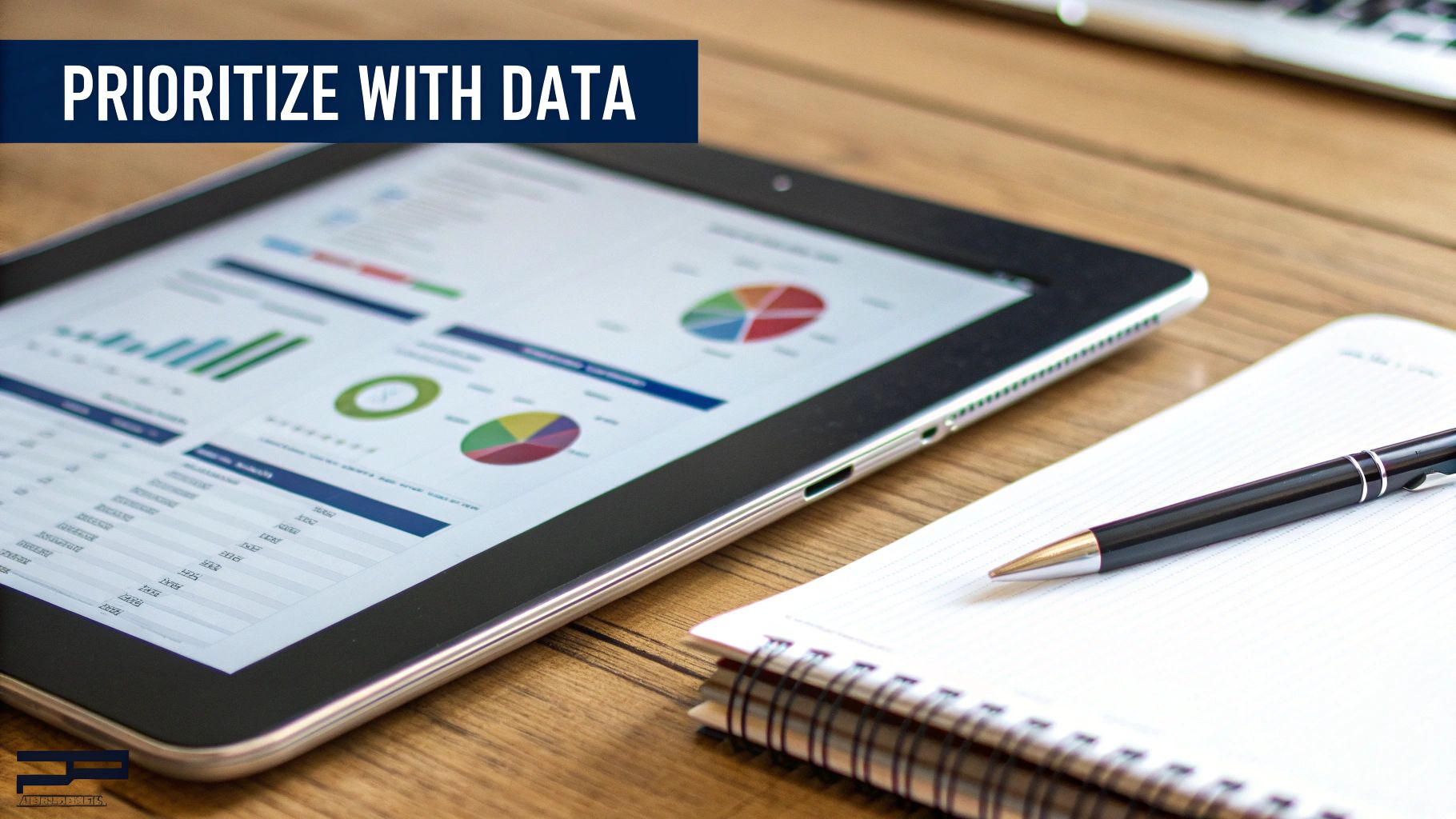
Use Data to Prioritize What Truly Matters
Every IT roadmap I've ever seen has one thing in common: more bright ideas, urgent requests, and "critical" projects than time or budget could ever cover. That's just a fact of life. The real difference between a roadmap that stalls out and one that actually drives growth comes down to how you answer one simple question: "What do we work on next?"
For too long, that answer has been a messy mix of guesswork, gut feelings, and whoever has the loudest voice in the room. This isn't just inefficient; it's a dangerous way to run a business. A data-driven prioritization framework is your way out—it replaces subjectivity with objective, quantifiable evidence so you're always putting your resources where they’ll have the biggest impact.
It all starts by learning how to translate all that qualitative feedback you're getting into hard numbers that can guide your strategy.
Turning Qualitative Feedback into Hard Numbers
You're probably sitting on a goldmine of data without even realizing it. It's scattered across support tickets in Zendesk, chat transcripts from Intercom, call notes in your CRM, and even developer comments in GitHub. The secret is to pull all this unstructured feedback together and connect it to real, quantitative outcomes.
Think about it this way: a single bug is mentioned in ten different support tickets. On its own, that might not ring any alarm bells. But what if you could see that seven of those tickets were from enterprise customers who are in the final stages of a $250,000 renewal? And what if two others were from high-value prospects currently in a sales cycle?
Suddenly, that "minor" bug has a quantifiable revenue risk attached to it. This is where modern product intelligence platforms are changing the game, by automatically surfacing these connections and putting a dollar value on both problems and opportunities. This is the first, crucial step toward building a roadmap that directly impacts the bottom line. To see just how powerful this can be, check out our guide on AI-powered decision making.
Create a Balanced Prioritization Scoring Model
Once you can quantify the potential impact of an initiative, you need a consistent way to weigh competing priorities. I've found that a simple but effective scoring model brings incredible clarity to roadmap discussions. It forces everyone to balance different types of value, making sure you don't get distracted by shiny new features while ignoring critical, foundational issues.
A great model usually scores projects across three core pillars:
- Revenue Impact: This could be direct new revenue from a feature, churn reduction from fixing a bug, or expansion opportunities from a platform improvement.
- Strategic Alignment: How well does this initiative line up with our high-level company goals for the next quarter or year?
- Effort & Complexity: What's a realistic estimate of the time and resources needed from engineering, design, and other teams?
By assigning a score (say, 1-5) to each of these categories, you can generate a final priority score that objectively ranks everything on your roadmap. This simple exercise is fantastic for preventing a low-effort, high-impact project from getting buried under a massive, long-term initiative that feels more "important" but won't deliver value for months.
A scoring model isn't about removing human judgment; it's about focusing that judgment on the right criteria. It turns a subjective debate into a structured, data-informed conversation about trade-offs.
Factoring in Future Costs and Technical Debt
A truly strategic roadmap doesn't just look at immediate gains; it also accounts for the hidden costs of not doing something.
Take technical debt. It’s a tax on all future development. That server upgrade or code refactor you keep pushing off doesn't just sit there—it gets more expensive and more painful to deal with over time, slowing down every new feature you want to build.
Emerging technology also shifts the economic landscape in ways you have to anticipate. For example, Deloitte's Tech Trends 2026 report highlights a fascinating paradox: while the cost of AI tokens plummeted an incredible 280-fold in just two years, many companies now face huge monthly AI bills as usage explodes. This trend shows why you can't just assume old infrastructure will work for new tech. Your roadmap needs to plan for this kind of architectural evolution.
By adding a "Cost of Delay" or "Technical Debt Reduction" score to your framework, you make these invisible pressures visible. This ensures that essential infrastructure work and future-proofing projects get the attention they deserve, right alongside the exciting, revenue-generating features. This data-first approach is what transforms a simple wish list into a powerful, financially intelligent plan for sustainable growth.
Design a Roadmap That Bends Without Breaking
Let's be honest: the old-school, rigid, multi-year IT plan is dead. It's obsolete the moment it's printed. The most effective business IT roadmap today isn't a static document; it’s a living guide built to adapt to new data, market shifts, and unexpected opportunities. Rigidity just leads to irrelevance. Flexibility is what keeps your strategy sharp.
The trick is building a roadmap that can bend without breaking. You need a structure that holds firm on its high-level strategic direction but gives your teams the freedom to adjust tactics on the ground. A rigid plan will crumble under pressure, but an agile roadmap absorbs change and actually gets stronger because of it.
Structure Your Roadmap with Themes and Epics
Instead of a massive list of features and hard deadlines stretching out for years, try organizing your roadmap around broad strategic themes. Think of these as your north stars—the big problems you're trying to solve or the major business goals you're aiming for over the next 12-18 months.
Under each theme, you can then group the work into epics. These are larger chunks of work that contribute to the theme but are still flexible enough to be broken down into smaller, manageable stories or tasks later.
For example, a tiered approach might look something like this:
- Theme: "Enhance Customer Self-Service Capabilities to Reduce Support Costs"
- Epic 1: "Launch an AI-Powered Knowledge Base"
- Epic 2: "Develop a Proactive In-App Onboarding Flow"
This kind of structure gives your product and engineering teams clear goals without micromanaging how they get there. They know the destination ("reduce support costs"), but they have the autonomy to find the best route as they learn more. If you're looking for a solid starting point, our guide offers a great technical roadmap template to help you visualize this structure.
Create a Simple Governance Framework
Of course, flexibility without any structure is just chaos. You need a lightweight governance framework to ensure any changes to the roadmap are intentional and well-communicated, not just knee-jerk reactions. The goal isn't to create red tape but to establish clear rules of engagement for making decisions.
Your framework really only needs to answer a few key questions:
- Who can propose a change? Define how new ideas or urgent requests get into the system.
- How are changes evaluated? Use your data-driven prioritization model to see how a new item stacks up against what's already planned.
- Who has the final say? Establish a small, cross-functional group of decision-makers.
Having this simple process in place prevents endless debates and ensures that when the roadmap does change, it's for the right reasons.
The purpose of roadmap governance is not to prevent change, but to manage it. It turns chaotic, reactive shifts into strategic, deliberate adjustments.
A regular review cadence is also critical. A quarterly business review (QBR) with key stakeholders is the perfect time to re-evaluate your high-level themes. Then, a monthly or bi-weekly check-in with product and engineering leads can keep the epics on track. This rhythm keeps the roadmap from becoming a forgotten document collecting digital dust.
Bake In Security and Data Sovereignty Early
In a world of increasing global volatility, security and data control aren't just nice-to-haves; they are foundational pillars of your strategy. This becomes even more critical as AI gets woven into every part of the business.
Recent research is pretty telling: by 2026, a staggering 93% of executives believe AI sovereignty must be a core part of their business strategy to stay resilient. A forward-thinking roadmap addresses this head-on, turning IT from a cost center into a strategic asset that actually protects the business.
By embedding security and data sovereignty into your roadmap from day one, you build trust and future-proof your infrastructure. You can dive into the full findings from IBM to get the whole picture. This kind of foresight prevents costly emergencies down the road and makes sure your growth is built on a secure, solid foundation.
Measure and Communicate Your Roadmap's Impact
A brilliant business IT roadmap is useless if no one understands its value. Honestly, this is where most roadmaps fall flat. You can have the most well-thought-out plan in the world, but if you can't show how it moves the needle for the business, you'll struggle for budget, buy-in, and respect.
The final, and arguably most crucial, part of the process is shifting from just guiding the work to actively demonstrating its impact. This is where you connect the dots between your team's technical execution and the business outcomes your leadership team actually cares about—like revenue, churn, and market share.
Your roadmap's success isn't measured in server uptime or tickets closed. It’s measured in reduced customer churn, increased expansion revenue, and faster time-to-market for critical features. Nailing this communication is what secures ongoing support and solidifies IT's role as a strategic partner, not just a cost center.
Move Beyond Technical Metrics
Your engineering team might get genuinely excited about hitting 99.99% uptime or cutting deployment failures by 50%. And they should be! Those are huge operational wins. But those numbers don't land with a CEO or CFO. To get their attention, you have to speak their language.
So, instead of saying, "We improved database query speed by 40%," reframe it.
Try this: "We improved database performance, which cut the average time for customers to generate a report by 15 seconds. This directly solves a top complaint from our enterprise users and has already lowered related support tickets by 22%." See the difference? One is a technical spec; the other is a business solution.
The goal is to build a clear narrative that links every major initiative on your business IT roadmap to a tangible improvement in a core business metric. This is how you prove ROI, not just activity.
Create Simple, Visual Dashboards
The best way to get this message across is with simple, visual dashboards that people can understand in seconds. Forget the complex spreadsheets with hundreds of rows. Your audience is busy, and your job is to serve up the key insights as efficiently as possible.
A great impact dashboard connects the dots between your team's work (leading indicators) and the business results (lagging indicators).
Here’s a practical example of what this could look like in a simple table:
| IT Initiative | Technical Metric | Business Outcome | Status |
|---|---|---|---|
| New CRM Integration | Reduce manual data entry time for the sales team. | +10% in sales activities logged; $150k in new pipeline influenced. | ✅ Complete |
| Fix High-Impact Bug | Resolve issue causing frequent crashes for power users. | -5% in churn risk among affected enterprise accounts. | 🚧 In Progress |
| AI Knowledge Base | Increase self-service article resolution rate. | -20% in inbound support ticket volume; $45k saved in annual support costs. | 🚀 Launched |
This format immediately shows the "so what?" behind each project. Any stakeholder can quickly see how a technical task like an integration directly helps grow revenue, or how fixing a bug protects the revenue you already have.
Talking Points for Leadership Updates
When you're presenting roadmap updates to leadership, your narrative is just as important as your data. You're not just giving a status report; you're reinforcing the strategic value of your team’s work and building confidence in your plan.
Here are a few talking points I’ve seen work well to keep the conversation focused on business value:
- To Highlight Churn Reduction: "Our work on platform stability this quarter, specifically fixing the three bugs most cited by at-risk customers, helped us secure $300,000 in renewals that were previously flagged as uncertain by the Customer Success team."
- To Showcase Revenue Enablement: "The new API we launched is already being used by two major partners to build integrations. The sales team projects these partnerships will generate over $500,000 in new revenue over the next fiscal year."
- To Justify Infrastructure Investment: "By migrating to a new cloud provider, we’ve not only improved performance but also cut our monthly infrastructure spend by 18%. This gives us an extra $20,000 per month to re-invest in product innovation."
These statements are direct, quantifiable, and tied to financial results. They show you have a deep understanding of what matters to the business and position IT as a team that is actively managing its contribution to the bottom line.
When you consistently measure and communicate your impact this way, your business IT roadmap transforms from a simple plan into a powerful tool for building trust and driving strategic alignment across the entire organization.
Your Business IT Roadmap Questions Answered
Building a business IT roadmap is one thing; keeping it alive and effective is another challenge entirely. Even the most carefully crafted plan will run into real-world friction.
Let's walk through some of the most common questions and hurdles that pop up once the roadmap is in motion. These answers are pulled from years of experience helping teams navigate these exact situations.
How Often Should We Update Our Business IT Roadmap?
There's no single right answer, but I've found a certain rhythm works best for most companies. Aim for a high-level strategic review quarterly and a much more thorough planning session annually. This cadence gives you the perfect mix of long-term focus and the flexibility to adapt.
Your quarterly check-in isn't about rewriting the whole plan. Think of it as a quick course correction. Has a competitor made a big move? Did a major company goal shift? This is your chance to make sure the roadmap still makes sense. The annual review, however, is where you make the big moves and set the major themes for the next 12 months.
The most important thing is to treat your roadmap as a living document, not a stone tablet. Its value comes from its relevance, not its rigidity. Agile teams working on specific projects might adjust their tactics on a sprint-by-sprint basis, which is perfectly fine as long as they stay aligned with the broader epic's goal.
What Is the Best Tool for Creating and Managing an IT Roadmap?
Honestly, the best tool is the one your team will actually use every day. The whole point of the platform is to create clarity and a single source of truth for everyone. If it's too complicated, people will stop using it, and you'll be back to square one.
Generally, you have a few options:
- Dedicated Roadmapping Software: Tools like Jira Align or Productboard are purpose-built for this. They're great for connecting high-level strategy directly to the work your development teams are doing.
- Project Management Platforms: You can get a lot done with tools you might already be using. Asana, Monday.com, or even Trello can work surprisingly well, especially if you use custom fields and timeline views to build your roadmap.
- Spreadsheets or Presentation Software: Don't knock the classics. For smaller teams or those just getting started, a well-organized Google Sheet or a clear PowerPoint slide can be an incredibly effective way to visualize your priorities.
My advice? Focus on ease of use and visibility. A simple tool that everyone uses is infinitely better than a powerful one nobody opens.
How Do We Handle Unexpected Urgent Requests?
This is the big one. Those "fire drill" requests that aren't on the roadmap can completely derail your plans. The trick is to have a calm, objective process for dealing with them instead of just reacting to the loudest voice in the room.
First, create a simple intake process for all new requests, no matter how urgent they seem. This ensures nothing falls through the cracks and everything is judged by the same standards.
When a crisis pops up, don't just drop everything. Push that request through the exact same data-driven prioritization framework you used to build the roadmap. Ask the hard questions. Is this a critical security flaw? Is a bug actively costing us thousands in revenue or blocking a major customer's renewal?
If the data shows the new request genuinely has a higher impact than something you already have planned, you can make a conscious, strategic trade-off. This isn't about saying "no"—it's about making a deliberate, informed decision to swap one priority for another.
Ready to stop guessing and start quantifying the real revenue impact of every bug and feature request? SigOS is an AI-driven product intelligence platform that connects customer feedback to business outcomes, helping you build a business IT roadmap that truly drives growth. Learn more about how SigOS can reduce churn and accelerate expansion.
Keep Reading
More insights from our blog
Ready to find your hidden revenue leaks?
Start analyzing your customer feedback and discover insights that drive revenue.
Start Free Trial →