How to Improve NPS Score and Turn Customers Into Promoters
Learn how to improve NPS score with actionable strategies. We'll show you how to analyze feedback, close the loop, and empower your teams to drive real change.
Improving your Net Promoter Score isn't about chasing a number. It's really about building a system that turns raw customer feedback into your biggest asset for growth. You have to get to the bottom of why customers feel the way they do, make sure you follow up with every single one, and give your teams the power to fix what they learn.
Moving Beyond the Number: A Practical NPS Improvement Plan

Too many companies get stuck treating their Net Promoter Score as just another KPI for the monthly report. A high score gets a round of applause, a low one causes a wave of panic, but the number itself is only the first clue. Real, sustainable improvement only kicks in when you stop obsessing over the score and start digging into the why behind it.
A score that’s flatlining or, worse, dropping is often a symptom of bigger problems under the hood. Maybe customer comments are being collected but then just disappear into a spreadsheet, never to be seen again. Or maybe your frontline teams see the score, know exactly what the problems are, but have no power to actually solve them. It's a frustrating place to be.
Building a Framework for Change
To really move the needle on your NPS, you need a solid, repeatable plan. This guide is all about giving you that framework—less theory, more action. We’re going to walk through the practical steps to turn customer sentiment into real business results. The aim here is to build a machine that consistently turns your unhappy Detractors into neutral Passives, and, even better, nudges those Passives into becoming true Promoters.
This whole process boils down to a few core ideas:
- Deep Diagnosis: You have to get past the labels. What specific moments or features are creating friction and turning customers into Detractors?
- Operationalized Feedback: This means building real workflows. Every piece of feedback needs to go to the right team, and every customer needs to know they've been heard.
- Frontline Empowerment: Your support and success teams are on the ground floor. Give them the training, tools, and authority to resolve issues right then and there.
- Data-Driven Action: The goal is to turn all that qualitative feedback into a prioritized roadmap for improving your product and processes.
Your Net Promoter Score is a direct reflection of your entire customer experience. Improving it takes more than a survey; it demands a company-wide commitment to listen, learn, and act on what your customers are telling you.
To get started, it helps to visualize the journey. This simple framework breaks down the essential stages of a successful NPS improvement initiative.
Core NPS Improvement Framework
| Stage | Primary Goal | Key Activities |
|---|---|---|
| 1. Diagnosis | Uncover the "why" behind your score. | Segmenting feedback, running root cause analysis, identifying key themes. |
| 2. Prioritization | Focus on high-impact issues. | Mapping issues to business impact, ranking by frequency and severity. |
| 3. Action & Experimentation | Implement targeted solutions. | Launching product fixes, updating support docs, running A/B tests. |
| 4. Closing the Loop | Communicate with customers. | Following up with Detractors and Promoters, sharing progress updates. |
| 5. Measurement | Track progress and validate impact. | Monitoring NPS trends, analyzing segment-level changes, tracking KPIs. |
Think of this table as your roadmap. Each stage builds on the last, creating a cycle of continuous improvement rather than a one-off project.
While NPS is a fantastic starting point, remember it’s just one piece of the puzzle. Combining it with other client satisfaction metrics will give you a much richer, more complete view of customer health. With this foundation in place, you’ll not only boost your score but also build a more resilient, customer-focused business ready for the long haul.
Finding the 'Why' Behind Your Current NPS Score
Your Net Promoter Score is a starting point, not a conclusion. A score of 45 doesn't tell you why your customers are happy, just as a score of -10 doesn't explain what’s driving them away. To make that number mean something—and more importantly, to improve it—you have to put on your detective hat and dig into the root causes.
This means looking past the simple labels of "Promoter," "Passive," and "Detractor." While those categories are fine for a quick snapshot, the real story is in the details. By slicing your feedback in different ways, you can turn a vague, single number into a detailed map pinpointing exactly where things are going wrong.
Segmenting Feedback to Reveal Hidden Patterns
Your customer base isn't one monolithic block; it's a collection of different groups with unique experiences. Segmentation is your tool for understanding each of them. Start by looking at your NPS data through a few different lenses to see what patterns emerge.
Here are some of the most powerful ways to slice the data:
- By Customer Lifecycle Stage: How do scores from new users in their first 30 days stack up against loyal customers who've been with you for over a year? A low score from newbies probably means your onboarding is confusing. A sudden dip among your veterans? You might have a recent, unpopular product change on your hands.
- By Product Usage or Plan Tier: Do people who use "Feature A" consistently rate you higher than those who depend on "Feature B"? Are your enterprise customers happier than those on the starter plan? This is how you tie satisfaction directly to specific parts of your product.
- By Support Interaction History: Look at the scores from customers who recently contacted support versus those who haven't. If the group that just talked to your team has a much lower NPS, that’s a massive red flag for your customer service process.
This kind of segmentation gives you a much clearer target. You stop chasing a vague goal like "improve NPS" and can finally focus on a concrete problem, like "fix the post-support experience that’s dragging our score down by 15 points."
Blending Quantitative Scores with Qualitative Stories
Knowing what the score is gets you halfway there. Understanding why is where the real breakthroughs happen. The open-ended comments in your NPS surveys are a goldmine for this. This is where you get the raw, human context behind the numbers.
But don't stop there. The best insights come from weaving this feedback together with data from other places your customers are talking to you. This creates a complete picture that no single survey ever could.
Your goal isn't just to collect feedback; it's to build a unified "root cause map." This map connects specific customer complaints from various channels—like support tickets and sales calls—to their direct impact on your NPS score, helping you prioritize what to fix first.
Start pulling together unstructured feedback from every touchpoint you can. Look beyond the NPS comments and dive into:
- Support Tickets & Chat Transcripts: What are the most common complaint categories? You're looking for recurring keywords like "confusing," "slow," or "buggy."
- Sales Call Recordings: What objections or friction points do prospects bring up? Often, these are the same frustrations that plague your existing customers.
- User Reviews & Social Media Mentions: Public forums give you the unfiltered truth. People will tell you exactly what they love and, more importantly, what they hate.
With all this raw data in hand, you can start tagging and categorizing the common themes. Maybe you discover that 20% of your Detractors mention "slow loading times," while a huge chunk of your Promoters rave about your "excellent customer support." This process is the foundation of a strong voice of customer analysis. It’s how you turn a mountain of scattered comments into a clear, prioritized to-do list, ensuring you're working on the things that actually matter to your customers.
Building a Feedback Loop That Actually Closes
Getting NPS feedback is just the starting line. The real work—and the real value—begins when you build a system to act on it. A solid closed-loop feedback process is the engine that drives any good NPS program, making sure every customer who gives you their time feels heard.
This goes way beyond a generic "Thanks for your feedback!" auto-reply. We're talking about a smart, operational workflow that gets every single response to the right person or team, fast. Without it, your NPS surveys are just a data-gathering hobby, not a growth strategy.
Automating the Triage Process
Trying to manually read and forward every comment is a surefire way to burn out your team and miss critical issues. The only way to scale this is with automation. You need to set up rules that instantly sort and route feedback based on the score and, more importantly, what the customer actually said.
Here’s a practical way to think about it:
- Detractor Alerts (Scores 0-6): These are your house-on-fire moments. A detractor response should immediately trigger a high-priority ticket for your customer success or support team. The goal here is rapid, personal outreach to understand what went wrong and start making it right.
- Passive Feedback (Scores 7-8): This group is sitting on a goldmine of constructive criticism. Their comments, which often contain specific product suggestions, should be routed directly to your product managers. This is where you spot the minor annoyances before they turn into deal-breakers.
- Promoter Praise (Scores 9-10): Don't just let a "10" sit in a spreadsheet. Send these glowing reviews straight to your marketing team. They're perfect for testimonials, case studies, and social proof. Plus, sharing this praise internally is a massive morale booster.
This simple breakdown shows how you can move from just collecting data to actually doing something meaningful with it.
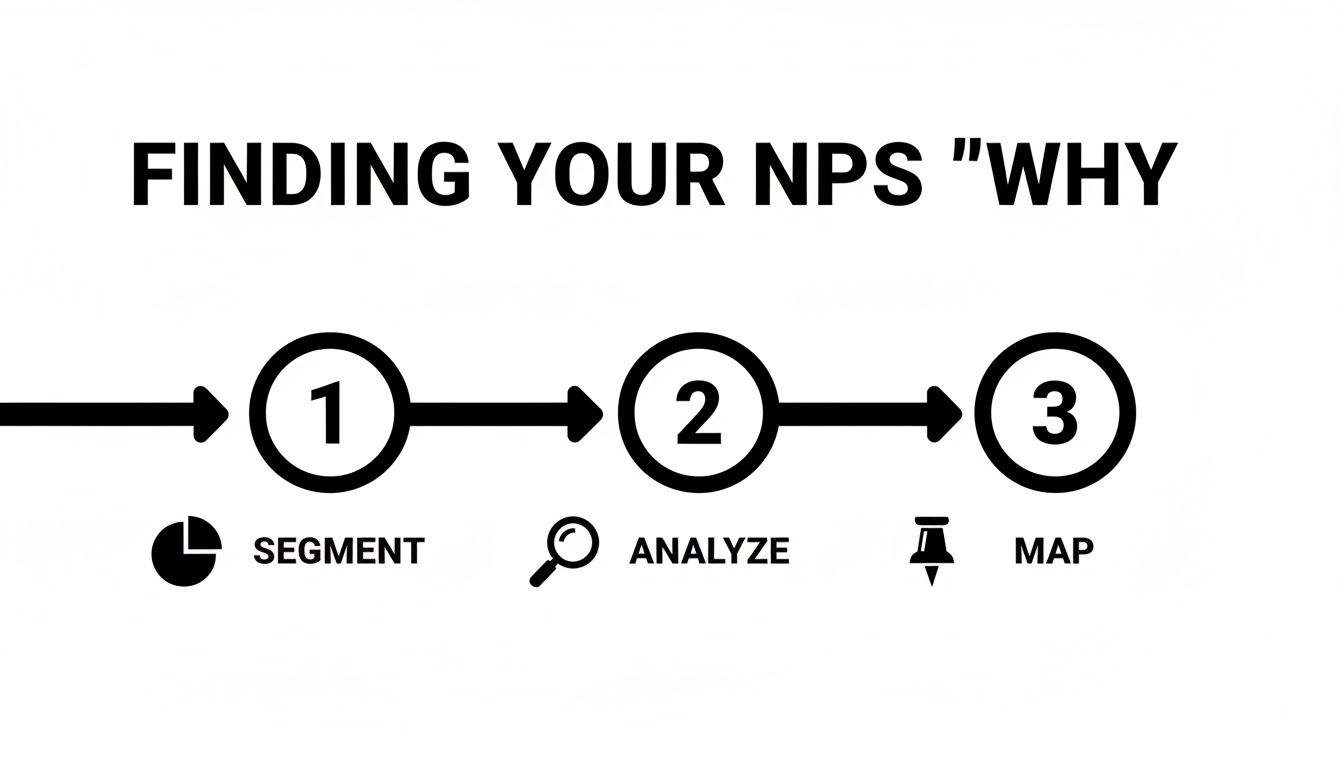
By segmenting, analyzing, and mapping feedback, you build a clear path from a customer’s comment to a specific, targeted action within your organization.
Connecting Your Tools for Seamless Action
A feedback loop is only as strong as its integrations. When you connect your survey tool directly to the software your team uses every day—like Slack, your CRM, or your project management tool—acting on feedback becomes a natural part of the workflow, not an extra chore.
For example, a simple automation can post a new NPS response directly into a dedicated Slack channel. This ensures the right team sees critical feedback in real-time, slashing response times and making sure nothing falls through the cracks. To take this even further, you can explore streamlining feedback collection with AI chatbots to get responses directly into your systems.
Tagging and Categorizing for Deeper Insights
While quick follow-ups are essential for individual customers, the long-term win comes from spotting trends. This is where a smart tagging system becomes your best friend. By applying consistent tags to feedback—like "usability," "pricing," "bug," or "customer support"—you can start turning anecdotes into hard data.
A closed-loop process isn't just about responding to customers one-by-one. It's about systematically learning from their feedback to fix the root cause of their problems, preventing future customers from having the same negative experience.
These tags let you quantify your customers' biggest pain points. Imagine being able to tell your product team that 35% of all detractor comments last quarter were tagged with "confusing navigation." That’s a powerful, data-driven argument for prioritizing a redesign. For a deeper dive into organizing this data, check out our guide on https://www.sigos.io/blog/customer-feedback-analysis-tools.
The impact here is huge. Companies with a structured closed-loop process often see a 20–60% reduction in detractor churn and a 3–8 point lift in their overall NPS score in just 6–12 months. When you close the loop, you’re not just solving one customer's problem—you’re improving the entire experience.
Empower Your Frontline Teams to Be NPS Champions

While your product and pricing obviously matter, the real make-or-break moments for your Net Promoter Score happen on the front lines. Your support agents, customer success managers, and sales reps are the human face of your company. Their empathy, skill, and attitude can single-handedly shape how customers feel about your brand.
A fantastic support interaction can turn a furious Detractor into a loyal Promoter. On the flip side, a disempowered, poorly trained agent can alienate a happy customer in minutes. To genuinely move the needle on NPS, you have to stop seeing customer service as a cost center and start treating it as your primary engine for building loyalty.
It all comes down to giving your teams the tools, training, and—most importantly—the authority to create exceptional customer experiences.
Foster a Culture of Ownership
First things first, connect your frontline teams directly to the feedback they generate. A company-wide NPS score is just an abstract number to an individual support agent. It’s not personal, and it’s not motivating.
Instead, create personalized dashboards showing each team member their own NPS or CSAT score, pulled from the customers they've personally interacted with. When an agent can see how their work directly impacts customer sentiment in real-time, it creates a powerful sense of ownership. Suddenly, the metric becomes tangible.
Your frontline team isn't just closing tickets; they are shaping customer loyalty with every conversation. Empowering them with data and autonomy transforms them from reactive problem-solvers into proactive champions for your brand.
This visibility helps everyone understand their role in the bigger picture. The job is no longer about hitting a "tickets closed" quota; it’s about creating positive outcomes that boost customer happiness and drive the business forward.
Equip Teams for First-Contact Resolution
Few things frustrate customers more than having to explain their problem over and over again to different people. It’s a guaranteed way to create Detractors. That’s why a laser focus on first-contact resolution (FCR) is one of the most powerful NPS strategies you can deploy.
This means giving your agents the knowledge and authority to solve issues on the first try. Here’s how to set them up for success:
- A Killer Knowledge Base: Make sure your internal documentation is comprehensive, current, and easy to search. Agents need to find answers fast, without needing to escalate.
- Cross-Functional Training: Don’t silo your teams. Train support staff on basic technical troubleshooting or billing questions so they aren't constantly transferring customers for common issues.
- Discretionary Power: Trust your team. Give agents the authority to issue small refunds, apply credits, or offer a discount to solve a problem without hunting down a manager for approval.
The goal is to eliminate the dreaded phrase, "Let me transfer you." Every time an agent can say, "I can fix that for you right now," you’re creating a positive experience. Understanding how these interactions contribute to building brand loyalty through exceptional customer support is key to making this shift.
Incentivize Proactive Problem-Solving
Finally, make sure your incentives align with your customer-centric goals. If you only reward agents for speed (like low average handle time), you’re encouraging them to get customers off the phone quickly, whether the problem is truly solved or not.
Rethink your reward structure to celebrate the outcomes you actually want. Consider programs that recognize:
- Happy Customers: Tie bonuses or team shout-outs directly to high CSAT or NPS scores from the customers an agent personally helped.
- Proactive Fixes: Reward team members who spot recurring issues and contribute to a knowledge base article or bug report that solves the root cause for everyone.
- Team Wins: Create team-based incentives for hitting a collective NPS target. This encourages collaboration and a culture of sharing best practices.
This approach creates a powerful, self-reinforcing cycle. Engaged, empowered employees provide better service, which leads to happier customers and a higher NPS. In fact, companies that invest heavily in their employee experience often see NPS uplifts of 5–12 points within 12–18 months, a finding highlighted by experts at Bain & Company on their Net Promoter System. Investing in your team is one of the most direct and effective ways to improve your customer experience.
Turning Customer Insights Into Real Company-Wide Change
Collecting customer feedback without a plan to act on it is like running a diagnostic test on a car and then just letting the error codes flash. The real work—and honestly, where most NPS programs stumble—is closing the loop between identifying a problem and actually fixing it.
Insights are only valuable when they spark real improvements across the company. This means you need a system to translate those recurring themes from your NPS feedback into concrete, prioritized projects for your product, operations, and support teams. Otherwise, all that valuable customer sentiment just sits in a dashboard, gathering digital dust instead of driving change. The end game is to build a culture where the customer's voice directly shapes your roadmap.
From Vague Complaints to a Compelling Business Case
Let's be real: product and engineering teams have a finite amount of time and resources. To get on their radar, you can't just show up saying, "Customers are unhappy with the checkout process." You have to speak their language, and that language is data and business impact.
The trick is to calculate the 'cost of friction' for the most common complaints. Let's say detractors are constantly flagging a confusing checkout flow. It’s time to connect the dots.
- Dig into your churn data. Are customers who churned leaving right after a failed transaction? Look for the pattern.
- Tally up support tickets. How many tickets are about checkout issues? You can put a real dollar amount on the support team's time spent putting out those fires.
- Watch session replays. Tools that let you see recordings of users rage-quitting their carts at a specific step are pure gold. This is the visual proof that brings the frustration to life.
By doing this, you reframe a qualitative complaint ("The checkout is confusing") into a powerful business case: "Our confusing checkout flow generated 250 support tickets last quarter, costing us 5,000 in support hours. It's also directly linked to a 15% cart abandonment rate at the final step, which represents ****40,000 in lost potential revenue."
Now that's a problem that gets prioritized.
Run Small Experiments to Validate Big Ideas
You don't need a massive, six-month project to start moving the needle. I've found that the most effective way to improve an NPS score is through small, targeted experiments. This lets you test a hypothesis, measure the impact, and iterate quickly without betting the farm on a single big idea.
Think of it like a scientist in a lab. You’ve identified a problem area from your NPS feedback—now it’s time to test a potential solution.
The most powerful shift you can make is from treating feedback as a report card to using it as a lab notebook. Each piece of detractor feedback is not a failure, but a hypothesis waiting to be tested.
For example, if new users consistently give low scores and complain about a confusing setup process, your hypothesis might be: "A more guided onboarding flow will improve new user satisfaction." From there, you can design a simple, focused experiment to see if you're right.
A Framework for Targeted NPS Experiments
Instead of blowing up your entire onboarding sequence, you could run a focused A/B test on just the first-week experience. Here’s how that might look:
- Isolate a Variable: Create a new, simplified onboarding checklist and show it to 50% of new sign-ups (Group B). The other 50% get the existing experience (Group A).
- Define Success: Your main goal is to see if the new checklist impacts the NPS score for these users after their first 30 days. As a secondary metric, you could also track feature adoption rates.
- Measure and Compare: After a month, survey both groups. If Group B has a statistically significant higher NPS score—let's say an average of +20 compared to Group A's -5—you have solid evidence that your new onboarding is working.
This experimental mindset is the key to sustainably improving your NPS score. It shifts the conversation from guessing what customers want to systematically discovering what actually improves their experience. By running these small-scale tests across different friction points—whether it's in your product, support process, or billing system—you create a reliable engine for turning customer insights into measurable, impactful change.
Common Questions We Hear About Improving NPS
As teams start digging into their Net Promoter Score, a few practical questions always pop up. It's one thing to talk about NPS in theory, but putting it into practice can get messy. Let's tackle some of the most common hurdles you'll face when you start turning that raw NPS data into a real engine for growth.
These questions usually come down to real-world constraints, like abysmal survey engagement or just trying to figure out where to even start when you're staring at a mountain of feedback.
How Do We Get More People to Actually Respond to Our Survey?
A low response rate is probably the number one frustration I see with NPS programs. If only a tiny slice of your customers are replying, you can't really trust that the score reflects how everyone feels. The good news is, you can usually give your participation a serious boost with a few smart tweaks.
First off, take a hard look at when you're sending the survey. Does it make sense in the context of their journey with you?
- Transactional Surveys: These need to go out immediately. Think right after a support ticket is closed or a customer activates a new feature. The experience is fresh, and they'll be way more likely to give you two seconds of their time.
- Relational Surveys: For those big-picture health checks, aim for a regular cadence (quarterly or biannually is common), but please, don't spam people. A great trick is to check your product analytics and send the survey when they're most active.
Next, make the request feel human. An email from a "no-reply@company.com" address screams "delete me." Instead, have it come from a real person—your Head of Customer Success or even the CEO. I’ve seen simple subject lines like, "Quick question about your experience?" outperform formal, corporate-sounding ones every time.
Finally, make it dead simple to respond. Your survey must be mobile-friendly, and you should embed the 0-10 scale right in the email. The fewer clicks, the better. Every single click you add to the process will cause a chunk of people to drop off.
What's a "Good" NPS Score, Anyway?
Ah, the million-dollar question. And the honest-to-goodness answer is: it depends. It’s so tempting to get hung up on a magic number, but an NPS score is meaningless without context. An NPS of +20 might be best-in-class for an ISP, but that same score could be a five-alarm fire for a beloved consumer brand.
Instead of chasing some universal benchmark, focus on these two things:
- Your Industry's Average: At least get a feel for the neighborhood you're in. Data from firms like Retently and Satmetrix can give you a baseline. For example, B2B SaaS companies often hover around an average NPS of +41, while internet service providers can dip as low as +16. This just helps you set realistic goals.
- Your Own Trend Line: This is the benchmark that truly matters. Is your score getting better? A steady climb from +10 to +25 over six months is a far more powerful signal of success than a score that swings wildly from +50 one quarter to +30 the next.
The only NPS benchmark that really matters is the one you set last quarter. A score that's better than your last one is always a good score. It’s proof that what you’re doing for your customers is actually working.
Your goal shouldn't be to hit an arbitrary number; it should be to get consistently better. Focus on the trend, not the snapshot.
We're Drowning in Feedback. What Do We Tackle First?
When you first open the floodgates to qualitative feedback, it can feel like you’re drinking from a firehose. You’ve got hundreds of comments pulling you in a dozen different directions. The trick is to build a simple framework that balances what customers are screaming about with what actually matters to the business.
As we covered earlier, your first job is to tag all that feedback by theme. Once you've got comments bucketed into categories (like "bug," "pricing," or "UI confusion"), you can run them through two critical filters:
- Frequency: How many people are bringing this up? An issue mentioned by 30% of your Detractors is obviously a much bigger deal than a one-off comment from a single user.
- Severity: What’s the actual business impact here? A bug that stops a user from completing a core task is infinitely more severe than a typo on the settings page. To really nail this down, try connecting the feedback to other data. Does this issue lead to more support tickets, or is it correlated with churn?
By plotting your issues on a simple frequency vs. severity matrix, the top priorities become glaringly obvious. The problems that are both common and severe are your immediate targets. Fixing those will give you the biggest, fastest lift in your NPS.
At SigOS, we help you move beyond manual analysis by using AI to automatically identify and quantify the revenue impact of customer feedback. Our platform connects support tickets, sales calls, and usage data to pinpoint the issues costing you money and the opportunities that will drive growth, so you can confidently prioritize the changes that matter most. Learn more at https://sigos.io.
Keep Reading
More insights from our blog



Ready to find your hidden revenue leaks?
Start analyzing your customer feedback and discover insights that drive revenue.
Start Free Trial →