Turn Feedback From Users Into Your Strongest Growth Engine
Struggling with churn? This guide shows you how to use feedback from users to predict risks, prioritize fixes, and drive revenue growth in 2026.

When we talk about feedback from users, we're not just talking about survey responses or App Store reviews. It’s every single clue your customers leave behind—from direct complaints in a support ticket to the subtle story their click patterns tell about your software. It’s the lifeblood of a product that actually solves problems.
The Real Value Hidden in Feedback From Users

Think about your customer base like an ocean. The handful of users who proactively give feedback are the waves crashing on the shore—they're impossible to ignore. But what about the silent majority? They’re the deep, powerful currents beneath the surface, the ones that will either carry you toward sustainable growth or pull you into the depths of churn.
Too many companies get stuck listening only to the loudest voices and miss the bigger picture entirely. This is a huge mistake because the most honest feedback is often unspoken. It’s revealed through behavior. A customer who never complains but constantly gets stuck on the same confusing checkout page is giving you incredibly valuable, actionable feedback without saying a word.
Becoming a Data Detective
Your job is to become a data detective. You have to gather clues from all over the place to solve the big mystery: What do our users really want and need? These clues aren't always neatly packaged in a survey. The best insights are often buried in plain sight.
You'll find them in places like:
- Support Tickets: That one "minor" complaint that keeps popping up? It’s probably a symptom of a much larger product flaw.
- Chat Logs: Casual conversations between users and your support team can contain offhand comments that reveal deep-seated frustrations.
- Usage Data: Where people click, which features they ignore, and the exact spot they abandon a task are all concrete evidence of their real-world experience.
- Sales Calls: The objections and questions from prospects are a goldmine for understanding the friction points that kill new revenue.
Focusing on just one channel is like trying to solve a puzzle with only half the pieces. You need a systematic way to collect and analyze everything. For a deeper dive, check out our complete guide on how to gather customer feedback.
The goal is to treat every customer interaction as a piece of business intelligence. This transforms feedback from a simple customer service function into a core driver of your product and revenue strategy.
The Problem With Vocal Minorities
Building your roadmap based only on the demands of your loudest—or highest-paying—customers is a trap. It often leads to building niche features that serve a few but alienate the broader user base, creating more problems than you solve.
Real, sustainable growth comes from understanding the needs of that silent majority. That’s why getting a holistic view of feedback from users isn't a "nice-to-have" anymore. If you want predictable growth, you have to look past the surface and learn to read the signals hidden in the deep currents of everyday user behavior.
How to Decode Different Types of User Feedback
Not all user feedback is created equal. To really get what your customers are trying to tell you, you have to learn how to read the different signals they send. Think of yourself as a detective sorting through clues—some are direct confessions, while others are subtle fingerprints left at the scene.
The first split to understand is between solicited and unsolicited feedback. Solicited is the stuff you ask for directly through surveys, interviews, or beta tests. Unsolicited feedback, on the other hand, is the goldmine of raw, unfiltered opinions people share on their own terms—in support tickets, on social media, or during a sales call.
While what you ask for gives you answers, what you overhear often gives you the unvarnished truth.
Qualitative vs. Quantitative Data
Beyond just how you get it, feedback falls into two critical camps: the "why" and the "what." Getting a handle on both is non-negotiable if you want the full story.
- Qualitative Feedback (The "Why"): This is the story behind the numbers. It’s the descriptive, emotional context you find in support chats, interview notes, and app store reviews. When a user says your new dashboard feels "clunky," that's rich qualitative data. It tells you how they feel.
- Quantitative Feedback (The "What"): This is the hard data that shows what users are doing, not just what they're saying. It comes from your analytics—things like click-through rates, feature adoption metrics, and session duration. This data is objective, scalable, and reveals what’s actually happening.
One user complaining about a confusing button is a qualitative hint. But when your product analytics show that 75% of all users abandon their cart at that exact same step? Now you have quantitative proof that validates the feeling. The real breakthroughs happen when you connect the dots between what people say and what they do.
The most powerful insights come from linking what a user says with what they do. That’s how a subjective complaint becomes a measurable business problem you can actually solve.
For example, your sales team might keep hearing prospects mention a specific competitor during demos. That’s a qualitative signal. It's a lot like how reps learn to spot buying signals in sales to know when to push forward. If you then pair that anecdotal insight with conversion data showing those same prospects rarely become paying customers, you’ve just uncovered a major gap in your product or messaging.
To help you sort through these different streams of information, here’s a quick breakdown of each feedback type and where you’re most likely to find it.
User Feedback Types and Their Strategic Channels
| Feedback Type | Description | Example | Primary Channels |
|---|---|---|---|
| Solicited | Information you directly ask for to get answers to your specific questions. | "On a scale of 1-10, how happy are you with our new checkout process?" | Surveys (NPS, CSAT), user interviews, beta testing programs, usability tests. |
| Unsolicited | Spontaneous, unfiltered opinions that users offer up on their own time. | "I'm so frustrated. This bug keeps crashing the app, and I'm about to cancel." | Support tickets, social media mentions, app store reviews, sales calls, community forums. |
| Qualitative | Descriptive, non-numerical context that explains the "why" behind user actions. | A detailed email from a user explaining exactly why they find the billing page confusing. | Open-ended survey answers, support chat logs, call transcripts, interview notes. |
| Quantitative | Measurable, numerical data that shows the "what" and "how many" of user behavior. | Product analytics revealing that 40% of new users never complete the onboarding tutorial. | Product analytics tools, A/B test results, feature usage metrics, churn/retention rates. |
Ultimately, you need all four types. Solicited feedback validates your ideas, unsolicited feedback highlights your blind spots, qualitative feedback gives you context, and quantitative feedback proves the scale of the problem or opportunity.
Why Most Customer Feedback Programs Ultimately Fail
Everyone’s collecting feedback from users these days, but let's be honest—very few companies are actually good at it. It's one thing to have a system for gathering opinions; it's another thing entirely to turn those opinions into revenue. Most feedback programs, even with the best intentions, end up creating a dangerous illusion of being customer-centric.
The reality check comes from a famous Bain & Company study. It found that while 80% of companies believe they provide a top-tier experience, only a measly 8% of their customers agree. This huge gap is where product and growth teams get into trouble. You can read more about these kinds of customer experience statistics, but the bottom line is that thinking you're listening isn't the same as actually hearing what's going on.
So, where does it all go wrong? The failure almost always starts with a flawed strategy—letting the wrong voices dictate your product roadmap.
The Dangers of Listening to the Loudest Voices
It’s an easy trap to fall into. You start building your entire product strategy around the loudest complainers or the clients with the biggest contracts. While their input feels urgent, it’s a tiny, heavily biased slice of your actual user base. This approach creates a couple of major headaches:
- Squeaky-Wheel Syndrome: You end up chasing every bug report or feature request from a handful of noisy customers. This burns precious engineering time on niche fixes that serve a few, while ignoring the deeper, systemic problems affecting your silent majority.
- The High-Value Hostage: Bending over backward for a huge enterprise client might seem like a smart business decision. But before you know it, you're on the hook for building a custom solution for one company, alienating your core users and making your product less attractive to the wider market.
Building a product based on the loudest voices is like a doctor treating only the patients who scream the loudest, while ignoring the silent, life-threatening conditions of others in the waiting room.
The result is a reactive, defensive product roadmap that doesn’t reflect what most of your users actually need. You’re always playing catch-up, fixing isolated problems instead of building for growth. And that’s when the second big failure point shows up: total data chaos.
Buried in Data Chaos
Even when the feedback is valuable, it gets lost. Think about all the places feedback comes from today: support tickets in Zendesk, live chats in Intercom, call recordings in Gong, and reviews across social media. It’s a messy, disconnected flood of unstructured data.
Without a central nervous system to connect and make sense of it all, you're flying blind. A critical bug mentioned on a sales call, a feature idea from a mid-market customer, and a complaint in a support chat might all be pointing to the exact same underlying issue. But because they live in different data silos, no one ever connects the dots.
This is the exact problem that modern product intelligence platforms are built to solve. They act as a translator, cutting through the noise to find the signals that have a real impact on revenue. By doing this, they help you finally turn feedback from users from a chaotic mess into a predictable engine for growth.
Tying User Feedback Directly to Churn and Revenue

This is the moment your feedback strategy stops being a theoretical exercise and starts making a real impact on your bottom line. Let's be blunt: unaddressed feedback from users isn't just a collection of complaints. It's one of the biggest reasons customers churn. Every bug report you ignore and every feature request you dismiss chips away at customer trust, slowly nudging them toward your competitors.
The financial risk here is massive. We're at a point where customer frustration is sky-high, with a shocking 73% of consumers saying they'll jump ship to a competitor after just a few bad experiences. It gets even more specific—having to explain the same problem over and over again will cause 54% of customers to leave for good. If you're running a SaaS company, that number represents a steady, predictable drain on your revenue, all stemming from problems you could have solved. You can dig into more of these eye-opening numbers in these customer service statistics on Zendesk.com.
The small, repetitive issues piling up in your support queue aren't just noise. They are often the earliest warning signs of future churn.
Two Companies, Two Different Fates
Think about two SaaS companies. Both start getting a trickle of support chats about a minor, annoying bug during the login process.
- Company A writes them off as low-priority, one-off problems. They get logged, sure, but the engineering team is busy building "more important" features. Six months later, they realize an entire segment of users—the ones most affected by that bug—has quietly canceled, taking thousands in annual recurring revenue with them.
- Company B has a system that uses AI to scan its support conversations. It quickly flags the login complaint as a recurring pattern and connects it to a drop in product engagement from a specific user group. They see the financial risk, push a fix in the next sprint, and prevent a wave of customer cancellations.
This simple comparison reveals a fundamental truth: a smart feedback system is your best line of defense against losing revenue. It pulls you out of a reactive, fire-fighting posture and into a proactive one where you can protect the customer base you worked so hard to build.
A single piece of feedback is an anecdote. A pattern in feedback, tied to user behavior, is a business case. The goal is to find the patterns that put revenue at risk or promise new growth.
Finding Expansion Revenue in the Noise
It’s not all about playing defense. The same process that stops churn can also be your best offensive tool for uncovering huge growth opportunities. Hidden inside sales call notes or buried in feature requests from your power users are the clues that could lead to your next six-figure deal.
Imagine you start analyzing transcripts from your enterprise sales calls. You might notice that prospects from a certain industry keep asking for the same specific integration. On their own, each request seems small. But when you see the pattern across multiple high-value deals, you've just uncovered a significant product gap. Building that feature is no longer just about pleasing one customer; it becomes a strategic move to unlock an entirely new market. There's a real science to how you can analyse customer feedback to find these hidden gems.
When you start connecting feedback from users to both churn risk and expansion potential, it stops being a cost center. It becomes one of the most reliable engines you have for driving predictable growth.
Turning Customer Conversations Into Actionable Insights

Let's be honest. The real challenge today isn't collecting more feedback from users; it's figuring out what to do with the mountains of it you already have. We’ve all been there, staring at spreadsheets full of subjective tags, trying to guess what’s truly important. The solution is to get smarter—not just work harder—by using automated analysis to cut through the noise.
Think of new AI-powered intelligence platforms as the central nervous system for your business. They connect all those scattered conversations and user actions, revealing what’s actually driving your bottom line. Instead of just counting how many times a bug is mentioned, they calculate its real financial cost.
From Vague Complaints to Revenue Impact
At the heart of this approach is a powerful metric called the Revenue Impact Score. It essentially acts as a translator, turning qualitative feedback into a hard dollar figure that everyone from engineers to executives can understand.
This score isn't magic; it's calculated by connecting three crucial data points:
- Qualitative Feedback: That complaint in an Intercom chat or a feature request mentioned during a sales call.
- Behavioral Data: The analytics showing what a user actually did before, during, and after leaving their feedback.
- Firmographic Data: Key information about the account, like its monthly recurring revenue (MRR) or current plan.
By bringing these sources together, AI can automatically quantify the financial risk or opportunity tied to any single piece of feedback.
This process turns vague complaints into prioritized, revenue-backed tasks for your product and engineering teams. It finally answers the question, "What should we work on next to protect or grow revenue?"
For instance, an AI can sift through thousands of support tickets, pinpoint a recurring login issue, and calculate that it’s putting $50,000 in MRR at risk. Suddenly, a vague bug report becomes a high-priority, financially justified fix.
Prioritizing by Dollar Value, Not Decibels
This dashboard from SigOS is a perfect example of how AI can automatically surface the highest-impact issues by connecting feedback directly to revenue.

Here, you can see that a "File Upload Error" isn't just a common annoyance—it's a problem directly affecting $12,500 in revenue. This is a game-changer. For an even wider view, many teams also integrate social listening API solutions to track brand mentions and emerging trends across the web.
Ultimately, this gives teams an objective, data-driven way to decide what gets fixed first, ensuring every engineering cycle is spent on what truly matters most to the business.
How to Build Your Revenue-Driven Feedback Loop
So, we've covered the theory. Now for the most important part: turning all that user feedback—the good, the bad, and the confusing—into actual revenue. It's time to build a system that moves beyond just collecting comments and starts actively driving business growth.
What we're building is a continuous cycle for your product, success, and growth teams. A true revenue-driven feedback loop isn't about chasing hunches or just listening to the loudest person in the room.
The hard truth is, most of your users are silent. A huge Qualtrics report covering 20,000 consumers found that only 30% of customers ever give direct feedback. If you only build for the vocal few, you risk missing the mark for everyone else.
The Four Stages of the Feedback Loop
A truly effective feedback loop is a simple, repeatable process. It's built on four stages that help you prioritize action and impact, ensuring the insights you gather actually turn into engineering work that protects and grows your revenue.
- Ingest: First, you have to get all your data into one place. This means automatically pulling in every piece of feedback, whether it’s a support ticket in Zendesk, a sales call transcript, or raw usage data from your product. This is how you break down the walls between departments and see the whole picture.
- Analyze: Once everything is centralized, you can use AI to start connecting the dots. This is where the magic happens. The system should link what users say with what they do and, crucially, how much their account is worth. Suddenly, you can see which bugs are causing the most churn or which feature requests are tied directly to big expansion deals.
The goal is to hear what your silent majority is telling you through their actions. This transforms feedback from a collection of anecdotes into a source of strategic business intelligence.
- Prioritize: This is where you shift from focusing on volume to focusing on value. Instead of just counting how many times a feature is requested, you need to rank issues by their dollar impact. A single bug affecting a handful of your top enterprise clients is almost always more critical than a minor annoyance impacting hundreds of free users.
- Act: Finally, you have to turn those insights into action. This means pushing prioritized tasks directly into your engineering team's workflow, whether they use Jira or Linear. At the same time, you can automatically alert sales or customer success about at-risk accounts or new opportunities, closing the loop between what customers need and what your business does.
When you put a loop like this in place, you start building a product that truly serves the people paying for it. To see how specialized software makes this possible, you can take a deeper look at what makes a top-tier customer feedback analysis tool.
Common Questions on Turning Feedback into Revenue
Getting started with a feedback strategy that actually grows your business can feel daunting. Here are some of the most common questions we hear from product and growth leaders, along with straightforward, practical answers.
The goal is to move from simply collecting feedback to creating a predictable loop that drives revenue. It looks something like this:
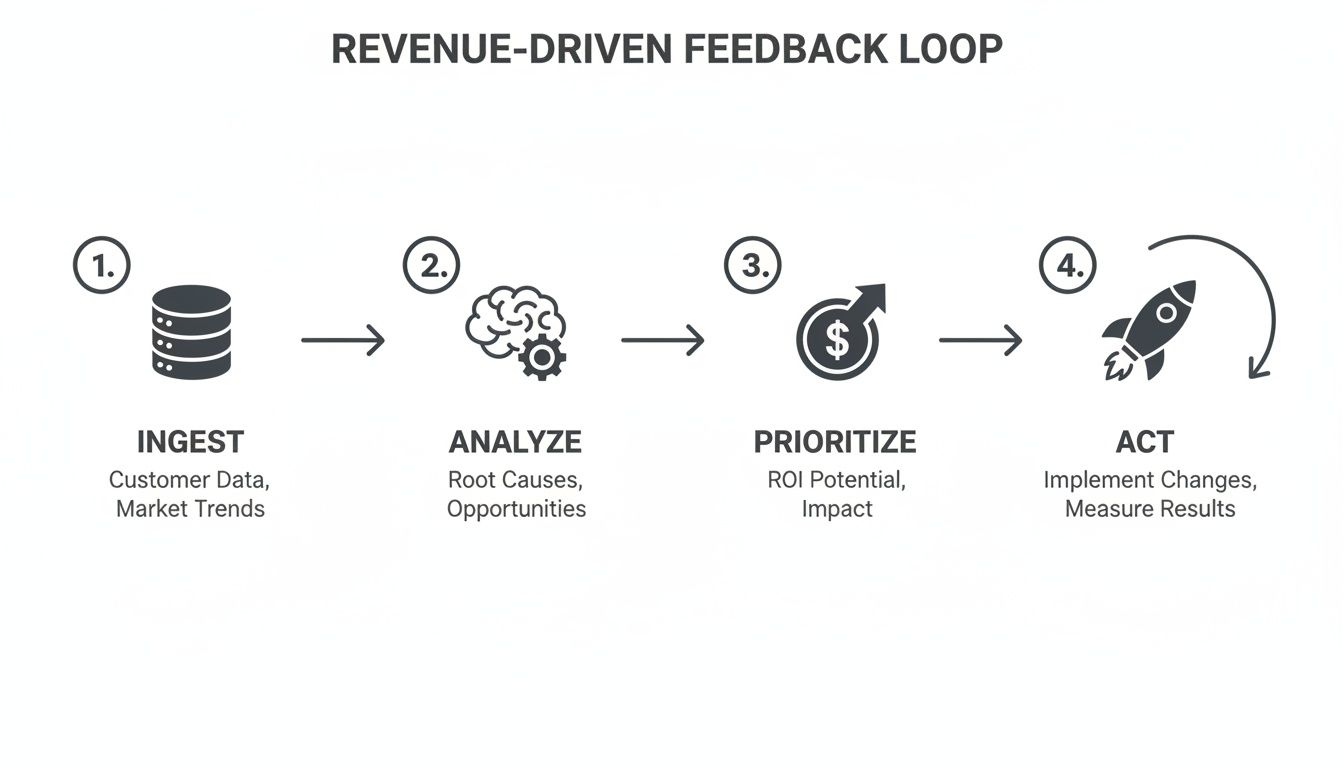
This loop is all about ingesting raw customer data, finding the hidden patterns, prioritizing what matters most financially, and then taking action.
How Do We Get Started if Our Feedback Is Everywhere?
That’s the most common starting point for almost everyone. The key is to not try and boil the ocean.
Start with your single richest source of unsolicited feedback. For most companies, this is the support desk—think Zendesk or Intercom. These conversations are where customers are their most honest and detailed.
Modern platforms are designed to connect all your sources, but prove the concept with one. Get a quick win by analyzing your support tickets first, then expand to other channels like sales calls or product analytics to build a 360-degree view of your customer.
Is AI Analysis of User Feedback Expensive?
It used to be. Not long ago, this required a dedicated data science team and a massive budget. But that’s changed completely. Today’s AI-powered tools have made this kind of analysis accessible and affordable for almost any team.
The cost of a smart feedback platform is usually a tiny fraction of the revenue it protects from churn or the new expansion revenue it helps you find.
Think of it less as another software expense and more as an investment in revenue intelligence. The right tool pays for itself by connecting what your teams build directly to your bottom line.
How Do We Get Engineers to Trust AI-Driven Priorities?
This is maybe the most important question. You get buy-in by showing them the money, plain and simple.
Engineers are builders; they want to solve meaningful problems. Instead of walking into a planning meeting saying, "A few users complained about this," you can now present a rock-solid business case.
Imagine being able to say, "This bug is impacting 15% of our enterprise users and puts $30,000 in ARR at immediate risk." When you tie engineering work directly to a quantified revenue impact, you’re no longer just talking about opinions. You’re aligning the entire product organization around a shared financial goal. It’s the fastest way to get everyone on the same page.
Ready to turn your feedback into your biggest growth lever? SigOS uses AI to analyze all your customer conversations and behavioral data, showing you exactly which issues are costing you money and which features will drive expansion. Discover your revenue-at-risk today at https://sigos.io.
Keep Reading
More insights from our blog
Ready to find your hidden revenue leaks?
Start analyzing your customer feedback and discover insights that drive revenue.
Start Free Trial →