What Are Power Users: what are power users and how to leverage them
Discover what are power users, how to identify them, and why they drive retention and growth. Practical tips to nurture these valuable users.

Who are your power users? Simply put, they're the small but mighty group of customers who live inside your product. They don't just log in daily; they master its most advanced features and weave it into the very fabric of their work.
Understanding Your Most Valuable Users

Let's go beyond a simple dictionary definition. Think of your user base as an orchestra. Most people play their part, but the power users are your lead violinists—they don’t just follow the sheet music; they set the tempo and elevate the entire performance. A power user pushes your product to its absolute limits, often discovering creative use cases your own team hadn't even thought of yet.
This small group has a massive impact on your business. They're your biggest champions, the ones who stick around through thick and thin and drive revenue, retention, and even your product roadmap. Because your tool is so deeply integrated into their success, they become invaluable partners in yours.
Defining Power Users With Data
While the idea of a "super fan" feels intuitive, you need data to truly pinpoint who they are. Most product teams define this segment as the top 5–20% of accounts based on how often or how intensely they use the product.
A common tool for this is the Power User Curve, which helps visualize user engagement. For many SaaS companies, a small slice of the user base—often just 10–15% of customers—is responsible for a staggering 50–80% of key actions like logins, transactions, or messages sent. This concentration makes it crystal clear just how valuable they are.
A power user isn’t just defined by how often they log in, but by how deeply they engage. Their actions demonstrate a mastery of the product that goes far beyond surface-level interaction, turning them into a source of critical product insights.
By digging into their behavior, you unlock a powerful feedback loop. They'll show you what works, what doesn't, and what you should build next, helping you create a better product for everyone.
Casual User vs Power User A Quick Comparison
To make the distinction even clearer, let's look at a side-by-side comparison of how these two groups behave.
| Attribute | Casual User Behavior | Power User Behavior |
|---|---|---|
| Frequency of Use | Logs in sporadically, perhaps weekly or less. | Logs in daily or multiple times a day. |
| Feature Adoption | Uses only the core, most obvious features. | Masters advanced features and explores new ones. |
| Workflow Integration | The product is a "nice-to-have" tool. | The product is essential to their daily workflow. |
| Feedback & Advocacy | Unlikely to provide feedback unless prompted. | Actively offers unsolicited feedback and advocates for the product. |
| Problem Solving | Contacts support for basic issues. | Troubleshoots complex problems independently. |
This table highlights the fundamental difference: for a casual user, your product is a tool; for a power user, it's a critical part of their success.
What Power Users Really Mean for Your Bottom Line
It’s one thing to know what a power user is, but it’s a completely different ballgame to grasp their real-world value. Their impact isn't just some vanity metric—it's a force that actively drives your company's growth and profitability.
You can really boil down their value to three key areas: retention, revenue expansion, and genuine advocacy.
First off, power users are your stickiest customers. They’ve woven your product so deeply into their daily work that the thought of switching to a competitor is a massive headache. This deep integration is your best defense against churn, giving you a solid, predictable revenue base to build on.
They Drive Revenue and Keep Costs Down
This loyalty is a direct pipeline to higher revenue. Power users are almost always the first in line to upgrade to a premium plan, try out a new paid feature, or get their entire team on board. They get the value of your advanced features and are happy to pay for it, which sends their lifetime value through the roof.
The true business impact of power users is clearly demonstrated by their contribution to customer lifetime value, making understanding the customer lifetime value calculation for SaaS a critical metric for any growth-focused team. To learn more, check out our guide on how to boost revenue by understanding the lifetime value of a customer.
But they don't just spend more—they save you money. Companies that do a great job nurturing this group see their customer acquisition costs (CAC) drop. Why? Because these users become your most effective, unpaid marketing team. In fact, highly engaged customers are about 60% more likely to refer others, directly lowering how much you have to spend to get that next customer.
They Become Your Best Marketing Channel
Finally, power users become your most authentic champions. They don't just use your product; they live it. This advocacy shows up in powerful ways that no marketing campaign could ever replicate.
- Word-of-Mouth Referrals: They bring in high-quality leads by telling their colleagues and peers all about your solution.
- Authentic Social Proof: They're the ones writing those incredibly detailed, glowing reviews on G2 or Capterra that actually convince prospects to buy.
- Community Leadership: They often take the lead in community forums or Slack channels, answering questions for other users and taking a load off your support team.
Investing in your power users isn't just a customer success initiative; it's a high-leverage growth strategy. By delighting this small but influential group, you create a ripple effect that strengthens retention, accelerates revenue, and builds a brand that new customers trust.
How to Pinpoint Your Power Users with Data
So, we know power users are a huge deal. But how do you actually find them? It’s not about guesswork or just looking at who logs in the most. You need to dig into the data and see how people are really using your product.
Finding them starts with looking at their behavior. We need to go past surface-level stats like daily active users and ask deeper questions. Are they just clicking around, or are they mastering the features that solve their biggest problems? This is where behavioral analytics comes in. If you're new to the concept, our guide on what is behavioral analytics is a great place to start.
It's worth the effort, because the impact of this small group is massive.
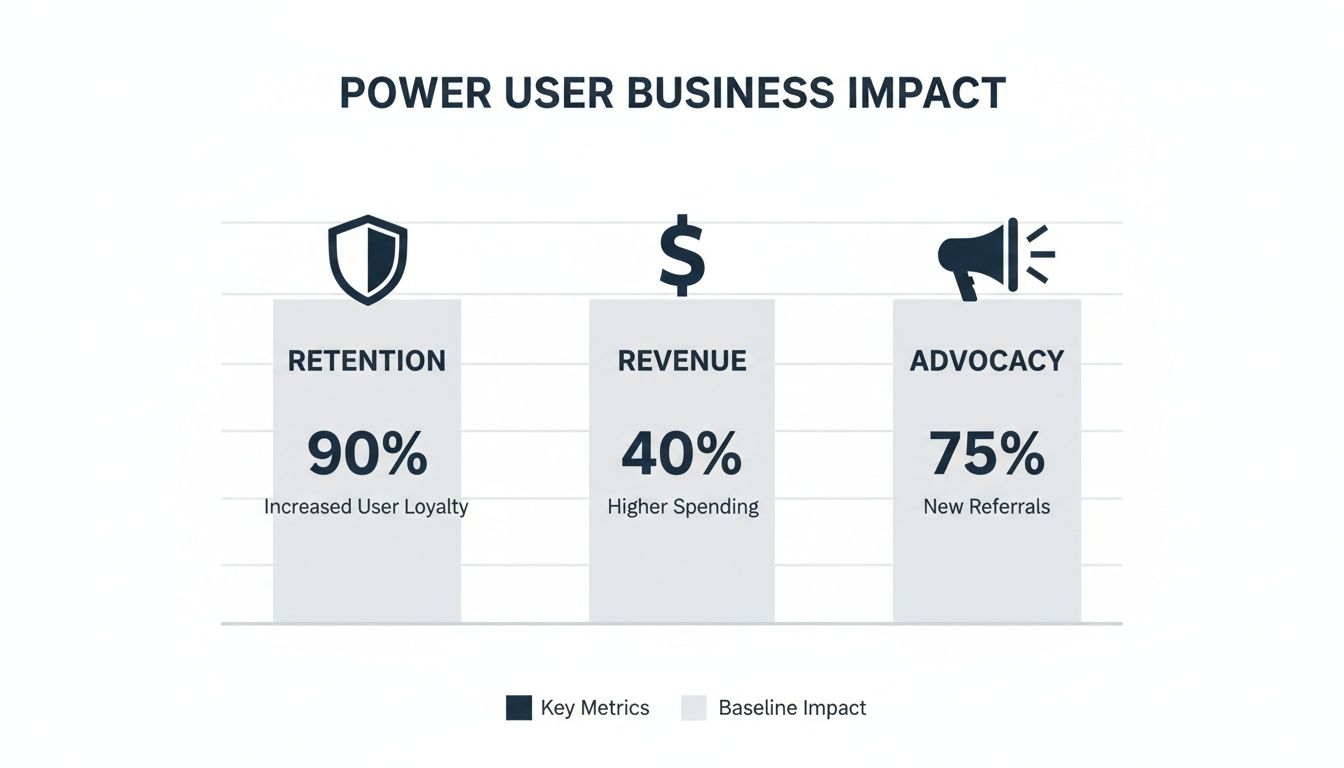
The numbers don't lie. A tiny fraction of your user base can be responsible for the lion's share of your retention, revenue, and word-of-mouth growth.
What to Look for in the Data
To truly separate your power users from everyone else, you need to track a combination of metrics. A single number won't tell you the whole story. Instead, look for patterns across a few key areas that signal deep, meaningful engagement.
Here are the signals that matter most:
- Frequency and Duration: How often are they in your app, and how long do they stick around? Power users aren't just visiting; your product is a core part of their daily or weekly workflow.
- Depth of Feature Use: Are they only using the most obvious features, or are they digging into the advanced stuff? Someone who has mastered complex functionalities is a clear power user.
- High-Value Actions: What are the key "aha!" moments or outcomes your product delivers? This could be anything from exporting a complex report to collaborating with ten teammates. Track who is hitting these milestones.
By blending these metrics, you can build a more complete and accurate picture of who your champions are. It helps you avoid mistaking someone who logs in every day to do one simple thing for a true power user.
To put this into practice, let’s look at some specific metrics you should be tracking.
Essential Metrics for Finding Power Users
| Metric Category | Specific Metric | Example Threshold (SaaS) |
|---|---|---|
| Engagement Frequency | Days Active | Top 10% of users or active 20+ days per month. |
| Feature Adoption | Depth of Use | Utilizes 5+ core features or 2+ advanced features. |
| Product Stickiness | Session Duration | Top 15% of average session length. |
| Business Value | Key Actions Completed | Top 5% in reports generated, projects completed, etc. |
| Team Integration | Collaboration Actions | Invites 3+ new team members. |
| Qualitative Signal | Feedback Provided | Submits 2+ feature requests or bug reports. |
Tracking a mix of these quantitative and qualitative signals gives you a much more reliable way to segment your user base.
Frameworks for Data-Driven Identification
Now, how do you turn this data into a system? Many teams use proven frameworks to set clear benchmarks. One popular method is the L30 Power User Curve, which is essentially a histogram showing how many days in the last 30 days each user was active. It’s a simple visual that makes it easy to spot the highly engaged cohort.
The biggest mistake you can make is relying on a single metric. A smart strategy combines multiple data points—like session counts, feature depth, and key actions—to build a nuanced and accurate profile of your most valuable customers.
Of course, the L30 curve is just a starting point. The best approaches layer on other data. For example, you might define a power user as someone who is active 20+ days per month and falls into the top 5% for feature adoption. Other teams might flag users who are in the top revenue-generating segment.
The key is to combine multiple indicators to get a holistic view. There's a lot of great thinking out there on measuring tool adoption that can help you figure out which KPIs matter most for your specific product.
Segmenting Your Power Users for Smarter Engagement
So, you've pinpointed your power users. Great! But the real magic happens next, and it’s not about blasting them all with the same message. Treating them as one monolithic group is one of the biggest missed opportunities I see.
Smart segmentation is the key. It lets you get personal and effective with your engagement because you start connecting with them based on why they're power users in the first place. A one-size-fits-all approach just doesn't work here. Different power users get value from your product in completely different ways—some are obsessed with efficiency, others are all about pushing the boundaries, and some just love being part of the community.
Understanding these little differences is everything. It helps you tweak your communication, decide who gets to see new features first, and ask for feedback that actually matters to each group. This is how you shift the relationship from being purely transactional to a genuine partnership.
Common Power User Archetypes
Think of your power users less like a crowd and more like a team of specialists, each with their own unique role. When you can spot these different archetypes, you move beyond just a generic "power user" label and start building a real strategy for engagement and loyalty.
Here are a few classic archetypes you’ll probably find in your own user base:
- The Innovator: This is the person who lives for your beta program. They’re the first to try new features and are constantly pushing your product to see what it can really do. They love exploring and are driven by finding new ways to get things done, which makes their feedback on your roadmap incredibly valuable.
- The Advocate: These are your champions, your evangelists. They don't just use your product; they actively tell others about it. You’ll see them making referrals, shouting you out on social media, and writing glowing reviews. Their motivation comes from community and sharing what they know.
- The Optimizer: This user is a master of efficiency. They’ve dug deep into your core features and have built sophisticated workflows and templates to get the absolute most out of them. They’re all about productivity, making them the perfect people to ask for feedback on usability and workflow improvements.
Treating all power users the same is like giving a carpenter, a plumber, and an electrician the exact same tool. By segmenting them, you can give each one precisely what they need to do their best work, which makes them feel seen and valued.
Once you start seeing these personas in your user base, you’ve laid the groundwork for creating much more meaningful interactions.
Why This Segmentation Matters
When you understand these groups on a deeper level, you can build programs that actually resonate. For example, you can create an exclusive beta testing community just for your Innovators. You can invite your Advocates to a special referral program with great perks. Or you could feature your Optimizers in case studies to show off their slick, advanced workflows.
This targeted approach means your efforts actually count. Instead of a generic email newsletter that gets ignored, you’re delivering content and opportunities that speak directly to what drives each person. By recognizing what makes each power user tick, you build a much stronger connection, get more value from their expertise, and turn your best customers into true partners in your product's journey.
Actionable Strategies to Nurture Your Power Users

So, you've found your power users. That's a huge step, but it’s really just the starting line. The real magic happens when you start to actively cultivate those relationships. A one-size-fits-all approach just won’t cut it here; you need to make these folks feel seen, heard, and valued as true partners.
The idea is to graduate from a simple customer-vendor relationship to something much deeper. You want to make them feel like an extension of your own team. This takes a deliberate strategy, one that’s built on exclusivity, access, and recognition.
When you invest in these key relationships, you're doing more than just preventing churn. You’re building a powerful feedback loop that fuels product innovation and creates a kind of loyalty that no marketing budget can buy.
Create an Exclusive Community
One of the best things you can do is get your power users talking to each other. Creating an exclusive space for them to connect—with each other and with your team—builds a powerful sense of belonging. It makes them feel important.
This doesn't have to be a massive project. A private Slack channel or a hidden section in your community forum can work wonders. This space becomes a think tank for advanced discussion, where users swap sophisticated workflows, troubleshoot tricky problems, and genuinely feel like insiders.
Imagine a project management tool creating a "Power Creators" Slack group. In there, members share their most creative templates and strategies. Every so often, the product team pops in to ask for direct feedback on a new feature they're building. That direct line of communication is pure gold for everyone involved.
Offer Early Access and Influence
Your power users are your biggest fans—they want to be on the cutting edge. They love what you've built and are eager to help you shape what's next. Giving them a sneak peek at beta features is a fantastic way to reward their loyalty while getting mission-critical feedback.
Inviting them into an exclusive beta program gives them a real stake in your product’s future. This isn’t just about squashing bugs. It's about validating your roadmap with the people who understand your product inside and out.
Make your power users feel like co-creators, not just customers. When they see their feedback directly influence a new feature release, you solidify a bond that turns them into lifelong advocates. Their insights are a strategic asset that can prevent costly development mistakes.
This approach is a win-win. Your power users get to play with new tools before anyone else, and your product team gets high-quality, real-world testing before a feature is released to the masses.
Provide High-Touch, Proactive Support
Standard support queues are fine for everyday questions. Your power users, though, are often tackling much bigger challenges or stretching your product to its limits. Giving them dedicated, high-touch support shows that you get it—you understand their needs are different.
Consider a few high-impact tactics:
- Dedicated Support Channels: Give them a special email address or a direct line to a senior support specialist who can speak their language and understand their complex use cases.
- Proactive Check-ins: Have customer success managers schedule regular calls just to talk about their goals and figure out how you can help them get there.
- Direct Access to Product Teams: Every now and then, invite them to a one-on-one chat with a product manager to share their wish list and experiences directly.
This VIP treatment does more than just solve problems faster. It sends a loud and clear message: "We value your business and your expertise." That feeling is the bedrock of a lasting, mutually beneficial partnership.
How SigOS Automates Power User Identification
Let’s be honest: manually digging through user data to find your power users is a grind. It’s slow, often inconsistent, and can feel like you’re searching for a needle in a haystack. By the time you’ve actually crunched the numbers, that perfect moment to engage a budding champion might have already passed you by. This is where automation really changes the game.
SigOS plugs directly into your product and communication tools, keeping an eye on the behavioral signals that separate your most dedicated users from the rest. Instead of waiting for someone to pull a report, the platform works around the clock to flag users the moment they hit those key engagement milestones. This frees up your team from hours of manual work and puts the focus back on strategy.
Turning Insight Into Instant Action
Spotting a power user is one thing, but acting on that knowledge quickly is what really matters. This is the gap SigOS is built to close. It doesn't just show you who your power users are; it kicks off automated workflows based on their behavior.
Think about these kinds of scenarios running 24/7 without anyone lifting a finger:
- A user gets the hang of a complex, high-value feature. SigOS immediately sends them a personalized email inviting them to your exclusive beta program.
- An entire account's usage patterns start to mirror your ideal power user profile. SigOS pings their dedicated Customer Success Manager with a heads-up to reach out and explore expansion opportunities.
SigOS transforms power user identification from a reactive, data-crunching chore into a proactive, automated way to grow your business. It makes sure you never miss an opportunity to build a stronger relationship with your best customers.
This kind of immediate, automated engagement lets you connect with emerging champions at exactly the right time. To see how SigOS can help you analyze user behavior and pinpoint key segments, take a look at what our platform can do.
Power User FAQs
Let's tackle some of the common questions that pop up when teams start thinking seriously about their best users.
Aren't Power Users Just Daily Active Users (DAUs)?
Not quite, and it's a critical distinction. While a power user might also be a daily active user, the two aren't the same. A DAU is all about frequency—they just need to open your app or log in once a day. That could be for a two-second check-in.
A power user is defined by the depth of their engagement. They're the ones mastering your advanced features, spending significant time in the product, and weaving it into their essential workflows. Think of it this way: the DAU punches the clock, but the power user lives and breathes your product.
Is This a Viable Strategy for Small Businesses?
Absolutely. You don't need a huge budget or a data science department to connect with your top users. The core ideas work just as well, if not better, on a smaller scale.
You can start by blending simple data with what you're already observing.
- Who consistently gives you detailed, thoughtful feedback?
- Which customers are always requesting sophisticated new features?
- Who clocks the longest session times in your basic analytics?
Engaging them can be as simple as sending a personal thank-you email, inviting them to a 15-minute feedback call, or giving them a sneak peek at a new feature. At any size, making your best customers feel heard is a winning strategy.
What's the Biggest Mistake Companies Make with Power Users?
The most common trap is using a single, shallow metric to define them, like "the top 10% of users by login count." This is a huge oversimplification and often misses the point entirely.
A user who masters your most valuable feature once a week could be infinitely more important than someone who logs in daily to perform a trivial task. Real value is found in depth and impact, not just raw frequency.
The right way to do it is to build a more holistic picture. Look at a combination of factors: which features they use, how often they're active, and what specific actions they take that create real value. This approach gives you a far more accurate and useful definition of who your true champions are.
Ready to stop guessing and start automatically identifying your most valuable users? SigOS uses behavioral analysis to pinpoint your power users in real time, turning insights into automated actions that drive retention and revenue. Learn how SigOS can help you connect with your best customers.
Keep Reading
More insights from our blog

Ready to find your hidden revenue leaks?
Start analyzing your customer feedback and discover insights that drive revenue.
Start Free Trial →