What Is A Sprint In Agile: Purpose & Benefits
Discover what is a sprint in agile, its core purpose, ceremonies, and practical examples. This guide covers planning, metrics, and common pitfalls in 2026.

An agile sprint is a fixed-length period, usually 1 to 4 weeks, where a team commits to completing a defined set of work and delivering a usable increment of the product. That short cycle creates a predictable rhythm for planning, building, testing, learning, and shipping value.
If you're a new product manager, this usually becomes real the moment your backlog starts to feel like a junk drawer. Sales wants one feature for a deal. Support wants a bug fixed because customers keep complaining. Leadership wants roadmap certainty. Engineering wants time for refactoring. Everyone is asking for something reasonable, and the team still can't do all of it at once.
Without a sprint cadence, work turns reactive fast. Teams jump between requests, half-finish important initiatives, and lose the thread on what matters to the business. You end up with motion instead of progress.
A sprint gives that chaos boundaries. For a short, fixed window, the team aligns on one goal, selects a realistic amount of work, and protects focus long enough to finish something meaningful. Done well, that doesn't just improve delivery discipline. It makes it easier to connect product decisions to outcomes like retention, expansion, and the timing of revenue-critical releases.
From Chaos to Cadence An Introduction to Sprints
A familiar scene plays out in a lot of SaaS teams.
Monday starts with a roadmap review. By Tuesday, a high-value prospect has raised a product gap in a sales call. Wednesday brings a support escalation from an unhappy account. On Thursday, someone from leadership asks why a different feature still isn't live. By Friday, the team has touched ten things and finished almost none of them.
That pattern doesn't usually come from laziness or poor intent. It comes from a missing operating rhythm. When work arrives as a stream of interruptions, every request feels urgent and no decision stays stable long enough for the team to build momentum.
A sprint is the mechanism that creates that rhythm. It doesn't remove change. It contains change inside a practical delivery cycle so the team can make decisions, execute, review outcomes, and adapt on purpose instead of by panic.
Teams don't need less feedback. They need a better way to decide when feedback changes the plan and when it waits for the next planning window.
This is also where agile separates itself from traditional project management. If you want a useful primer on how the planning assumptions differ, this guide to compare waterfall and agile models is worth reading before you try to run sprints inside a waterfall mindset.
What changes when a team adopts sprints
The most immediate shift is focus. A sprint tells the team, "For this short period, this is the goal and this is the work that supports it."
That creates a few practical benefits:
- Fewer moving targets: New ideas don't automatically disrupt current execution.
- Clearer trade-offs: Product managers have to choose what fits the sprint and what waits.
- Visible progress: Stakeholders can inspect finished work instead of status theater.
- Faster learning: Every sprint ends with a review of both product output and team process.
Sprints aren't valuable because the calendar says two weeks have passed. They're valuable because they force prioritization, reveal capacity, and create regular moments to decide whether the team is building the right thing.
What Exactly Is a Sprint in Agile
At its core, what is a sprint in agile comes down to one idea. It's a time-boxed, fixed-length iteration where a cross-functional team plans, designs, develops, tests, and delivers a potentially shippable increment of product work.
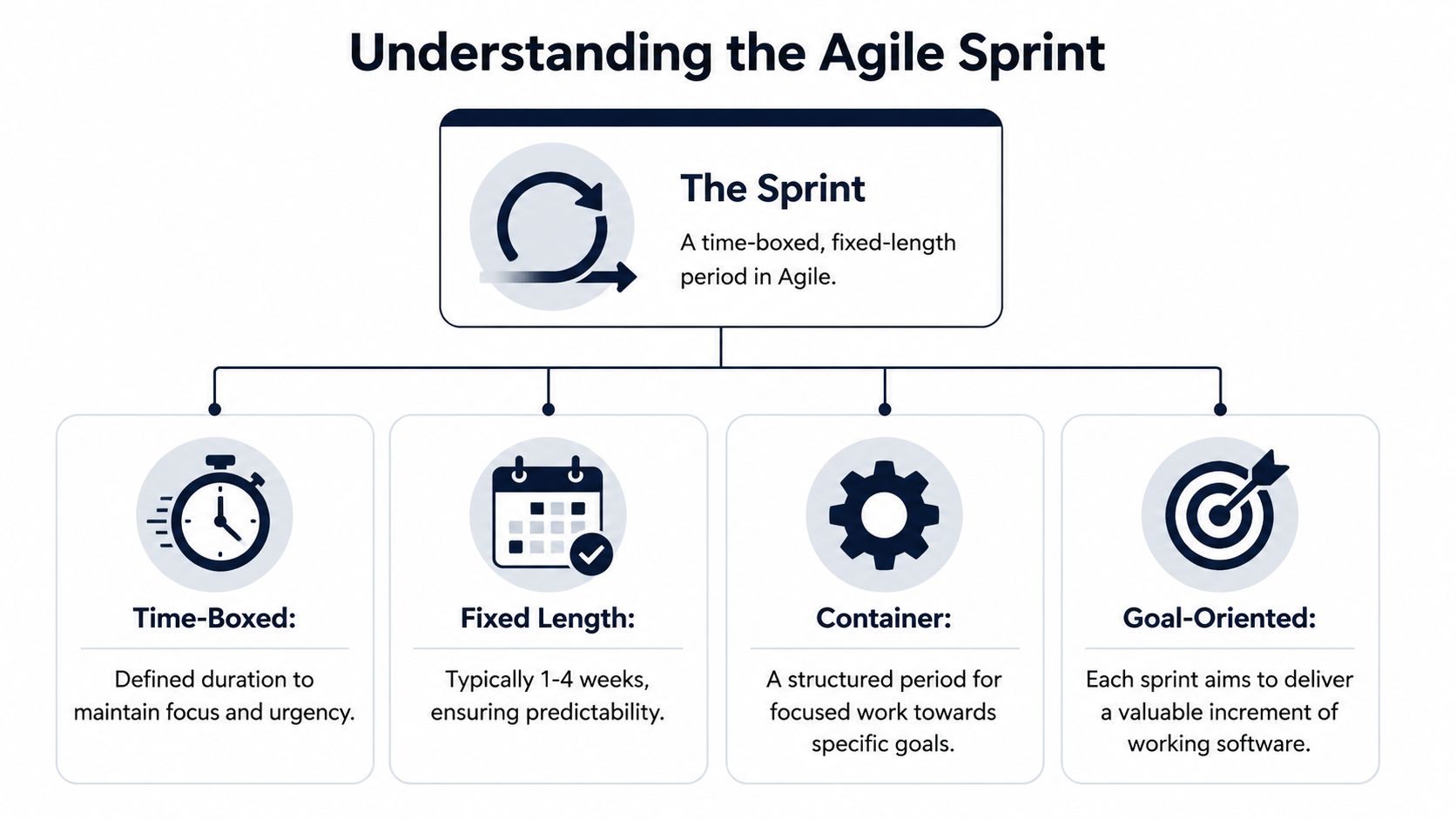
The "fixed-length" part matters more than many realize at first. The sprint doesn't expand because the work is harder than expected. The team adjusts scope, solves blockers, or learns from the miss. That constraint is what makes future planning more reliable.
Think of a sprint as a training block
A useful analogy is an athlete preparing for competition. They don't train with every possible exercise every day. They work in focused blocks with a clear objective, a defined time window, and a way to inspect results before the next cycle.
A sprint works the same way. It is not a bucket for random tasks. It's a focused block of effort aimed at a specific outcome.
That outcome should produce something done, usable, and reviewable. If the team exits a sprint with partial work, hidden dependencies, and unresolved testing, they may have spent effort but they haven't created the transparency a sprint is supposed to provide.
Here's a short visual walkthrough of the concept in practice:
Why Scrum uses sprints
The sprint concept began with the Scrum framework in 1993, and Scrum was first presented publicly in 1995. Its purpose is to support empirical process control through transparency, inspection, and adaptation. Teams that consistently track sprint metrics against historical velocity can improve delivery predictability by up to 20 to 30%, according to Scrum sprint statistics collected by Echometer.
That phrase, empirical process control, sounds abstract until you see it in a real team. It means you stop pretending long-range plans are certain. Instead, you work in short cycles, inspect what happened, and adapt based on evidence.
Practical rule: A sprint should answer two questions by the end of its cycle. What did we deliver, and what did we learn?
What a sprint is not
A sprint isn't just a shorter project plan. It also isn't a productivity hack where people cram in more tasks under a tighter deadline.
What doesn't work:
- Treating the sprint as a deadline container: Teams rush, quality drops, and spillover becomes normal.
- Loading work without a sprint goal: The backlog fills up, but the increment lacks coherence.
- Changing direction every few days: The team loses the focus that makes time-boxing useful.
What works is simpler. A sprint creates a stable planning horizon, a shared goal, and a feedback loop short enough to correct mistakes before they become expensive.
The Anatomy of a Successful Sprint
A sprint works because a small set of roles, ceremonies, and artifacts reinforce each other. When one part gets skipped or misunderstood, the whole thing starts to feel heavier than it should.
The roles that keep the sprint healthy
In Scrum, three groups carry the sprint.
The Product Owner decides what matters most and makes sure the team is working on the highest-value problems. The Scrum Master protects the process, removes friction, and helps the team improve how it works. The Development Team turns backlog items into a finished increment. In practice, that includes engineers, designers, QA, and anyone else needed to deliver something real.
The sharpest sprint teams don't blur these responsibilities too much. Product decides priority. The team decides how to execute. The Scrum Master protects the conditions that let both happen well.
The four ceremonies
Each ceremony exists for a reason. If it feels pointless, the team is usually running it badly, not proving the ceremony unnecessary.
| Ceremony | Purpose | Typical Duration (for a 2-week sprint) | Key Attendees |
|---|---|---|---|
| Sprint Planning | Define the sprint goal and select the work | Up to 4 hours | Product Owner, Scrum Master, Development Team |
| Daily Scrum | Re-plan daily work around the sprint goal | 15 minutes | Development Team, Scrum Master |
| Sprint Review | Demonstrate the increment and gather stakeholder feedback | Up to 2 hours | Scrum Team, Stakeholders |
| Sprint Retrospective | Improve how the team works in the next sprint | Up to 1.5 hours | Product Owner, Scrum Master, Development Team |
A few practical notes matter here.
- Sprint Planning: Good planning isn't backlog recitation. It is a negotiation between value, capacity, and risk.
- Daily Scrum: This is not a status meeting for managers. It is a coordination meeting for the team.
- Sprint Review: Review finished work, not slides about work.
- Retrospective: Pick a small process change and try it next sprint.
If the daily scrum feels repetitive, the team is probably reporting activity instead of discussing progress toward the sprint goal.
The artifacts that provide visibility
Three artifacts give a sprint its transparency.
The Product Backlog is the ordered list of work the product may need. The Sprint Backlog is the subset selected for the current sprint, plus the plan for delivering it. The Increment is the working result at the end.
For new product managers, the biggest mistake is treating backlog items as self-explanatory. They rarely are. Better backlog items have context, constraints, and acceptance criteria. If you need a practical model for that handoff, this guide on how to write a PRD is a useful companion to sprint planning.
What makes the anatomy work together
A sprint doesn't succeed because every ceremony happened on the calendar. It succeeds when the structure helps the team maintain one line of sight from backlog priority to delivered outcome.
When teams struggle, I usually see one of two root causes. Either they don't have a clear sprint goal, or they are carrying poorly prepared work into planning. In both cases, the sprint becomes administrative overhead instead of a decision system.
How to Plan Sprints That Drive Results
A strong sprint plan starts with a goal, not a capacity spreadsheet.
That sounds obvious, but many teams still plan by asking, "How much work can we fit?" instead of, "What outcome matters most in this window?" Those are not the same question. One creates a full sprint board. The other creates a coherent sprint.

Start with a sprint goal that changes decisions
A useful sprint goal helps the team choose between trade-offs during execution. If a blocker appears, the team should be able to ask, "Does solving this help us achieve the goal?" If not, it probably doesn't belong in the sprint.
Good goals are outcome-based. "Improve onboarding completion" is stronger than "build three onboarding tickets." Tasks support the goal. They are not the goal.
Why planning meetings often go wrong
Sprint planning usually compresses a large backlog into a small set of action items. According to Epicflow's discussion of sprint-based work, teams often filter a backlog of 200+ items down to 15 to 25 tasks. When that filtering relies on opinion instead of evidence, it creates waste and missed opportunities.
That problem gets worse in organizations with loud stakeholders and fragmented customer input. Support sees pain. Sales sees deal blockers. Product sees strategy. Engineering sees complexity. All of those perspectives matter. None should single-handedly decide the sprint.
The loudest request isn't always the most valuable one. It is often just the easiest one to remember in the meeting.
What better planning looks like
A practical sprint planning motion usually includes:
- Refined backlog items: The team understands scope well enough to discuss trade-offs.
- A realistic capacity view: Use recent delivery patterns, not optimism.
- A mix of work types: New features, bugs, and technical debt all compete for room.
- A clear ordering logic: Value first, then feasibility.
If your team is trying to improve this operating rhythm, formalizing backlog prioritization techniques helps create better inputs before planning even starts.
For AI-heavy product work, another planning trap shows up. Teams collect lots of raw user comments, experiment notes, and prompt feedback, then struggle to convert that noise into sprint-ready work. In those cases, examples of structured feedback for AI projects can be useful because they show how to turn vague reactions into actionable backlog items.
The product manager's job in planning isn't to fill every available slot. It's to make sure the sprint contains the smallest set of work that can create meaningful progress for the business and the customer at the same time.
Connecting Sprints to Business Impact with SigOS
Most sprint guides stop at delivery mechanics. That's useful, but incomplete.
In SaaS, the better question is not only whether the team shipped. It's whether the sprint moved a business metric that matters. Did it reduce the friction driving churn? Did it remove a blocker in a sales cycle? Did it improve adoption for a feature tied to expansion conversations?

The missing link between backlog and outcomes
A backlog usually contains a mix of feature requests, bugs, usability issues, and technical chores. The hard part isn't collecting that work. The hard part is knowing which items affect retention and revenue.
Product intelligence changes sprint quality. Instead of ranking work by request volume alone, teams can look at which issues appear in support conversations, which pain points show up in sales calls, and which patterns in product usage suggest a customer is struggling or ready to expand.
That changes the planning conversation from "Who asked the loudest?" to "Which work has the strongest business signal?"
Why velocity matters beyond engineering
Velocity is often treated as an internal engineering metric. Used well, it becomes more than that.
By connecting sprint velocity data with product intelligence, SaaS organizations can forecast deal closure timelines against feature roadmaps with 70 to 85% accuracy, according to GeeksforGeeks' discussion of sprints and forecasting. That's the point where sprint execution starts to inform go-to-market planning, not just engineering planning.
For product leaders, that means a sprint is not merely a development interval. It is a business timing mechanism. If the team knows what it can usually finish in a cycle, and it knows which backlog items are tied to churn risk or expansion opportunities, roadmap choices become much more concrete.
A sprint becomes strategically useful when product, engineering, support, and revenue teams can all interpret its output the same way.
Turning signals into decisions
This is the practical shift. Connect customer feedback systems, usage data, and issue trackers. Then enrich backlog items with business context before sprint planning begins.
That approach is easiest to understand when you see the operational layer in one place. SigOS shows this model through its product intelligence features, where teams can connect signals across tools and prioritize around revenue impact instead of raw request count.
The value for a product manager is straightforward. You stop defending priorities with intuition alone. You walk into sprint planning with evidence about which work is likely to protect accounts, improve adoption, or help revenue teams close what is already in flight.
Common Sprint Pitfalls and How to Avoid Them
Teams don't usually fail at sprints because they forgot a ceremony. They fail because they keep the outward form and lose the underlying discipline.

Pitfall one is overcommitment
The common assumption is that ambitious planning shows commitment. Usually it shows weak capacity discipline.
Symptom: the team carries work over sprint after sprint. Root cause: planning from aspiration instead of observed throughput. Fix: plan to a sustainable level, leave room for uncertainty, and stop rewarding heroic last-minute recovery.
Pitfall two is mid-sprint scope creep
Teams often say they're agile, so they should be able to absorb change at any time. That's a misunderstanding. Agility means adapting at the right decision points, not resetting priorities every day.
Use a parking lot for new requests. If the issue is urgent, make the trade-off explicit. Something leaves if something enters.
Pitfall three is turning daily scrum into status theater
If people report to a manager one by one, the meeting is broken.
A useful daily scrum sounds more like coordination than performance review. What is blocked, what changed, and how does the team still hit the sprint goal? That's the conversation.
Pitfall four is skipping the retrospective
This often happens when teams feel too busy to reflect. In practice, that guarantees the same problems will repeat.
If your broader operating rhythm is weak, it helps to look outside Scrum language for a moment. A lot of the same failure patterns show up in goal systems too, and this piece on how to fix broken OKR operating rhythms is useful because it explains how teams drift when review loops become ceremonial instead of corrective.
A healthy retrospective doesn't need to be long. It needs to be honest, specific, and tied to one change the team will test next sprint.
If your team wants to connect sprint execution to churn, expansion, and roadmap timing, SigOS helps surface which customer signals matter before planning begins. It gives product, support, and growth teams a shared view of what to build next based on business impact, so your next sprint can do more than move tickets across a board.
Keep Reading
More insights from our blog



Ready to find your hidden revenue leaks?
Start analyzing your customer feedback and discover insights that drive revenue.
Start Free Trial →