What Is Pattern Recognition A Simple Guide
Discover what is pattern recognition and how it drives AI, machine learning, and SaaS growth. Learn how to turn data into a competitive advantage.

At its heart, pattern recognition is about teaching a computer to see the world like we do—spotting recurring themes and making sense of chaos. Think about how you know an apple is an apple. You recognize its shape, color, and maybe its texture. Pattern recognition gives machines that same ability to identify, classify, and interpret information from raw data.
Decoding the Digital World

This whole process is about turning a flood of messy data into clear, actionable insights. It’s the quiet engine running behind the scenes of so much modern technology. It’s how your phone knows your face, how your music app nails that perfect song suggestion, and how your inbox magically filters out spam.
Computer algorithms are trained on huge datasets to pick out these repeating structures and trends. The end game isn't just finding patterns for the sake of it; it's about using them to make intelligent predictions and decisions. While it feels incredibly futuristic, the concept has been around for a while, with roots in statistics. In fact, the first formal pattern classifier, the linear discriminant, was introduced by Ronald Fisher way back in 1936. You can discover more about its historical foundations on Wikipedia.
From Data Points to Decisions
The real magic happens when pattern recognition automates perception on a massive scale—far beyond what any person could ever handle. By sifting through data, a system learns to perform tasks that once required human judgment.
This is the ground floor for more advanced artificial intelligence. Before any AI can do something truly impressive, it first has to learn to make sense of its environment by recognizing the patterns all around it.
How AI Learns to Spot Patterns
So, how does a machine actually learn to find a needle in a digital haystack? Artificial intelligence doesn't have intuition like we do. Instead, it relies on structured learning methods to make sense of data. Think of these methods as different teaching styles, each perfect for a different kind of problem.
H3: The Core AI Learning Models
The most common approach is supervised learning. You can think of this like studying for a test with flashcards. The AI is fed a massive dataset where every single piece of information is already labeled correctly. For instance, you could give it thousands of customer support tickets, each one pre-tagged as "Urgent" or "Not Urgent." By sifting through these examples, the system starts to recognize the specific words, phrases, and contexts that signal a high-priority issue.
The image below gives you a glimpse into how these learned patterns show up in the apps and services we use every day.
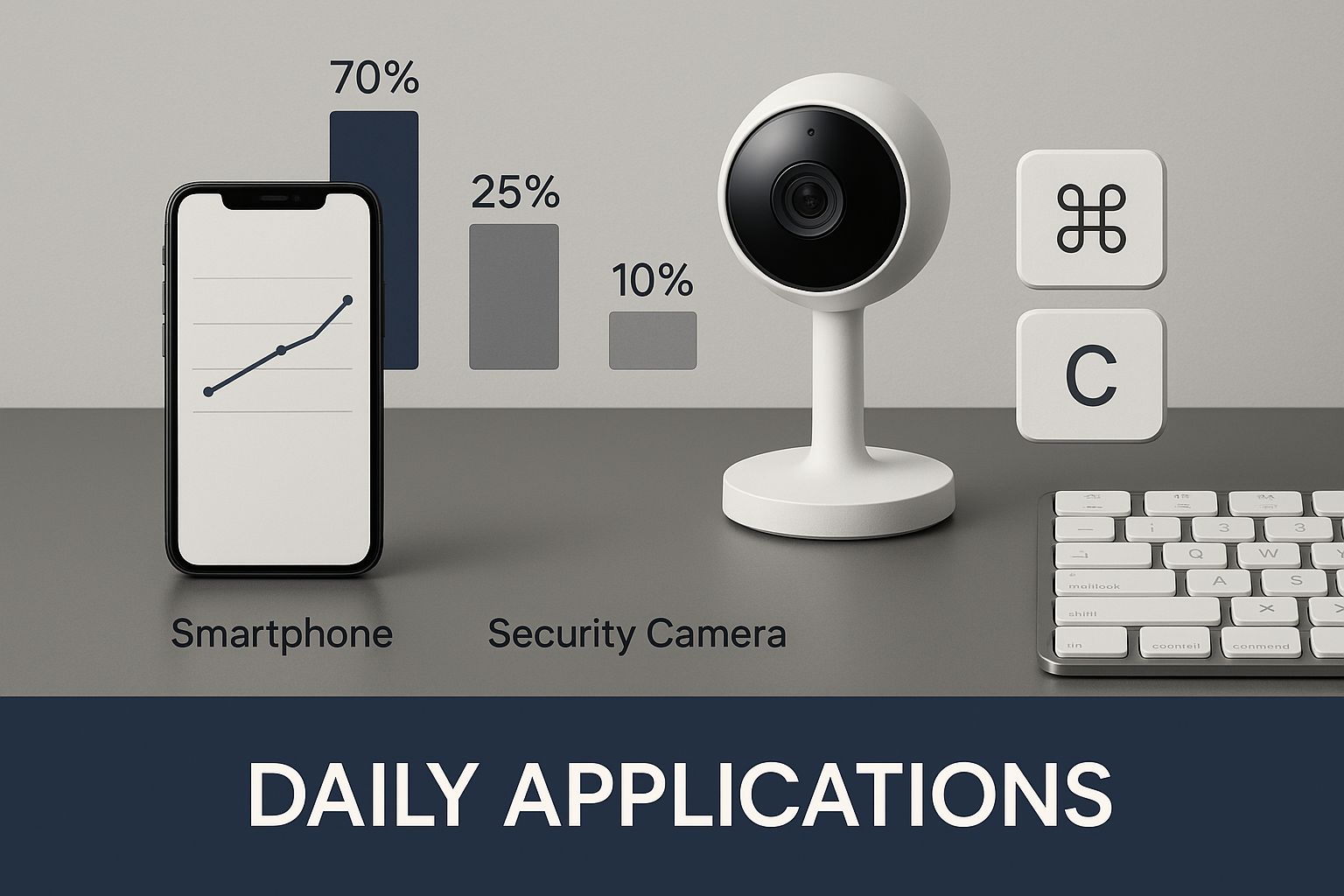
From unlocking your phone with your face to getting a fraud alert from your bank, pattern recognition is constantly working behind the scenes.
Then there’s unsupervised learning, where the AI plays the role of a detective. It’s handed a huge jumble of unlabeled data and tasked with finding the hidden structures all by itself. This is how an e-commerce platform might group customers into different segments based on their browsing and buying habits, without any prior instructions on what those segments should be. It just finds the natural clusters in the data.
This method really took off in the 2000s, building on the data-centric tools of the 1990s like support-vector machines. If you're curious about the history, you can explore the full timeline of machine learning's evolution to see how we got here.
Finally, we have reinforcement learning. This one is a lot like training a dog with treats. The AI learns by doing, taking actions in a dynamic environment. It gets a "reward" for a good decision and a "penalty" for a bad one, gradually figuring out the best strategy through pure trial and error. This is the secret sauce behind game-playing AIs and robotic navigation systems.
Each of these learning models gives us a powerful way to teach machines how to think. To make the differences clearer, here's a quick breakdown of how they stack up against each other.
Comparison of AI Learning Models for Pattern Recognition
| Approach | Learning Method | Data Requirement | Example Application |
|---|---|---|---|
| Supervised Learning | Learns from a dataset with predefined labels or correct answers. | Labeled Data | Email spam filters, sentiment analysis. |
| Unsupervised Learning | Identifies hidden patterns and structures in raw, unlabeled data. | Unlabeled Data | Customer segmentation, anomaly detection. |
| Reinforcement Learning | Learns through trial and error, getting rewards or penalties for its actions. | Dynamic feedback from an environment | Self-driving cars, AI in gaming. |
Ultimately, the choice of model depends entirely on the problem you're trying to solve and the kind of data you have available. These three approaches are the engines that enable today's technology to find meaningful patterns in a world overflowing with data.
Putting Pattern Recognition to Work
You might not realize it, but pattern recognition is already a huge part of your daily routine. It's the invisible engine running behind the scenes, from your morning commute to your evening Netflix queue. This isn't just some abstract concept for computer scientists; it’s a practical tool that powers many of the devices and services you rely on every day.
Think about unlocking your phone with your face. Your device isn’t just taking a selfie. It's instantly analyzing a specific pattern—the unique geometry of your facial features—and matching it against the secure data it has stored. Or consider Optical Character Recognition (OCR), the tech that lets you scan a receipt and get a digital copy. It works by recognizing the distinct shapes of letters and numbers.

Advanced Real-World Implementations
Beyond everyday convenience, pattern recognition is tackling some seriously complex problems with massive impact. Take the financial world, for example. Banks lean on it heavily to protect you from fraud. Their systems are constantly sifting through thousands of transactions a second, looking for anything that breaks your typical spending pattern—like a random, huge purchase in another country—to flag a potential scam in real time.
The medical field is another area where this technology is making waves. AI systems analyze medical scans like X-rays and MRIs, spotting subtle patterns that could point to the early stages of a disease. In some cases, these algorithms can pick up on anomalies that are almost impossible for the human eye to see, leading to earlier and more effective treatments.
That same core idea—finding meaningful patterns in data—is also key to understanding how people interact with a product. By analyzing streams of support tickets and user feedback, a system can pinpoint recurring bugs or highlight the most requested features. To see how this plays out in practice, check out our guide on what is behavioral analytics.
Forecasting models also rely on pattern recognition to predict what's coming next based on historical data. By turning a sequence of data points into a visual chart, algorithms can even use image recognition to spot trends. Each of these applications proves the fundamental value of pattern recognition: it’s all about turning raw, messy data into smart, confident action.
How Pattern Recognition Fuels SaaS Growth
For any SaaS company today, user data is more than just numbers on a dashboard—it's a goldmine. Pattern recognition is the key to digging in and finding the real value. It lets you move past surface-level metrics and start understanding the subtle user behaviors that whisper secrets about risk and opportunity. Essentially, it turns a chaotic stream of user actions into a clear path toward real, sustainable growth.
Think about customer churn. By analyzing how people interact with your product, smart algorithms can pick up on the quiet signals that often come before a customer leaves. Maybe a user suddenly stops using a feature they once loved, or their login frequency drops off a cliff. These are early warnings. This gives your customer success team a chance to step in and solve the problem before it ends in a lost subscription.
From User Clicks to Smart Business Decisions
But this isn't just about preventing churn; it's also about finding new avenues for growth. Pattern recognition can show you exactly which features your most successful customers can't live without, highlighting clear upselling opportunities.
For instance, if you notice a group of users on your basic plan constantly hitting the paywall for a premium feature, that’s not a complaint—it’s a buying signal. It’s the perfect time to reach out with a targeted upgrade offer.
This kind of analysis also sharpens your product roadmap. Instead of guessing or relying on the loudest voices in your feedback inbox, you can see which features genuinely drive engagement and which ones are collecting dust.
This data-first approach means you’re investing your time and money into features that customers actually want and will use. Getting a handle on the applications of SaaS artificial intelligence is the first step. When you can turn user behavior into clear insights, you can build a better product, slash churn, and grow revenue with a lot more confidence.
How This Helps Your Product and Engineering Teams
Think of pattern recognition as a translator. It takes the chaotic, overwhelming flood of user data and turns it into clear, actionable insights for the people building your product. For product managers, this is a game-changer. It replaces guesswork with evidence.
Instead of relying on a gut feeling, PMs can see precisely which features are getting all the love and where users are hitting a wall. It’s the difference between guessing where a road needs repairs and having a map that pinpoints every single pothole.
This creates a powerful, fast-moving feedback loop. A bug report is no longer a single, isolated complaint. With pattern recognition, that one ticket can be instantly linked to hundreds, or even thousands, of other user sessions showing the same issue. Suddenly, you can quantify its impact—you know exactly how much churn risk or lost revenue that one "minor" bug is causing. That's how you prioritize what really needs fixing.
Speeding Up Development and Building a More Robust Product
The value for engineering teams goes way beyond just squashing bugs. By digging into performance logs, pattern recognition tools can spot tiny, almost invisible signals that predict a major outage or a security vulnerability. It's like having an early warning system for your entire infrastructure, catching problems before they escalate into full-blown crises.
At its core, this technology gives your teams the "why" behind the numbers. It tackles the big, expensive questions that guide intelligent product development:
- Which tiny bug is secretly causing the most customer friction?
- What hidden feature request is the key to unlocking major enterprise deals?
- Where are users getting frustrated and dropping off in our onboarding flow?
By delivering clear, data-backed answers, teams can finally focus their energy on work that moves the needle. To see how this plays out in more detail, you can learn more about how AI for product management is fundamentally changing the way software gets made. It’s about ensuring you're not just shipping features, but solving the real problems that ignite growth.
Here’s a quick look at how these benefits translate directly to your teams.
Direct Impact of Pattern Recognition on SaaS Teams
| Team | Key Benefit | Example Outcome |
|---|---|---|
| Product Management | Data-Driven Roadmapping | Prioritizing a small UI fix that reduces user drop-off by 15% in the checkout flow. |
| Engineering/DevOps | Proactive Issue Detection | Identifying a memory leak pattern that prevents a site-wide crash during a peak traffic event. |
| Customer Success | Churn Prediction | Flagging at-risk accounts based on declining feature usage patterns, enabling proactive outreach. |
| Sales & Marketing | Ideal Customer Profiling | Discovering that power users consistently use three specific features, refining marketing messaging. |
Ultimately, integrating pattern recognition isn't just a technical upgrade; it's a cultural shift toward making smarter, faster, and more customer-centric decisions across the board.
As we dig into pattern recognition, a few questions always seem to pop up. Let's tackle them head-on to clear up any confusion and really nail down how this technology fits into the bigger picture.
What Is the Difference Between Pattern Recognition and Machine Learning?
This is a great question, and it's easy to see why they get mixed up. The simplest way to think about it is that pattern recognition is the goal, while machine learning is the engine that gets you there.
Pattern recognition is the broad idea of finding meaningful, repeatable structures in data. Machine learning, on the other hand, is the set of powerful algorithms and statistical models that computers use to learn those patterns automatically, without a human having to write code for every single possibility.
Almost any advanced pattern recognition system you see today is powered by machine learning.
Is Pattern Recognition the Same As AI?
Not quite, but they are very closely related. Think of pattern recognition as one of the most important skills that Artificial Intelligence (AI) has. AI is a much wider field that also includes things like problem-solving, planning, reasoning, and even creativity.
So, while not all of AI is pattern recognition, most of the AI that's useful to us today relies on it heavily.
Can Small Businesses Use Pattern Recognition Technology?
Absolutely. You no longer need a team of PhDs and a room full of servers to make this work for you. The reality is that powerful pattern recognition is now baked into many of the SaaS platforms you might already be using.
This means small and mid-sized businesses can get incredibly sophisticated insights without having to build anything from scratch. A few examples you've probably seen:
- Marketing tools that automatically group customers into segments based on their buying habits.
- Customer support software that spots trending problems by analyzing the text in support tickets.
- E-commerce platforms that suggest products you might like based on what you've looked at before.
These tools put the power of pattern recognition right where it needs to be—in the hands of the people who can use those insights to make better decisions and grow the business.
SigOS helps your team automatically discover the most critical patterns hiding in your customer feedback. By analyzing support tickets, reviews, and usage data, our platform pinpoints the issues costing you revenue and the feature requests that will unlock your next big deal. Learn how to prioritize your roadmap with SigOS.
Keep Reading
More insights from our blog


Ready to find your hidden revenue leaks?
Start analyzing your customer feedback and discover insights that drive revenue.
Start Free Trial →