8 Groundbreaking Ah Ha Moments Examples That Defined Modern SaaS in 2026
Discover 8 deep-dive ah ha moments examples from top SaaS companies. Learn the triggers, impact, and how to replicate these breakthroughs for your own product.

The term 'aha moment' is more than a buzzword; it's the critical instant a user truly understands a product's value, transforming them from a casual visitor into a committed advocate. This shift from "What does this do?" to "This is exactly what I need" is the bedrock of sustainable product growth and customer retention. But these moments aren't random flashes of insight. They are the result of deep analysis, pattern recognition, and a relentless focus on solving a core user problem. For product managers and growth teams, pinpointing these inflection points is the key to unlocking activation, engagement, and long-term loyalty.
This article moves beyond generic definitions to provide a strategic breakdown of pivotal ah ha moments examples from iconic SaaS companies. We will deconstruct the specific user actions and contexts that signal value discovery, from Netflix’s recommendation engine to Slack’s ambient communication. You will learn not just what their aha moments were, but how they were identified and operationalized.
For each example, we will dissect:
- The trigger and user context leading to the insight.
- The measurable impact on key business metrics.
- An actionable implementation pattern or recipe to replicate the strategy.
- Common pitfalls to avoid during your own discovery process.
We’ll explore how identifying the subtle signals hidden in user behavior and customer feedback can unlock exponential growth. You'll gain a practical framework for turning qualitative noise into quantitative, revenue-driving action, and see how modern tools like SigOS can automate this discovery process to accelerate your product’s journey to its own defining aha moment.
1. The Netflix Recommendation Engine Breakthrough
Netflix’s transformation from a DVD rental service to a streaming titan hinged on one of the most powerful ah ha moments examples in modern tech: realizing that what users do is far more predictive than what they say. The company's initial recommendation system relied heavily on explicit star ratings, a common practice at the time. However, data scientists discovered a significant disconnect between user ratings and their actual viewing habits.

This breakthrough shifted Netflix's focus from explicit feedback to implicit behavioral signals. The engineering team, including former VP Xavier Amatriain, began analyzing billions of micro-interactions. They found that metrics like completion rates, pause points, rewatch frequency, and even the time of day a user watched a specific genre were better indicators of true preference. This insight was revolutionary because it allowed Netflix to uncover latent needs users couldn't articulate themselves, leading directly to the hyper-personalized experience it's known for today.
Strategic Breakdown and Tactical Takeaways
The core lesson here is the immense value of behavioral data mining. While direct feedback has its place, it's often biased by what users think they should like. Behavioral signals are unfiltered truth.
- Trigger: The "aha" moment was triggered by observing that a user might give a critically acclaimed documentary five stars but spend every weekend binge-watching reality TV shows. Their behavior revealed their actual entertainment preference.
- Implementation: Netflix built a sophisticated data pipeline to capture and analyze these signals. They developed algorithms that weigh completion rates more heavily than initial views and correlate viewing patterns among millions of users to find "taste communities." This process is a powerful application of advanced data analysis, which you can explore further by understanding more about the fundamentals of pattern recognition.
- Measurable Impact: This shift directly correlated with increased user engagement, higher retention rates, and reduced churn. The more relevant the recommendations, the more indispensable the service became.
How to Apply This Insight
Product teams can replicate this strategy by looking beyond surface-level feedback.
- Track Micro-Behaviors: Implement analytics to track actions like hesitation on a feature, repeat usage of a specific tool, or abandonment points in a workflow.
- Correlate to Outcomes: Build dashboards that connect these micro-behaviors to macro-outcomes like churn or feature adoption. Does a user who ignores a key feature churn within 30 days?
- A/B Test Insights: Before a major product change, validate your behavioral hypotheses with A/B tests. Test whether promoting a feature based on observed behavior increases engagement more than promoting it to everyone.
2. Slack's Discovery of Ambient Awareness in Team Communication
Slack's monumental growth wasn't just about replacing email; it was fueled by one of the most profound ah ha moments examples in modern SaaS: the realization that the platform's true power lay in creating "ambient awareness" and a searchable, collective team memory. Initially conceived as an internal tool, its founders, led by Stewart Butterfield, discovered that asynchronous, channel-based conversations did more than just facilitate communication. They created an always-on, transparent record of decisions, problems, and progress.
The breakthrough was understanding that teams didn't just need a faster way to chat. They needed a living archive of their institutional knowledge. This insight transformed Slack from a simple messaging app into an indispensable operating system for business. It provided visibility into organizational patterns and decision-making that was previously fragmented across siloed email inboxes and private conversations, allowing teams to passively absorb context and history.
Strategic Breakdown and Tactical Takeaways
The core lesson from Slack is that the byproduct of communication, its searchable history, can be more valuable than the communication itself. It creates a powerful feedback loop where past conversations inform future actions and strategies without requiring active participation in every thread.
- Trigger: The "aha" moment was triggered when teams noticed they could identify recurring bugs by searching a
#support-escalationschannel or spot documentation gaps by seeing the same questions pop up in the#engineeringchannel. The history itself revealed systemic patterns. - Implementation: Slack was architected around public channels and a powerful search function from the beginning. This encouraged transparency and made information accessible by default. They built features like threaded replies and integrations to structure conversations, turning chaotic chatter into organized, searchable data streams.
- Measurable Impact: This led to faster onboarding for new employees, reduced time spent searching for information, and accelerated problem-solving. Product teams could track feature requests and bug reports organically, leading to more customer-centric development and a direct impact on user satisfaction and retention.
How to Apply This Insight
Companies can cultivate this ambient awareness to unlock hidden intelligence within their own communications.
- Create Purpose-Driven Channels: Establish specific, public channels for critical feedback streams like
#customer-feedback,#feature-requests, or#churn-alertsto centralize and make these conversations searchable. - Leverage Search and Automation: Train teams to use advanced search operators to find historical context before asking questions. Set up keyword alerts for terms like 'bug,' 'confusing,' or 'blocked' to proactively identify friction points.
- Document Decisions in Public: Foster a culture where key decisions and their rationale are documented within relevant public channels, not in private messages. This builds a transparent and accessible knowledge base for everyone.
3. Intercom's Realization That Support Conversations Contain Product Insight
Intercom’s revolutionary approach to customer communication stems from one of the most impactful ah ha moments examples in the SaaS world: the realization that support conversations are not a cost center but a goldmine of product intelligence. The founders, including Eoghan McCabe, saw that customer support tickets were the earliest and most honest signals for feature requests, usability friction, and critical bugs.
This insight pivoted the traditional view of customer support from a reactive, problem-solving function to a proactive, product-shaping engine. Instead of just closing tickets, the Intercom team began to see patterns in the conversations. They recognized that a spike in questions about a specific feature didn't just mean customers were confused; it meant the product's design or documentation was failing them. This reframing allowed them to get ahead of issues before they escalated into widespread frustration or churn.
Strategic Breakdown and Tactical Takeaways
The core lesson is that the voice of the customer, captured in its rawest form during support interactions, is your most valuable feedback loop. This data is immediate, specific, and directly tied to user experience, offering a real-time pulse on product health.
- Trigger: The "aha" moment was triggered when the team noticed recurring themes in support chats. A series of questions about integrations wasn't just a support burden; it was a clear signal to improve API documentation and build a better developer experience.
- Implementation: Intercom built its platform around this concept, unifying communication channels to capture these insights. They developed internal processes to tag conversations (e.g., "bug," "feature request," "churn risk") and established direct feedback loops between support, product, and engineering teams. This created a system where qualitative support data directly influenced the product roadmap.
- Measurable Impact: This strategy led to a more responsive product development cycle. By identifying and addressing user pain points faster, Intercom reduced churn, increased user satisfaction, and built a reputation for being deeply customer-centric. This also improved operational efficiency by solving root problems instead of just symptoms.
How to Apply This Insight
Any SaaS company can transform its support function into an intelligence hub by treating conversations as data.
- Systematically Tag Conversations: Implement a tagging system within your support platform to categorize every interaction. Use tags like
bug-report,feature-request,UI-confusion, andpricing-question. - Create Feedback Loops: Establish a formal process for the support team to share weekly or bi-weekly reports with the product team. Highlight the top 5 most frequent issues and their potential revenue impact. A comprehensive understanding of the voice of the customer is essential for this.
- Analyze for Deeper Insights: Go beyond simple frequency counts. To dive deeper into leveraging existing customer interactions, consider how dedicated Support Ticket Analysis can unlock crucial product insights by revealing sentiment, urgency, and underlying user needs.
4. Amplitude's Discovery That Cohort Behavior Predicts Product Success
Amplitude’s rise as a product analytics leader was fueled by one of the most fundamental ah ha moments examples in SaaS: the realization that cohort analysis, not vanity metrics, is the true north star for product improvement. The company, co-founded by Spenser Skates, saw that metrics like total users or daily active users were misleading. A product could be growing its user base while simultaneously failing its newest customers, a fatal flaw hidden by top-line numbers.
This breakthrough came from understanding that a product's health is revealed by comparing the behavior of user groups over time. The "aha" moment was recognizing that if the retention curve of users who signed up in April was worse than those who signed up in March, the product experience was actually getting worse, despite overall growth. This shifted the industry's focus from "How many users do we have?" to "Are we getting better at retaining the users we acquire?"
Strategic Breakdown and Tactical Takeaways
The core lesson is that new user cohorts are a direct reflection of your current product and onboarding experience. By isolating them, you get an unadulterated signal of whether your changes are having a positive or negative impact.
- Trigger: The "aha" moment was triggered when a SaaS company would see its total user count increasing but its revenue stagnating. Cohort analysis revealed that recent cohorts had 40% lower retention than cohorts from six months prior, exposing a critical leak in the user journey.
- Implementation: Amplitude built its entire platform around this concept. Teams began to religiously track retention curves for weekly or monthly cohorts. This allowed them to see, for example, that a new onboarding flow directly led to a 15% improvement in week-one retention for the cohort that experienced it. This methodology is central to performing a rigorous cohort retention analysis.
- Measurable Impact: This focus directly correlates business outcomes with product changes. It provides clear, empirical evidence to justify product investments, demonstrating that a specific feature release improved the retention curve and, therefore, the long-term viability of the business.
How to Apply This Insight
Any product team can adopt this cohort-centric mindset to measure what truly matters.
- Compare Retention Curves Monthly: Make it a team ritual to review and compare the retention curves of your last few monthly user cohorts. This is your product's report card.
- Segment by Key Attributes: Don't just cohort by sign-up date. Segment by acquisition channel, user persona (e.g., professional vs. hobbyist), or initial plan type to find your most valuable and healthiest user groups.
- Track Cohort-Based Revenue: Go beyond usage retention and track cohort-based expansion revenue. This reveals which user segments are not only staying but also becoming more valuable over time.
5. Figma's Insight That Real-Time Multiplayer Changed Design Collaboration
Figma's rise to dominance in the design world was powered by one of the most transformative ah ha moments examples in modern SaaS: the realization that making design a real-time, multiplayer experience would fundamentally change the creative process itself. Before Figma, design was largely a solitary, sequential activity involving files, exports, and formal reviews. Founders Dylan Field and Evan Wallace's breakthrough was understanding that seeing teammates' cursors moving on the canvas wasn't just a feature; it was a revolution.

This insight shifted the focus from merely building a better design tool to creating a collaborative hub. The ambient awareness created by seeing live changes from engineers, copywriters, and executives eliminated the bottlenecks of traditional handoffs and approvals. Figma’s core innovation was that process transformation happens when the tool’s capabilities fundamentally shift what is possible, turning isolated work into a shared, living conversation.
Strategic Breakdown and Tactical Takeaways
The lesson here is that a feature's true value may lie in how it changes a user’s workflow, not just in its functional utility. Figma didn't just digitize design; it made it interactive and transparent.
- Trigger: The "aha" moment occurred when observing early users. Instead of emailing static mockups, teams started inviting product managers and even customer success reps directly into their design files to provide instant feedback. The design process became a live workshop.
- Implementation: Figma was architected from the ground up to be browser-based and multiplayer, using advanced WebGL technology for smooth performance. Features like observation mode, cursor chat, and in-line commenting were built to enhance this live collaboration, not just as add-ons. The tool itself became the meeting room.
- Measurable Impact: This led to drastically shorter feedback loops, reduced time spent on design reviews, and faster decision-making. The "time to final approval" metric plummeted as stakeholders could witness and influence the design process in real time, building consensus along the way.
How to Apply This Insight
Product and growth teams can apply this principle by evaluating how new features can reshape entire workflows.
- Encourage Cross-Functional Use: Intentionally design and market features that bring different departments together. For example, allow customer success to tag support issues directly on design prototypes.
- Use Visibility to Surface Conflict: Leverage real-time visibility to identify disagreements or misunderstandings early. Instead of waiting for a formal review, teams can resolve issues as they arise on the canvas.
- Track Collaborative Influence: Build analytics to understand which collaborators contribute most to key decisions. Tracking comment threads and edit histories can reveal who the true influencers and decision-makers are, helping to optimize future collaboration.
6. Mixpanel's Recognition That Funnel Analysis Reveals Hidden Friction Points
Mixpanel’s core breakthrough was not just about collecting data, but visualizing it to expose hidden user friction. This is one of the most powerful ah ha moments examples for product teams, as it shifted the focus from broad, aggregate metrics like "daily active users" to granular, actionable user journey analysis. The company, co-founded by Suhail Doshi, championed the idea that understanding precisely where users drop off in a process is far more valuable than knowing how many completed it.
The central insight was that metrics like sign-up rates or total conversions are lagging indicators that mask the real problems. By visualizing the user flow as a multi-step funnel, product managers could pinpoint the exact step causing the most significant drop-off. For instance, a SaaS company might discover that 60% of new users abandon the onboarding process when asked to connect their calendar. This granular view transforms a vague problem ("low activation") into a specific, solvable issue ("calendar connection is a major friction point").
Strategic Breakdown and Tactical Takeaways
The fundamental lesson from Mixpanel's approach is that granularity drives actionability. High-level metrics tell you if you are winning or losing, but funnel analysis shows you exactly where the game is being played. It moves teams from guessing to data-driven hypothesis testing.
- Trigger: The "aha" moment occurs when a team sees a clear visual of a massive drop-off between two specific steps in a critical user journey, realizing that a single tweak could unlock significant growth. For example, an e-commerce app identifies that users who interact with the FAQ section convert at a 3x higher rate.
- Implementation: Mixpanel built its platform around event-based tracking, allowing teams to define custom funnels for any user journey (e.g., sign-up, checkout, feature adoption). They empowered teams to segment these funnels by user attributes like device, location, or acquisition channel to find if certain user groups were struggling more than others.
- Measurable Impact: This focus on funnel optimization directly leads to higher conversion rates, improved user activation, and reduced churn. By fixing the leakiest parts of the product, companies retain more users and increase revenue without needing to boost top-of-funnel traffic.
How to Apply This Insight
Any product or growth team can adopt this mindset to systematically improve their user experience and core metrics.
- Map Critical Journeys: Identify and instrument every step of your most important user flows, including onboarding, activation, purchase, and renewal.
- Segment Your Funnels: Don't just look at the overall funnel. Segment the data by user cohorts, such as new vs. returning users or users by subscription plan, to uncover population-specific issues.
- Combine with Qualitative Data: When you identify a major drop-off point, use tools like session recordings or user surveys to understand the "why" behind the "what." This qualitative context is crucial for developing an effective solution.
7. Stripe's Epiphany That Payment Friction Cost Companies Real Revenue
Stripe was founded on one of the most financially impactful ah ha moments examples in the SaaS world: the realization that the complex, fragmented online payment process was actively costing businesses real revenue. Founders Patrick and John Collison saw that developers were spending weeks integrating clunky payment gateways, and every tiny point of friction, from a confusing form field to a vague error message, caused customers to abandon their carts.
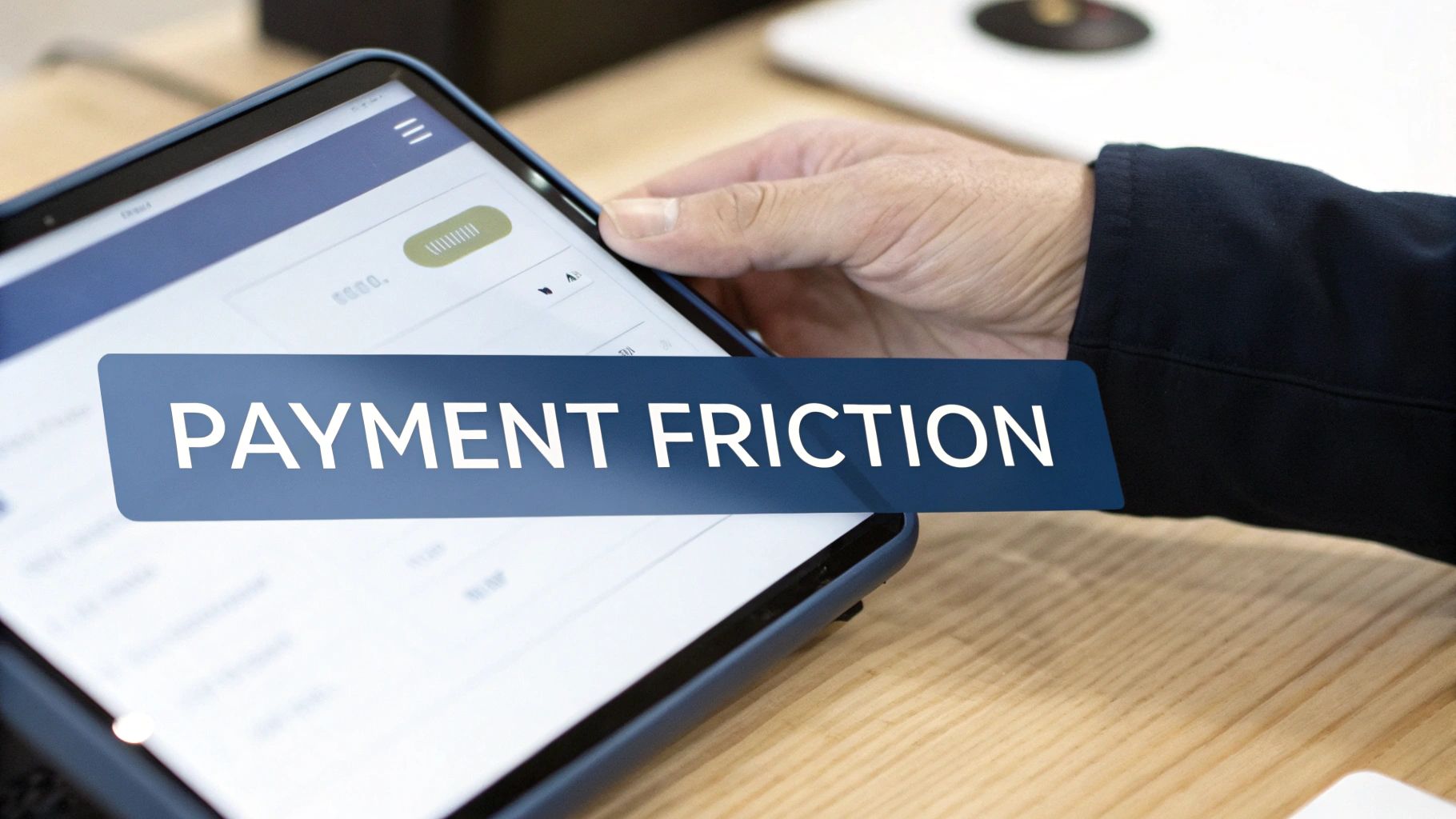
This core insight shifted the focus from merely processing payments to obsessively optimizing the entire checkout experience. Stripe’s breakthrough was understanding that payment processing wasn’t just a technical problem but a revenue optimization problem. They discovered that by analyzing where money literally leaves the system at a granular level, they could build a product that directly increased their customers' top line. It wasn't just about making payments easier for developers; it was about making it easier for customers to complete a purchase, thereby plugging revenue leaks.
Strategic Breakdown and Tactical Takeaways
The key lesson from Stripe is to treat every step in a critical user flow as a potential point of failure with a quantifiable financial cost. By framing friction in terms of lost revenue, the value of solving it becomes immediately obvious.
- Trigger: The "aha" moment was triggered by observing the immense developer pain and high customer drop-off rates associated with existing payment systems. For example, discovering that asking for a CVV could cause a 12% abandonment rate or that users from specific countries had double the transaction failure rate.
- Implementation: Stripe built its entire platform around this insight. They created a simple, developer-first API that abstracted away the complexity. More importantly, they built sophisticated data tools like Stripe Radar and Sigma to track every step of the transaction flow, measure drop-off at each stage, and identify patterns in payment failures.
- Measurable Impact: The impact was direct and massive. By reducing friction, Stripe's customers saw immediate increases in conversion rates and revenue. This created a powerful value proposition: using Stripe didn't just cost money, it made money by capturing sales that would have otherwise been lost.
How to Apply This Insight
Any team with a transactional component can apply Stripe’s friction-focused methodology.
- Map and Measure the Funnel: meticulously map every single step a user takes, from adding an item to their cart to seeing the confirmation screen. Implement event tracking to measure the drop-off rate between each step.
- Segment Friction Points: Don't just look at aggregate data. Segment your funnel analysis by geography, device type, browser, and payment method to pinpoint specific, high-impact friction points.
- Translate Friction into Revenue: Quantify the financial impact of each drop-off point. Instead of saying "20% of users drop off at the shipping page," frame it as "We are losing $50,000 per month because of friction on the shipping page." This makes the problem impossible to ignore.
8. Calendly's Discovery That Scheduling Complexity Consumed Massive Time and Money
Calendly's success stems from a profound ah ha moments examples that founder Tope Awotona experienced firsthand: the seemingly minor inconvenience of scheduling meetings was actually a massive, hidden source of economic waste. The breakthrough was not just creating a tool to book meetings, but realizing that the endless email chains and phone tag consumed hundreds of hours of high-value professional time across entire organizations.
This insight reframed scheduling from a simple administrative task into a significant productivity bottleneck. Awotona saw that by solving this "small" problem, Calendly could unlock immense value for individuals and businesses alike. The platform's core value proposition was built on quantifying and eliminating this friction, transforming a tedious workflow into a seamless, one-click action that resonated universally across sales, recruiting, and customer success teams.
Strategic Breakdown and Tactical Takeaways
The core lesson from Calendly is that the most valuable problems are often the ones so deeply embedded in our daily routines that we accept them as the cost of doing business. The real opportunity lies in quantifying the aggregate impact of these "invisible" frustrations.
- Trigger: The "aha" moment was triggered by Awotona's own painful experience trying to coordinate meetings, leading him to recognize the cumulative time and money lost to inefficient scheduling. He saw patterns everywhere: sales reps losing momentum, recruiters delaying hires, and consultants wasting billable hours.
- Implementation: Calendly was built to directly address this pain. Instead of a complex solution, it offers a simple, shareable link that integrates with a user's calendar availability. This removes the back-and-forth entirely. The company then built analytics to demonstrate the value, showing users exactly how much time they saved.
- Measurable Impact: The impact was immediate and quantifiable. Sales teams reported saving over five hours per week, while recruiting departments cut down their coordination time by more than ten hours. This directly translated into faster sales cycles, quicker hiring processes, and improved customer satisfaction due to more timely support.
How to Apply This Insight
Product leaders can find their own Calendly-like opportunities by auditing common, repetitive workflows for hidden inefficiencies.
- Quantify Hidden Costs: Look for pain points that seem minor but occur frequently. Calculate the total time wasted across a team or organization per week, then convert that time into salary cost or lost revenue opportunity.
- Focus on Repetitive Friction: Identify workflows where the same small, frustrating step is repeated thousands of times a day across your user base. Solving that one step can deliver exponential value.
- Build Value-Based Analytics: Don't just build a tool; build a dashboard that proves its worth. Show users the concrete metrics of what they've gained, such as "Hours Saved" or "Meetings Accelerated," to reinforce your product's ROI.
8 Aha Moments Comparison
| Example | Implementation Complexity 🔄 | Resource Requirements ⚡ | Expected Outcomes ⭐📊 | Ideal Use Cases 💡 | Key Advantages ⭐ |
|---|---|---|---|---|---|
| The Netflix Recommendation Engine Breakthrough | 🔄 High — large-scale ML pipelines, real-time personalization, continuous tuning | ⚡ High — massive behavioral data, compute for training and serving | ⭐⭐⭐⭐⭐ 📊 Significant engagement lift (e.g., −20–30% churn); scalable personalization | Personalization for large user bases with rich micro-interactions | Data-driven personalization; competitive moat from behavioral signals |
| Slack's Discovery of Ambient Awareness in Team Communication | 🔄 Medium — messaging/threading architecture and search indexing | ⚡ Moderate — storage for message history, search infrastructure, integrations | ⭐⭐⭐⭐ 📊 Improved team efficiency, reduced duplicate questions, better audit trails | Async teamwork, organizational knowledge capture, cross-team visibility | Searchable institutional memory; reduces context switching |
| Intercom's Realization That Support Conversations Contain Product Insight | 🔄 Medium–High — NLP pipelines, tagging, integration with product systems | ⚡ High — labeled data, NLP compute, volume handling for support streams | ⭐⭐⭐⭐ 📊 Faster bug/feature discovery; earlier churn signals from conversations | Support-driven product intelligence, churn prediction, roadmap inputs | Turns reactive support into proactive product signal source |
| Amplitude's Discovery That Cohort Behavior Predicts Product Success | 🔄 Medium — cohort computations and time-series comparisons | ⚡ Moderate — event tracking volume, analytics tooling and storage | ⭐⭐⭐⭐ 📊 Early warning on retention regressions; segment LTV insights | Retention analysis, product trajectory monitoring, cohort comparisons | Prioritizes cohort trends over vanity metrics for actionable decisions |
| Figma's Insight That Real-Time Multiplayer Changed Design Collaboration | 🔄 High — low-latency sync, presence systems, conflict resolution | ⚡ High — real-time servers, bandwidth, robust sync logic | ⭐⭐⭐⭐ 📊 Compressed design cycles (≥50% faster); reduced approval delays | Collaborative design sessions, cross-functional reviews, live feedback | Real-time collaboration and ambient awareness that speeds decisions |
| Mixpanel's Recognition That Funnel Analysis Reveals Hidden Friction Points | 🔄 Medium — precise event instrumentation and funnel logic | ⚡ Moderate — clean tracking, analytics storage, segmentation tools | ⭐⭐⭐⭐ 📊 Pinpoints conversion drop-offs; enables prioritized optimizations | Conversion optimization, funnel diagnosis, experiment validation | Quantifies exact friction points to guide fixes with ROI clarity |
| Stripe's Epiphany That Payment Friction Cost Companies Real Revenue | 🔄 High — end-to-end payment tracking, error classification, global handling | ⚡ High — PCI-compliant infra, payments integrations, geolocation data | ⭐⭐⭐⭐⭐ 📊 Direct revenue recovery by fixing payment leaks; measurable lift | Checkout optimization, payment failure reduction, global merchant flows | Ties technical payment friction directly to dollars lost |
| Calendly's Discovery That Scheduling Complexity Consumed Massive Time and Money | 🔄 Low–Medium — calendar integrations, timezone logic, conflict handling | ⚡ Low — calendar APIs, simple analytics, integration maintenance | ⭐⭐⭐⭐ 📊 Large time savings (hours/week); measurable productivity gains | Scheduling automation, interview coordination, repeated administrative workflows | Eliminates high-frequency hidden costs with simple UX and integrations |
Finding Your Next Breakthrough: How to Systematically Uncover Aha Moments
Throughout this collection of ah ha moments examples, a powerful and unifying theme emerges: transformative insights are not born from random sparks of genius. They are the result of a deliberate, systematic process of listening to customer signals. The breakthroughs at Slack, Figma, and Calendly weren't lucky guesses; they were uncovered by deeply understanding user friction and the underlying jobs-to-be-done.
These companies mastered the art of connecting user behavior to business outcomes. They moved beyond vanity metrics and superficial feedback to find the core actions that create retained, high-value customers. Whether analyzing cohort behavior like Amplitude or transactional friction like Stripe, the pattern is consistent: the most impactful insights lie hidden within the vast streams of customer data.
From Manual Sifting to Automated Discovery
The challenge today is not a lack of data, but a surplus of it. Manually sifting through support tickets, sales calls, usage logs, and survey responses to find the next game-changing pattern is an inefficient and often impossible task. The "needle in a haystack" problem has become an entire farm of haystacks. This is where the methodology for discovering aha moments must evolve.
The key is to transition from a reactive, manual analysis to a proactive, automated system. This means adopting tools and processes that can:
- Ingest Multiple Data Streams: Combine qualitative feedback from conversations (support, sales) with quantitative behavioral data (product usage).
- Identify Patterns at Scale: Use technology to detect recurring themes, friction points, and feature requests across thousands of customer interactions.
- Correlate Insights to Revenue: Move beyond just counting mentions. Quantify the business impact by linking customer feedback directly to revenue, churn risk, and expansion opportunities.
Your Actionable Roadmap to the Next Aha Moment
Harnessing these principles is the definitive path to building a product that not only solves problems but also creates indispensable value. The examples from Netflix and Intercom show us that the clues are already there, waiting in your data. Your task is to build a system to find them reliably. To systematically uncover these breakthroughs, you must embrace a multi-faceted approach. Understanding and applying different forms of research to uncover ideas provides a foundational framework for this exploration, blending qualitative and quantitative methods to paint a complete picture of the user journey.
Here are your next steps to operationalize this process:
- Centralize Your Signals: Begin by mapping all your customer feedback and behavioral data sources. Where do your customers express pain or delight? Consolidate these signals into a single source of truth.
- Shift from 'What' to 'Why': Don't just track what users are doing. Dig into why they are doing it. Connect usage patterns from tools like Mixpanel with the rich context found in support conversations.
- Quantify the Impact: For every piece of feedback or observed friction, ask: "What is the revenue impact of solving this?" Prioritize your roadmap based on the potential to reduce churn, increase retention, or drive expansion.
Mastering this process is no longer a competitive advantage; it is a fundamental requirement for sustainable growth. By building a system that continuously surfaces and prioritizes customer-driven insights, you transform product development from a series of bets into a predictable engine for creating value. You stop guessing what customers want and start building what you know they need.
Ready to stop searching for your next aha moment and start having it delivered to you? SigOS ingests and analyzes all your customer feedback and behavioral signals, automatically identifying the patterns that correlate with revenue impact. Transform your customer data into a prioritized, actionable roadmap and discover your next breakthrough with SigOS.
Keep Reading
More insights from our blog
Ready to find your hidden revenue leaks?
Start analyzing your customer feedback and discover insights that drive revenue.
Start Free Trial →