Top 12 AI Product Management Tools to Watch in 2026
Discover the 12 best AI product management tools transforming how teams build. Get an in-depth review of tools for insights, roadmapping, and prioritization.
The world of product management is awash with customer feedback from countless channels-support tickets, sales calls, community forums, and app reviews. Sifting through this data to find actionable insights is a monumental task, often leading to missed opportunities and decisions based on gut feelings rather than hard evidence. The core challenge is separating the signal from the noise and connecting specific feedback to tangible revenue impact. This is where modern ai product management tools are making a significant difference.
These platforms move beyond simple keyword tracking, using AI to analyze, categorize, and prioritize feedback at scale. They help product teams quantify qualitative data, identify emerging trends, and build a data-backed business case for new features or fixes. By automatically surfacing the most pressing customer needs, these tools enable product managers to focus on strategic work instead of manual data entry and analysis. To effectively use these systems, a foundational understanding of AI Agents is beneficial, as many tools employ them to automate complex workflows.
This guide provides an in-depth, curated list of the best AI-powered tools available today. We’ll cut through the marketing copy to give you a clear, practical overview of what each platform actually does. For each tool, you'll find:
- A concise summary and key features.
- Honest pros and cons based on real-world use.
- The ideal user persona it’s built for.
- Critical integration details (Jira, Zendesk, Intercom).
- Clear pricing signals to help you budget.
We've structured this resource to help you quickly compare options like Productboard, Enterpret, Dovetail, and more. Our goal is to help you find the right tool to solve your specific product intelligence and feedback challenges, complete with screenshots and direct links for evaluation. Let’s dive in.
1. SigOS
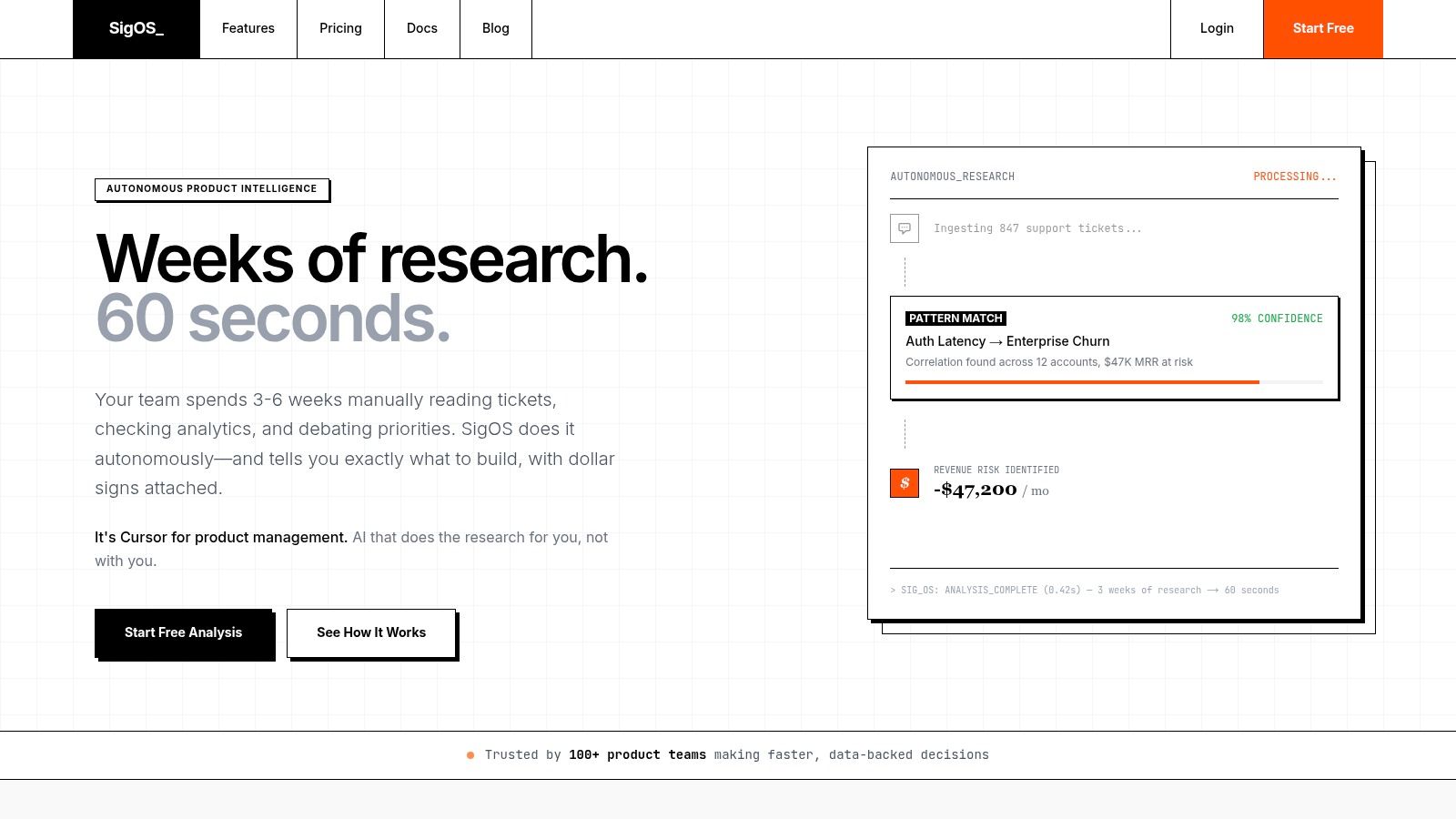
SigOS stands out as an autonomous product intelligence platform designed to connect customer feedback directly to revenue impact. It moves beyond simple feedback summarization by autonomously ingesting, analyzing, and quantifying data from disparate sources. This unified approach gives product teams a clear, financially-backed roadmap for prioritization, transforming messy qualitative data into actionable, high-confidence signals.
The platform continuously processes support tickets, chat logs, call transcripts, and usage metrics from tools like Zendesk, Intercom, and Mixpanel. It then correlates these inputs with financial data from Stripe or Salesforce and development data from Jira or GitHub. The result is a prioritized dashboard that highlights exactly which bugs are costing the most money, which feature requests are tied to high-value deals, and which emergent trends predict churn risk. This makes it one of the most direct ai product management tools for tying product decisions to business outcomes.
Key Features & Analysis
- Revenue-Driven Prioritization: The core differentiator is its ability to assign a dollar value to qualitative feedback. Instead of relying on vote counts or gut feelings, teams can see that a specific bug is costing $20,000 in monthly recurring revenue or that a feature request is blocking a six-figure expansion deal. This creates objective, defensible arguments for resource allocation.
- Autonomous Research Engine: SigOS replaces the tedious manual work of reading tickets and exporting data. Its analysis runs in under a minute, delivering a daily digest of top priorities. This frees up product managers to focus on strategic execution rather than data wrangling.
- Multi-Layer Data Synthesis: It uniquely connects four critical data layers: qualitative feedback (what users say), quantitative behavior (what users do), revenue impact (what it costs/is worth), and shipping velocity (what gets fixed). This 360-degree view uncovers patterns that are impossible to spot when data lives in silos.
- Automated Outcome Measurement: The platform automatically tracks the impact of fixes. For instance, it can validate that shipping a patch reduced related support tickets by 78% or led to a two-week payback period on engineering investment, providing clear ROI visibility.
Practical Considerations
| Category | Details |
|---|---|
| Best For | B2B SaaS companies (late-stage startup to enterprise) with established data sources and a need to connect product decisions directly to revenue goals. |
| Pros | Connects feedback directly to ARR/MRR impact; automates weeks of manual research into daily dashboards; measures the ROI of fixes; strong focus on data security. |
| Cons | Requires quality, integrated data sources for best results; no public pricing, suggesting a higher, enterprise-focused price point that may not suit very small startups. |
| Integrations | Zendesk, Intercom, Mixpanel, Segment, Stripe, Salesforce, Jira, GitHub, and more. |
| Pricing | Pricing is not public and is likely tailored to company size, data volume, and specific needs. SigOS offers a free analysis to demonstrate initial value. |
Website: https://sigos.io
2. Productboard (Productboard Spark)
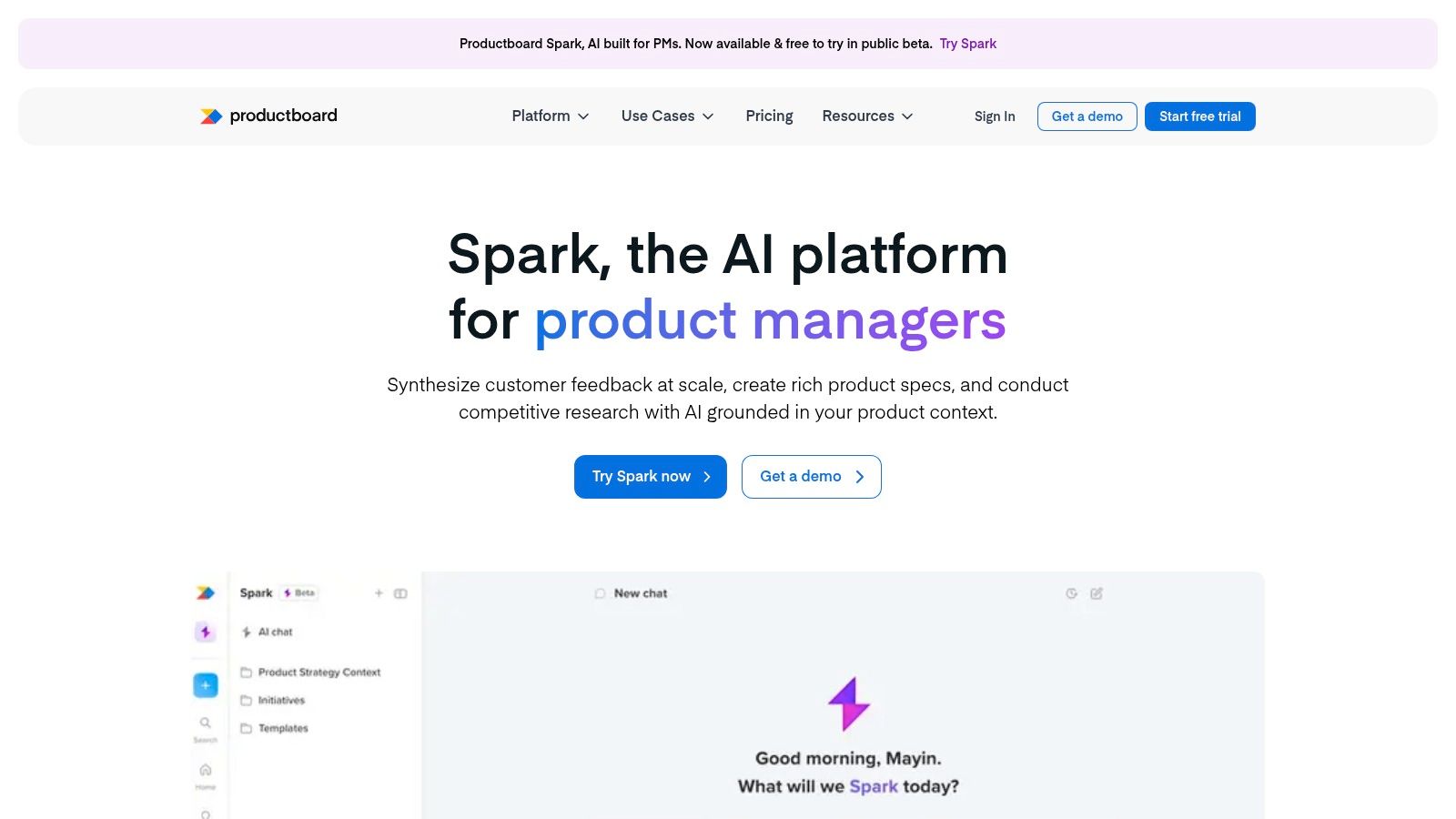
Productboard is a well-established product management platform known for its robust workflows connecting customer feedback to roadmaps. With the introduction of its AI assistant, Spark, it solidifies its position as one of the essential ai product management tools for teams looking to blend mature PM practices with artificial intelligence. Spark assists by summarizing feedback from various channels, drafting sections of product requirements documents (PRDs), and even monitoring competitor activities.
The platform’s strength lies in integrating AI directly into its core functionality. Instead of feeling like a tacked-on feature, Spark enhances existing processes like insight synthesis and spec writing. To understand how such platforms fit into a broader strategy, exploring the fundamentals of AI for product development can provide valuable context. For a deeper dive into how Productboard connects its product strategy with client needs, you might find value in these insights from Productboard's VP of Customer Success.
Core AI Features
- Spark AI Agent: Summarizes customer feedback, drafts PRD sections, and tracks competitors.
- AI-Powered Summaries: Synthesizes notes and feedback with a delayed update window to ensure contextual accuracy.
- Integrated Workflows: AI capabilities are built into the roadmapping and prioritization frameworks, tying features directly to customer impact.
Pricing & Access
- Productboard offers several tiers, with AI features often included in higher-level plans or available as an add-on.
- AI usage is managed through a credits system, which can be purchased as needed. Be mindful that credits can run out before a billing cycle ends, potentially pausing AI-assisted workflows.
Pros & Cons
- Pro: Mature, full-featured PM platform with a strong user base.
- Pro: AI is integrated logically alongside core strengths in feedback aggregation and roadmapping.
- Con: AI functions are primarily an add-on, not standard in all plans.
- Con: The credit-based system for AI can be unpredictable for teams with heavy usage.
3. Jira Product Discovery + Atlassian Intelligence
For teams deeply embedded in the Atlassian ecosystem, Jira Product Discovery offers a native solution for idea capture, prioritization, and roadmapping. The recent addition of Atlassian Intelligence augments this by introducing AI-powered features for natural-language search, content summarization, and editing. This makes it one of the most practical ai product management tools for organizations aiming to keep discovery and delivery tightly connected within a single platform.
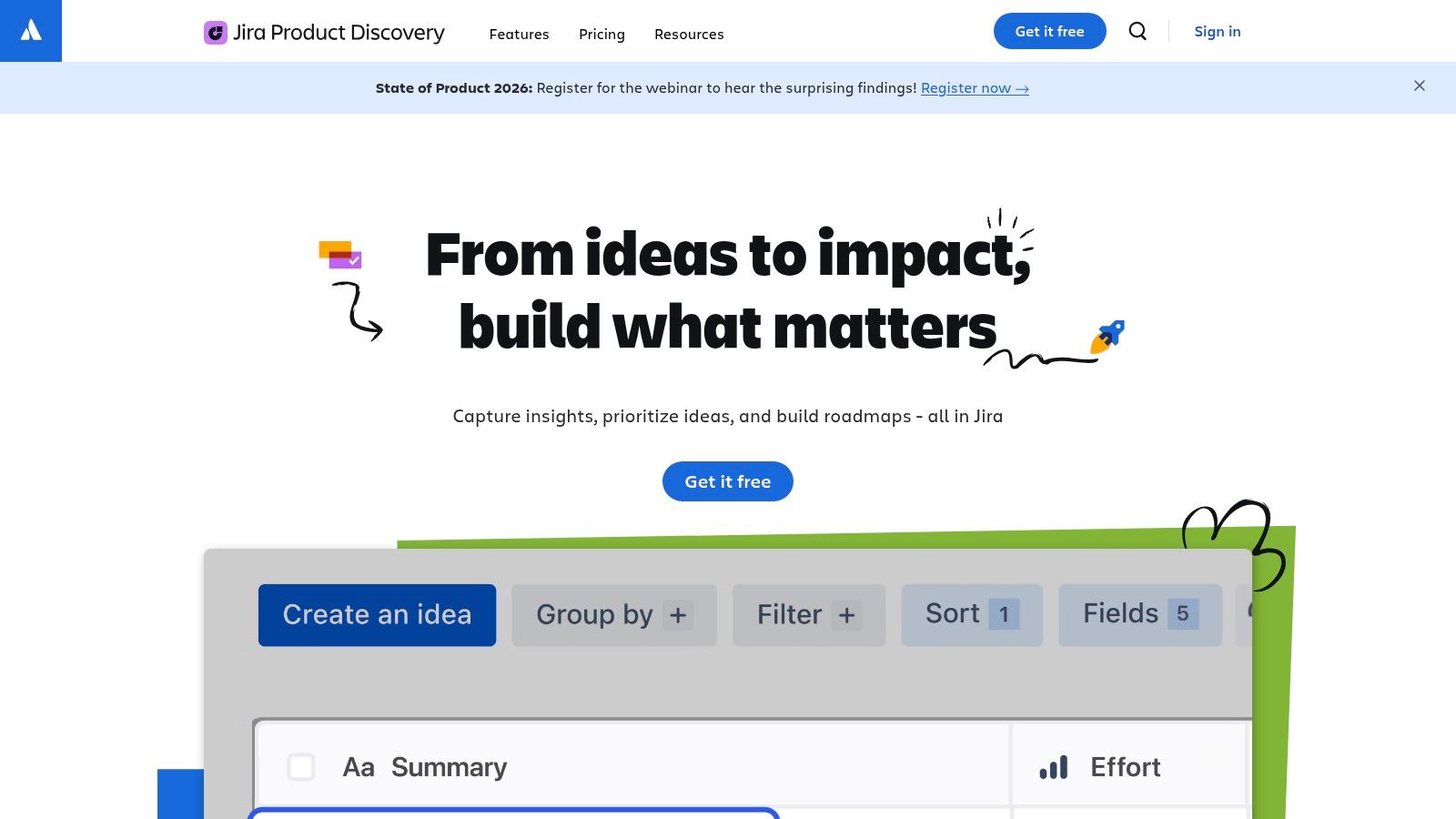
The platform's main advantage is its seamless integration with Jira Software, which allows teams to move ideas directly from discovery into the development backlog. Atlassian Intelligence supports this workflow by helping product managers quickly synthesize project information, draft summaries for stakeholders, and find related ideas using plain language queries. To see how this fits into your workflow, visit their product page at Jira Product Discovery.
Core AI Features
- Atlassian Intelligence: Enables natural-language search and editing, allowing users to ask questions and generate content directly within Jira.
- AI-Assisted Summarization: Quickly synthesizes long idea descriptions, comment threads, and linked issues into concise summaries.
- Integrated Discovery & Delivery: Ideas and insights can be directly linked to Jira issues, maintaining context from conception to execution.
Pricing & Access
- Jira Product Discovery uses a creator/contributor model. It is free for up to 3 creators, with unlimited contributors.
- Paid plans are priced per creator, making it cost-effective for larger teams where most users only need to view or comment. Atlassian Intelligence is included in the Standard and Premium plans.
Pros & Cons
- Pro: Reduces tooling sprawl for teams already using the familiar Jira ecosystem.
- Pro: Sensible pricing model with unlimited contributors encourages broad collaboration.
- Con: Best suited for teams already using Jira; can feel heavyweight for standalone PM teams not on the Atlassian platform.
- Con: AI features are still developing and may not be as extensive as those in dedicated, AI-first platforms.
4. Aha! (Roadmaps/Ideas + Aha! AI)
Aha! provides a complete strategy-to-launch product suite, and its addition of Aha! AI makes it a powerful contender among ai product management tools. The platform is designed for teams that need deep functionality from strategy and roadmapping to idea management and knowledge base creation. Aha! AI is embedded across its modules, helping teams draft documents, summarize feedback, and explore new ideas with administrative oversight.
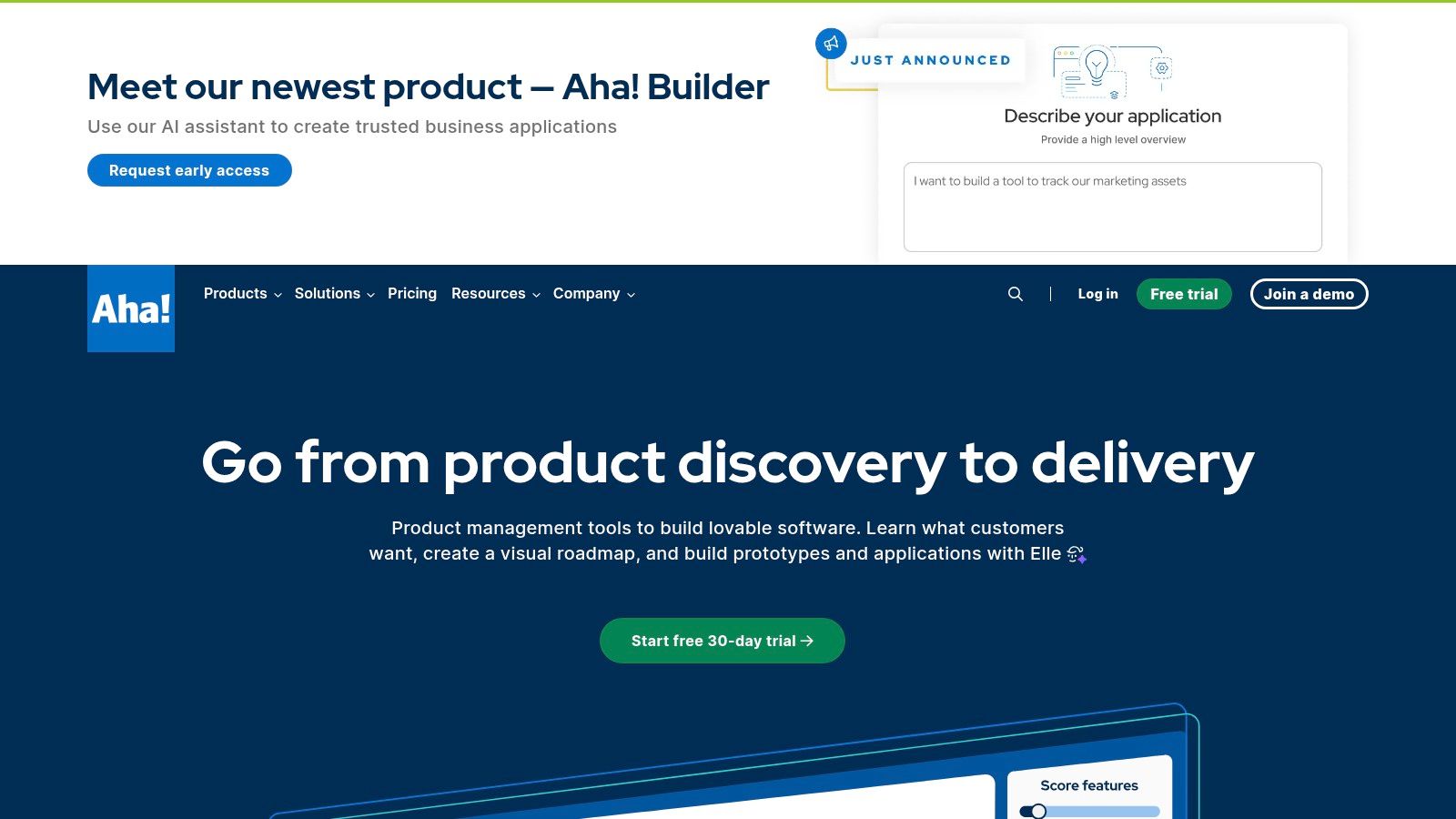
The system’s strength is its integrated nature, where AI assists workflows rather than operating in a silo. For example, AI can synthesize notes from various sources like Zoom or Gong directly within the platform, connecting raw feedback to strategic initiatives. This level of integration, combined with strong enterprise-grade controls, makes it suitable for organizations that require both advanced AI assistance and strict governance over its use. You can learn more about their offerings on the Aha! website.
Core AI Features
- AI Assistant: Drafts and summarizes text within records, notes, and whiteboards to accelerate documentation.
- AI Idea Exploration: Available in Ideas Advanced, this feature helps analyze and cluster user feedback to uncover hidden themes and opportunities.
- Enterprise Governance: Provides admin controls for managing AI usage and integrations, ensuring secure and compliant operation.
Pricing & Access
- Aha! AI is available as an add-on across its various product modules (Roadmaps, Ideas, etc.).
- Pricing is credits-based, with consumption tied to specific AI actions. Administrators can monitor and control credit usage.
Pros & Cons
- Pro: Deep, integrated functionality covering the entire product development lifecycle.
- Pro: Strong admin controls and enterprise integrations offer security and governance.
- Con: Costs can accumulate as you add more modules and AI credits.
- Con: The credits-based model can lead to unpredictable costs for teams with high AI usage.
5. Linear (with Linear Agent)
Linear is a high-velocity issue and project management platform celebrated for its speed and streamlined UX, especially among engineering and product teams. With the introduction of Linear Agent, it’s positioning itself as one of the key ai product management tools by embedding intelligent automation directly into its core workflows. Agents act like virtual teammates, assigned to help with backlog hygiene, triage incoming issues from integrations like Zendesk, and synthesize feedback.
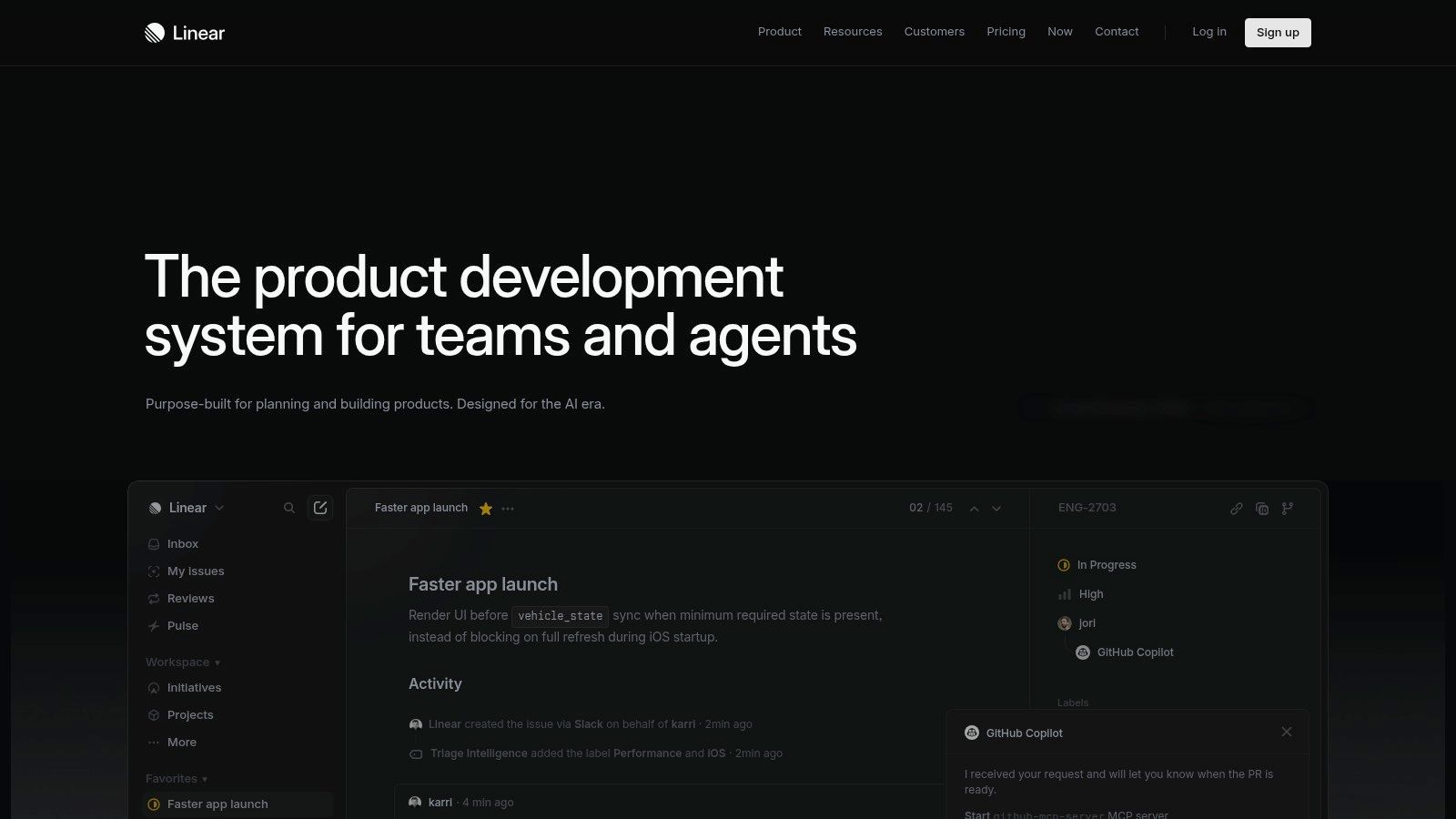
The platform's approach is practical, focusing AI on reducing the manual effort of maintaining a clean, actionable backlog. Instead of broad, abstract AI, Linear Agent uses "Skills" for repeatable tasks and automation. This allows product managers to spend less time on administrative work and more time on strategic planning. For teams already invested in a fast-paced development cycle, Linear’s AI features feel like a natural extension of its "need for speed" philosophy. For more details on their AI capabilities, visit the Linear Agent page.
Core AI Features
- Linear Agent: An AI assistant that can be assigned to projects for tasks like research, issue synthesis, and triage.
- Reusable "Skills": Create and save repeatable AI workflows for consistent automation of routine tasks.
- AI-Assisted Triage: Automates the processing of new issues from integrations such as Zendesk and Intercom, assigning labels or escalating as needed.
Pricing & Access
- Linear Agent is available in public beta for users on all plans, including the Free tier, with no extra cost during this period.
- Advanced automation capabilities and higher usage limits for AI are expected to be part of the Plus and Business tiers.
Pros & Cons
- Pro: Exceptionally fast and well-designed UX, purpose-built for modern product and engineering teams.
- Pro: Practical AI features that solve real-world problems like backlog grooming and issue synthesis.
- Con: Code intelligence and more advanced AI functions are still on the roadmap ("coming soon").
- Con: The most powerful automations will likely be restricted to paid, higher-tier plans post-beta.
6. airfocus (AI Assist)
airfocus presents a modular product management platform designed for flexibility, covering everything from high-level strategy and portfolio management to detailed feedback and insights. Its AI Assist feature is integrated directly into its core workflows, helping teams accelerate the drafting and analysis of product artifacts. This makes it a strong contender among ai product management tools for organizations that need a highly configurable system with robust enterprise-grade security.
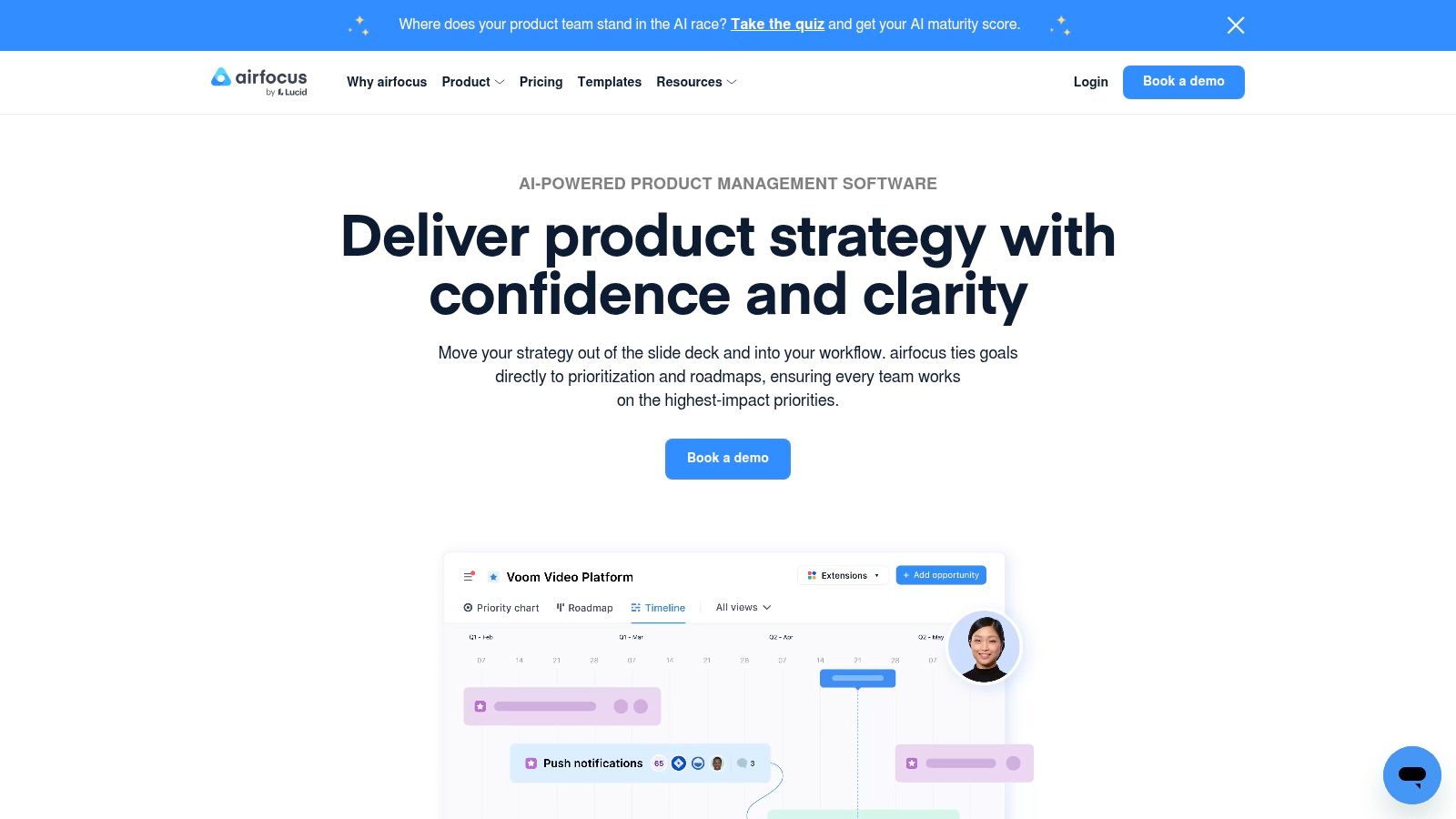
The platform's strength is its modularity, allowing teams to adopt the components they need, whether for strategy, roadmapping, or feedback management. AI Assist acts as a productivity layer on top, speeding up tasks like writing item descriptions or summarizing comment threads within Jira-mapped items. This approach to prioritization can be further refined by exploring different methodologies, such as using a feature prioritization matrix to align development efforts with strategic goals. The emphasis on security, with SOC 2 and ISO 27001 compliance, makes it a reliable choice for larger companies.
Core AI Features
- AI Assist: Provides contextual help for drafting and summarizing content within item descriptions, comments, and other product artifacts.
- Feedback & Insights Hub: Manages incoming feedback with triage workflows, connecting qualitative data directly to roadmap items.
- Portfolio Roll-ups: Aggregates data across multiple products or teams, providing a unified view of progress against strategic goals.
- Jira Mapping: Deep integration with Jira allows for seamless synchronization and AI-assisted analysis of development-related discussions.
Pricing & Access
- airfocus offers a tiered pricing model, but detailed public pricing is limited, particularly for enterprise plans.
- Many plans are sales-led, meaning prospective customers will likely need to engage with the sales team to get a full quote and understand feature availability.
Pros & Cons
- Pro: Strong enterprise readiness with ISO 27001:2022 and SOC 2 certifications and options for US/EU data hosting.
- Pro: Highly flexible and modular platform that can be configured to match a company's specific product management process.
- Con: Limited public pricing information requires a sales conversation for most plans, which can slow down evaluation.
- Con: The AI features are more focused on drafting and summarizing rather than deep, autonomous analysis.
7. ProductPlan (ProductPartner AI)
ProductPlan is known for its approachable strategic roadmapping and portfolio planning tools, designed for clear executive and stakeholder alignment. With the introduction of ProductPartner AI, it aims to augment this strength with contextual AI assistance. This positions it as one of the key ai product management tools for teams that prioritize high-level strategy communication but need intelligent summaries to support it. The AI assistant can summarize the current view, whether it's objectives, initiatives, or roadmaps, and answer questions about progress and risks.
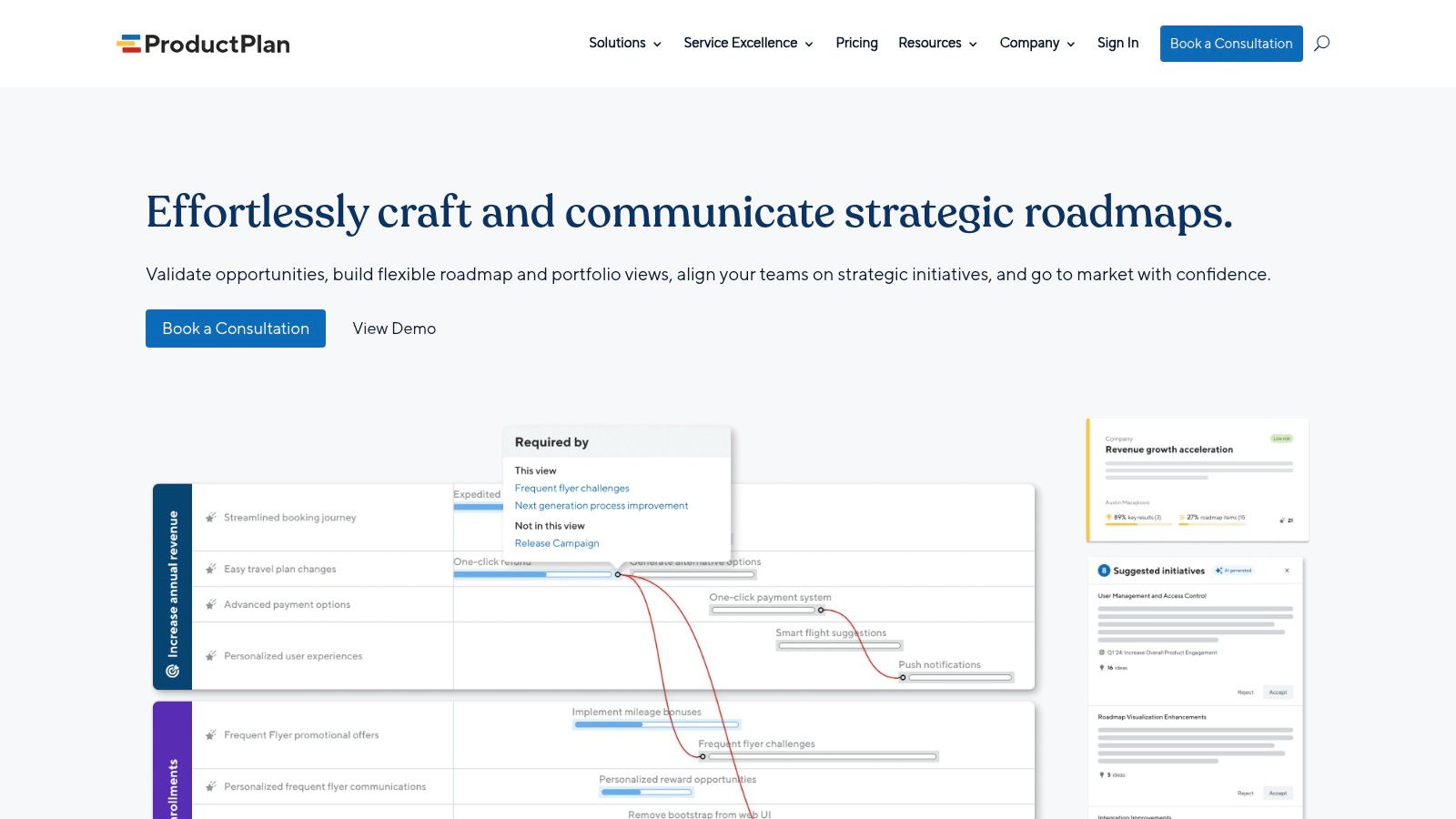
The platform’s approach focuses on making existing roadmap views more actionable and easier to digest for stakeholders. By integrating Winware.ai technology, ProductPlan is incrementally adding deeper product intelligence capabilities. This strategy makes it an interesting tool for managers who need to justify plans and communicate status efficiently without getting bogged down in overly technical data analysis. For more information, visit the ProductPlan website.
Core AI Features
- ProductPartner AI Assistant: Summarizes roadmap views, objectives, and initiatives on command.
- Contextual Q&A: Allows users to ask questions about progress, risks, and dependencies directly within their roadmap view.
- In-Product Guidance: Links to help content and best practices based on the user's current context.
Pricing & Access
- ProductPlan offers tiered pricing (Basic, Professional, Enterprise). AI features are typically included in the higher-tier plans.
- Access to the full suite of AI capabilities is part of a phased rollout extending through 2026.
Pros & Cons
- Pro: Very approachable for executive and stakeholder alignment with a focus on clear visualization.
- Pro: Contextual AI guidance and summaries make complex roadmaps more digestible for non-technical audiences.
- Con: AI capabilities are still in a staged rollout, so some features may not be immediately available to all users.
- Con: The full integration of deeper product intelligence is an incremental process, not a fully realized feature set at present.
8. Canny (Autopilot)
Canny excels at customer feedback management and public roadmapping, and its AI suite, Autopilot, makes it a potent tool for teams overwhelmed by feedback volume. Autopilot automates the discovery and ingestion of feedback from sources like Intercom, Zendesk, and Gong. This automation positions it as one of the most practical ai product management tools for teams that need to organize user input without heavy manual effort. The system identifies duplicate requests, summarizes lengthy comment threads, and even suggests smart replies to help product teams close the loop with users more quickly.
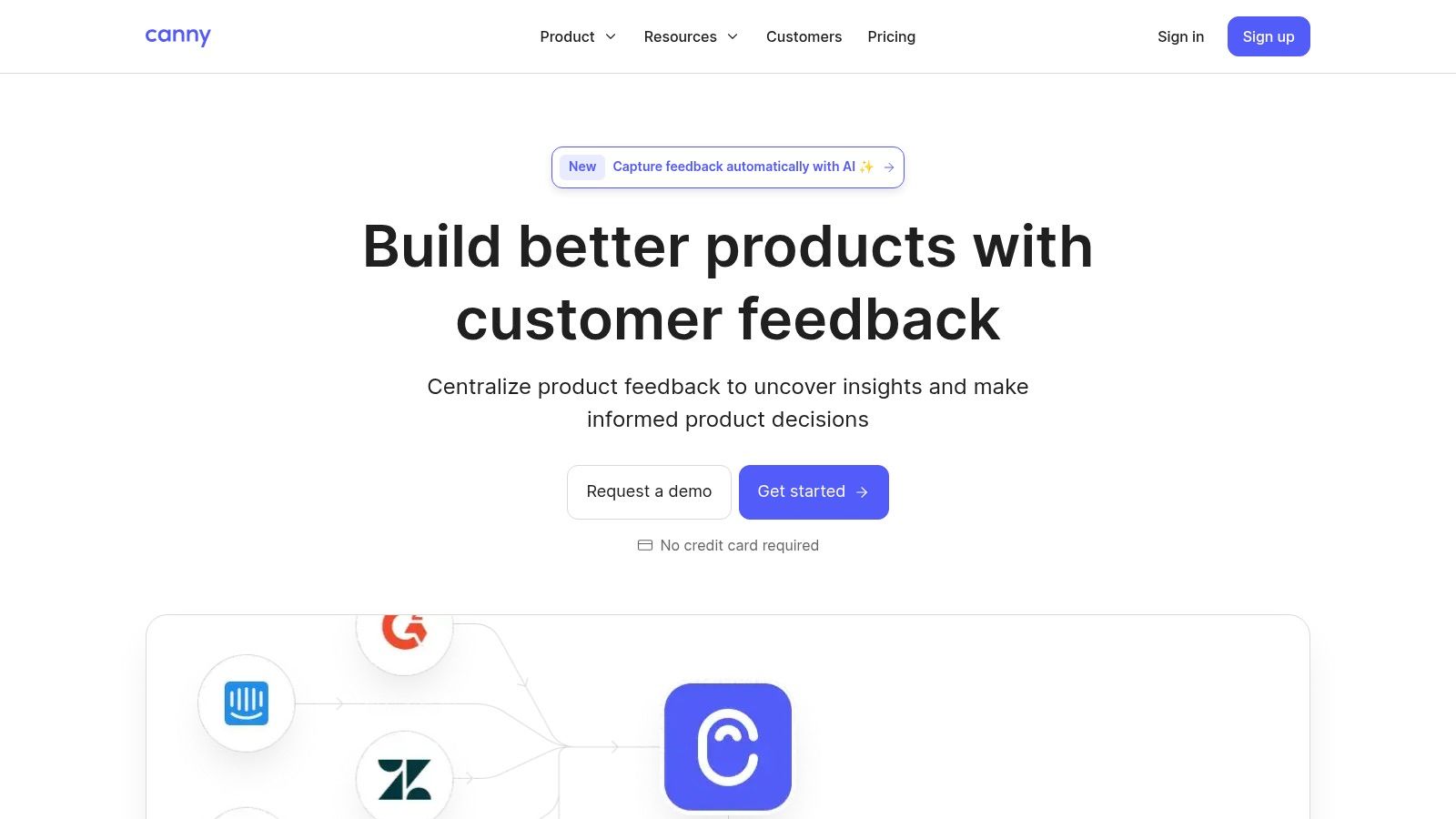
The primary benefit of Canny’s AI is its focus on operational efficiency. It directly addresses the common PM pain point of managing a constant flood of ideas and bug reports. Instead of building complex research models, Autopilot focuses on cleaning, sorting, and responding to feedback, freeing up product managers to focus on strategic analysis. You can learn more about its features at Canny's website.
Core AI Features
- Automated Feedback Discovery: Ingests and categorizes feedback from connected systems like Zendesk, Intercom, and Gong without manual intervention.
- Smart Duplicate Detection: Intelligently identifies and merges duplicate feedback posts to keep the backlog clean.
- Comment Summarization & Smart Replies: Generates concise summaries of long discussion threads and suggests replies, speeding up communication with customers.
Pricing & Access
- Canny offers a tiered pricing model, including a free plan with limited features.
- The Autopilot AI suite is typically included in the higher-tier paid plans, designed for growing and larger teams that handle significant feedback volume.
Pros & Cons
- Pro: Excellent balance of automation and user control, with clear action logs and the ability to undo AI suggestions.
- Pro: Well-suited for teams wanting lightweight, efficient feedback operations without a steep learning curve.
- Con: Primarily focused on feedback capture and roadmapping, not a complete product research platform.
- Con: May need to be paired with other tools for deeper quantitative analysis or user behavior tracking.
9. UserVoice (AI Idea Insights)
UserVoice is an enterprise-grade customer feedback and idea management platform that excels at handling large volumes of input. Its AI Idea Insights feature automatically identifies problems and solutions within user suggestions, explaining the "why it matters" behind each idea. This makes it one of the more focused ai product management tools for organizations needing to quickly understand the substance of their feedback without manual sorting.
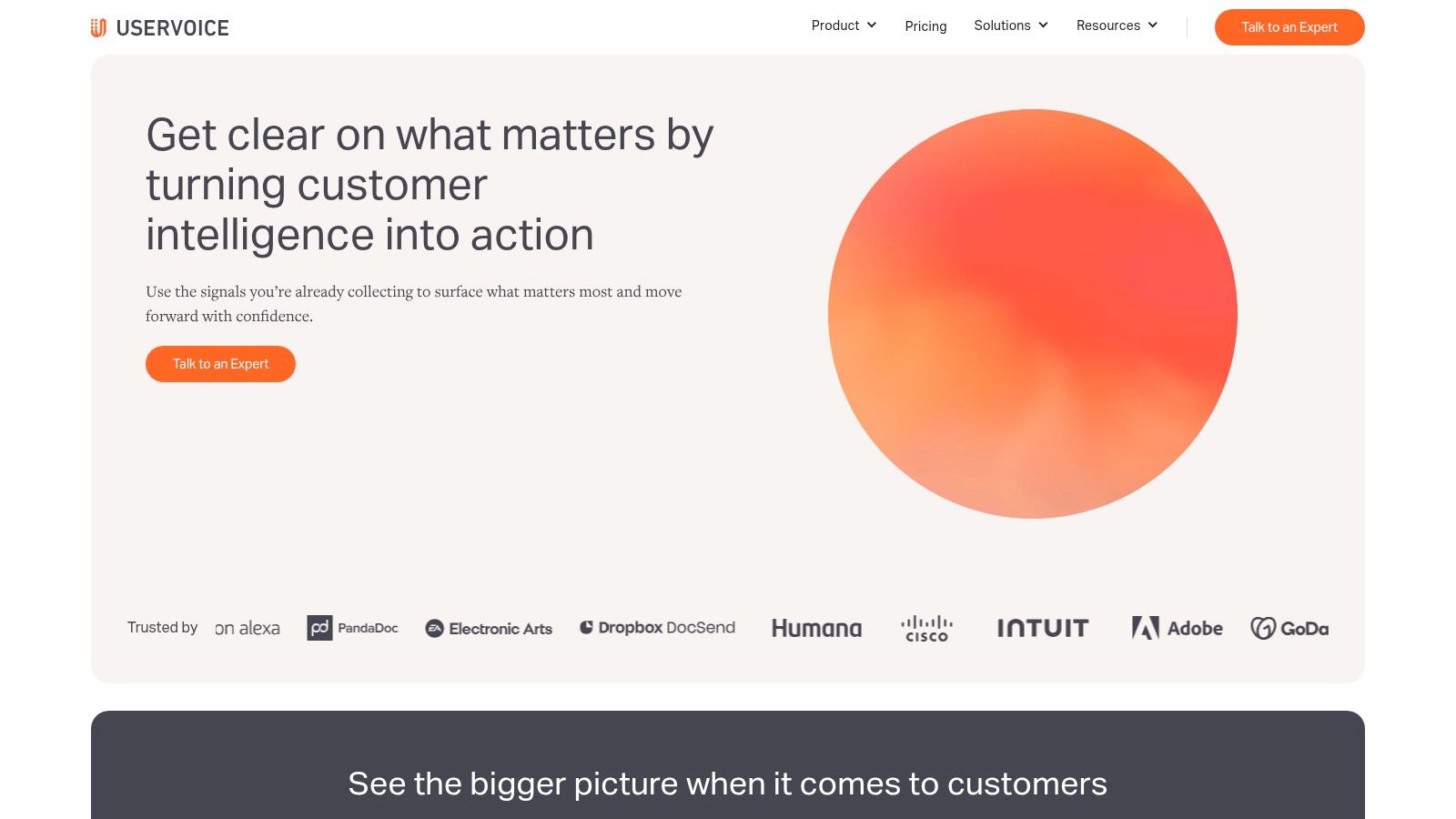
The platform’s strength is its seat-agnostic pricing, making it ideal for large, cross-functional teams that need widespread access to customer intelligence. Instead of per-user fees, its pricing is based on feedback volume, encouraging broad participation. This approach aligns with a modern strategy for a complete customer feedback analysis tool, where insights are democratized across the company. You can find out more by exploring this guide on customer feedback analysis tools.
Core AI Features
- AI Idea Insights: Automatically surfaces the core problem, proposed solution, and business rationale from user-submitted ideas.
- AI Summaries: Provides concise summaries at both the individual idea level and for overall impact reporting.
- AI Smart Search: Helps users connect feedback highlights and notes from Contributor extensions directly to existing ideas, reducing duplication.
Pricing & Access
- UserVoice is priced based on feedback volume, not user seats, and typically requires an annual contract.
- AI features are available as an add-on package to their core plans.
- The entry-level price is higher than many SMB-focused tools, reflecting its enterprise positioning.
Pros & Cons
- Pro: Seat-agnostic pricing model is cost-effective for large organizations requiring cross-departmental access.
- Pro: Strong enterprise support, onboarding, and centralized portals for different stakeholders.
- Con: The annual entry price point can be a significant investment for smaller companies.
- Con: Key AI capabilities are locked behind an add-on package, not included as standard.
10. Monterey AI
Monterey AI is a dedicated product insights platform that unifies customer feedback from multiple sources and applies AI to surface actionable patterns. It stands out by connecting these insights directly to revenue and operationalizing them within existing product workflows. For teams drowning in data from support tickets, sales calls, surveys, and feedback widgets, Monterey AI is one of the more focused ai product management tools for translating qualitative noise into a clear, prioritized signal.
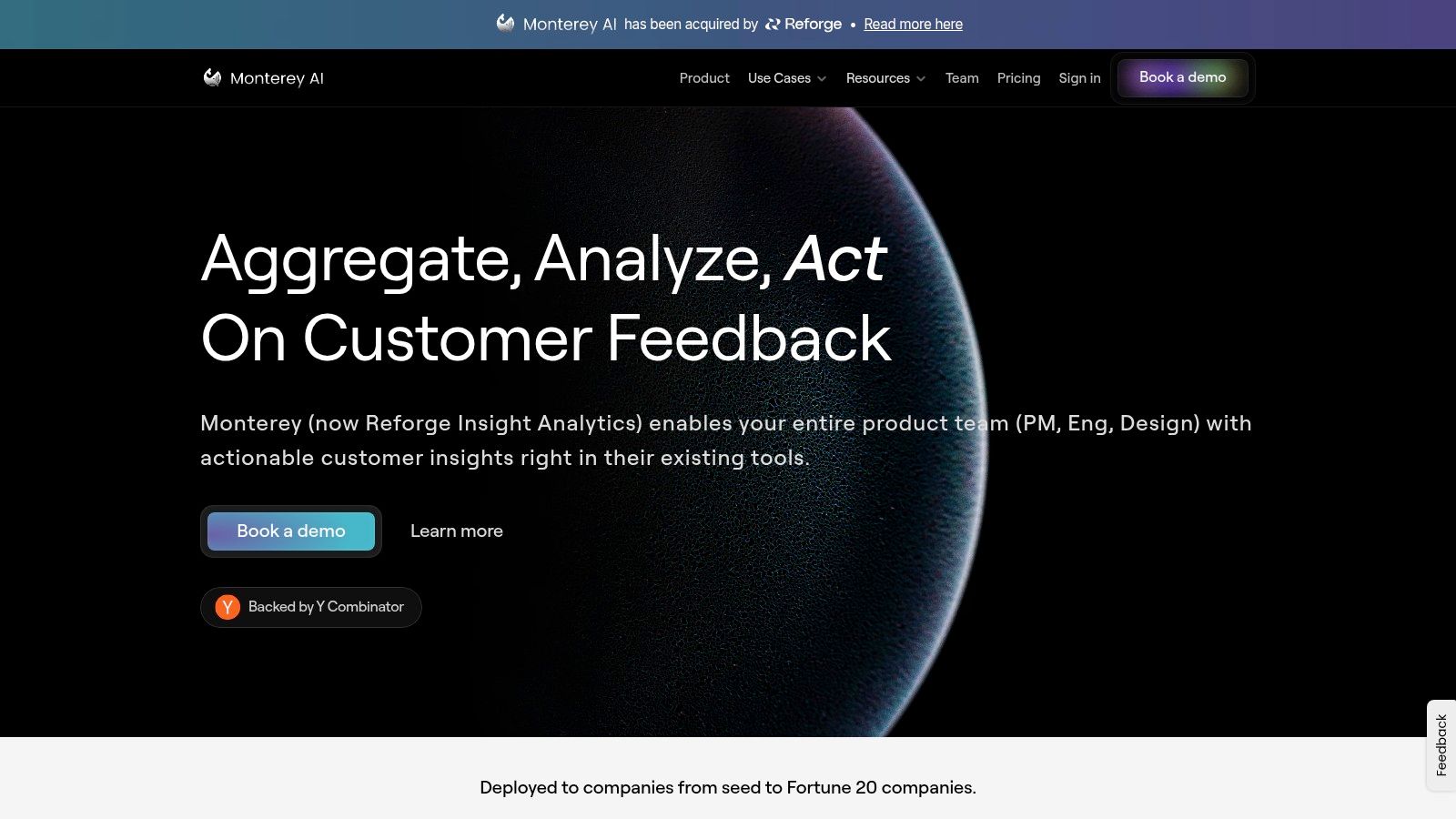
The platform’s core strength is its ability to ingest feedback from almost anywhere, from its own widgets and portals to third-party tools like Zendesk and Intercom. Its AI then automatically applies smart tags and organizes feedback into segments, helping product managers see which issues affect high-value customers. The emphasis is on making AI insights a routine part of the development cycle, not just a one-off analysis. You can learn more about its approach on the Monterey AI website.
Core AI Features
- Unified Feedback Ingestion: Collects and centralizes data from its native widgets, surveys, and portals, plus integrations with support and CRM systems.
- AI Smart Tagging & Segmentation: Automatically categorizes feedback and groups it into themes, identifying patterns and emerging trends without manual effort.
- Revenue-Aware Insights: Connects feedback to customer data to help prioritize features based on their potential impact on revenue and retention.
Pricing & Access
- Monterey AI uses a consumption-based pricing model tied to feedback volume, which can be more predictable than per-seat costs.
- Detailed pricing is sales-led and requires a demo to create a tailored plan. Options for unlimited seats are available, making it accessible for growing teams.
Pros & Cons
- Pro: Flexible, consumption-based pricing is ideal for teams with varying feedback volumes.
- Pro: Strong focus on operationalizing insights and integrating them into PM workflows.
- Con: Pricing is not transparent; requires direct contact with sales for a quote.
- Con: As a specialized insights tool, it may need to be paired with a separate roadmapping platform for a complete PM solution.
11. Enterpret (Wisdom AI and Agents)
Enterpret is a customer intelligence platform designed to centralize feedback and surface business-critical insights. It unifies data from over 50 sources, including support tickets, app reviews, and social media, then uses AI to build a dynamic, multi-level taxonomy. This makes it one of the more specialized ai product management tools focused squarely on translating unstructured feedback into actionable, revenue-tied intelligence. The platform’s conversational interface, Wisdom AI, allows PMs to ask natural-language questions and receive evidence-backed answers with source citations.
The true distinction of Enterpret lies in its proactive agent capabilities and its focus on business context. Instead of just summarizing data, its agents can be configured to monitor for quality issues, escalate risks automatically, and deliver targeted digests directly into workflows like Slack or Jira. This automates the continuous discovery process, allowing teams to move from reactive analysis to proactive monitoring. For teams struggling to connect disparate customer feedback to concrete business outcomes and feature development, Enterpret provides a powerful solution.
Core AI Features
- Wisdom AI: A conversational engine for natural-language querying that provides answers with direct citations and data visualizations.
- Adaptive Taxonomy: Automatically builds and maintains a classification system that links feedback themes to product features, customer segments, and revenue impact.
- AI Agents: Configurable agents that automate monitoring for anomalies, escalate critical issues, and distribute summary digests into existing team workflows.
Pricing & Access
- Enterpret is positioned for the enterprise market, with pricing and plans customized based on needs.
- Access is provided through a demo-led sales process, and you must contact their sales team for specific packaging and cost details.
Pros & Cons
- Pro: Designed for deep alignment between product and CX teams by providing evidence-backed answers.
- Pro: Agents automate the manual work of monitoring feedback and escalating risks into relevant channels.
- Con: The enterprise focus and demo-led sales cycle make it less accessible for smaller teams or those needing immediate, self-serve access.
- Con: Custom pricing means total cost is not transparent upfront.
12. Dovetail (Customer Intelligence + AI Chat/Channels/Agents)
Dovetail has evolved from a popular user research repository into a formidable customer intelligence platform driven by AI. It excels at transforming high volumes of qualitative feedback from support tickets, NPS surveys, and app reviews into structured, searchable insights. This makes it one of the most effective ai product management tools for teams that need to connect raw customer feedback directly to product strategy, ensuring every decision is backed by verifiable evidence.
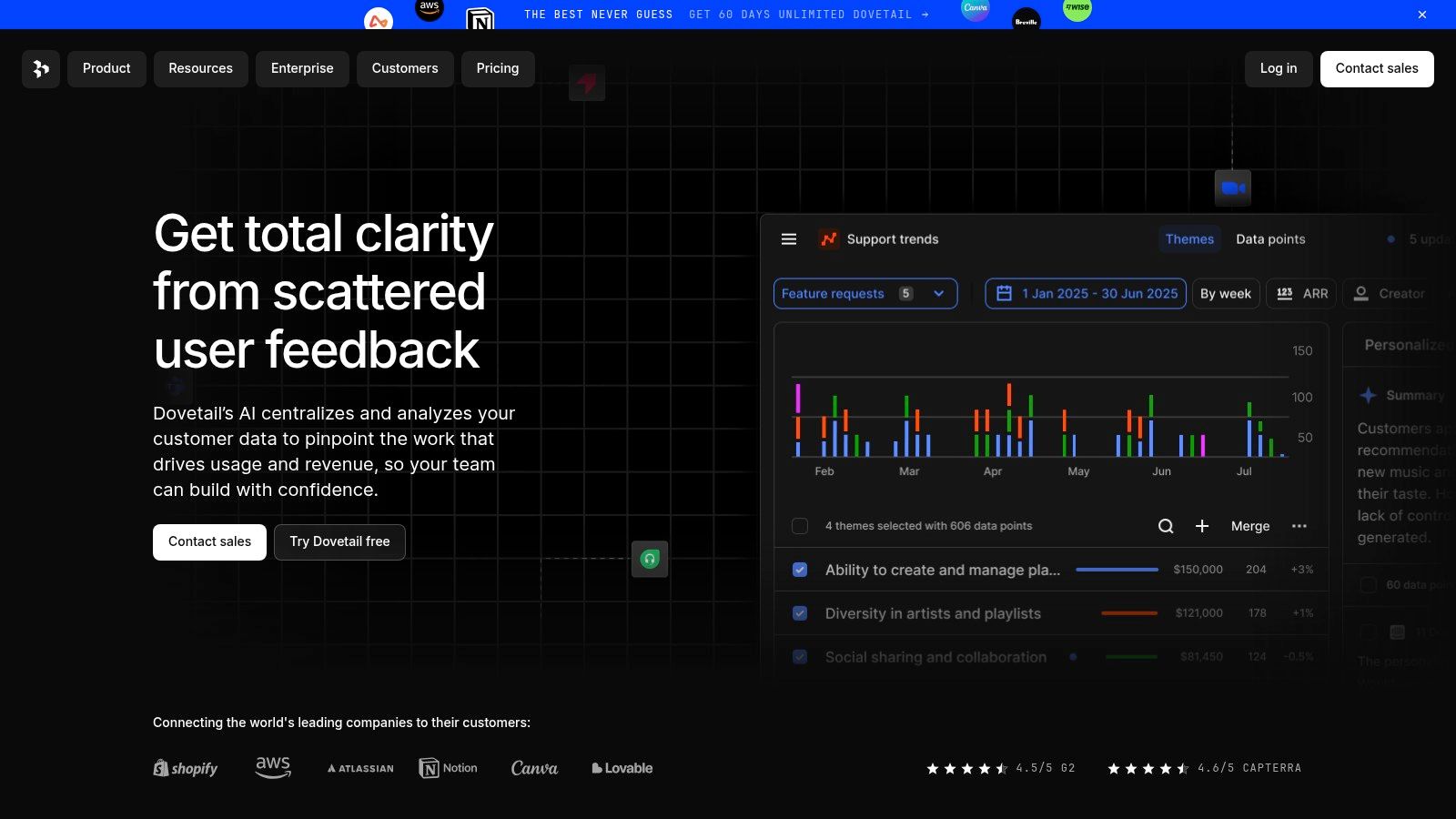
The platform’s standout features are its AI-native components designed for continuous analysis. AI Chat allows product managers to ask natural language questions across entire project workspaces and receive answers with direct citations to the source data. This traceability is a significant advantage, as it removes the "black box" mystery of AI summaries. Dovetail also offers Channels, which automatically classifies incoming feedback, and is developing AI Agents for proactive alerts and reporting.
Core AI Features
- AI Chat: Ask questions across projects and get summarized answers with clickable citations linking back to the original customer feedback or research note.
- Channels: Provides continuous, automated thematic analysis of high-volume data streams like support tickets, app reviews, and NPS comments.
- AI Agents & Dashboards (Beta): Proactively run summaries, identify emerging themes, and generate alerts to keep the team informed of new trends or critical issues.
Pricing & Access
- Dovetail provides a free tier suitable for small projects or for getting familiar with the platform.
- Advanced AI features, higher data point limits, and add-ons like Channels are included in the paid Business and Enterprise tiers.
Pros & Cons
- Pro: Excellent traceability from AI-generated insight back to the raw qualitative data.
- Pro: The product roadmap shows a strong, active commitment to adding new AI capabilities.
- Con: Key AI features and the most generous data caps are restricted to more expensive plans.
- Con: Some of the most promising features, like AI Agents, are still in beta and not yet fully available.
12 AI Product Management Tools Comparison
| Platform | Core focus & integrations | Value / Unique selling ✨ | UX / Accuracy ★ | Target audience 👥 | Pricing 💰 |
|---|---|---|---|---|---|
| SigOS 🏆 | Autonomous product intelligence; ingests tickets, chats, calls, usage & billing (Zendesk, Intercom, Mixpanel, Stripe, Jira, GitHub) | Assigns $ impact to issues; daily prioritized dashboards; outcome measurement; automated issue creation ✨ | Sub-minute analysis (~0.4s); ~87% churn correlation; high-confidence signals ★★★★☆ | Product, growth & success teams; enterprise PMs 👥 | Free initial analysis; enterprise‑tailored pricing 💰 |
| Productboard (Spark) | End‑to‑end PM: idea capture, prioritization, roadmaps; Spark AI for summaries & PRDs | Mature PM workflows + AI-assisted spec drafting & feedback summaries ✨ | Polished UX; AI on some plans; credits model ★★★★ | PM teams needing structured roadmaps & spec writing 👥 | Tiered plans; AI credits add‑on 💰 |
| Jira Product Discovery + Atlassian Intelligence | Idea capture & roadmaps tightly linked to Jira; NL search & summaries | Direct path discovery→delivery; shared roadmaps & voting ✨ | Familiar for Jira users; integrated execution ★★★★ | Teams already in Atlassian ecosystem 👥 | Part of Atlassian pricing; varies by plan 💰 |
| Aha! (AI) | Strategy-to-launch suite: Roadmaps, Ideas, Discovery, Whiteboards; Aha! AI assistant | Deep strategy tooling with AI drafting, enterprise governance & controls ✨ | Feature-rich enterprise UX; credits-based AI ★★★★ | Enterprise product & strategy teams 👥 | Modular pricing; AI credits can add cost 💰 |
| Linear (with Agent) | High-velocity issue/project mgmt; Linear Agent for triage, research & automations | Agent-as-teammate for backlog hygiene and automations ✨ | Fast, streamlined interface; practical AI workflows ★★★★★ | Product + engineering teams focused on velocity 👥 | Public tiers; Agent beta available (no extra cost) 💰 |
| airfocus (AI Assist) | Modular PM: strategy, portfolio, roadmaps, feedback hub; AI Assist for drafting | Portfolio roll-ups, goal alignment & enterprise security (ISO/SOC) ✨ | Flexible setup; strong enterprise readiness ★★★★ | Portfolio/enterprise PMs needing governance 👥 | Sales‑led tiers; public pricing limited 💰 |
| ProductPlan (ProductPartner AI) | Strategic roadmapping & portfolio planning; page-aware AI summaries | Exec/stakeholder alignment with contextual AI guidance ✨ | Approachable for execs; in-product guidance ★★★★ | Execs, PMs & stakeholder-facing teams 👥 | Tiered plans; AI features rolling out 💰 |
| Canny (Autopilot) | Feedback collection, public roadmaps; Autopilot auto-ingests and dedups feedback | Automated discovery, duplicate detection, smart replies to close loop faster ✨ | Lightweight, transparent workflows; free plan available ★★★ | SMBs and product teams wanting simple feedback ops 👥 | Free tier + affordable paid plans 💰 |
| UserVoice (AI Idea Insights) | Enterprise feedback & idea management; AI Idea Insights & impact reporting | Seat-agnostic access; impact reporting and enterprise portals ✨ | Enterprise onboarding & centralized portals ★★★★ | Large organizations needing cross‑functional access 👥 | Higher entry price; AI as add‑on 💰 |
| Monterey AI | Unified feedback (widgets, support, calls); smart tags & revenue-aware insights | Operationalizes AI insights into workflows; consumption-based packaging ✨ | Enterprise integrations & SLA options; flexible UX ★★★★ | Teams with high feedback volume and ops focus 👥 | Consumption‑based / sales‑led; unlimited seats options 💰 |
| Enterpret (Wisdom AI & Agents) | Unifies 50+ sources; Wisdom AI Q&A, adaptive taxonomy & agents | Conversational Q&A with citations; agents for monitoring & escalations ✨ | Evidence-backed answers; knowledge graph for context ★★★★ | PM/CX teams seeking deep insight & automation 👥 | Enterprise, demo‑led pricing 💰 |
| Dovetail | Research & customer feedback with Channels, AI Chat & Agents (beta) | Continuous thematic analysis; AI Chat with citations; proactive agents ✨ | Strong traceability from qualitative→quant; active AI roadmap ★★★★ | Researchers, product teams and CX analysts 👥 | Free tier + paid plans; some AI features on higher tiers 💰 |
Final Thoughts
Navigating the ecosystem of AI product management tools can feel like charting unknown territory. As we've explored, the market is brimming with specialized solutions, from comprehensive roadmapping platforms like Aha! and Productboard with their integrated AI features, to focused intelligence engines like Enterpret and Monterey AI that excel at deep user feedback analysis. The key takeaway is not that one tool reigns supreme, but that the right tool is the one that directly solves your most pressing product management bottleneck.
The shift is clear: product management is moving away from manual data wrangling and gut-feel decisions toward an AI-assisted, data-informed strategic function. The tools we’ve discussed, whether it's Jira Product Discovery's tight integration with development workflows or Dovetail's ability to turn qualitative research into structured insights, all share a common goal. They aim to give you back your most valuable asset: time. Time to think strategically, talk to customers, and build products that resonate.
How to Choose Your AI Product Management Stack
Selecting the right solution requires introspection about your team's current processes and future goals. Don't be swayed by an impressive feature list alone. Instead, use this framework to guide your decision:
- Identify Your Core Pain Point: Are you drowning in user feedback across Zendesk, Intercom, and social media? A tool like Enterpret or SigOS might be your best starting point. Is your roadmap disconnected from strategic objectives? Look closer at Productboard or airfocus. Is your primary challenge the gap between customer support and product development? Canny's Autopilot could be the bridge you need.
- Assess Your Integration Ecosystem: A tool's power is magnified by how well it connects to your existing stack. Before committing, map out how a new AI tool will integrate with Jira, GitHub, Slack, and your customer communication platforms. A seamless data flow is non-negotiable for true efficiency.
- Consider Your Team's Maturity: A small, agile team might thrive with a nimble tool like Linear and its new AI agent. A larger, more structured organization may require the robust governance and enterprise-grade features found in platforms like Aha! or UserVoice. Be realistic about your team’s capacity for adoption and implementation.
- Start with a Pilot Project: You don't need to overhaul your entire workflow overnight. Choose a specific, measurable problem to solve. For example, use an AI tool to analyze the last quarter's support tickets to identify the top three feature requests. This proves the tool's value and builds momentum for wider adoption.
The Future is Collaborative Intelligence
The most powerful takeaway from our review of these AI product management tools is the concept of collaborative intelligence. This isn't about replacing product managers with algorithms. It’s about creating a partnership where AI handles the scale of data processing, pattern recognition, and summarization, freeing up product leaders to focus on the human elements of the job: empathy, strategic vision, and cross-functional leadership.
The true value of these tools is unlocked when they move beyond simple automation and become a central nervous system for your product organization. They connect the voice of the customer from a support ticket directly to a feature on the roadmap and, ultimately, to the revenue it generates. By implementing the right AI tools thoughtfully, you are not just adopting new software; you are building a more responsive, intelligent, and customer-centric product organization.
Ready to connect customer feedback directly to revenue and prioritize with confidence? SigOS specializes in transforming scattered customer feedback from sources like Zendesk and Intercom into clear, revenue-tied signals for product teams. See how our AI-driven platform can help you build the right features by visiting SigOS to learn more.
Keep Reading
More insights from our blog

Ready to find your hidden revenue leaks?
Start analyzing your customer feedback and discover insights that drive revenue.
Start Free Trial →