Top 12 Customer Sentiment Analysis Tools for 2025
Explore our in-depth review of the top 12 customer sentiment analysis tools. Compare features, pricing, and use cases to find the best fit for your team.
In today's competitive landscape, simply collecting customer feedback isn't enough. The real advantage comes from understanding the emotion and intent behind the words. Are your customers frustrated, delighted, or simply indifferent? Answering this question accurately separates market leaders from the rest. This is where dedicated customer sentiment analysis tools become essential, transforming raw feedback into a strategic asset.
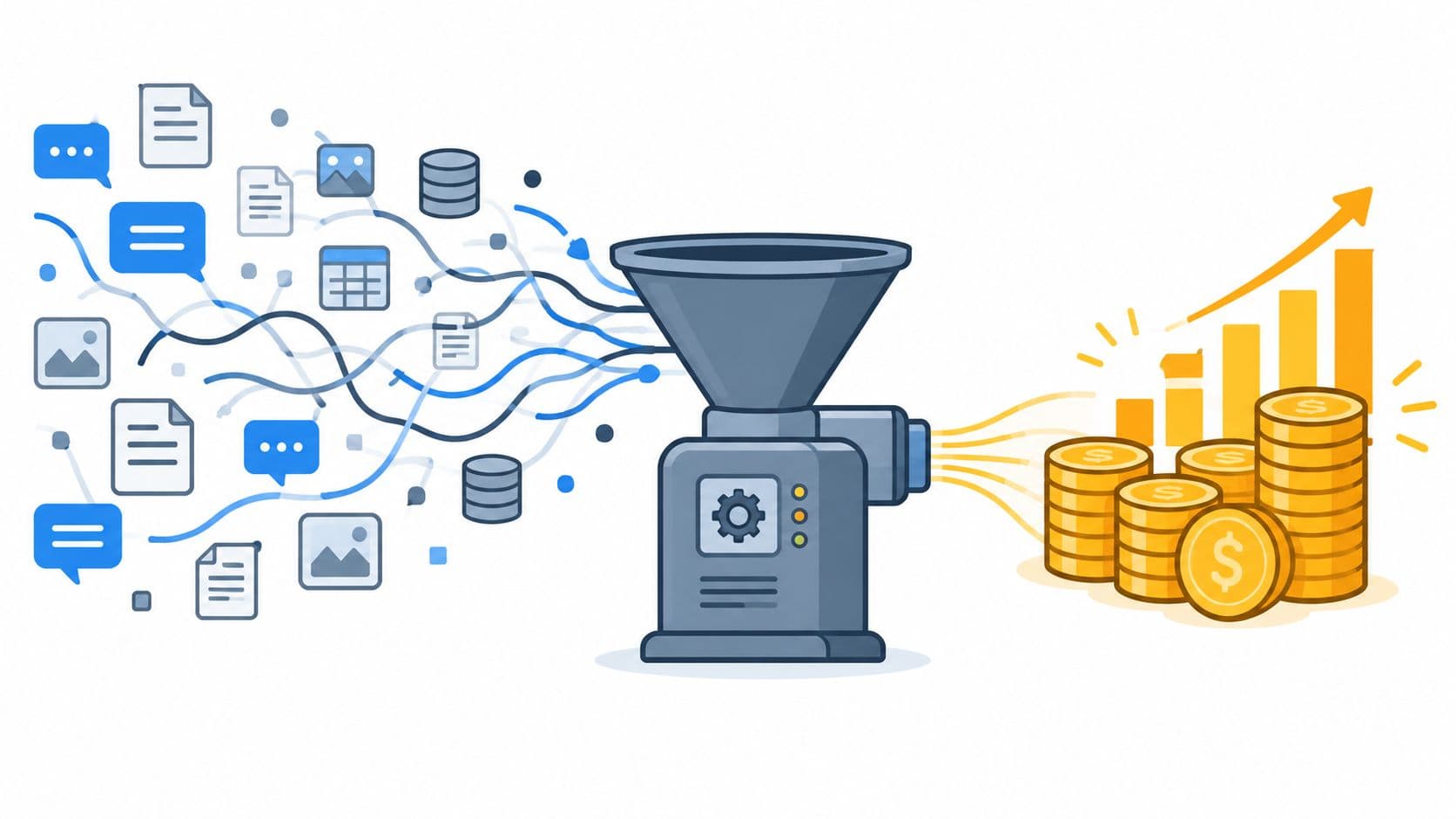
This guide dives deep into the best platforms available, moving beyond generic feature lists to provide actionable insights. We'll explore how these solutions transform unstructured text from support tickets, social media mentions, app reviews, and surveys into a clear roadmap for your business. The goal is to help you reduce churn, prioritize product features that matter, and uncover new opportunities for revenue growth.
We have rigorously evaluated a wide range of options, from enterprise-grade platforms like Qualtrics and Medallia to powerful developer-focused APIs from Google Cloud and AWS. For each tool, you will find a detailed breakdown of its core strengths, potential limitations, and ideal use cases to help you make an informed decision.
This comprehensive resource is designed to help you find the right fit, whether you're a product manager at a fast-growing SaaS company, a CX leader at a large enterprise, or a data analyst seeking powerful AI-driven insights. Each profile includes screenshots and direct links, so you can quickly compare solutions and find the platform that best aligns with your team's technical capabilities, budget, and strategic objectives. Let's find the tool that will unlock the true voice of your customer.
1. SigOS
Best For: Revenue-Focused SaaS Product & Growth Teams
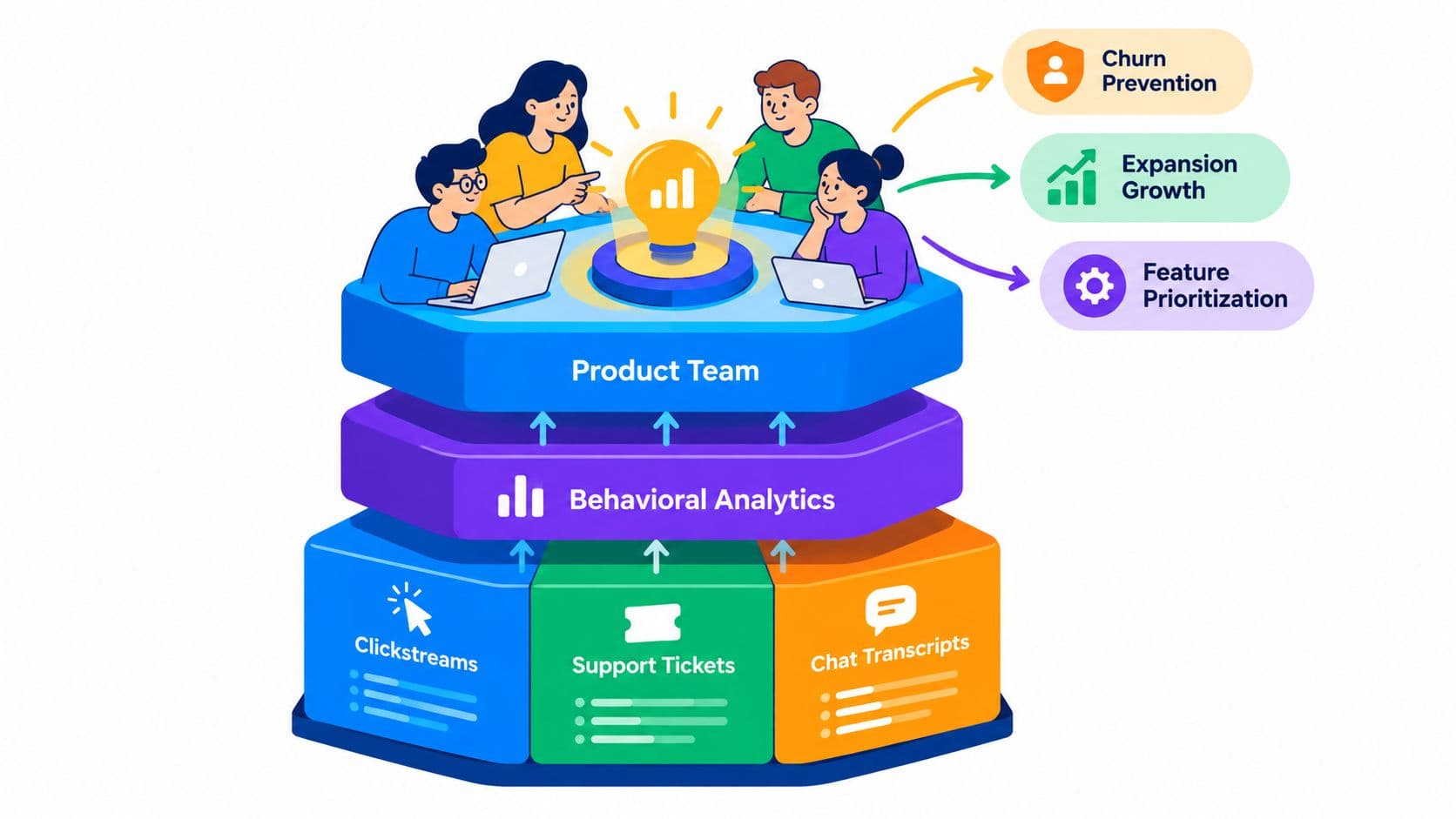
SigOS stands out as a premier choice among customer sentiment analysis tools, distinguishing itself by moving beyond simple sentiment classification. It is an AI-driven product intelligence platform engineered specifically to connect customer feedback directly to tangible business outcomes like churn reduction and revenue expansion. This makes it an indispensable asset for SaaS product managers, customer success leaders, and growth teams who need to prioritize their efforts based on financial impact.
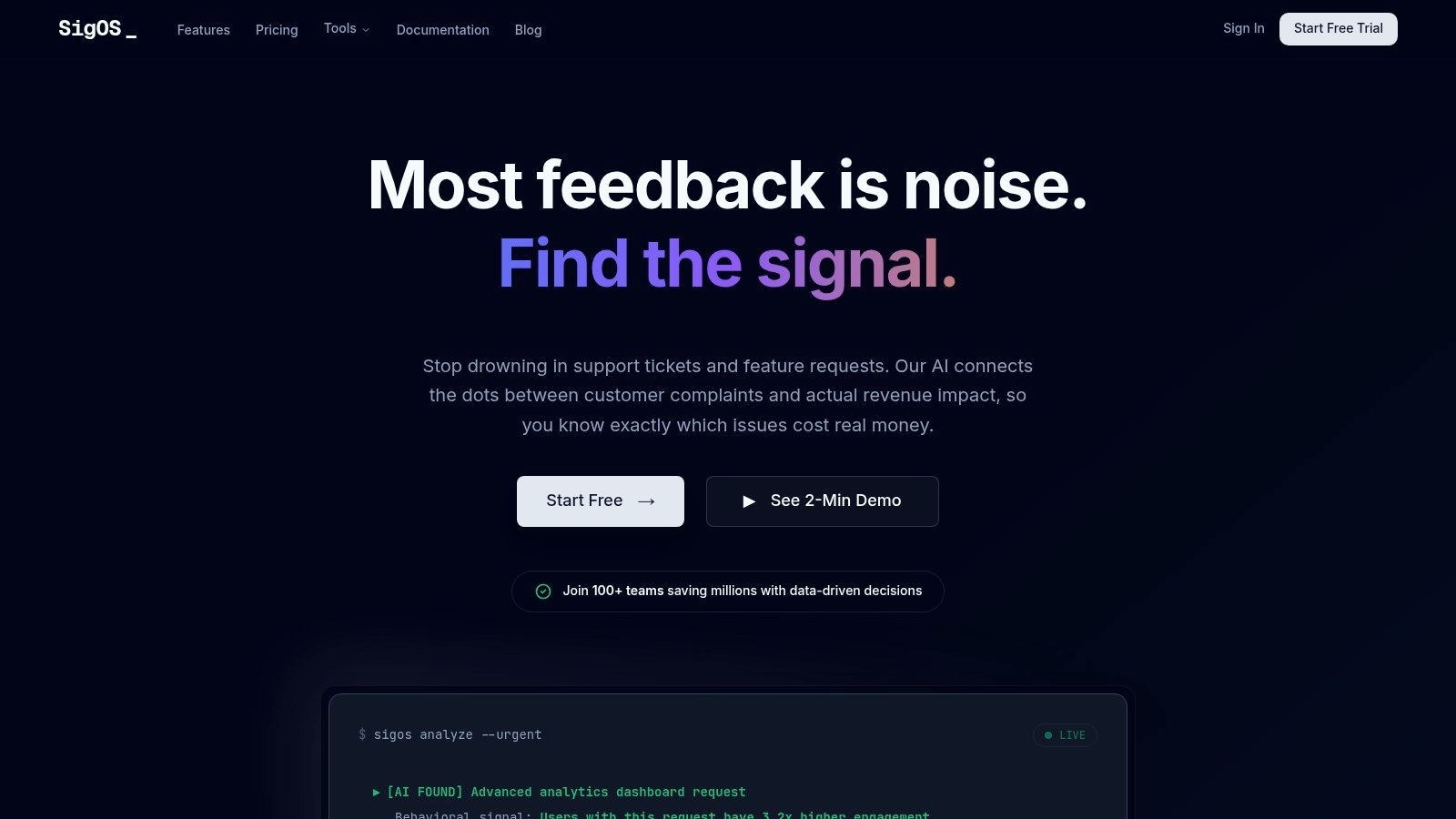
The platform's core strength lies in its proprietary AI, which analyzes a wide array of unstructured feedback from sources like Zendesk tickets, Intercom chats, and sales calls. It then correlates this qualitative data with quantitative usage metrics to identify critical patterns. SigOS claims an impressive 87% accuracy in correlating specific feedback themes, like bug reports or feature requests, with churn risk and expansion opportunities.
Instead of just telling you if a customer is happy or upset, SigOS tells you why and quantifies the financial stakes. For instance, it can pinpoint a specific bug that is costing your company thousands in potential revenue or highlight a feature request that is common among high-value accounts, unlocking a six-figure expansion deal. This elevates the conversation from subjective feedback to data-driven, strategic decision-making.
Key Features and Use Cases
- Revenue Impact Analysis: SigOS assigns a direct monetary value to customer feedback, enabling teams to prioritize bugs and features that have the highest financial impact. This is a game-changer for roadmap planning and resource allocation.
- Automated Issue & Alerting System: The platform integrates seamlessly with project management tools like Jira, Linear, and GitHub. It automatically creates tickets for high-priority issues, complete with the associated revenue impact data and customer context. Real-time alerts ensure that critical churn risks are addressed proactively.
- Proactive Churn Prediction: By identifying the leading indicators of customer dissatisfaction hidden within support conversations and product usage, SigOS provides an early warning system. Customer success teams can intervene before an account is at risk.
- Robust Data Privacy: A significant advantage for security-conscious organizations, SigOS guarantees that its models are never retrained on customer data. All information is encrypted at rest, ensuring full data privacy and compliance.
Practical Considerations
While its focus on SaaS and tech companies makes it incredibly powerful for that niche, its feature set may be less applicable to non-software businesses like e-commerce or retail. Pricing is not publicly available and requires contacting their sales team for a quote or starting a free trial, which is a standard practice for enterprise-focused SaaS platforms. To learn more about how platforms like these operate, SigOS provides additional context in its guide to customer feedback analysis tools.
Website: https://sigos.io
2. Qualtrics XM Discover (formerly Clarabridge)
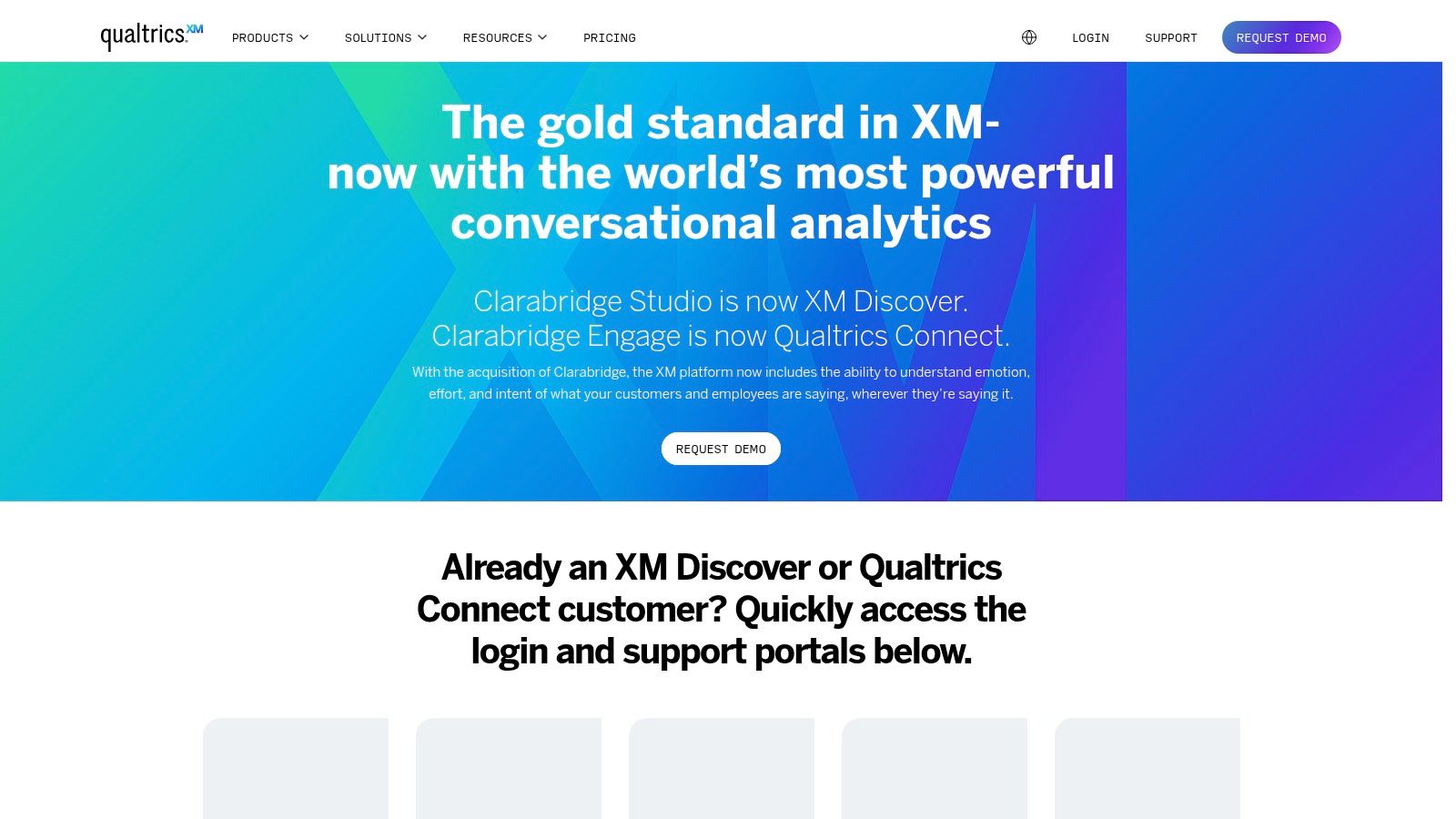
Qualtrics XM Discover positions itself as an enterprise-grade solution, moving beyond simple positive/negative sentiment to provide a deep, contextual understanding of customer conversations. Acquired from Clarabridge, its strength lies in analyzing unstructured text and speech from myriad sources like contact center calls, support chats, social media, and product reviews. It’s one of the most powerful customer sentiment analysis tools for organizations looking to perform sophisticated root-cause analysis.
The platform's core differentiator is its extensive library of over 150 industry-specific Natural Language Understanding (NLU) models. This means a healthcare provider's sentiment model will understand industry-specific terminology differently than one for a financial services firm, leading to far more accurate and nuanced insights into emotion, intent, and customer effort.
Key Features & Use Cases
- Advanced Conversational Analytics: XM Discover excels at parsing complex data from call transcripts and chat logs. It can automatically identify the reasons for contact, detect friction points in the customer journey, and score agent performance based on the emotional tenor of the conversation.
- Root-Cause and Driver Analysis: Using its proprietary iQ analytics engine, the tool connects sentiment trends to specific business outcomes. For example, a product manager can use it to pinpoint which newly released feature is driving a spike in negative support tickets.
- Proactive Action with xFlow: The platform enables real-time alerts and automated workflows. A support leader could configure a rule to automatically create a high-priority ticket in their CRM and notify a manager whenever a customer expresses severe frustration or intent to churn.
Pricing and Implementation
Qualtrics XM Discover is squarely aimed at the enterprise market. There are no self-serve or publicly listed pricing plans; access requires a custom quote and a formal sales process. Implementation is a significant consideration and typically involves professional services to integrate data sources, configure the NLU models, and establish governance, making it less suitable for small businesses seeking a quick, out-of-the-box solution.
Website: https://www.qualtrics.com/clarabridge/
3. Medallia (Text Analytics)
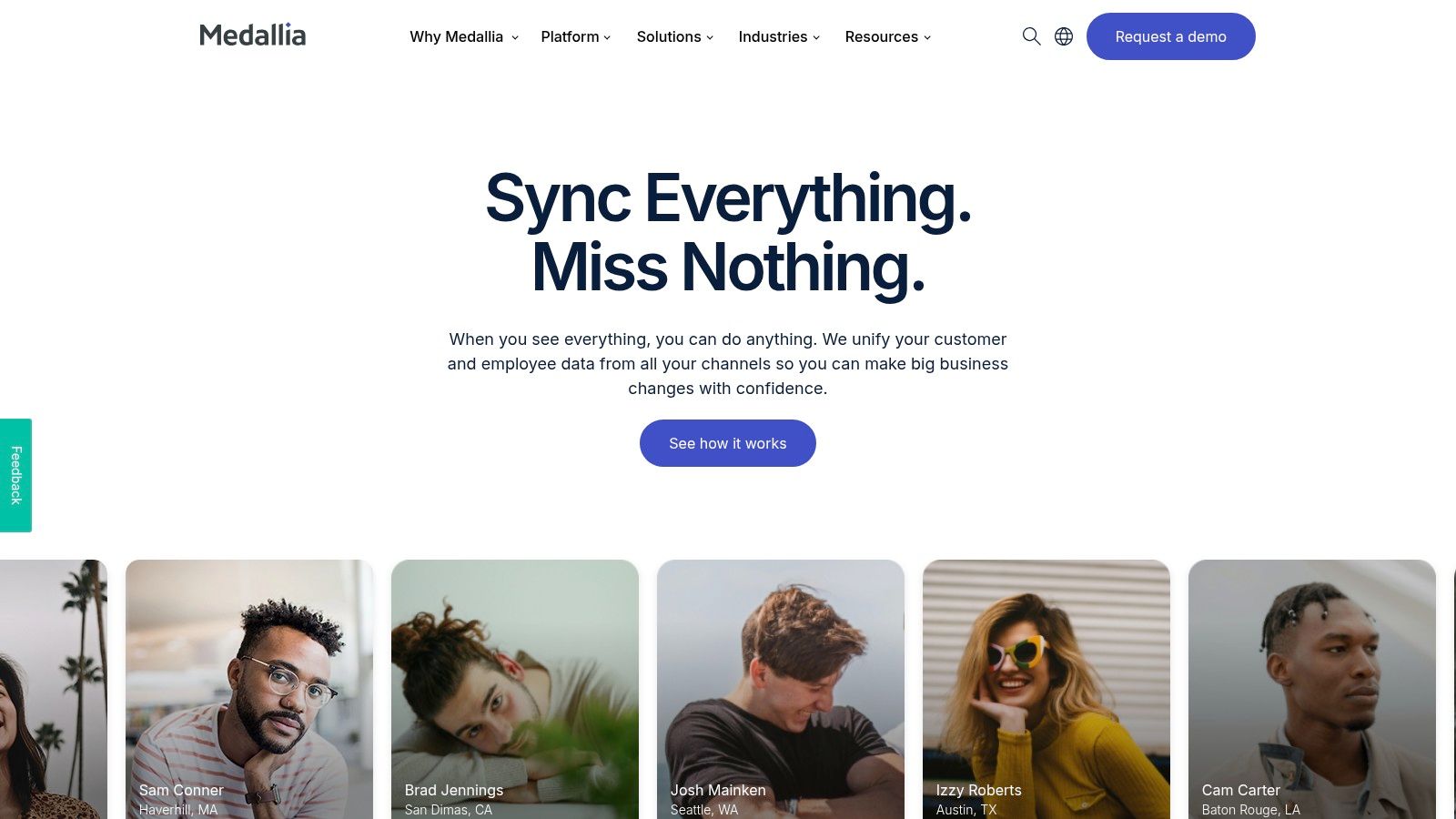
Medallia is a comprehensive customer experience (CX) platform where text analytics is a deeply integrated component, not just a standalone feature. Its strength lies in unifying sentiment data from diverse sources like surveys, social media, voice calls, and even video feedback directly into its core CX workflows. This makes it one of the most cohesive customer sentiment analysis tools for businesses already invested in the Medallia ecosystem for managing customer journeys.
The platform automatically applies sentiment tags to unstructured feedback in multiple languages, allowing teams to instantly gauge emotional tone. A key differentiator is its ability to process sentiment from audio and video transcripts, complete with timeline views that pinpoint specific moments of frustration or delight. This granular analysis helps connect sentiment directly to operational metrics.
Key Features & Use Cases
- Integrated CX Metric Analysis: Users can apply real-time sentiment filters to their existing dashboards to see how positive or negative comments are impacting KPIs like Net Promoter Score (NPS) or Customer Satisfaction (CSAT). This allows leaders to immediately assess the 'why' behind their scores.
- Multilingual Theme and Topic Detection: Medallia automatically categorizes unstructured feedback into themes, such as "product quality" or "customer service," and assigns a sentiment score to each. This helps product teams identify which areas are driving the most negative customer experiences globally.
- Voice and Video Sentiment Timelines: For contact centers, this feature is invaluable. Managers can review call or video transcripts and visually identify the exact points in a conversation where a customer's sentiment shifted, providing powerful data for agent coaching and process improvement.
Pricing and Implementation
Medallia is an enterprise-level solution with pricing available only through a custom quote from their sales team. There is no public pricing information or self-service option, reflecting its focus on large-scale deployments. The more advanced text and speech analytics capabilities are often gated behind higher-tier packages. Implementation typically requires professional services to integrate data streams and configure the platform to align with specific business objectives, making it a significant investment.
Website: https://www.medallia.com/
4. Sprinklr Social Listening (with AI sentiment)
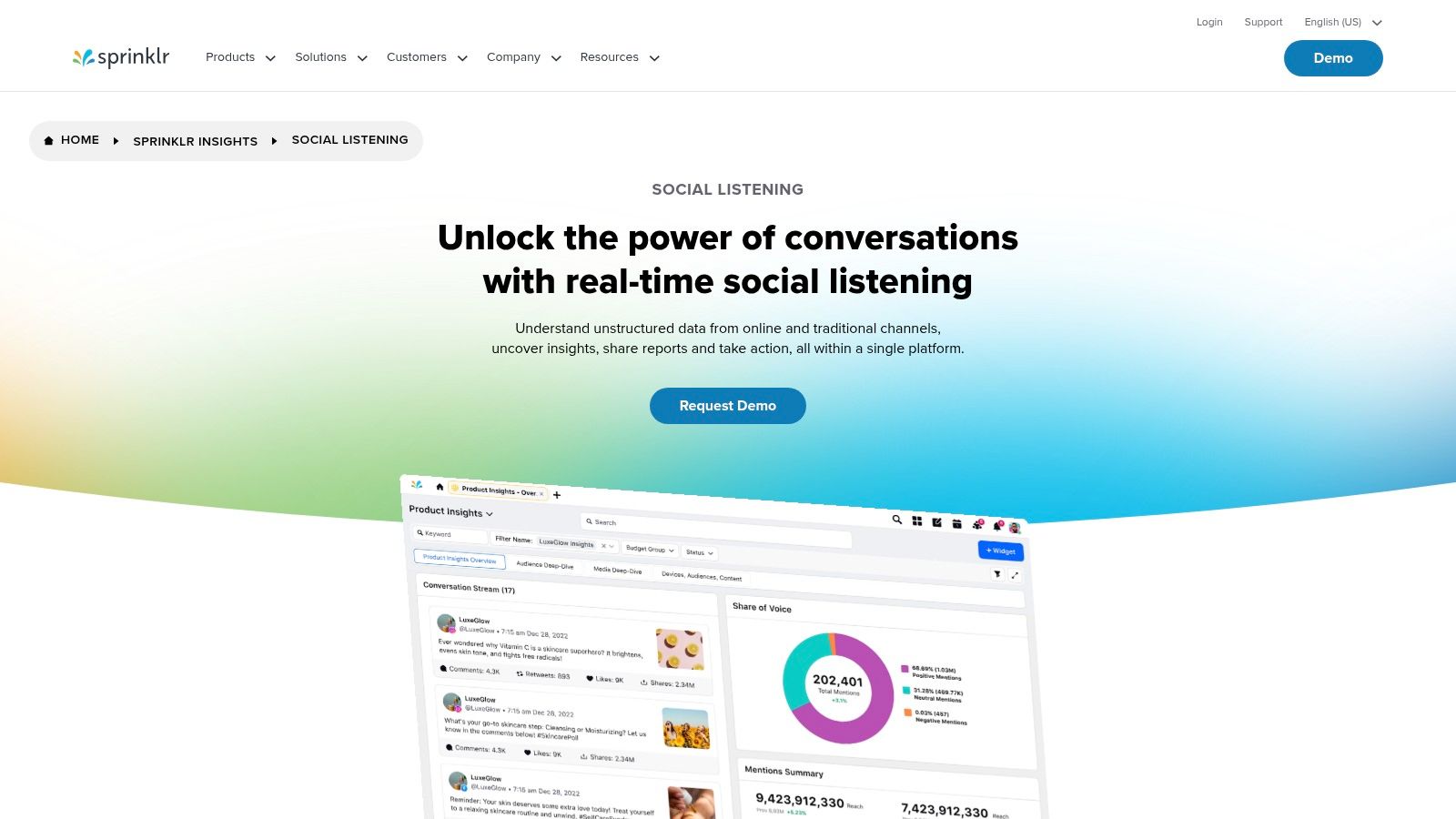
Sprinklr offers an enterprise-grade social listening platform designed for large-scale consumer intelligence, tapping into over 30 social and digital channels. Its strength lies in its ability to process petabyte-scale data in real-time, making it one of the most powerful customer sentiment analysis tools for brands that need to monitor massive volumes of public conversations. The platform goes beyond basic sentiment to provide emotion classification and entity detection.
Sprinklr’s core differentiator is its unified approach and expansive data access, including firehose access to major social networks. This allows for comprehensive brand health tracking, competitive analysis, and crisis detection at a global scale, all within a single, integrated customer experience management (CXM) environment.
Key Features & Use Cases
- Real-Time Social Listening: Monitor conversations across social media, blogs, forums, and news sites to instantly gauge public reaction to a product launch, marketing campaign, or PR issue. It helps teams track how various customer satisfaction measurement methods play out in public discourse.
- AI-Driven Crisis Detection: The platform's AI can automatically identify anomalies in conversation volume or sentiment, alerting teams to potential crises before they escalate. A communications team can use this to get ahead of negative stories.
- Competitive Benchmarking: Create sophisticated dashboards to track your brand’s share of voice, sentiment score, and key conversation themes against your top competitors, providing actionable insights for strategic planning.
Pricing and Implementation
Sprinklr is firmly positioned for the enterprise market, and pricing is available only through a custom quote. The platform's complexity and broad capabilities mean implementation is a significant undertaking, often requiring dedicated training and professional services. Users frequently note a steep learning curve due to the sheer number of features. Its cost and complexity make it less suitable for small to mid-sized businesses that need a more straightforward, plug-and-play solution.
Website: https://www.sprinklr.com/products/consumer-intelligence/social-listening/?utm_source=openai
5. Brandwatch Consumer Research
Brandwatch Consumer Research is a powerful consumer intelligence suite that excels at large-scale public conversation analysis. Its core strength is its massive, proprietary data archive, giving users access to over 1.4 trillion historical posts dating back to 2008. This makes it one of the best customer sentiment analysis tools for brands looking to track historical sentiment trends, benchmark against competitors, and understand the evolution of public opinion on a global scale.
The platform uses automated sentiment classification to score conversations from social media, forums, blogs, and news sites in real time. Beyond just public data, Brandwatch allows organizations to enrich this external view by uploading their own first-party data, such as support tickets or survey responses, via an API. This creates a unified view, connecting external chatter with internal customer feedback for deeper context.
Key Features & Use Cases
- Historical Trend Analysis: With its vast data archive, a marketing team can analyze how public sentiment around their brand or key topics has shifted over several years, identifying long-term patterns and the impact of past campaigns.
- Real-Time Crisis Monitoring: The platform’s robust alerting system can be configured to notify stakeholders of sudden spikes in negative sentiment. This enables a PR team to react quickly to emerging crises or viral negative feedback before it escalates.
- Enriched First-Party Data Analysis: By uploading call logs or survey results, a product manager can cross-reference internal feedback with public conversations. This helps validate if a feature request from a survey is also a widespread demand on social media.
Pricing and Implementation
Brandwatch is an enterprise-level solution with custom pricing that requires a consultation with their sales team. There are no public pricing tiers available. While powerful, the platform's query-building and taxonomy setup have a learning curve, and most customers will require dedicated onboarding and training to maximize its capabilities. Its comprehensive nature and associated cost make it best suited for larger organizations with dedicated market research or social intelligence teams.
Website: https://www.brandwatch.com/products/consumer-research/
6. Talkwalker (Consumer Intelligence)
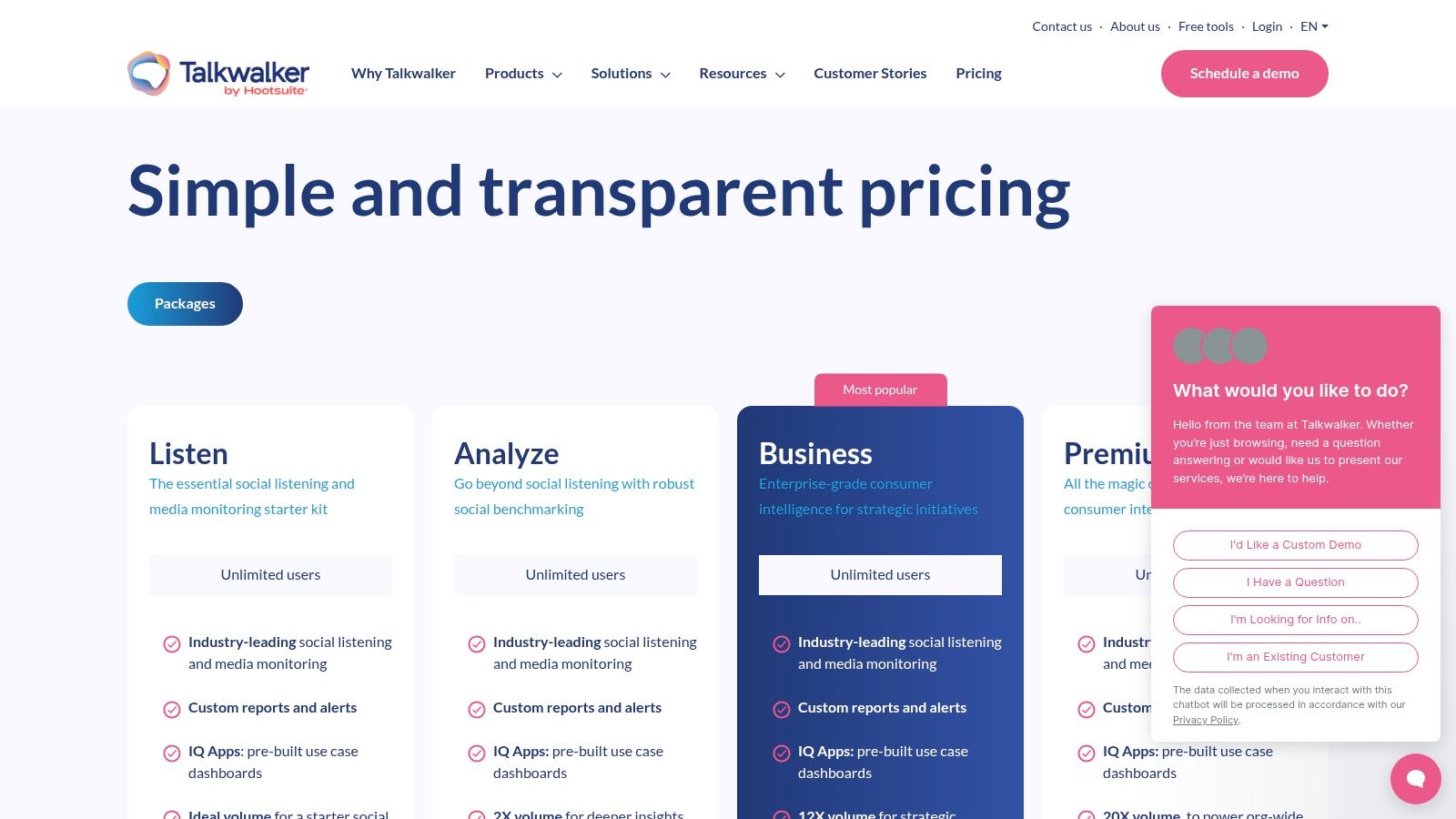
Talkwalker is a powerful consumer intelligence platform that excels in social listening and media monitoring, powered by sophisticated, AI-driven sentiment analysis. It scans a vast digital landscape, drawing insights from over 150 million sources, including social media, blogs, forums, and news sites in 187 languages. This makes it an exceptional choice for global brands needing to understand public perception and customer conversations across different regions and cultures.
The platform's standout feature is its Blue Silk™ AI, which not only categorizes sentiment but also identifies themes, trends, and even visual context within images and videos. This provides a multi-layered view of brand health and competitive intelligence. Its tiered subscription model and unlimited user seats on all paid plans make it a scalable solution for growing teams.
Key Features & Use Cases
- Global Media Monitoring: Talkwalker's extensive language and source coverage allows marketing teams to track brand mentions, campaign performance, and competitive sentiment on a global scale, ensuring no conversation is missed.
- AI-Powered Insights: Users can leverage pre-built IQ Apps and dashboards to quickly surface critical insights without extensive manual analysis. For example, a PR manager can instantly identify the emotional drivers behind a sudden spike in brand mentions.
- Visual Analytics: The platform can analyze sentiment and context from images containing a brand's logo, even without a text mention. This is invaluable for understanding how customers are visually representing and engaging with a product.
Pricing and Implementation
Talkwalker offers a tiered structure with plans for "Listening," "Analytics," and "Research," though specific pricing is available only through a custom quote. The plans are designed to scale, offering unlimited users and enterprise-grade governance, which simplifies adoption across large organizations. While there is no advertised free trial, the transparent plan structure helps prospective customers understand the feature progression between tiers before engaging with the sales team.
Website: https://www.talkwalker.com/pricing?utm_source=openai
7. InMoment XI Platform
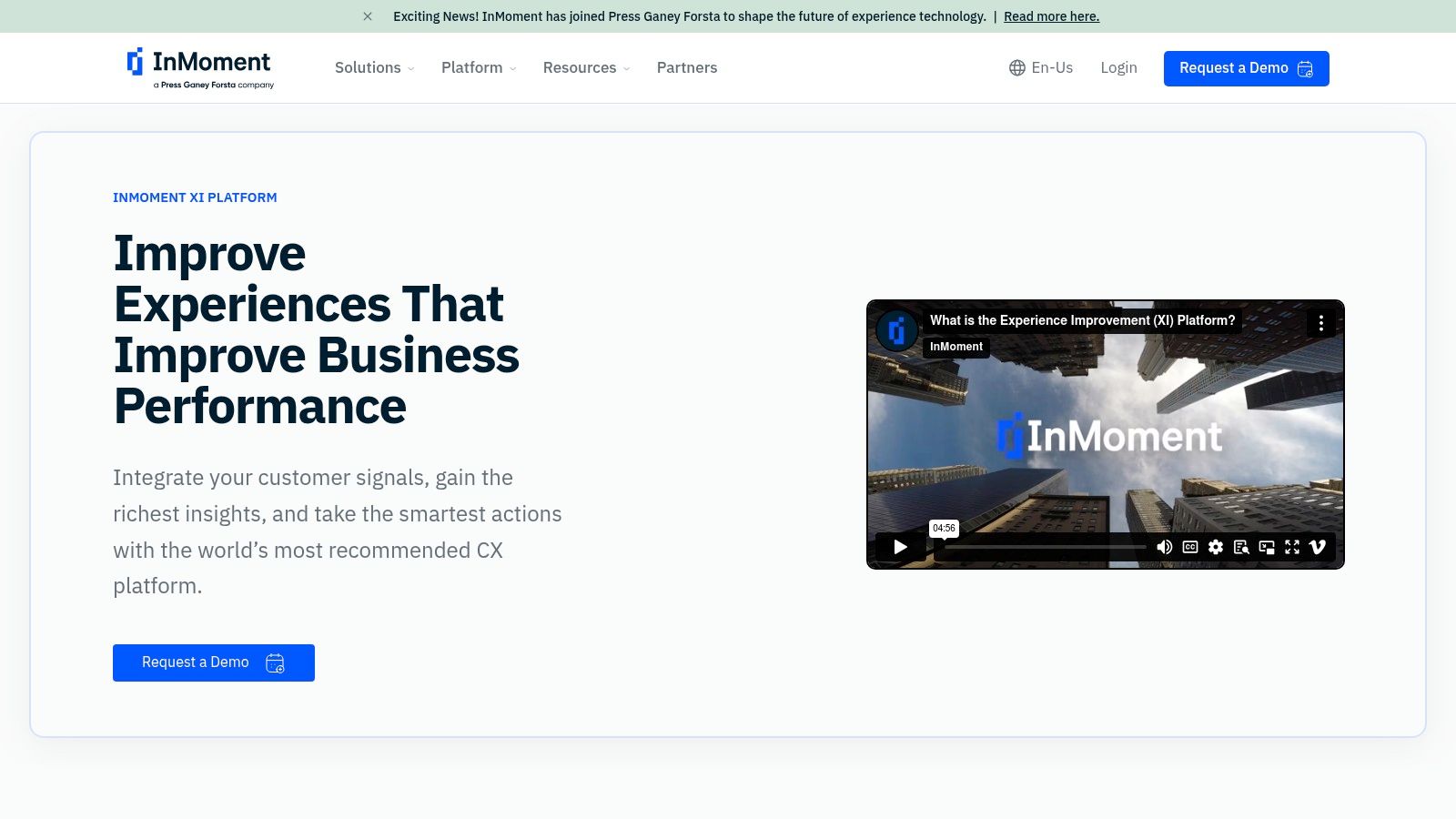
The InMoment XI Platform provides an integrated, end-to-end solution that connects customer experience (CX) data collection with powerful text and sentiment analytics. It positions itself as a unified system for not just understanding customer feedback but for driving direct action from it. This platform is designed to process a wide array of unstructured data sources, from surveys and contact center interactions to social media and online reviews, making it a comprehensive choice among customer sentiment analysis tools.
InMoment’s core strength is its ability to merge experience data with operational metrics within a single ecosystem. It moves beyond basic sentiment scoring by incorporating native language understanding and emotion recognition, enabling teams to detect subtle shifts and anomalies in customer feedback. This allows businesses to not only see what customers are saying but to understand the underlying emotional drivers and prioritize responses accordingly.
Key Features & Use Cases
- Integrated Action and Case Management: The platform includes built-in case management and automated workflows. A user can set a rule to automatically create a support ticket and assign it to the appropriate team whenever sentiment drops below a certain threshold or a specific theme, like "product defect," is mentioned.
- Search-Based Data Mining: Users can perform intuitive, search-based queries to explore unstructured feedback. A product manager could, for example, search for "confusing interface" and instantly see all related comments, their associated sentiment scores, and the impact on customer loyalty.
- Anomaly Detection and Impact Simulation: The platform can proactively identify unusual spikes in negative or positive sentiment related to specific topics. This enables teams to quickly address emerging issues or capitalize on positive trends before they escalate.
Pricing and Implementation
The InMoment XI Platform is an enterprise-level solution with pricing available only through a custom quote. Implementation is a key part of the offering and typically requires professional services to integrate data streams, configure the analytics engine, and operationalize the workflow capabilities. This makes it better suited for mid-market to large organizations rather than small businesses looking for a simple, self-serve tool.
Website: https://inmoment.com/xi-platform/
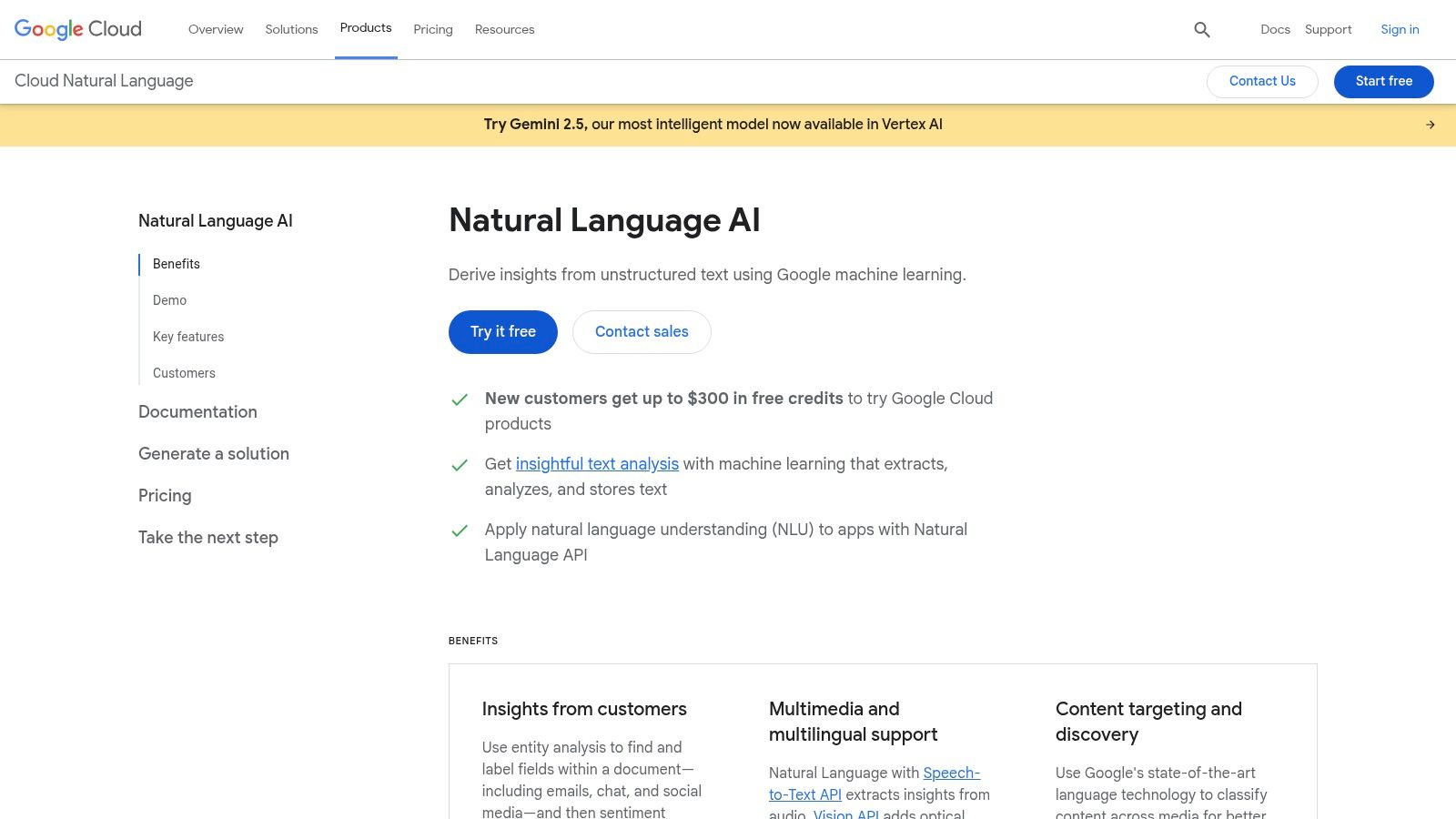
8. Google Cloud Natural Language AI
Google Cloud Natural Language AI is not a standalone platform but a powerful, flexible API that developers and product teams can leverage to build custom text analytics solutions. It provides a foundational layer for understanding unstructured text, making it one of the most accessible and scalable customer sentiment analysis tools for embedding directly into applications or data pipelines. Its strength lies in its raw analytical power and seamless integration within the Google Cloud ecosystem.
The platform's core offering is a simple REST API that can perform sophisticated document-level and entity-level sentiment analysis. This allows a business to not only understand the overall feeling of a customer review but also to identify the sentiment attached to specific entities mentioned, like a product name, a feature, or a brand, providing a much more granular view of customer feedback.
Key Features & Use Cases
- Granular Entity Sentiment Analysis: The API can isolate specific entities (people, products, locations) within text and assign a sentiment score to each. A product manager could use this to automatically process thousands of app store reviews, identifying which specific features are consistently generating positive or negative comments.
- Multilingual Support: It effectively analyzes sentiment across numerous languages, making it ideal for global companies looking to consolidate feedback from different regions without needing separate tools for each language.
- Custom Model Development: Through AutoML Natural Language, teams with specific needs can train custom models on their own data. This is useful for industries with unique jargon where standard sentiment models might fall short.
Pricing and Implementation
Google Cloud Natural Language AI operates on a pay-as-you-go model, with pricing based on the volume of text processed (per 1,000 characters). This makes it highly accessible for projects of any size, from small prototypes to large-scale production systems. Implementation requires engineering resources to call the API, process the data, and build a user interface or dashboard to visualize the results. While this offers immense flexibility, it means there is no out-of-the-box solution; you must build the surrounding infrastructure yourself, making it less suitable for non-technical teams.
Website: https://cloud.google.com/natural-language
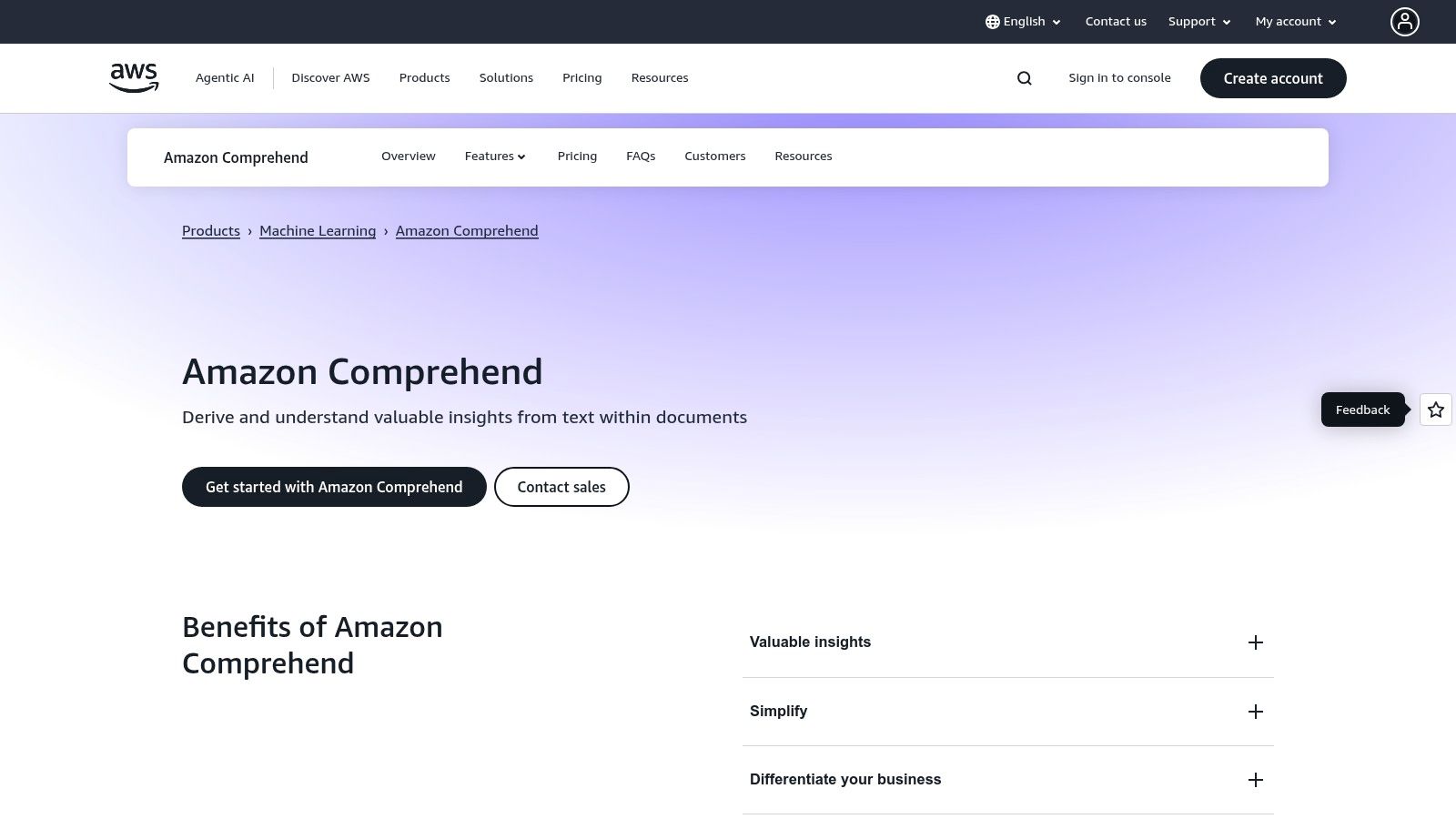
9. Amazon Web Services – Amazon Comprehend
For development teams already operating within the Amazon Web Services ecosystem, Amazon Comprehend offers a powerful, API-driven approach to sentiment analysis. It's a managed Natural Language Processing (NLP) service that removes the need to build and train models from scratch. Comprehend analyzes text to identify sentiment (Positive, Negative, Neutral, Mixed), key phrases, entities, and more, making it one of the most flexible customer sentiment analysis tools for custom applications.
The service's key advantage is its deep integration with other AWS services like S3 for data storage, Lambda for serverless processing, and Textract for extracting text from documents. This allows engineers to build sophisticated, automated data pipelines that can process feedback from support tickets, product reviews, or social media mentions at scale. It provides a foundational layer for companies wanting to infuse sentiment insights directly into their proprietary software.
Key Features & Use Cases
- Targeted Sentiment Analysis: Comprehend can go beyond document-level sentiment to identify the sentiment towards specific entities or features within the text. A product manager could use this to automatically determine if mentions of "user interface" in reviews are positive or negative.
- Synchronous and Asynchronous Processing: The service supports both real-time analysis via a synchronous API endpoint for immediate feedback (like in a live chat) and asynchronous batch jobs for processing large volumes of historical data stored in S3.
- Custom Models: For higher accuracy with domain-specific language, teams can train custom classification and entity recognition models using their own labeled data, tailoring the analysis to their unique business context. The role of AI in product management is expanding, and tools like Comprehend are central to this shift.
Pricing and Implementation
Amazon Comprehend follows a pay-as-you-go pricing model, which is highly attractive for startups and teams with fluctuating needs. There is a generous free tier for the first 12 months. Beyond that, pricing is based on the number of text units (1 unit = 100 characters) processed. However, costs can become complex; hosting real-time endpoints incurs an additional per-second charge, and training and using custom models are billed separately. Implementation is technical and requires developer expertise to integrate the API into an application or data workflow.
Website: https://aws.amazon.com/comprehend/?utm_source=openai
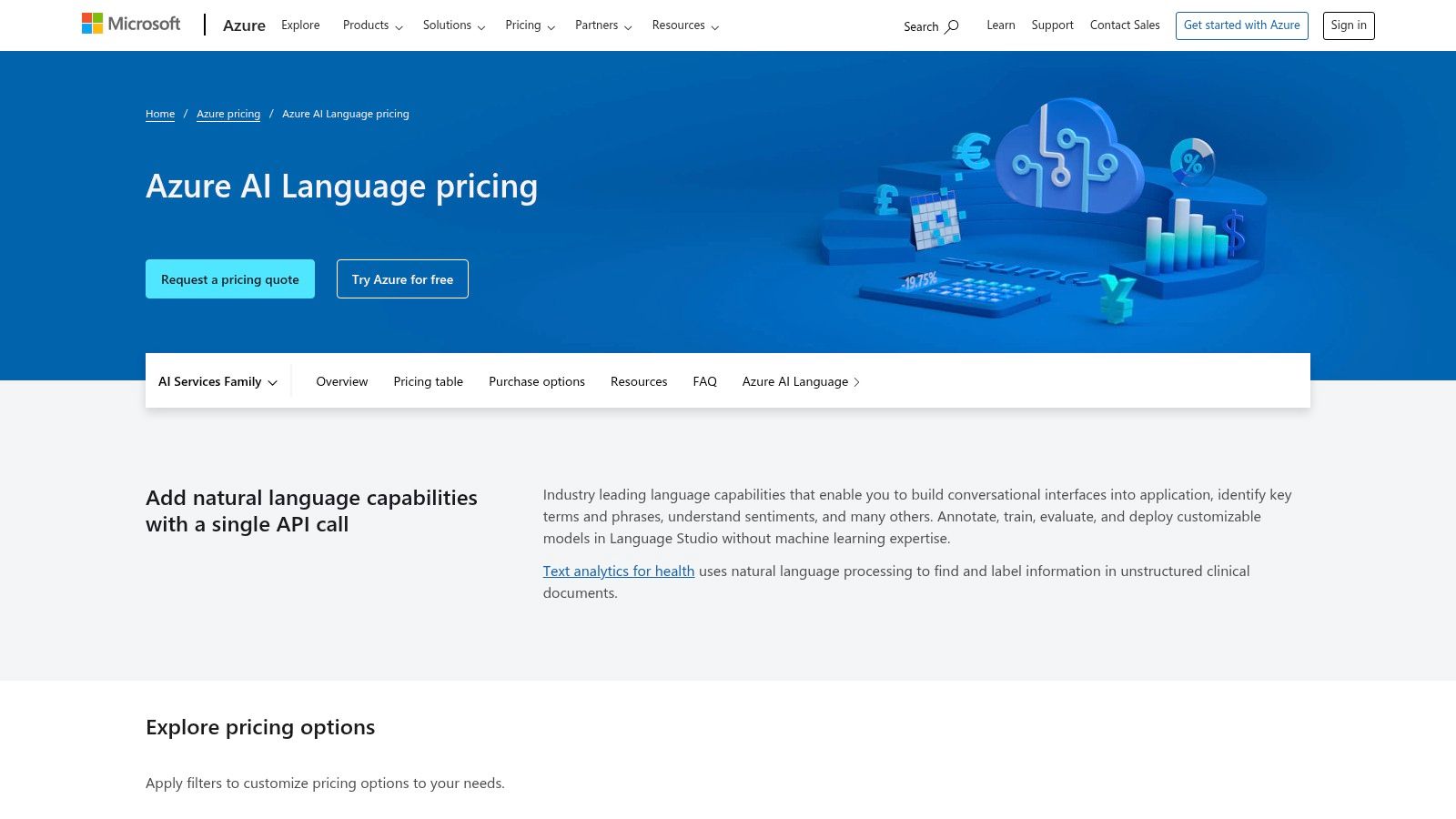
10. Microsoft Azure AI Language (Text Analytics)
Microsoft Azure's AI Language service provides a powerful, developer-focused suite of Natural Language Processing (NLP) capabilities, including robust sentiment analysis. Rather than a ready-made dashboard, it offers APIs that organizations can integrate into their existing applications, data warehouses, and business intelligence tools. This makes it a highly flexible and scalable option for companies with engineering resources looking to build custom customer sentiment analysis tools tailored to their specific data ecosystems.
The service's key differentiator is its enterprise-grade foundation, built on Microsoft's trusted cloud infrastructure. It offers features like aspect-based sentiment analysis (opinion mining), which can pinpoint sentiment towards specific attributes of a product or service mentioned in text. Furthermore, its support for container deployment allows for a hybrid approach, enabling businesses to run the service on-premises for enhanced data control and security, a critical feature for highly regulated industries.
Key Features & Use Cases
- Aspect-Based Sentiment Analysis: Go beyond a general sentiment score to understand opinions about specific topics or product features. A product team could analyze reviews to find out that while overall sentiment for their app is positive, sentiment specifically related to the "new UI" is negative.
- Flexible and Hybrid Deployment: The ability to run the language service in a container on-premises or in a private cloud is a major advantage. This allows organizations in finance or healthcare to analyze sensitive customer feedback without the data ever leaving their controlled environment.
- Integrated Language Capabilities: The service combines sentiment analysis with other valuable functions like key phrase extraction, named entity recognition, and personally identifiable information (PII) detection. A support team can use this to automatically redact sensitive data from feedback before it's analyzed for sentiment.
Pricing and Implementation
Azure AI Language operates on a consumption-based pricing model, charging per 1,000-character text records. This pay-as-you-go model is accessible, but costs can scale quickly with high volumes. For predictability, Microsoft offers commitment tiers and disconnected container licenses at fixed prices. Implementation requires development and engineering resources to call the API, process the JSON responses, and integrate the sentiment data into internal systems or BI platforms like Power BI. It is not an out-of-the-box solution for non-technical users.
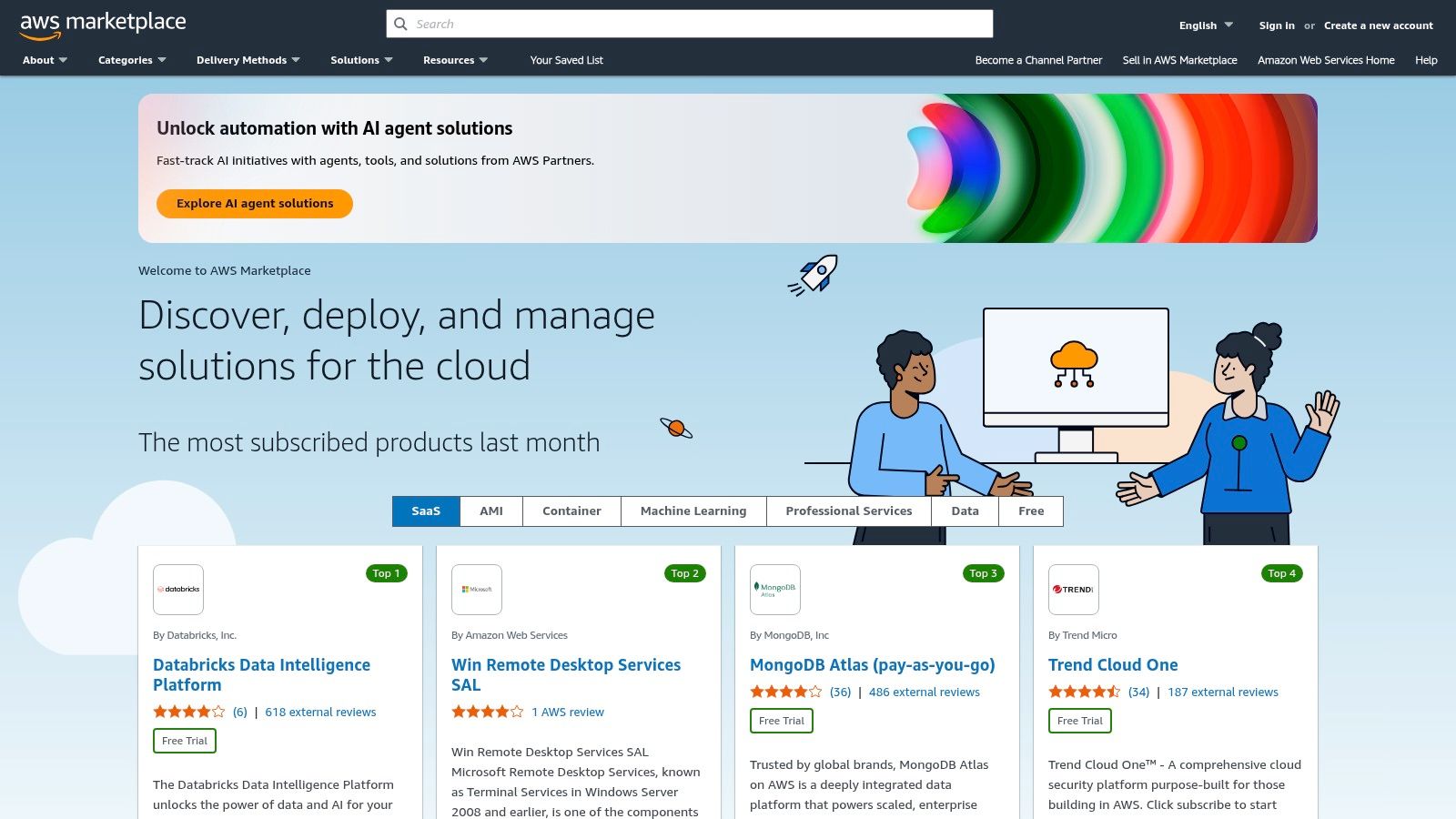
11. AWS Marketplace (3rd-party sentiment tools)
For organizations already embedded in the Amazon Web Services ecosystem, the AWS Marketplace offers a direct and efficient way to procure customer sentiment analysis tools without extensive vendor onboarding. Rather than a single product, it’s a curated digital catalog where teams can find, test, and deploy pre-built sentiment analysis APIs and machine learning models from various third-party vendors. This approach simplifies procurement by leveraging existing AWS billing and governance structures.
The marketplace model allows technical teams to quickly experiment with different solutions from vendors like Twinword and others. It's an ideal route for developers or data scientists who need to integrate a sentiment analysis function into an existing application or data pipeline and prefer a pay-as-you-go, API-driven approach over a full-platform subscription.
Key Features & Use Cases
- Simplified Procurement and Deployment: Users can subscribe to sentiment APIs directly through their AWS account, with charges appearing on their consolidated AWS bill. Deployment is often as simple as subscribing and gaining access to an API endpoint.
- Wide Vendor and Model Selection: The marketplace provides access to a diverse range of specialized sentiment models. A developer could find an API optimized for social media slang or another tailored for formal product reviews, allowing for a best-fit selection.
- Flexible and Usage-Based Pricing: Many listings offer pay-as-you-go or tiered pricing based on API call volume. This is highly advantageous for projects with variable demand or for teams wanting to run a small-scale proof-of-concept without a long-term contract.
Pricing and Implementation
Pricing is determined by individual vendors on the marketplace and varies significantly. Models range from free trials and per-API-call charges to monthly subscriptions. Implementation is typically straightforward for technical users, involving API key integration into their applications. However, the quality, language support, and documentation can vary greatly between vendors, requiring careful evaluation before committing to a specific tool for a large-scale project.
Website: https://aws.amazon.com/marketplace/?utm_source=openai
12. G2 – Text Analysis (category hub to compare sentiment tools)
Unlike a standalone platform, G2's Text Analysis category serves as a crucial research hub for buyers. It aggregates verified user reviews, feature comparisons, and real-time market rankings, making it an essential starting point for any team evaluating customer sentiment analysis tools. Instead of relying solely on vendor marketing, G2 provides a peer-driven perspective on how these tools perform in real-world scenarios.
The platform’s primary value lies in its proprietary Grid reports, which visually map out vendors based on market presence and customer satisfaction scores. This allows decision-makers to quickly identify market leaders, high-momentum contenders, and niche solutions that might otherwise be overlooked. By filtering results based on company size, industry, or required features, teams can efficiently create a validated shortlist of potential tools.
Key Features & Use Cases
- Vendor Shortlisting and Validation: Product managers can use G2’s Grid reports and detailed reviews to compare their initial list of tools against a benchmark of user satisfaction, helping to validate choices or discover better alternatives.
- Feature-Level Comparison: The platform allows for side-by-side comparisons of specific features like emotion detection, intent analysis, or CRM integrations. This helps technical leads ensure a tool meets their exact functional requirements.
- Understanding Implementation Realities: Verified reviews often contain valuable, candid insights into the implementation process, customer support quality, and the true total cost of ownership, information not typically found on a vendor's website.
Pricing and Implementation
G2 is free to use for buyers researching software. However, accessing certain in-depth reports or comparison tools may require creating a free account. The platform's main purpose is to connect buyers with sellers, so each profile provides direct links to request demos or pricing from the vendors themselves. While G2's sponsored placements can sometimes affect visibility, the sheer volume of verified, recent reviews makes it an indispensable resource for unbiased due diligence.
Website: https://www.g2.com/categories/text-analysis?utm_source=openai
Customer Sentiment Analysis Tools Comparison
| Product | Core Features/Characteristics | User Experience/Quality ★ | Value Proposition 💰 | Target Audience 👥 | Unique Selling Points ✨ | Price Points 💰 |
|---|---|---|---|---|---|---|
| 🏆 SigOS | AI-driven pattern detection, 87% correlation | Fast, sub-minute insights ★★★★ | Revenue impact quantification, churn ↓ | SaaS PMs, Growth, Customer Success | Automated integrations, real-time alerts, strong privacy | Contact sales, trial available |
| Qualtrics XM Discover | 150+ NLU models, root-cause, real-time alerts | Deep domain analysis ★★★★ | Actionable CX insights, multi-source | Enterprises, CX leaders | Domain-specific tuning, iQ analytics | Enterprise pricing |
| Medallia (Text Analytics) | Multichannel sentiment, video/audio transcripts | Integrated CX workflows ★★★ | Scalable sentiment scoring | Large enterprises, CX teams | Multilingual auto-tagging, timeline sentiment views | Quote-based pricing |
| Sprinklr Social Listening | Real-time social/firehose access, AI sentiment | Broad channel coverage ★★★ | Large-scale social insights | Enterprises, social teams | Crisis alerts, benchmarking dashboards | Pricing by quote |
| Brandwatch Consumer Research | 1.4T+ historical posts, API for uploads | Extensive data depth ★★★★ | Rich historical sentiment analysis | Enterprises, market researchers | Vast archive, robust alerting | Custom pricing |
| Talkwalker (Consumer Intelligence) | 150M sources, AI dashboards, unlimited users | Strong multilingual support ★★★ | Tiered plans for varied business sizes | SMB to enterprise, marketing | IQ Apps, Blue Silk AI dashboards | Tiered subscriptions |
| InMoment XI Platform | Sentiment, anomaly detection, workflow automation | End-to-end CX stack ★★★ | Action planning + automation | CX/EX professionals | Search-based mining, case management | Enterprise quotes |
| Google Cloud Natural Language AI | API-based sentiment, entity recognition | Scalable, prototyping friendly ★★★ | Pay-as-you-go, transparent pricing | Developers, product teams | REST API, integrations with Speech/Vision APIs | Per 1,000 chars pay-as-you-go |
| Amazon Comprehend | Sentiment/aspect level, batch & real-time | Flexible AWS integration ★★★ | AWS ecosystem integration | Developers, AWS users | Custom models, free tier first 12 months | Pay per usage |
| Microsoft Azure AI Language | Sentiment, opinion mining, PII detection | Enterprise-grade security ★★★★ | Hybrid deployment, predictable costs | Enterprises, regulated industries | Container support, compliance | Complex tiered pricing |
| AWS Marketplace (3rd-party) | Multiple sentiment APIs/vendors | Variable quality ★★ | Fast procurement, consolidated billing | AWS customers | Wide vendor choice, free trials | Varies by vendor |
| G2 – Text Analysis (category) | Reviews, Grid reports, buyer guides | User-verified ratings ★★★ | Vendor discovery & comparison tool | All buyers | Recent feedback, detailed profiles | Free access |
From Insight to Impact: Making Your Final Decision
The journey through the landscape of customer sentiment analysis tools reveals a powerful truth: understanding customer emotion is no longer a "nice-to-have" metric. It is the central nervous system of a modern, customer-centric organization. We've explored everything from comprehensive CX management platforms and specialized social listening suites to highly flexible, developer-focused APIs. The core takeaway is that the right tool doesn't just collect data; it provides a strategic lens through which you can prioritize resources, mitigate churn, and identify untapped growth opportunities.
Your selection process should now be clearer. You've seen how enterprise-grade solutions like Qualtrics XM Discover and Medallia offer a holistic view of the customer experience, ideal for large organizations managing feedback across numerous touchpoints. In contrast, tools like Sprinklr and Brandwatch excel at capturing the unstructured, unfiltered voice of the customer from the vast expanse of the social web, making them essential for brand health monitoring and competitive intelligence. For teams with the technical prowess to build bespoke systems, the raw power of APIs from Google Cloud, AWS, and Azure offers unparalleled customization.
Charting Your Path Forward: Key Decision Factors
Choosing from this diverse array of options can feel overwhelming. To cut through the noise, focus your decision-making process on three critical pillars: your primary use case, your available resources, and your desired business outcome. A mismatched tool, no matter how powerful, will only create friction and lead to underutilized investment.
Here are the crucial questions to guide your shortlisting process:
- What is your primary source of truth? Is your most valuable feedback buried in support tickets and CRM notes? Are you more concerned with public brand perception on social media and review sites? Or do you need to analyze survey responses at scale? The answer will immediately point you toward either an internal feedback aggregator, a social listening platform, or a survey analysis tool.
- What is your team's technical capacity? Be honest about your internal resources. Do you have a dedicated data science and engineering team ready to integrate an API like Amazon Comprehend? Or do you need an out-of-the-box, no-code solution with intuitive dashboards that your product and support teams can use immediately?
- What is the desired end-action? This is the most important question. Is your goal simply to generate a monthly sentiment report for leadership? Or is it to directly influence the product roadmap, automate the routing of at-risk customers to success teams, and tie specific customer feedback to revenue impact? Your answer separates reporting tools from true operational intelligence platforms.
From Analysis to Action: The Final Mile
Ultimately, the best customer sentiment analysis tools are those that close the loop between insight and action. A dashboard full of sentiment scores is only valuable if it tells you what to do next. This is where a clear connection between customer feedback and business metrics becomes non-negotiable. If a tool can highlight that 15% of your negative sentiment is linked to a specific usability issue that is also a primary driver of churn, you have a clear, data-backed case for prioritizing a fix.
This final mile is where many initiatives fail. The implementation of your chosen tool should include a clear workflow for acting on the insights it generates. Who owns the feedback? How are critical insights routed to the correct product, engineering, or support teams? How will you measure the impact of the changes you make based on this feedback? Answering these questions upfront will ensure your investment translates into tangible business growth, improved customer loyalty, and a superior product.
Your next step is to take this guide, create a shortlist of two or three top contenders that align with your needs, and begin the trial process. Engage their sales and support teams, connect your actual data sources, and see which platform delivers the most actionable clarity for your unique challenges. Transforming customer feedback from a noisy dataset into your most valuable strategic asset is within reach.
Ready to move beyond simple sentiment scores and connect customer feedback directly to revenue and product priorities? SigOS is a product intelligence platform that uses advanced sentiment analysis to automatically surface the most impactful issues and opportunities from your support tickets, reviews, and surveys. See how SigOS can help you build a customer-driven roadmap.
Keep Reading
More insights from our blog

Ready to find your hidden revenue leaks?
Start analyzing your customer feedback and discover insights that drive revenue.
Start Free Trial →