Growth strategy framework: SaaS playbook with AARRR, North Star, and JTBD
Explore a practical growth strategy framework for SaaS startups and compare AARRR, North Star, and JTBD to drive sustainable growth.

A growth strategy framework is really just a structured model that guides a company’s decisions on how to grow in a sustainable way. Think of it as a repeatable system—a GPS for your business—that gets every team aligned around the same set of priorities and metrics.
Why Your SaaS Needs a Growth Strategy Framework
Without some kind of structured approach, growth efforts can feel pretty chaotic. Marketing is off launching campaigns, sales is chasing down every possible lead, and the product team is busy building new features. The problem is, these activities often happen in silos, completely disconnected from each other.
A growth strategy framework acts as the connective tissue. It transforms all those scattered efforts into a focused, unified engine driving toward a single destination. It gives everyone a shared language and a clear set of rules for making the tough decisions that inevitably come up.
This kind of thinking isn't new. One of the earliest corporate growth models was the Ansoff Matrix, which came out way back in 1957. It helped leaders decide whether to grow by focusing on existing products, new products, existing markets, or new markets. Companies that used its "market penetration" strategy historically saw steady annual revenue growth of 5-10%, which just goes to show how powerful a focused plan can be.
Turning Ambition into Action
A well-defined framework does a lot more than just organize your thoughts; it directly impacts your ability to scale. It forces you to answer the big, critical questions that are all too easy to ignore in the day-to-day rush of running a business.
This is especially critical for SaaS companies. The right framework helps you cut through the noise and navigate common challenges by providing real clarity on:
- Prioritization: What do we do next? Deciding which feature to build, which market to enter, or which bug to fix.
- Resource Allocation: Justifying where to invest your limited time, budget, and engineering talent to get the highest possible return.
- Performance Measurement: Defining what success actually looks like with clear, measurable metrics that everyone understands.
- Team Alignment: Making sure that product, marketing, sales, and support are all rowing in the same direction toward a common goal.
Ultimately, a growth strategy framework is the bridge between your high-level vision and the daily actions your team takes to make it happen. To get a better handle on the foundational elements, you can explore insights on a digital marketing strategy framework. It provides the discipline you need to move beyond random acts of growth and build a business that can scale sustainably.
Comparing Popular Growth Frameworks for SaaS
Picking a growth strategy framework is a bit like choosing the right lens for a camera. You wouldn't use a wide-angle lens for a portrait, and you wouldn't use a macro lens for a landscape. Each framework is designed to bring a specific part of your business into sharp focus, giving you the clarity you need for a particular challenge or stage of your SaaS journey.
Let's walk through four of the most trusted frameworks that top SaaS companies swear by. Getting a feel for their core philosophies will help you understand not just what they measure, but why they’re so effective.
This map gives you a high-level view of how these systems help you prioritize initiatives, align your teams, and measure what truly matters.
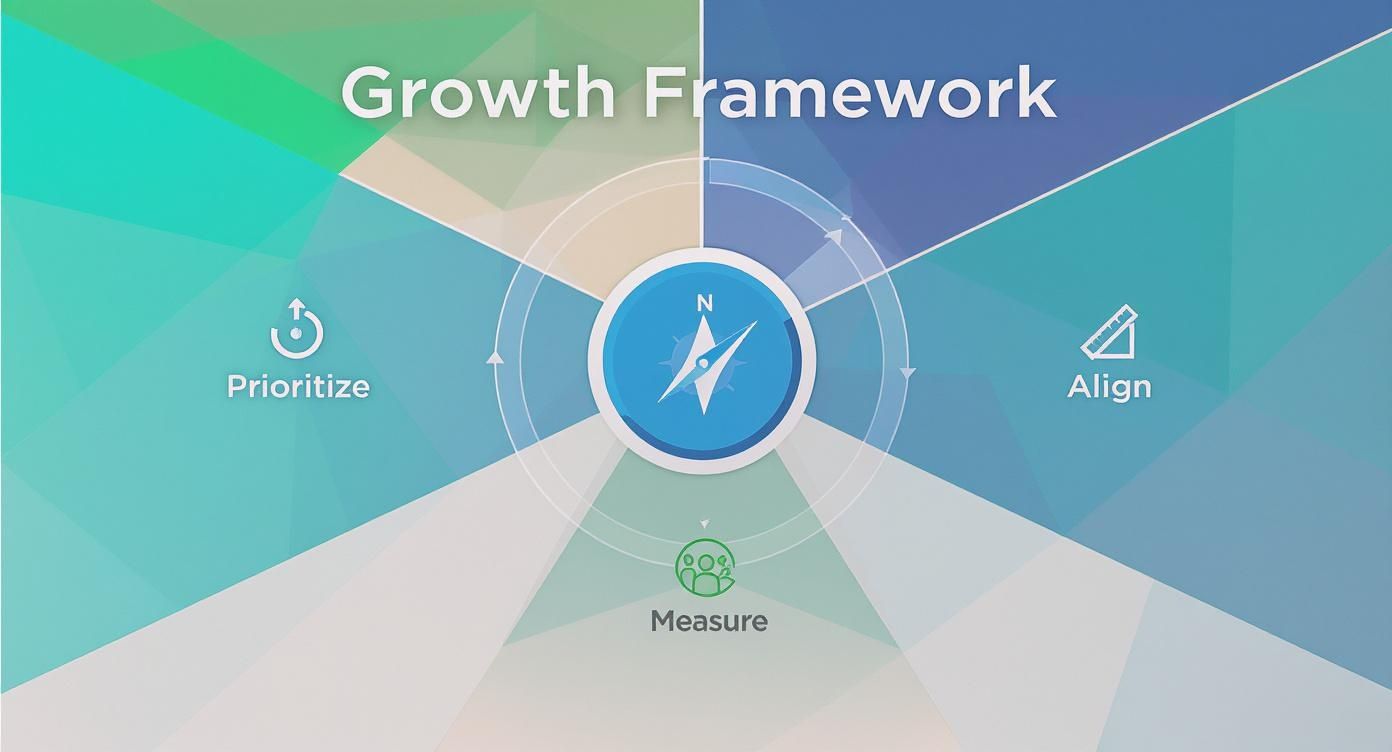
The real power here isn’t just in the metrics themselves. It's in having a complete system for making smarter, more coordinated decisions across the entire company.
To help you see how these frameworks stack up, here’s a quick side-by-side comparison.
Growth Strategy Frameworks At a Glance
| Framework | Primary Focus | Best For | Key Question It Answers |
|---|---|---|---|
| AARRR (Pirate Metrics) | Customer Lifecycle & Funnel Health | Diagnosing and fixing leaks in the user journey, especially for new products. | Where are users dropping off in our funnel? |
| North Star Metric (NSM) | Company-Wide Alignment & Value Delivery | Uniting all teams (product, marketing, sales) around a single, customer-centric goal. | What is the single most important measure of the value we deliver? |
| Jobs-to-be-Done (JTBD) | Customer Motivation & Innovation | Uncovering deep customer needs to inform product development and messaging. | What progress is our customer trying to make by "hiring" our product? |
| RICE Scoring Model | Feature & Initiative Prioritization | Making objective, data-informed decisions about what to build next. | Which idea will have the biggest impact with the least amount of effort? |
Each framework offers a unique perspective. Some are for high-level direction, while others are for tactical, on-the-ground decision-making. Now, let's get into the specifics of each one.
AARRR Pirate Metrics for Funnel Optimization
The AARRR framework, affectionately known as "Pirate Metrics," is your go-to diagnostic tool for the entire customer lifecycle. It forces you to look at the user journey as a series of five distinct, measurable stages:
- Acquisition: How are people discovering you?
- Activation: Are they having a fantastic first experience?
- Retention: Are they coming back for more?
- Referral: Are they telling their friends about you?
- Revenue: How are you actually making money from their activity?
This model is a lifesaver for plugging leaks in your customer funnel. For instance, if you have a ton of sign-ups (Acquisition) but almost no one completes the setup process (Activation), you know instantly that your onboarding is broken. It gives you a clear, linear map of user behavior, which is particularly valuable for teams leaning into a product-led growth motion. If that's you, our deep dive on product-led growth principles is a must-read.
The North Star Metric for Company Alignment
If AARRR is the map of the journey, the North Star Metric (NSM) is the destination you're sailing toward. It’s a single, powerful metric that perfectly encapsulates the core value your product delivers to its users.
Take Airbnb. Their NSM is "nights booked." That one number aligns every single team. Marketing launches campaigns to drive bookings. The product team builds features to make booking easier. Customer support works to resolve issues that stand in the way of a booking. A great NSM is a leading indicator of success; it predicts future revenue, unlike a trailing metric like last month's MRR.
Jobs-to-be-Done for Deep Customer Understanding
The Jobs-to-be-Done (JTBD) framework completely reframes how you think about your product. It pushes you to stop focusing on what your product is and start obsessing over why a customer "hires" it in the first place. The central idea? People don't buy products; they hire them to make progress in their lives.
JTBD helps you answer the crucial question: "What job is my customer desperately trying to get done?" For a project management tool, the job isn't just "manage tasks." It’s more likely "reduce my anxiety about missing a big deadline" or "help me look organized and in control in front of my boss." This kind of insight is pure gold for innovation, marketing messaging, and building features that solve the real, nagging problems people face every day.
The RICE Model for Prioritization
Okay, so you’ve used these other frameworks and now you have a backlog overflowing with brilliant ideas. How on earth do you decide what to tackle next? Enter the RICE scoring model, a beautifully simple system for bringing objective, data-driven thinking to your prioritization process. It strips away emotion and gut feelings.
RICE has you score every potential project against four clean factors:
- Reach: How many people will this impact over a set period?
- Impact: How much will this move the needle for those people? (Often scored on a scale: 3 for massive, 2 for high, 1 for medium, 0.5 for low).
- Confidence: How sure are you about your Reach and Impact numbers? (Use percentages: 100% for high confidence, 80% for medium, 50% for low).
- Effort: How much time and resources will this take from your team? (e.g., person-months).
The final score is calculated with a simple formula: (Reach x Impact x Confidence) / Effort. The higher the RICE score, the higher the priority. This makes it an incredibly powerful tool for product managers who need to make transparent, justifiable decisions about what gets built and when.
How to Choose the Right Framework for Your Business
Picking a growth strategy framework isn't like ordering off a menu. Grabbing the most popular one without thinking is like using a hammer to fix a software bug—you have a tool, but it’s the wrong one for the job. The right framework for you depends entirely on where you are as a business, the specific walls you're hitting, and what you’re ultimately trying to achieve.
Think of it this way: your choice of framework should be a direct answer to your biggest growth question. What’s the one problem that keeps you up at night? Answering that honestly is the first, most crucial step toward finding a system that will actually guide your team and focus your efforts.
Match the Framework to Your Business Stage
The maturity of your company is probably the single biggest factor. An early-stage startup wrestling with product-market fit has a completely different set of problems than a market leader trying to fend off new competition. Each stage needs a different lens to see the path forward.
Here’s a simple way to think about it:
- Early-Stage (Pre-Product-Market Fit): Right now, your entire world revolves around one question: have we built something people truly want and will pay for? This is where the Jobs-to-be-Done (JTBD) framework shines. It forces you to stop admiring your own solution and instead uncover the deep, underlying motivations of your customers. You'll build a product that solves a real-world problem, not just a problem you think exists.
- Growth-Stage (Post-Product-Market Fit): You’ve got traction. You have a solid product and customers who pay. The problem? Your user journey feels like a leaky bucket. Users are signing up, but they're also disappearing. The AARRR (Pirate Metrics) framework is your best friend here. It gives you a diagnostic map of your entire funnel, showing you exactly where users are dropping off—from acquisition to revenue—so you can plug the biggest holes first.
- Mature Stage (Scaling and Optimization): The company is growing, but things are getting messy. Teams are starting to drift apart. Marketing has their KPIs, product has theirs, and sales is chasing a different number altogether. This is the perfect time to introduce a North Star Metric (NSM). It gives every single department one unifying goal that’s directly tied to delivering customer value, ensuring everyone is rowing in the same direction.
Diagnosing Your Biggest Growth Bottleneck
Beyond your company’s stage, you need to get brutally honest about the specific bottleneck holding you back right now. A framework is a problem-solving tool, so you have to define the problem first.
Is your team stuck in endless debates about which features to build next? Does every new idea seem like the most important one? The RICE scoring model can cut through that noise. It replaces subjective opinions with a clear, data-driven process, bringing much-needed objectivity to your roadmap prioritization.
This kind of clarity is more important than ever. With global GDP growth projected to slow to 3.1% by 2026, you can no longer rely on a booming economy to lift your business. Growth has to come from smart, efficient, and targeted strategies that make the most of every resource. Choosing the right internal framework is a huge step toward building the resilience you'll need to thrive when the market gets tough. You can read more about these macroeconomic trends from the IMF.
Key Questions to Guide Your Decision
Still on the fence? Get your leadership team in a room and work through these questions. The answers will point you toward the framework that will make the biggest impact today.
- What is the single biggest obstacle to our growth right now?
- Lack of team alignment? Go with the North Star Metric.
- A leaky, confusing user journey? You need AARRR.
- Can’t decide what to build next? Implement RICE.
- Don't really know what our customers want? Start with JTBD.
- What is the most important outcome we need to achieve this year?
- Increase customer value and long-term retention? That’s an NSM.
- Fix our broken onboarding and conversion rates? That’s AARRR.
- Find new, game-changing market opportunities? That’s JTBD.
- What behavior do we want to encourage in our teams?
- Cross-functional collaboration? The NSM is built for exactly this.
- Rapid experimentation and funnel optimization? AARRR is your playbook.
- Deep customer empathy? JTBD hardwires this into your culture.
By honestly assessing your stage, identifying your main bottleneck, and asking these tough questions, you can confidently pick the growth strategy framework that will not only solve your immediate problems but also build a foundation for sustainable, long-term success.
Putting Your Growth Framework Into Action
A growth strategy framework is just a pretty theory until you roll up your sleeves and put it to work. Choosing a model is the easy part. The real magic happens during implementation—turning those high-level ideas into daily actions, experiments, and team-wide habits. This is where the abstract concept of "growth" becomes a tangible, measurable process.
To make this real, let’s walk through a scenario with a fictional SaaS company. We'll call them ConnectSphere, a project management tool for remote teams. They've seen a nice surge in sign-ups, but their long-term engagement is weak. They've realized their user journey is a classic leaky bucket.
Their biggest headache? Turning those "activated" users who've kicked the tires into loyal, paying customers. Based on this very specific bottleneck, they’ve wisely chosen the AARRR (Pirate Metrics) framework to diagnose the leaks and start patching the holes.

Step 1: Define Each Stage of the AARRR Funnel
First things first, ConnectSphere has to define what each stage of the AARRR funnel means for their business specifically. Generic definitions are useless here. The metrics have to reflect their unique product and how users actually behave.
- Acquisition: A visitor signs up for a 14-day free trial.
- Activation: The user creates their first project and invites at least two team members. This is their "aha!" moment.
- Retention: A user is active in the platform at least three days within a given week.
- Referral: A user successfully invites a new team that activates their own account.
- Revenue: A user upgrades to a paid plan.
By setting these clear, unambiguous definitions, every team at ConnectSphere is now speaking the same language. There’s no more confusion about what it means to be an "active" or "acquired" user.
Step 2: Identify and Track Key Metrics
With the stages defined, it's time to hook up the analytics and track the conversion rates between each one. ConnectSphere needs to see exactly where users are bailing.
They pull the data from last month to establish a baseline:
- Acquisition Rate: 5,000 new trial sign-ups.
- Activation Rate: 40% of new users activate (2,000 users).
- Retention Rate (Week 1): Only 30% of activated users are still active after seven days (600 users).
- Referral Rate: A tiny 2% of activated users refer a new team.
- Revenue Conversion: 15% of activated users convert to paid (300 users).
The data tells a clear story. They have two massive leaks: the drop-off between Activation and Retention is a chasm (a 70% loss), and the Referral rate is basically a rounding error. Now they know exactly where to focus their energy.
Improving retention often means digging into user behavior over time. We've actually written a detailed guide on how to perform a cohort retention analysis to get these kinds of deeper insights.
Step 3: Design and Run Targeted Experiments
Now for the fun part: taking action. Armed with hard data, ConnectSphere’s growth team can form educated hypotheses to fix the leaks. No more guessing games. The framework guides their experiments.
Hypothesis to Fix Retention: "We believe users who don't get a project template during onboarding feel overwhelmed and don't come back. If we introduce a template library during the activation flow, we predict week-one retention will jump by 20%."
Hypothesis to Boost Referrals: "We think our users are happy, but they probably don't even know we have a referral program. If we add a clear 'Invite & Earn Credit' call-to-action on the main dashboard, we predict the referral rate will climb to 5%."
See the difference? These aren't vague goals. They are specific, measurable, and time-bound experiments that give the team a clear plan to execute.
Case Scenario: North Star Metric Implementation
What if ConnectSphere had a different problem? Let's imagine their main issue wasn't a leaky funnel but a lack of focus across teams. In that case, they might have picked the North Star Metric (NSM) framework instead.
Their process would look totally different:
- Brainstorm a Metric Tied to Customer Value: The team gets in a room and debates what single action best represents a customer getting real value. They argue over "Projects Completed" vs. "Tasks Checked Off" vs. "Weekly Active Teams." They eventually land on "Weekly Active Teams" because it perfectly captures both engagement and collaboration—the core promise of their product.
- Validate the NSM Against Revenue: They dig into historical data and find a powerful correlation. Teams that are active every week are 80% more likely to upgrade to a paid plan and 90% less likely to churn. The metric is a winner.
- Define Input Metrics for Each Team: This is the most crucial step for getting everyone aligned. The NSM is the big-picture outcome, but each team needs a goal they can directly control.
- Product Team: Increase the percentage of teams using the new "integrations" feature.
- Marketing Team: Increase the number of new teams signing up from their targeted content marketing.
- Customer Success Team: Decrease the time to first response for support tickets, keeping teams unblocked and active.
Just like that, every department at ConnectSphere understands exactly how their day-to-day work drives the company's single most important goal. By following these structured steps, any SaaS company can take a growth framework off a slide deck and turn it into a powerful, action-oriented system that actually delivers results.
Tying Your Framework to Real Customer Insights
A growth strategy framework is brilliant at showing you what's happening. It’ll tell you that your Week 1 retention rate just dropped by 15% or that your activation numbers are flatlining. But it can't tell you the most important thing: why. To get that answer, you have to connect the dots between your quantitative data and the voice of your customer.
Think of your framework's metrics as the smoke signals. The qualitative customer insights—the real stories, frustrations, and ideas—are the fire. When you systematically pull in feedback from support tickets, sales calls, surveys, and app store reviews, you build a direct line from real-world user problems to your strategic priorities. This is how a framework goes from being a simple reporting tool to a dynamic, customer-led engine for growth.

From Metrics to Motivation
Let's say your AARRR dashboard is flashing red. Your Retention metric has taken a serious nosedive. The numbers themselves don’t offer a solution; they just pose a question. But when you start digging into support tickets from that same timeframe, a clear pattern emerges: a 40% spike in complaints about a confusing new feature you just added to the navigation bar.
Bingo. You've just found a direct, actionable link. That confusing feature is frustrating people and pushing them away. This insight is pure gold. It gives you a data-backed hypothesis for an experiment: "If we simplify the navigation, we believe our retention metric will improve." To consistently uncover these kinds of truths, it's crucial to get comfortable with various qualitative research analysis methods.
A growth framework without customer feedback is like driving with a GPS that shows your location but doesn't have any roads on the map. You know where you are, but you have no context to decide which way to turn next.
This feedback loop is what separates the good growth teams from the great ones. They aren’t just trying to move numbers up and to the right; they're solving the human problems that are driving those numbers in the first place.
Building a Systematic Feedback Loop
To make this connection work consistently, you need a repeatable system for gathering and analyzing all that qualitative data. You can't let valuable feedback get trapped in departmental silos.
Here’s a practical way to get started:
- Centralize All Your Feedback: Find a tool or set up a process to funnel every piece of customer communication—from support chats and sales call notes to user interviews and survey responses—into one single, accessible place.
- Tag Feedback by Framework Stage: Start categorizing each piece of feedback based on the metric it impacts. A complaint about a bug during onboarding? Tag it 'Activation.' A brilliant feature request from a long-term power user? That gets tagged 'Retention.'
- Quantify the Qualitative Data: Once everything is tagged, you can look for trends. If 25% of your churned users mention the same missing integration in their exit surveys, you suddenly have a quantified business case for prioritizing it.
This process is absolutely essential for frameworks like Jobs-to-be-Done, where the entire focus is on understanding the customer's struggle. If you want to dive deeper, our guide includes a really useful Jobs-to-be-Done template to help you get going.
Platforms like SigOS take this a step further by operationalizing these customer insights. They can analyze thousands of unstructured comments and automatically surface the issues that are most strongly correlated with churn or lost revenue. This allows teams to prioritize not just by the volume of complaints, but by the actual financial impact of solving a user's problem. It ensures your growth strategy framework is always laser-focused on what truly matters to your customers and, ultimately, your bottom line.
Common Questions About Growth Frameworks
When teams first start putting a growth strategy into practice, a few key questions always pop up. It's one thing to understand a framework in theory, but making it work day-to-day can feel like a different beast entirely. Let's walk through some of the most common hurdles to smooth out the process.
Getting these things straight from the get-go helps get everyone on the same page. It transforms a framework from a rigid set of rules into a genuinely useful tool for your team.
Can We Use More Than One Growth Framework at a Time?
Yes, absolutely. In fact, the best growth teams rarely stick to just one. Think of these frameworks less like competing philosophies and more like different tools in a toolbox, each designed for a specific job.
It’s incredibly common—and effective—to see a company stack them:
- A North Star Metric acts as your company's compass, giving everyone a single, high-level destination to aim for.
- The RICE model then comes in at the team level, helping product managers or feature teams decide which specific projects will actually move that North Star.
- Meanwhile, AARRR can be used to map out and optimize the entire customer journey, ensuring you're improving the path that leads users to the value your North Star represents.
The secret is making sure they all work in harmony. Your North Star defines the "what," while frameworks like RICE and AARRR help you nail the "how."
How Often Should We Revisit Our Growth Framework?
Your main, big-picture framework—like a North Star Metric—should be pretty stable. You want to give it at least a year to take hold and really start guiding decisions across the company. If you’re constantly changing your primary goal, you'll just create confusion and whiplash.
That said, the specific projects, experiments, and smaller metrics feeding into that framework should be looked at all the time. Most teams do this quarterly, monthly, or even weekly in their growth meetings.
A major change to your core growth framework should only happen if your business model makes a fundamental shift or it becomes crystal clear that you're chasing the wrong outcome.
What Is the Biggest Mistake to Avoid When Implementing a Framework?
The number one mistake we see is when teams treat a framework like a report card instead of a decision-making engine. It's easy to get caught up in tracking the numbers perfectly but then fail to use that data to ask "why," form new hypotheses, and run experiments.
The real power of a framework isn't in the pretty charts it generates; it's in the actions and learning it inspires. The second-biggest trap is not getting real buy-in across the company. If only the product or marketing team cares, the framework stays in a silo, and you miss out on the incredible power of organization-wide alignment.
SigOS helps you avoid these mistakes by connecting your framework directly to customer feedback. Our platform turns qualitative data from support, sales, and reviews into prioritized, revenue-impacting inputs, ensuring your growth strategy is always guided by what customers truly need. Learn how to operationalize your framework with SigOS.
Keep Reading
More insights from our blog
Ready to find your hidden revenue leaks?
Start analyzing your customer feedback and discover insights that drive revenue.
Start Free Trial →