How to Write Product Requirements That Get Built
Learn how to write product requirements that align your team and prevent rework. Get practical strategies, real-world examples, and proven templates.
Writing product requirements is all about creating a clear, shared understanding of what you're building, who you're building it for, and why it matters. This document becomes the single source of truth that guides your design, engineering, and marketing teams, ensuring everyone is pulling in the same direction.
Why Great Requirements Are Your Project’s Foundation

Let's be honest—drafting a Product Requirements Document (PRD) can sometimes feel like a chore. It's tempting to jump straight into design mockups or coding. But from my experience, rushing this step is one of the most expensive mistakes a product team can make. A solid PRD is what separates successful projects from those that spiral into confusion, rework, and missed deadlines.
When you don't have a clear, shared understanding of the goals, the entire project is built on shaky ground. Vague requirements are the number one reason I've seen budgets get blown and teams get frustrated. It forces engineers to make assumptions and designers to guess what users actually need.
The True Cost of Ambiguity
The damage from poorly defined requirements isn't just a minor headache; it has a massive financial impact. Research has shown that a staggering 60% to 80% of software development costs can be traced back to rework caused by misalignment. On the flip side, getting requirement management right can slash project defects by up to 80%, saving countless hours and getting your product to market faster. You can find more insights on how clear requirements impact project costs online.
This process isn't about creating rigid, bureaucratic documents that nobody reads. It’s about creating alignment and giving your team the clarity they need to build the right thing from the start.
Before we get into the nitty-gritty of how to write product requirements, let’s look at the essential building blocks. Think of these as the key pillars that support your entire project.
Core Components of a Product Requirements Document (PRD)
A quick summary of the essential elements every PRD should contain to ensure clarity and alignment across teams.
| Component | Purpose and Key Questions Answered |
|---|---|
| Objectives & Success Metrics | Why are we building this? This section defines what success looks like with specific, measurable goals (e.g., "increase user engagement by 15%"). |
| User Personas & Scenarios | Who are we building for? This brings your target user to life, detailing their problems and the situations where your product will help them. |
| User Stories & Features | What will it do? This is the heart of the document. It breaks down functionality into actionable items, prioritizing features from the user's perspective. |
| Technical Constraints & Assumptions | What are the boundaries? This part addresses potential roadblocks, technical limitations, or dependencies the team needs to know about before they start. |
Each of these components answers critical questions that prevent ambiguity down the line, giving your team the context and direction they need to succeed.
Gathering Insights That Actually Matter
Solid product requirements aren't born from a blank page; they start with deep listening. It’s all about digging past the surface-level feature requests to get to the root of the problem your customers are desperately trying to solve. Forget the generic advice to "just talk to users." Let's get into the nitty-gritty techniques that pull out the insights that truly move the needle.
This early discovery work is your foundation. It's the evidence you'll lean on for every single decision you make down the line. The goal isn't to ask people what features to build, but to deeply understand what they're trying to accomplish.
Go Beyond Surface-Level Interviews
Everyone does stakeholder and user interviews, but most of them are a waste of time. Their value hinges completely on how you ask questions. If you ask, "Would you use a new dashboard?" you're just begging for a polite "yes" that tells you nothing.
You have to shift the focus to their past behavior and current reality. Ask questions that get them to tell you a story about their struggles:
- "Walk me through the last time you had to [complete a specific task]. Where did you get stuck or frustrated?" This gets you real, tangible friction points.
- "What workarounds have you pieced together to solve this today?" This is gold. It tells you how motivated they are and what they've already tried.
- "If you had a magic wand and could change anything about this process, what would it be?" This opens the door to bigger thinking beyond just small tweaks.
By focusing on the "job" they are trying to get done, you move beyond a simple feature wish list. To really nail this, I'd recommend using a framework. You can explore a practical Jobs-to-be-Done template to help keep your interviews focused on outcomes, not outputs.
Mine Your Existing Data for Gold
Believe it or not, your company is already sitting on a treasure trove of user feedback. You just need to know where to look and how to piece it all together. Don't let this raw intelligence go to waste.
Support tickets, call logs from customer success, and even notes from the sales team are unfiltered sources of user pain. Sift through them looking for patterns. Are 20% of your support tickets circling back to the same confusing UI element? That’s not a coincidence; it's a signal flare.
It’s also worth spending time on public review sites like G2 or Capterra. The feedback there is incredibly candid. I particularly look for comments where users compare our product to a competitor—that's where you'll find what really matters to them, for better or for worse.
Analyze the Competitive Landscape
Looking at your competitors isn't about blindly copying their features. It's about spotting the gaps in the market—the places where you can deliver something uniquely valuable. A good competitive analysis is your defense against building a "me-too" product.
Here's a simple way to approach it:
- Pinpoint 3-5 competitors. Include both direct rivals and the indirect tools your customers might be using instead of you (think spreadsheets, an in-house solution, etc.).
- Map out their core features. How are they solving the same problem you're tackling? What's their angle?
- Read their user reviews. The one-star and five-star reviews are the most revealing. They'll tell you what people absolutely love and what drives them crazy.
- Dissect their positioning and pricing. What story are they telling the market? Who are they trying to be?
Doing this homework gives you crucial context. The insights you pull from this process will feed directly into your objectives, helping you write requirements that are not just user-centric but strategically sharp.
Structuring a PRD for Maximum Clarity
So, you've done the hard work of gathering all your raw insights. Now comes the real challenge: how do you turn that mountain of knowledge into a document that people will actually read and use? A great Product Requirements Document (PRD) isn't some dusty, static spec sheet; it's a living, breathing communication tool. Its entire structure should be designed to walk the reader through the why, who, and what of your project with zero ambiguity.
Think about it this way: the organization of your PRD directly impacts its success. A messy or confusing document just creates more questions, encourages bad assumptions, and ultimately leads to rework down the line. But a well-structured PRD? That becomes the team's single source of truth, empowering everyone from engineering to marketing to make smart decisions on their own.
This visual flow shows how you can take all those inputs and wrangle them into a structured, coherent document.
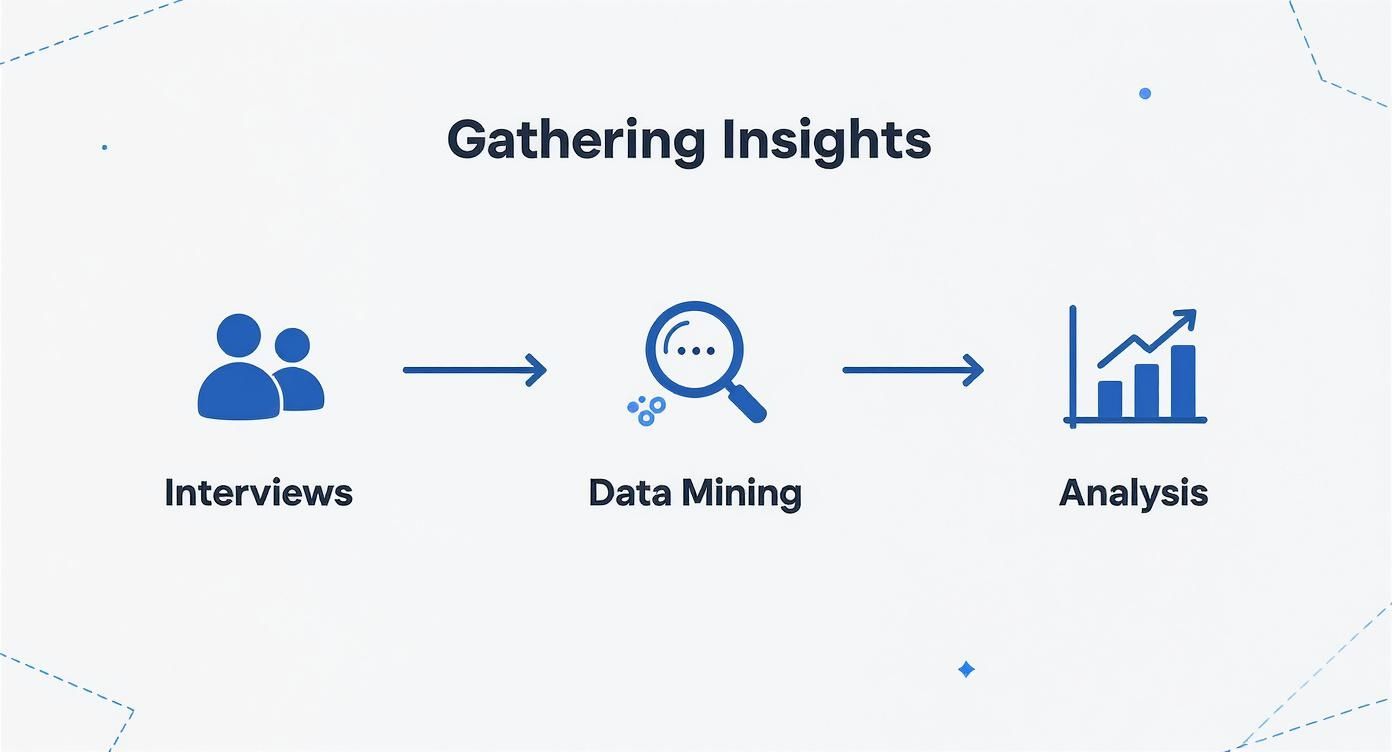
The key takeaway here is that building the document is the final step. It only comes after you've rigorously interviewed users, mined the data, and synthesized your findings to make sure every requirement is backed by real evidence.
Start with a Compelling Summary
Your executive summary is, without a doubt, the most important part of the entire PRD. Why? Because it’s often the only part senior stakeholders will read. It has to be short, sharp, and compelling, hooking them immediately with the project's core purpose and business value. This isn't just an introduction; it's your elevator pitch for the whole initiative.
A solid summary gives a high-level view of the product's purpose, the background context (like market shifts or a competitor's move), and crystal-clear, measurable goals. Think in terms of outcomes, like increasing user engagement by 15% or cutting churn by 10%. The PRD should also clearly define who the stakeholders are, from internal team members like product managers and engineers to external ones like customers or even regulatory bodies.
Define the Problem and Success Metrics
Once you've set the stage, you need to get laser-focused on the specific user problem you're solving and exactly how you'll measure success. This section is your best defense against scope creep because it forces every feature to justify its existence against a measurable outcome. If you don't have clear metrics, you have no objective way of knowing if the project actually worked.
For our notification system example, the metrics need to be tangible and undeniable:
- Primary Metric: Reduce support tickets tagged "missed update" from 200/month to under 100/month.
- Secondary Metric: Hit a 75% open rate for in-app "new feature" announcements within the first week they go live.
- Counter Metric: Make sure the unsubscribe rate for email notifications stays below 2%.
See how these are specific, measurable, and tied directly to the business goals from the summary? They give the entire team an objective benchmark to rally around.
Detailing User Stories and Scope
This is where the rubber meets the road—the heart of your document where you translate those high-level goals into concrete, functional requirements. The best way to do this is with user stories, which frame each feature from the end-user's perspective. This simple shift in framing fosters empathy and brings a ton of clarity. Just make sure every story has clear acceptance criteria that define what "done" truly looks like.
If you want to make sure your PRD has a consistent and easy-to-follow structure, it's a good idea to explore software documentation templates, including those for PRDs.
Let's break down a story for our new notification system:
- User Story: As a Project Manager, I want to receive an in-app notification when a team member completes a task so that I can stay updated on project progress without having to constantly check my email.
- Acceptance Criteria:
- A notification badge appears on the app's top navigation bar.
- The notification message must include the team member's name, the task name, and the project it belongs to.
- Clicking the notification marks it as "read" and navigates me directly to the completed task view.
Finally, always include an "Out of Scope" or "Future Scope" section. I can't stress this enough: explicitly stating what you are not building is just as important as defining what you are. For our project, this might include things like "Push notifications to mobile devices" or "User-customizable notification sounds." This draws a clear line in the sand and manages expectations for the initial release.
Writing Requirements Your Team Will Understand

Alright, you’ve done the research and have a solid structure in mind. Now comes the real test: writing requirements so clear they leave zero room for misinterpretation. This is where you translate that high-level vision into a practical blueprint your engineers and designers can run with. Get this right, and you’ll squash confusion before it ever starts.
One of the biggest traps I see product managers fall into is confusing the what with the how. Your job is to define the problem we’re solving for the user and what a successful outcome looks like. Leave the implementation details—the how—to your engineering team. This simple boundary empowers them to find the most elegant technical solution without feeling micromanaged.
From Vague to Valuable Requirements
Clarity is everything. Ambiguous requirements are the single biggest cause of project delays and wasted cycles. Your team doesn't need a vague wish; they need specific, measurable, and testable instructions to build the right thing.
Let's take a real-world example. A stakeholder comes to you and says, "We need to make the login process better." That's a goal, not a requirement. What does "better" even mean? Faster? More secure? More options? An engineer can't build "better."
Here's how to sharpen that into something actionable:
- Vague: "Make the login process better."
- Specific: "Users must be able to log in via Google SSO with a single click from the main login page."
See the difference? The second version is crystal clear and can be tested. It defines what success looks like. If you're looking to really hone this skill, there are some great guides on how to write product requirements effectively.
This focus on specificity ensures every line in your PRD is pulling its weight and moving the project forward.
Using User Stories to Build Empathy
One of my favorite tools for writing great requirements is the user story. It's a simple but powerful framework that forces you to frame every feature from the perspective of the person who will actually be using it. This subtle shift helps build empathy and a shared vision across the entire team.
The classic user story format is straightforward: "As a [type of user], I want to [perform some action] so that I can [achieve some goal]."
This structure immediately connects a technical task to real human value. Suddenly, it’s not just an item on a backlog; it’s a solution to someone's problem. You can find plenty of excellent examples of user stories online to get a feel for how they work in practice.
Let's break down another common feature request:
- Start with the Persona: "As a busy project manager..."
- Define Their Action: "...I want to filter my task list by due date..."
- Explain the Benefit: "...so I can quickly see what’s most urgent."
Now, the team isn't just "adding a date filter." They're building a tool to help a project manager feel more in control of their day. This context is gold for designers creating an intuitive UI and for engineers deciding how to optimize the database queries.
The final piece of the puzzle is to pair each user story with clear acceptance criteria. These are simple, testable statements that must be true for the story to be considered "done," ensuring everyone is perfectly aligned on the finish line.
Validating and Refining Your Requirements
Hitting "publish" on your first draft of a Product Requirements Document (PRD) isn't the finish line—it’s the starting gun. A PRD written in a silo is just asking for trouble. Its real power is unlocked when you treat it as a living document, one that evolves through a constant back-and-forth with your design and engineering partners.
Your first step is to get it in front of the team. But don't just throw it over the wall and hope for the best. I’ve found that the most productive review sessions happen when you share the document ahead of time, asking everyone to come prepared with specific questions tied directly to the goals you've laid out. This simple step keeps the conversation focused on constructive input, not runaway scope creep.
Building a Continuous Feedback Loop
True alignment doesn't come from a single meeting; it's the result of an ongoing conversation. I make it a point to set up dedicated time with my engineering lead to gut-check technical feasibility and with my design lead to ensure the proposed user experience actually meets the requirements.
This kind of collaboration is crucial. It surfaces potential roadblocks and misunderstandings early, long before they turn into costly mistakes buried in the codebase.
This example from Asana shows a great way to use comments to track discussions and decisions right where they happen—inside the document itself.
Look at how the feedback is specific and actionable. This approach keeps the PRD as the single source of truth and stops important context from getting scattered across endless Slack threads and email chains.
Modern Tools for a Living Document
Trying to manually manage versions and track feedback in a spreadsheet is a recipe for chaos. This is where modern tools become indispensable for keeping your PRD a dynamic and reliable resource.
Many teams are also exploring Intelligent Document Processing (IDP) to make this even smoother. The market for document processing automation is projected to hit $6.78 billion, largely because manual work is so slow and expensive. Using AI to extract and validate data, IDP can cut down on miscommunication and help speed up development. You can find more document processing statistics at SenseTask.com.
At the end of the day, a well-vetted PRD creates confidence and a sense of shared ownership across the entire team. To help streamline how your team gathers and prioritizes this crucial feedback, you might find our guide on how to set up a process to request a feature useful.
Got Questions About Product Requirements?
Even with a great framework, you're bound to run into some tricky situations when writing product requirements. I've seen it time and time again. Let's walk through some of the most common questions that trip up product managers and get you some clear, practical answers.
How Detailed Do My Requirements Really Need to Be?
Ah, the classic "it depends" question. But what it really depends on is your team's context.
I've worked with seasoned, co-located agile teams who could build amazing things from a few high-level user stories and razor-sharp acceptance criteria. They share a hive mind, a deep-seated context that lets them fill in the gaps without needing a novel-length document.
On the flip side, if you’re managing a distributed team scattered across time zones, or you're building a product for a heavily regulated space like finance or healthcare, you can't afford ambiguity. In those scenarios, ambiguity isn't a feature; it's a massive risk. Your job is to provide enough clarity for the team to build the right thing, but not so much that you're dictating the technical "how" and stifling their problem-solving creativity.
Think of your PRD as a map, not a turn-by-turn GPS. It clearly marks the destination and key landmarks (the what and why). It then trusts your team of expert drivers (engineers and designers) to navigate the best route to get there (the how).
What’s the Difference Between Functional and Non-Functional Requirements?
Getting this right is crucial, because you absolutely need both for a product people will actually love to use.
- Functional requirements are all about what the system does. These are the actions, the features. Think: "A user can upload a profile picture."
- Non-functional requirements define how the system performs its functions. This is where you cover qualities like performance, security, and usability. For example: "Profile picture uploads must complete in under 3 seconds," or "All user data must be encrypted at rest."
Skipping non-functional requirements is one of the most common mistakes I see. It’s how you end up with a product that technically "works" but feels slow, clunky, and delivers a miserable user experience.
So, Who Actually Writes the PRD?
The Product Manager owns the PRD, no doubt. But the best PRDs are never written in a vacuum. The PM’s role is less of an author and more of a lead facilitator in a deeply collaborative effort.
You’re the one holding the pen, yes, but you’re gathering insights from everywhere—customer interviews, engineering discussions, design workshops, sales calls, and marketing feedback. Your responsibility is to weave all that input into a single, coherent vision.
But the entire cross-functional team has a hand in shaping and validating that document. That's how you get a final PRD that represents a truly shared understanding and a real commitment from everyone involved.
SigOS is designed to build that shared understanding, turning scattered customer feedback into prioritized insights that are directly tied to revenue. You can stop guessing what your users want and start building features backed by undeniable data. Discover how SigOS can sharpen your product requirements today.
Keep Reading
More insights from our blog

Ready to find your hidden revenue leaks?
Start analyzing your customer feedback and discover insights that drive revenue.
Start Free Trial →