Reactive vs Proactive Strategy That Actually Pays Off
Reactive vs proactive explained for product and CX teams. Compare KPIs, costs and playbooks to choose the right mode and scale proactive work with AI signals.

A widely used 2026 KPMG survey found that organizations averaged a net proactivity score of only +12.5 out of +100 across eight disruption-response areas. The same analysis reported that proactive moves succeeded 92% of the time, compared with 62% for reactive moves, a 30-point gap that turns “be proactive” from a management slogan into a measurable business question. (KPMG's analysis of the proactivity advantage)
The result doesn't mean reactive work is useless. Product teams still need incident response, support agents still need to resolve the ticket in front of them, and operators still need a way to handle events nobody could have predicted. The core problem is allowing repeatable, revenue-sensitive problems to remain in firefighting mode when the organization has enough evidence to intervene earlier.
Introduction Why Reactive vs Proactive Matters Now
SaaS companies operate on two clocks. The reactive clock starts when a customer reports a defect, an account stops using a feature, or an outage reaches support. The proactive clock starts when usage changes, customer language shifts, or repeated failures reveal a pattern before the full commercial impact appears.
AI can surface those early signals faster. Detection alone creates no value, though. Alerts without ownership, thresholds, or a revenue rationale become another queue for the team to monitor. The operating question is specific: which issues justify prevention, and which cost less to handle after they occur?
The financial case for anticipation is strong, but it does not support a universal preference for proactive work. KPMG's survey found a substantial difference between proactive and reactive outcomes. Research on cognitive control also shows that the better mode depends on conflict frequency, predictability, workload, and uncertainty. Proactive control may perform better in some conditions while demanding more sustained attention and energy. (Research on proactive and reactive control)
Workload and revenue exposure should determine the mix. A recurring billing defect affecting expansion accounts belongs in a prevention loop because the signal repeats and the commercial downside is identifiable. A rare edge case with no reliable precursor may belong in a well-instrumented reactive process. A sudden incident can require both modes simultaneously, with one team containing the event while another searches for an earlier signal.
Operating principle: The target is not maximum proactivity. It is the highest-value mix of prevention and response for the workload your team carries.
This article treats reactive vs proactive as a decision system, not a personality test. It defines both modes in product and customer work, compares their costs and operating demands, connects effort to business KPIs, and sets criteria for shifting work from response into prevention. The practical test is whether a proactive signal can identify enough revenue at risk to justify the attention, tooling, and intervention it requires.
What Reactive and Proactive Mean in Product and Customer Work
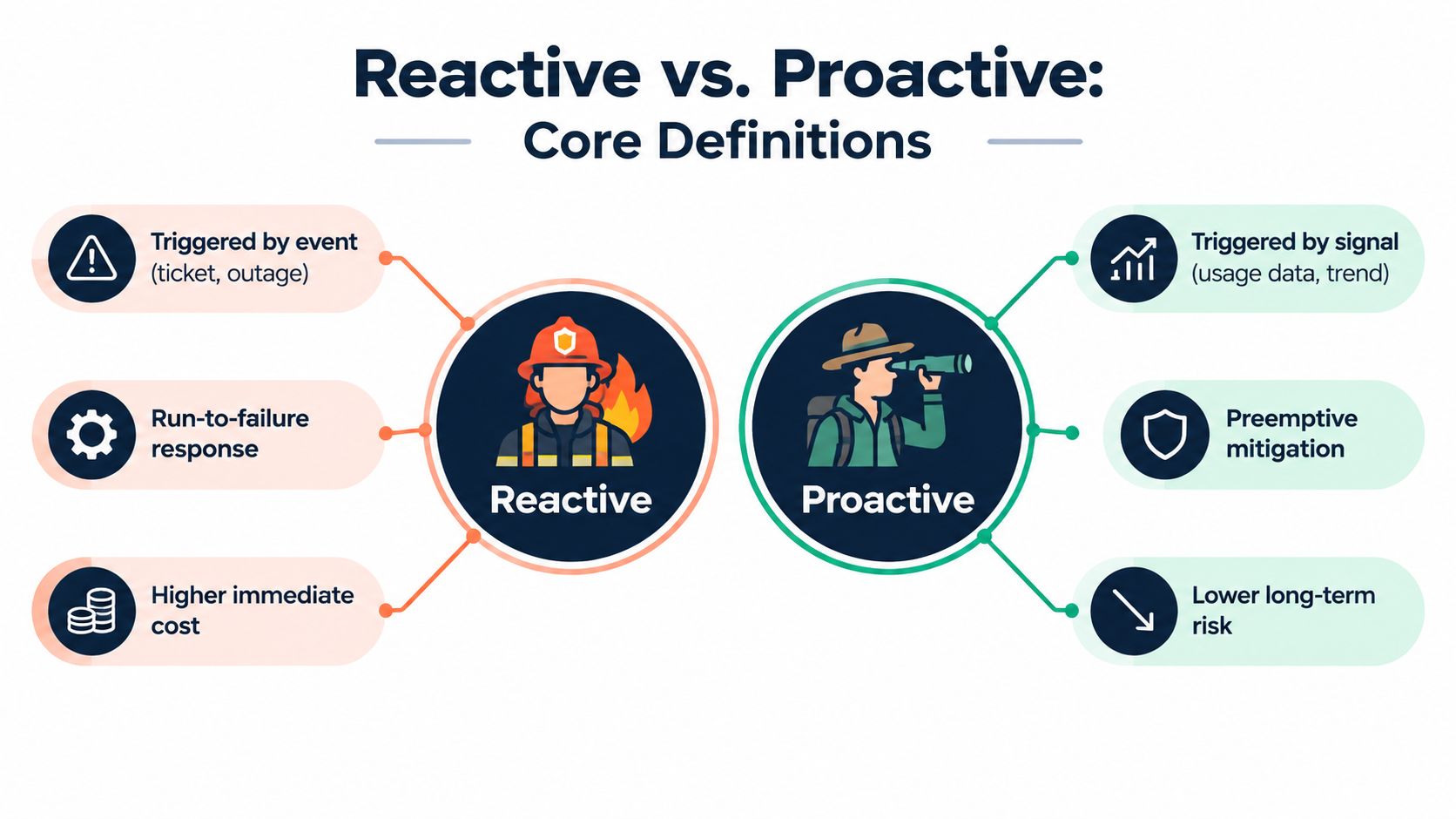
In product and customer operations, reactive work begins after an event. A customer opens a ticket, an integration fails, an account churns, or monitoring detects an outage. The team responds to the observed failure, restores service, communicates with the customer, and records what happened.
This is closely related to reactive maintenance, which industry literature defines as run-to-failure corrective work. Proactive maintenance instead emphasizes root-cause elimination and condition-based intervention, a useful distinction for software teams deciding whether to keep closing symptoms or remove the mechanism producing them. (System Dynamics literature on maintenance strategies)
Proactive work starts with a signal rather than a complaint. The signal might be a usage decline, repeated mentions of the same workflow problem, a cluster of failed jobs, or an emerging pattern in customer conversations. The team intervenes before the issue spreads, usually by contacting affected customers, changing the product, adjusting a process, or creating a safeguard.
How the modes appear in daily work
A backlog makes the distinction visible:
- Reactive prioritization: Product moves the issue upward because a strategic customer reported it or support volume has risen.
- Proactive prioritization: Product moves the issue upward because usage data and feedback indicate that a broader customer segment is approaching the same failure.
- Reactive success work: A manager contacts an account after an escalation or cancellation request.
- Proactive success work: A manager reaches out after a meaningful change in adoption suggests the account may need help.
- Reactive roadmap planning: Engineering reserves capacity for known defects and current incidents.
- Proactive roadmap planning: The team funds root-cause work, instrumentation, and safeguards before the defect becomes a larger commercial problem.
Ownership also differs. Support and incident teams often own the immediate response, while product, engineering, data, and customer success share responsibility for prevention. The switch from reactive to proactive should happen when the team can identify a repeatable pattern, a credible early signal, and an intervention whose expected value exceeds its operating cost.
For teams building that customer signal layer, the Sprints & Sneakers engagement guide offers useful context on turning customer interaction into a more deliberate operating practice. The important point is to connect engagement evidence to action, not to collect feedback without a decision path.
Detailed Comparison of Reactive and Proactive Approaches
Reactive and proactive approaches solve different operating problems. Reactive work optimizes for speed after an event. Proactive work aims to reduce exposure before an event becomes expensive. The right comparison is therefore workload-dependent, based on recurrence, revenue at risk, and the team's capacity to act on signals.
Timing and cost structure
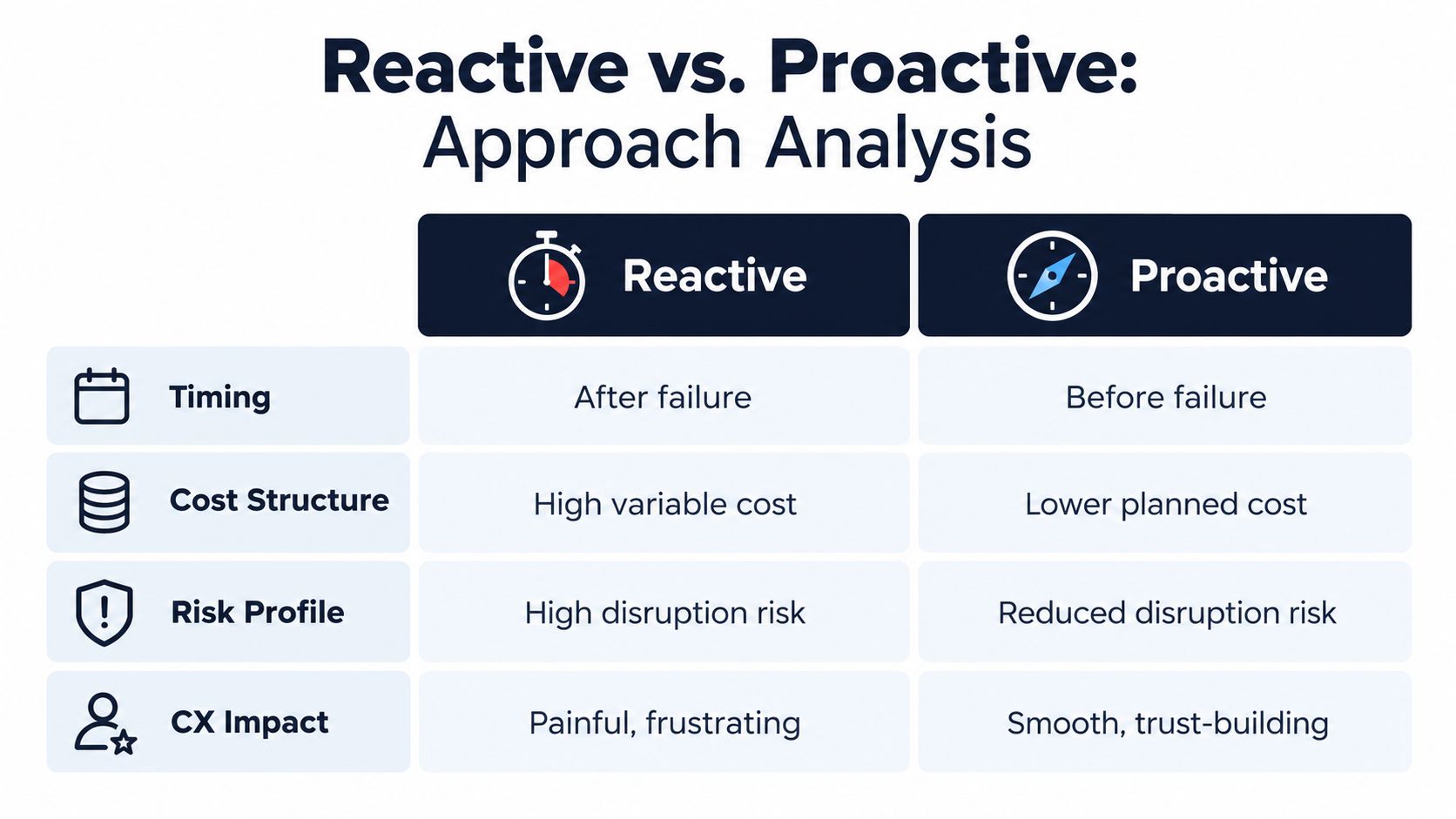
Reactive work has a low entry cost because the team does not need to predict the problem. Its variable cost rises when failures arrive through escalations, context switching, emergency engineering, and customer recovery. The organization pays after the commercial impact is visible.
Proactive work requires earlier investment in instrumentation, analysis, maintenance, and coordination. That cost is easier to plan, but it can be wasted when a signal is weak, an issue is rare, or an intervention does not alter the outcome. The decision should therefore weigh the probability of recurrence, revenue exposure, and cost of detection, rather than treating prevention as automatically cheaper.
A study of power generation companies reported that shifting from reactive to proactive maintenance cut maintenance costs by about 20% and reduced equipment breakdowns by 35%. (Empirical study of proactive maintenance in power generation) The benchmark does not transfer directly to SaaS, but it demonstrates the economic logic of root-cause work when the same failure returns.
Risk and customer experience
Reactive systems accept greater disruption risk because customers or frontline teams often discover the issue first. They remain appropriate when events are unpredictable and response speed is worth more than forecasting. A mature reactive process still needs escalation paths, runbooks, communication templates, and post-incident learning.
Proactive systems reduce exposure when teams can identify leading signals and assign ownership before a threshold is crossed. They can also produce a smoother customer experience by delivering guidance or a fix before a complaint. That matters when an operational failure could weaken acquisition efficiency, customer confidence, or brand reputation. Teams spanning incident response and marketing can use resources to safeguard brand trust and ad spend when assessing the wider cost of visible failures.
Data and team load
Reactive work can function with limited data because the event itself supplies the trigger. Proactive work needs a reliable signal, a baseline, a threshold, and an owner who can act. Poor data quality turns monitoring into noise, while unclear ownership turns a valid alert into delayed response.
The workload trade-off is cognitive as well as financial. Proactive control generally demands sustained attention, whereas reactive control can require less continuous effort and remain useful when conflicts are rare or difficult to predict. That makes the operating mix a capacity decision, not a simple maturity ladder.
The key differentiator: Choose proactive coverage when a revenue-weighted signal can trigger a named owner and a defined intervention before likely loss exceeds monitoring cost.
Teams can improve that calculation by applying alert setup practices for operational monitoring, then measuring whether alerts produce decisions, prevented incidents, or retained revenue rather than merely increasing notification volume.
KPIs and Business Impact You Should Track
A reactive versus proactive program should appear in the business dashboard, not only in an operations retrospective. NICE's 2021 contact-center analysis reported that proactive firms improved customer satisfaction by 14.0% annually, compared with 7.0% for reactive firms. It also reported retention improvement of 17.9% versus 3.3%, client-spend growth of 11.1% versus 4.8%, and service-cost reduction of 8.3% versus 3.8%. (NICE analysis of proactive and reactive contact centers)
The same analysis reported 8.4% annual revenue growth for proactive firms and a 1.1% decline for reactive firms. These figures are historical benchmarks, not a forecast for every SaaS organization, but they show why leaders should connect operating mode to commercial outcomes instead of treating prevention as an abstract quality goal.
Performance benchmark
| Metric | Proactive Result | Reactive Result |
|---|---|---|
| Annual customer satisfaction improvement | 14.0% | 7.0% |
| Customer retention improvement | 17.9% | 3.3% |
| Client-spend growth | 11.1% | 4.8% |
| Service-cost reduction | 8.3% | 3.8% |
| Annual revenue growth | 8.4% | 1.1% decline |
Every percentage in the table comes from the NICE analysis linked above. The more useful lesson is how to pair these lagging outcomes with leading indicators, rather than copying benchmarks into a target sheet.
The dashboard that supports a decision
Use time to detect and time to intervene to measure whether signals arrive early enough to matter. Track recurrence rate to distinguish a one-off event from a pattern that deserves root-cause work. A falling recurrence rate with stable response quality indicates that proactive investment is removing causes rather than hiding them.
Add revenue-weighted issue cost, calculated from the accounts, renewals, expansion opportunities, or usage paths exposed to the issue. This is more informative than raw ticket count because a small cluster affecting high-value accounts may deserve earlier action than a large cluster of low-impact requests.
For product teams, track feature adoption after intervention and expansion influenced by the resolved problem. For support leaders, pair escalation volume with service effort and customer outcome. For finance and revenue teams, compare prevented exposure with the cost of monitoring and intervention.
A leading and lagging indicators framework can help teams keep these measures together. The switch toward more proactive work is justified when early signals predict costly outcomes and interventions consistently change those outcomes. It should be reconsidered when alerts rise, effort rises, but retention, revenue exposure, recurrence, or service cost doesn't improve.
Real World Use Cases and Situational Playbooks
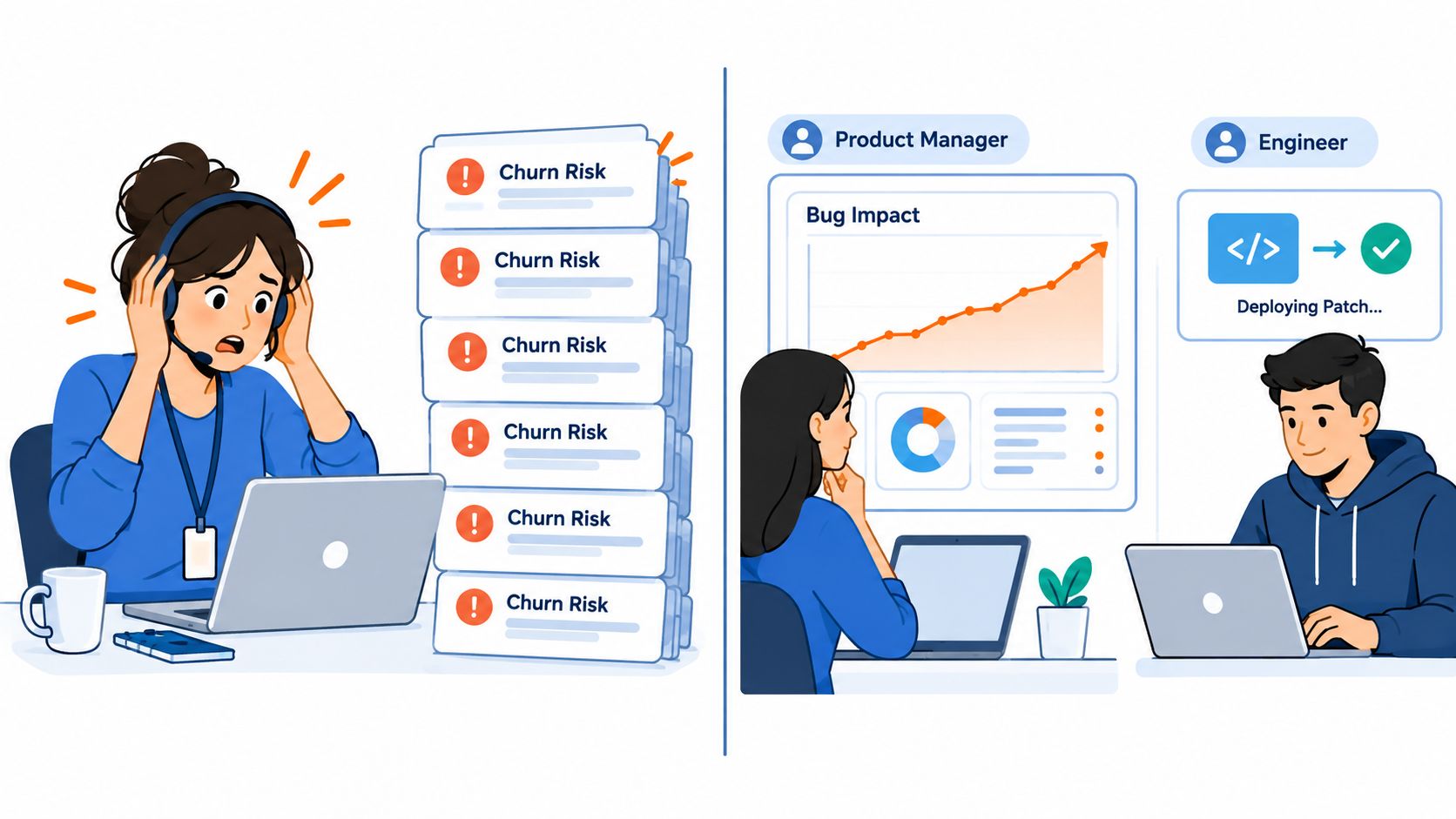
A support queue can contain both modes at once. The same team might react to an urgent customer outage while proactively investigating a repeated workflow failure that hasn't yet produced an escalation.
A new churn signal in support conversations
Stay reactive when one customer reports an isolated misunderstanding and no broader pattern exists. Resolve the question, document the context, and avoid building an elaborate detection workflow for a problem with no evidence of recurrence.
Shift proactively when several conversations contain the same objection, workaround, or sign of declining adoption. The trigger isn't the number of conversations alone. It is the combination of repeatability, affected account value, and an intervention such as better onboarding, a product change, or targeted success outreach.
Resources on proactive support workflows can help teams think through how support moves from answering individual requests toward identifying and addressing emerging customer risk.
A recurring bug with hidden revenue exposure
Engineering can remain reactive for an isolated defect with a clear workaround and limited commercial exposure. It should invest proactively when the defect repeatedly affects the same workflow, creates manual work, or appears in accounts connected to renewal or expansion activity.
A practical signal system would join ticket language, product usage, account context, and issue recurrence. The output should be a ranked intervention, not an undifferentiated alert. A bug affecting fewer customers can outrank a high-volume request if those customers represent greater revenue at risk.
A short media walkthrough can help teams visualize how signal detection fits beside frontline response:
Feature requests and sudden incidents
Feature requests should stay reactive when they represent isolated preferences with no adoption or commercial evidence. They deserve proactive discovery when repeated requests align with usage friction, a clearly defined customer segment, and credible expansion potential.
Incidents require a mixed model. The response team contains the current failure, communicates status, and restores service. A parallel owner tests whether telemetry, dependency behavior, or customer reports can identify the next occurrence earlier. Research on crisis response cautions against treating either mode as universally superior, because context and uncertainty determine which control strategy fits the moment. (Research on proactive and reactive control under changing conditions)
How to Build a Proactive System Without Overinvesting
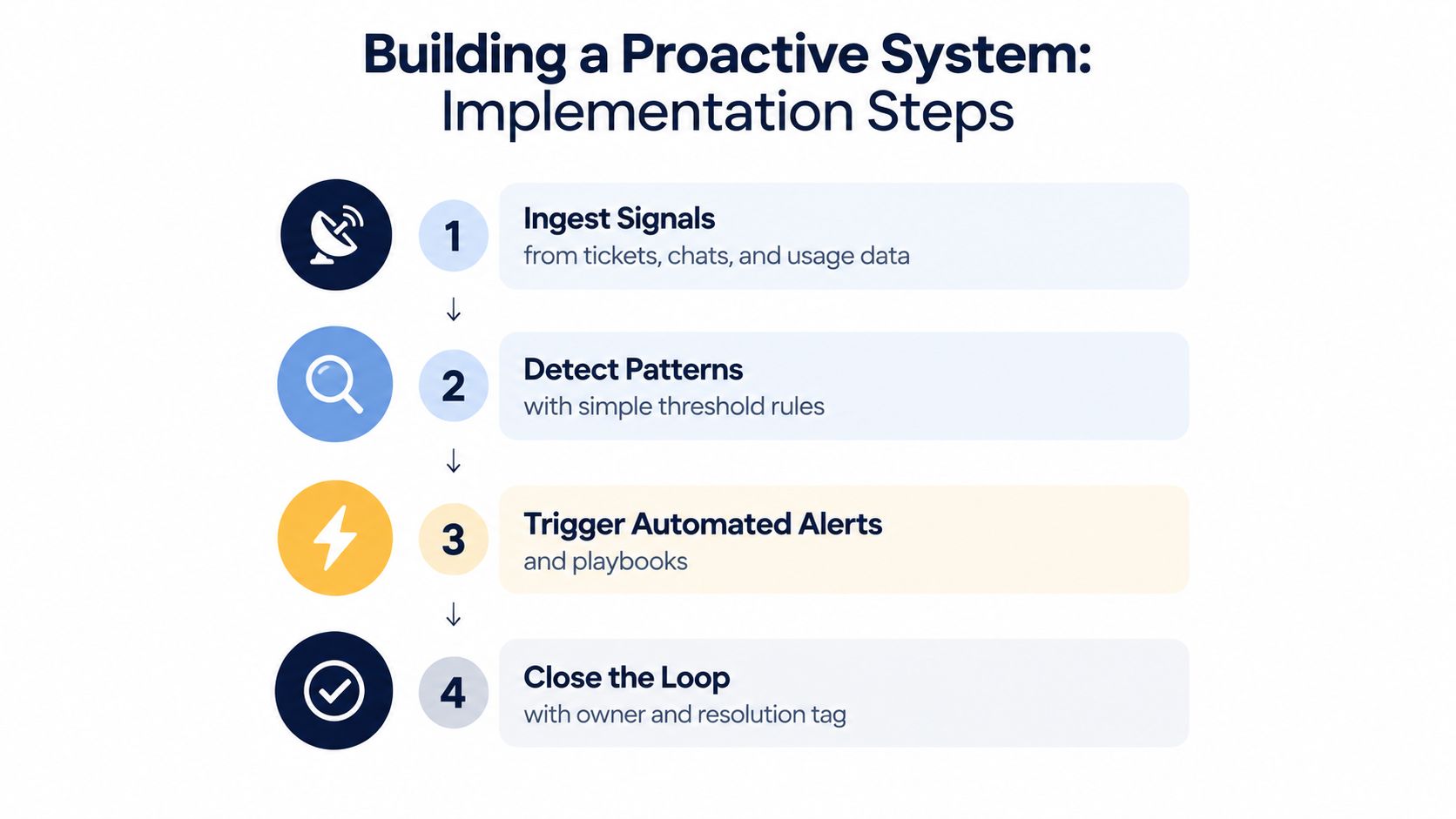
A lean proactive system starts with one repeatable problem where earlier action could protect customer adoption, renewal, expansion, or service capacity. Build a narrow loop from signal to owner to measured outcome before expanding coverage.
Start with signal coverage
Use evidence already present in support tickets, chat transcripts, call notes, usage changes, incident records, and feature requests. Monitoring every behavior creates review work without necessarily improving decisions. Select signals connected to a defined action, such as customer outreach, an engineering investigation, or a documentation update.
Define the pattern in operational terms. “Customers seem unhappy” cannot trigger consistent work. “Accounts show declining use of a core workflow and mention the same configuration obstacle” is testable, assignable, and suitable for comparison against revenue exposure.
Score the intervention before alerting
Rank candidate issues with four questions:
- Frequency: Does the pattern repeat often enough to justify attention?
- Predictability: Can the team observe a precursor before impact?
- Revenue exposure: Which renewals, expansions, or usage paths could be affected?
- Intervention cost: Can a small action reduce the likely impact?
The threshold should create a decision, not another inbox item. A qualifying pattern might open a product issue in Linear or Jira, create a support workflow in Zendesk or Intercom, or notify a customer-success owner. Teams can use automated insight generation to connect detection with a documented action path, while keeping a human accountable for the decision.
Revenue weighting changes which alerts deserve investment. A lower-volume issue affecting accounts with substantial renewal or expansion exposure may outrank a frequent request from accounts with limited commercial impact. That comparison helps determine whether proactive coverage is justified or whether a faster reactive process is sufficient.
Add guardrails against over-proactivity
The hidden cost of proactive work is sustained attention. Each alert requires review, triage, maintenance, and eventual retirement. Proactive control also demands more ongoing coordination and can be disrupted by competing work, so alert fatigue is a capacity problem, not only a configuration flaw.
Set a review cadence, assign an owner, and record whether each alert led to action. Retire rules that produce noise or fail to change outcomes. Keep reactive runbooks active for low-frequency, unpredictable events instead of forcing every exception into a forecasting model.
A useful launch sequence is:
- Choose one repeatable issue with visible customer or revenue impact.
- Define the earliest reliable signal and the intervention it should trigger.
- Route the alert to one accountable owner.
- Tag the resolution and compare predicted exposure with the observed outcome.
- Expand coverage only after the loop proves useful.
Choosing the Right Mix and Recommended Next Steps
The practical choice can be made with a simple matrix. High frequency, high predictability, and high revenue exposure justify proactive investment. Low frequency, low predictability, and low exposure usually belong in a reactive process. Mixed cases require a small experiment, not a permanent platform commitment.
Detection cost changes the answer. If monitoring is expensive and intervention is complex, the issue needs stronger evidence before the team shifts modes. If detection is cheap and the response is lightweight, proactive coverage can be sensible even when the event isn't highly frequent.
| Operating conditions | Preferred mode | Decision logic |
|---|---|---|
| Frequent and predictable, high revenue exposure | Proactive | Build detection, prevention, and ownership |
| Frequent but low commercial impact | Selective proactive | Automate only the highest-value response |
| Rare and unpredictable | Reactive | Invest in response speed and recovery |
| Uncertain frequency with meaningful exposure | Hybrid | Run a bounded signal experiment alongside response |
For product managers, prioritize recurring problems that block adoption or expansion. Support leaders should separate urgent resolution from pattern investigation. Growth teams should connect customer friction to renewal and expansion context before funding outreach or product work. Rebalance when recurrence, service cost, or revenue exposure changes, because the same issue can move between quadrants as the product and customer base evolve.
SigOS can be evaluated as one option for this workflow. Its stated product function is to analyze support tickets, chats, sales calls, and usage data, identify patterns related to churn or expansion, and connect prioritized findings with issue creation in tools such as Zendesk, Intercom, Linear, and Jira. Use the same ROI test as any other system: measure the value of prevented or reduced exposure against the cost of signals, review time, and intervention.
To begin, select one revenue-sensitive recurring issue, define its leading signal, assign its owner, and establish the lagging outcome that will determine whether the proactive loop stays funded.
SigOS helps product, support, and growth teams connect customer feedback, usage signals, and revenue context so they can identify which issues deserve proactive action. Visit SigOS to evaluate a signal-driven workflow for prioritizing customer problems and creating accountable follow-up.
Keep Reading
More insights from our blog



Ready to find your hidden revenue leaks?
Start analyzing your customer feedback and discover insights that drive revenue.
Start Free Trial →