Your Guide to a Better Research Planning Template
Stop running directionless research. This guide shows you how to build a research planning template that aligns teams and delivers actionable insights.
Think of a research planning template as the blueprint for your entire study. It’s a living document that guides your product team through defining, running, and analyzing research. Essentially, it turns those big, ambiguous questions into a clear, step-by-step plan that leads to real, actionable insights.
This isn't just about documentation; it’s about creating a single source of truth for every research initiative you kick off.
Why A Template Is Your Research Superpower
Let’s be real for a moment. Research without a plan is just a conversation. It's the kind of thing that leads to wasted hours, fuzzy results, and valuable insights getting lost in a forgotten Google Drive folder. A solid research planning template is so much more than a fill-in-the-blanks document—it’s a strategic framework that brings much-needed discipline and clarity to your entire process.
It’s what separates teams who are constantly reacting to problems from those who are proactively building the future of their product.
The template forces you and your team to answer the hard questions right from the start. What business goal are we actually trying to impact? Who exactly are we talking to, and why them? What does success even look like for this project? Getting all of this down on paper creates a shared brain across the entire team, from product managers and engineers to designers.
Align Stakeholders and Prevent Scope Creep
One of the template's biggest wins is its uncanny ability to get everyone on the same page. When all your key stakeholders agree on the objectives, methods, and timeline before a single interview is scheduled, you sidestep so many potential headaches, like last-minute changes or completely mismatched expectations.
This alignment is your strongest defense against scope creep. You know, that thing where a simple usability test suddenly morphs into a massive market exploration project.
Your template effectively becomes a contract. If a new request pops up mid-project, you can simply refer back to the agreed-upon plan and ask, "How does this fit with the original goals we all committed to?" That one simple question can keep your project focused, on time, and on budget.
From Reactive Research to Proactive Strategy
Without a structured plan, it's easy for teams to get stuck in a reactive cycle, constantly putting out fires with quick-and-dirty studies that don't lead anywhere conclusive. A template flips that script, pushing you toward a more proactive, strategic mindset. You'll start building a library of well-documented research that ties directly back to core business goals.
Let's look at the difference a template can make. The common ad-hoc approach often leads to confusion, while a structured, template-driven process delivers clarity and impact.
Ad Hoc Research vs Template-Driven Research
| Attribute | Ad Hoc Research (Without a Template) | Template-Driven Research |
|---|---|---|
| Goals & Objectives | Vague, inconsistent, or defined on the fly. | Clear, measurable, and tied to business outcomes. |
| Stakeholder Alignment | Low. Often leads to last-minute changes and debates. | High. Everyone is aligned from the very beginning. |
| Scope Management | Prone to scope creep and shifting priorities. | Well-defined scope with a clear process for changes. |
| Data Consistency | Inconsistent data collection makes analysis difficult. | Standardized methods ensure comparable results over time. |
| Insight Actionability | Insights are often disconnected from product decisions. | Insights are directly actionable and linked to the roadmap. |
| Project Timeline | Unpredictable, often delayed by rework and confusion. | More predictable timelines and efficient execution. |
Ultimately, a template-driven approach helps you move from simply gathering data to consistently delivering strategic value that shapes the product.
This structured approach has a real impact. Companies that adopted standardized research planning templates saw a 42% reduction in project completion time compared to those still using unstructured methods. A survey of over 1,200 project managers also revealed that 78% of teams using templates delivered actionable insights within the first month.
To see how other structured frameworks create a sanity-saving workflow, you can explore a comprehensive standard operating procedure template and see how documented processes drive consistency across the board.
Building the Core of Your Research Template
A great research planning template isn't just a document to fill out; it's a thinking tool. It's what helps your team navigate from a fuzzy business problem all the way to a set of crisp, answerable questions. Getting this core structure right is the single most important thing you can do to turn chaotic research into a reliable source of actionable insights.
The whole point is to bring some order to the initial mess of a new research question. You start with a tangle of ideas and, by following the template, end up with clarity.
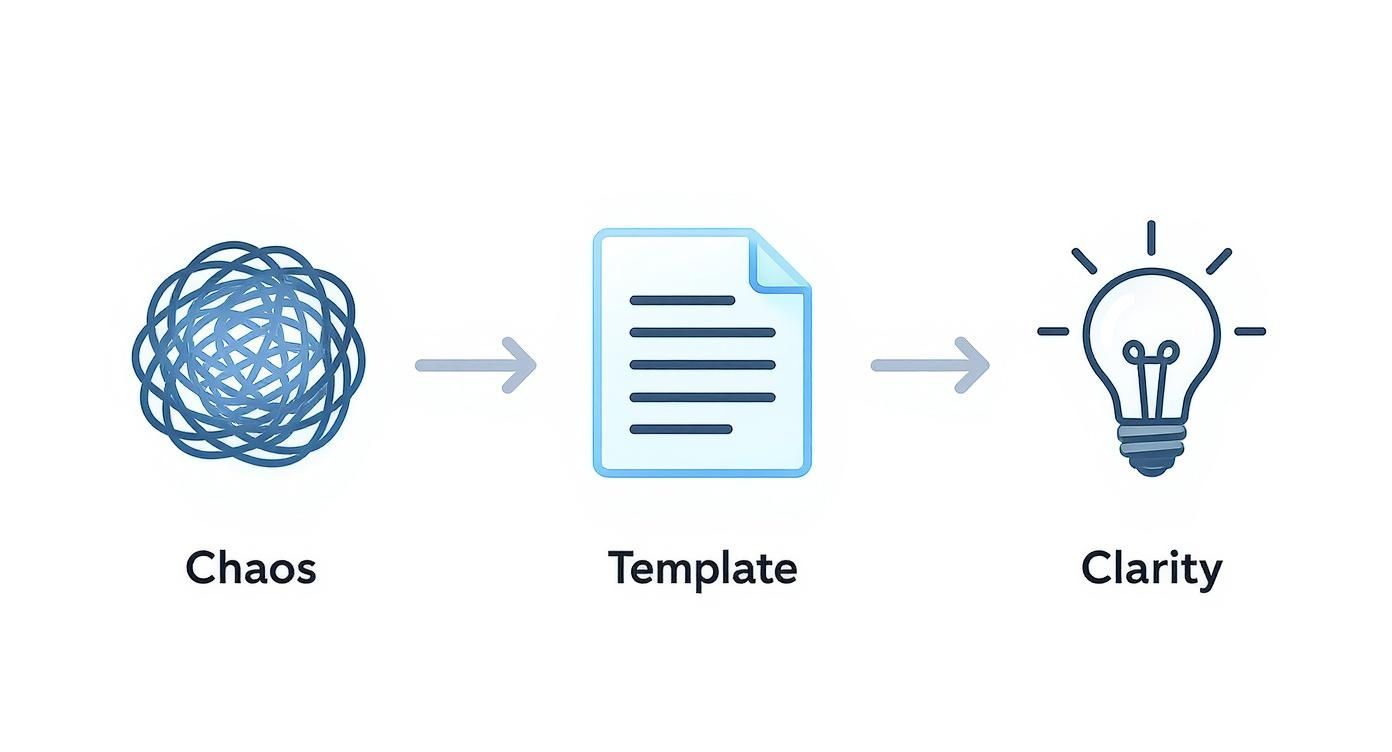
This journey from confusion to insight is exactly what a good template facilitates. It’s the bridge between unstructured brainstorming and the focused answers that actually drive smart product decisions.
From Vague Goals to Sharp Hypotheses
Let’s get practical. Most research projects start with something big and broad, like, “We need to figure out why trial users aren't converting.” That’s a valid business concern, but it’s far too vague to be a research goal. A strong template will force you to break that down into specific, testable hypotheses.
Think of it this way: the research goal is your "why," the high-level business objective. A hypothesis is your "what if"—a specific, falsifiable prediction about what users are doing or thinking.
For example, let's break down that churn problem:
- Vague Goal: Understand churn among trial users.
- Hypothesis 1: We believe users are churning because they don't grasp our core value proposition within the first 3 days of the trial.
- Hypothesis 2: We believe users are churning because they hit a major friction point during the onboarding workflow.
See the difference? This pivot is critical. It moves your team from aimless exploration to a focused investigation. You're no longer just wandering around asking for opinions; you're actively hunting for evidence to prove or disprove a specific idea.
Defining Your Participants and Methodology
Once you have clear hypotheses, the next part of your template should nail down who you’re going to talk to and how.
Defining your participants is all about precision. "SaaS product managers" is a terrible recruitment criteria. You need to get much more specific: "Product managers at Series B companies with 50-200 employees who have used our product for at least 14 days and logged in 3+ times." That level of detail ensures you're learning from the right people, not just any people.
Your methodology should then tie directly back to your hypothesis.
Choosing the right method from the start stops you from making common mistakes, like trying to measure user sentiment with analytics data or attempting to validate a complex workflow with a simple survey.
A Starter Template You Can Copy
To help you get going, here’s a simple structure you can copy and paste for the core of your research plan. It hits all the essential fields you need to bring focus to a study. For a deeper dive with more examples, check out our guide on creating a https://www.sigos.io/blog/sample-research-plan.
- Project Title: [Give it a clear, descriptive name.]
- Background & Context: [Just 1-2 sentences on why this research matters right now.]
- Business Goal: [What business metric are we ultimately trying to move?]
- Research Questions & Hypotheses: [List 1-3 specific, testable hypotheses.]
- Methodology: [e.g., Moderated user interviews, unmoderated usability test, survey.]
- Participant Criteria: [List the key behavioral and demographic attributes you need.]
As you get more comfortable, you can expand this. Looking at some of the best operations manual templates can even give you some great ideas for building structured, repeatable processes around your research. Taking the time to build a robust template is an investment that will pay off again and again in clarity, speed, and the impact of your work.
How to Prioritize Research for Maximum Impact
With a never-ending list of questions and only so many hours in the day, product teams constantly have to decide where to focus their research. Let's be honest: not every question is created equal. A structured approach to prioritization is what separates the teams that spin their wheels from those who invest their time in studies that actually move the needle on business goals.
Think of prioritization less like a to-do list and more like a strategic bet. You're betting that digging into this specific user problem will unlock more value than chasing down that other one. This is where a simple, effective framework becomes your best friend, especially when you’re building it into your research planning template.
This is especially critical for leaner teams. It's no surprise that downloads of market research and strategy planning templates shot up by 68% between 2020 and 2024. What’s really telling is that 79% of those users came from small and medium-sized businesses—the very teams that need to make every single resource count. You can see more on the trends in strategy template downloads at leadflowmanager.com.
Adopting a Prioritization Framework
One of the most practical frameworks I’ve used for prioritizing research is a modified RICE model. It stands for Reach, Impact, Confidence, and Effort, and it gives you a simple scoring system to objectively weigh different research ideas against each other.
- Reach: How many users will this research touch? A study on your core onboarding flow, for instance, has a much higher reach than one on a rarely used settings page.
- Impact: If your assumptions pan out, how big of a deal will this be for the business? Research that could improve a feature tied directly to conversion has a massive impact compared to a minor UI tweak.
- Confidence: This is your gut check. How sure are you about your Reach and Impact estimates? I find it helps to use a simple scale like 25% (low confidence), 50% (medium), 80% (high), or 100% (data-backed).
- Effort: How much time and how many resources will this study eat up? A quick survey is low effort; a multi-week diary study is very high effort.
The score is calculated with a simple formula: (Reach x Impact x Confidence) / Effort. The idea is to tackle the projects with the highest scores first, since they offer the best potential return on your team's valuable time.
A Real-World Prioritization Scenario
Let's make this real. Imagine a product team for a project management tool is staring at three research requests in their backlog:
- Request A: Find out why our biggest enterprise customers are so slow to adopt the new, complex reporting feature. (High Impact, Low Reach)
- Request B: Figure out what’s causing friction in the initial user sign-up process. (Medium Impact, High Reach)
- Request C: Explore if there's any demand for integrating with a niche third-party calendar app. (Low Impact, Low Reach)
The team gets together to score each one. Request A could have a huge impact on a few key accounts—that’s big money. But Request B, while maybe less impactful per user, affects every single person who tries to sign up. Request C is interesting, but it just doesn't line up with what the company is trying to achieve this quarter.
After running the numbers through the RICE formula, it turns out that Request B—understanding sign-up friction—is the clear winner. The enterprise reporting feature (Request A) is definitely important and goes on the "next up" list. But fixing the top of the funnel promises a much broader and more immediate benefit for the business as a whole.
This kind of data-informed decision, guided by a simple framework, gives the team the confidence to know they're putting their energy in the right place.
Nailing Down Research Logistics and Recruitment
A brilliant research plan is only as good as its execution. This is where so many promising studies fall apart—not because the ideas were bad, but because the nitty-gritty operational details were completely overlooked. Your research planning template needs a dedicated, robust section for logistics to turn that high-level strategy into an actual, doable project.
This part of the template is all about the "how." It forces you to think through timelines, recruitment methods, and all the small but crucial details that make a study run smoothly. Skipping this is like planning a cross-country road trip without checking if the car has gas; you’re not going to get very far.
Finding and Screening Your Participants
Let's be honest: recruitment is almost always the most time-consuming part of any research project. Your template should spell out exactly where you'll find participants. Will you use a customer email list, an in-app pop-up, a third-party panel like UserInterviews, or social media outreach? Each channel comes with its own timeline and potential biases you need to account for.
Once you know where you're looking, the next critical step is writing a sharp screener survey. Its only job is to filter out people who don't fit your precise criteria. A good screener asks behavioral questions ("When was the last time you used our reporting feature?") instead of leading ones ("Do you like our reporting feature?"). This simple change is key to getting data from a relevant, unbiased sample.
Creating a Realistic Timeline and Checklist
Timelines go off the rails when they don't account for the full research lifecycle. I’ve seen teams budget time for the interviews themselves but completely forget the days (or even weeks) needed for recruitment, scheduling, analysis, and pulling together the final report.
Your research planning template should have a simple logistics checklist to keep everything on track. This isn't just busywork; it creates accountability and makes sure nothing falls through the cracks when things get hectic.
Sample Logistics Checklist:
- Screener Survey: Drafted, reviewed by the team, and finalized.
- Recruitment Channel: Confirmed and ready to go (e.g., email copy is written and approved).
- Incentives: Value decided, budget approved, and distribution method ready.
- Consent Forms: Prepared and run by legal for compliance.
- Scheduling Tool: Set up and tested to avoid embarrassing booking conflicts.
- Interview Guide: Finalized and shared with all observers ahead of time.
- Data Analysis Plan: Method confirmed (e.g., thematic analysis) and necessary tools are ready.
It's also crucial to define your numbers upfront. You might aim for 10 interviews, but what's the plan if you only get 7 really high-quality participants? Understanding the basics of what is statistical significance can help frame these conversations about sample sizes, even for qualitative work. It gets the whole team aligned on what a "complete" and trustworthy study actually looks like.
Turning Research Into Real Product Decisions
Finishing a study isn't the finish line. Far from it. The real test of any research project is whether it actually influences product decisions or just ends up as another slide deck gathering digital dust. Success shouldn't be measured by the report you produce, but by the outcomes you drive—like the number of product decisions you shaped or a key metric that moved because of what you learned.
The biggest challenge is weaving those hard-won insights directly into the product development workflow. It’s not enough to just know things; you have to make that knowledge impossible to ignore. This requires a deliberate process for synthesizing and communicating your findings, ensuring they actively shape what gets built.
Synthesizing Insights for Action
Moving from raw data to actionable insights is where many teams get stuck. You've done the interviews, you've crunched the survey data, and now you're staring at a mountain of notes and numbers. The goal isn't to report on every little thing you found. It's to distill everything down into a few clear, powerful themes the team can actually do something with.
It all comes down to finding the signal in the noise—looking for recurring patterns, surprising contradictions, and those "aha!" moments.
- Group observations into themes. Start by clustering individual data points—user quotes, observed behaviors, survey responses—into bigger buckets. For instance, if you hear several users complain about a clunky checkout process, that becomes a "Checkout Friction" theme.
- Connect themes back to your hypotheses. Always circle back to your original research plan. Do these themes support or demolish the hypotheses you started with? This keeps your synthesis focused and purposeful.
- Prioritize themes by impact. Let's be honest, not all insights are created equal. Use your product sense to rank themes based on their potential impact on the user experience and, ultimately, the business.
This systematic approach keeps you from getting lost in the weeds and helps you build a compelling narrative around what truly matters.
Weaving Insights Into the Development Workflow
Once you have your prioritized themes, your next job is to get them in front of the product team in a way they can't ignore. Just emailing a report and hoping for the best is a recipe for inaction. You have to actively embed your findings into the places where decisions get made. In fact, a Miro report analyzing 5,000 projects found that teams using a research plan template saw a 29% increase in findings that directly influenced product decisions.
One of the best ways to do this is by reframing your insights as user problems or "Jobs to be Done." This simple shift in language is incredibly powerful. Instead of a finding like, "Users are confused by our pricing page," you create an actionable problem statement: "When evaluating our product, users need to clearly understand which plan fits their needs so they can make a confident purchase decision." Framing it this way makes it much easier for a PM to turn it into a backlog item. Our guide to the Jobs to be Done template can help you get really good at this.
Finally, the ultimate way to get attention is to connect your findings directly to revenue. When you integrate your qualitative insights with a tool like SigOS, you can tie what you heard in interviews to actual customer behavior and financial data. Suddenly, you're not just saying, "users are frustrated." You're saying, "This specific frustration point is correlated with a 5% higher churn rate among new users, costing us $15,000 per month." That’s the kind of language that gets research a permanent seat at the table.
Common Questions About Research Templates
As teams start getting more organized with their research, a few common questions always seem to pop up. Getting ahead of these can make the shift a lot smoother and help everyone appreciate having a solid plan from the get-go.
How Do I Convince My Team to Use It?
The single best way to get your team on board? Build the template with them. When people have a hand in creating something, they feel a sense of ownership, and you can be sure it actually fits how they work.
Position it as a tool that saves everyone a headache, not just another piece of bureaucratic red tape.
My best tip: Nothing convinces people like seeing it work. Run the first project yourself using the new template.
When you can point to how it helped get stakeholders aligned quickly and led to crystal-clear next steps, people will be lining up to use it. Also, try integrating it into the tools you already live in, like Jira or Asana. That way, it just becomes part of the natural workflow instead of feeling like an extra chore.
What Is the Difference Between Goals and Questions?
Getting this right is absolutely critical for keeping your research focused.
Think of the research goal as your "why." It’s the big-picture business objective you’re trying to move the needle on. For instance, a goal might be something like, "Figure out why so many trial users are dropping off without converting to a paid plan."
Then, the research questions are your "what." These are the specific, concrete things you need to find answers to in order to hit that goal. For the conversion goal above, your questions would be much more tactical:
- What are the biggest friction points in our onboarding right now?
- Do trial users actually "get" what our product does and why it's valuable?
- Are there certain features that paid users engage with during their trial that non-converters completely ignore?
Can I Use One Template for Different Methods?
Yes, absolutely. A good research template isn't tied to one specific method. Its real job is to force you to think strategically before you start doing the work, whether you're interviewing users or launching a survey.
The foundational pieces—like the project background, business goals, hypotheses, and who you need to talk to—are always the same. You just tweak the "Methodology" section to fit what you're doing. It could be user interviews one week and a usability test the next. The template provides the strategic guardrails, no matter the method.
Stop drowning in feedback and start driving revenue. SigOS uses AI to analyze customer conversations and connect qualitative insights directly to financial impact, showing you which product decisions will reduce churn and accelerate growth. Prioritize your roadmap with confidence at sigos.io.
Keep Reading
More insights from our blog
Ready to find your hidden revenue leaks?
Start analyzing your customer feedback and discover insights that drive revenue.
Start Free Trial →