Strategic product roadmap: Align teams and drive growth
Master a strategic product roadmap that unites teams, delights users, and drives SaaS growth.
Let's be honest—that timeline of features you're calling a roadmap? It probably isn't working. A strategic product roadmap is so much more than a project plan. It’s a powerful communication tool that tells a compelling story about where your product is headed and, more importantly, why. It’s all about solving real customer problems and hitting business goals, not just shipping code on a deadline.
Why Your Feature List Is Not a Roadmap
So many SaaS teams fall into the trap of creating a feature-driven timeline and slapping the "roadmap" label on it. This usually looks something like a Gantt chart, packed with specific features and hard deadlines. It feels safe and predictable, but it’s a fragile foundation for any real product strategy. This kind of plan focuses entirely on outputs (what we're shipping) instead of outcomes (what we're trying to achieve).
The moment stakeholders see a list of features with dates, they lock onto those specifics. Any deviation from that plan—which is an absolute certainty in product development—is viewed as a broken promise or a missed deadline. This forces you into a defensive cycle of protecting timelines instead of adapting to new customer insights, market shifts, or competitive threats.
The Dangers of a Feature-Centric Plan
A feature-first approach can easily send your product down the wrong path by prioritizing busy work over actual impact. It trains the team to just check boxes instead of digging in and solving genuine user problems.
Here are the biggest risks you run with a feature-list-as-roadmap:
- No Strategic Context: It completely fails to answer the "why" behind the work. This leaves your engineering and design teams in the dark, unable to make the smart, informed trade-offs needed to build great solutions.
- A False Sense of Precision: Committing to specific features and dates months in advance is just pretending you can predict the future. This rigidity kills your ability to pivot when a much better opportunity pops up.
- Misaligned Incentives: Success gets measured by shipping features on time and on budget. It doesn't matter if those features actually moved the needle on key business metrics or made customers happier.
Shifting to a Strategic Mindset
A true strategic roadmap changes the entire conversation from "what and when" to "why and for whom." It isn't a rigid list of tasks; it's a living document that communicates your high-level priorities and the customer problems you're committed to solving.
This evolution is a huge trend in product management. Modern teams have embraced continuous planning, regularly updating their roadmaps with real-time data and feedback. It's a world away from the old, static plans of the past. If you're curious, you can discover more insights about the evolution of product roadmaps and see just how much has changed.
This modern approach organizes work around themes, like "Improve New User Onboarding" or "Increase Team Collaboration." It gives your team clear direction without handcuffing them to a single, predetermined solution. This empowers them to explore, experiment, and discover the best way to achieve the desired outcome. That flexibility is what turns a simple project plan into a powerful strategic asset.
Anchor Your Roadmap in Business Outcomes
Before you can even think about what to build, you and your team need to be brutally honest about what success actually looks like. A roadmap without clear business goals isn't a strategy; it's a wish list. It’s a collection of features completely detached from the context needed to make smart trade-offs.
This is where everything starts. You have to anchor every future decision to a measurable business outcome. The trick is to move beyond fuzzy aspirations like "increase revenue" or "improve user satisfaction." They sound great in a meeting, but they're too broad to give your team any real direction. You need to translate those high-level company goals into focused, actionable product objectives.
From Vague Goals to Focused Objectives
This translation step is non-negotiable. It forces you to get specific about how the product can directly push the company’s strategy forward. Let’s say the big company goal is to “expand into the enterprise market.” That’s a good start, but it’s not a product objective.
A truly effective product objective born from that goal might be: “Become the go-to solution for compliance-heavy industries by Q4.” See the difference? That statement immediately provides focus. It tells your team exactly which customers to obsess over and hints at the kind of problems they need to solve—things like security, audit trails, and specific integrations.
Here’s another classic B2B SaaS scenario I’ve seen play out:
- Company Goal: Reduce customer churn by 10% this year.
- Weak Product Objective: Make the product "stickier." (What does that even mean?)
- Strong Product Objective: Increase the adoption of core collaboration features by 25% among at-risk accounts.
The stronger objective gives your team a specific lever to pull. It’s measurable, it’s targeted, and it’s directly tied to the business outcome of reducing churn. That clarity is empowering.
Crafting Compelling OKRs That Guide Action
To make these objectives even more concrete, the best product teams I know live and breathe the Objectives and Key Results (OKRs) framework. OKRs are brilliant because they break down your inspiring objective into specific, measurable milestones that tell you if you’re actually winning.
It's simple: an Objective is the what—the qualitative goal. The Key Results are the how—the quantitative metrics that prove you got there. And critically, they are outcomes, not outputs. It’s not about shipping features; it’s about changing user behavior and moving the needle.
Let's expand on our compliance-focused objective from before:
This set of OKRs eliminates ambiguity. Engineering knows why a robust audit log is a top priority. Marketing knows which industries to target. Every single initiative you consider for the roadmap can now be stress-tested against these specific results.
Gaining Executive Buy-In and Alignment
Defining these goals can’t happen in a vacuum. This has to be a collaborative process that gets real buy-in from leadership and stakeholders across the company. When you pitch your proposed OKRs, frame the entire conversation around business impact, not a feature list.
Instead of saying, "We need to build an audit log," you frame it like this:
"To hit our enterprise revenue targets, we have to shorten our sales cycle. Our data shows security reviews are the biggest bottleneck, and an advanced audit log is the key to unblocking those deals."
This approach ties your product strategy directly to the metrics the C-suite loses sleep over. Your roadmap is no longer a list of tech projects; it’s a clear, convincing plan for hitting shared business goals. That makes getting alignment—and the resources you need—a whole lot easier.
How to Gather Actionable Roadmap Insights
A product roadmap built on assumptions is a house of cards. To build a plan that actually works, you have to get out of your own head and tap into the unfiltered reality of your market. This isn't about occasionally checking a feature request board; it's about building a system to constantly gather, process, and translate a flood of information into real product intelligence.
The goal isn't just to collect feedback—it's to find the signal in the noise. It’s about digging into the "why" behind every request, bug report, and user action. This is where you uncover the real problems to be solved, which are rarely what customers explicitly ask for.
Blending The "What" and The "Why"
Your first move is to combine two very different, but equally critical, types of information. Quantitative data tells you what is happening in your product, while qualitative data tells you why. You need both. Relying on just one gives you a dangerously incomplete picture of reality.
We can’t build a solid roadmap without a solid foundation of data. Below is a breakdown of the key inputs I’ve found to be most valuable for any product team. These sources provide a balanced view, blending hard numbers with human context, which is essential for making informed decisions.
Key Inputs for a Strategic Product Roadmap
| Input Source | Type of Insight | Example Tools/Methods |
|---|---|---|
| Product Analytics | User behavior, feature adoption, friction points | Mixpanel, Amplitude |
| Customer Support Tickets | Pain points, bugs, usability issues, user friction | Zendesk, Intercom |
| Sales Call Recordings | Market needs, competitor weaknesses, prospect objections | Gong, Chorus.ai |
| User Interviews | Core motivations, frustrations, "Jobs to be Done" | In-person/video calls, surveys, feedback forms |
| Churn & Win/Loss Data | Reasons for leaving, deal-breakers, competitive gaps | CRM analysis, exit surveys, sales debriefs |
Ultimately, this table isn't just a checklist; it's a blueprint for building a continuous feedback loop. Regularly tapping into each of these sources ensures your roadmap stays grounded in reality, not just internal wishful thinking.
Diving Deeper into Your Data Sources
Let's break down how to use these inputs.
- Product Analytics: Tools like Mixpanel or Amplitude show you user funnels, feature adoption rates, and where people get stuck. This data is your ground truth. If you see 80% of users drop off during a specific setup step, that’s a clear, quantifiable problem to investigate.
- Customer Support Tickets: Your support team is on the front lines. They hear directly from users who are frustrated or confused. Digging through support transcripts from platforms like Zendesk or Intercom can reveal recurring pain points and usability flaws causing real friction.
- Sales Call Recordings: Your sales team’s calls are a goldmine. Listening to how prospects talk about their problems and what objections they raise can directly inform your product’s direction and highlight gaps in your current offering.
- User Interviews: There is simply no substitute for talking to your customers. These conversations are where you can go deep on their motivations and frustrations. Using frameworks like the Jobs to be Done theory helps you uncover the core problems they’re trying to solve. You can learn more about how to apply this with our Jobs to be Done template.
Structuring Your Insights for Clarity
Once you start collecting this information, you'll quickly find yourself buried in it. A chaotic pile of notes and data is useless. The trick is to synthesize these inputs into clear, actionable themes that can directly inform your roadmap.
To truly anchor your roadmap in business outcomes, start by creating a strong value proposition that defines the core problems you solve. This foundation makes it infinitely easier to filter and prioritize the feedback you gather.
This entire process has become so crucial that a whole market has sprung up around it. The global demand for product management roadmap tools is surging, driven by the need for more agile and collaborative planning. The market is actually projected to hit $2.5 billion in 2025, which shows just how essential these systems are for modern product teams. You can see the full research on product management tool market growth to understand the trends.
From Raw Data to Actionable Themes
The final step is translating your organized insights into strategic themes for your roadmap. This isn't about creating a laundry list of features. It’s about identifying broad areas of opportunity.
For example, instead of a feature like "Build a CSV import tool," a strategic theme might be "Streamline Data Integration for Enterprise Teams."
This thematic approach gives your team the creative freedom to find the best possible solution, while ensuring their work is directly tied to a validated customer need and a clear business objective. It’s this disciplined process—gathering, synthesizing, and theming—that turns random feedback into a powerful strategic advantage.
Prioritize What Matters With Proven Frameworks
You’ve got a mountain of great ideas, a stream of user feedback, and only so many hours in the day. So, what do you build next? This is the core challenge every product team faces. A strategic roadmap isn't about cramming in every possible feature; it's about making smart, deliberate choices about what to build—and what to leave for later.
This is where prioritization frameworks come in. They’re not magic wands, but they are incredibly useful tools for turning chaotic debates into structured, data-informed decisions. They help you get past gut feelings and "whoever shouts loudest" and into a process where every development cycle is a calculated bet on moving the business forward.
The RICE Framework For Data-Informed Bets
For SaaS teams, one of the most practical frameworks out there is RICE. It stands for Reach, Impact, Confidence, and Effort, and its real power is forcing a quantitative lens on what are often subjective conversations.
- Reach: How many actual users will this touch in a given period? (e.g., 500 customers per month)
- Impact: How much will this move the needle on our goals? (Use a simple scale: 3 for massive, 2 for high, 1 for medium, 0.5 for low)
- Confidence: How much of this is a solid bet versus a wild guess? (e.g., 100% for high confidence, 80% for medium, 50% for low)
- Effort: What's the real cost in team time? (Often measured in "person-months")
The formula is simple: (Reach x Impact x Confidence) / Effort. This gives you a single score that lets you compare completely different types of projects—say, a small UI tweak versus a major new integration—on a level playing field. It's a great way to reality-check pet projects and ensure you’re not sinking massive effort into something that only benefits a handful of users.
This whole process is about balancing the quantitative and qualitative sides of product management. You need the hard data, but you also need to understand the story behind it.
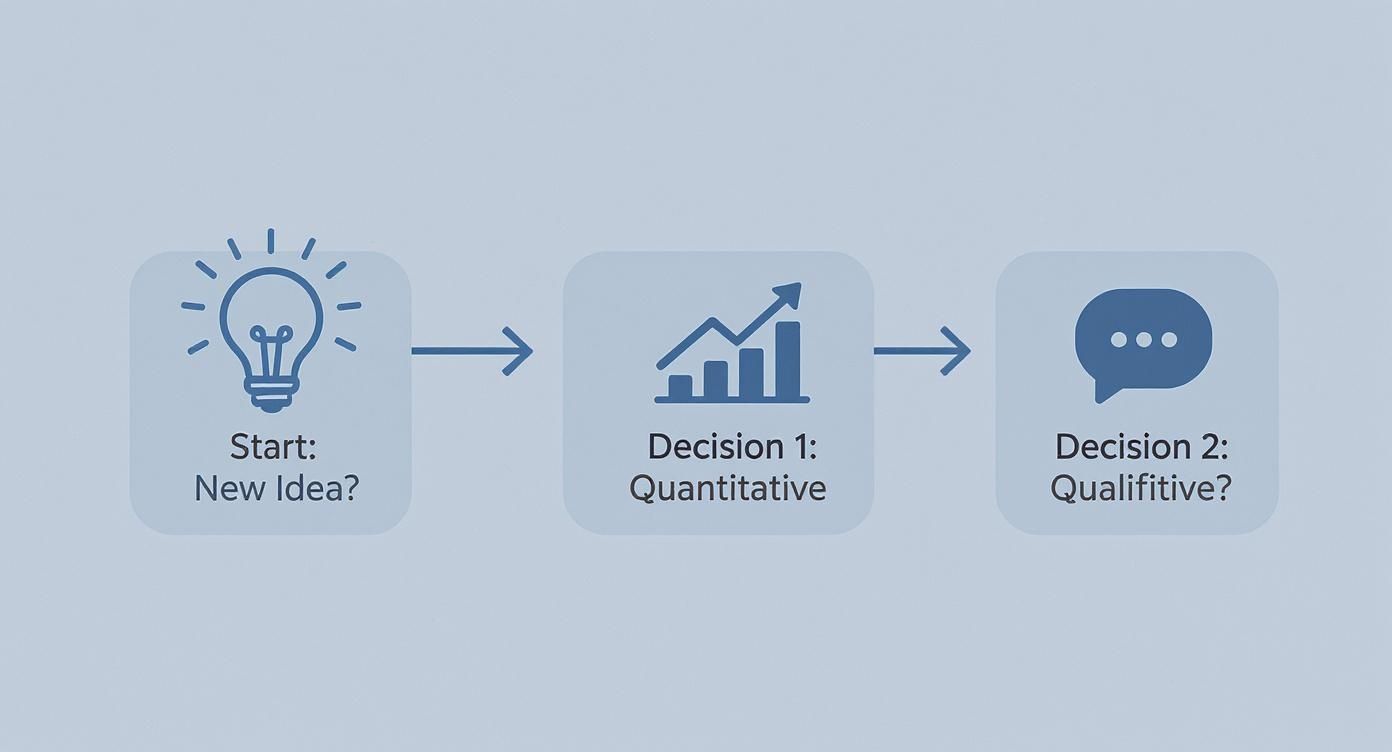
As you can see, the best decisions come from blending both worlds. Hard data and human insights aren't opposing forces; they're two sides of the same coin.
Comparing Prioritization Frameworks
Choosing the right framework really depends on what you're trying to solve. RICE is great for comparing disparate ideas, but other models excel in different situations. Here’s a quick breakdown to help you pick the right tool for the job.
| Framework | Best For | Key Benefit | Potential Pitfall |
|---|---|---|---|
| RICE | Comparing different types of initiatives against business goals. | Forces a data-driven, objective evaluation. | Estimates for Reach, Impact, and Confidence can still be subjective. |
| MoSCoW | Defining scope for a specific release or sprint. | Creates crystal-clear alignment on what's in and what's out. | Can lead to stakeholders trying to classify everything as a "Must-Have." |
| Kano Model | Understanding customer satisfaction and feature-market fit. | Helps balance foundational needs with delightful innovations. | Requires customer research; can be more time-consuming to implement. |
| Impact/Effort | Quick, high-level prioritization when speed is essential. | Simple, visual, and easy for the whole team to understand. | Lacks nuance; can oversimplify complex trade-offs. |
No single framework is perfect for every scenario. The trick is to have a few in your toolkit and know when to use each one. An experienced product manager often blends elements from different frameworks to fit their team's specific context.
The MoSCoW Method For Clear Release Planning
While RICE helps you decide what to work on, the MoSCoW method is perfect for defining the scope of a specific release. It’s all about creating clarity and managing expectations by bucketing features into four simple categories.
- Must-Have: These are the absolute, non-negotiable items. If these aren't shipped, the release is a failure. Period.
- Should-Have: Important and valuable, but not critical. The release can still go out without them, even if it’s a bit less impactful.
- Could-Have: These are the "nice-to-haves." You'll tackle them if you have extra time and resources, but no one's holding their breath.
- Won't-Have (this time): This is just as important as the others. It’s an explicit acknowledgment of what’s not in scope for this round, which helps prevent scope creep and keeps everyone on the same page.
MoSCoW forces those tough conversations early and helps the entire team agree on what "done" really means for a particular launch.
Using The Kano Model To Balance Needs and Delights
Finally, there's the Kano Model. This framework looks at prioritization through a customer-centric lens, helping you understand how features impact user satisfaction. It’s less about a formula and more about a mindset, sorting features into three key groups.
- Basic Needs: These are the features customers just expect. They won't sing your praises for having them, but they’ll be incredibly frustrated if you don’t. Think a "forgot password" link.
- Performance Needs: For these features, more is better. The faster your search, the more storage you offer, the happier your customers are.
- Delighters: These are the unexpected, brilliant little features that make users say "Wow!" They're not expected, but they can create fierce loyalty and a huge competitive edge.
Remember, these frameworks are meant to guide your thinking, not replace it. A feature could get a perfect RICE score, but if it doesn't map back to your core OKRs, it's just a distraction. Mastering these tools is a core part of effective product portfolio management, helping you connect day-to-day execution with your long-term vision.
This move toward structured, data-backed prioritization is only growing. One recent survey found that 76% of product leaders plan to increase their investment in AI-powered product strategy tools, showing a clear trend toward more intelligent roadmapping. By combining these proven frameworks with your strategic goals, you can build a roadmap that doesn't just get work done—it gets the right work done.
Communicate Your Roadmap and Drive Alignment
https://www.youtube.com/embed/PKkPI8oayjk
Let's be honest: a brilliant roadmap is completely worthless if it just sits in a folder somewhere. Once you’ve built it, its real job begins: communicating your vision and getting the entire company rowing in the same direction. A roadmap that isn’t shared, debated, and understood is just a document. A roadmap that drives real alignment? That's a powerful strategic asset.
But alignment doesn't mean showing everyone the exact same slide deck. The real secret to effective communication is tailoring how you present the roadmap to who’s in the room. Your board, your marketing team, and your lead engineers all care about very different things, and your delivery needs to respect that.
Tailor the Message to the Audience
Not every stakeholder needs—or wants—to see every detail. If you walk your executive team through an engineering sprint plan, you’ll see their eyes glaze over in minutes. On the flip side, a high-level strategic overview won't give your dev team the clarity they need to make smart architectural choices.
The goal is to create different views from a single source of truth.
- For the Board and Executives: Keep it high-level. Show them a theme-based view that connects directly to the business outcomes and OKRs you worked so hard to define. They want to hear about market opportunities, competitive positioning, and revenue impact. Think big picture, not feature list.
- For Sales and Marketing: These teams need to understand the story behind what’s coming so they can build compelling narratives. A roadmap organized by customer problems or benefits is perfect here. It helps them prep campaigns and talk to prospects about the future without getting tangled up in the technical weeds.
- For Engineering and Design: This is where you can finally get more granular. You should still lead with the strategic "why," but this view can break themes down into epics or larger initiatives. It needs to provide enough detail to kickstart technical planning and resource allocation. For a deeper dive, check out this excellent guide on creating a technical roadmap template that perfectly bridges strategy and execution.
Focus on the “Why,” Not Just the “What”
When you get up to present, the most common mistake is to just rattle off a list of features. That’s a surefire way to invite nitpicking over individual items and timelines. Instead, frame every single part of your presentation around the problems you’re solving and the outcomes you’re aiming for.
To really nail this, it helps to understand what makes a good presentation in the first place. Start each section by restating the customer problem or business goal. Then, introduce the roadmap theme as your solution.
By consistently tying every initiative back to your strategic goals, you elevate the conversation from "When will feature X be ready?" to "Is this the most effective way to increase user retention?" This reframing is crucial for building trust and genuine buy-in.
This storytelling approach turns your roadmap from a boring release schedule into a compelling vision for the future. It builds excitement and makes people feel like they’re part of a shared mission, not just watching a project plan unfold.
Handle Tough Questions and Manage Expectations
Presenting your roadmap means you’re going to get questions, challenges, and last-minute requests. It’s inevitable. How you navigate these conversations is what maintains alignment.
When a stakeholder starts pushing for their pet project, don't just shut them down. Use your prioritization framework as your shield. You can say something like, "That's an interesting idea. Here’s the framework we use to weigh all new initiatives against our current OKRs. Let's see how it scores." This takes the emotion out of it and shows that your roadmap is built on strategy, not just your opinion.
You also have to be disciplined about timelines. Avoid giving hard dates for anything outside the immediate future. Using broader time horizons like "Now," "Next," and "Later" communicates your intent without making brittle promises. This gives your team the breathing room to adapt as they learn, which is far better than constantly explaining why you’ve missed another deadline.
Got Questions? Let's Talk Roadmapping Realities
Even the most buttoned-up roadmapping process runs into messy, real-world problems. Let's be honest: product management is a constant balancing act between a long-term vision and the immediate chaos of stakeholder requests, market shifts, and development surprises.
So, let's tackle some of the tough questions that inevitably pop up once the framework is in place.
How Often Should We Actually Update This Thing?
Your roadmap should be a living, breathing guide, not a relic carved in stone. For most SaaS teams I've worked with, a quarterly review and refresh hits the mark. It's frequent enough to stay relevant but not so often that you give your engineering team whiplash.
This cadence syncs up nicely with the natural rhythm of business—quarterly business reviews, board meetings, and sales kickoffs.
While your big-picture strategic themes might hold steady for six months or even a year, the specific initiatives you're tackling need to be more fluid. A quarterly check-in gives you the space to react to new customer feedback or a competitor's move without derailing your entire strategy. It keeps the roadmap useful.
What’s the Real Difference Between a Roadmap and a Release Plan?
This is a big one. I see teams get tangled up here all the time, and it almost always leads to confusion and misaligned expectations. They are two very different tools for two very different jobs.
- Your roadmap is the "why." It's your story. It paints a picture of the future, focusing on the customer problems you're going to solve and the business outcomes you're driving toward. Think high-level, thematic, and inspirational.
- Your release plan is the "how" and "when." This is where the rubber meets the road. It's tactical, breaking down the roadmap's big ideas into epics, user stories, and a concrete schedule for the next few sprints.
Here's a simple way to think about it: The roadmap is your plan for a cross-country road trip, showing the major cities you'll hit (the outcomes). The release plan is the turn-by-turn GPS navigation telling you exactly which highway to take for the next 100 miles.
The roadmap gets the whole company excited and rowing in the same direction. The release plan gives the delivery team the clarity they need to build. When you mix them up, you start chasing dates instead of impact.
"Our Biggest Customer Needs This Feature... Yesterday." Now What?
Ah, the classic high-stakes feature request. It's incredibly tempting to drop everything when a major account comes knocking, but knee-jerk reactions are the fastest way to wreck a well-thought-out strategy. This situation calls for a bit of finesse and a lot of data-driven discipline.
First, just listen. Don't jump to solutions. The feature they're asking for is their idea for a solution, but your job is to uncover the root problem. Ask questions that get to the "why" behind their request.
- "What's the bigger business goal this would help you hit?"
- "Can you walk me through the workflow that's causing this friction for your team?"
This conversation shifts you from being an order-taker to a strategic partner.
Once you truly understand the problem, you can weigh it against your existing priorities using the frameworks we've already discussed. Instead of a flat "yes" or "no," you can frame the conversation around your strategy.
For instance, you might say:
"That's a really important problem, and I'm glad you brought it up. Right now, our team is heads-down on our [Strategic Theme X] work, which is focused on improving user retention across the board. Let's dig into this and figure out where it might fit into our planning for next quarter."
This response does two crucial things at once: It makes the customer feel heard by validating their feedback, and it reinforces that all work must align with the broader product strategy. You protect the roadmap from becoming a jumbled to-do list and maintain your credibility as a product leader.
Ready to transform your qualitative feedback into revenue-driving roadmap decisions? SigOS uses AI to analyze support tickets, sales calls, and usage data, pinpointing the insights that have the biggest impact on churn and expansion. Stop guessing and start prioritizing with product intelligence. Learn more about how SigOS works.
Keep Reading
More insights from our blog
Ready to find your hidden revenue leaks?
Start analyzing your customer feedback and discover insights that drive revenue.
Start Free Trial →