Technology Roadmap Format: technology roadmap format guide to success
Explore the technology roadmap format that fits your team. Compare common formats with concrete examples to help you choose a winning approach.

Let's get one thing straight—there's no magic, one-size-fits-all technology roadmap format. The "best" one is simply the one that clicks with your team's goals, speaks clearly to your audience, and fits right into your company culture.
Choosing Your Technology Roadmap Format
Think of it like choosing a map for a trip. A simple subway map is perfect for zipping around a city, but you wouldn't use it to hike a mountain. For that, you’d need a detailed topographical map. Your roadmap is no different; it has to match the strategic terrain you're navigating.
Get the format right, and you'll have a tool that brings clarity, gets everyone on the same page, and turns your vision into a real, actionable plan. Get it wrong, and you're stuck with a document that creates confusion and stalls progress before you’ve even started.

Core Roadmap Models to Consider
Most roadmaps fall into a few key categories, each with its own vibe and purpose. Some teams absolutely need hard deadlines to function, while others thrive on the flexibility to pivot when new information comes to light.
Understanding these core models is your first step. Let's break down the main types you'll encounter:
- Timeline-Based: This is the classic calendar-style view, often looking like a Gantt chart. It answers the question, "When will this be done?" It's a lifesaver for teams juggling complex dependencies or needing to communicate firm launch dates to partners and customers.
- Theme-Based: A favorite of agile teams, this format ditches rigid dates in favor of grouping work into big-picture themes or problem areas. Instead of focusing on when, it focuses on why. This approach gives teams the room they need to explore the best solutions without being locked into a specific timeline.
- Goal-Oriented: This model ties every single initiative back to a specific business objective, like an OKR (Objective and Key Result). It’s perfect for showing leadership exactly how engineering efforts are pushing the needle on key business metrics.
A great technology roadmap is a strategic compass, not a rigid set of turn-by-turn directions. Its format should empower your team to navigate toward your goals, even when the ground shifts beneath your feet.
Choosing a technology roadmap format is a truly strategic decision. To help you figure out which direction to go, here’s a quick comparison of the most common formats.
Quick Guide to Common Technology Roadmap Formats
This table breaks down the essentials of each format so you can quickly see which one might be the best starting point for your team.
| Format Type | Primary Use Case | Best For | Key Feature |
|---|---|---|---|
| Timeline-Based | Coordinating dependencies and managing external commitments. | Teams with fixed deadlines, such as hardware launches or regulatory compliance projects. | Clear, date-driven visualization of deliverables across months or quarters. |
| Theme-Based | Focusing on strategic initiatives and customer problems. | Agile development teams that need flexibility to adapt priorities based on learning. | Organization by strategic goals rather than by specific dates. |
| Goal-Oriented | Aligning all technology work with business outcomes (OKRs). | Leadership and executive teams who need to see the direct impact of tech investments. | Explicit connection between initiatives and measurable business metrics. |
Think of these as your basic templates. Many of the best roadmaps actually borrow elements from each, creating a hybrid that perfectly suits their unique needs. The key is to start with the model that most closely reflects how your team already thinks and works.
A Deep Dive into Popular Roadmap Formats
So, you're ready to build a roadmap. But which kind? Choosing the right technology roadmap format isn't about finding a one-size-fits-all template. It's about picking a communication style that actually clicks with your team, your stakeholders, and your company's goals.
Let's break down the most common formats you'll see in the wild. Each one tells a different story. Some are all about when things will happen, others focus on the why behind the work, and a few draw a straight line from a feature to the company's bottom line. Getting these differences is the first step to creating a roadmap people will actually pay attention to.
The Time-Based Roadmap
This is the classic, the one everyone pictures first. A time-based roadmap is essentially a strategic calendar, often looking like a Gantt chart with bars stretching across months or quarters. It’s built to answer the number one question from stakeholders: "When can I have this?"
This format is king when you're dealing with hard, unmovable deadlines. Think hardware launches, projects with regulatory compliance dates, or massive enterprise migrations. When dates are non-negotiable and dependencies are complex, the clarity of a time-based roadmap is tough to beat.
Here’s an example showing how a multi-layered, time-based roadmap can connect high-level strategy to the nitty-gritty project details.
This visual does a great job of separating the big-picture drivers from the specific projects and resources needed to make them happen over a set period.
The format itself has a long history. These Gantt-style charts, with layered bars running across a timeline, have been the standard since at least the 1990s. You’ll typically see broad strategic themes up top, technology domains in the middle, and individual projects at the bottom, all with clear start and end dates.
Pros and Cons of a Time-Based Format
- Pro: It offers crystal-clear timing and sequencing. This makes it a huge help for other departments, like sales and marketing, who need to plan their own activities around your launch dates.
- Pro: It’s fantastic for managing the tangled web of dependencies that often exist between different technical teams.
- Con: It can create a false sense of certainty. We all know dates slip, especially in software. When they do, the whole roadmap has to be redrawn, which can quickly erode trust with stakeholders.
- Con: It risks turning the team into a "feature factory." The focus can shift from solving real customer problems to just shipping something—anything—by the deadline.
The Theme-Based Roadmap
For most modern, agile teams, the theme-based roadmap is the way to go. Instead of locking you into specific features and firm dates, this format groups work into bigger strategic buckets or "themes." A theme could be something like "Improve New User Onboarding" or "Enhance System Performance."
This simple shift changes the entire conversation. You stop talking about "When is feature X shipping?" and start asking, "How are we making progress on solving problem Y?" It gives your development team the room they need to explore, learn, and find the best solution without being handcuffed to a rigid plan. It’s all about adapting as you go.
A theme-based roadmap gives your team a destination—the customer problem you need to solve—but lets them chart the best course to get there. It fosters innovation and ownership.
By focusing on outcomes instead of output, you ensure the team is always working on something that delivers real value. It’s a powerful way to connect the day-to-day grind to the bigger picture. Want to see how this looks in practice? Check out our collection of real-world technology roadmap examples for inspiration.
The Goal-Oriented Roadmap
If you want to take strategic alignment to the next level, look no further than the goal-oriented roadmap. Often built using frameworks like OKRs (Objectives and Key Results), this format ties every single initiative directly to a measurable business outcome. It’s the ultimate tool for proving the impact of your technology investments.
For example, an Objective might be "Increase Customer Retention by 10% in Q3." The roadmap would then list only the projects believed to contribute to that specific goal, with Key Results tracking whether they're actually working.
Why a Goal-Oriented Format Works
- Aligns Tech with Business: It forges a direct, undeniable link between engineering work and business success. This is absolutely critical for getting and keeping executive buy-in.
- Drives Prioritization: When every potential project is measured against its impact on a key metric, it becomes much easier to say "no" to distractions and focus on what really moves the needle.
- Fosters Accountability: Teams aren't just on the hook for shipping features. They're accountable for achieving specific business goals.
This format is especially powerful for leadership audiences who need to see exactly how resources are driving growth. It turns the roadmap from a simple project schedule into a compelling strategic story, making it a highly effective technology roadmap format for any outcome-driven organization.
How to Select the Right Format for Your Team
Choosing the right technology roadmap format isn't just some administrative box-ticking exercise. It's a strategic move that can set your plan up for success—or doom it before it even begins. The wrong format becomes a barrier, creating confusion and pulling teams in different directions. The right one? It’s a powerful tool for alignment, ensuring everyone from the C-suite to the engineering team is on the same page.
Think of your roadmap as the story you're telling about your product's future. The format is how you tell that story. Are you writing a detailed, chapter-by-chapter epic, or are you sharing the high-level plot points? The best answer always comes down to your audience and what you need them to understand.
This decision tree helps visualize how your primary audience should guide your format choice, whether you're presenting to executives or briefing developers.
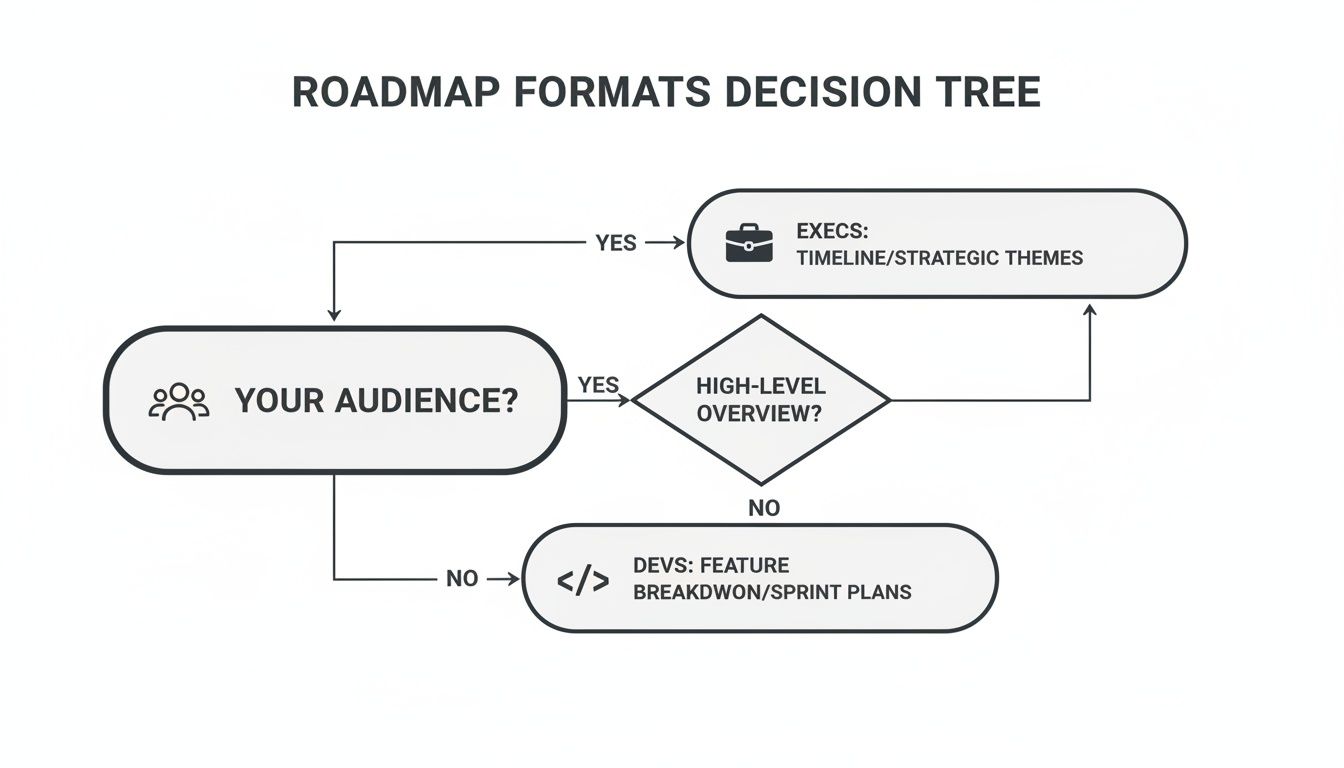
What this really drives home is a simple truth: executives need to see the strategic "why," making theme-based formats a great fit. Developers, on the other hand, need the tactical "what" and "how," which is where more detailed, sprint-level plans shine.
Consider Your Audience
Before you start looking at templates or signing up for a new tool, ask one simple question: "Who is this for?" Your roadmap is a communication document first and a plan second. The answer to that question changes everything.
- For Executives and Leadership: These folks need the 30,000-foot view. They don’t get bogged down in user stories or technical debt. They want to see a clear line connecting technology investments to business goals. A goal-oriented or high-level theme-based roadmap is perfect for this conversation.
- For Engineering and Development Teams: Your developers need absolute clarity on what to build next. While they definitely appreciate the strategic context, their immediate need is a well-prioritized list of initiatives. A more granular theme-based roadmap that can be broken down into epics usually hits the mark.
- For Sales and Marketing Teams: These teams need a heads-up on what’s coming down the pipeline so they can build their go-to-market plans. A timeline-based format—even one using broad strokes like quarters instead of exact dates—gives them the predictability they need to prep campaigns and manage customer expectations.
Align with Your Company Culture
The internal rhythm of your company is another massive factor. A format that’s a hit in a nimble startup will almost certainly fall flat in a large, process-heavy corporation.
Your roadmap format should reflect the culture you have, not the one you wish you had. Forcing an agile, theme-based roadmap on a team that thrives on deadlines and Gantt charts is a recipe for frustration.
Take an honest look at how your organization really operates:
- Agile and Adaptive: If your company is built on flexibility and quick iteration, a theme-based format is your best friend. It gives teams the freedom to adapt to new customer signals and learnings without having to constantly redraw a rigid timeline.
- Structured and Predictable: For organizations with long planning cycles, complex cross-team dependencies, or a history of waterfall development, a timeline-based format provides the structure everyone is used to. It brings clarity that’s essential for that kind of coordination.
- Outcome-Driven: Is your culture obsessed with metrics and key results (think OKRs)? A goal-oriented roadmap is the only real choice. It explicitly ties every single piece of work back to a measurable business outcome, which naturally reinforces that culture of accountability.
To make this decision easier, here’s a quick breakdown of how these formats map to different organizational needs.
Matching Roadmap Format to Your Organizational Needs
This table contrasts the most common formats against key factors to help you pinpoint the best fit.
| Decision Factor | Timeline-Based (Gantt) | Theme-Based (Kanban-style) | Goal-Oriented (OKR-based) |
|---|---|---|---|
| Primary Audience | External stakeholders, sales, marketing | Internal teams, developers, product managers | Executives, leadership, board members |
| Company Culture | Prefers structure and predictability | Values agility and responsiveness | Highly focused on metrics and results |
| Key Strength | Clear deadlines and dependency management | Flexibility to adapt to changing priorities | Direct link between work and business impact |
| Potential Weakness | Brittle; can break when priorities shift | Can feel too vague for external teams | May lack specific feature-level detail |
| Best for... | Projects with fixed deadlines and external commitments | Agile environments and continuous discovery | Organizations using OKRs or similar goal frameworks |
Ultimately, the best format is the one that sparks the right conversations and keeps everyone aligned. Don't be afraid to experiment to find what works for your specific context.
Factor In Your Planning Horizon
Finally, think about how far into the future you're trying to see. A universal rule of roadmapping is that your level of detail should shrink as your timeline expands. Trying to assign a specific feature to a specific developer 18 months from now isn't just hard—it's a waste of time.
Often, the most practical solution is a hybrid approach. You might use a detailed, sprint-level view for the current quarter, a broader theme-based view for the next two quarters, and a high-level, goal-oriented view for the year ahead. This creates a balanced technology roadmap format that gives you immediate clarity without sacrificing long-term flexibility.
A Practical Guide to Building Your Roadmap
Alright, you've seen the different types of technology roadmaps. Now for the fun part: rolling up your sleeves and actually building one. This is where abstract strategy gets real—where you create a concrete, actionable plan that your entire organization can get behind. Moving from a high-level vision to a visual guide isn't magic; it's a structured, deliberate process.
Remember, creating a roadmap is never a solo mission. It's a team sport that pulls together insights from across the business. By breaking the process down into clear, manageable stages, you can build a document that is both ambitious and, more importantly, achievable.

Step 1: Start with Your Strategic Vision
Before a single feature or project gets plotted on a timeline, you have to anchor your roadmap to the company's North Star. What’s the ultimate goal here? This isn’t just about the tech; it’s about the fundamental business objectives you’re trying to hit in the next one to three years.
Are you trying to capture market share? Slash operational costs? Break into a totally new vertical? Answering these big questions clarifies the "why" behind every single decision that follows. This strategic foundation is what makes your roadmap more than just a project plan—it's a direct reflection of your business strategy.
Step 2: Gather and Prioritize Initiatives
This is where the real work begins. It's time to collect potential initiatives from every corner of the organization. You'd be surprised where great ideas come from, so cast a wide net.
- Customer Feedback: Use tools like SigOS to dig into support tickets, sales calls, and user surveys. This is how you move past one-off anecdotes and spot the real patterns that point to churn risks or big expansion opportunities.
- Internal Stakeholders: Grab coffee with the sales team to hear what they need to close more deals. Sync with marketing about go-to-market requirements. And don't forget engineering—they know exactly where the critical technical debt is hiding.
- Competitive Analysis: Keep a close eye on what your competitors are shipping and where the market is headed. You don't want to get left behind.
Once you have a backlog of ideas, you have to prioritize. You can't do everything at once. Use a simple framework like RICE (Reach, Impact, Confidence, Effort) or just plot your ideas on an impact/effort matrix. This helps you quickly spot the low-hanging fruit and the big strategic bets. To ensure your plan is truly robust, it helps to explore real-world strategies for a digital transformation roadmap.
Step 3: Map Key Dependencies
No tech initiative exists in a vacuum. A huge part of building a realistic roadmap is figuring out all the dependencies between different projects and teams. Does Project A need to be finished before Team B can even start on Project C?
Visualizing these connections forces you to sequence work logically and helps you see potential bottlenecks before they happen. It also kicks off important conversations between teams about timing and resources early on. This step is absolutely critical if you're using a timeline-based technology roadmap format.
A roadmap without clear dependencies is just a wishlist. Identifying these connections early transforms your document from a collection of ideas into a coordinated, strategic execution guide.
For a more structured approach, you can look at how large organizations handle this. Many standard development processes for roadmaps feature 6–8 development stages and 4–6 report sections. Some government and defense handbooks even outline a formal 7-step process that covers everything from product identification to recommending technology alternatives.
Step 4: Allocate Resources and Draft the Roadmap
With your priorities and dependencies locked in, you can start assigning resources. This means connecting teams or individuals to key initiatives and putting some rough estimates on the effort required. And remember, these are just estimates, not blood oaths—especially for items further out on the timeline.
Finally, it’s time to bring it all together visually. Choose the format that best fits your audience and goals, just like we discussed earlier. Whether you land on a timeline, a theme-based board, or a goal-oriented chart, the visual should tell a clear and compelling story about where you're going and why. For a great starting point, check out our guide on finding the right technical roadmap template to get you going. This is the final step that turns all your strategic thinking into a tangible artifact that will align and inspire your entire team.
Finding the Right Tools for Modern Roadmapping
Even the most brilliant technology roadmap format will collect digital dust if it's not supported by the right software. We've moved far beyond the days of static spreadsheets and slide decks that were outdated the moment they were saved. Today's roadmaps need to be living, breathing guides, and that requires a dynamic, collaborative platform.
Choosing the right tool isn't about chasing the biggest brand name; it's about finding a set of capabilities that keeps your roadmap from becoming another forgotten file in a shared drive. This isn't just a nice-to-have. The market now expects product and tech teams to work from interactive, real-time plans.

This shift is all about agility. A static diagram simply can't keep up when development cycles are measured in weeks, not months.
Must-Have Features for Roadmapping Software
When you're shopping around for software, you need to zero in on features that actually help you stay agile, clear, and collaborative. These are the functions that separate a simple Gantt chart maker from a true strategic roadmapping platform.
Keep an eye out for these essentials:
- Real-Time Updates: The tool has to allow for instant changes that everyone can see. When priorities shift—and they always do—the roadmap must reflect that immediately. It has to be the single source of truth.
- Seamless Integrations: Your roadmap doesn't live on an island. It needs to talk to the tools your team already uses. Solid integrations with platforms like Jira or Asana are non-negotiable for connecting high-level strategy to the day-to-day grind.
- Powerful Data Visualization: One size doesn't fit all. The best tools let you switch views effortlessly—from a high-level timeline for the C-suite to a detailed Kanban board for engineers. This flexibility is key to communicating with different audiences.
- Reliable Version Control: Things change, and you need to know why. A good tool keeps a history of roadmap adjustments, which is invaluable for retrospectives and understanding how your strategy has evolved.
These features aren't just trendy; they’re a direct response to the industry's pivot from rigid annual plans to more fluid, quarterly planning. It’s all part of embracing agile thinking at the strategic level. You can see more examples of this trend in Smartsheet's guide to roadmap templates.
Connecting Tools to Your Strategy
The right software doesn’t just show you a plan; it helps you actively manage and validate it. Some of the most powerful platforms let you link roadmap initiatives directly to customer feedback or support tickets. This creates a crystal-clear line of sight from a customer’s problem straight to your proposed solution.
The goal is to find a tool that makes your roadmap a central hub for strategic conversations, not just a static artifact. It should facilitate discussion, not just document decisions.
This is where you unlock the real value. The software transforms your chosen technology roadmap format from a simple document into an interactive dashboard for keeping everyone aligned. Platforms with drag-and-drop interfaces and live data feeds empower teams to pivot quickly without losing sight of the North Star.
Ultimately, the best tools are the ones that slide right into your existing workflow and make collaboration feel effortless. For a deeper dive, check out our guide on the best tools for product managers, which can help you find a platform that gets your whole team on the same page.
Keeping Your Roadmap Relevant and Effective
Building a roadmap is just the beginning. The real work—and where you'll see the payoff—is in keeping it alive and useful. A roadmap isn't a static document you create once and then file away. Think of it as a living guide, a compass that needs regular calibration to keep your team pointed toward its strategic North Star.
The secret to great maintenance starts with great communication. How you present your technology roadmap format has to change depending on who's in the room. One size definitely does not fit all.
Tailor Your Communication Strategy
Different stakeholders need different levels of detail, and your format has to adapt. The whole point is to tell the right story to the right people to keep everyone aligned and bought-in.
- For the C-Suite: Stick to the high-level strategic narrative. You need to connect the dots between tech initiatives and business outcomes or OKRs. A goal-oriented or theme-based view works best here, emphasizing the why and the impact over the nitty-gritty implementation details.
- For Development Teams: This is where you get into the weeds. Your engineers need absolute clarity on what they're building next. A more detailed view showing upcoming themes, epics, and any critical dependencies is essential for them to plan sprints and actually get the work done.
This approach makes every conversation relevant. Executives don't get lost in technical details they don't care about, and developers get the exact clarity they need to execute.
Establish a Regular Review Cadence
The biggest enemy of a roadmap is neglect. If you let it gather dust, it quickly becomes irrelevant. The best way to prevent this is to schedule regular check-ins. For most teams, a quarterly review hits the sweet spot.
This meeting isn't just a status update. It’s a strategic session. This is your chance to reassess priorities based on what’s changed—a shift in the market, new customer feedback, or an evolution in business goals. When you treat your roadmap as a dynamic tool, you can adapt to new information without completely derailing your long-term vision.
Your roadmap is a statement of intent, not a set of unbreakable promises. Its real power comes from its ability to adapt to new learnings while keeping everyone focused on the ultimate destination.
By reviewing and adjusting your roadmap regularly, you reinforce the idea that it's a compass, not a rigid set of instructions carved in stone. For more ideas on keeping your roadmap dynamic and useful, check out these product roadmap best practices.
At the end of the day, the right format is more than just a document—it's a powerful communication tool. When you maintain it correctly, it aligns your teams, clarifies what matters most, and makes sure your technology investments actually deliver on their strategic promise.
Got Questions About Roadmap Formats? We've Got Answers.
Even with the best plan in hand, you're bound to have questions when you start building and sharing your tech roadmap. Let's tackle a couple of the most common ones we hear from teams.
How Much Detail Should I Put In My Roadmap?
The honest answer? It depends entirely on who you're talking to.
If you're presenting to the C-suite, keep it high-level. They care about the big-picture strategic themes and how your work ties back to business goals. They need the why, not the nitty-gritty of every user story.
Your development team, on the other hand, needs more substance to plan their sprints and spot dependencies. A great rule of thumb is to get specific for the current quarter, think in broader themes for the next quarter, and stick to high-level objectives for anything further out. This gives your team immediate clarity without pretending you have a crystal ball for the distant future.
A classic mistake is getting bogged down in specifics for things a year away. Remember, a roadmap is about strategic direction, not a rigid, unchangeable project plan with hard deadlines set in stone.
How Do I Deal With Unexpected Changes?
First, expect them. Change isn't the exception; it's the rule. The key is to build flexibility into your process from day one.
Set up a regular review cadence—quarterly is usually a good rhythm. This carves out dedicated time to look at new information, whether it's a shift in the market or fresh insights from customer feedback, and then adjust your priorities.
When a big change does hit, update the roadmap right away and, more importantly, communicate the why behind the pivot to everyone involved. Transparency builds trust. Using a more flexible technology roadmap format, like a theme-based or now-next-later roadmap, makes these adjustments way easier to manage than a strict, date-driven timeline. It helps your roadmap stay a living, breathing guide, not a dusty artifact.
Turn your customer feedback into a clear, revenue-driven roadmap. SigOS analyzes support tickets, sales calls, and usage data to show you which features will reduce churn and which will unlock major growth. Prioritize with confidence.
Keep Reading
More insights from our blog


Ready to find your hidden revenue leaks?
Start analyzing your customer feedback and discover insights that drive revenue.
Start Free Trial →