What Is a Power User and How Do You Find Them?
Learn what is a power user with our practical guide. Discover data-driven methods to identify, engage, and retain your product's most valuable customers.

When you hear the term "power user," what comes to mind? It’s more than just someone who logs in a lot. Power users are the elite 1-5% of your user base who have woven your product into the very fabric of their daily work. They're the ones who've gone beyond the core features, mastering every advanced function, shortcut, and even the undocumented workarounds.
Decoding the Power User in Your Product

Let’s use an analogy. Think of your product as a high-end professional camera. The casual user will probably leave it on "auto" mode. They’ll get decent pictures, sure, but their interaction is purely on the surface. They use the camera for its most basic purpose and are perfectly happy with the results.
Then you have the power user. This is the professional photographer who only shoots in manual mode. They know the delicate dance between aperture, ISO, and shutter speed. They’re constantly swapping lenses, customizing button layouts, and using advanced techniques to get that perfect shot. They don't just use the camera; they push it to its absolute limits to squeeze out every drop of value.
That distinction is everything. Your power users are a direct reflection of your product's health and one of your most potent engines for growth.
A power user isn't defined by login counts alone. They are defined by the depth of their engagement and their ability to extract disproportionate value from your platform.
Figuring out who belongs in which group is the first real step toward building a stickier product, boosting retention, and finding a sustainable path to growth. While casual users make up the majority of your audience, your power users are the ones holding the map to your future.
Power User vs. Casual User At a Glance
To make this crystal clear, let's break down the key behavioral differences and motivations that set these two groups apart. This table gives you a quick reference for spotting the patterns that separate your most dedicated advocates from everyone else.
| Characteristic | Power User | Casual User |
|---|---|---|
| Feature Adoption | Explores and masters advanced features. | Sticks to core, well-known functionalities. |
| Usage Frequency | High, often daily or multiple times a day. | Infrequent, weekly, or monthly sessions. |
| Product Knowledge | Deep understanding of workflows and shortcuts. | Basic understanding of primary functions. |
| Feedback Quality | Provides specific, sophisticated feature requests. | Offers general feedback or reports obvious bugs. |
| Community Role | Often an advocate, answering other users' questions. | A passive consumer of information. |
As you can see, the contrast is stark. Power users aren't just using your product more; they're using it differently. They are your innovators, your testers, and your most honest critics, all rolled into one.
The Anatomy of a Power User

To really get a handle on what a power user is, we have to look past the label and observe what they actually do. These aren't just people logging more hours. They're interacting with your product on a totally different level, driven by a need for efficiency and a genuine curiosity to master the tool.
Their actions tell a story—one of someone who has made your solution a non-negotiable part of their daily workflow. A power user's behavior really boils down to three key traits: they go deep into features, they use the product constantly, and they weave it seamlessly into everything they do.
Diving Deep into Features
Think about it: most of your users probably stick to the main path, using maybe 20% of your product's total capabilities. Your power users? They’re the explorers, actively seeking out the other 80%. They're poking around in advanced settings, testing out beta features, and finding every hidden shortcut.
Let’s take a project management tool like Asana or Monday.com as an example. A typical user creates tasks, assigns them, and sets due dates. A power user, on the other hand, is playing a different game entirely.
- They build complex automations. They’re setting up intricate rules to handle recurring workflows, saving their team hours of grunt work.
- They master advanced reporting. They don’t just glance at the default dashboards; they’re creating custom reports with specific filters and formulas to track niche KPIs.
- They connect everything. They leverage all the integrations, linking your tool to their entire tech stack—Slack, Salesforce, GitHub—to create a true command center for their work.
This isn’t random tinkering. Power users are on a mission to find the smartest, fastest way to get their job done, and they see your product’s advanced features as the keys to unlocking that efficiency.
Establishing a High Usage Cadence
Frequency is the next big piece of the puzzle. Power users don't just pop in when a notification reminds them. For them, your product is an always-open tab in their browser, a constant presence throughout the workday. This daily, habitual interaction is one of the strongest signals that they’re getting real, consistent value.
This pattern is a perfect example of the Pareto principle in action. Your power users might only make up the top 10-20% of your user base, but they often drive around 80% of all core activity. It’s so common that many companies graph this out on a "Power User Curve," which makes it easy to visually separate this hyper-engaged group from the long tail of casual users. You can find more great insights about the 80/20 rule in product engagement at kissmetrics.io.
A power user’s relationship with a product isn't transactional; it's habitual. Their consistent presence is a testament to the indispensable role your tool plays in their success.
This daily reliance transforms them from simple customers into deeply invested partners who have a real stake in your product's future.
Achieving Seamless Integration
The ultimate sign of a power user is how they effortlessly weave your product into their entire work ecosystem. They don't view your tool as a standalone app; they see it as a critical gear in a much larger machine. This integration is both technical and mental.
Take a designer using a tool like Figma. A standard user creates designs within the app, and that's about it. A power user, however, takes it much further:
- They develop a component library. They build a systematic, reusable library of design components that becomes the single source of truth for the whole team.
- They utilize the API and plugins. They install third-party plugins to add new capabilities or even use the API to connect Figma to their own custom development tools.
- They define team workflows. They don't just use the tool; they create and champion best practices for how the entire organization should use it, becoming a passionate internal advocate.
By building systems around your product, they create powerful switching costs and embed your solution deep into their company's DNA. This is the clearest signal that they’ve moved from just using your product to truly depending on it.
Why Power Users Are Your Growth Engine
It’s easy to lump power users in with every other customer segment, but that's a massive strategic mistake. Think of them less as customers and more as your company's most valuable, multi-purpose asset. They don't just use your product; they actively participate in its success, acting as a powerful force multiplier across your entire organization.
Investing in this top tier of users delivers returns that ripple out and benefit everyone.
For product teams, this group is an absolute goldmine. They offer sophisticated, nuanced feedback that goes way beyond surface-level bug reports. Because they’ve pushed your advanced features to their limits, their insights can directly shape your roadmap, helping you prioritize high-impact improvements over minor tweaks. They're basically your free, hyper-engaged R&D department.
At the same time, they dramatically lighten the load on your customer support teams. Power users often become community champions, jumping into forums or social media groups to answer questions from newer folks. This peer-to-peer support doesn't just resolve issues faster—it builds a stronger, more self-sufficient community around your product.
The Financial Impact of Power Users
The value of a power user isn't just a warm, fuzzy feeling; it translates directly into hard numbers that drive sustainable growth. When you focus on nurturing this segment, you kickstart a positive feedback loop that strengthens your business from the inside out.
Three key metrics, in particular, get a serious boost:
- Higher Lifetime Value (LTV): Power users are deeply embedded in your product. They are far more likely to upgrade to premium tiers, snap up add-ons, and stick around for years, which drastically increases the total revenue you see from them over time.
- Increased Monthly Recurring Revenue (MRR): Their high retention rates and willingness to upgrade create a stable and growing revenue base. They are the very bedrock of the predictable income every SaaS business dreams of.
- Lower Customer Acquisition Cost (CAC): This is where their role as a growth engine truly shines. Power users become your most authentic and effective marketing channel through genuine word-of-mouth. Their recommendations are trusted, leading to a steady stream of high-quality organic leads that cost you nothing to acquire.
This dynamic is a core pillar of a successful product-led growth strategy, where the product itself becomes the main driver of customer acquisition. By delighting your most engaged users, you turn them into a volunteer sales and marketing team. You can dive deeper into this idea in our comprehensive guide on building a product-led growth strategy.
A Double-Edged Sword: Engagement and Churn
Here’s the interesting part. The very qualities that make a power user so valuable also make them a flight risk if their needs aren't met. Research shows a strange paradox with this group: their sky-high engagement is often paired with a surprisingly high potential for churn. They are selective, digitally savvy, and will drop a tool in a heartbeat if it stops serving their advanced needs.
For instance, one industry analysis found that power users in the digital media space had a staggering 58% churn rate, compared to just 33% for everyone else. Why? Because they aren't just passive consumers; they are constantly evaluating whether your solution is the absolute best tool for their workflow. They engage deeply but demand continuous value in return. You can find more insights on digital-media power user trends at Deloitte.com.
This combination of high engagement and high churn risk means you can't ever take your most valuable users for granted. They are your greatest asset, but their loyalty has to be earned over and over again through innovation, responsiveness, and a deep understanding of what they need next.
This reality makes it crystal clear that you have to actively nurture this relationship. Just identifying a power user is only the first step. You must consistently deliver the value they're looking for through personalization, premium features, and a responsive feedback loop. If you don't, you risk losing not just a customer, but a powerful advocate and a key driver of your company's growth.
The takeaway is simple: investing in your top 10% of users is one of the highest-leverage things you can do to secure the success of the other 90%.
How to Actually Find Power Users in Your Data
Alright, let's move past the theory. To really get a handle on what a power user is, you have to roll up your sleeves and find them in your own product data. This is where the rubber meets the road—blending hard numbers with human feedback to get the full picture.
Finding these folks isn't about gut feelings. It's about following the digital trail they leave behind every time they log in. You need to look at both what they do (the quantitative side) and try to understand why they do it (the qualitative side). One gives you the cold, hard facts, and the other provides the crucial human context.
This infographic really drives home why this is so important. It’s not just an academic exercise; it’s a core business function with a massive impact on your bottom line.
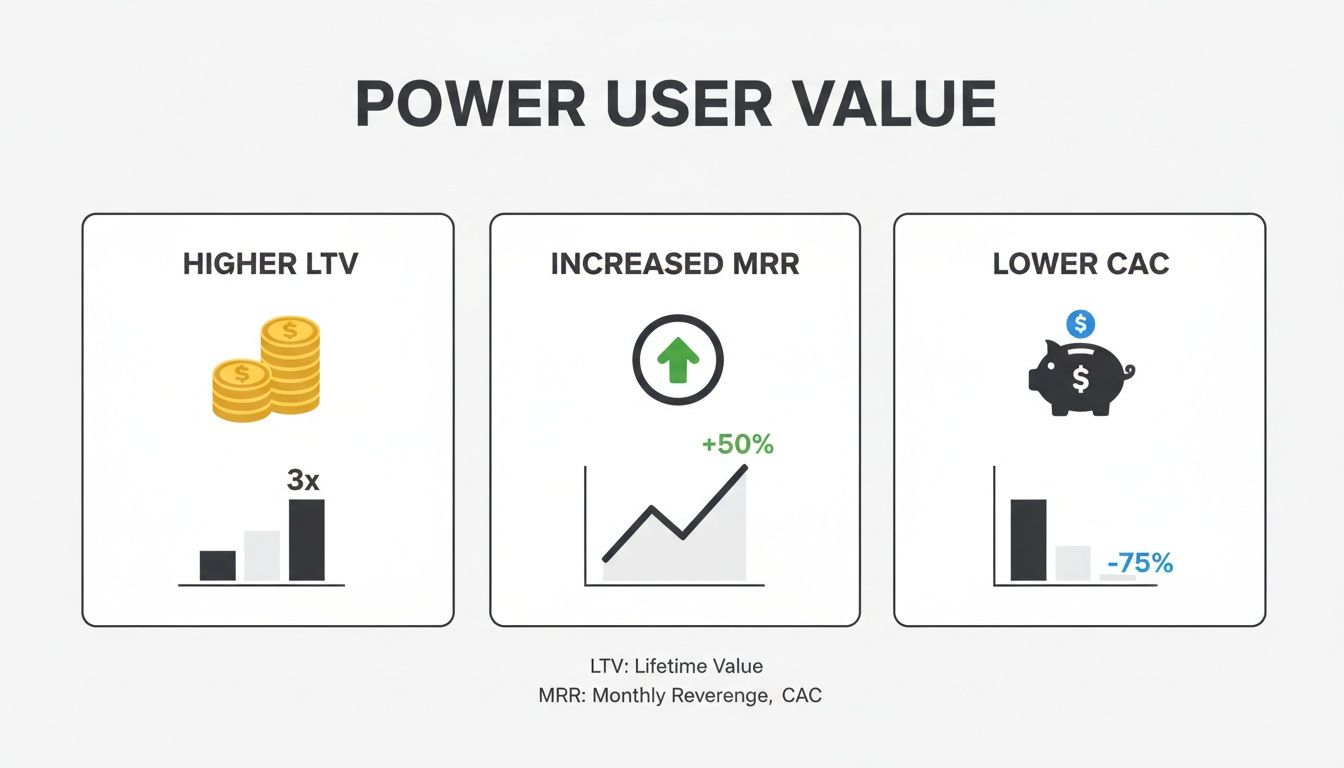
As you can see, nurturing this top-tier segment pays off directly in higher LTV, bigger MRR, and lower CAC. That’s the trifecta every SaaS business is chasing.
Unpacking the Quantitative Signals
Quantitative data gives you the objective proof of power user behavior. These are the hard numbers that let you filter your most dedicated users from everyone else. This is your starting point.
Here are the most common signals to track:
- High Session Frequency and Duration: Power users don't just pop in and out; they practically live in your product. Look for people with daily—or near-daily—sessions that last way longer than the average user's.
- Broad Feature Adoption: These aren't one-trick ponies. A power user consistently explores, adopts, and masters advanced features that most casual users don't even know exist. Check the adoption rates of your most complex features to see who’s really pushing the limits.
- High DAU/MAU Ratio: The ratio of Daily Active Users to Monthly Active Users is a classic "stickiness" metric for a reason. A high ratio in a user segment points directly to habitual use, a key trait of a power user.
- The Power User Curve: This is a fantastic visual. It’s a histogram plotting how many days in a month your users are active. You’ll usually see a "swoosh" shape, with a small, elite group active 20-30 days. That little spike on the far right? That’s your power user cohort, clear as day.
Smart product teams don't just use these metrics to identify users; they use them to drive growth. They'll run A/B tests on new onboarding flows or feature promotions aimed specifically at users who show early signs of becoming power users.
Listening for the Qualitative Clues
Data tells you what is happening, but the qualitative clues tell you why. This is where you get the rich, human context that numbers alone will never give you. You'll usually find these breadcrumbs in support tickets, community forums, and direct feedback channels.
To get the full story, look for these indicators:
- Submitting Detailed Feedback: Power users don't just say "this is broken." They file bug reports and feature requests that are incredibly specific, often with screenshots, console logs, and a well-reasoned case for why a change would make the product better.
- Pushing Support to Its Limits: They ask the kind of sophisticated questions that stump your first-line support agents. Their inquiries often uncover obscure edge cases or highlight challenges in complex workflows that your own team might have missed.
- Becoming a Community Leader: You'll spot them in your community Slack, on forums, or even on Twitter, answering other users' questions and acting as your unofficial product evangelists. They're out there defending and promoting your product for free.
By the way, there's a lot more to measuring customer satisfaction than just waiting for feedback, but these user-initiated signals are pure gold.
A support ticket from a power user is a gift. It’s a free, expert-level consultation on how to improve your product, coming from someone who knows it almost as well as you do.
When you start combining these human signals with the hard data, you get a robust, multi-dimensional view of your most valuable users. This balanced approach ensures you’re not just chasing clicks but truly understanding the people who matter most to your business. To dig deeper into this methodology, check out our guide on https://www.sigos.io/blog/what-is-behavioral-analytics.
Strategies to Engage and Retain Power Users
Pinpointing your power users is a huge win, but it’s really just the first step. The real work begins now: making sure they stick around for the long haul. Retaining these folks isn't about sending generic email blasts or routing them through standard support. It’s about making them feel seen, valued, and genuinely essential to your product’s journey.
Your goal is to transform the relationship from a simple transaction into a genuine partnership. When a power user feels like an insider, their loyalty skyrockets, their feedback becomes brutally honest (in the best way), and their advocacy becomes a powerful growth engine. This requires a thoughtful, multi-pronged approach that acknowledges their unique status and rewards the deep investment they’ve made in your platform.
Create an Exclusive Community
One of the most powerful moves you can make is to give your power users a space of their own. I’m not talking about another noisy support forum. This is about creating a direct, exclusive line to your team and, just as importantly, to each other.
- Dedicated Channels: A private Slack or Discord channel is perfect for this. It fosters a real sense of belonging and allows for the kind of high-level conversations that would be completely lost in a public setting.
- Direct Access: Make sure your product managers, engineers, and even executives are active in this space. When a power user’s detailed feedback gets an immediate reply from the very person who can act on it, that experience is incredibly validating.
- Peer Networking: This community also lets them connect with other experts. They can swap advanced workflows, troubleshoot complex problems, and build a professional network—all centered around their mastery of your product.
This kind of community quickly becomes a sticky retention tool. It’s a place where your best customers feel heard and can see the direct impact of their insights.
Roll Out the Red Carpet with VIP Treatment
Power users pour a ton of time and energy into your product, and they deserve a level of service that reflects their importance. Let's be honest, standard support queues often aren't equipped to handle their advanced questions, which can easily lead to frustration and churn.
Offering premium, white-glove treatment isn't a cost center; it’s an investment that makes them feel prioritized and understood.
Treating your power users like VIPs isn't about cutting costs; it's about investing in your most valuable assets. Their continued success is a direct reflection of your product's strength.
Think about implementing a tiered support system:
- Dedicated Support Agents: Assign them a specific support contact who already knows their use case and history inside and out. This simple step eliminates the pain of having to re-explain complex issues every single time they need help.
- Faster Response Times: Guarantee faster SLAs for this user group. When they hit a roadblock, a quick, expert resolution is critical to their workflow and their entire perception of your company.
This elevated service reinforces their value and proves you’re as invested in their success as they are in your product.
Involve Them in Your Product Journey
The single best way to keep a power user for life is to make them a co-creator in your product's future. They have a deep, personal interest in seeing it improve, and their sophisticated insights are pure gold for your product team.
- Beta Programs: Invite them to an exclusive beta program. Giving them early access to new features not only makes them feel special but also provides you with incredibly high-quality feedback before a public launch.
- Customer Advisory Boards (CABs): Handpick a small, formal board of your top power users. Meet with them quarterly to discuss your roadmap, get feedback on strategic decisions, and understand how their needs are evolving.
These initiatives do more than just generate good ideas; they build powerful emotional buy-in. When a power user sees a feature they suggested go live, they stop being just a customer. They become a true champion. Ultimately, building these deep relationships is key, and you can explore more high-level strategies to improve customer retention for a broader perspective.
Keeping these users engaged is a continuous effort, but the payoff is immense. By monitoring the right customer retention metrics you should be tracking, you can measure the direct impact of these engagement strategies on your bottom line.
Using Continuous Analysis to Drive Growth
Trying to find your power users by manually digging through spreadsheets and dashboards is like panning for gold with a teaspoon. It's tedious, slow, and you're almost guaranteed to miss the biggest nuggets. This old-school, reactive approach means you usually figure out who a power user is long after they've established their habits. Even worse, you might only notice them when their behavior changes—a classic sign they're about to churn.
A much smarter way to work is to flip this model on its head. Instead of doing periodic checks, you shift to proactive, real-time engagement. This is made possible by continuous behavioral analysis, a system that's always on, working 24/7 to catch meaningful shifts in user activity the moment they happen. Forget waiting for a quarterly report; you get an alert the second a user’s actions show they're on the path to becoming a power user.
This real-time insight is exactly where a product intelligence platform like SigOS completely changes the game.
From Data Points to Revenue Impact
It’s one thing to know a user is clicking around a lot. But the real question is, what’s the dollar value of that activity? Continuous analysis is what connects those user actions to actual business outcomes. It automatically flags opportunities for upsells, points out cross-sell potential, and spots critical retention risks before they blow up.
For instance, the system can instantly flag an account that keeps bumping up against the usage limits of its current plan—that’s a crystal-clear expansion opportunity. On the flip side, it can also detect when a long-time power user suddenly stops using a key advanced feature. This can trigger an automated alert for your customer success team to jump in and figure out what's wrong before it's too late.
The SigOS dashboard below gives you a sense of how these signals are brought to the surface, ranked by their potential financial impact.
This kind of interface turns a flood of raw behavioral data into a simple, prioritized to-do list. It helps your teams focus their energy on the issues and opportunities that actually move the needle on revenue.
By prioritizing signals based on revenue, you stop guessing and start making data-driven decisions. This transforms your power user program from a simple engagement tactic into a consistent, revenue-generating engine for the business.
This automated intelligence gives you the ability to:
- Identify Emerging Power Users: Spot the users who are quickly adopting advanced features and starting to look just like your best customers.
- Predict Churn Risk: Get an early warning when a power user’s engagement starts to drop, giving you a crucial window to step in.
- Surface Expansion Opportunities: Automatically pinpoint accounts that are primed for an upgrade because of how deeply they're using your product.
Ultimately, this automated, continuous approach means you never miss a critical signal again. It gives your team the confidence to act decisively, turning insights about your best users into real, measurable growth.
Got Questions About Power Users? We've Got Answers.
As you start shifting your focus toward your most valuable customers, a few common questions always pop up. Let's tackle them head-on to clear things up and help you build a smarter strategy.
Can Someone Be a Power User of More Than One Product?
Of course. In fact, it's pretty much a defining characteristic. Power users are often the most tech-forward people on their teams, relying on a whole arsenal of tools to get their jobs done efficiently.
Think of a graphic designer who lives and breathes in Figma. They're almost certainly a power user of Slack for team communication and probably a master of a project management tool like Asana or Trello, too. They don't just use these tools; they weave them together into a high-performance workflow. This is a huge clue for you—understanding their full toolkit can show you exactly where your next big integration opportunity lies.
What Percentage of Our Users Should Be Power Users?
There isn't a single magic number here, but a great starting point is the Pareto Principle, better known as the 80/20 rule. You'll often find that roughly 20% of your user base is responsible for 80% of the real action inside your product.
But the true power users—the absolute top-tier, most fanatical segment—are usually an even smaller slice of the pie, often sitting somewhere between 1-5% of your total users.
The key isn't to obsess over hitting a specific target. What you really want to track is whether that core group is growing and becoming even more engaged over time. A healthy, expanding power user base is one of the best signs of a strong product and future growth.
What's the Single Biggest Mistake Companies Make with Power Users?
Ignoring them. It sounds simple, but it happens all the time.
Companies get so caught up in the chase for new logos and fresh sign-ups that they completely forget about the champions they already have. This is a massive, unforced error. Power users are your most engaged customers, but they can also be the first to leave if they feel their advanced needs are being overlooked or the product stagnates.
When you take them for granted, you lose more than just a subscription. You lose your best source of feedback, your most authentic brand advocates, and a reliable stream of revenue. The fix is to treat them like design partners—listen to them, create exclusive communities for them, and make them part of your product's story. Investing in them is a direct investment in your own success.
Ready to stop guessing and start pinpointing the signals that drive revenue? SigOS uses continuous behavioral analysis to automatically identify your power users, surface churn risks, and highlight expansion opportunities.
Keep Reading
More insights from our blog


Ready to find your hidden revenue leaks?
Start analyzing your customer feedback and discover insights that drive revenue.
Start Free Trial →