What Is Product Strategy A Guide to Winning Markets
Struggling with what is product strategy? This guide demystifies the process, helping you build a clear framework that links your vision to tangible results.
A product strategy is your roadmap—the high-level plan that bridges the gap between your company’s big-picture vision and the real-world problems you solve for customers. It's the "why" that guides every feature you build, every market you chase, and every tough decision you make. Ultimately, it’s what ensures your product isn't just a collection of features, but something that creates genuine value and hits its business targets.
The Foundation of Product Success

Think of it like this: your company's vision is the destination you want to reach, say, a distant shore. Your product strategy is the actual route your ship's navigator plots to get there. It accounts for the currents (market trends), the weather (competition), and any potential storms along the way. It’s not just a document that gathers dust; it's the living framework that keeps your entire team focused and sailing in the same direction.
Without a clear strategy, teams tend to drift. They get caught up building features that sound cool in a meeting but don’t add up to a cohesive whole. This is how you end up with a bloated, confusing product that doesn't stand for anything in the market. A strong strategy is the anchor that prevents this chaos.
Defining Your Direction and Focus
This kind of proactive planning has become the single most important job in modern product management. In fact, recent studies show that strategy development is now the top priority for product managers worldwide. How a company defines and communicates its strategy is a massive factor in its overall success. You can dive deeper into this data in the 2025 State of Product Management report.
A product strategy articulates what you want to achieve, who you're serving, and how you'll beat the competition. It transforms an ambitious vision into an actionable game plan for your product and marketing teams.
At its core, a good strategy answers three fundamental questions:
- Who are we building this for? This means getting crystal clear on your target customer and market segment.
- What problem are we solving? You have to pinpoint the exact needs and frustrations your product will eliminate.
- How will we win? This is all about your unique value proposition and what makes you different from everyone else.
It’s crucial to remember that your strategy defines why the product exists. It's the long-term vision, not the short-term launch plan. To learn more about how the launch itself comes together, check out our guide on what product marketing does.
The Three Pillars of a Winning Product Strategy
A great product strategy doesn't just spring to life from a single "aha!" moment. It's carefully constructed on a foundation of three core pillars. When these components work in harmony, they create a clear, logical path from your big-picture vision right down to the day-to-day work your teams are doing.
Think of it like building a house. You need a blueprint (the vision), the main structural supports (the goals), and the major construction phases (the initiatives). Getting this structure right is what elevates a strategy from a simple feature wishlist to a powerful tool for alignment and decision-making.
Pillar 1: Market Vision
Everything starts here. Your Market Vision is the first and most critical pillar. This isn't some fuzzy mission statement destined for a dusty plaque on the wall. It’s a vivid, compelling picture of the future you’re creating for a very specific group of people.
It forces you to answer the big questions: Who are we building this for? and How will their world be fundamentally better once we've solved their problem? This vision becomes your North Star, the constant reference point for every single decision that follows.
For instance, a B2B SaaS company might land on a vision to "become the undisputed command center for freelance finances, wiping out the anxiety of tax season and giving creators the confidence to grow their business." This is specific. It names the audience (freelancers), pinpoints their pain (tax anxiety), and defines the ideal outcome (confidence and growth).
Your Market Vision is the story you tell about the future. It has to be ambitious enough to get your team fired up, yet clear enough that everyone knows exactly what part they play in making it happen.
Without a strong vision, teams tend to wander. They build features that sound good in a meeting but don't add up to a cohesive whole. A sharp vision ensures everyone is pulling in the same direction.
Pillar 2: Strategic Goals
With your destination set, the second pillar translates that ambition into something you can actually measure: Strategic Goals. These are the big, concrete outcomes you have to hit to bring your vision to life. If the vision is the city you're traveling to, these goals are the major landmarks you need to pass on your journey.
Good goals are specific and time-bound. Frameworks like Objectives and Key Results (OKRs) are perfect for this because they force you to define not just what you want to accomplish (the Objective) but also how you'll prove you did it (the Key Results).
Let's stick with our B2B SaaS example. To realize their vision, a strategic goal might look like this:
- Objective: Become the go-to financial tool for US-based freelancers within 18 months.
- Key Result 1: Grow our market share from 15% to 30%.
- Key Result 2: Onboard 50,000 new active subscribers.
- Key Result 3: Achieve a Net Promoter Score (NPS) of +60 within this user segment.
Notice these aren't features. They are business-level outcomes that the product is responsible for driving. This distinction is crucial—it keeps the team focused on impact, not just shipping code.
Pillar 3: Business Initiatives
The third and final pillar, Business Initiatives, is where the rubber meets the road. Initiatives are the major projects or themes your team will tackle to achieve your strategic goals. They’re the big rocks that will populate your product roadmap and give your development sprints a clear sense of purpose.
Think of initiatives as the major plays you're going to run to hit your numbers. They're still high-level, but they provide clear direction for product, marketing, and engineering.
To hit that goal of market leadership, our B2B SaaS company might identify these initiatives:
- Simplify User Onboarding: Overhaul the setup experience to slash new user churn by 25%, getting freelancers to their first "win" faster.
- Expand into Invoicing: Build and launch an integrated invoicing module to capture users who are currently juggling multiple tools.
- Launch a Strategic Partnership Program: Integrate with the top three creator platforms to drive qualified referrals and establish our presence where freelancers already work.
See the connection? Each initiative directly supports a strategic goal, and each goal is a stepping stone toward the market vision. This cascade—from vision to goals to initiatives—is the essence of a powerful product strategy. It ensures that every single task has a clear "why" behind it, tied directly to the success of the entire business.
How to Build Your Product Strategy From Scratch
Creating a killer product strategy isn't some abstract thought exercise for an offsite retreat. It's a hands-on, step-by-step process for turning a big vision into a concrete plan that guides your team's every decision. Get it right, and you’ll build products people not only want but are happy to pay for—creating a real, sustainable edge in your market.
This visual gives you a bird's-eye view of the whole process, showing how you move from a broad vision to specific, actionable initiatives.
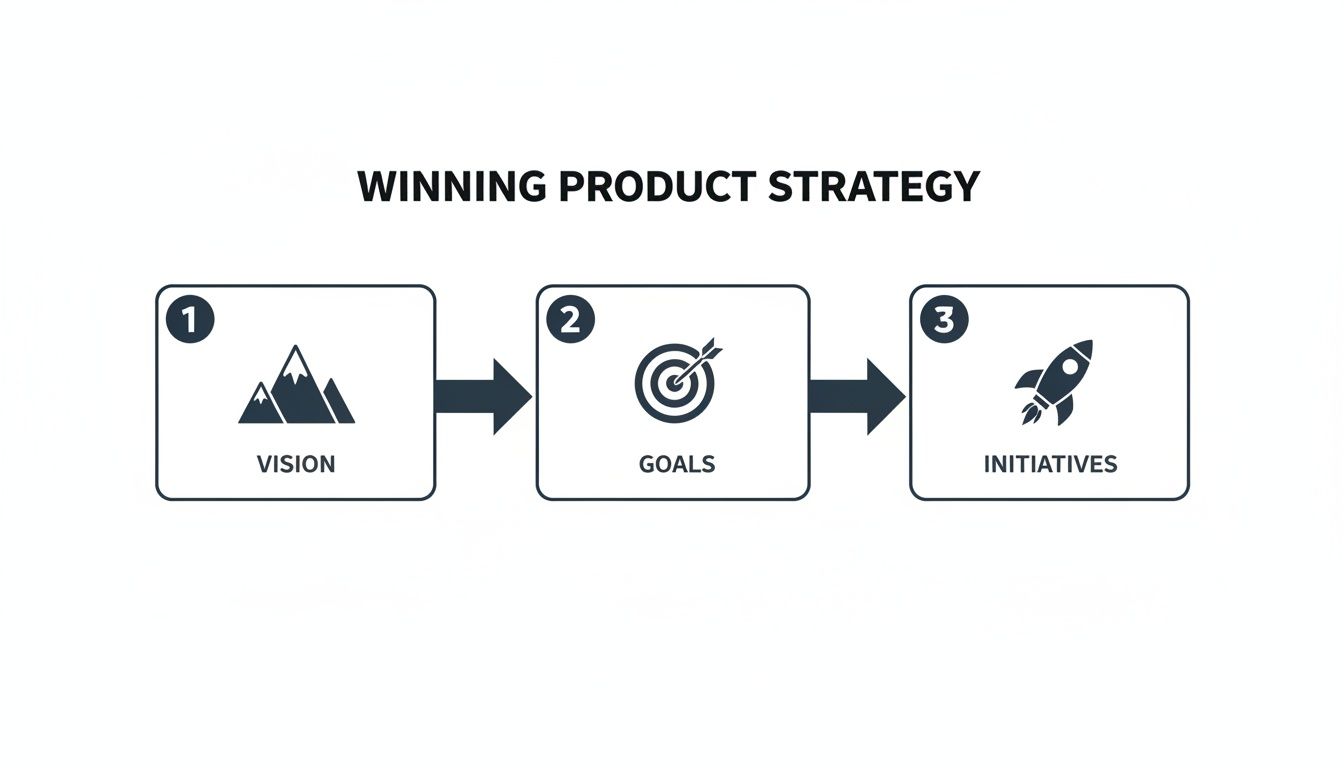
As you can see, a winning strategy flows down from that high-level vision into measurable goals and, finally, the focused initiatives that actually shape your roadmap.
Uncover Deep Customer Needs
Let's be clear: the bedrock of any great strategy is a deep, almost obsessive, understanding of your customer’s world. This goes way beyond surface-level assumptions. It means rolling up your sleeves to uncover the real, often unspoken, problems your target audience grapples with every single day.
To do this right, you need to blend two types of insight:
- Qualitative Insights: Get on the phone. Run one-on-one interviews, usability tests, and small focus groups. Ask open-ended questions to truly get at their motivations, their frustrations, and the "jobs" they’re trying to get done.
- Quantitative Data: Dive into the numbers. Analyze usage metrics, support tickets, and survey results to spot broad patterns. Look for where users are dropping off, which features are collecting dust, and what they keep asking for.
More and more product teams are realizing that customer feedback isn't just a suggestion box—it’s one of the most powerful drivers of strategy. It’s what helps you decide what to build next. This customer-led approach ensures every dollar you invest delivers real value and keeps you ahead of the curve.
Analyze the Competitive Landscape
Once you know your customer inside and out, it’s time to size up the competition. This isn't about creating a feature-for-feature copycat. It’s about methodically identifying the gaps in the market that your product can uniquely and brilliantly fill. A solid competitive analysis helps you see where everyone else is dropping the ball.
You need to find answers to a few key questions:
- Who are our direct and indirect competitors? (Don't forget the workarounds people use!)
- What are their biggest strengths and most glaring weaknesses?
- How are they positioning themselves? What story are they telling the market?
- Where are the underserved customer segments they’re completely ignoring?
By mapping out this landscape, you can discover your "blue ocean"—that uncontested space where you can offer something truly different and escape the cutthroat, head-to-head battles.
Define Your Unique Value Proposition
Okay, now it’s time to stake your claim. Your Unique Value Proposition (UVP) is a crystal-clear, no-fluff statement that spells out exactly what makes your product different and better than anything else out there. It’s the promise you make to your customers.
A strong UVP nails three questions from the customer's point of view:
- Relevancy: How does this solve my problem or make my life better?
- Quantified Value: What specific, concrete benefits will I get?
- Differentiation: Why should I pick you over all the other options?
A great UVP isn't just a catchy marketing slogan. It's the very soul of your strategy. It communicates the one-of-a-kind benefit that makes you the obvious choice for your ideal customer.
Take Slack, for example. Their UVP isn't just "chat for teams." It's about making your work life "simpler, more pleasant, and more productive" by killing your inbox and centralizing communication. That sharp focus guides every feature they ship. To get this right, you first have to nail your customer segmentation strategies to know exactly who you're talking to.
Set Measurable Product Metrics
Finally, a strategy is just a nice-looking document if you can't measure its success. You have to define a small handful of key performance indicators (KPIs) that tell you, in no uncertain terms, whether your strategy is actually working. These metrics force you to move past fuzzy vanity numbers (like page views) and focus on what truly drives the business forward.
The ultimate goal here is to identify your North Star Metric (NSM). This is the one metric that best captures the core value your product delivers to customers. It’s a leading indicator of long-term, sustainable growth.
Think about these examples:
- Spotify: Time spent listening
- Airbnb: Nights booked
- HubSpot: Number of active weekly teams
When you rally the entire company around improving this single metric, you create incredible alignment and clarity. Everyone knows what winning looks like. And that’s how your strategy transforms from a document into a daily guide for making decisions that matter.
Choosing the Right Strategic Framework
Embed: https://www.sigos.io/blog/jobs-to-be-done-template
Once you've nailed down your core strategy, you need the right tools to bring it to life. Strategic frameworks are essentially different lenses for looking at your product. They help you evaluate opportunities, prioritize what to build next, and make those tough trade-off decisions.
Think of them less as a replacement for your strategy and more as a structured way to execute it.
The trick is knowing which framework to pull out of your toolbox for the job at hand. Are you deciding which huge new initiative gets funding this year? Or are you down in the weeds, prioritizing features for the next sprint? Each question demands a different approach. It’s like a carpenter’s toolkit—you wouldn't use a hammer to cut wood. Your goal is to build up a set of go-to mental models you can apply to different problems, ensuring every decision you make ladders up to your overarching strategy.
The DHM Model for High-Level Decisions
When you’re staring down a massive strategic decision, the DHM model is a lifesaver. Developed by Gibson Biddle, the former VP of Product at Netflix, it’s a simple but powerful way to sanity-check your biggest bets.
It forces you to ask three critical questions:
- Delight Customers: Will this genuinely wow our customers? We're not talking about a minor tweak; this needs to be an improvement so significant they’ll rave about it.
- Hard to Copy: Does this build a competitive moat around our business? This could be anything from proprietary tech or network effects to a brand that people absolutely love.
- Margin Enhancing: Will this actually improve the financial health of the business? Think in terms of boosting revenue, increasing profitability, or making operations more efficient.
The DHM model is perfect for those big-picture moments, like entering a new market or launching a flagship product. It's probably overkill for prioritizing small bug fixes, but for your most significant investments, it's invaluable.
The Kano Model for Feature Prioritization
If the DHM model helps you figure out what to do, the Kano Model helps you understand the why behind feature development. It’s a brilliant way to categorize features based on how they impact customer satisfaction.
It sorts features into three buckets:
- Basic Expectations: These are the table stakes. Customers expect them, and they'll be furious if they're missing. Think of a login page for a SaaS app. Having one doesn’t make anyone happy, but not having one is a dealbreaker.
- Performance Payoffs: For these features, more is simply better. The faster you make that report run or the more storage you offer, the happier your customers become. Satisfaction is linear.
- Delighters: These are the unexpected, game-changing features that create a "wow" moment. Customers weren't asking for them, but they generate huge satisfaction and loyalty when they discover them.
The Kano Model is a game-changer for roadmap planning. It shifts the conversation from "what features should we build?" to "what kind of value do we want to deliver to our customers?"
This model shines when you've got a long backlog and need a logical way to sort through it. It helps you build a balanced roadmap with a healthy mix of must-haves, performance boosts, and delightful surprises.
Jobs-to-be-Done for Deep Customer Insight
The Jobs-to-be-Done (JTBD) theory, popularized by the late Clayton Christensen, will completely reframe how you think about your product. It argues that customers "hire" products to get a specific "job" done in their lives.
Instead of obsessing over user personas and demographics, JTBD forces you to ask a more fundamental question: What progress is the customer trying to make? People don’t buy a drill because they want a drill; they hire it to get a quarter-inch hole in their wall. The hole is the job.
Understanding the "job" uncovers your real competition, which is often not who you think it is. The biggest competitor to a new project management tool isn't another SaaS app—it’s often a messy spreadsheet, a whiteboard, or a series of chaotic email chains.
To dig deeper into this mindset, check out our guide and grab a free Jobs-to-be-Done template. JTBD is incredibly powerful for sparking true innovation because it focuses you on the customer's underlying need, not just iterating on an existing solution.
Choosing the Right Product Strategy Framework
Deciding on a framework can feel overwhelming, but it really comes down to the problem you're trying to solve right now. The table below breaks down these popular models to help you see where each one shines.
| Framework | Primary Focus | Best Used For |
|---|---|---|
| DHM Model | High-level strategic alignment | Vetting major initiatives, new market entry, or significant product launches. |
| Kano Model | Customer satisfaction and feature value | Prioritizing a feature backlog and planning a balanced product roadmap. |
| Jobs-to-be-Done | Uncovering deep customer needs and motivations | Discovering unmet needs, identifying true competition, and driving innovation. |
Ultimately, there's no single "best" framework. The most effective product leaders have a few of these in their back pocket and know exactly when to use each one to guide their teams toward decisions that support the broader strategy.
Translating Strategy into a Powerful Product Roadmap
A product strategy, no matter how brilliant, is just a document until it’s put into action. The bridge between your high-level vision and your team's daily work is the product roadmap. So many teams get this wrong, treating their roadmap as a glorified to-do list—a long, uninspired backlog of features.
That approach completely misses the point. A great roadmap is a communication tool, first and foremost. It tells a compelling story about why you’re building something, not just what you're building. It’s a visual narrative that shows exactly how your team's hard work pushes the company toward its North Star.
This strategic focus is more critical than ever. As highlighted in a recent State of Product Management report, teams are smaller and resources are tighter. That means every single development cycle has to count.
From Initiatives to Strategic Themes
So, how do you build a roadmap that actually tells a story? You stop organizing it around features and start organizing it around strategic themes. Think of themes as high-level goals that bundle related features and initiatives together. They provide the "why" that connects the day-to-day grind back to the big picture.
For example, instead of a line item that just says, "Build new dashboard widget," a thematic roadmap would frame it like this:
- Theme: Make New User Onboarding Effortless
- Theme: Become the Go-To Choice for Enterprise
- Theme: Drastically Improve Core Product Speed
When you structure work this way, every task has purpose. A developer working on an API integration understands they’re not just coding an endpoint; they’re helping the company achieve the theme of "Become the Go-To Choice for Enterprise." That context is a powerful motivator that gets everyone pulling in the same direction.
A theme-based roadmap transforms the conversation from "When will this feature be done?" to "How will this theme impact our strategic goals?" It elevates the discussion from timelines to outcomes.
Grouping features under themes also gives you incredible flexibility. If one specific feature turns out to be a dead end, you can pivot to another idea that still moves the theme forward without derailing everything. For a hands-on guide to structuring this, check out our technical roadmap template.
Ruthless Prioritization for Maximum Impact
Once you have your themes, the real work begins. It's time for ruthless prioritization. In a world of finite time and budgets, you can't build everything. Your roadmap must be a series of deliberate choices about where to invest your team's most valuable asset: their focus.
Effective prioritization isn’t about picking the coolest ideas. It’s about choosing the work that delivers the biggest punch against your strategic goals, and that requires evidence, not just gut feelings.
Here are a few lenses to help you prioritize your themes:
- Customer Value: Which themes solve the most painful or widespread problems for your customers? Dig into support tickets, user interviews, and behavioral data to find out.
- Business Objectives: How does each theme directly contribute to core business goals like growing revenue, cutting churn, or capturing a new market segment?
- Level of Effort: What's the real cost—in time and engineering resources—to deliver on each theme? This is crucial for calculating the potential return on investment.
When you consistently evaluate your themes against these criteria, your roadmap stops being a wish list and becomes a powerful strategic plan. It becomes a living document that guarantees your team is always focused on what actually matters—delivering real value to customers and driving the business forward.
Common Product Strategy Mistakes and How to Avoid Them
Even the sharpest product strategy can get knocked off course by a few surprisingly common mistakes. Knowing what these pitfalls look like is just as important as knowing what to do right—it’s the key to avoiding wasted effort, frustrated teams, and a product that just doesn't connect with its audience.
Let's break down some of the most frequent stumbles I’ve seen teams make.
Mistake #1: Confusing Your Strategy with a Feature List
This is probably the most common trap. A product strategy is your "why"—the big-picture plan for how you'll win in your market. A feature list is just the "what"—a laundry list of things to build. When your roadmap morphs into an endless queue of stakeholder requests with no clear strategic thread tying them together, you’ve lost the plot.
Scenario: A project management SaaS company spends a year frantically building every feature its competitors offer. They finally reach feature parity, but they're just a copycat. They don't solve any specific problem better than anyone else, their identity is non-existent, and user growth is flat.
The fix? Always connect the work back to your strategy. Instead of a ticket that says, "Build calendar integration," frame the initiative as, "Increase daily user engagement by embedding our tool into essential workflows." See the difference? One is a task; the other is a goal.
Mistake #2: Setting Vague or Immeasurable Goals
Another classic blunder is setting goals that sound impressive but are impossible to measure. Think "improve user satisfaction" or "become the market leader." They sound great on a PowerPoint slide, but they give your team zero direction. If you can't measure it, you can't know if you're winning.
This kind of ambiguity kills focus. It makes it impossible to know when to celebrate a real win or when to pivot because an idea just isn't working.
- The Mistake: "We want to make our app more intuitive."
- The Correction: "We will cut the time it takes a new user to set up their first project from 12 minutes down to under 5 minutes by the end of Q3."
Now that's a target you can actually hit.
Mistake #3: Ignoring Market Shifts and Customer Feedback
Your product strategy isn't something you carve in stone and forget about. Markets are living things—competitors launch products, customer needs change, and new tech appears out of nowhere. If you aren't constantly checking your assumptions against what's happening in the real world, you're building for a past that no longer exists.
You have to build a system for staying in touch with reality.
- Schedule Quarterly Strategy Reviews: Get your key stakeholders in a room every three months to formally challenge and validate your strategic assumptions.
- Monitor Customer Signals: Use tools to keep a pulse on support tickets, sales call notes, and product usage data. Look for the patterns.
- Stay Curious: Make time for competitive analysis and exploring trends that could disrupt your industry.
Treat your strategy like a living document, not a dusty artifact. That’s how you stay agile, adapt, and keep your edge.
Frequently Asked Questions About Product Strategy
Even the most well-thought-out plan raises questions once you start putting it into practice. Getting clear answers to these common sticking points is key to building confidence, keeping your team aligned, and making sure everyone is pulling in the same direction.
Here are the questions I hear most often from product leaders—and my straight-to-the-point answers.
How Often Should I Update My Product Strategy?
A product strategy isn't something you carve in stone and forget about. While your core vision might hold steady for years, the strategy itself needs to breathe. Think of it as a living guide that must adapt to the world around it to stay relevant.
A good rule of thumb is to review your strategy quarterly. This cadence is frequent enough to let you check progress against your goals and react to new market data, competitive moves, or shifting customer needs. You might only do a major overhaul annually, but these quarterly check-ins are crucial.
This approach gives you the best of both worlds: you get the stability of a long-term plan without the whiplash of constantly changing direction.
Your product strategy should be durable enough to guide you for months, yet flexible enough to adapt to new learnings. It's a marathon with built-in checkpoints, not a sprint with a fixed finish line.
What Is The Difference Between Product and Go-To-Market Strategy?
It's incredibly easy to blur the lines between these two, but they have very different jobs. They’re two sides of the same coin—both are essential for a product to succeed, but they focus on different parts of the journey.
Here’s a simple way to think about it:
- Product Strategy is the "Why and What." It digs into the core questions: Why are we even building this? What specific problem are we solving, and for whom? This strategy guides the actual development and evolution of the product itself.
- Go-to-Market (GTM) Strategy is the "How." This is all about execution in the market. It answers: How will we launch, market, sell, and support this thing to connect with our target audience? This strategy is what drives commercial success and adoption.
Simply put, your product strategy makes sure you build the right product. Your GTM strategy makes sure you bring it to market the right way.
Do Small Startups Really Need a Product Strategy?
Yes, without a doubt. I’d argue that for a startup, a product strategy is even more critical than it is for a big, established company. When every dollar and every hour is precious, you simply can't afford to chase shiny objects or build features that don't directly push you toward your goals.
A sharp strategy acts as a ruthless filter for prioritization. It gives the team a clear framework for saying "no" to distracting ideas and a confident "yes" to the work that truly matters. It's the roadmap that guides every decision, ensuring each line of code and every marketing dollar gets you one step closer to achieving product-market fit.
Plus, a compelling strategy is your best tool for selling your vision to early hires, investors, and those all-important first customers.
Ready to build a strategy driven by real customer needs? SigOS uses AI to analyze customer feedback and pinpoint the issues and feature requests that have the biggest impact on your revenue. Transform qualitative noise into quantifiable, actionable insights and make strategic decisions with confidence. See how SigOS can quantify your strategy today.
Keep Reading
More insights from our blog



Ready to find your hidden revenue leaks?
Start analyzing your customer feedback and discover insights that drive revenue.
Start Free Trial →