The Ultimate Guide to Idea Management Platform Success
Discover how an idea management platform turns customer feedback into revenue. Our 2026 guide covers features, ROI, and choosing the right tool for SaaS growth.

So, what exactly is an idea management platform? It's much more than just a digital suggestion box. Think of it as a central nervous system for your product, one that takes all the scattered feedback you get and turns it into a clear, revenue-focused roadmap.
Instead of feedback languishing in Zendesk tickets, sales call notes, or usage logs, this platform brings everything into one place to be captured, analyzed, and prioritized.
From Feedback Chaos to Revenue Clarity
If you're on a growing SaaS team, you know the feeling of drowning in feedback. Customer insights are everywhere—buried in support threads, mentioned in passing during a sales demo, hidden within user behavior data—but connecting those dots to what you should actually build next feels impossible. This is "feedback chaos," and it's where great ideas go to die.
An idea management platform is built to solve this exact problem. It’s not just for collection; it’s a system designed to unify all those different feedback streams into a single source of truth. It’s the first step to making sense of all the noise.
This journey from messy, disconnected feedback to a clear, strategic plan is what these platforms are all about.
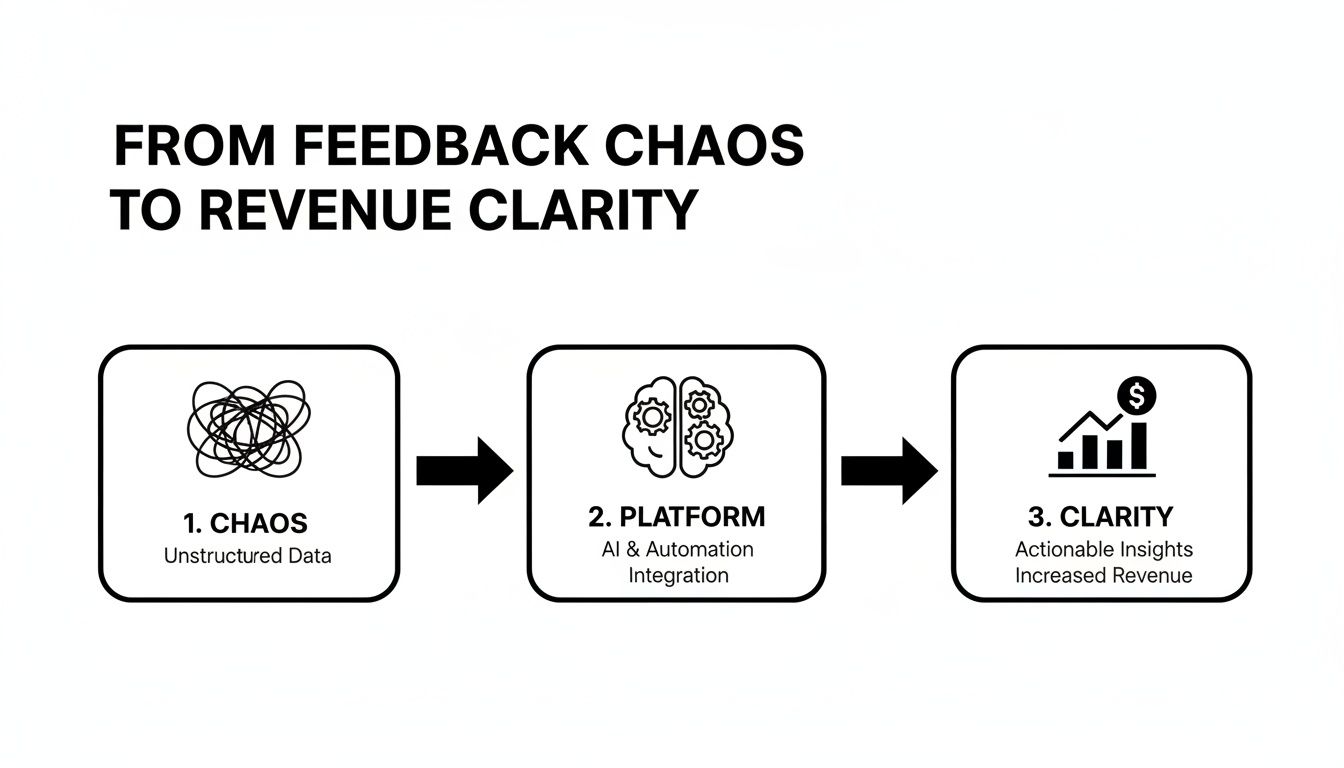
As you can see, the platform acts like a filter, taking in all the raw, chaotic inputs and producing something organized and valuable on the other side.
What Does an Idea Management Platform Actually Do?
At its heart, an idea management platform performs a few critical jobs that are nearly impossible to do manually at scale. This table breaks down its core functions.
Core Functions of an Idea Management Platform
| Function | Primary Benefit for SaaS Teams |
|---|---|
| Centralize Feedback | Gathers ideas from all channels (e.g., support, CRM, surveys) into one organized repository. |
| Quantify Impact | Connects qualitative feedback (e.g., "this is annoying") to quantitative data (e.g., revenue, churn risk). |
| Prioritize Opportunities | Helps teams identify and rank ideas based on strategic goals and business impact, not just volume. |
These functions work together to create a system that moves beyond just listening to customers and starts building what they will actually pay for.
Unlocking Actionable Insights
Once all your feedback is in one place, the real magic begins. You can finally stop guessing. Instead of product managers spending days staring at spreadsheets trying to spot trends, the system does the heavy lifting by identifying patterns and quantifying the real-world impact of customer requests. This is where AI-driven platforms are a complete game-changer.
An idea management platform’s main job is to put a number on the narrative. It translates customer complaints, feature requests, and behavioral trends into the only language that gets everyone on the same page: revenue.
This shift empowers your entire team to make decisions backed by data, not just gut feelings. A huge benefit is its ability to turn data into actionable insights without you needing to be a data scientist.
Ultimately, this lets you build a predictable, repeatable process for innovation. You can finally answer the most important questions with confidence:
- Which bug fixes will have the biggest impact on reducing churn?
- Is that one feature request tied to a potential $100,000 expansion deal?
- Which ideas actually matter to our highest-value customers?
By putting a proper idea management platform in place, you stop letting valuable customer signals fall through the cracks and start using them to drive profitable growth. You move from constantly reacting and fighting fires to proactively building what truly matters for your bottom line.
What Is an Idea Management Platform, Really?
Forget the textbook definition for a moment. An idea management platform isn't just a digital suggestion box or a slightly more organized spreadsheet. The best way to think about it is as a central hub for innovation—a system built to catch every important signal your business receives and turn it into smart, decisive action.
Picture all the feedback coming at your team from every angle: support tickets, comments on sales calls, feature requests from a key customer, and even great ideas from your own engineers. An idea management platform is designed to capture all of it in one place.
But it doesn't stop there. The real magic happens when the platform starts connecting the dots, pulling out critical patterns from that raw data that you'd never spot otherwise. It then helps you send clear, prioritized tasks to your product and development teams so they're always focused on the work that truly matters.

From Disorganized Noise to Strategic Signal
Without a proper system, that constant flow of ideas descends into pure chaos. Most teams end up relying on a patchwork of manual methods that just don't work once you start to scale.
Sound familiar? You're probably dealing with one of these:
- The Monster Spreadsheet: Some poor product manager is tasked with manually logging every piece of feedback in a massive Excel or Google Sheet. It’s out of date the minute they save it, siloed from everyone else, and nearly impossible to analyze.
- The Chaotic Slack Channel: That #feedback channel seemed like a great idea at first, right? Now it's a never-ending scroll of conversations, GIFs, and buried nuggets of gold that no one can ever find again.
- The Feedback Black Hole: Ideas sent to a generic
feedback@company.comemail address might as well be sent into space. They sit unread, and customers and colleagues feel completely ignored.
These approaches are doomed to fail because they only focus on collecting ideas, not managing them. They offer no way to evaluate, prioritize, or tie feedback to actual business goals.
The real job of an idea management platform is to turn the qualitative "noise" of scattered feedback into a quantitative "signal" that product leaders can act on with total confidence. It’s about building a structured pipeline for innovation, not just a wish list.
This is the exact shift that separates fast-growing, product-led companies from the ones constantly playing catch-up. It's no longer about simply gathering suggestions; it's about strategically managing them to boost revenue and growth. You can see how these tools fit into a broader strategy in our guide to customer feedback management software.
The Growing Importance of Structured Innovation
This isn't just a niche trend; it's a fundamental change in how modern companies are built. The global market for idea management software was valued at USD 5.905 billion in 2024 and is on track to explode to over USD 19.21 billion by 2035.
That kind of growth tells a story. Companies are realizing that structured innovation is a major competitive advantage. With North America leading the charge and over 38% of users located in the US, businesses using these platforms are shipping products faster and using their resources more effectively. For a closer look at the data, you can read the full research on the idea management market.
A modern platform makes this possible by creating a single source of truth. It plugs directly into the tools your teams live in every day—like Zendesk, Jira, and Slack—to automatically pull in and centralize every idea, complaint, and feature request.
Getting everything into one place is the crucial first step. Instead of digging through a dozen different sources, your team gets a single, organized view of what your customers and internal teams are saying. This is how you move from reactively putting out fires to proactively building a product based on clear, data-backed insights.
Core Features That Drive Product Success
An idea management platform is only as valuable as the problems it actually solves. So, instead of just giving you a laundry list of features, let's look at the core capabilities that help busy SaaS teams get things done. A great platform isn't about adding more noise; it’s about cutting through it to make smarter decisions, faster.

Feedback Aggregation and Centralization
Any product manager knows the pain of the daily feedback treasure hunt. You start your day digging through Zendesk tickets, Slack DMs, CRM notes from the sales team, and random email threads. It's a slow, manual grind that practically guarantees you'll miss something important.
With a proper idea management platform, that chaos disappears. All that scattered feedback is automatically funneled into one unified inbox. The platform plugs directly into the tools your teams already use, creating a single source of truth for every customer suggestion, bug report, and feature request. No more copy-pasting, and no more good ideas getting lost in the shuffle.
AI-Driven Prioritization
Okay, so you have all your feedback in one place. Now what? The next hurdle is figuring out what’s actually important. For years, this has been a mix of guesswork, gut feelings, and listening to the loudest customer in the room. Simple upvoting systems don't help much either, often pushing popular but low-impact ideas to the top.
This is where AI completely changes the equation. An advanced platform goes beyond just counting votes. It digs into the content of the feedback and, crucially, connects it to your business metrics. It can instantly tell you which bug is hitting your highest-value accounts or which feature request is linked to multiple expansion deals sitting in your pipeline.
Instead of just telling you what customers are asking for, AI-powered analysis tells you why it matters. It answers the critical question: "If we build this, what will be the impact on our revenue?"
This is how you turn a simple wish list into a strategic, growth-focused roadmap. To really get into the weeds on this, check out our guide on building a feature prioritization matrix and see how data can sharpen your decisions.
Streamlined Workflow Automation
Without a system, the handoff from product to engineering is often a mess. A PM has to manually create a Jira ticket, paste in all the context they can find, and then hunt down the right people to notify. It’s a classic bottleneck where vital information gets lost and momentum dies.
Workflow automation cleans this all up. It builds a seamless bridge between your idea platform and your development tools. When an idea gets the green light, the platform can automatically:
- Create a ticket in a tool like Jira or GitHub, instantly populating it with all the original customer feedback, revenue data, and internal notes.
- Notify the right people in Slack or by email, keeping everyone in the loop without another meeting.
- Update the idea's status, giving both customers and internal teams full visibility into its progress.
This kind of automation doesn't just save time. It ensures the "why" behind every feature travels with it from concept to code.
A Hub for Collaboration
Great ideas rarely happen in a vacuum; they get better with debate and discussion. But when that collaboration is spread across disconnected email chains and back-to-back meetings, it’s impossible to track how an idea has evolved.
A modern idea platform provides a central space for this to happen. It’s a place where team members from product, engineering, sales, and customer support can all weigh in, ask questions, and add their own insights. This creates a transparent, living record of the decision-making process and helps build a sense of shared ownership over the product.
Reporting and Analytics Dashboards
At the end of the day, you have to prove your product strategy is working. It used to be incredibly difficult to draw a straight line from a new feature launch to a drop in churn or a bump in revenue. Measuring the ROI of your product team's work was more art than science.
With a strong reporting dashboard, you can finally close the loop. These analytics give you clear, data-backed answers to the questions your leadership team is asking:
- How many new ideas did we actually ship last quarter?
- What was the total revenue impact tied to those features?
- Did that critical bug fix really move the needle on customer churn like we thought it would?
This is the kind of reporting that demonstrates the value of your product investments and gives you the hard data you need to keep refining your strategy.
How to Evaluate the Right Platform for Your Team
Choosing the right idea management platform isn't like buying just another piece of software. It’s more like hiring a strategic partner. You’re not just looking for a long list of features; you need a system that fits naturally into your team's workflow and, most importantly, helps you hit your business goals. A platform that can't speak the language of revenue is just a glorified digital suggestion box.
So, how do you make the right call? You need a clear framework for evaluation. It's time to look past the flashy dashboards and zero in on what really matters: how it integrates with your current tools, how it proves its own value, how it protects your data, and whether it can grow alongside you.
Assess Integration and Workflow Harmony
An idea management platform that exists in a vacuum is useless. It has to act as a central hub, connecting the tools your teams already live in day in and day out. If your people have to constantly switch tabs or manually copy-paste information, they simply won't use it. Adoption will flatline.
The key is to find a platform with deep, bi-directional integrations. This means data doesn't just flow in; the platform can also push updates and actions back out to other systems.
- Customer Support Tools (Zendesk, Intercom): Can it automatically pull feedback and tie it to specific customer accounts? Can a support agent check on a customer's idea without ever leaving their ticketing system?
- Development Tools (Jira, GitHub, Linear): When an idea gets the green light, does the platform automatically create a ticket in your development backlog? Crucially, does it fill that ticket with all the context—customer quotes, revenue data, and all—so engineers know why they're building it?
- Communication Tools (Slack, Microsoft Teams): Does it send smart notifications to the right channels when a high-value idea pops up or when a feature's status changes?
A truly integrated system breaks down the walls between departments, making the journey from customer feedback to a developer’s to-do list smooth and almost invisible.
Prioritize Analytics and True ROI Measurement
Plenty of platforms can give you basic analytics, like the number of ideas or upvotes. That’s a start, but it’s not nearly enough. To make smart product decisions, you need to connect ideas directly to real business outcomes. The most critical question a platform can answer isn't "How many people want this?" but "How much revenue is this idea actually worth?"
Your evaluation should focus on the platform's ability to move beyond simple popularity contests. An advanced system quantifies the dollar value of a feature request by linking it to churn risk, expansion opportunities, and new sales deals.
Look for a platform that surfaces these kinds of revenue-based insights. For example, it should be able to tell you that a particular bug is affecting 15% of your enterprise customers, putting $50,000 in ARR at risk. This is the kind of hard data that turns product management from a cost center into a powerful engine for growth. As you connect these dots, exploring different customer insights platforms can offer a wider view of what's possible.
Verify Security, Privacy, and Scalability
When you’re gathering all your customer feedback in one place, you're handling sensitive data. Security can't be an afterthought. You have to ensure any platform you're considering has rock-solid security protocols, including end-to-end encryption for data both at rest and in transit. A crucial question to ask is how the platform's AI handles your data—top-tier providers will guarantee your proprietary customer information is never used to train their global models.
Beyond security, think about scalability. The platform you pick today has to support your team as it grows. Can it handle a jump from 100 ideas a month to 1,000? Does performance lag as you add more users and integrations? A scalable platform means you won't have to go through this whole evaluation process again in two years. This forward-thinking approach pays off, as industry data shows 65% of companies see a 25% improvement in idea-to-execution timelines after adopting these tools. You can discover more insights about the innovation market.
To simplify this process, we've put together a checklist to help you compare your options and see how a basic tool stacks up against a more advanced, AI-driven one.
Platform Evaluation Checklist
| Evaluation Criteria | Basic Platform Feature | Advanced (AI-Driven) Platform Feature |
|---|---|---|
| Idea Capture | Manual submission forms and upvoting. | Automated capture from all channels (email, support, Slack). |
| Integration | One-way data pulls from a few sources. | Deep, bi-directional sync with all core tools (Jira, Zendesk, etc.). |
| Prioritization | Relies on vote counts and manual sorting. | Automatically quantifies revenue impact and surfaces high-value ideas. |
| Analytics & ROI | Tracks idea volume and feature status. | Measures direct impact on ARR, churn risk, and expansion deals. |
| Security | Standard data encryption and user roles. | Enterprise-grade security with guarantees on data privacy for AI models. |
| Workflow | Manual steps to move ideas to development. | Fully automated workflows from feedback submission to a dev ticket. |
This checklist isn't about finding a platform that just ticks all the boxes. It's about finding the one that aligns with your business reality—turning customer ideas from a noisy backlog into your most valuable source of predictable revenue growth.
Implementing Your Idea Management Strategy
So you’ve invested in a powerful idea management platform. That’s a great first step, but it’s just that—a first step. Simply switching on the software won't magically create a culture of innovation. To get real value, you need a smart implementation plan that weaves the platform into the very fabric of your company, preventing it from becoming just another tool gathering digital dust.

Think of it this way: buying a top-of-the-line kitchen doesn't make you a Michelin-star chef. You still need the recipes, the right techniques, and a clear process from prep to plating. The same goes for your new platform; its success hinges on clear processes and getting your whole team on board from day one.
Define Clear Ownership and Roles
Before you do anything else, you have to decide who owns the platform. If no one is accountable, the system will quickly fall into disuse and chaos. You need a dedicated person or team to champion the tool, manage its setup, and make sure it's running like a well-oiled machine.
For most SaaS companies, this responsibility naturally lands with the product team. They live at the crossroads of customer feedback, business goals, and engineering reality, making them the perfect fit.
A platform without an owner is an orphan. It will be neglected. Assign a product manager or a small product ops team to be the central point of contact. Their job is to keep the system healthy and ensure the feedback pipeline is always flowing.
Getting this right from the start eliminates confusion and gives everyone in the company a clear point of contact. It’s the single most important step you can take to build a disciplined innovation process.
Establish Your Implementation Checklist
Rolling out an idea management platform is a major project, so treat it like one. A simple checklist ensures everyone is on the same page and no crucial steps are forgotten. Here's a five-step plan to get you launched successfully.
- Set Up Key Integrations Immediately: Your first move should be connecting the platform to the tools your team already lives in. Link it to Zendesk, Jira, and Slack right away. This gets customer feedback and internal ideas flowing into one place automatically, without anyone having to do manual data entry.
- Define and Configure Workflows: Map out the entire journey of an idea, from the moment it's submitted to its final review and potential development. Who gets notified at each stage? What's the criteria for an idea to move forward? Automating these rules is what turns a messy process into an efficient one.
- Train Your Go-To-Market Teams: Your customer support, success, and sales teams are your eyes and ears on the ground. Give them simple, direct training on how to log feedback for customers. Once they see how their input directly influences the product, they’ll become your best source of game-changing insights.
- Establish a Communication Loop: Radio silence is the fastest way to kill participation. You must have a process for communicating the status of ideas back to customers and internal teams. Whether an idea is a "yes," "no," or "not right now," closing the loop builds trust and makes people want to contribute again.
- Set Concrete Success Metrics: How will you know if any of this is actually working? Define your key performance indicators (KPIs) before you launch. Are you aiming to reduce churn, spot more upsell opportunities, or ship features faster? Tracking these metrics is essential to proving the platform's ROI and justifying its existence.
Frequently Asked Questions
If you’re looking into idea management platforms for the first time, you probably have a few questions. We get it. Let's clear up some of the most common ones we hear from product leaders.
How Is an Idea Management Platform Different from Jira?
This is a great question. The simplest way to think about it is that an idea management platform is for figuring out what to build and why, while a project management tool like Jira is for managing how and when it gets built. They're two different tools for two different, but connected, jobs.
Your idea management platform is where all the messy, raw input lives—customer feedback from support, feature requests from the sales team, and insights from usage data. Its job is to find the signal in the noise. For instance, it might discover that a specific bug is secretly responsible for $50,000 per month in customer churn. That’s the strategic why.
Once you have that crucial insight, the decision is made. Then you push that prioritized task over to Jira. From there, your engineering team takes over with the tactical execution, managing sprints and tracking the development cycle. They work together to create a seamless workflow from raw idea to shipped feature.
Can Small Startups Benefit from This?
Absolutely. In fact, for a startup where every single engineering hour is gold, it might be even more critical. An idea management platform is your defense against wasting those precious resources on features that don't actually move the needle.
Instead of building based on founder intuition or simply reacting to the loudest customer, a platform gives you a data-driven compass. It helps you zero in on product-market fit faster by showing you exactly which requests are tied to your first high-value users or what friction points are causing early customers to churn.
A modern idea management platform gives a small team the same kind of strategic firepower as a large enterprise. It's about making every decision count, especially when you're just starting out.
How Can We Trust the AI Prioritization?
It’s smart to be skeptical. The key to trusting any AI system is transparency—it can't be a "black box" that just spits out a score. A trustworthy platform has to show its work.
That means you should be able to see the evidence behind every single recommendation. When the AI flags an issue as high-priority, you can drill down and see the exact customer conversations, support tickets, and data patterns that led to that conclusion. The system should show you which customer segments are most affected, the quantifiable revenue at risk, and even the verbatim quotes from users.
This doesn't replace the product manager; it supercharges them. The AI acts as a powerful, transparent advisor, combining its data-driven insights with your own expertise. You always have the context needed to make the final call and stay in complete control of your product strategy.
Ready to stop guessing and start building what your customers will actually pay for? See how SigOS uses AI to connect feedback directly to revenue and gives you the confidence to build a winning product roadmap. Discover the SigOS platform today.
Keep Reading
More insights from our blog

Ready to find your hidden revenue leaks?
Start analyzing your customer feedback and discover insights that drive revenue.
Start Free Trial →