What is product discovery? A must-read guide for 2026 teams
Explore what is product discovery and how it drives value in 2026 with practical frameworks, tools, and real-world SaaS examples.
Ever seen an engineering team spend six months building a new feature, only for it to flop at launch? It’s a SaaS company’s worst nightmare—a huge waste of time, money, and morale. This is exactly the problem that product discovery is designed to prevent.
At its core, product discovery is about deeply understanding your customers' problems before you even think about building a solution. It's the work you do to avoid building something nobody wants or will pay for. Think of it as creating a detailed blueprint before starting construction on a skyscraper. You wouldn't just start pouring concrete and hope for the best.
What Is Product Discovery Really
Product discovery is a continuous cycle of asking the tough questions upfront, not after a failed launch. It’s an iterative process that helps teams clarify their ideas by getting to the heart of real user needs and figuring out the smartest way to address them.
This isn’t just a preliminary phase you check off a list. It’s a complete shift in mindset. It's about moving away from being a "feature factory"—where success is measured by how many features you ship—to building a discovery-led culture, where success is all about the customer value you create.
Simply put, you stop asking "Can we build this?" and start asking, "Should we build this, and why?"
Shifting from Features to Outcomes
In a discovery-led culture, the priority is always on learning and de-risking ideas. Instead of jumping straight into development, teams invest their time in genuinely understanding the problem space first. If you're looking for a solid primer on the basics, this guide on what is product discovery is an excellent place to start.
This move toward data-backed decisions is more than just a trend. The market for data discovery tools, which are the backbone of these efforts, was valued at a massive USD 10.04 billion in 2022. It's expected to grow at a 15.3% CAGR through 2030, which shows just how serious the industry is about moving past gut feelings. It’s about turning messy, qualitative feedback into clear, prioritized actions.
Ultimately, this is a strategic approach. It's not about churning out features; it's about generating successful outcomes that push your business forward. This work ties directly into your high-level planning. You can learn more about connecting discovery efforts to your company's vision in our guide on what is a product strategy.
The difference between these two ways of working is night and day. Let's break it down.
Discovery-Led Culture vs Feature-Factory Mindset
This table highlights the fundamental differences in mindset, activities, and what "success" looks like in both environments.
| Aspect | Discovery-Led Culture | Feature-Factory Mindset |
|---|---|---|
| Primary Goal | Solve validated customer problems | Ship features on a timeline |
| Key Question | "What problem are we solving?" | "What are we building next?" |
| Success Metric | Positive change in user behavior | Number of features launched |
| Team Focus | Customer outcomes and learning | Engineering output and velocity |
| Risk Approach | Mitigates risk through testing | Discovers risk after launch |
As you can see, a discovery-led culture is focused on impact, not just output. It's a proactive approach that sets teams up for real, sustainable success by ensuring they're always building something that matters to their customers.
The Goals and Business Impact of Product Discovery

Let's be honest. Every new product idea is a gamble. You're betting precious time, money, and engineering effort on a hunch. The whole point of product discovery is to stack the odds in your favor.
It’s a strategic process designed to do one thing exceptionally well: de-risk your product roadmap. Instead of blindly committing to a six-month build, you’re systematically pressure-testing your ideas against reality before writing a single line of production code.
Think of it as an intelligence-gathering mission. You’re asking the tough questions upfront to ensure you're not just building a product, but building the right product for the right people.
This is all about risk mitigation. Product discovery forces your team to stop thinking about features and start obsessing over customer problems. You develop deep user empathy and learn continuously, which is the only way to build something people truly need.
This mission for certainty is built on four critical questions. Get a 'yes' to all four, and you've got a green light.
The Four Big Risks
A great product idea has to clear four specific hurdles. If it stumbles on even one, you risk a failed launch, wasted cash, and a deflated team. The goal of discovery is to find an idea that confidently clears them all.
- Value Risk (Desirability): Will customers actually use this? Do they even want it in the first place? This is the most important question.
- Usability Risk: Assuming they want it, can they figure out how to use it? A powerful feature that’s confusing is a useless feature.
- Feasibility Risk: Can our engineers realistically build this? Do we have the skills, the time, and the technology to pull it off?
- Business Viability Risk: Does this actually work for our business? Does it align with our company strategy, support our brand, and can we effectively market and sell it?
Answering these questions is how you validate product ideas fast and stop a bad idea from turning into a costly mistake.
When teams get this right, the impact goes straight to the bottom line. You’re not just avoiding failures; you’re building products that customers adopt enthusiastically. This leads directly to higher feature usage, lower churn rates, stronger brand loyalty, and ultimately, a much healthier, more predictable revenue stream.
Essential Frameworks for Your Discovery Toolkit
Knowing you should do product discovery is easy. Figuring out how to actually do it can feel overwhelming. The best teams don't get stuck in theory; they have a go-to toolkit of frameworks they can pull from.
These aren't rigid, academic rules. Think of them as different tools in your workshop. Sometimes you need a magnifying glass to inspect a tiny detail of the user journey, and other times you need binoculars to see where the market is headed. The real skill is knowing which tool to grab for the task at hand. Let's walk through some of the most reliable methods.
Uncovering Customer Needs with Qualitative Insights
The only way to build a product people love is to genuinely understand them. This goes way beyond surface-level demographics. You have to dig into their real-world workflows, their biggest frustrations, and what they’re truly trying to accomplish. Qualitative methods are how you build that essential empathy.
- User Interviews: This is ground zero for discovery. It’s all about having real, one-on-one conversations where you ask open-ended questions. Your job isn't to sell your idea; it's to shut up and listen. You're trying to learn about their world, not validate your own.
- The Jobs-to-be-Done (JTBD) Framework: This is a simple but profound shift in perspective. Instead of focusing on who the user is, you focus on the "job" they are "hiring" your product to do. The classic example? People don't buy a drill because they want a drill; they buy it because they want a quarter-inch hole in the wall. JTBD helps you get to the core motivation behind why someone would even bother using your product.
These methods shine when you’re exploring a new problem space or trying to figure out the why behind a specific user behavior. They give you the rich, human stories that raw data can never provide.
Measuring Behavior with Quantitative Signals
While talking to users gives you the "why," data gives you the "what" and "how many." Looking at user behavior across your entire customer base helps you see if the stories you heard in interviews are isolated incidents or widespread trends. This is where product analytics tools become your best friend.
The market for these tools is growing fast for a reason. Valued at USD 14.81 billion in 2023, it’s expected to climb to USD 58.78 billion by 2030. Why? Because teams are realizing that behavioral data is the key to figuring out what to build next. The best product teams are already using analytics to cut churn by 20-30% by focusing on features that actually matter to users.
Key Takeaway: Your product usage data is a goldmine. It shows you exactly where users get stuck, which features they can't live without, and which ones are collecting dust. When you combine these hard numbers with your qualitative findings, you get a complete, 360-degree view of the user experience.
Validating Ideas with Experimentation
Okay, so you've talked to users and looked at the data. You have a good grasp of the problem and a promising idea for a solution. Now what? Before you sink a ton of engineering time and money into building it, you need to test your assumptions. Experimentation is all about finding low-cost ways to see if your idea has legs.
Here are a few ways to do it:
- Hypothesis-Driven Testing: Don't just say, "Let's build a new dashboard." Frame your idea as a testable hypothesis: "We believe that building a simplified dashboard for new users will result in a 15% increase in weekly active users." This simple structure forces you to be specific about who you're building for and what you expect to happen.
- Prototyping and Usability Testing: Create a quick-and-dirty version of your solution. This could be a simple paper sketch, a set of wireframes, or a clickable mockup made in Figma. Then, put it in front of real users and watch them try to use it. This is the fastest way to learn if your brilliant design is actually intuitive or just plain confusing. For help deciding which ideas are worth prototyping first, check out our guide on using a feature prioritization matrix.
Running Your First Product Discovery Cycle
Alright, let's move from theory to action. Understanding product discovery is one thing, but running a cycle yourself is where the real learning happens. This isn't a massive, one-off project; think of it as a repeatable, structured loop that helps you learn fast and take the guesswork out of your decisions. You don’t need a huge team or a massive budget to get started—just a clear process and a genuine curiosity to listen.
Let's walk through a simple yet powerful five-phase cycle you can use. It’s designed to guide you from a broad goal to a tangible, validated next step. This is your playbook for building confidence and momentum.
This five-phase cycle is your map for navigating the process from start to finish.
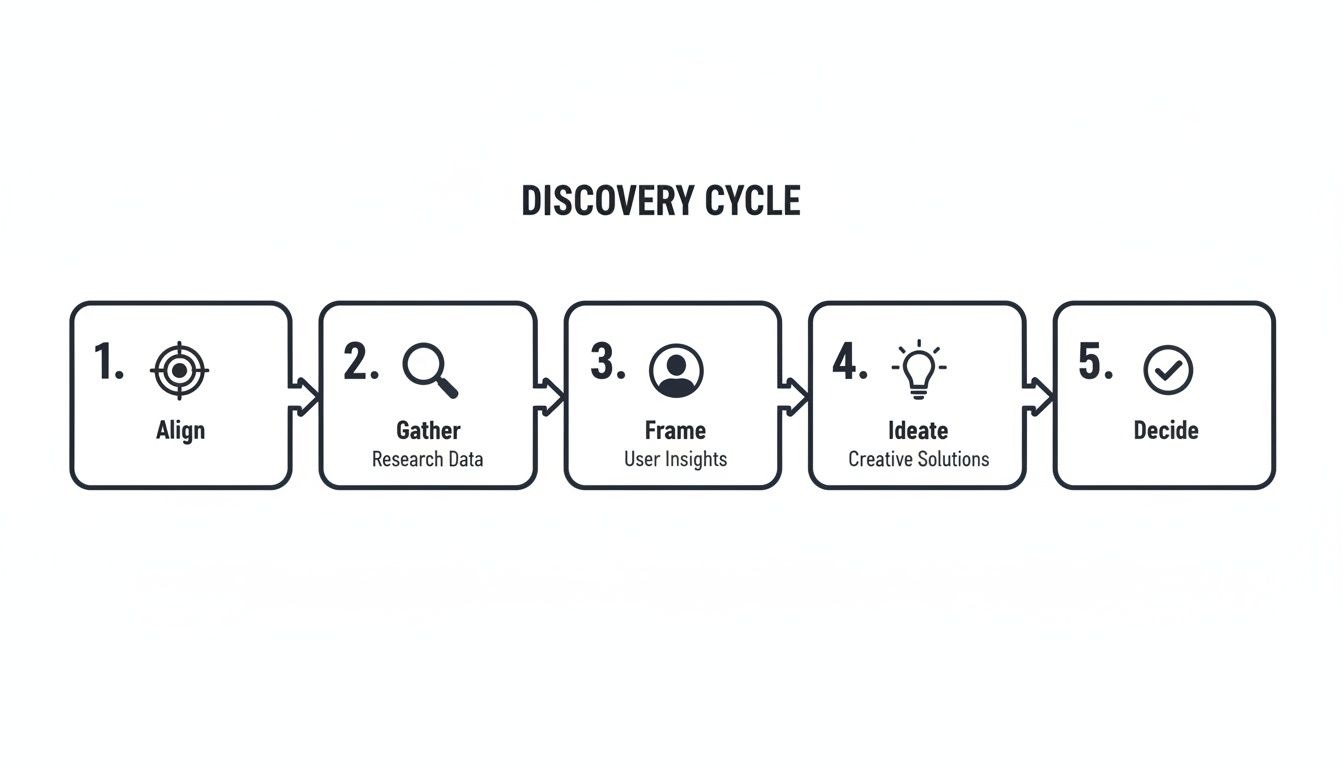
As you can see, this isn't just a linear path. It's a loop that moves from defining an outcome to making a data-informed decision, providing a clear roadmap for your team's efforts.
Phase 1: Align on the Outcome
First things first: you need to get your team on the same page about the desired outcome, not a specific feature. This is a critical distinction. Instead of starting with, “We need to build a new dashboard,” frame it as a goal: “We need to reduce new user churn by 15%.” This approach keeps everyone laser-focused on solving the right problem.
At this stage, your only job is to establish a shared vision of success. Everyone involved—product, engineering, marketing, sales—should have a crystal-clear understanding of the problem you're tackling for both the user and the business.
Phase 2: Gather Customer Insights
With a clear outcome in mind, it’s time to go straight to the source: your customers. The goal here is to gather a mix of qualitative and quantitative insights to see the full picture.
- Qualitative Data: Start talking to people. Conduct customer interviews and run usability tests. Ask open-ended questions like, "Can you walk me through how you currently handle X?" to uncover their real-world struggles and workarounds.
- Quantitative Data: Dig into your analytics. Look at product usage metrics, support tickets, and survey results. You're hunting for patterns that reveal where users are getting stuck, dropping off, or what features they request most often.
Using both types of data stops you from getting swayed by one particularly loud customer or misreading a metric without its human story.
A common mistake is thinking you know what customers want. Product discovery is the process of admitting you have assumptions and then methodically replacing them with evidence. True insights come from observing behavior and listening, not from guessing.
Phase 3: Frame the Problem
Now it’s time to make sense of all that research. Your goal is to synthesize your findings into a clear, concise problem statement. A great problem statement always focuses on the user's need, not your potential solution. For example: "New users struggle to find our key reporting feature, which leads to low engagement and causes them to churn early."
This is the perfect moment to create or update user personas. It helps the whole team visualize who they’re solving for. Getting the problem frame right is absolutely crucial—it becomes the anchor for every idea and test that follows.
Phase 4: Ideate and Test Solutions
Okay, this is the fun part. Get your team together and brainstorm a wide range of potential solutions to the problem you just framed. Don't hold back or filter ideas at this point; the goal is quantity over quality initially.
Once you have a healthy list of ideas, pick the one or two that feel most promising. The next step isn't to write code, but to test the concept. Create low-fidelity prototypes—think simple wireframes, sketches, or clickable mockups—and get them in front of real users. Your mission is to get feedback quickly and cheaply, not to build a pixel-perfect product.
Phase 5: Decide and Share Learnings
Finally, bring it all together. Review the feedback and data from your tests. Did the solution actually solve the user's problem? Did it move the needle on your outcome?
Based on the evidence, you can make an informed decision on what to do next. That might mean moving forward with a high-fidelity design, pivoting to a different idea, or—and this is perfectly okay—killing the concept entirely.
No matter the result, document and share what you learned with the rest of the organization. This builds a collective intelligence and ensures that every discovery cycle, win or lose, makes the company smarter.
How AI-Powered Intelligence Augments Discovery
The biggest challenge in product discovery today isn't a shortage of data; it's the sheer volume of it. Product teams are drowning in feedback. Trying to manually sort through thousands of support tickets, sales call transcripts, user surveys, and app analytics is a slow, costly, and deeply flawed process.
When you're overwhelmed with noise, it's easy to fall back on gut feelings or listen to the loudest person in the room. This is where modern AI-driven intelligence fundamentally changes the approach to discovery.

AI tools help you move beyond the slow, subjective world of spreadsheets. They provide a data-backed environment where you can finally connect what users say they want with what they actually do in your product.
From Manual Noise to Automated Signal
Instead of having a product manager spend days manually tagging customer feedback, an AI-powered platform like SigOS can ingest all of that disparate data for you. Think of all your Zendesk tickets, Gong sales calls, and survey responses being analyzed automatically to find the underlying patterns. It’s like having a team of data scientists working 24/7 to connect the dots.
But this technology does more than just find common themes. It quantifies them.
For example, it can tell you that a specific bug isn’t just a minor annoyance—it’s directly correlated with a 3% spike in churn among your highest-paying enterprise customers. That’s an insight you can take to the bank.
The real power of AI in discovery is its ability to turn messy, qualitative feedback into quantifiable business opportunities. It answers the critical question: "If we build this feature or fix this bug, what is the expected impact on revenue?"
Suddenly, your product roadmap is no longer just a list of feature requests. It becomes a strategic document where every initiative is tied to clear business outcomes like revenue growth or customer retention. You're building what the data proves is most valuable, not just what a handful of vocal customers asked for.
Making Data-Driven Decisions a Reality
The business case for this shift is clear. While only 14% of consumers give retailers high marks for their product discovery experience, companies using AI have seen massive gains. In e-commerce, AI chat can produce 4X higher conversion rates. In SaaS, this translates to analyzing user behavior to spot critical churn signals hiding in the noise. In fact, companies that have adopted AI-driven personalization have reported revenue increases of up to 40%.
AI helps product teams move faster and with much more confidence. Here’s how:
- Quantifying Revenue Impact: It connects specific feature requests and bug reports directly to the revenue they affect, whether that's from churn risk or new expansion opportunities.
- Identifying Hidden Patterns: AI can spot emerging issues or opportunities across multiple data sources long before a human analyst ever could.
- Reducing Bias: Decisions get made based on comprehensive data from your entire customer base, not just the loudest, most recent, or most persistent feedback.
This gives product teams a clear, defensible "why" behind every single item on their roadmap. To go a level deeper, check out our guide on using AI for product development. It's a game-changer that helps turn the art of discovery into more of a science.
Common Questions About Product Discovery
Even when everyone agrees on the frameworks and processes, making discovery a real habit brings up practical questions. It's one thing to read about it, but it's another to fit it into your team's already packed schedule. These questions are a normal part of bridging the gap between theory and practice.
Getting these answers straight is how you build the buy-in you need. It helps everyone get on the same page about what product discovery really is and, more importantly, why it's worth the effort.
How Does Product Discovery Differ From Market Research
This is a big one. While they're related, they operate at completely different zoom levels.
Think of market research as your telescope. You’re scanning the entire galaxy, looking at the big picture—competitors, overall market size, and broad industry trends. It helps answer questions like, "Is there a growing market for project management tools built for marketing agencies?" It tells you if there’s an ocean out there.
Product discovery, on the other hand, is your microscope. You’re zeroing in on a single user’s world. You’re looking at their specific day-to-day workflows, their unique frustrations, and their deep, unmet needs. It’s all about the "why" behind their actions.
Market research tells you that a market exists. Product discovery tells you why a specific user is struggling and what a better solution must do to win them over. One identifies the pond; the other helps you design the perfect lure to catch the fish in it.
So, while market research confirms there’s a game to be played, product discovery gives you the playbook to actually win it.
How Often Should We Do Product Discovery
One of the biggest myths is that product discovery is a phase you check off before development starts. That’s just not how it works. The best teams treat discovery not as a one-time project but as a continuous, ingrained habit.
The intensity just changes depending on what you’re focused on.
- For a major new product or feature, you'll dive deep into intensive discovery to make sure the core idea holds water from the very beginning.
- For an existing product, it becomes a steady rhythm. This looks like weekly customer calls, digging into usage data, and running small experiments to decide what to build next.
Think of it as a constant pulse, not a single event. It's about staying connected to your customers' reality, week in and week out.
We Are a Startup Can We Really Afford This
A better question is: can you afford not to? For any startup, the single greatest risk is building something nobody wants. Wasting months of precious engineering time on a feature that lands with a thud can be a death sentence.
Product discovery is your cheapest insurance policy against that risk. It doesn’t have to mean a big budget or hiring a dedicated research team.
It can be as scrappy as:
- Carving out time for five 30-minute customer calls this week.
- Sending a simple one-question survey to your email list.
- Just reading through your support tickets to find common pain points.
The cost of a few hours of conversation is microscopic compared to the cost of a failed launch. The real risk isn't doing discovery; it’s betting your entire runway on an unvalidated guess.
Ready to stop guessing and start building a product roadmap based on real, quantifiable data? SigOS is the AI-driven intelligence platform that turns customer feedback into revenue-driving insights. See how you can connect bugs and feature requests to their actual revenue impact by exploring SigOS.
Keep Reading
More insights from our blog
Ready to find your hidden revenue leaks?
Start analyzing your customer feedback and discover insights that drive revenue.
Start Free Trial →