What is revenue intelligence? AI-driven insights for growth
Discover what is revenue intelligence and how AI-powered platforms turn sales data into predictable growth with actionable insights.

Revenue intelligence is all about using technology—specifically AI—to automatically pull together and make sense of all the data your sales and marketing teams generate. The goal? To uncover the critical insights that actually help teams close more deals.
Think of it as a GPS for your revenue strategy. It doesn't just show you where you are; it gives you a real-time, predictive map that guides you toward your revenue targets by analyzing every single customer touchpoint. It turns a messy pile of data into a predictable engine for growth.
What Is Revenue Intelligence
Imagine your company’s sales data is like a thousand-piece puzzle, but all the pieces are scattered across different boxes. Your CRM has a handful, your team's emails and calendars have hundreds more, and all those call recordings are stashed in another box entirely. Trying to piece together a clear picture of your revenue health is a frustrating, manual, and often impossible task.
This is where revenue intelligence steps in. It's the technology that automatically finds all those scattered pieces, brings them together, and assembles the puzzle for you—in real time.
Unlike traditional tools that rely on reps manually entering data and mostly give you a backward-looking view, revenue intelligence is proactive. It doesn’t just sit on information; it actively analyzes it to offer guidance on what to do next.
Beyond a Simple Address Book
A standard CRM, at its core, is a sophisticated digital address book. It’s fantastic for storing customer contact info and logging past activities, but it can’t tell you the story behind the data. It won't automatically raise a red flag when a key decision-maker on a big deal suddenly goes dark, nor will it tell you which talking points are consistently landing with prospects.
Differentiating from Business Intelligence
It's also important to see how revenue intelligence differs from traditional business intelligence (BI). BI tools are powerful for crunching historical data to spot broad, company-wide trends. But they often act like a rearview mirror, giving you a crystal-clear view of where you’ve already been. Many teams discover this firsthand when trying to implement business intelligence best practices.
Revenue intelligence, on the other hand, is more like a forward-facing radar combined with that GPS. It analyzes live deal data, conversation sentiment, and buyer engagement levels to give you a dynamic, forward-looking perspective.
A quick comparison can make the distinction crystal clear.
Revenue Intelligence vs Traditional Sales Tools
| Capability | Traditional CRM/BI | Revenue Intelligence Platform |
|---|---|---|
| Data Capture | Manual entry required | Automatic capture of all interactions |
| Focus | Historical data (what happened) | Real-time & predictive (what is happening & will happen) |
| Primary Use | System of record, reporting | System of insight, forecasting, coaching |
| Insights | High-level trends | Granular deal & rep-level guidance |
| Forecasting | Based on manual rep input | AI-driven, based on real deal activity |
Ultimately, revenue intelligence provides a complete, living picture of your entire revenue process. It takes the guesswork out of sales and turns it into a data-driven science.
The Engine Behind Your Revenue Insights
So, what makes revenue intelligence actually work? To really get it, you have to look under the hood. Beyond the buzzwords, there's a powerful engine running in the background, with several key parts working together to turn mountains of raw data into clear, actionable insights. Once you understand these components, the "magic" of revenue intelligence becomes much clearer.
This infographic paints a great picture of how revenue intelligence serves as a central brain, pulling together different data streams to give you a single, forward-looking view of your business.
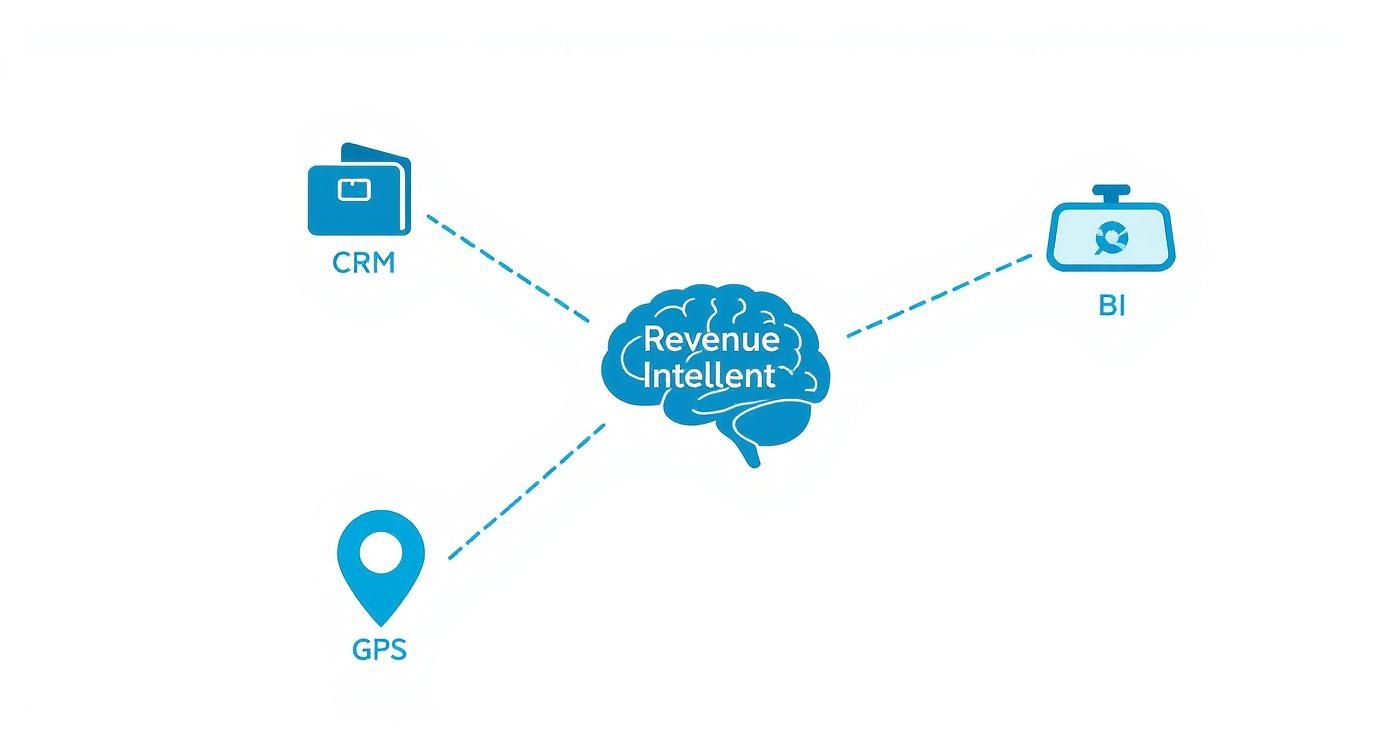
It’s not just another tool in the stack. Think of it as a command center that fuses historical data (your BI tools), customer records (your CRM), and predictive guidance (like a GPS for your sales team) into one cohesive system.
Data Aggregation: The Central Nervous System
Everything starts with data aggregation. This is the foundation, the central nervous system for your entire go-to-market operation. The system automatically and passively captures every single touchpoint a prospect or customer has with your company.
And I mean everything. We're not just talking about what's logged in the CRM. This includes every email, calendar invite, video conference, and phone call. This hands-off approach creates a complete, unbiased record of activity, finally freeing your team from the soul-crushing chore of manual data entry, which is notoriously spotty and inaccurate.
The result is a single source of truth you can actually trust, ensuring every insight is built on what really happened, not just what was remembered or recorded.
AI-Powered Analysis: Finding The Signal In The Noise
Once all that data is collected, the AI-powered analysis kicks in. This is where the real intelligence happens. Raw, messy data from calls and emails gets transformed into structured, meaningful information. If data aggregation is the nervous system, AI is the brain that makes sense of all the signals.
Machine learning algorithms tear through conversations to pinpoint key topics, competitor mentions, buyer sentiment, and even talk-to-listen ratios. This process uncovers the winning habits of your top reps and flags the conversational landmines that put deals at risk. It’s like having a sales coach listening to every single call, offering objective feedback at a scale no human manager could ever achieve.
It’s this deep analysis that reveals the subtle patterns and trends that would otherwise be completely invisible across thousands of customer interactions.
Deal And Pipeline Inspection: The X-Ray Machine
With your data gathered and analyzed, the next piece of the puzzle is deal and pipeline inspection. Think of this as an X-ray machine for your pipeline. It lets you see straight through the surface-level CRM stages to understand the true health of every single opportunity.
Instead of relying on a rep's gut feeling about a deal, you get objective health scores based on actual customer engagement.
- Is a key contact going dark? The platform will immediately flag a drop-off in email and call activity.
- Is a champion about to leave their company? The system can detect shifts in communication patterns or out-of-office replies.
- Is a deal stuck in the same stage for way too long? It highlights stalled opportunities by comparing them against historical data.
This completely changes the conversation in pipeline reviews, moving them from subjective storytelling to data-driven strategy sessions.
Revenue Forecasting: From Guesswork to Science
Finally, all of these components come together to power revenue forecasting. This is where the process is elevated from educated guesswork to a reliable, data-backed science. By analyzing the health scores of every deal in the pipeline and stacking them up against historical win rates, the platform generates forecasts you can actually count on.
This capability gives leaders an incredible amount of confidence. Instead of just accepting a rep's number, they can now pressure-test it with real data. You can ask questions like, "You've forecasted this deal to close, but our data shows zero executive engagement for three weeks. What's the plan to fix that?" It makes the entire forecasting process more rigorous, predictable, and ultimately, far more trustworthy.
How AI Changes Your Day-to-Day Sales Workflow
Revenue intelligence isn't just about high-level dashboards for executives; it completely changes how a sales team operates on the ground, every single day. It closes the enormous gap between having data and knowing what to do with it, turning routine tasks from subjective guesswork into sharp, strategic actions. The difference is immediately obvious in everything from the weekly pipeline review to one-on-one coaching.

Think about the classic pipeline meeting. It’s usually a collection of stories, with reps giving optimistic updates based on a "good feeling" about a deal. This is how "happy ears" syndrome takes over, leading managers to hear what they want to believe and turning the forecast into a work of fiction.
Revenue intelligence flips that entire conversation on its head. Instead of vague feelings, the discussion is anchored in hard facts. A manager can pull up any deal and instantly see its actual health score, which is calculated from real-time engagement data. The conversation shifts from, "So, how did the call go?" to, "The AI flagged that we have zero contact with the economic buyer. What's our strategy to get that meeting?"
From Random Shadowing to Pinpoint Coaching
Sales coaching gets a massive upgrade, too. For years, managers have relied on randomly sitting in on calls, hoping to stumble upon a "coachable moment." It's an inefficient, hit-or-miss method that provides feedback on a tiny, unrepresentative sample of a rep's work.
Revenue intelligence is like having a coaching assistant that has sat in on every single call. It automatically flags the precise moments a rep needs help—maybe they consistently get tripped up by pricing questions or forget to mention a critical feature. This allows managers to deliver targeted, effective coaching that solves specific problems, making every interaction a genuine learning opportunity. This is a perfect example of AI-powered decision making driving real team improvement.
Uncovering Hidden Opportunities
The same change happens in strategic planning and forecasting. Gone are the days of manually sifting through CRM notes, hoping to spot an upsell opportunity. The AI brings these moments right to the surface.
- Strategic Account Planning: The system can analyze communication patterns within a major account and flag that a new department is suddenly showing interest in a product they don't own. Just like that, you have a data-backed reason to reach out.
- Confident Forecasting: When it’s time for the forecast call, leaders no longer have to cross their fingers. They can present AI-generated projections supported by deal health scores, historical win rates, and engagement metrics, building real credibility with the board.
The results speak for themselves. Industry analysis shows that organizations using sophisticated revenue intelligence are seeing a 32% higher win rate and a 28% faster sales cycle than their peers still using traditional methods. The technology makes the day-to-day work more effective and, in doing so, builds a far more predictable revenue engine. As AI creates new efficiencies, it's even giving rise to new concepts like AI SDRs.
Building a Business Case for Revenue Intelligence
https://www.youtube.com/embed/oUEveudt5Ec
Getting sign-off for any new tech investment means you have to build a rock-solid business case. You need to show real strategic value and a clear path to ROI. With revenue intelligence, that conversation is easier than you might think. It’s not about adding another cost; it’s about making a strategic investment in predictable growth.
The trick is to connect the platform's capabilities directly to the results that your leadership team actually cares about.
The strongest argument you can make is that revenue intelligence turns forecasting from an art into a science. Let's be honest, traditional forecasting is a mess. It's built on whatever a sales rep thinks is going to happen, mixed with a healthy dose of gut instinct.
This process is notoriously unreliable. You get "happy ears," where reps are overly optimistic, or "sandbagging," where they intentionally aim low. Both scenarios create huge uncertainty for the business, making it impossible to plan effectively.
Revenue intelligence throws all that guesswork out the window. It anchors every forecast in cold, hard, objective activity data. By analyzing every single email, meeting, and call, the platform creates a deal health score based on what’s actually happening, not just a rep’s opinion. This gives you a data-backed projection you can actually trust for strategic planning.
Connecting Actions to Outcomes
Beyond better forecasting, your business case needs to show how this tech makes a tangible difference to core sales metrics. The platform doesn't just give you a dashboard of what's happening; it tells you why it's happening, giving leaders a chance to step in and fix problems before a deal goes south.
It’s this direct line from insight to outcome that gets executives on board.
- Shorter Sales Cycles: The system automatically flags deals that are starting to stall out. It can pinpoint communication gaps with key buyers, helping your team get ahead of bottlenecks and keep the momentum going. The result? Opportunities move through the pipeline faster.
- Higher Win Rates: Conversation intelligence is a game-changer here. It can sift through thousands of customer interactions to figure out which talking points, questions, and value props are closing deals. You can then take what your top performers are doing right and scale it across the whole team.
A Market Poised for Growth
The sheer momentum behind this technology adds another compelling layer to your business case. The global revenue intelligence market is absolutely exploding. It's projected to jump from 2.1 billion in 2025 to a staggering ****13.4 billion by 2027.
This isn’t just hype. The growth is driven by huge leaps in AI and machine learning, cementing its place as an essential part of any modern sales tech stack. If you want to dive deeper, you can discover more insights about revenue intelligence market trends.
At the end of the day, getting this adopted is about framing revenue intelligence as an engine for efficiency and predictability. It's about giving your entire revenue team the tools they need to make smarter, data-driven decisions that hit the bottom line.
Putting Revenue Intelligence into Practice

Okay, so we've covered the "what." But the real magic happens when you see revenue intelligence solve actual business problems. It's not just a tool for one kind of company; its applications are incredibly flexible, stretching from tech startups to traditional manufacturers, helping them all sharpen their competitive edge.
Let’s take a fast-growing SaaS company. In a market flooded with competitors, their messaging is everything. Using conversation intelligence—a core feature of most revenue intelligence platforms—they can comb through thousands of sales calls. Suddenly, they can pinpoint which competitor talking points are catching prospects' attention and which of their own value props are falling flat.
This creates a data-driven feedback loop that lets them tweak their sales playbook almost instantly. The result? Their team is always armed with the most effective messaging to close deals.
Applications Across Different Industries
But this isn't just a software-world phenomenon. Consider a manufacturing firm, which wrestles with completely different beasts like long sales cycles and tangled supply chains.
For them, analyzing pipeline data is a game-changer. By tracking how deals progress and monitoring engagement metrics, they can forecast demand for their products with far greater accuracy. This newfound clarity helps them manage inventory and smooth out supply chain kinks, heading off costly overproduction or stockouts that could kill a major contract.
This adaptability is why the market is catching on so quickly. While the IT and telecommunications sector was an early adopter, currently holding 27% of the market share, other industries are jumping in. The retail and e-commerce space, for instance, is poised for major growth as businesses hunt for better lead management solutions—an application that already makes up 64% of the market. You can dig deeper into these sales intelligence market trends to see the numbers for yourself.
Tailoring Insights to Business Needs
At the end of the day, the real power of revenue intelligence is its flexibility. This isn't some rigid, one-size-fits-all system. Think of it more like a toolkit that can be configured to solve specific, high-stakes business problems.
Here are a few more ways teams are putting it to work:
- Financial Services: A wealth management firm can track client communication patterns, getting automatic alerts for accounts at risk of churn due to low engagement. This gives advisors a chance to step in before it's too late.
- Healthcare Technology: A med-tech company selling devices can analyze sales calls to make sure reps are sticking to strict regulatory compliance guidelines in their pitches, which significantly cuts down on legal risk.
- Professional Services: A consulting agency might notice that certain services consistently come up in expansion conversations with existing clients. This insight helps them focus their business development efforts where they'll have the biggest impact.
Each of these examples shows how revenue intelligence moves past abstract dashboards to offer real, actionable guidance. It grounds your biggest strategic decisions in what's actually happening on the ground, giving any business a much more predictable path to growth.
Weaving Revenue Intelligence into Your Sales Workflow
Bringing a new platform into your tech stack can feel like a massive undertaking. But when it comes to revenue intelligence, it’s less about installing software and more about shifting your culture. The goal is to build a team that runs on data, making smarter decisions that lead to predictable growth.
The first step is picking the right platform, and that means looking past a flashy feature list. You need a true partner. Think about the long-term: Is the platform intuitive? What's their customer support really like? And most importantly, how well does it integrate with the CRM and tools you already use every day? A system that creates data silos or friction is a step backward, not forward.
Getting Your Team On Board
Let's be honest: new tech is only as good as its adoption rate. If your team doesn't use it, it’s just another expensive line item. The secret to getting everyone on board is to show them the "what's in it for me" right away. A slow, deliberate rollout almost always beats a big-bang launch.
- Kick things off with a pilot group. Find a handful of your most motivated reps and let them take the platform for a spin.
- Solve one problem first. Don't try to boil the ocean. Start with a single, nagging pain point, like nailing down forecast accuracy or getting reps better at handling competitor talk-tracks.
- Broadcast the wins. Keep a close eye on the pilot team's results. When they start hitting their numbers or closing deals faster, share that success story far and wide. Nothing convinces the rest of the team like seeing their peers win.
This strategy takes the pressure off and proves the platform's value with real results before you commit to a full rollout. Of course, the insights you get are only as good as the data you feed the system. Having clean, reliable data is non-negotiable, which is why it’s critical to understand how to build data pipelines correctly from the start.
Once you’ve got that initial momentum, you can start rolling out more advanced features. This turns the implementation process from a mandate handed down from the top into a movement that builds from the ground up, with your team actively asking for the tools that help them succeed.
Got Questions About Revenue Intelligence? We've Got Answers
It's only natural to have questions when you're looking at a new way of doing things. Let's tackle a couple of the most common ones we hear about revenue intelligence to clear things up.
How Is Revenue Intelligence Different From a CRM?
This is a great question, and the distinction is crucial. Your CRM is essentially a digital filing cabinet—a system for storing customer data. It's a static database where you log contact info, past interactions, and deal stages. It holds the "what."
A revenue intelligence platform, on the other hand, is a system of action. It plugs into your CRM, along with your email, calendar, and call recordings, and actively analyzes all that data. It doesn't just store information; it tells you what that information means and what you should do next to move a deal forward.
Think of it like this: Your CRM is the list of ingredients in your pantry. Revenue intelligence is the chef that tells you which ingredients to combine to make a fantastic meal—and even warns you if something is about to spoil.
Is This Just for Huge Enterprise Companies?
Absolutely not. While big corporations were certainly the first to jump on board, the game has completely changed. Many of today's best revenue intelligence platforms are built with small and mid-market businesses in mind.
They offer flexible pricing and give smaller teams the kind of data-driven power that used to be reserved for the giants. This helps you level the playing field, making your sales process smarter and far more predictable. For more general business questions, this page of frequently asked questions is a solid resource.
At SigOS, we help you turn customer feedback into revenue. Our AI-driven platform analyzes support tickets, sales calls, and usage data to pinpoint the issues costing you money and the features that will drive growth. Learn how SigOS can help you prioritize with confidence.
Keep Reading
More insights from our blog

Ready to find your hidden revenue leaks?
Start analyzing your customer feedback and discover insights that drive revenue.
Start Free Trial →