How to Measure Customer Engagement A Practical SaaS Guide
Learn how to measure customer engagement with actionable strategies for SaaS. Move beyond vanity metrics to drive retention, growth, and real business impact.

Measuring customer engagement is about so much more than just counting logins. It's about quantifying the real value people get from your product. This means tracking the specific actions—like adopting a key feature or completing a core workflow—that tell you a customer is healthy, active, and far less likely to churn.
Moving Beyond Vanity Metrics to True Engagement

For far too long, SaaS teams have leaned on easy-to-track, surface-level metrics. I'm talking about the usual suspects: Daily Active Users (DAU) and Monthly Active Users (MAU).
But here’s the problem with those numbers: they don't tell you the story. They don't tell you if customers are actually succeeding, or if they're just logging in out of habit before they cancel. A user can pop in every single day, accomplish nothing, and be a massive churn risk waiting to happen. True engagement measurement goes much deeper.
The real goal is to draw a straight line from user actions to business outcomes. A genuinely engaged customer isn't just active; their behavior is a leading indicator of future revenue and retention. To get this right, you have to think like a performance marketer and measure marketing effectiveness within your own product. This mindset shift is the first, most crucial step toward a measurement system that actually drives business impact.
Defining What Engagement Means for You
Before you start tracking a single event, you have to define what a "good," successful user looks like for your specific product. What is the sequence of actions that tells you a customer is on the path to long-term value? This means getting past generic definitions and zeroing in on the behaviors unique to your platform.
These valuable actions might look like:
- Completing a core workflow for the first time within 24 hours of signing up.
- Inviting a new team member to their workspace, signaling deeper organizational buy-in.
- Integrating your tool with another critical piece of their software stack (like a CRM or a data warehouse).
- Regularly using an advanced feature that separates the casual users from the true power users.
The most powerful engagement models are never one-size-fits-all. They are custom-built to reflect your product's unique value proposition. Your job is to find that 'aha moment' and then measure how consistently users are getting there.
Connecting Actions to Outcomes
Once you’ve identified these critical user behaviors, the next step is to tie them directly to tangible business goals. This is where you move from just collecting data to making strategic decisions based on what that data is telling you.
The table below shows how you can connect some of these core metrics to the outcomes that really matter for a SaaS business.
Connecting Key Engagement Metrics to Business Impact
| Metric | What It Measures | Direct Business Impact |
|---|---|---|
| Product Stickiness (DAU/MAU) | How many "monthly active" users return on a daily basis. | High stickiness correlates with lower churn and better long-term retention. |
| Feature Adoption Rate | The percentage of users who use a specific feature. | Indicates if new features are delivering value and can predict upgrades. |
| Session Depth | The number of key actions a user takes per session. | Deeper sessions often signal higher user intent and successful outcomes. |
| Net Promoter Score (NPS) | Customer loyalty and willingness to recommend the product. | A strong predictor of word-of-mouth growth and brand health. |
This framework makes the connection between user activity and business health crystal clear.
For example, you might run a query and discover that users who adopt your "Automated Reporting" feature have a 30% higher retention rate after six months. Or maybe customers who complete the onboarding checklist are twice as likely to upgrade from a trial to a paid plan.
This is how you measure customer engagement in a way that directly fuels your product roadmap and growth strategy. You're turning abstract user behavior into a clear story about churn risk, expansion opportunities, and overall customer health.
Choosing the Right Customer Engagement Metrics and KPIs
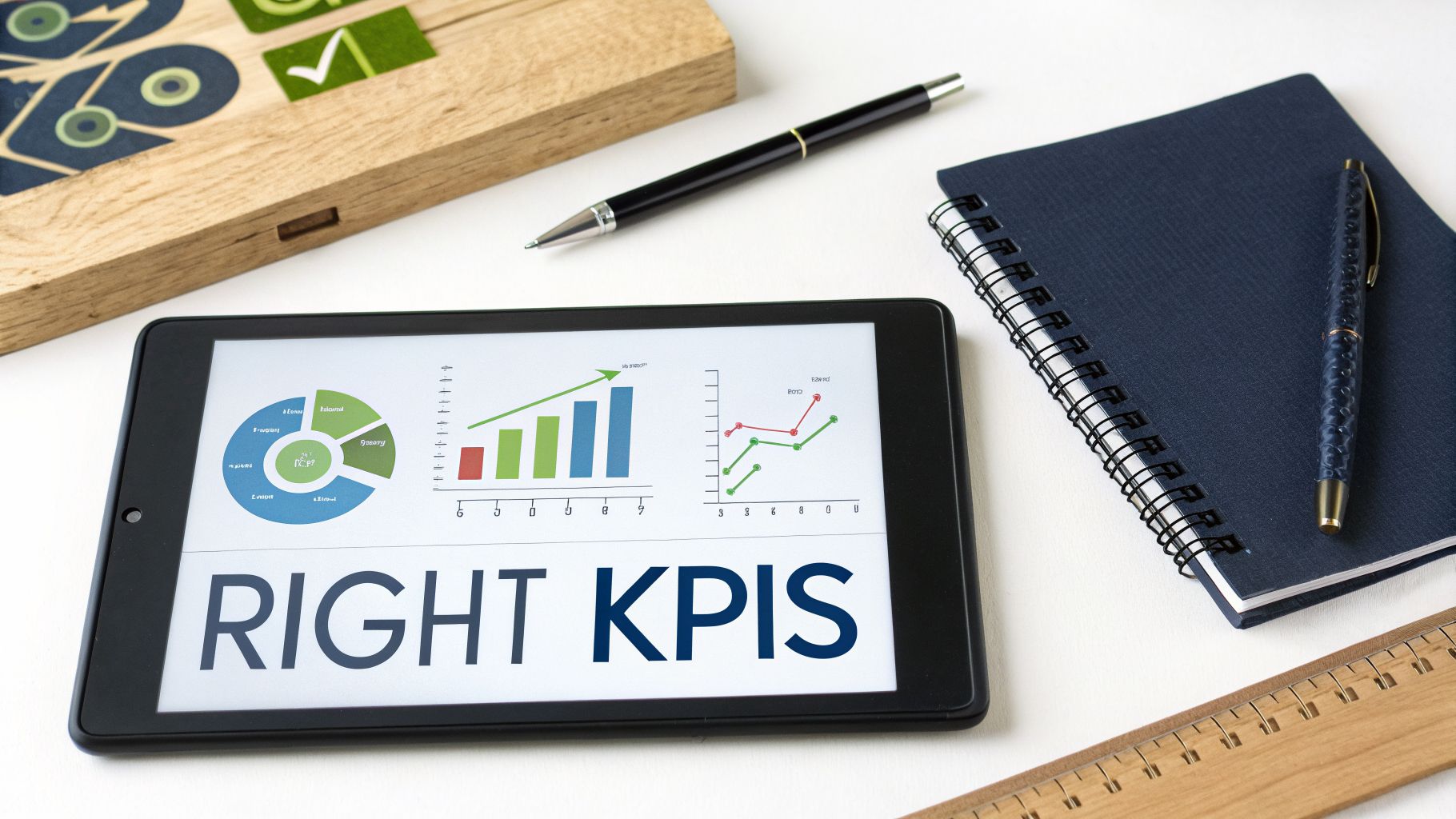
Once you’ve defined what "good engagement" looks like for your product, it's time to translate that definition into cold, hard numbers. The goal isn't to track everything under the sun. It's to pick a handful of metrics that, together, tell a clear story about whether users are getting value from your product.
The most effective approach I've seen is building a balanced dashboard. You need quantitative data to show you what users are doing, but you also need qualitative signals to understand how they feel about it. Focusing on just one gives you a dangerously incomplete picture.
Key Quantitative Engagement Metrics
These are the hard numbers, the behavioral breadcrumbs users leave inside your product. They’re the foundation of any engagement measurement system. If you’re just starting, focus on these few to get a quick, high-level read on user health.
- Product Stickiness (DAU/MAU Ratio): This is the classic for a reason. It shows how many of your monthly users are forming a daily habit. To get it, just divide your Daily Active Users (DAU) by your Monthly Active Users (MAU). For a B2B SaaS tool, a stickiness score over 20% is a good sign, while the best-in-class products often blow past 50%.
- Feature Adoption Rate: This one is simple but powerful: what percentage of your users are actually using a given feature? It’s the ultimate reality check on your development efforts and tells you which parts of your product are really moving the needle for customers.
- Session Depth: Forget session duration. Time-in-app can be a vanity metric. What matters is what they do. Session depth tracks the number of valuable, meaningful actions a user completes in a single visit. This shifts the focus from passive screen time to productive activity.
Weaving in Qualitative Signals
Numbers alone can lie. A user might log in constantly because they're frustrated and fighting with a broken workflow—that looks like great engagement, but it’s a prelude to churn. This is exactly why you need to layer in qualitative feedback to get the full story.
A user can be highly engaged but deeply unsatisfied, making them a major churn risk. Merging behavioral data with sentiment is the only way to get a true reading on customer health.
These metrics add the "why" to your quantitative "what." They capture sentiment, satisfaction, and the user's actual voice.
Primary Qualitative Indicators
- Net Promoter Score (NPS): The old standby. Asking "How likely are you to recommend us?" on a 0-10 scale is still one of the best ways to gauge overall customer loyalty.
- Customer Satisfaction (CSAT): This is more transactional. Usually triggered after a specific event like a support ticket, CSAT measures satisfaction with a single interaction, giving you laser-focused feedback on parts of the customer journey.
- Direct User Feedback: This is the goldmine of unstructured data—support chats, call transcripts, survey responses, and forum posts. It's harder to analyze, but the richest, most actionable insights are almost always hiding here.
Building Your Balanced KPI Dashboard
Now, pull it all together. Your dashboard should tell a story. For example, you might notice the Feature Adoption Rate for a new tool is tanking. By digging into recent NPS comments and support tickets, you might discover a critical bug is blocking users, turning potential value into pure frustration.
A great dashboard should also mix leading and lagging indicators.
- Leading Indicators: These are predictive. Things like session depth and adoption of core features can forecast future retention or churn.
- Lagging Indicators: These are historical results. Churn rate and Customer Lifetime Value (CLV) tell you what already happened.
A well-designed dashboard shows you how today's leading indicators are directly shaping tomorrow's lagging ones. For a closer look at structuring your dashboards, check out our guide on key metrics and reporting frameworks. By creating this balanced view, you can finally stop just reacting to churn and start proactively guiding users toward success.
Building a Unified Customer Data Foundation
Great insights don't come from messy data. While choosing the right KPIs is a crucial first step, it’s only half the battle. Now comes the hard part: building the technical plumbing to track those metrics accurately. This is where you put the theory into practice and start instrumenting your tools to get a single, reliable view of every customer's journey.
Let's be blunt. Without a solid data foundation, all your work measuring engagement is built on a house of cards. You'll have numbers, sure, but you won't be able to trust them. The goal isn't just to collect data points; it's to weave them together into a complete story.
This means firing up your product analytics tools, like Mixpanel or Amplitude, to capture those key user events you identified earlier. But the real magic happens when you merge that behavioral data with the qualitative gold hiding in your other business systems.
This flow chart gives you a good visual for how to structure your data collection, moving from scattered tool data to a single, unified view of your customer.

Think of this as your roadmap—from tracking raw events in your product to building a rich customer profile that makes true engagement measurement possible.
Instrumenting Your Product Analytics
First things first, you need to set up event tracking inside your app. This isn't about logging every single click. That’s a recipe for noise. Instead, be deliberate. Focus only on the actions that truly signal value or friction for the user.
Your engineering team will use your analytics tool's SDK to send data when a user performs a meaningful action. For instance, in a project management tool, you'd want to track events like:
Project_CreatedTask_CompletedComment_AddedTeam_Member_Invited
But don't stop there. Each event needs context. For a Task_Completed event, you should include properties like task_due_date or project_template_used. This level of detail is what unlocks much deeper, more powerful analysis down the road.
Pro-Tip: Create a tracking plan. Seriously, do this. It’s just a spreadsheet that defines every event and its properties. This simple document forces clarity, ensures everyone is on the same page, and saves your analytics from becoming an unusable mess of inconsistent data.
Merging Behavioral and Qualitative Data
Product analytics tell you what users are doing. To find out why, you have to connect that behavior to what they're saying. I can't stress this enough: this is the most important step for building a data foundation that actually gives you answers.
It's time to pull data from every corner where the customer's voice can be heard. This means integrating data from places like:
- Support Platforms (Zendesk, Intercom): What are users complaining about? Where are they getting stuck? A spike in support tickets about your new reporting feature right after a release is a massive engagement red flag.
- CRM (Salesforce): Sales call notes and customer emails are a goldmine. They reveal the core pain points that drive buying decisions and the objections that kill deals.
- Survey Tools (SurveyMonkey, Typeform): Your NPS and CSAT scores give you a direct pulse on sentiment, but it’s the open-ended feedback that explains the why behind those numbers.
The end goal is to tie all these disparate data sources back to a single user or account ID. Suddenly, you can see that a user with dropping session depth also submitted three support tickets about your reporting feature. That’s not just correlation; that's a powerful, actionable insight. For a deeper dive into the architecture behind this, checking out a modern data architecture diagram can be incredibly helpful.
Without this unified view, you're flying blind. You might see a dip in usage for a key customer segment but have no idea it’s because of a bug they reported to support last week. Merging these datasets closes that gap and turns engagement measurement from a passive reporting task into a proactive, strategic advantage. This is how you finally connect the dots between what people do and what they really mean.
Going Deeper: Finding the "Why" with Funnel and Cohort Analysis

Alright, you've got your data pipelines humming and your core metrics on a dashboard. Now for the fun part. This is where you move beyond simply reporting numbers and start turning that data into a product roadmap that actually drives growth. Two of the most powerful tools in your analytics arsenal for this are funnel analysis and cohort analysis.
Think of it this way: your basic metrics tell you what's happening. These advanced techniques help you discover why. Funnels are your diagnostic tool for user friction, showing you exactly where people get stuck. Cohorts, on the other hand, reveal how user behavior changes over time. Put them together, and you have a clear map to your biggest opportunities.
Pinpointing Friction with Funnel Analysis
A funnel analysis is just what it sounds like: it tracks the sequential steps a user takes to get to a valuable outcome. This could be anything from completing your onboarding sequence to activating a paid feature. The entire point is to visualize where people are dropping off. Every user who doesn't make it to the end of the funnel represents a lost opportunity for engagement—and often, revenue.
Let's say your SaaS has a critical three-step onboarding flow:
- User signs up.
- User creates their first project.
- User invites a colleague.
When you build your funnel, you might see that 90% of signups complete step one (great!), but only 40% ever create a project. Then, a tiny 10% go on to invite a team member. That massive drop between steps one and two is a flashing red light. It’s screaming that something in your project creation workflow is broken, confusing, or just too much work.
Funnels turn an abstract user journey into a concrete scorecard for your user experience. They don't just tell you there's a problem; they show you precisely where the fire is burning hottest.
Once you’ve identified a major drop-off, you can start digging. Is the UI a mess? Is there a hidden bug? By combining this quantitative data with qualitative insights—like support tickets or session recordings from users who dropped at that exact step—you can form a solid hypothesis and take action.
Understanding Behavior Over Time with Cohort Analysis
While funnels are perfect for dissecting a specific, linear path, cohort analysis helps you zoom out and see how engagement evolves over the long haul. A cohort is just a group of users who share a common trait, usually when they signed up.
You could, for instance, group all your January signups into one cohort, February signups into another, and so on. From there, you can track a key metric like retention rate or feature adoption for each group month after month.
This is where you truly measure the impact of your work. Did you roll out a huge onboarding redesign in March? By comparing the March cohort to the January and February groups, you can see if the new users are actually more engaged or sticking around longer.
Let’s look at a real-world example.
Retention Analysis by Signup Month
| Signup Month | Month 1 Retention | Month 2 Retention | Month 3 Retention |
|---|---|---|---|
| January 2024 | 55% | 40% | 32% |
| February 2024 | 52% | 38% | 29% |
| March 2024 (New Onboarding Launched) | 71% | 65% | 58% |
The table makes the impact of the new onboarding crystal clear. The March cohort is retaining at a dramatically higher rate. This is how you prove to your team and stakeholders that the changes you're making are directly improving customer engagement.
Combining Funnels and Cohorts for Deeper Insights
The real magic happens when you start layering these two methods. Use cohort analysis to segment your funnels and see how different user groups behave. For example, you could build the same onboarding funnel but compare the completion rate for users who came from a paid ad campaign versus those who found you through organic search. If you want to go further on this, our guide on what is a cohort analysis has even more examples.
By slicing your data this way, you might uncover powerful insights:
- Users from organic search might complete the funnel at a 50% higher rate than users from paid ads.
- Your "power user" cohort (e.g., those who use 3+ features in their first week) might have almost no drop-off in a specific feature activation funnel.
- Users who sign up on a free trial might be twice as likely to abandon onboarding as users who jump straight to a paid plan.
This level of granular analysis is what separates companies that guess from companies that know. It transforms how you measure customer engagement from a passive reporting task into a strategic hunt for actionable insights. You're no longer just looking at data; you're finding the stories that tell you exactly where your product shines and where it's failing your users.
Turning Engagement Insights into Revenue with AI
So you’ve built the dashboards, run the cohort analyses, and dissected your funnels. You’re sitting on a mountain of engagement data. Now what? The real challenge isn't just collecting this data—it's connecting it to your product roadmap in a way that actually boosts revenue and retention.
The truth is, trying to do this manually is a complete slog. It’s a classic product manager’s nightmare: spending an entire week digging through support transcripts and trying to cross-reference them with product usage logs just to figure out the real impact of a single bug. It's slow, painfully subjective, and you never get the full picture.
This is where AI-powered product intelligence tools like SigOS change the game. Instead of you manually hunting for the signal in the noise, these platforms do the heavy lifting automatically. They can turn what would have been months of painstaking correlation into a single, actionable dashboard.
Let AI Connect the Dots for You
Imagine knowing, with a high degree of certainty, which bug fix or feature request will deliver the biggest financial return. That’s the entire point of an AI-driven approach. Tools like SigOS go beyond simply counting how many times a problem is mentioned. They connect user behavior trends directly with qualitative feedback to pinpoint the issues that are costing you the most money.
This marks a huge shift from how product teams typically operate. You move from a reactive mode, looking back at historical data, to a proactive, predictive model. The system connects the what—like a 15% drop in session depth for your highest-paying customer segment—with the why, such as a spike in support chats complaining about a slow-loading report.
Instead of just asking, "What should we build next?", you can finally answer a much more powerful question: "What's the most expensive problem we're not solving for our customers right now?" That's how you start building a roadmap based on revenue impact, not just feature requests.
This kind of clarity comes from synthesizing data from all over the business—your product analytics, support conversations, sales call notes, and CRM data—and letting AI find the patterns you'd never spot on your own.
Putting a Price Tag on Bugs and Features
Perhaps the most powerful capability of an AI platform is its ability to attach a dollar value to customer feedback. How does it work? By connecting the dots between customer issues and real business data.
Let's walk through an example. A specific bug keeps popping up in your support tickets. An AI platform can instantly tell you:
- Who is affected? Are they enterprise accounts on your top-tier plan or users on a free trial?
- What is their churn risk? The system can see if their product usage has tanked since they first ran into the issue.
- What's the revenue at risk? It totals the monthly recurring revenue (MRR) of every affected account.
Suddenly, a bug that seemed like a minor annoyance is revealed to be a $50,000/month churn risk. A problem that big gets fixed—fast. The same logic applies to feature requests. SigOS can flag when multiple high-value prospects mention the same missing feature in sales calls, quantifying the potential expansion revenue you’re missing out on.
Your New, Action-Oriented Dashboard
Forget about wrestling with pivot tables and spreadsheets. The end result of this automated analysis is a clear, prioritized dashboard that shows your product team exactly what to tackle next.
A Typical AI-Powered Prioritization View
| Issue | Revenue at Risk (MRR) | Affected High-Value Accounts | Urgency |
|---|---|---|---|
| Bug: Report Export Fails | $72,000 | 14 | Critical |
| Feature: API Integration | $45,000 | 8 (expansion blocked) | High |
| Friction: Slow Dashboard | $21,000 | 32 (low usage) | Medium |
This isn't just a list of tasks; it's a data-driven battle plan for your product. Plus, with advanced methods like Conversation Intelligence, the AI can analyze the nuances of customer conversations for even deeper insights into their sentiment and intent.
By turning qualitative feedback into quantifiable, revenue-backed priorities, you empower your product teams to stop guessing and start building what customers truly need and will pay for. This is the final, most important step in measuring engagement—translating your hard-won insights into tangible business growth.
Common Questions About Measuring Customer Engagement
Even with a solid plan, once you start digging into customer engagement data, a few common questions always seem to surface. Let's walk through some of the tricky ones that SaaS teams grapple with and get you some straight answers.
How Often Should We Review Our Customer Engagement Metrics?
The honest answer is that the right cadence really depends on who's looking and why. There’s no magic one-size-fits-all schedule, but getting into a rhythm is absolutely key to making the data useful.
For your product and growth teams—the ones in the trenches—a daily or weekly review is best. You can keep an eye on high-level health with a weekly check on the DAU/MAU ratio. But for more granular metrics like feature adoption or funnel conversions, you’ll want to check more often. This is especially true right after a new release, so you can spot wins or fix problems immediately.
Your leadership team, on the other hand, doesn't need to be in the weeds every day. A curated dashboard of key KPIs reviewed monthly or quarterly is usually perfect for tracking progress against the big, strategic company goals. The idea is to find a rhythm that lets you react to bad news fast while still keeping your eyes on long-term growth.
What Is a Good Engagement Score for a SaaS Product?
This is the million-dollar question, isn't it? And the truth is, it depends. A universal "good" score just doesn't exist. Engagement benchmarks swing wildly depending on your industry, how complex your product is, and who your customers are (think B2B vs. B2C).
That said, we can work with some general rules of thumb. For a B2B SaaS tool, a DAU/MAU ratio (a great measure of product stickiness) above 20% is a strong signal. For those truly elite, habit-forming products, that number can even push past 50%.
The most powerful benchmark you have is yourself. Establish a baseline for your key metrics, and then laser-focus on continuous, incremental improvement. Comparing the engagement patterns of your most successful, highest-value customers to your average user is an incredibly powerful internal benchmark.
Can We Measure Engagement Without Expensive Tools?
Absolutely. You don’t need a massive budget to get started. Many product analytics platforms offer generous free tiers that are more than capable of helping an early-stage company track core events and build its first dashboards.
You can also get scrappy with the tools you already have.
- Surveys: Use free survey tools to send out quick NPS or CSAT polls.
- Manual Feedback: Get disciplined about tagging and categorizing feedback from support emails and sales calls. A simple spreadsheet can work wonders here.
The real challenge without a dedicated platform is the manual labor. It takes a ton of effort to connect the behavioral dots (what users do) with the qualitative feedback (how they feel). It’s time-consuming, no doubt, but it’s a perfectly good way to start building a data-informed culture.
How Is User Engagement Different from User Satisfaction?
This is a crucial distinction to make. Think of them as two sides of the same coin—you need both for a healthy, growing customer base.
- Engagement is all about what users do. It’s the data behind their actions: how often they log in, which features they use, and how deeply they interact with your product.
- Satisfaction is all about how users feel. It’s their perception of your product, which you capture with sentiment metrics like NPS and CSAT.
You can easily have a user who is highly engaged but deeply unsatisfied. Picture someone forced to use a clunky, outdated tool for their job. They have to use it, but they hate it, which is a massive churn risk. On the flip side, a satisfied but unengaged user is a sign that your product is a "nice-to-have," not a "must-have."
A truly healthy customer is both highly engaged and highly satisfied. That's the sweet spot.
Ready to stop guessing and start quantifying the revenue impact of every bug and feature request? SigOS uses AI to automatically connect user behavior to qualitative feedback, creating a prioritized roadmap that’s proven to boost engagement and reduce churn. Discover how SigOS can transform your product strategy.
Keep Reading
More insights from our blog
Ready to find your hidden revenue leaks?
Start analyzing your customer feedback and discover insights that drive revenue.
Start Free Trial →