Ai Driven Customer Insights: ai driven customer insights to boost revenue
Unlock ai driven customer insights to turn data into revenue. Predict churn, spot expansion opportunities, and prove ROI with your product decisions.

AI-driven customer insights are the clear, actionable signals that artificial intelligence finds in the mountains of data your customers generate every day. Think of it as a translator that cuts through the noise of support tickets, sales calls, and product usage to tell you a clear story about what your customers are going to do next.
What Are AI-Driven Customer Insights Really
Let's get past the buzzwords. Imagine you tried to truly understand your customer base by personally reading every email, listening to every recorded call, and tracking every single click. It's an impossible task. You’d spot a few issues here and there, but you’d never see the full picture.
Now, imagine an intelligent system doing that for you, around the clock. That’s the real job of AI-driven customer insights. It’s not just about hoarding data; it's about connecting the dots at a scale and speed that no human team could ever hope to match. The technology acts like an expert analyst, turning raw, messy data into predictive signals that show you where to focus your efforts.
Moving Beyond Basic Reports
Your traditional business intelligence (BI) dashboards are great at one thing: telling you what already happened. They can report on last quarter’s churn rate or show you which features got the most clicks. This is all rearview-mirror analysis—helpful for understanding the past, but it doesn't help you navigate what's ahead.
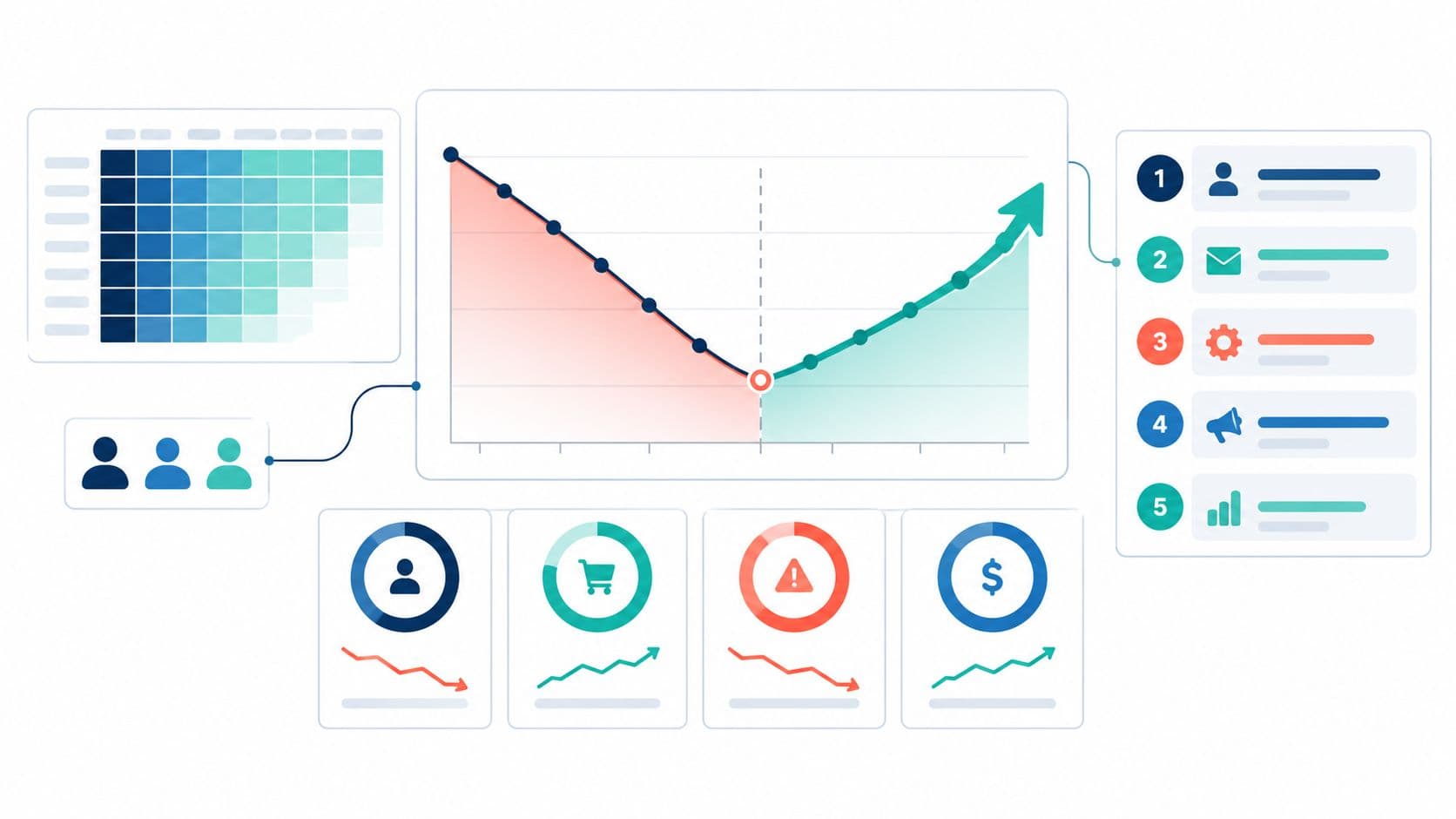
AI-driven insights work more like a GPS for your business. They dig into the why behind the data and start predicting what comes next. So, instead of just telling you the churn rate was 5%, an AI model can pinpoint that the churn was concentrated among customers who ran into a specific bug and then stopped using a key feature two weeks later.
The real magic happens when the AI connects seemingly unrelated events. A model might link a minor complaint a customer made on a sales call six months ago to a recent dip in their product usage, flagging them as a high-risk account long before they start shopping for a competitor.
From Data Points to Business Strategy
This deeper level of understanding changes how your entire organization works. Your teams no longer have to guess which bugs are most critical or which features customers actually want. They can prioritize their work based on a clear, quantified impact on the business.
- Product Teams: Can finally build features that are directly tied to documented customer needs and expansion revenue.
- Support Teams: Can get ahead of problems by proactively addressing the issues causing the most friction for high-value customers.
- Growth Teams: Can see churn risks developing in real-time and step in with the right intervention to save the account.
By putting these insights to work, a business can shift from being reactive to proactive. Of course, this is about more than just data; to see how this fits into the bigger picture, you should understand what revenue intelligence is and how it drives growth. It’s about turning the daily chatter of customer behavior into your most valuable strategic asset.
How AI Finds the Money Hidden in Customer Feedback
So, how does an AI actually sift through all the "noise" of customer conversations to find real, actionable signals tied to revenue? It's not magic, but it is a sophisticated process. Think of it less like a crystal ball and more like having a team of thousands of analysts reading every single customer interaction at once.
The process kicks off by pulling in all the raw, unstructured data that’s usually a nightmare to track manually. We're talking about the rich, conversational gold buried in places like:
- Zendesk support tickets and internal agent notes
- Transcripts from your Gong and Chorus sales calls
- Intercom live chat logs
- Public reviews and social media chatter
Once all this data is in one place, the AI gets to work. This is where advanced techniques like Natural Language Processing (NLP) come in. In simple terms, NLP gives the machine the ability to read and comprehend human language—not just the words, but the intent, topics, and emotion behind them. A key part of this is customer sentiment analysis, which helps the system figure out how a customer truly feels, even if they aren't explicit.
This basic flow—from raw data to a clear, strategic signal—is what it’s all about.

The goal here isn't just to collect feedback. It's to transform a chaotic flood of information into a prioritized list of what actually matters to your bottom line.
Manual Feedback Analysis vs AI Driven Customer Insights
For years, businesses have tried to understand customer feedback manually. But as anyone who's tried knows, it’s a slow, biased, and ultimately limited process. Here’s a quick comparison of the old way versus the new, AI-powered approach.
| Aspect | Manual Analysis | AI-Driven Analysis (e.g., SigOS) |
|---|---|---|
| Speed | Weeks or months to collect and analyze. | Near real-time; insights generated continuously. |
| Scale | Can only cover a small, sampled percentage of feedback. | Analyzes 100% of interactions across all channels. |
| Accuracy | Prone to human bias, interpretation errors, and fatigue. | Objective, consistent, and identifies patterns humans miss. |
| Quantification | Relies on anecdotal evidence and gut feelings. | Directly connects feedback to financial metrics like revenue at risk. |
| Actionability | Results in static reports that are quickly outdated. | Creates live, prioritized tasks and tickets in operational tools. |
The difference is stark. AI doesn’t just do the same job faster; it does a fundamentally different job, turning qualitative feedback into a quantitative, strategic asset.
From Vague Complaints to Concrete Financials
This is where things get really interesting. The AI doesn’t just stop at categorizing what customers are saying. It digs deeper, looking for connections between what customers say and what they do.
For example, it might spot that dozens of support tickets mention the same frustrating bug. But then it goes a step further and correlates those tickets with product usage data, revealing that those specific customers have stopped using a key feature.
Suddenly, you have a financial signal. Instead of a vague report that "some customers are unhappy," the AI can calculate the exact revenue at risk by tallying up the subscription value of all the affected accounts.
A platform like SigOS turns this analysis from a slow, manual chore into a live, strategic advantage. It automatically quantifies the financial impact of customer issues, flagging both threats and opportunities long before they ever appear on a quarterly report.
This shift from reactive to predictive is what's fueling massive growth in the space. The AI in Customer Experience market is projected to hit USD 22.67 billion by 2026 and is expected to surge to USD 59.71 billion by 2030. Companies are realizing that the ability to find these patterns is the key to getting ahead of churn and spotting expansion opportunities.
Closing the Loop From Insight to Action
The final piece of the puzzle is turning these financial signals into immediate, concrete action. A truly intelligent system doesn't just hand you a dashboard and wish you luck. It plugs directly into the tools your teams already use, like Jira or Linear.
Let's say the AI identifies a critical bug that’s threatening $50,000 in annual recurring revenue. Instead of just flagging it, it can automatically draft a ticket for your engineering team.
This ticket arrives pre-loaded with all the crucial context: aggregated customer quotes, links to the original support conversations, and, most importantly, the calculated revenue-at-risk score. This closes the loop between insight and action, giving your product and engineering teams the data they need to prioritize with confidence.
If you're looking to build a more effective feedback loop, our guide on how to analyse customer feedback offers a deeper look into these workflows.
The Real-World Business Impact of AI Insights
While the technology behind AI-driven customer insights is fascinating, what really matters is the impact it has on your bottom line. Theory is great, but revenue is what keeps the lights on. This is where AI stops being an abstract concept and becomes one of the most powerful tools in your arsenal, directly connecting your team’s daily activities to tangible business results.
For instance, when you apply AI insights in sales and marketing, you empower your teams to stop guessing and start making decisions based on what the data says will actually work.
Preventing Customer Churn Proactively
One of the quickest and most significant wins you’ll see is in churn reduction. Most companies only figure out a customer has churned after they’re already gone. AI-driven platforms flip this around, acting as an early-warning system that flags at-risk accounts long before they even think about leaving.
Imagine getting a real-time alert because a specific bug is frustrating a customer worth 300,000 a year. The AI has already done the heavy lifting, connecting their recent support tickets to a noticeable drop in product usage. Suddenly, you’re not just looking at a technical bug; you’re looking at a ****300,000 problem. This lets you intervene, save the account, and turn a potential loss into a story of great customer service. You can learn more by predicting customer churn with AI in our detailed guide.
Uncovering High-Value Expansion Opportunities
But it's not just about protecting the revenue you already have—it's about finding new growth opportunities. Hidden inside thousands of customer conversations and feature requests are the clues to your next big expansion deal. An AI can instantly spot when several of your highest-growth accounts are all asking for the same new feature.
By automatically correlating feature requests with the subscription value and growth potential of the requesting accounts, AI surfaces the opportunities with the highest ROI. This lets product teams build roadmaps backed by provable revenue demand, not just the loudest opinions.
This is a fundamental shift toward data-backed product development. Instead of building what you think customers want, you build what you know your best customers will pay for. This approach delivers results across the board—in some markets, this level of personalization alone can boost sales conversions by 20%. For our users at SigOS, tying customer feedback directly to expansion opportunities is a proven way to unlock major deals.
Ultimately, the business impact is crystal clear:
- Reduced Churn: Stop revenue leakage by solving the most critical issues for your most valuable customers before they become deal-breakers.
- Accelerated Expansion: Pinpoint and act on the feature requests that are directly tied to new or expanded contracts.
- Revenue-Backed Roadmaps: Prioritize development work based on quantified financial impact, ensuring your engineering team is always focused on what moves the needle.
Operationalizing Insights in Your Daily Workflow
It's one thing to talk about the potential of AI-driven customer insights, but what does that actually look like for a product manager on a Tuesday morning? Let's walk through a real-world scenario to see how a platform like SigOS moves these ideas from a high-level concept to your daily to-do list.
This isn't about adding another dashboard to your collection. It’s about completely changing how you start your day.

Instead of a chaotic inbox and a vague sense of what's on fire, you log in to a clear, prioritized list of actions. While you were offline, the AI was busy connecting the dots across thousands of support tickets, sales calls, and product usage logs. It’s done the hard work of finding the signal in the noise, presenting you with the day’s top three revenue-impacting issues.
From Noise to a Clear To-Do List
This morning, your dashboard flags two items that need your attention right away: a subtle bug in the user onboarding flow and a feature request that keeps popping up in conversations with high-growth accounts.
But the AI doesn't just flag them; it tells you exactly why they matter.
- The Bug: The system has tied this seemingly minor glitch to a pattern of new user drop-offs. It's not just an annoyance; it represents a calculated monthly churn risk of $50,000.
- The Feature Request: This isn’t just a popular idea. The AI has linked it directly to expansion conversations with customers representing a $250,000 opportunity.
Suddenly, your priorities aren't based on who shouts the loudest in a meeting or what you think is important. They’re tied to direct, measurable financial outcomes. You’re not just fixing a bug; you’re protecting $50,000 in monthly revenue.
Closing the Loop From Insight to Action
This is where the magic really happens. With a single click on the bug, you get all the aggregated customer evidence in one place. You can see the original support tickets, read direct quotes from frustrated users, and even review the usage data that shows precisely where people are getting stuck.
An AI-driven system bridges the enormous gap between raw data and decisive action. It turns weeks of manual analysis into a few minutes of focused work, ensuring your team is always aimed at the biggest business impact.
Even better, the platform handles the tedious admin work. It has already drafted a Jira ticket, pre-populating it with all the crucial context: the revenue-at-risk score, a summary of customer quotes, and links back to the source data. Your engineering team receives a ticket that doesn't just describe a problem—it explains its financial urgency.
This completely reshapes your workflow. You shift from being a reactive problem-solver to a proactive, data-informed strategist. The AI takes care of the "what" and the "why," freeing you and your team to focus entirely on the "how"—building the solutions that will defend revenue and drive growth.
Measuring the ROI of Your AI Insights Engine
So, you’ve invested in an AI platform. That’s a major strategic decision, not just a tech purchase. Now comes the hard part: proving it was worth the money.
To get—and keep—leadership buy-in, you have to show a clear return on that investment. This means moving past vanity metrics and focusing on KPIs that connect directly to the bottom line.

The real shift happens when you stop asking, "How many insights did we find?" and start asking, "How much revenue did those insights help us generate or save?" It’s all about drawing a straight line from an AI signal to a financial outcome.
Key Metrics That Matter
To prove the real-world value of your AI-driven customer insights, you need to track metrics that reflect the health and growth of the business. These are about outcomes, not just activity.
- Churn Correlation Accuracy: How often are the AI's predictions about at-risk customers actually correct? If your system hits an accuracy rate of 85% or higher, you can trust it’s a reliable early-warning system, not just a fancy guessing game.
- Revenue Saved from Prioritized Fixes: This is a big one. Tally up the total subscription value of all the accounts your AI flagged as "at risk" due to specific product issues. When your team swoops in, resolves those problems, and the customer stays, that retained revenue is a direct result of AI-led prioritization.
- Expansion Win Rate from AI Leads: Keep an eye on the closing rate for expansion opportunities that came directly from an AI-surfaced insight. For example, if the AI flags a feature request that’s common among your highest-potential accounts, what percentage of them actually upgrade once you build it?
The goal is to put a number on what used to be a gut feeling. Instead of just saying, "We fixed a bug that was annoying customers," you can now confidently state, "We fixed a bug that was threatening $120,000 in ARR and successfully retained 95% of that revenue."
Building a Bulletproof Business Case
When you bring these metrics together, they tell a powerful story for your leadership team. And you’re not alone—in B2B SaaS, 61% of companies are already reporting tangible results from this approach. They’re seeing 2.8x higher demo-to-paying-customer conversions and a 25% drop in churn by using predictive analytics. You can dig into more of these trends in this detailed market report on AI in customer experience.
When you make your case, always frame it in financial terms. Presenting a 25% reduction in at-risk revenue or a 15% lift in expansion deals sourced from AI insights gives them undeniable proof of value.
This is how you transform your AI platform from a "cost center" in the budget into a proven revenue engine for the business.
Implementing AI Insights Without the Headaches
Even the most sophisticated AI-driven customer insights are worthless if they're stuck in a dashboard nobody uses. The real challenge isn't just generating the insights; it's weaving them into the fabric of your team's daily decisions. A successful AI project is less about flipping a switch and more about building a stable bridge between your data, your tools, and your people.
Getting this right comes down to three things: having great ingredients, connecting the pipes, and making sure people actually turn on the tap. If you miss one, the whole system breaks down.
The Three Pillars of a Smooth Rollout
First, you have to get serious about clean and consistent data. Your AI model is only as smart as the information you feed it. If you’re pulling messy or incomplete data from your CRM or support desk—think Zendesk or Salesforce—you're going to get unreliable results. It’s the classic "garbage in, garbage out" problem.
Next, you need seamless integration. The last thing your team needs is another tool to log into. For an AI platform to be truly useful, it has to plug directly into the tools your teams already live in. Whether that's Jira, Slack, or Linear, the goal is to get the right insight to the right person in the right place, automatically.
Finally, and this is the part most companies fumble, you have to drive team adoption. The AI isn’t a mysterious black box meant to replace your team’s judgment. It's a tool that gives them hard evidence to back up their instincts and focus their efforts where they matter most.
A successful implementation is what finally ends the "loudest voice in the room" decision-making. It creates a culture where choices are consistently backed by clear, revenue-based data.
This ability to drive real-world action is why the AI-as-a-Service market is exploding. Global spending is expected to jump from 28.81 billion in 2026 to an incredible ****240.48 billion by 2034. As you can read more about the growing AIaaS landscape on Outsource Accelerator, companies that master these three pillars will be the ones who confidently turn AI signals into bottom-line impact.
Answering Your Top Questions About AI Insights
When teams first explore AI-driven customer insights, a few key questions always come up. Let's walk through them, because the answers are crucial for understanding how this actually works for your business.
How Is This Different From Our BI Tools?
This is probably the most common question we get. Think of it this way: your Business Intelligence (BI) tools are like a rearview mirror. They’re fantastic at showing you what already happened—last quarter’s sales, the churn rate from six months ago. They tell you the what.
AI insights platforms are your forward-facing radar. They dig into the messy, unstructured data that BI tools can't touch—like call transcripts, support tickets, and survey comments—to figure out why things are happening. More importantly, they predict what will happen next, flagging the specific customers who are about to churn and the exact reasons for it. This gives you a chance to get ahead of problems instead of just reacting to them.
Will This AI Replace My Product Managers?
Absolutely not. It’s about making them superheroes, not obsolete.
Your product managers are brilliant, but they’re probably spending countless hours manually sifting through feedback, trying to connect dots between a support ticket and a feature request. This AI automates that grind. It handles the mind-numbing data crunching, freeing your team to do what people do best: strategize, innovate, and make confident decisions backed by real evidence.
The goal of AI isn't to replace human judgment, but to sharpen it. It clears the noise so your team can focus on strategy and creative solutions.
How Fast Can We See a Return on Investment?
You’ll see the impact much faster than you might think. Getting started isn't a massive, months-long project. Modern platforms can plug directly into the tools you already use, like Zendesk, Gong, or Jira, often in just a few days.
Once connected, the AI gets to work immediately, analyzing both your historical data and new information as it flows in. It's common for teams to see their first actionable, revenue-tied insights within the first week. This means you can start plugging revenue leaks and spotting expansion opportunities right away.
Ready to turn customer noise into financial signals? See how SigOS uses AI to surface the bugs and feature requests that directly impact your revenue. Discover your highest-priority actions.
Keep Reading
More insights from our blog
Ready to find your hidden revenue leaks?
Start analyzing your customer feedback and discover insights that drive revenue.
Start Free Trial →