Adoption of product: Growth Tactics (adoption of product)
Discover practical steps for adoption of product that boost engagement, retention, and sustainable growth, crafted to drive real results.

So, what exactly is product adoption?
Think of it as the journey a new user takes from "What is this thing?" to "I can't imagine my work without this thing." It’s more than a one-time signup or a quick look around. Real adoption happens when your product becomes a go-to tool, fully woven into a user's regular habits to help them get things done. It's when they don't just use your product; they rely on it.
Why Product Adoption Is Your True Growth Engine

It’s easy to get obsessed with user acquisition—watching those signup numbers climb is a real thrill. But getting a new user is like inviting someone to a party. Product adoption is making sure they have such a fantastic time that they come back again and again. It’s the difference between a user who logs in once and disappears, and one who integrates your tool into their daily workflow.
This distinction is where sustainable, long-term growth is born. An acquired user has simply opened the door. An adopted user has moved in, unpacked their bags, and made your product their home. They've found the core value you offer and made it a non-negotiable part of their routine.
Many companies mistakenly chase acquisition numbers while ignoring the "leaky bucket" of users who sign up and quickly leave. It's crucial to understand the difference.
Key Differences Between User Acquisition and Product Adoption
| Aspect | User Acquisition Focus | Product Adoption Focus |
|---|---|---|
| Primary Goal | Get as many new users as possible to sign up. | Guide users to experience core value and become active. |
| Key Metrics | Signups, Downloads, Free Trial Starts, Cost Per Acquisition (CPA) | Activation Rate, Daily/Monthly Active Users (DAU/MAU), Feature Adoption Rate, Retention |
| Timeframe | Short-term, top-of-funnel activity. | Long-term, focuses on the entire user lifecycle. |
| Business Impact | Increases market reach and initial user count. | Drives retention, reduces churn, and increases Customer Lifetime Value (CLV). |
Focusing on acquisition alone might look good on paper for a while, but adoption is what builds a solid foundation for a healthy, growing business.
The Journey to the "Aha!" Moment
The turning point in this entire process is what we call the "aha!" moment. This isn't just a buzzword; it's that magical instant when a user truly gets it. It’s when they experience firsthand how your product solves their problem and makes their life easier.
For a project management tool, that moment might be when they assign a task and see their team collaborating on it in real time. For a design app, it's creating their first professional-looking graphic in just a few minutes.
Getting users to this "aha!" moment is the first critical goal of any adoption strategy. It’s the spark that turns casual curiosity into real engagement. Without it, users will likely churn before you ever get a chance to show them what you can really do.
From Adoption to Advocacy
When you nail product adoption, you create a powerful ripple effect that fuels your business in some incredibly important ways:
- Higher Customer Lifetime Value (CLV): Adopted users stick around for the long haul. They’re far more likely to upgrade to premium plans and expand how they use your product over time.
- Reduced Customer Churn: When your product becomes essential to someone's workflow, the thought of switching to a competitor becomes a huge headache. High adoption rates are a direct antidote to high churn.
- Powerful Brand Advocacy: The best users don't just use your product; they become its biggest fans. They turn into your most authentic marketing channel, recommending you to friends and colleagues and creating a self-powering growth loop. This is a central idea you can explore in our guide to product-led growth strategies.
Ultimately, focusing on product adoption means shifting your entire mindset. You stop just counting sign-ups and start measuring the real, tangible value you deliver to your users every single day. This focus on deep-seated value is what separates fleeting fads from true market leaders.
Navigating the Product Adoption Journey

Getting users to embrace your product isn't a single event; it's a journey. You're not selling to one big, uniform audience, but to a series of distinct groups who adopt new technology at different paces. The Product Adoption Curve is the classic model that maps this out, breaking your market into five key segments.
Think of it less like a stuffy theory and more like a strategic playbook. Each stage presents a new crowd to win over, and each crowd needs a slightly different approach. Mastering the handoff from one group to the next is what separates fleeting fads from products with real staying power.
Let's break down this journey and look at who these groups are and what they really want.
Winning Over the Innovators
First up are the Innovators. They’re a tiny slice of your potential market—just 2.5%—but they punch way above their weight. These are the die-hard tech fans and visionaries who love trying new things just for the sake of it.
Innovators don't mind a few bugs or a missing feature here and there. They're drawn to potential and are hunting for what's next. They are also your most critical early-feedback mechanism, giving you the raw, unfiltered insights that will help you refine everything. The best way to engage them is to bring them into the fold, make them feel like co-creators, and listen closely to what they have to say.
Engaging the Early Adopters
Right behind the Innovators are the Early Adopters, making up about 13.5% of the market. These aren't just hobbyists; they are respected leaders and influencers in their fields. They're on the lookout for a real competitive edge, not just the latest gadget.
To capture their interest, you have to prove your product solves a major problem and delivers a clear, tangible benefit. Get them on board, and they become your most passionate advocates. Their testimonials and success stories create the social proof needed to convince everyone else it’s safe to jump in. Their endorsement is the market’s signal that your product is a serious tool, not just a novelty.
The leap from Early Adopters to the next group, the Early Majority, is famously called "crossing the chasm." It's the make-or-break moment for many products. This is where you have to shift your messaging from "it's new and exciting" to "it's proven and reliable."
A great way to see how this works in practice is to study successful Product-Led Growth (PLG) examples. You'll see how top SaaS companies tailor their strategies to pull customers through each stage of this journey.
Capturing the Majority
If you successfully cross the chasm, you'll meet the Early Majority (34%). These folks are practical and cautious. They aren't looking to be trailblazers; they want a dependable solution that fits right into their daily work without causing a fuss.
To win them over, you need to emphasize ease of use, provide rock-solid support, and show them plenty of case studies from people just like them. A smooth, intuitive onboarding experience is absolutely critical. It’s worth taking the time to map this out perfectly, and you can get some great ideas by looking at different user flow examples. They need to see it works for others before they’ll even consider it.
Next comes the Late Majority, another 34% chunk of the market. This group is even more skeptical. They typically adopt new technology only when they feel they're being left behind or when it becomes an industry standard. For them, it’s all about simplicity, a low barrier to entry, and overwhelming proof that they're making the safe choice.
Finally, you have the Laggards (16%). These are the true traditionalists, deeply resistant to change, who will be the very last to come aboard. While they are technically part of the market, your growth efforts are far better spent on the earlier, more receptive groups.
Measuring What Truly Matters in Product Adoption
It's so easy to get lost in a sea of data. You can drown in impressive-sounding but ultimately hollow numbers. Metrics like total signups or even Daily Active Users (DAU) can paint a deceptively rosy picture. They tell you people are showing up to the party, but they don’t tell you if they're actually having a good time or planning to stick around.
To get the real story of your product's health, you have to measure what matters. This means zeroing in on the key performance indicators (KPIs) that show how deeply users are engaged. These are the metrics that move beyond "how many" to answer the far more important questions of "how well" and "for how long."
Key Metrics That Tell the Real Story
To get a clear picture, you need to look at a handful of metrics together. Think of each one as a different lens. On its own, it gives you one perspective. But when you combine them, you get a full, actionable view of how your product is really doing.
Let's break down the essentials:
- Product Adoption Rate: This is your headline number. It’s simply the percentage of your active users who are new. A steady, rising rate is a great sign that you're successfully bringing new people into the fold.
- Time to First Value (TTFV): How quickly does a new user get that "aha!" moment? TTFV measures the time it takes for someone to perform a key action that delivers on your product’s core promise. A shorter TTFV means your onboarding is working and people are "getting it" right away.
- Feature Adoption Rate: Let's be honest, not all features are created equal. This metric tracks how many users engage with your most important, high-value features. It’s crucial for figuring out which parts of your product are a hit and which might need a redesign or a better introduction.
- Customer Engagement Score: This is a neat way to roll up several user actions—like how often they log in, which features they use, and how long their sessions are—into a single score. It gives you a holistic snapshot of how embedded a user is in your product.
Tracking these KPIs provides a much richer story. A high product adoption rate is fantastic, but if the adoption rate for your core features is in the gutter, it's a huge red flag. It tells you that new users are coming in the door but failing to discover the very tools that would make them stay.
This is where a clear dashboard comes in, connecting the dots between product activity and business goals.
The screenshot shows how a platform like SigOS can tie product metrics directly to revenue, helping you focus your team's energy on work that actually moves the needle.
The Power of Cohort Analysis
Measuring these KPIs is a great start, but the real magic happens when you bring in cohort analysis. A cohort is just a group of users who all signed up around the same time (e.g., "the January 2024 crew"). By tracking how each cohort behaves over the weeks and months, you can see exactly how changes you make to the product impact their long-term adoption and loyalty.
Cohort analysis turns raw data into a compelling narrative. It allows you to see if your product is getting "stickier" over time, proving that your improvements are making a real difference to the user experience.
Imagine you launched a new interactive tutorial in March. By comparing cohorts, you might see that the March group has a 20% higher feature adoption rate after one month than the February group. That's not a guess; it's hard evidence that your new tutorial worked. Understanding these behavioral patterns is fundamental to improving retention, a topic we dive into in our guide to essential customer retention metrics.
Benchmarking Your Adoption Success
Knowing your numbers is one thing. Knowing if they're good is another. The reality of building products can be a bit sobering. Statistics show that only 40% of developed products even make it to market, and of those, just 60% generate any revenue at all.
When you look specifically at core feature adoption, the median rate is a mere 16.5%. This just goes to show how tough it is to get users deeply engaged. You can discover more insights about these product adoption statistics on bestcolorfulsocks.com.
Ultimately, your most important benchmark is your own past performance. By using cohort analysis and consistently tracking these core adoption metrics, you create a clear, data-driven path toward building a product that users don't just try, but truly can't live without.
Unsticking Your Users: How to Solve the Most Common Product Adoption Barriers
Even the most brilliant product can stall out if users hit a wall of frustration. When you see high churn rates and low engagement, they're usually just symptoms of deeper issues—common barriers that stand between a user signing up and truly making your tool a part of their daily life. To get product adoption right, you have to play detective, diagnose these roadblocks, and then systematically tear them down.
Getting a handle on these challenges starts with a clear-eyed look at your product's overall health. This means focusing on the metrics that tell the real story of the user's journey.
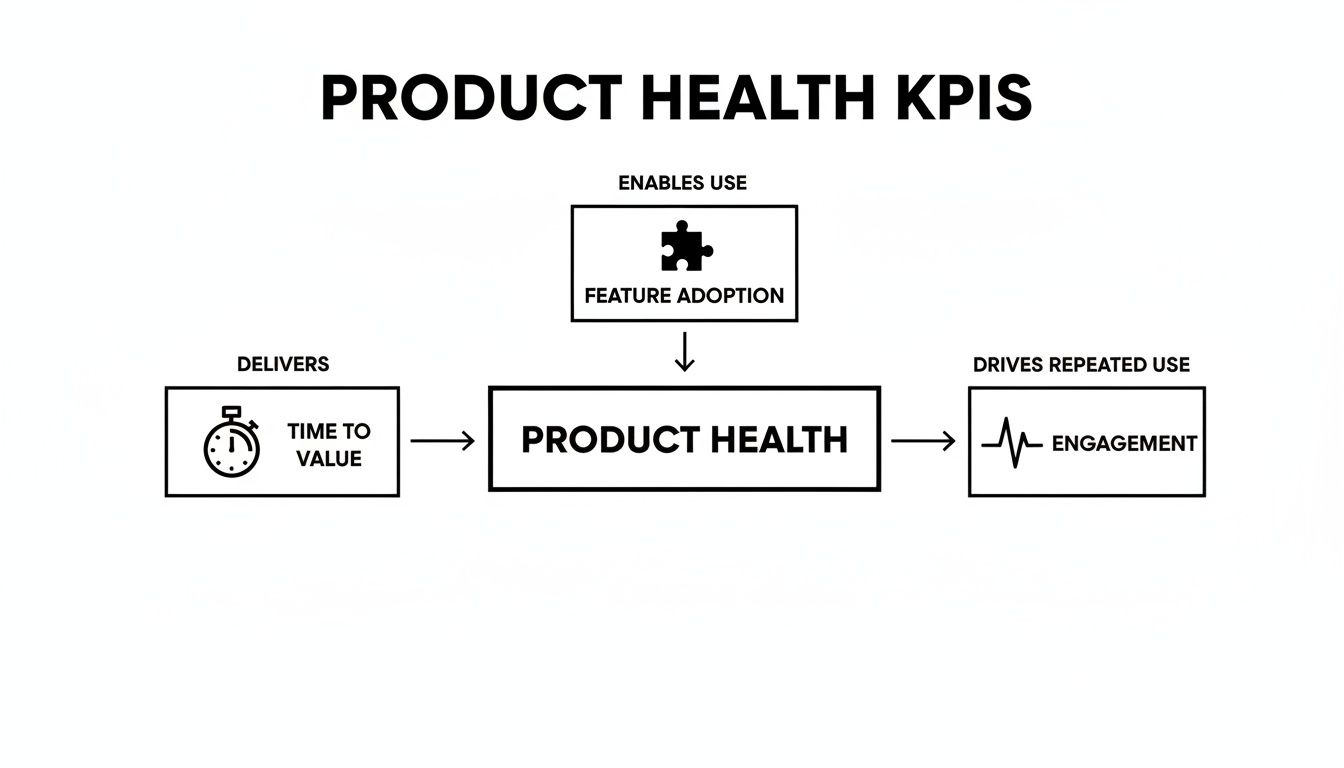
This diagram isn't just a bunch of buzzwords; it shows how tightly Time to Value, Feature Adoption, and Engagement are linked. When you track these areas, you can pinpoint exactly where people are getting stuck and start digging into the "why" behind the numbers.
Barrier 1: A Bumpy or Broken Onboarding
Those first few moments a user spends with your product are everything. A confusing, clunky, or unguided onboarding experience is like handing someone a state-of-the-art power tool with no instruction manual. Most people will just put it down and walk away.
This initial fumble is the fastest way to a low activation rate. Users never hit that critical "aha!" moment because they get lost or overwhelmed before they even see what your product can do for them.
The fix? Guide them to a quick, meaningful win.
- Build Interactive Walkthroughs: Ditch the static, one-size-fits-all tours. Use contextual, step-by-step guides that teach by doing, helping users complete a core task in their very first session.
- Personalize the Welcome Mat: Ask new users what they hope to achieve during signup. Use that info to customize their onboarding, showing them the features most relevant to their goals right away.
- Celebrate the Small Stuff: Acknowledge when a user hits a milestone, like creating their first project or inviting a teammate. This little bit of positive reinforcement goes a long way in building momentum.
Barrier 2: The Value Proposition is Hidden
If users can't quickly grasp why they should invest their precious time in your product, they won't. This barrier isn't about having a weak product; it's a failure to communicate its value. Your tool might be the perfect solution to their biggest headache, but if that benefit isn't crystal clear from the get-go, its potential stays locked away.
This often happens when product messaging gets stuck talking about what the features are instead of what problems they solve.
A user doesn't care about your "AI-powered synergistic data processor." They care about getting their monthly reports done in five minutes instead of five hours. Connecting features to tangible outcomes is everything.
To close this value gap, you have to constantly reinforce the "why" behind your product.
- Lean on Social Proof: Show, don't just tell. Case studies and testimonials from customers who look and feel like them are incredibly powerful for proving real-world value.
- Speak in Benefits, Not Features: Frame every announcement, email, and in-app message around what the user gains. Always answer their unspoken question: "What's in it for me?"
- Listen to Your Fans: Use surveys and interviews to understand what your happiest customers value most. Then, use their exact language in your marketing and onboarding to attract more people just like them.
Barrier 3: The Product is Just Too Complicated
As products mature, they can easily become bloated with features, settings, and options. While each addition might seem logical at the time, the cumulative effect can create a steep learning curve that intimidates new users and even frustrates loyal ones. When someone is faced with a dozen unfamiliar buttons, the easiest choice is to click none of them.
This is a classic driver of low feature adoption rates, where most users cling to one or two basic functions and ignore all the other incredible value you've built.
To fight back against complexity, you need to master progressive disclosure.
- Protect the Core Workflow: Make sure the main path a user takes through your product is as clean and intuitive as possible. Guard it against clutter.
- Tuck Away the Advanced Stuff: Keep complex settings and niche features out of the main interface. Power users will find them, but new users won't be overwhelmed.
- Make Empty States Useful: Don't just show a blank screen. Use that space—before a user has created any content—to offer helpful tips, short tutorials, or clear calls to action that guide their next step.
Identifying these roadblocks is the first step. The table below connects these common pain points to concrete symptoms and solutions you can implement.
Common Adoption Barriers and Strategic Solutions
| Barrier | Common Symptoms | Actionable Solution |
|---|---|---|
| Ineffective Onboarding | High drop-off after signup, low activation rates, immediate support tickets from new users. | Implement interactive, personalized walkthroughs (Appcues is great for this). Celebrate early "wins" to build momentum. |
| Failure to Demonstrate Value | Low engagement metrics, users not exploring key features, feedback like "I don't get it." | Focus messaging on outcomes, not features. Use case studies, in-app benefit reminders, and customer testimonials. |
| Overwhelming Complexity | Low feature adoption, users sticking to only 1-2 core functions, feature requests for things that already exist. | Simplify the UI with progressive disclosure. Hide advanced options and use empty states to guide first-time users. |
By using this framework, you can move from guessing what's wrong to systematically diagnosing and fixing the real issues holding back your growth. It's about creating a smoother path to value so more users can experience your product at its best.
How AI Is Redefining Product Adoption

Traditional product analytics are great at telling you what your users are doing. You can see which buttons they click, how often they log in, and which features they ignore. But this data almost always leaves you guessing about the most important question of all: why?
To truly understand and improve product adoption, you need to get inside the user's head. And that’s where Artificial Intelligence is completely changing the game.
AI-powered tools move way beyond simple quantitative data. They can dive into the massive, messy world of qualitative feedback—the thousands of support tickets, sales call transcripts, survey responses, and user reviews—and actually make sense of it all. This isn't just a faster way to read feedback; it's a new way to listen to your entire customer base at once.
Uncovering the Voice of the Customer
Think of AI as your team’s superhuman analyst. It uses technology like natural language processing (NLP) to read, categorize, and understand human language at a scale no human team ever could. Instead of basing decisions on a few anecdotal support tickets, you can instantly see trends emerging from thousands of real conversations.
This capability finally closes the gap between user behavior and user intent. It connects the dots between a sudden drop-off in your onboarding funnel and a spike in support tickets all mentioning a "confusing setup process."
By analyzing the unstructured data where customers express their true feelings—frustration, delight, confusion—AI provides the context that raw numbers lack. It finds the "why" behind the clickstream data, turning ambiguity into actionable insight.
For instance, an AI tool could analyze all your recent feedback from churned users and discover that 35% mentioned a specific missing integration. That’s not just another feature request; it’s a clear, revenue-tied signal about what's blocking deeper product adoption. This process transforms qualitative data from a source of subjective stories into a quantifiable driver for your roadmap.
From Reactive Fixes to Proactive Insights
One of the biggest shifts AI brings to product adoption is moving teams from a reactive to a proactive stance. Instead of waiting for users to complain or churn, AI can spot the subtle, early warning signs of trouble long before they escalate into bigger problems.
Here’s how that works in practice:
- Pinpointing Friction Points: AI algorithms can detect patterns of frustration in support chats or negative sentiment in reviews related to a new feature, alerting you to usability issues in near real-time.
- Surfacing High-Demand Features: By quantifying how often certain features are requested in sales calls with high-value prospects, AI helps you prioritize the roadmap based on direct revenue potential.
- Predicting Churn Risk: AI models can identify combinations of behavior and feedback—like decreased usage of key features paired with a recent support ticket about pricing—that strongly correlate with a user's likelihood to churn.
This level of intelligence allows you to intervene at the perfect moment with the right solution, whether it's a targeted in-app guide, a proactive email from customer success, or a high-priority bug fix. It makes improving product adoption a precise, data-driven discipline.
Making AI a Standard Business Practice
This isn't some far-off future concept; it's happening right now. The business world has moved quickly to integrate AI into its core operations. Enterprise AI adoption hit 78% in 2025, a clear sign that it has become a standard tool for getting results. The investment is paying off, too, with companies reporting a $3.70 return for every dollar spent and seeing major productivity gains. You can dig into more data on the tangible returns of AI investments on fullview.io.
For product teams, this means that using AI isn't just an advantage—it's fast becoming an expectation. Platforms like SigOS bring this power directly to you, connecting the dots between qualitative customer feedback and its direct impact on revenue. By automatically analyzing all your customer conversations, SigOS surfaces the most urgent issues and valuable opportunities, ensuring your development efforts are always focused on what will most effectively boost product adoption and drive growth.
Your Action Plan for Better Product Adoption
All that data is useless until you turn it into decisions. The good news is that a solid product adoption strategy isn't some complex mystery—it’s a repeatable, systematic process. Think of the following as your playbook for turning those user insights into real, measurable growth.
This isn't about theory; it's a practical checklist for moving from analysis to action. It’s built to guide you through a continuous loop: define success, measure where you are, understand your users, and then make smart, data-backed calls about your product's future.
Define What Success Looks Like
First things first: you and your team need a crystal-clear, shared definition of "successful adoption." This goes way beyond high-level vanity metrics. We're talking about identifying the specific user behaviors that tell you someone has truly embedded your product into their routine.
Get your team in a room and ask: what are the three to five key actions a new user must take to get that "aha!" moment and experience our product's core value? Maybe it’s creating their first report, inviting a teammate, or completing a specific project. These actions are your North Star, defining the "win" you need to guide every user toward.
A well-defined success metric acts as a filter for all future product decisions. If a proposed feature or fix doesn't directly contribute to driving these core actions, you should question its priority on your roadmap.
Establish a Baseline and Segment Users
Once you know what success looks like, it's time to measure your starting point. Use the metrics we talked about earlier—like Time to First Value and Feature Adoption Rate—to get a hard baseline. You need this data to track your progress and prove your work is actually making a difference.
Next, start slicing up your user base into meaningful cohorts. Group them by signup date, company size, or user persona. Digging into how these different segments behave is incredibly revealing. You'll quickly see which groups are crushing it and which are struggling, letting you target your efforts with surgical precision.
For example, you might find that users from small businesses adopt a key feature 30% faster than those from enterprise clients. That’s not just an interesting stat; it’s a bright, flashing sign that you need better onboarding for your larger teams.
Gather Feedback and Prioritize Your Roadmap
The numbers tell you what is happening, but you need qualitative feedback to understand why. This is where you get your hands dirty. Dive into support tickets, run user interviews, and send out surveys to uncover the friction points and unmet needs holding people back.
Finally, pull all this data together to prioritize your product roadmap. Stop guessing and start focusing on the initiatives that will move the needle on the success metrics you defined from the start.
A huge piece of any adoption strategy is just clear communication. For some practical tips, check out this guide on creating compelling product explainers that break down complex features and showcase their value.
Your action plan should boil down to a simple, continuous cycle:
- Define: Set clear, behavior-based goals.
- Measure: Establish baselines and track everything.
- Learn: Mix quantitative and qualitative data to see the full picture.
- Iterate: Prioritize your roadmap based on what will actually drive adoption.
When you stick to this discipline, product adoption stops being a vague goal and becomes a deliberate, measurable engine for growth.
Got Questions About Product Adoption? We've Got Answers.
As you start digging into how to get more people using your product's features and workflows, some common questions inevitably pop up. Let's tackle a few of the big ones that product managers grapple with all the time.
How Do You Get People to Adopt a Really Complex Product?
When your product is packed with dozens of features, it's incredibly easy to overwhelm a new user. The secret is to resist the temptation to show them everything at once. Instead, your entire focus should be on guiding them to a single, high-value "win" that solves an immediate problem for them.
Think about it: your onboarding shouldn't be a generic, click-every-button tour. It needs to be a personalized path based on why that user signed up in the first place. For example, if someone joins your marketing platform specifically to build landing pages, your onboarding should laser-focus on getting them to publish their first page. Forget the email and social media tools for now.
Once they get that initial taste of success, you can start to introduce other relevant features bit by bit. This concept, often called "progressive disclosure," is fantastic because it prevents that dreaded cognitive overload. It builds a user's confidence, making them much more likely to explore and adopt more of your product down the road.
What’s the Best Way to Bring Inactive Users Back?
Trying to win back users who've gone quiet is a totally different game than onboarding new ones. The absolute first step is to figure out why they ghosted you. Were they confused? Did they run into a paywall they didn't expect? Did a competitor poach them? You need to dig into your analytics and user feedback to spot the patterns.
Once you have a solid guess, you can craft re-engagement campaigns that speak directly to those potential pain points.
- Show Them What’s New: If you’ve launched a feature they asked for months ago, send them a personalized email to let them know. It shows you were listening.
- Offer a Helping Hand: Sometimes, a simple message asking if they need help accomplishing their original goal is all it takes. Point them to a new tutorial or a relevant case study.
- Give Them a Reason to Return: A temporary trial extension or a small discount can be the perfect nudge to convince them to give your product a second look.
The real goal isn't just to get another login. It's to remind them of the value they're missing out on and smoothly guide them back into being an active, happy user.
How Can We Actually Measure the ROI of Our Adoption Efforts?
This is the big one. Tying your team's work on adoption directly to revenue is how you get buy-in and prove your impact. To measure the return on investment (ROI), you need to look at the behavioral differences between users who adopt key features and those who don't.
Track how feature adoption correlates with key business metrics. You might find that users who adopt your "reporting dashboard" feature have a 25% higher customer lifetime value (CLV) and a 15% lower churn rate.
Once you assign a dollar value to outcomes like these, you can calculate the real financial impact of your work. For instance, if a project you ran increased the adoption of that reporting feature by 500 users, you can quantify the expected revenue gain and weigh it against the project's cost. Suddenly, "improving adoption" stops being a fuzzy goal and becomes a measurable, revenue-driving activity.
Ready to stop guessing what drives churn and expansion? SigOS uses AI to analyze all your customer feedback and connect it to revenue, so you can prioritize the work that truly boosts product adoption and grows your bottom line. Discover how to build a product your customers can't live without.
Keep Reading
More insights from our blog

Ready to find your hidden revenue leaks?
Start analyzing your customer feedback and discover insights that drive revenue.
Start Free Trial →