Your Guide to AI for Product Development in SaaS
Discover how to leverage AI for product development to reduce churn and accelerate growth. This guide covers use cases, implementation, metrics, and pitfalls.
Using AI for product development is about making a fundamental shift away from gut-feel decisions and toward a data-driven strategy. It’s about taking all that messy, qualitative user feedback and translating it into clear, quantifiable insights that are directly tied to revenue. Think of AI as a powerful signal processor, helping your team zero in on the right features to build, predict and reduce churn, and spot new growth opportunities with a level of precision that was previously out of reach.
The New Engine of SaaS Growth

Before AI came into the picture, product development often felt like trying to navigate with a blurry, outdated map. Teams would spend endless hours digging through support tickets, call transcripts, and survey responses, trying desperately to connect a single user's complaint to the bigger picture.
This manual process was a recipe for frustration and created some serious pain points:
- Wasted Engineering Cycles: Too often, development resources were poured into features that didn't actually move the needle, all based on subjective feedback from a few vocal customers.
- High Customer Churn: By the time a critical issue was recognized as a "theme," many valuable customers had already walked away, tired of feeling unheard.
- Missed Expansion Opportunities: Game-changing feature requests from high-value accounts would get lost in the noise, stalling potential expansion revenue.
Shifting from Noise to Signal
AI completely flips this script. It doesn't just count keywords; it understands the intent, sentiment, and context behind what customers are saying. It essentially acts as a financial translator for your customer feedback, connecting their words to their actions—and showing you how it all impacts your bottom line.
This change is happening fast. AI adoption is projected to hit 72% among companies by 2025, a massive jump from the 50% it hovered at between 2020 and 2023. Product teams are at the forefront of this wave, using AI tools like SigOS to analyze everything from support tickets to user metrics and pinpoint revenue-impacting issues with 87% accuracy.
To understand this shift better, let's compare the old way with the new AI-powered approach.
Traditional vs AI-Powered Product Development
| Aspect | Traditional Approach | AI-Powered Approach |
|---|---|---|
| Decision Making | Based on gut feel, anecdotes, and the loudest voices. | Driven by quantitative data and predictive models. |
| Feedback Analysis | Manual, slow, and prone to human bias. | Automated, real-time, and surfaces hidden patterns. |
| Prioritization | Subjective; features often built without clear ROI. | Objective; features prioritized by predicted revenue impact. |
| Churn Management | Reactive; addresses problems after customers have left. | Proactive; identifies at-risk accounts before they churn. |
| Time-to-Insight | Weeks or months to identify a meaningful trend. | Minutes or hours to connect feedback to business metrics. |
The table makes it clear: this isn't just a minor tweak to the old process. It's a completely different way of thinking about building products.
By connecting customer feedback directly to business outcomes, AI for product development moves teams from reactive problem-solving to proactive value creation. It's no longer just about building features faster; it's about building the right features that drive measurable growth.
For any SaaS business looking to compete, knowing How To Build SaaS App With AI is no longer optional—it's essential for becoming the new engine of SaaS growth. This strategic move ensures every product decision is backed by solid data, maximizing ROI and building a real competitive edge in a crowded market.
Turning Raw Data into Real-World Product Wins with AI

Let's move past the buzzwords. Putting AI for product development into practice is all about solving real problems your business faces every day. It's not about collecting more data; it's about finding the signals in that data that point directly to revenue growth, churn reduction, and hidden opportunities.
This is where the magic happens. AI takes mountains of messy, qualitative feedback—from support tickets to sales calls—and distills it into a clear, prioritized roadmap. Here are three practical ways AI delivers real value from day one.
Prioritizing Feedback at Scale
Every product team is drowning in feedback. The old way of doing things—manually tagging tickets or counting keyword mentions—is slow, riddled with bias, and completely disconnected from business impact. It's like trying to gauge a company's financial health by just reading news headlines. You get a vague idea, but you miss the actual numbers.
AI acts as a financial translator for your customer voice. It goes way beyond just counting words to truly understand user intent, sentiment, and context. By mapping specific issues and requests back to customer segments and their associated revenue, AI gives every piece of feedback a clear dollar value.
Suddenly, you can answer the questions that really matter:
- Which specific bug is putting our high-value accounts at risk of churning?
- What's the most requested feature among enterprise customers whose renewals are coming up?
- How much potential expansion revenue is locked behind improving this one workflow?
By quantifying the financial impact of qualitative feedback, AI removes the guesswork from prioritization. Your roadmap is no longer dictated by the loudest voice in the room but by data that clearly shows which initiatives will drive the most significant business growth.
Proactively Predicting Customer Churn
Trying to manage churn after a customer has already canceled is a losing game. Once that email hits your inbox, it's usually too late. The real goal is to spot the at-risk accounts before they even decide to leave, and this is where AI shines.
Think of AI as an early-warning system for your entire customer base. It sifts through a mix of behavioral data (like dips in feature usage or login frequency) and qualitative feedback (like a spike in support tickets or frustrated language in chat logs). From there, it identifies the subtle patterns that almost always pop up right before a customer churns.
This creates a proactive defense. Instead of just reacting to a cancellation, your customer success team gets a heads-up when an account's "churn score" starts to climb. This gives them a critical window to step in with targeted support, extra training, or a strategic check-in, turning a potential loss into a saved customer.
Discovering Hidden Feature Opportunities
Your customers are constantly telling you what they need, but their best ideas are often buried in everyday conversations. The same feature request might be worded a hundred different ways across support tickets and sales calls, making it nearly impossible for a person to connect the dots.
AI is built for this kind of automated opportunity discovery. It uses natural language processing (NLP) to analyze thousands of conversations from platforms like Intercom, Zendesk, and Gong, surfacing new themes and feature gaps that manual analysis would completely miss.
This is how you uncover high-value opportunities you didn't even know were there. For instance, AI might notice that dozens of users in a specific industry are all trying to MacGyver your product to solve a problem you never designed it for. That's not a complaint—it's a massive clue pointing to a lucrative new market or a powerful feature. Staying current with the best AI productivity tools discovery platforms can help you find the right systems to make this analysis seamless.
By automating this discovery process, AI for product development ensures your roadmap is built around what customers genuinely need, not just what you think they want. You can dive deeper into this concept in our guide on AI-powered decision making. It's a data-first approach that leads to building products people actually love to use because they solve real problems.
Building Your Product Intelligence Engine
Turning raw customer data into a predictive, revenue-driving force isn't about finding one clever algorithm. It’s about building a sophisticated technical foundation—think of it as a "product intelligence factory" working tirelessly behind the scenes. You're essentially creating a central nervous system for your product, connecting every customer touchpoint into a single, intelligent whole.
At the very heart of this system are your data pipelines. These aren't just simple connectors; they are the arteries that carry vital information from all your customer-facing tools. Without them, your most valuable data is trapped in isolated silos, completely useless for any real analysis.
For this engine to work, it needs to constantly drink from a firehose of information from all over the business:
- Support Platforms: Tools like Zendesk and Intercom are goldmines of direct user feedback, bug reports, and early signs of customer frustration.
- CRM Systems: Your CRM, whether it's Salesforce or something else, holds critical context about account size, contract value, and overall customer health.
- Communication Channels: Unfiltered user sentiment and needs are hiding in plain sight in Slack channels, sales call recordings from Gong, and countless email threads.
Building these pipelines from the ground up is a massive engineering headache. If you want to go down that rabbit hole, you can learn more about how to build data pipelines that scale. The key takeaway is that getting them right is what provides the steady, real-time flow of information—the fuel for any effective AI.
Weaving a Web of Seamless Integrations
Once the data is flowing, you have to make it useful. This is where seamless integrations are absolutely critical. Your product intelligence engine can't just sit in a corner by itself; it has to plug directly into the tools your teams live in every single day.
This means creating two-way streets for information to travel. For example, when the AI flags a critical bug that's impacting 15% of your enterprise customers, it should automatically open a ticket in Jira or Linear. That ticket can't be generic, either. It needs to be rich with context, showing the predicted revenue at risk and linking directly to the customer conversations that surfaced the problem.
In the same way, integrations with tools like GitHub give engineers a direct line of sight into the customer impact of their code. This closes the loop between what customers are asking for and what the development team is building, making sure everyone is focused on what actually matters.
Building this connective tissue is a complex job. It requires deep expertise in countless APIs, authentication methods, and data mapping to ensure information moves between systems instantly and accurately, with no one having to copy and paste anything.
The Non-Negotiable Foundation of Security and Privacy
When you start centralizing huge amounts of sensitive customer data, security and privacy stop being features and become the bedrock of the entire system. A data breach doesn't just erode trust; for many companies, it's an extinction-level event. A real product intelligence engine has to be built on a security-first architecture, period.
This means putting several critical layers in place:
- End-to-End Encryption: All data has to be encrypted, whether it's sitting in a database or flying through a pipeline.
- Data Anonymization: Personally identifiable information (PII) should be stripped out or masked wherever possible to protect user privacy.
- Strict Access Controls: Solid, role-based access controls make sure people can only see the data they absolutely need to do their jobs.
- Model Training Integrity: This one is huge. You need a firm guarantee that your proprietary customer data is never used to train shared AI models for other companies.
Trying to build this infrastructure from scratch is not only incredibly time-consuming and expensive, but it's also incredibly risky. One tiny misconfiguration could expose your entire customer database. This is exactly why many teams choose a platform like SigOS, which handles all the heavy lifting of data ingestion, integration, and security so you can focus on finding and acting on insights.
This idea of an integrated infrastructure is catching on. Experts are now calling them "AI factories"—a combination of platforms, data, and algorithms that accelerate how quickly you can develop and deploy models. In fact, 39% of companies with scaled AI have already adopted this approach. For customer success leaders, this is key, as platforms like SigOS correlate data patterns directly to revenue, which contributes to the massive $9.1 trillion economic boost AI is expected to generate on the consumption side by 2030. Learn more about the worldwide impact of AI.
So, you’re thinking about bringing AI into your product development process. That’s a great move, but how do you actually prove it's worth the investment? To get buy-in from leadership, you need to go beyond cool tech demos and connect AI directly to real business results.
Measuring the return on investment (ROI) isn't about geeking out on model performance. It’s about showing how AI impacts revenue, makes your teams more efficient, and helps you build a better product strategy. To make a strong case, you need to focus on metrics that product, growth, and finance leaders all understand. Let's break it down into three key areas.
Tracking Direct Revenue Impact
The clearest way to show ROI is to draw a straight line from an AI insight to a dollar sign. This is where AI stops being a cost and starts becoming a revenue driver. When you can put a financial value on customer feedback, every product decision becomes easier to justify.
This is especially true for revenue teams. The potential economic boost from AI is massive—some estimates project a $15.7 trillion lift to the global GDP by 2030, driven in part by this exact ability to quantify feedback and inform smarter business moves. You can learn more about these AI economic trends and what they mean for the market.
Here are the key metrics to watch:
- Churn Reduction: What's the dollar value of the accounts you saved because an AI model flagged them as "at-risk"? If your AI spots churn-like behavior in an account worth $50,000 in ARR and your team steps in to save them, that's a direct, measurable win.
- Expansion Revenue: Track the new revenue that comes from features prioritized by AI-surfaced opportunities. This creates a clear link between what your engineers are building and what customers are willing to pay more for.
Gauging Operational and Strategic Gains
Beyond the top line, AI delivers incredible value by making your product and engineering teams faster and smarter. These efficiency gains are huge. They free up your best people from tedious work, cut down on wasted effort, and help you react to market changes in record time.
It’s like giving your team a real-time GPS instead of a folded paper map.
AI dramatically shortens the feedback loop between what customers are saying and what developers are building. This ensures your most expensive resource—engineering time—is always aimed at the highest-impact work. This operational lift is a massive part of the total ROI.
This diagram shows how a product intelligence engine works behind the scenes, connecting all your data and workflows to power these strategic advantages.
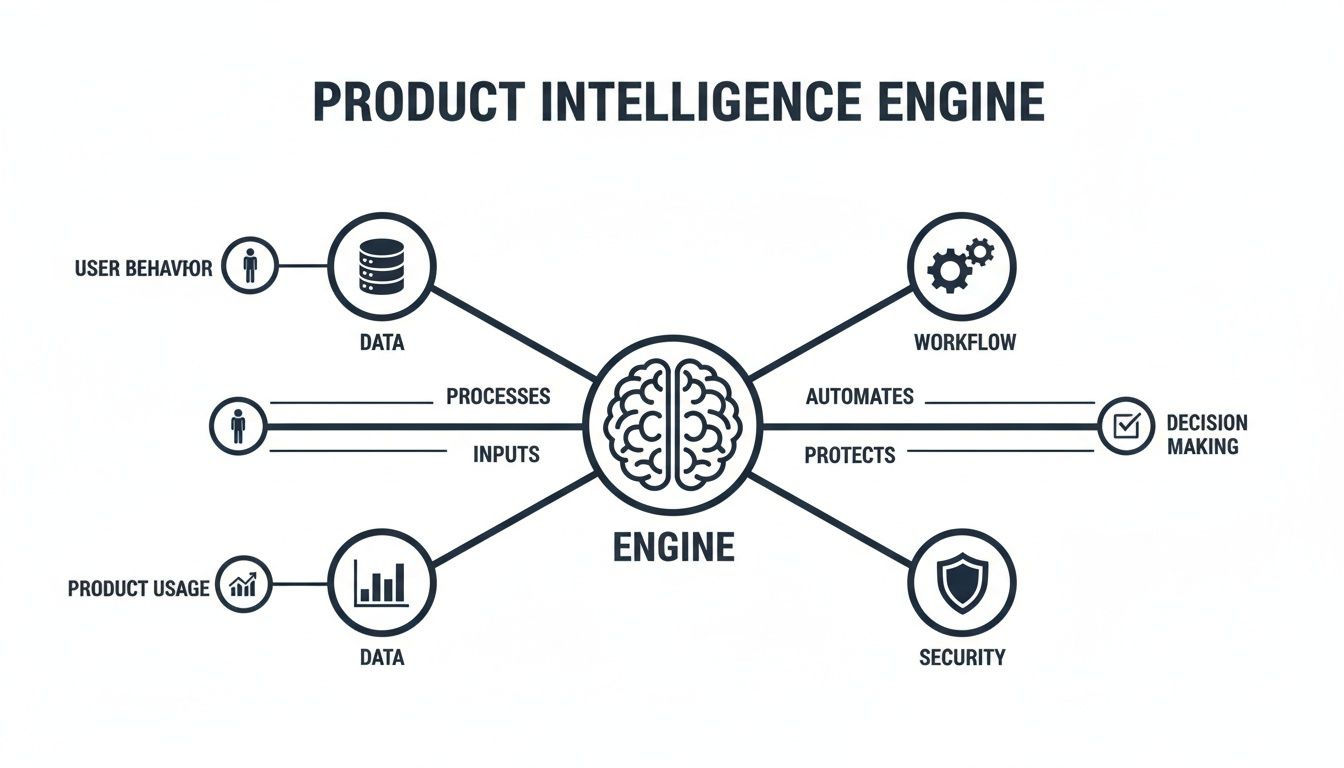
As you can see, a central engine that ingests data and automates processes has a direct impact on how efficiently your team operates.
Important efficiency metrics to track include:
- Time-to-Insight: How long does it take to go from a piece of raw customer feedback to a prioritized, revenue-scored ticket in Jira? AI should shrink that timeline from weeks or even months down to just a few hours.
- Reduction in Engineering Waste: Measure the decrease in time spent building features nobody wants or fixing issues that AI could have helped you prioritize correctly from the start. This shows you’re building the right things, not just more things.
Validating AI Model Performance
Finally, while business outcomes are the ultimate goal, you can’t ignore the engine under the hood. You have to make sure the AI models themselves are actually accurate and reliable. If the predictions are off, it's only a matter of time before your business metrics start to suffer.
Think of these metrics as a regular health check for your AI system. Correlation accuracy is a big one here. It measures how well the AI's predictions (like churn risk or potential feature revenue) actually match what happens in the real world.
A high accuracy rate, like the 87% we often see with a platform like SigOS, builds critical trust. It proves that the strategic decisions you're making are based on solid, dependable insights, giving you the confidence that your AI strategy is built to last.
Common AI Implementation Pitfalls to Avoid

Bringing AI into your product development process can feel like giving your team a superpower, but it's not a magic wand. Like any powerful tool, it comes with a learning curve and a few common traps that can easily trip you up if you're not prepared.
Successfully weaving AI into your workflow means knowing what these hurdles look like ahead of time. Getting the fundamentals right—from the data you use to how your team thinks about it—is what separates a game-changing investment from a frustrating distraction.
The Garbage In, Garbage Out Problem
There's an old saying in data science that's more relevant than ever with AI: "garbage in, garbage out." Simply put, your AI model is only as good as the data you feed it. If you train it on messy, incomplete, or biased information, you’ll get back insights that are just as messy and unreliable.
Think of it like trying to build a house on a foundation of sand. It doesn’t matter how well-designed your blueprint is; the whole structure is compromised from the start. AI models trained on junk data from a dozen disconnected systems will crank out flawed predictions, potentially sending your entire product strategy down the wrong path.
To sidestep this, you need to get serious about data hygiene. That means:
- Unified Data Sources: Pulling all your customer data from tools like Zendesk, Intercom, and Salesforce into one clean, consolidated view.
- Consistent Labeling: Making sure data is tagged and categorized the same way everywhere so the AI can actually spot meaningful patterns.
- Data Cleaning Processes: Setting up automated ways to find and fix duplicate records, correct errors, and fill in missing information.
A solid data foundation isn't just a nice-to-have; it's the absolute first step. To dig a little deeper, check out these data integration best practices that are essential for any AI project.
Over-Relying on AI Without Human Oversight
Another big mistake is thinking of AI as a magic black box that can completely replace human judgment. It can't. AI is a tool to augment your team's intelligence, not make them obsolete. Its real power is in finding signals and patterns in data at a scale no human ever could, but it still needs a human at the wheel to interpret those signals.
Your product managers and strategists bring context, gut feelings, and years of industry experience to the table—things an algorithm will never have. They understand the competitive landscape, the subtle nuances of your market, and the long-term vision for the product.
AI can tell you what is happening and even predict what might happen, but it can’t tell you why it matters for your business strategy. That critical step of connecting data-driven insights to strategic action remains a fundamentally human task.
Failing to Manage Organizational Change
Finally, the most sophisticated AI on the planet is completely useless if your team doesn't trust it or know what to do with its insights. Bringing AI into the mix is just as much a cultural shift as it is a technical one. If your team is used to making decisions based on their intuition and a handful of customer anecdotes, just throwing a new dashboard at them is a surefire way to see it ignored.
Getting your team on board requires a real change management plan. This means training people on how to read and question AI-driven recommendations and, more importantly, plugging those insights directly into the tools and routines they already use.
For instance, when an AI platform like SigOS automatically creates a Jira ticket and scores it with its predicted revenue impact, it closes the gap between insight and action. This makes the AI’s output feel tangible and practical, building the trust needed to make sure it actually gets used.
Time to Put Your AI Product Strategy to Work
We’ve covered a lot of ground—from turning customer feedback into a financial forecast to calculating the real ROI of your roadmap. We’ve even navigated the common traps that can derail an AI implementation. If there's one thing to take away, it's this: AI isn't some far-off concept anymore. It's a practical engine for SaaS growth that delivers real results today.
But success isn't automatic. It hinges on having the right approach and the right tools in your corner. It’s all about creating a smooth, repeatable process that turns raw customer feedback into development tickets your team can act on—tickets that are directly tied to revenue.
Your First Practical Steps
Getting started shouldn’t feel like a six-month science project. A platform like SigOS is built to show you its value right out of the box. Here’s a simple, three-step plan to get your own product intelligence engine humming:
- Connect the Tools You Already Use: First things first, you need to plug in your data. This just means connecting SigOS to the platforms you rely on every day, like Zendesk, Intercom, and Salesforce. This is where your best insights are hiding, and the process is quick, secure, and sets the stage for everything that follows.
- Get Your First Insight Dashboard: This isn’t a "check back in a few weeks" situation. Within hours, the AI is already at work, sifting through thousands of customer conversations to find meaningful patterns. It connects the dots between what customers are saying and your revenue data. Your first dashboard will shine a spotlight on the top issues costing you money and the feature requests with the highest potential for growth.
- Create Revenue-Scored Tickets: This is where the magic happens—turning insight into action. The platform connects directly with tools your engineers live in, like Jira or Linear. With just one click, you can push a new ticket that’s pre-filled with customer context and, crucially, a clear revenue score. This ensures your engineering team knows exactly what to prioritize for the biggest business impact.
Using AI in product development is about a fundamental shift in mindset. You stop building features you think customers want and start building what the data proves they need. Every engineering cycle starts to count toward a measurable outcome, whether that's cutting churn or driving new sales.
The whole journey starts with one simple but powerful step: seeing what the AI can find in your own data. Once you quantify the opportunities and risks buried in your customer conversations, you’ll have everything you need to build a rock-solid case for a smarter way of building products.
Ready to see what that ROI could look like for your business? Get a real-time analysis with SigOS today.
Got Questions About AI in Product Development?
Jumping into AI for product development is exciting, but it almost always brings up a few practical questions. Let's tackle some of the most common ones we hear from product teams. Getting these answers sorted out upfront is the best way to get everyone on the same page and set the stage for a smooth rollout.
How Long Until We See an ROI?
This is probably the biggest surprise for most teams. Unlike old-school software projects that drag on for months, you can see the first wave of value from an AI product intelligence platform incredibly fast.
With a tool like SigOS, for instance, you can connect your data sources—think Zendesk or Intercom—and have your first AI-powered insight dashboard ready within 24 to 48 hours. This isn't just a data dump; it's an immediate, clear picture of the biggest revenue blockers or the feature requests with the most growth potential. From there, you can start pushing revenue-scored tickets into your backlog almost right away. Your time-to-insight shrinks from months down to a matter of days.
Do We Need a Team of Data Scientists for This?
There's a persistent myth that you need a Ph.D. in machine learning to get any real value out of AI. That's just not true anymore. Modern platforms are built for product managers, founders, and growth leaders—not just engineers. The whole point is to put powerful insights in your hands without forcing you to write a single line of code or build a model from scratch.
Seriously, if your team can navigate tools like Jira, Slack, and your CRM, you have all the technical skills you need. All the heavy lifting, like cleaning up data, running the analysis, and keeping the models tuned, is handled behind the scenes. Your team gets to stay focused on what they do best: interpreting the insights and making smart, strategic calls.
How Does This Fit with the Tools We Already Use?
Integration isn't just a nice-to-have; it's everything. A good AI platform has to plug directly into the tools your team lives in every day. It becomes the connective tissue for your product feedback loop. Typically, this means connecting to:
- Where you hear from customers: Zendesk, Intercom, Salesforce, Gong
- Where you manage work: Jira, Linear, Asana
- Where you communicate: Slack, Microsoft Teams
Why is this so critical? Because it automates the entire workflow. An insight buried in a support ticket can instantly become a prioritized, revenue-scored task in Jira. This kills the manual copy-pasting and makes sure nothing important falls through the cracks.
The real magic happens when AI for product development works inside your team's existing flow. It shouldn't force you to change how you work; it should make your current processes smarter and faster. Data has to move seamlessly from where it's gathered to where decisions get made.
Ready to stop guessing and start quantifying the impact of your product decisions? SigOS connects directly to your existing tools to transform raw customer feedback into a revenue-driven roadmap. See how much churn you can prevent and which features to build next.
Keep Reading
More insights from our blog

Ready to find your hidden revenue leaks?
Start analyzing your customer feedback and discover insights that drive revenue.
Start Free Trial →