A Founder’s Guide to Growing ARR in SaaS
Master ARR in SaaS with our complete founder's guide. Learn to calculate, analyze, and strategically grow your Annual Recurring Revenue with proven expert tips.

When you run a SaaS company, you're constantly looking for a single, reliable number that tells you how you're really doing. That number is Annual Recurring Revenue (ARR).
So, what is it? Put simply, ARR is the predictable revenue your business can expect from all your active subscriptions over a one-year period. It’s a clean metric that intentionally ignores one-time fees, focusing purely on the contractually committed, recurring revenue that forms the backbone of your business.
Why ARR Is Your SaaS Company’s North Star Metric

Think about your personal finances for a moment. A one-off freelance project is great, but you can't build your life around it. Your annual salary, on the other hand, is the predictable income you use for budgeting, planning, and making big decisions.
That's exactly what ARR is for your SaaS company. It's your steady, reliable salary. One-time setup fees or professional services projects are like those freelance gigs—nice to have, but they don't tell you about the long-term health of your business. ARR does. It cuts through the noise and answers the most critical question: "How much recurring revenue can we confidently count on over the next 12 months?"
The Strategic Value of ARR
Once you have a firm grip on your ARR, you stop reacting and start planning. It turns your financial data from a rearview mirror into a GPS for the road ahead.
Here's why it's so powerful:
- Predictable Forecasting: ARR gives you a solid foundation for projecting future revenue and cash flow, making budgeting far more accurate.
- Informed Investments: A clear, growing ARR is the best justification for hiring another engineer, expanding the sales team, or doubling down on marketing.
- Investor Confidence: In the world of SaaS, ARR is the language investors speak. It’s the primary metric they use to gauge traction, validate your business model, and ultimately determine your company's valuation.
- Operational Alignment: When everyone from product to marketing to customer success is focused on growing ARR, the entire organization pulls in the same direction toward one clear, measurable goal.
The Core Forces Shaping Your ARR
At the end of the day, your ARR is a product of just three fundamental forces. Each one tells a crucial part of your growth story, and mastering all three is the key to building a powerhouse SaaS company.
The rest of this guide will dig into how to calculate, analyze, and grow your ARR by focusing on these key drivers:
- New Business: Acquiring brand-new customers on annual contracts.
- Expansion: Growing revenue from your existing customers through upgrades, add-ons, or cross-sells.
- Churn: Losing customers—and their recurring revenue.
Understanding how these three levers work together is the first step toward taking control of your company’s financial future.
How to Calculate Your ARR Correctly

When it comes to SaaS, getting your ARR calculation right isn't just a "nice-to-have"—it's non-negotiable. While the idea seems simple enough, the details matter. Botch the numbers, and you could end up with a flawed growth strategy, wildly inaccurate forecasts, and a serious blow to investor confidence.
Let's start with the most straightforward approach. If most of your customers are on monthly plans, you can get a quick snapshot of your Annual Recurring Revenue by simply annualizing your Monthly Recurring Revenue (MRR).
The formula is as clean as it gets: ARR = MRR x 12
So, if your MRR for June was 50,000, your estimated ARR would be ****600,000. This is a great back-of-the-napkin calculation for a quick health check, but it doesn't tell the whole story. It’s a still photo, not the complete motion picture of your company's momentum.
A More Comprehensive ARR Formula
To really get a feel for the pulse of your business, you need to break ARR down into its moving parts. This deeper view shows you exactly where your revenue is coming from. Are you crushing it with new sales? Are existing customers spending more? Or are you losing ground to churn?
This more detailed formula gives you that clarity: Ending ARR = Beginning ARR + New ARR + Expansion ARR - Churned ARR
Think of this as the story of your revenue over a set period, like a quarter or a year. Each component is a lever you can pull to steer your growth. Let’s break down what each one actually means for your business.
Defining the Core Components
To truly master ARR in SaaS, you have to understand what goes into the calculation. Each piece of the formula represents a different stage of your customer journey and a key indicator of your company's performance.
Let's put some real-world context to these terms.
- New ARR: This is the lifeblood of growth—all the annualized revenue you've generated from brand-new customers you signed during a specific period. If you close 10 new deals on a 1,200/year plan, you’ve just added ****12,000 in New ARR.
- Expansion ARR: Often called "upgrade ARR," this is the extra recurring revenue you earn from the customers you already have. It happens when they upgrade to a pricier plan, buy add-on features, or add more users. It’s proof that your product is delivering value.
- Churned ARR: This is the tough one. It’s the total annualized revenue you lose when customers cancel their subscriptions. This number directly reflects the financial hit from customer churn, and keeping it low is a top priority for any healthy SaaS business.
The Four Core Components of ARR Calculation
To really lock these concepts in, let’s look at a breakdown of the key elements that contribute to your final Annual Recurring Revenue calculation, with examples for each.
| Component | Description | Impact on ARR | Example |
|---|---|---|---|
| New ARR | Revenue from new customers acquired in a period. | Increases ARR | Signing 5 new clients at 2,000/year each adds 10,000. |
| Expansion ARR | Additional revenue from existing customers upgrading. | Increases ARR | An existing customer upgrades from a 5k to an 8k plan, adding $3,000. |
| Churned ARR | Revenue lost from customers who cancel their plans. | Decreases ARR | A client on a 10,000/year plan cancels, resulting in -10,000. |
Tracking these components separately is like giving your business a diagnostic check-up. For instance, if your New ARR is high but your Churned ARR is also climbing, you have a "leaky bucket" problem. You’re pouring new customers in the top, but they're draining out the bottom because of issues with your product, onboarding, or support.
Getting these details right isn't just about ARR; it’s a critical first step for accurately calculating customer lifetime value in SaaS, another metric that defines long-term success.
The Hidden Metrics That Fuel Your ARR Growth
While your final ARR number tells you the score at the end of the game, it doesn't show you the game-winning plays. Real, sustainable growth comes from obsessing over the metrics that work behind the scenes. Think of your ARR as a sophisticated control panel—knowing which levers to pull and when is the key to building momentum.
Your Monthly Recurring Revenue (MRR) is the engine that keeps your business running, but the real acceleration comes from mastering the dynamics of customer expansion and retention.
Expansion ARR: The Turbo Boost for Your Growth
We often think new customer acquisition is the only way to grow, but for mature SaaS businesses, the real power lies in Expansion ARR. This is the extra recurring revenue you generate from your existing customers through upsells, cross-sells, and add-ons. It's the turbo boost that propels you forward without the high cost of finding brand-new logos.
When a customer upgrades from a basic plan to a premium one or adds a new feature set, they're directly fueling your Expansion ARR. This metric is a fantastic indicator of product stickiness and customer happiness. It proves you're not just selling a tool; you're providing value that evolves with them, value they're happy to pay more for over time.
This isn't just a side project; it's becoming the main event. Customer expansion is now the dominant engine for SaaS growth once companies pass the 20 million ARR mark. On average, Expansion ARR contributes about 40% to total new ARR. As businesses scale, that number explodes: firms in the ****50 million to 100 million ARR range see expansion drive 58% of new ARR, and it climbs to a staggering 67% for companies over ****100 million. You can find more on these 2025 SaaS benchmarks and their implications.
Churned ARR: The Emergency Brake on Your Momentum
On the other hand, Churned ARR is the emergency brake that can bring your growth to a screeching halt. This is the annualized revenue you lose when customers cancel their subscriptions. High churn is a massive red flag that something is fundamentally broken—it could be a product-market fit issue, a clumsy onboarding process, or a failure to show your customers you're still valuable to them.
Even with a killer sales team bringing in New ARR, high churn creates a "leaky bucket" that makes growth feel impossible. You have to run twice as fast just to stay in the same place. This is why getting a handle on churn is every bit as critical as signing new deals.
Net Revenue Retention: The Ultimate Health Metric
So, how do you see the combined impact of expansion and churn? That’s where Net Revenue Retention (NRR) comes in. Also known as Net Dollar Retention, this metric calculates the percentage of revenue you've kept from a specific group of customers over a period, usually a year.
An NRR over 100% is the holy grail for SaaS. It means your Expansion ARR from existing customers is bigger than your Churned ARR. Put simply, your business would keep growing even if you didn't sign a single new customer.
Think of it like this:
- New ARR: The gas pedal for acquiring new customers.
- Expansion ARR: The turbo boost, getting more from the customers you already have.
- Churned ARR: The brake, slowing you down.
A high NRR shows investors and your board that you have a powerful and efficient growth model built on a solid foundation of customer loyalty. To really dig in and use these hidden metrics, you need strong Revenue Analytics to drive growth that turn raw data into a clear strategy. Mastering the interplay between these forces is what separates good SaaS companies from great ones, and it all starts with tracking the right customer retention metrics.
Common ARR Reporting Mistakes to Avoid
Getting your Annual Recurring Revenue reporting right isn't just an accounting exercise—it's about credibility. Botch the numbers, and you could mislead your team, build a strategy on a shaky foundation, and seriously erode investor confidence. The whole point of clean reporting is to stay laser-focused on what ARR actually measures: predictable, repeatable revenue.
Too many SaaS companies trip up by lumping in revenue sources that don't belong. These little mistakes add up, painting a picture of company health that's far rosier than reality. You have to draw a hard line between recurring and non-recurring income from the very beginning.
Mixing One-Time Fees with Recurring Revenue
The most common pitfall is adding one-time charges into the ARR calculation. Doing this instantly inflates your numbers and masks the true stability of your revenue. Think of ARR as your company's baseline salary; one-time fees are like a surprise bonus. They’re great to get, but you can't build your annual budget around them.
Here are the usual suspects you need to keep out of your ARR:
- Setup or Implementation Fees: These are charges for getting a customer up and running. By definition, they only happen once.
- Professional Services Contracts: Revenue from consulting gigs, custom development work, or training sessions isn't recurring. It needs its own line item.
- Usage-Based Overages: While these might happen often, they're too variable and unpredictable to be part of your core ARR figure.
This diagram shows how the right inputs—and only the right inputs—should influence your ARR.
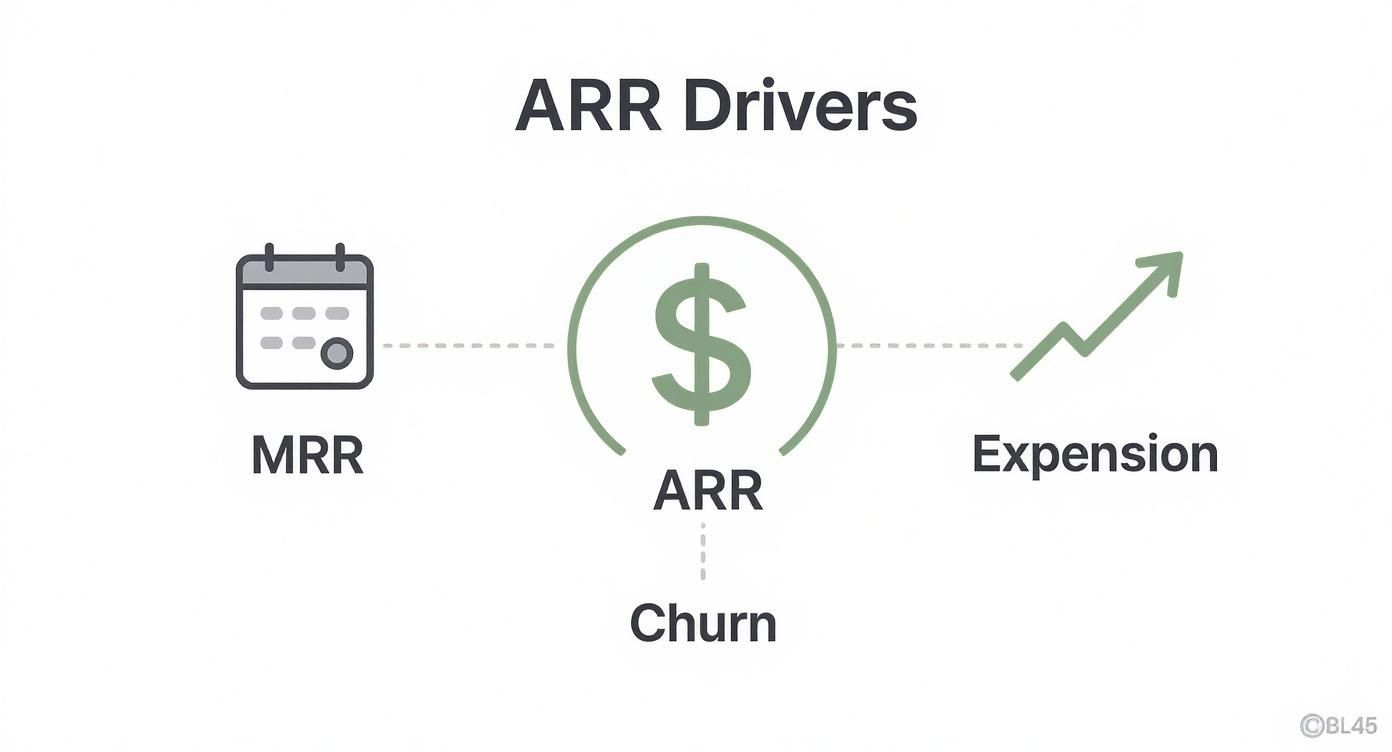
As you can see, ARR is the central outcome, directly fed by your monthly recurring revenue and expansion efforts, while churn constantly pulls it down.
Confusing Bookings with Recognized Revenue
Another massive blunder is treating bookings like they're the same thing as ARR. They aren't. These two terms represent completely different points in a customer's financial journey, and getting them mixed up is a serious reporting foul.
Let's break it down:
- Bookings: This is the total value of a new contract a customer signs. It’s a commitment to pay you over the full term. For instance, if you sign a customer to a two-year deal worth 24,000, you have a ****24,000 booking.
- ARR: This is the portion of that booking that you recognize as recurring revenue on an annual basis. For that same 24,000 two-year contract, the ARR is ****12,000.
Bookings are a fantastic forward-looking indicator of sales momentum and future cash. It tells you how much business the sales team is closing. But ARR is the standardized, annualized measure of your subscription revenue right now.
Reporting a 24,000 booking as ****24,000 in New ARR effectively doubles the real recurring value of that deal, which will throw all of your growth projections out of whack.
Keeping this distinction crystal clear is fundamental to trustworthy financial reporting. It ensures your big strategic decisions are based on the actual, predictable revenue you can expect each year, not just on contractual promises. Steering clear of these common mistakes builds a foundation of financial integrity that will support real, sustainable growth.
Actionable Strategies to Increase Your SaaS ARR

Knowing your Annual Recurring Revenue is the starting line. Actually growing it? That’s the real race. Increasing your ARR in SaaS isn't about finding a single silver bullet. It’s a deliberate, multi-pronged effort focused on three core pillars: acquiring new customers, expanding revenue from your current ones, and keeping them around for the long haul.
When you get these three areas right, ARR stops being a passive metric you report on and becomes an active goal your whole team can rally behind. Each pillar needs its own playbook, but they all work together to build a powerful, sustainable growth engine.
Master Customer Acquisition and Monetization
Bringing new customers in the door is the most obvious path to growing ARR. But a smart acquisition strategy is about more than just closing deals. It’s about optimizing your pricing and packaging to capture the most value from day one while attracting the right kind of customer.
Your pricing tiers are a great place to start. They need to align directly with the value customers get from your product.
- Value-Based Tiers: Don't just gate features. Structure your plans around specific outcomes that solve progressively bigger problems. This gives customers a natural ladder to climb as they grow.
- Targeted Packaging: A scrappy startup has wildly different needs than a global enterprise. Your packages should reflect that, speaking directly to the pain points of each persona.
- Strategic Freemium or Trials: A free plan shouldn't just be a user magnet; it should be a qualifier. A well-designed trial proves your product's core value and creates a compelling reason to pull out a credit card.
This approach is fundamental to a solid go-to-market motion. For a deeper look at using your product to drive growth, you should read more about the principles of product-led growth.
Drive Expansion Revenue from Existing Accounts
Honestly, your current customer base is a goldmine for ARR growth. It’s almost always cheaper and faster to generate more revenue from happy customers than it is to land new ones. This is where a laser focus on Expansion ARR pays off big time.
Look for the tell-tale signs in product usage that a customer is outgrowing their current plan. Platforms like SigOS are built for this, analyzing user behavior to automatically pinpoint these critical moments.
- Identify Power Users: Find the customers who are constantly bumping up against usage limits or living in your advanced features. They are your prime candidates for an upgrade.
- Monitor Feature Adoption: See which customer segments are adopting new features first. This can reveal clear opportunities to cross-sell complementary products or add-on modules.
- Automate Upgrade Prompts: Trigger in-app messages or targeted emails the moment a user’s behavior shows they’d get more value from a higher-tier plan.
By proactively spotting these expansion signals, you can guide customers toward greater success while boosting your own ARR.
Proactively Reduce Customer Churn
Every single customer you lose is a direct hit to your ARR. That makes reducing churn one of the most efficient ways to protect and grow your recurring revenue. The best retention strategies are proactive, not reactive—you have to spot at-risk customers before they've mentally checked out.
This means looking beyond surveys and support tickets. You need to understand the subtle behavioral cues that scream "churn risk."
- Declining Engagement: A sudden drop-off in how often a team logs in or uses key features is a massive red flag.
- Unresolved Issues: A spike in support tickets or consistently negative feedback from one account points to growing frustration.
- Product Friction: If users are constantly getting stuck in a specific workflow or fumbling with a feature, their patience is wearing thin.
Modern tools are essential for this level of analysis. For example, SigOS connects qualitative feedback from support chats and sales calls with hard, quantitative usage data. It uncovers the behavior patterns that correlate with churn, empowering your customer success teams to step in with the right support at the right time.
By prioritizing fixes for bugs that have the biggest revenue impact and smoothing out friction points for at-risk accounts, you turn customer support from a cost center into a powerful retention machine. This relentless focus on keeping the customers you’ve worked so hard to win is what makes sure your acquisition efforts translate into real, long-term ARR growth.
How Your ARR Stacks Up Against Industry Benchmarks
Knowing your Annual Recurring Revenue is only half the battle. The real question that keeps founders up at night is, "Is our growth healthy?" You could be doubling your ARR year-over-year, but if you're burning through cash unsustainably, that growth is just an illusion. This is where industry benchmarks come in.
Without comparing your numbers to similar companies, you're flying blind. You have no way of knowing if you're over-hiring, underperforming on sales, or actually running a lean, efficient growth machine. Benchmarking is what turns your raw data from a simple number into a powerful strategic tool.
The Power of ARR per Employee
One of the most revealing efficiency metrics for any SaaS business is ARR per Full-Time Employee (FTE). This simple calculation cuts straight to the heart of your company's scalability. It tells you how much recurring revenue each person on your team is generating, answering the most vital question: "Are we building a sustainable business or just adding headcount?"
A low ARR per FTE might signal that you’ve hired ahead of revenue—a common trap for venture-backed startups chasing aggressive growth targets. On the flip side, a high number suggests you're running a lean, capital-efficient operation. Tracking this metric as you scale is absolutely critical for maintaining healthy unit economics.
By measuring ARR per FTE, you get a clear, unbiased view of your team's productivity and your business model's efficiency. It’s a powerful health check that reveals whether your growth is driven by genuine value or simply by spending more.
Benchmarking by Company Size
As your company grows, so too should its efficiency. The ARR per FTE metric has become a go-to benchmark for SaaS companies trying to navigate different growth stages.
Recent data shows that companies in the 50 million to ****100 million ARR range report a median ARR per FTE of around 200,000. But once a company crosses the ****100 million ARR mark, that metric jumps significantly to approximately $300,000 per FTE.
Interestingly, top-performing companies are pushing these numbers even higher, and faster. The best companies with 20-50 million ARR have elevated their median ARR per FTE by an impressive 42% to about ****350,000, setting a new standard for operational excellence. You can dig into more data on these 2025 SaaS benchmarks to see how different segments perform.
Comparing your own ARR per FTE to these figures gives you an immediate sense of where you stand.
- Are you below the median for your size? It might be time to take a hard look at your hiring pace and operational costs.
- Are you above the median? This is a strong signal that you've built a scalable model—the kind that investors love to see.
Ultimately, these benchmarks aren't just numbers on a page; they're guideposts. They help you make smarter decisions about hiring, spending, and strategy, ensuring that as your ARR grows, your business becomes stronger, not just bigger.
Got Questions About ARR? We've Got Answers.
As we wrap up, let's tackle a few of the most common questions that pop up when founders, investors, and SaaS operators talk about Annual Recurring Revenue. These are the details that often trip people up, so getting them straight is key.
What’s the Real Difference Between ARR and Revenue?
Think of it this way: ARR is the steady, predictable heartbeat of your subscription business. Total revenue, on the other hand, is the full story of every single dollar that comes through the door.
ARR zeroes in only on the annualized value of your recurring subscription contracts. It’s pure, predictable income.
Total revenue, however, is a much broader bucket that includes:
- Your ARR from subscriptions
- One-time setup fees or onboarding charges
- Any professional services or consulting gigs
- All other non-recurring payments
By isolating that stable, repeatable income stream, ARR gives you the clearest possible metric for forecasting and valuation. It’s the number that truly shows the health and momentum of your core business.
How Should I Calculate ARR for Multi-Year Contracts?
This is a classic pitfall, and it's absolutely critical to get right. When a customer signs a multi-year deal, you only count one year's worth of value in your ARR calculation.
Let’s say you land a fantastic three-year contract worth 36,000. The total contract value (TCV) is indeed ****36,000. But the ARR from that deal is only $12,000.
If you were to report the full $36,000 as New ARR, you’d be inflating your recurring revenue by 3x and giving a completely misleading picture of your annual growth.
When Should a Startup Start Tracking ARR?
The short answer? As soon as you have customers on annual or multi-year plans.
Even if you’re an early-stage company focused on Monthly Recurring Revenue (MRR) because most of your customers pay month-to-month, it's smart to build the habit of tracking ARR early on. Why? Because the moment you start talking to investors, ARR becomes the universal language. It’s the gold-standard metric they use to evaluate a SaaS company’s performance and nail down a valuation.
Stop guessing which product improvements will grow your revenue. SigOS analyzes customer behavior and feedback to show you exactly which bugs are causing churn and which feature requests will unlock major expansion opportunities. Prioritize your roadmap with revenue-impact data.
Keep Reading
More insights from our blog

Ready to find your hidden revenue leaks?
Start analyzing your customer feedback and discover insights that drive revenue.
Start Free Trial →