Cross Functional Alignment: A Practical Playbook for 2026
Cross functional alignment made practical. Learn frameworks, KPIs, governance rituals and AI signals that turn shared goals into measurable revenue outcomes.
By 9:07 on Monday, three teams can be working hard on the same business and still be pulling it in different directions. Product is protecting a reliability commitment, sales is chasing a competitive deal, support is trying to keep an at-risk customer from leaving, and engineering is calculating what can be delivered without destabilizing the release. Nobody is being irrational. The operating system is.
Cross functional alignment fixes that operating system. It turns competing departmental priorities into a measurable decision process built around shared goals, shared decision rights, and shared evidence. The payoff isn't a nicer meeting calendar. It's faster execution, clearer portfolio choices, and fewer revenue leaks caused by work that looked important inside one function but wasn't important to the business.
The Monday Morning Where Everything Was Already Off Track
The Monday standup starts with Product presenting a Q3 reliability push. Recent incidents have consumed engineering attention, customers are noticing slower workflows, and the product manager has a clear argument for reducing feature work until the core experience is more dependable.
Support interrupts with a different emergency. Several important accounts are blocked by a known billing bug. The issue has been appearing in tickets, and support leaders want a fix before those customers escalate or reconsider renewal. Their request isn't theoretical. They're dealing with the consequences in live conversations.
Then Sales brings up the feature demonstrated to a prospect last Thursday. The prospect wants a competitive capability before signing, and the account executive has already positioned the roadmap as responsive. Sales wants a commitment. Product sees another interruption. Engineering sees another dependency entering an already crowded queue.
Each team has optimized for a legitimate outcome:
- Product wants a roadmap that improves the product's long-term health.
- Support wants to remove friction that threatens customer trust.
- Sales wants to convert a live opportunity while momentum exists.
- Engineering wants to protect system stability and avoid expensive rework.
The meeting ends with a compromise. Engineering takes the billing bug, Product keeps part of the reliability initiative, and Sales receives a tentative roadmap statement. Nobody can explain which business result justifies the trade-off, who has final authority, or what gets delayed as a consequence.
The leadership question: Who owns the trade-off when every function has a defensible priority?
That question is the beginning of alignment. Without an explicit answer, the loudest stakeholder, the most recent escalation, or the person with the strongest executive relationship wins. The company calls this prioritization, but it's really a sequence of local negotiations.
Cross functional alignment gives those negotiations a shared operating logic. It doesn't eliminate disagreement. It makes disagreement productive by connecting it to customer impact, revenue exposure, delivery capacity, and a named decision owner.
What Cross Functional Alignment Actually Means
Cross functional alignment isn't everyone agreeing all the time. A sports team can disagree about a play and still execute because players understand the objective, their roles, and who calls the adjustment. A kitchen during service works the same way. The chef, expeditor, and line cooks don't need identical perspectives, but they need shared timing and clear handoffs. A trading desk adds the final piece, with decisions based on the same market data rather than separate interpretations of filtered reports.
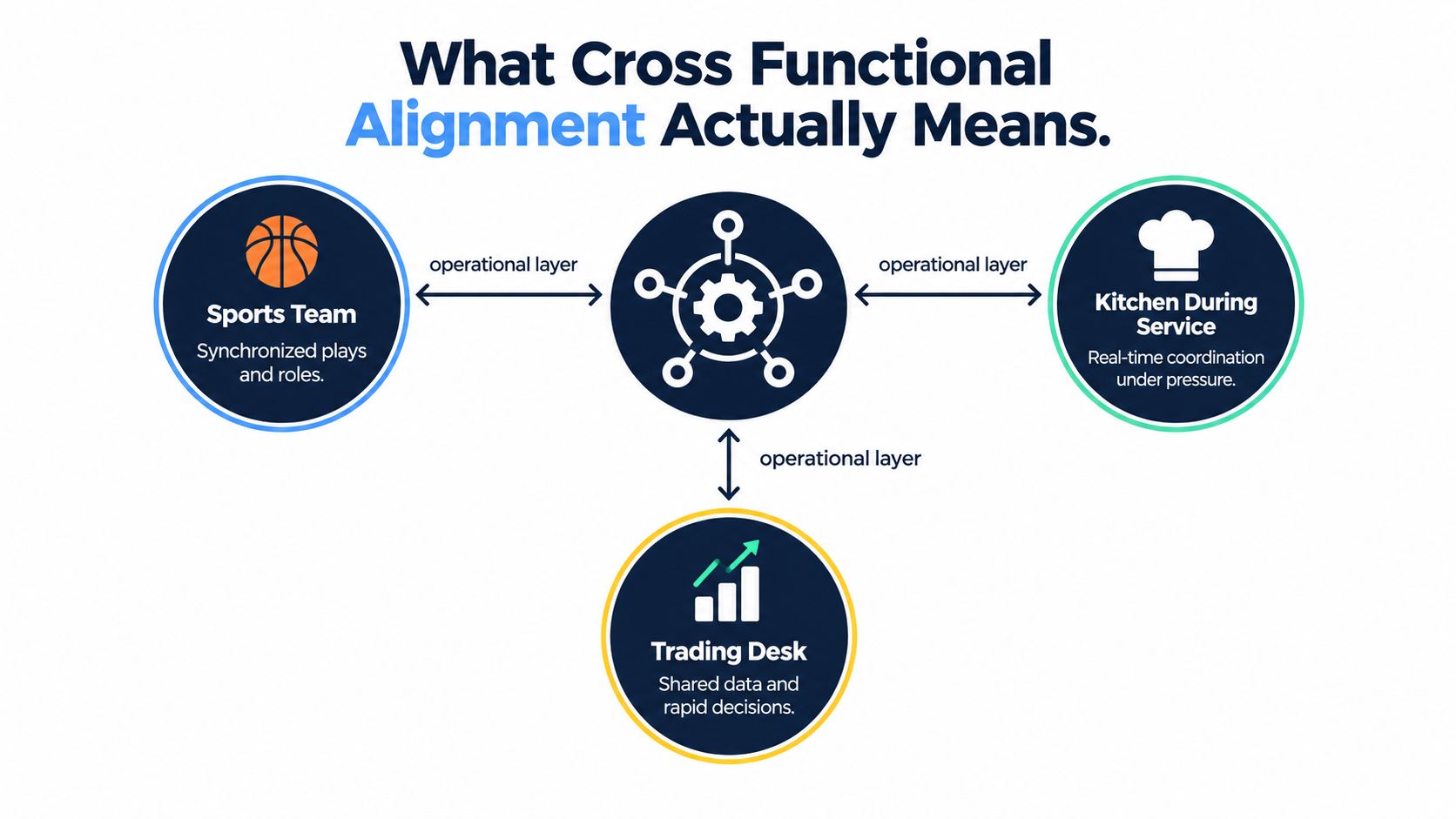
Use three operational layers to diagnose your organization.
Shared goals
Teams need one business outcome that outranks their departmental scorecards. “Improve customer experience” is too vague. A useful goal connects the work to a result such as protecting retention, increasing expansion, or accelerating delivery of a strategic initiative.
Shared goals don't require identical KPIs. Support can still track resolution quality, and engineering can still track reliability. The difference is that those measures support a common outcome rather than competing with it.
Shared decisions
A goal without decision rights creates polite paralysis. Every revenue-critical initiative needs one accountable owner with authority to resolve scope, sequencing, and resource conflicts. Consulted teams should influence the decision, but they shouldn't be able to reopen it indefinitely.
Use the same discipline in handoffs. Define who supplies the input, who validates it, who decides, and who receives the result. For a practical introduction to the broader concept, this simple guide to alignment provides useful context on how shared direction becomes an operating practice.
Shared signals
Most companies fail here. Leaders publish common objectives, then let Product, Sales, Support, and Customer Success work from different customer evidence. One group reads ticket volume, another reads call notes, another reads usage, and another reads pipeline pressure.
Ask yourself:
- Can every function see the same evidence behind a priority?
- Does every major decision have one accountable owner?
- Can you trace a team's work to a business outcome?
- Do your metrics expose trade-offs, or hide them inside departmental dashboards?
If the answer to the first question is no, fix signal parity before adding another alignment meeting.
The Business Impact That Gets Misalignment Budget
Executives rarely fund alignment because collaboration feels uncomfortable. They fund it when the connection to revenue and execution is clear. The strongest business case usually sits in three places: net revenue churn, expansion attach rate, and delivery lead time for strategic initiatives.
Misalignment affects all three. Product may delay a defect that threatens renewal because a feature has stronger internal visibility. Sales may promise a capability that Customer Success can't support. Engineering may rebuild work after requirements change late in the cycle. Each incident looks isolated. Together, they create a revenue leak and slow the initiatives intended to produce growth.
Research supports treating alignment as an operating variable rather than a culture slogan. A multi-country review found that stronger alignment between manufacturing and business strategy was associated with better firm performance and a larger incremental contribution from manufacturing to performance, supporting the broader principle that strategy, structure, and decision rights must reinforce one another (review of manufacturing and business strategy alignment).
A 2011 study across 232 firms found that cross-functional collaboration had a stronger relationship with product novelty when decision autonomy, shared responsibility, social interaction, trust, and goal congruence were higher, and concluded that relational context mattered more than structural context in converting collaboration into innovation (study of cross-functional collaboration and product innovativeness).
The financial model below illustrates how to frame the problem without pretending every company has the same exposure. It uses the scenario specified for this analysis, not a reported company result.
| Alignment Failure | Metric Affected | Estimated Annual Impact |
|---|---|---|
| Renewal-risk defects wait behind lower-impact roadmap work | Net revenue retention | A 40M ARR SaaS company losing 2 points of net retention would forfeit roughly 800K in annual recurring revenue per cohort |
| Sales requests aren't connected to product and customer evidence | Expansion attach rate | Expansion opportunities can slip when teams can't agree which product gaps matter most |
| Repeated reprioritization creates late requirements and rework | Strategic delivery lead time | Strategic initiatives take longer when teams resolve trade-offs after work has already started |
Use your own finance definitions and customer data to replace the qualitative rows. A useful business impact metrics framework can help connect product and customer signals to the measures executives already defend in planning reviews.
Why Alignment Quietly Breaks in High Growth Teams
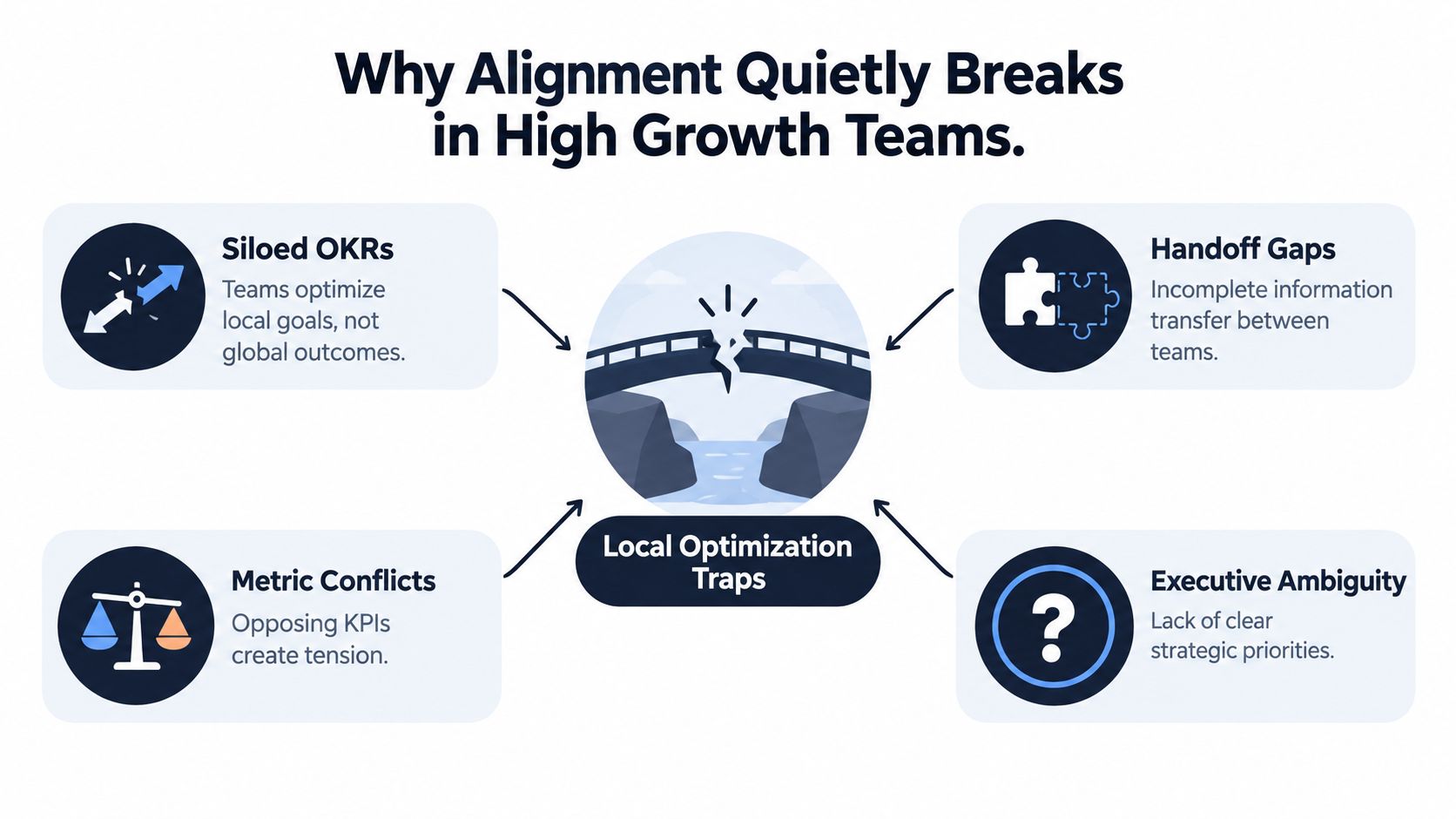
A growth team can leave Monday's planning meeting with four “top” priorities and still have no shared rule for choosing between them. That is how alignment fails. Good intentions remain intact, while revenue signals, customer evidence, and execution decisions split across functions.
The root cause is local optimization traps. As headcount increases, context that once moved through a few conversations gets locked inside specialist teams. New dashboards and handoffs then measure activity by function rather than whether the business is solving the right customer problem.
Siloed OKRs
Product tracks shipping velocity while Support tracks ticket closure. Both teams can meet their goals while customers face the same unresolved issue. Neither scorecard measures the complete customer outcome, so the conflict stays invisible until retention or expansion suffers.
Handoff gaps
Sales captures a request in a call note. Customer Success hears a different version during onboarding. Product receives a summarized ticket without account context. By planning time, the evidence needed to judge urgency, revenue exposure, and customer impact has been removed.
Metric conflicts
Sales prioritizes net-new bookings while Customer Success prioritizes retention. Engineering protects uptime while Marketing promotes workflows that increase system demand. The functions may share the company's goals, but their measurements can reward decisions that create friction for another team.
Executive ambiguity
Leadership announces several priorities without ranking them. Teams infer the order from funding, escalation behavior, or the latest executive comment. The roadmap fills with commitments, yet no dependable rule determines what gives way when capacity, evidence, or customer needs change.
More communication will not repair these failures by itself. Research found that stronger functional subgroup differentiation can support greater cross-functional synthesis with relatively less communication, challenging the habit of prescribing more meetings as the universal fix (research on subgroup differentiation and cross-functional synthesis).
The operating answer is deliberate integration. Let functions build expertise independently, then require a shared signal for ranking work and resolving trade-offs. Product intelligence can connect customer evidence, revenue exposure, and execution constraints, replacing subjective prioritization with a decision system the whole business can inspect.
A Governance Layer That Holds Without Bureaucracy
Governance becomes wasteful when it records activity instead of producing decisions. Keep the layer small. Anchor it to one business outcome, assign one accountable owner, and require every recurring ritual to create an artifact someone will use.
The minimum cast is straightforward:
- Accountable initiative owner: One person owns the revenue-critical outcome and resolves trade-offs.
- Decision logger: Rotate this responsibility so decisions, rationale, owner, and follow-up date don't disappear into meeting notes.
- Functional representatives: Product, Engineering, Sales, Customer Success, and Support bring evidence and constraints, not vetoes without an alternative.
Three rituals are enough:
- Weekly cross-functional triage: Rank new signals, decide what enters the active queue, and publish the decision log.
- Monthly metric review: Inspect the shared outcome and supporting measures, then identify which assumption or dependency changed.
- Quarterly objective reset: Confirm the business priority, retire work that no longer supports it, and record cross-functional commitments.
| Layer | Element | Owner | Output | Cadence |
|---|---|---|---|---|
| Direction | Shared business outcome | Executive sponsor | One ranked objective | Quarterly |
| Decisions | Initiative trade-offs | Accountable owner | Decision record | Weekly |
| Evidence | Common metrics and definitions | Metric owner | Reviewed scorecard | Monthly |
| Handoffs | Narrow RACI assignments | Functional leads | Named responsibility map | At planning and change points |
| Learning | Ritual and outcome audit | Operations lead | Keep, change, or kill recommendation | Quarterly |
Use RACI narrowly. It should clarify a cross-team handoff, such as who provides usage evidence, who validates account context, and who approves a roadmap change. It shouldn't become a sprawling project plan that everyone updates and nobody reads.
Write OKRs with dependency keys. If Product's objective depends on Support tagging a recurring issue or Sales supplying deal context, name that dependency in the objective. Teams can then expose blockers before the quarterly review instead of hiding them until delivery slips.
Operating rule: If a ritual has no output owner, no logged decision, and no metric it can move, kill it.
A lightweight decision log template can keep this system practical. The tool matters less than the discipline. Every meeting must earn its place by reducing uncertainty or committing the organization to a choice.
How Product Intelligence Creates One Shared Signal
Dashboards show what happened. Product intelligence helps teams decide what deserves attention next. That distinction matters because cross functional alignment breaks when each function brings a different interpretation of the customer to the same prioritization meeting.
An AI-driven product intelligence platform such as SigOS can combine support tickets, chat transcripts, sales calls, usage metrics, and other feedback sources into a ranked view of product and revenue signals. The objective isn't to replace judgment. It's to give judgment a common starting point.
Start with ingestion, not opinion
Connect the systems where customer evidence already exists. Support may work in Zendesk or Intercom, Sales may capture context in Salesforce, and Product or Engineering may manage work in Linear, Jira, or GitHub. A shared signal begins by bringing those fragments into one analytical layer.
The system then needs to remove duplication. Ten customers describing the same billing problem shouldn't appear as ten unrelated requests. Deduplication groups overlapping complaints so the organization sees the underlying issue rather than the number of channels through which it arrived.
Score the evidence against business exposure
Volume alone is a weak prioritization method. A frequently mentioned cosmetic issue may matter less than a less common defect affecting a strategically important account. Score signals against account value, churn risk, usage behavior, expansion potential, and delivery context.
The output should be a ranked set of opportunities and risks, not another passive dashboard. Product can evaluate a roadmap slot against revenue at risk. Customer Success can identify an expansion conversation using the same evidence. Sales can see whether a requested capability reflects one prospect's preference or a recurring market pattern.
The mechanics are worth making explicit:
- Collect: Ingest qualitative feedback and behavioral data from connected systems.
- Normalize: Resolve duplicate accounts, products, terms, and issue descriptions.
- Detect: Identify recurring patterns and changes in customer behavior.
- Prioritize: Rank issues and requests against business impact.
- Activate: Create the next action in the team's existing workflow.
A useful explanation of how this differs from ordinary reporting appears in this guide to signal detection. The key distinction is actionability. A dashboard asks someone to interpret a view. Intelligence ranks the evidence and points toward a decision.
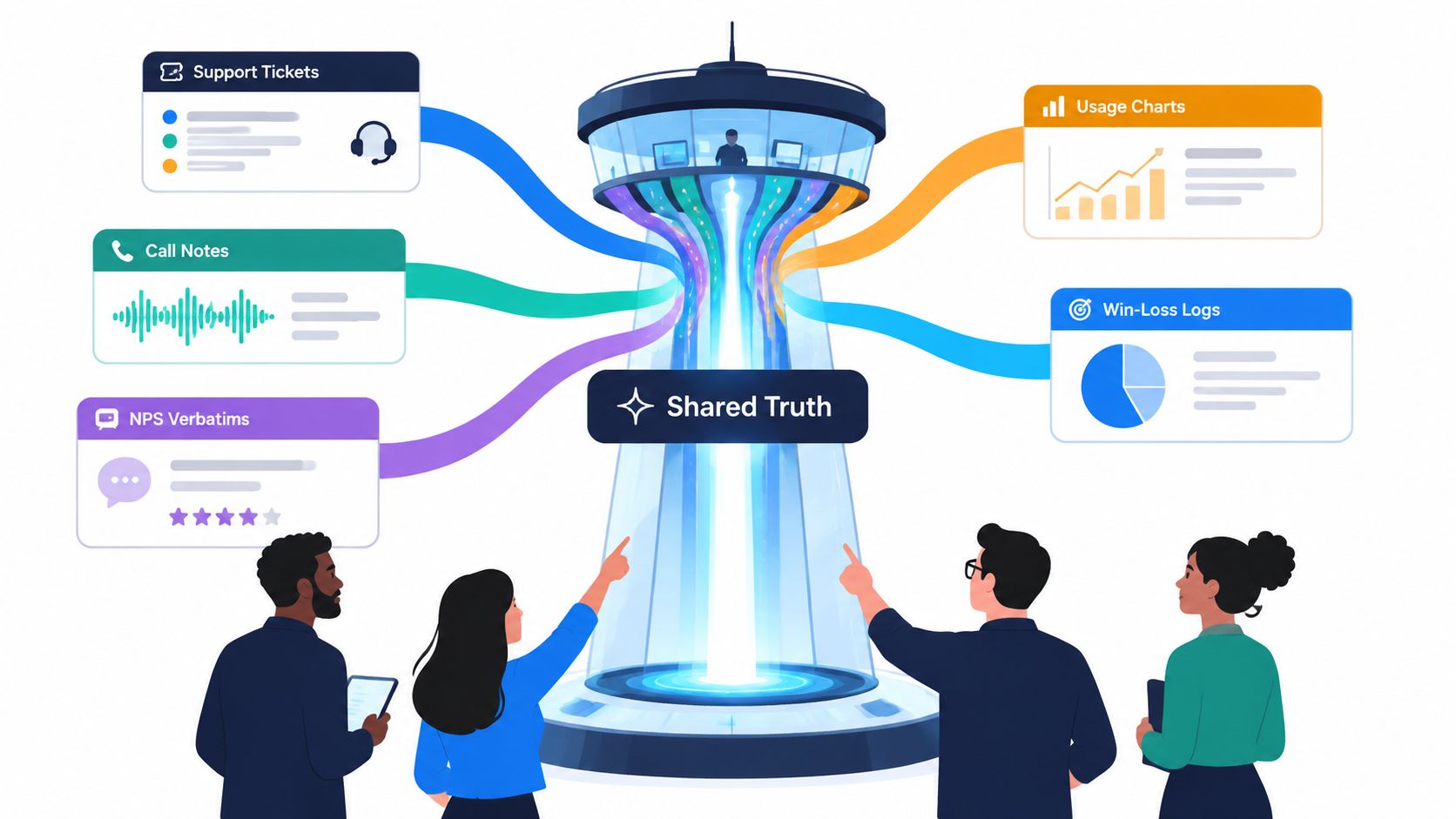
The shared signal also changes meeting behavior. Teams stop arguing over whose anecdote is more representative and start debating the scoring model, data quality, and business trade-off. Those are healthier disagreements because they can be inspected, corrected, and recorded.
AI introduces a new alignment layer, but governance still matters. A 2026 survey of 505 recruiting leaders and hiring managers found that teams where AI was core were 3.8x more likely to rate cross-functional relationships as excellent, while 68% of AI-core teams started searches with high alignment compared with 49% of non-AI teams (2026 AI hiring alignment survey). The implication for product organizations is useful but limited. AI may improve the starting signal, yet leaders still need shared definitions, accountable owners, and a process for challenging recommendations.
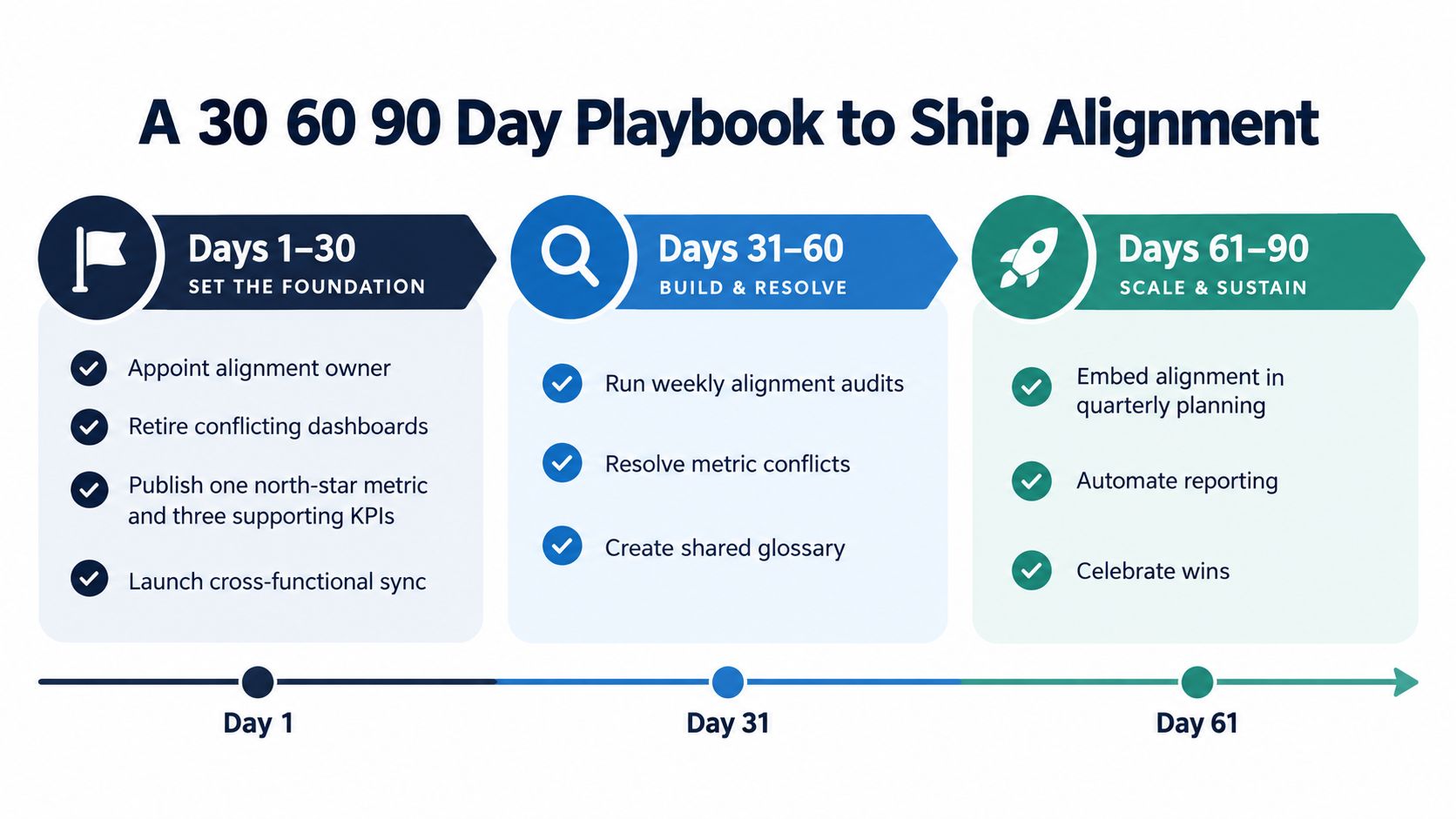
A 30 60 90 Day Playbook to Ship Alignment
Alignment doesn't need a transformation program. It needs a sequence that changes decisions before the organization loses patience.
Days 1 to 30
The executive sponsor appoints one alignment owner. That person inventories active dashboards, retires conflicting views, and publishes one north-star metric with three supporting KPIs. The Product, Customer Success, Sales, and Support leads then launch a weekly business review focused on decisions, not status updates.
The first month should produce three artifacts:
- One metric glossary: Define the business outcome, supporting measures, ownership, and source of truth.
- One priority queue: Rank active risks and opportunities against the shared outcome.
- One decision log: Record what changed, who decided, why, and what work moved as a result.
Days 31 to 60
Functional leads wire narrow RACI assignments into planning. Each strategic initiative gets an accountable owner and explicit dependency keys. Replace feature debates with revenue-impact scoring from product intelligence, then review the scoring logic when teams find missing context or misleading inputs.
Run a weekly alignment audit with three questions:
- Which decision took too long?
- Which handoff lacked the information needed to act?
- Which metric encouraged a locally efficient but globally harmful choice?
At the quarterly checkpoint, each function commits to the dependencies it controls. A Customer Success commitment might involve structured account context. A Sales commitment might involve consistent win-loss evidence. An Engineering commitment might involve making delivery constraints visible before roadmap approval.
Days 61 to 90
Audit every ritual. Keep only the meetings that change the north-star metric, improve decision cycle time, or remove a recurring dependency. Codify the operating cadence in a one-page playbook that names attendees, inputs, decision rights, outputs, and escalation rules.
Measure the time from signal to shipped decision. Don't treat speed as the only goal. A fast decision based on poor evidence creates faster rework. Pair cycle time with decision quality, customer impact, and whether the chosen work addressed the signal that triggered it.
Print this checklist for the next planning cycle:
- Ownership: One accountable owner exists for every revenue-critical initiative.
- Metrics: One north-star metric and three supporting KPIs are defined.
- Evidence: Product, Sales, Support, and Customer Success can inspect the same signal.
- Decisions: Trade-offs are logged with rationale and follow-up ownership.
- Dependencies: Cross-functional handoffs have narrow RACI assignments.
- Cadence: Weekly, monthly, and quarterly rituals each produce a named output.
- Quality: The team reviews whether decisions improved the intended business outcome.
A 2026 global survey of 667 planning and PMO leaders across 43 countries found that 27% identified cross-functional alignment as their top improvement area, while 90% said their organizations encouraged adaptability and alignment, revealing a gap between declared intent and operating reality (2026 planning and PMO alignment survey). Close that gap by changing the evidence and decision system, not by adding another slogan.
SigOS connects customer feedback, product usage, and revenue context to help teams identify ranked signals and coordinate action across their existing workflows. Visit SigOS to see how product intelligence can give Product, Support, Customer Success, Sales, and Engineering one evidence base for cross functional alignment.
Keep Reading
More insights from our blog



Ready to find your hidden revenue leaks?
Start analyzing your customer feedback and discover insights that drive revenue.
Start Free Trial →