Customer Behavior Modeling: A Practical SaaS Guide
A practical guide to customer behavior modeling for SaaS. Learn techniques, data sources, implementation steps, and ROI to reduce churn and drive growth.

Most SaaS teams start customer behavior work the same way. Support says churn is coming from bugs. Product says adoption is the issue. Growth says the onboarding emails need work. Sales says pricing objections are getting worse. Everyone has evidence. Nobody has a model that connects those signals into a single view of what customers are likely to do next.
That's where customer behavior modeling becomes useful. Not as a data science side project, and not as a dashboard nobody trusts, but as an operating system for decisions. When it's built well, it tells you which accounts are drifting, which users are ready to expand, which product frictions are expensive, and which signals matter more than raw activity.
The deeper payoff is strategic. Most companies stop at churn prediction. The more valuable layer is understanding when behavior is being driven by trust, perceived fairness, and uncertainty. In SaaS, those factors often decide whether a customer becomes durable revenue or silent risk.
What Customer Behavior Modeling Really Means
A familiar pattern shows up in product reviews. One segment asks for more functionality. Another complains the product is too complex. Customer success flags accounts with heavy support volume, but some of those accounts renew and some don't. If you only look at raw counts, the story stays messy.
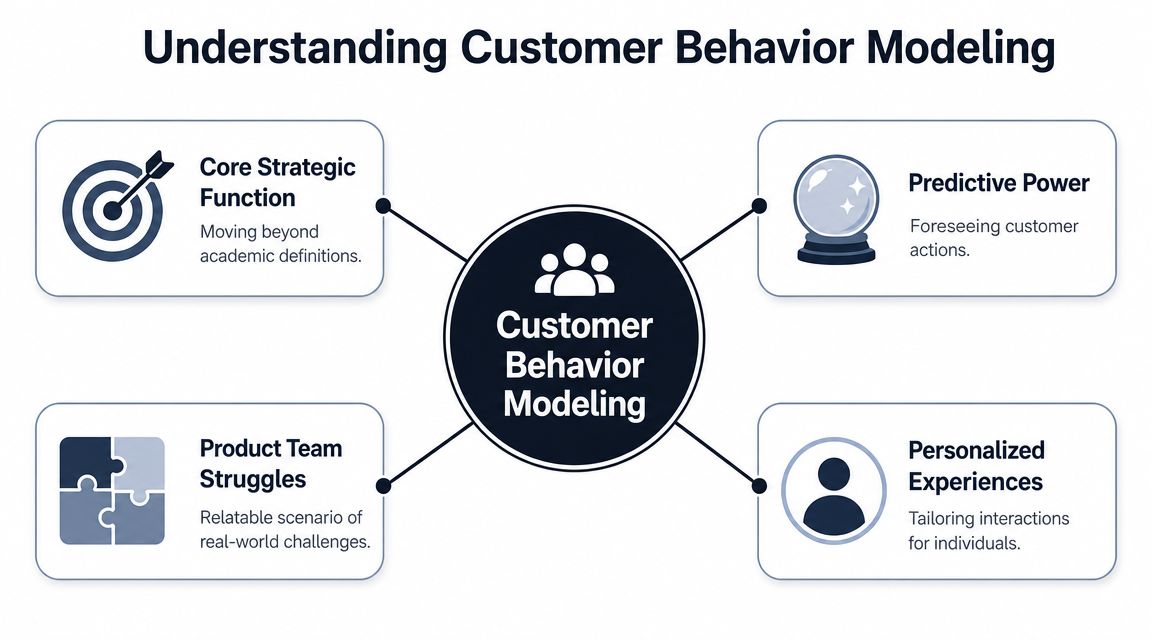
Customer behavior modeling is the discipline of turning that mess into a usable forecast. A widely used definition describes it as “the creation of a mathematical construct” that represents common behaviors so firms can predict how similar customers will act under similar circumstances, as explained in Optimove's overview of customer behavior modeling.
It's a forecast, not a report
The easiest way to explain it is with a weather forecast. A report tells you it rained yesterday. A forecast tells you whether to carry an umbrella this afternoon. Customer behavior modeling works the same way. It uses historical patterns to estimate what customers are likely to do next, such as renew, expand, disengage, or stall.
That distinction matters because many teams still confuse analytics with modeling. Analytics explains what happened. Modeling helps teams act before the outcome lands in finance.
Practical rule: If your output doesn't change what product, growth, or customer success does this week, you built reporting, not customer behavior modeling.
The model is only as good as the business question
In SaaS, the useful questions are concrete:
- Retention questions: Which accounts show signs of avoidable churn?
- Growth questions: Which usage patterns usually appear before an upgrade conversation?
- Product questions: Which bug clusters correlate with revenue risk?
- Experience questions: Which users are struggling, even if they haven't filed a complaint?
Those questions usually require more than one type of input. The strongest programs pull from behavior, transactions, and customer sentiment rather than treating product events as the whole truth. That's one reason teams looking to sharpen their instrumentation often also invest in better customer behavior insights.
Why it becomes cross-functional fast
Once a company starts modeling behavior seriously, it stops being “the data team's thing.” Product uses it to prioritize. Growth uses it to personalize campaigns. Customer success uses it to triage risk. Sales uses it to time outreach. Finance uses it to understand which patterns affect future revenue.
That's the shift. Customer behavior modeling isn't a technical add-on. It's a business capability that helps teams decide sooner, with less guesswork.
Common Modeling Techniques Compared
Teams often don't need a more advanced model. They need the right model for the job. The mistake I see most often is using one approach for every question, then wondering why the output feels vague.
Start with the question, not the algorithm
If you're trying to group similar accounts, you need a segmentation method. If you want to estimate whether someone will cancel, you need a probability model. If you want to understand the order of actions before expansion, you need sequence logic. If timing matters, you need a model that estimates when the event is likely.
A strong baseline for many SaaS teams is RFM analysis, which stands for recency, frequency, and monetary value. It's widely used because it turns customer history into predictive cohorts for retention, personalization, and churn reduction, as outlined in this RFM guide from Convert.
Comparison of Customer Behavior Modeling Techniques
| Technique | Business Question It Answers | Example Use Case |
|---|---|---|
| Clustering and RFM | Which customers behave similarly? | Group accounts into high-value, dormant, or at-risk cohorts for lifecycle campaigns |
| Propensity models | How likely is a specific action? | Predict the probability of churn, conversion, or upgrade |
| Sequence models | What action order tends to lead to an outcome? | Identify paths that usually precede activation or support escalation |
| Survival analysis | When is an event most likely to happen? | Estimate when a customer is most likely to cancel after a usage decline |
Where each technique works best
Clustering and RFM are the most practical starting point. They're less glamorous than machine learning pipelines, but they often create the first segmentation your company can use. Think of them as sorting your customer base into recognizable neighborhoods rather than treating everyone like the same household.
Propensity models answer the question leadership usually asks first. Who's likely to churn, convert, or expand? These models are useful when you need prioritization. Customer success can't call every account. Growth can't personalize every journey manually. A propensity score helps narrow attention.
The best propensity model isn't the most complex one. It's the one sales, success, and product will actually trust enough to use.
Sequence models become valuable once simple counts stop being enough. Ten logins can mean progress or confusion. The order matters. A user who creates a project, invites teammates, then hits integration settings is moving differently from a user who bounces between setup screens and error states. Sequence models help capture that difference.
Survival analysis is underused in SaaS. Many teams know who is at risk but not when intervention matters most. Timing changes the playbook. If churn risk spikes soon after a failed onboarding pattern, the response belongs in onboarding. If risk rises later around pricing or value realization, the fix belongs elsewhere.
For teams that also work across commerce or hybrid subscription models, this guide to predictive analytics for Shopify brands is a useful companion because it shows the same decision logic in a different operating context.
What usually doesn't work
Three patterns fail repeatedly:
- Overfitting the first model: Teams build for historical perfection instead of operational usefulness.
- Using black-box outputs too early: If stakeholders can't understand the drivers, adoption stalls.
- Skipping baseline methods: Companies jump to advanced models before they've even built reliable cohorts.
The mature path is simpler. Start with segment clarity. Add action likelihood. Then model sequence and timing when the business has the process maturity to use them.
The Data and Features That Power Your Models
Bad customer behavior modeling usually starts with bad input design. Not bad algorithms. Not bad infrastructure. Bad input design.
A lot of SaaS teams still rely too heavily on product event data. That creates a narrow view of the customer. It tells you what happened inside the app, but not always what it meant.
The three data types that matter
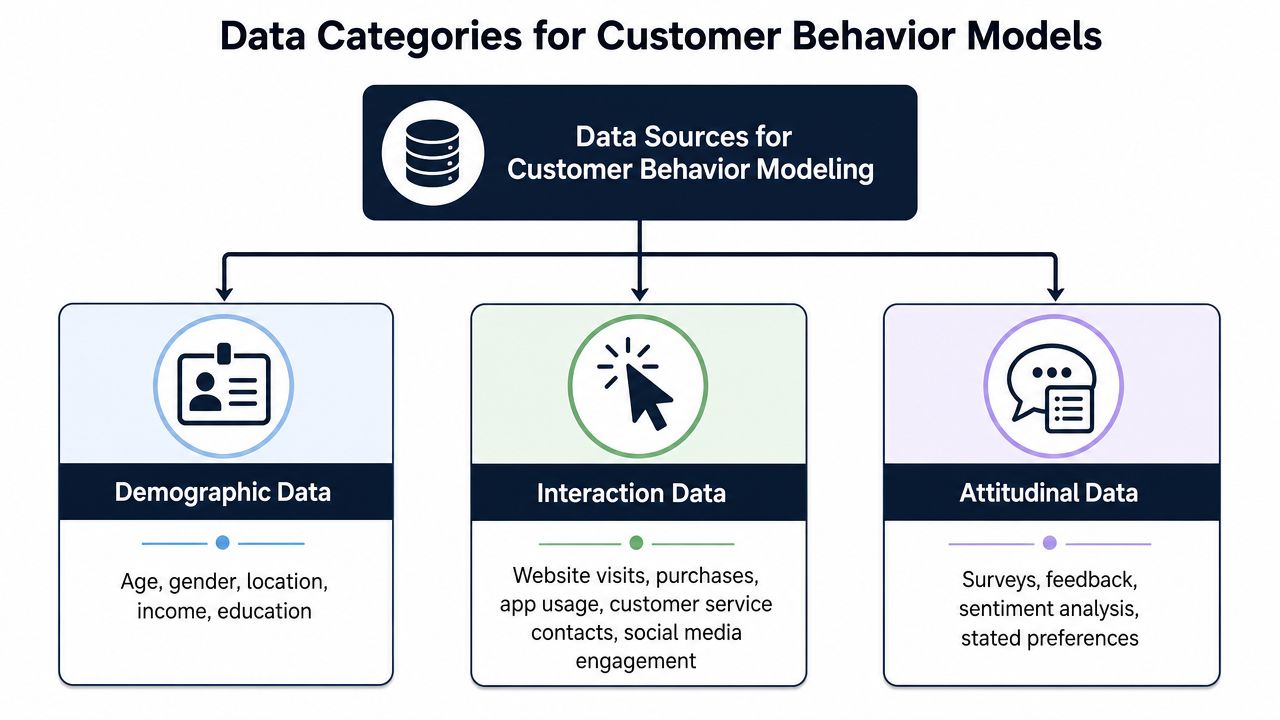
Effective modeling combines transactional, behavioral, and sentiment data. That matters because the same signal can mean very different things in context. Qualtrics gives a clear example in its discussion of customer behavior analysis: repeated support contacts plus declining usage often points to churn risk, while similar support volume without usage decay may reflect onboarding intensity.
Here's how I think about the three categories:
- Transactional data: Plan changes, renewals, billing history, discounts, expansion events, contract status.
- Behavioral data: Logins, feature usage, project creation, collaboration events, failed actions, session flow.
- Sentiment data: Support tickets, chat transcripts, call notes, feedback forms, review language.
If you leave one out, you miss context. A user may be active but unhappy. An account may contact support often but still be growing. A customer may reduce usage without comment while never submitting a ticket.
Feature engineering is where the real work happens
Raw events rarely predict much on their own. The useful layer comes from transforming them into features that capture behavior patterns.
Examples that tend to work in SaaS:
- Friction features: Error-heavy sessions, repeated failed configuration attempts, loops through the same settings pages.
- Adoption features: Number of core actions completed in a defined window, breadth of feature usage, teammate invites.
- Support-derived features: Topic clusters from tickets, complaint recurrence, negative language tied to pricing or reliability.
- Commercial features: Discount dependence, stalled expansions, usage growth without contract adjustment.
This is also where data quality problems become expensive. If account IDs don't join cleanly across billing, product telemetry, and support systems, the model will learn nonsense. Teams dealing with fragmented pipelines should fix those data quality issues before investing in more model complexity.
Raw data is evidence. Features are interpretation. Most of the business value sits in the interpretation layer.
Qualitative inputs deserve more respect
Many companies still treat surveys and support conversations as “soft” data. That's a mistake. Sentiment often explains the why behind the behavior. If customers repeatedly mention pricing confusion, trust concerns, or unmet expectations, those themes belong in your features.
That can include structured collection methods too. For example, marketing and research teams sometimes use interactive prompts to gather intent and preference data. A tool that helps create engaging quizzes for marketing can be useful when you want first-party signals that standard product analytics won't capture.
One practical note. Don't engineer every imaginable feature. Build the smallest feature set that captures behavior, business context, and customer voice. Then expand only when the model proves it can drive a decision.
From Model to Market Your Implementation Roadmap
Most customer behavior modeling programs fail in deployment, not development. The team builds something statistically respectable. Then it sits in a notebook, or a BI tool, or a dashboard that nobody checks during real decisions.
A working implementation needs a business process around it.
Define a narrow objective first
Start with one decision the company already struggles to make. Don't begin with “build a customer behavior model.” Begin with something operational, such as identifying accounts that need proactive outreach or surfacing the product issues most associated with stalled expansion.
That keeps the work grounded. It also forces alignment on ownership. Someone has to act on the output.
Build the data layer with operations in mind
The model should reflect how the business runs. That means joining product events, CRM context, support records, and billing data into a customer-level view. It also means deciding what a prediction will trigger. A Slack alert? A CRM task? A prioritized backlog item?
Modern modeling has moved beyond simple reporting. Teams use historical data and machine learning to forecast outcomes, and they monitor measures such as conversion rate, churn rate, and CLV to quantify behavior. That commercial pressure is growing as 49% of customers expect to be recognized for their loyalty, according to InMoment's customer behavior analysis.
A product roadmap matters here too. If your company doesn't know how modeled insights feed prioritization, this new product development roadmap is a useful planning reference.
Use a phased rollout
I've found the cleanest rollout looks like this:
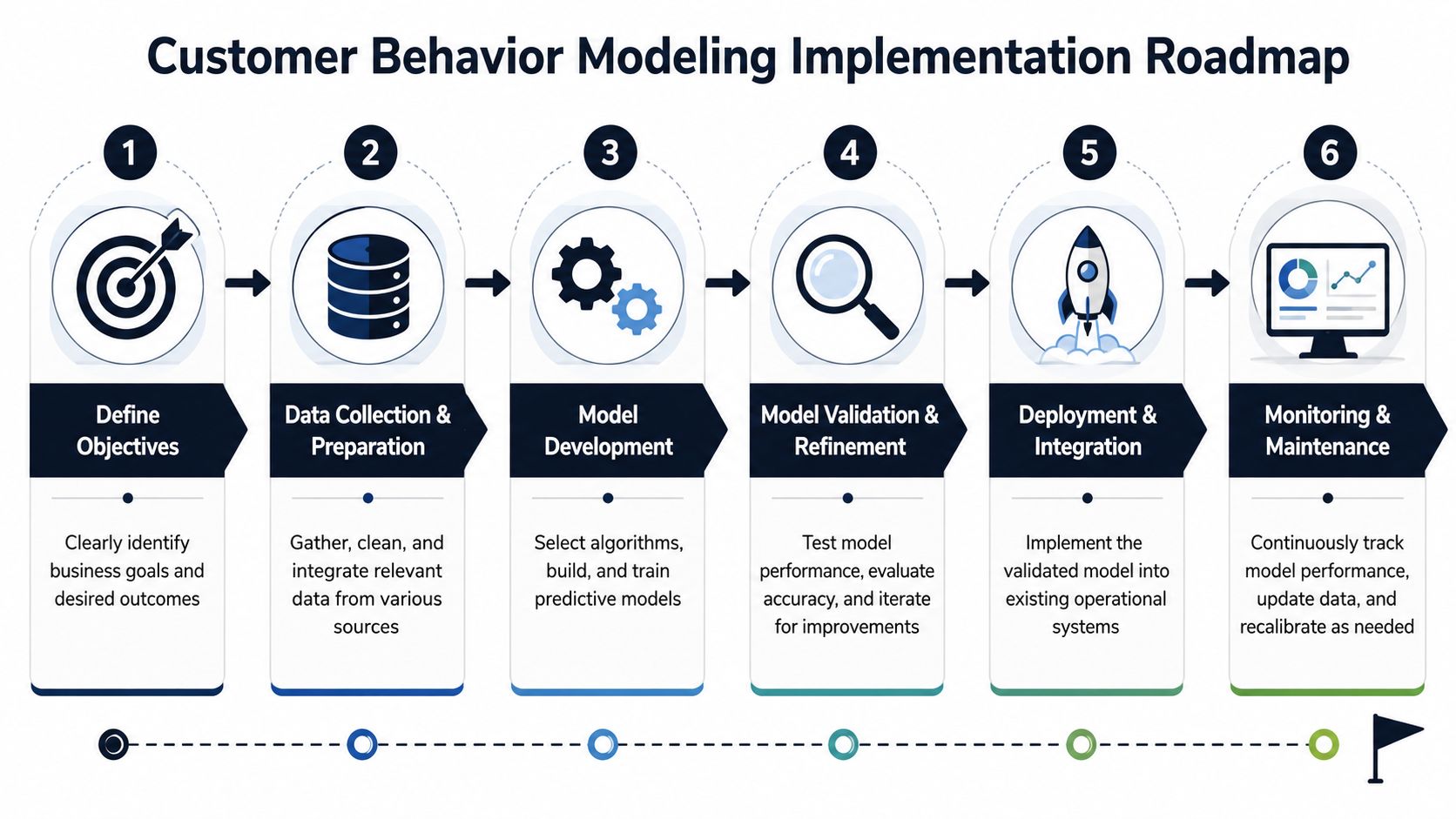
- Choose one use case. Pick churn triage, expansion detection, onboarding guidance, or another single outcome.
- Assemble a stable training set. Use customer histories that are complete enough to represent the behavior you care about.
- Train a baseline model. Start with something interpretable before moving to more complex methods.
- Validate on past periods. Check whether the model would have surfaced known outcomes early enough to matter.
- Operationalize the output. Push scores or flags into the tools teams already use.
- Review and recalibrate. Look at false positives, missed signals, and process friction every cycle.
A quick explainer helps if your stakeholders are newer to implementation mechanics:
Deployment is a workflow problem
The most common implementation mistake is shipping a score without a playbook. If an account gets flagged as at risk, what happens next? Who owns the follow-up? What message changes? Which product issues should be investigated? Without that layer, prediction quality doesn't matter much.
This is one place where tooling can help. Platforms such as SigOS connect feedback and usage patterns, then surface issues and requests associated with churn or expansion so product and growth teams can prioritize action inside systems like Zendesk, Intercom, Jira, and GitHub.
Monitor the model like a product
Customer behavior changes. Pricing changes. Onboarding changes. The model will drift if the business changes and the assumptions don't.
Treat the model like a product surface, not a one-time deliverable:
- Watch for behavior drift: New customer segments can break old patterns.
- Check actionability: A slightly less accurate model that triggers clear action is often more valuable.
- Review unintended effects: Teams can start optimizing for the score rather than the customer if governance is weak.
The point isn't to deploy intelligence. It's to deploy decisions.
SaaS Use Cases and Proving ROI
The cleanest way to justify customer behavior modeling is to attach it to recurring SaaS decisions that already affect retention and expansion. When teams try to “prove ROI” in the abstract, the conversation gets fuzzy fast.
Four use cases that usually create traction
Proactive churn intervention is the most obvious starting point. An account stops using a core workflow, support complaints change tone, and billing context shows upcoming renewal pressure. That's a better trigger for outreach than waiting for a cancellation request.
Expansion timing is often more valuable than teams expect. Some accounts don't ask for an upgrade because nobody noticed the signal. Heavy usage in advanced workflows, increased collaboration, and growing operational dependence can all indicate readiness for a larger plan or additional seats.
Development prioritization gets sharper when behavior is tied to revenue risk. A bug affecting a low-value edge case shouldn't outrank a recurring friction that appears in accounts with meaningful renewal exposure. Modeling helps quantify that difference in a way anecdotal feedback can't.
Adaptive onboarding is where many SaaS companies get early wins. Instead of giving every new account the same experience, the company can route users based on their first patterns. Fast movers get deeper activation prompts. Struggling users get guided setup and support.
A lot of “customer education” problems are really detection problems. Teams don't know who is confused until the confusion becomes churn.
How to think about ROI without inventing certainty
ROI comes from changed outcomes, not model outputs. The right evaluation question is simple: did the team act differently, and did those actions improve retention, expansion, or prioritization quality?
Useful ways to measure that include:
- Saved revenue from successful retention efforts among accounts flagged early enough for intervention
- Faster expansion identification when sales or success reaches high-intent accounts sooner
- Better backlog allocation when teams fix issues tied to customer risk rather than the loudest request
- Improved onboarding efficiency when support effort shifts toward users who need it
What a credible proof loop looks like
A practical proof loop has three parts.
First, define the action tied to the model. For example, a success manager reviews a risk queue each week, or product gets a list of issues associated with account degradation.
Second, compare modeled intervention against the old process. Don't ask whether the score looks smart. Ask whether it changed who got attention and when.
Third, review outcomes with skepticism. Some flagged customers would have renewed anyway. Some “missed” accounts were never recoverable. The goal isn't perfect attribution. It's better resource allocation.
That's why the strongest customer behavior modeling programs don't stop at prediction. They close the loop between signal, action, and commercial result.
Pitfalls Privacy and The Future of Modeling
The fastest way to lose trust in customer behavior modeling is to make it feel intrusive, brittle, or detached from reality. Teams do this when they train on biased data, optimize for vanity metrics, or push predictions into workflows without clear human review.
Another common failure is treating activity as value. More clicks don't always mean healthier customers. More support tickets don't always mean dissatisfaction. Context matters, and privacy does too.

If your program uses support transcripts, call notes, or behavioral telemetry, governance has to be explicit. Teams need documented handling rules, access controls, retention policies, and customer-facing clarity about how data is used. A plain-language policy page like Dokly privacy is a good reminder that transparency matters as much as compliance.
The more interesting shift is strategic. Customer behavior modeling is becoming more operational and more cross-functional, with AI being used to predict churn, conversion friction, and emerging preferences. A gap in current practice is knowing when trust signals and pricing dynamics should matter more than conventional engagement metrics, as discussed in this analysis of emerging behavior modeling trends.
That matters in SaaS because long-term value often breaks before usage fully collapses. Customers may still log in while confidence erodes. They may keep paying while questioning price fairness. They may delay expansion because the product feels risky, not because the feature set is weak. The next generation of models needs to capture that uncertainty, not just count clicks.
If you're trying to connect support noise, usage data, and revenue impact into one operating view, SigOS is built for that workflow. It helps teams analyze behavioral and feedback signals continuously, identify issues associated with churn or expansion, and turn those patterns into decisions product, growth, and customer teams can act on.
Keep Reading
More insights from our blog

Ready to find your hidden revenue leaks?
Start analyzing your customer feedback and discover insights that drive revenue.
Start Free Trial →