Why Is Customer Feedback Important
Unlock growth by understanding why is customer feedback important for SaaS. Translate insights into revenue, improve retention, and build products customers

Increase customer retention by just 5%, and profits can rise by 25% to 95% according to a Bain finding summarized by Dovetail's overview of customer feedback benefits. The same source notes that repeat customers spend 67% more than new customers after about their third year with a business. That shifts the question from “Why is customer feedback important?” to a harder one: how much revenue are you risking when you ignore it?
In SaaS, most losses don't begin with a cancellation click. They begin with friction customers describe long before they leave. A support ticket about a broken workflow. A sales call where a buyer says a missing integration blocks rollout. A survey comment that keeps resurfacing across accounts. Teams often treat those as anecdotes. Strong operators treat them as revenue signals.
That difference matters because product teams rarely fail from lack of input. They fail from misreading it. They ship features for the loudest users, miss the recurring issues behind churn, and confuse volume with business impact. Feedback only becomes strategically useful when you connect it to account value, usage behavior, and retention risk.
More Than Opinions The Real Cost of Ignoring Feedback
The financial case for feedback is stronger than generally acknowledged. If a small improvement in retention can materially change profit, then any system that helps you detect churn drivers early deserves board-level attention. Feedback is one of those systems. It shows you where customers get blocked, disappointed, or unconvinced before the loss appears in revenue reporting.
Revenue leaks start as customer friction
A common SaaS mistake looks rational on the surface. The roadmap fills up with feature requests from prospects, executives push for launches that help demos, and engineering spends a quarter building visible additions. Meanwhile, existing customers keep reporting the same onboarding friction, weak reporting workflow, or integration failure. The team ships “growth” work while renewals weaken underneath them.
That's why feedback shouldn't sit inside support or survey tooling as passive reference material. It should function as an early warning system for revenue leakage. In subscription businesses, a small service failure doesn't stay small if it affects renewal confidence across multiple accounts.
Practical rule: If customers repeatedly describe the same obstacle in different channels, treat it as a business issue first and a support issue second.
Cancellation data makes this even more concrete. If you want a practical lens on the reasons subscribers leave, the Nuxie blog on cancellation reasons is useful because it reframes churn as a set of identifiable causes rather than a vague retention problem. That's the right mindset for feedback analysis too. You're not collecting opinions. You're tracing lost revenue back to specific patterns.
Feedback changes how leaders allocate effort
Product leaders often ask for certainty before making roadmap tradeoffs. Feedback won't give certainty. It gives something more operationally useful: evidence about where customers feel pain, where expectations are slipping, and where trust is eroding.
Used well, feedback helps teams answer questions that financial dashboards alone can't answer:
- What's making valuable accounts hesitate at renewal
- Which product gaps appear often enough to justify engineering time
- Where service issues are distorting customer perception of the whole product
- Which complaints reflect broad friction versus one-off preferences
The cost of ignoring feedback isn't just churn. It's misallocation. Teams burn time solving visible requests while hidden repeat issues continue to weaken retention, expansion, and advocacy.
How Feedback Directly Influences Revenue and Retention
Revenue rarely drops without warning. It usually declines after customers encounter friction, repeat it across channels, and fail to see it resolved before renewal. Feedback is the record of that sequence. Teams that treat it as an input to revenue decisions can spot risk earlier than teams that wait for churn reports.
Churn reduction starts with pattern detection
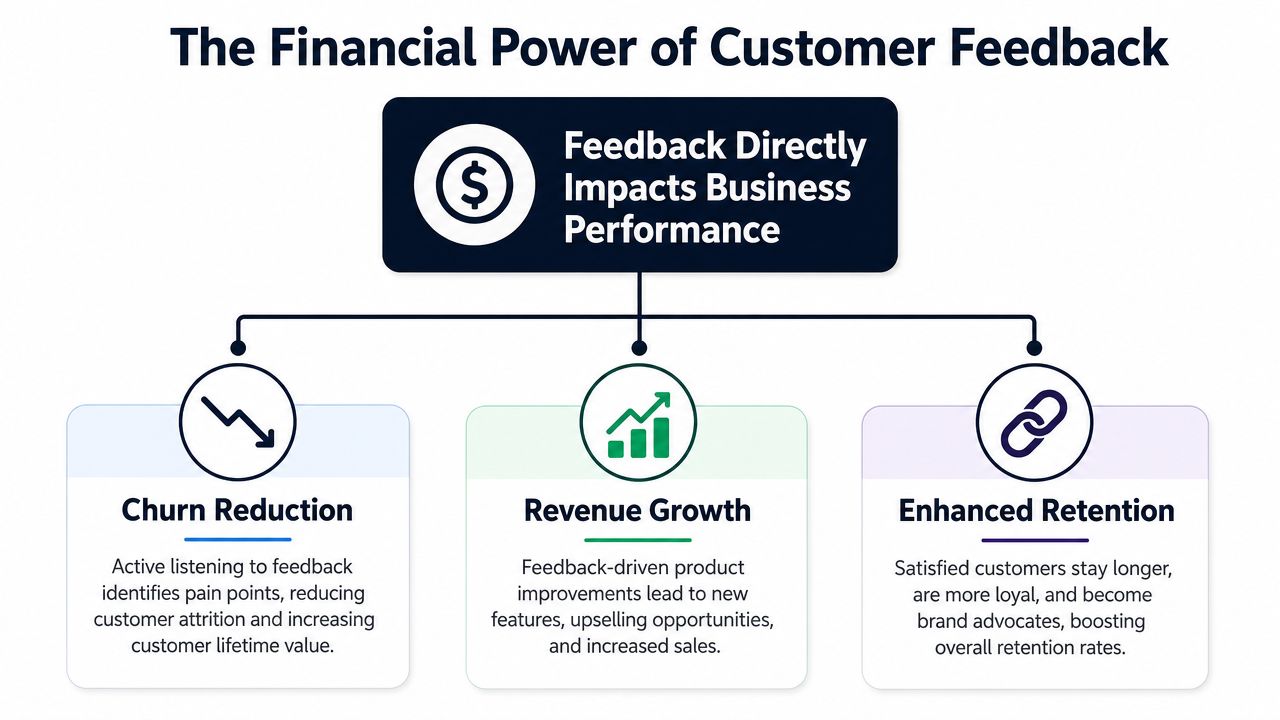
The most direct financial effect of feedback is lower avoidable churn. Revuze's analysis of customer feedback operations explains why. Companies that pull in helpdesk emails, survey responses, and call transcripts into one analysis flow can identify recurring product and service issues faster than teams reviewing each channel separately.
For a SaaS company, that speed matters. A single support ticket about failed Salesforce syncs may look isolated. Ten similar complaints spread across Zendesk, onboarding calls, and QBR notes point to a renewal problem in the making, especially if the affected accounts are high-ACV customers with low integration completion rates. The operational question is no longer whether the issue is real. It is whether the business can afford another quarter of preventable friction.
Expansion revenue follows adoption, and feedback shows what blocks it
Feedback also affects growth inside existing accounts. Expansion usually depends on broader usage across teams, stronger workflow fit, and fewer adoption gaps. Customers often state those blockers directly. They ask for role-based permissions because rollout stalled with finance. They request better reporting exports because executive reviews still happen in spreadsheets. They want a deeper integration because manual work is limiting daily use.
Those requests have different economic value. A feature request from a power user in an account preparing to add 200 seats should be weighted differently from a niche preference in a stagnant account. Teams working on proven NRR strategies already know that net revenue retention improves when product decisions remove barriers to expansion, not just when sales teams negotiate larger contracts.
A useful question in renewal reviews is simple: which customer requests are tied to wider deployment, higher usage frequency, or additional seats?
Feedback becomes more valuable when paired with behavior
Qualitative input on its own is noisy. The signal gets stronger when teams compare what customers say with what they do in the product. If several administrators request audit logs and those same accounts show high weekly usage, multiple active teams, and upcoming security reviews, the revenue case is stronger than the request text alone suggests.
That is why mature SaaS teams score feedback by business context. They look at account size, plan tier, feature adoption, renewal date, support volume, and expansion potential before assigning roadmap priority. A complaint from a low-usage trial account and a complaint from a healthy enterprise customer should not carry the same weight, even if the wording is identical.
If your team needs a repeatable method for that process, this guide on how to analyze customer feedback offers a practical framework for turning unstructured comments into decisions.
The operating model that links feedback to revenue
Teams that use feedback well tend to share the same operating habits:
- They centralize inputs: Support tickets, sales calls, onboarding notes, surveys, and cancellation reasons feed one review system.
- They prioritize repeated issues with commercial impact: Frequency matters, but so do ARR exposure, segment concentration, and renewal timing.
- They connect themes to specific outcomes: Reduced time-to-value, better adoption, lower support burden, stronger renewal rates, or expansion within target accounts.
- They review feedback with cross-functional ownership: Product, customer success, support, and revenue teams examine the same evidence, then decide what deserves action.
This is the revenue case for customer feedback. It helps companies protect recurring revenue, identify expansion blockers before they show up in net retention, and invest in fixes that change account economics rather than just clearing the loudest queue.
Measuring What Matters From NPS to Behavioral Data
The way companies collect feedback has matured. SurveyMonkey's guide to the benefits of customer feedback surveys notes that Net Promoter Score was introduced in 2003, and that modern feedback programs increasingly combine quantitative ratings with qualitative comments to find recurring pain points. That shift matters because scores alone tell you how customers feel. Comments tell you why.
For SaaS teams, the practical distinction is between solicited feedback and unsolicited feedback. Solicited feedback is requested on purpose through surveys, interviews, or in-product prompts. Unsolicited feedback shows up naturally in support conversations, sales calls, onboarding sessions, community threads, and cancellation forms.
Solicited channels are clean but narrow
Survey-based inputs are useful because they're structured. You can compare responses across time, customer segments, and lifecycle stages. NPS, CSAT, and post-onboarding surveys are especially helpful when you want a stable listening system rather than sporadic anecdotes.
But structured inputs have limits. Customers answer the question you asked, at the moment you asked it, in the format you allowed. That makes surveys good for measurement and trend detection, but not always for root-cause discovery. If you're trying to improve score quality rather than just collect it, this piece on how to improve NPS score is useful because it pushes beyond score tracking into operational follow-up.
Unsolicited channels are messy but richer
The highest-value insight often sits in unstructured text and conversation. A frustrated support ticket contains context. A sales call reveals objections in the buyer's own words. A cancellation note often exposes the last unresolved problem before churn. These channels are harder to analyze at scale, but they usually contain the clearest signal about where the product or experience is failing.
That's why tool selection matters. Teams comparing platforms for text clustering, sentiment grouping, and theme extraction can review this roundup of top customer feedback analysis tools to see the categories available.
Customer Feedback Channels in SaaS
| Channel Type | Examples | What It Measures | Best For |
|---|---|---|---|
| Solicited | NPS surveys, CSAT prompts, onboarding surveys, customer interviews | Satisfaction, loyalty sentiment, stated priorities | Trend tracking, lifecycle checkpoints, benchmarking internal experience over time |
| Unsolicited | Support tickets, live chat logs, help center searches, cancellation forms | Real-world friction, recurring defects, urgency | Finding root causes, spotting churn risk, identifying operational issues |
| Revenue-facing | Sales call transcripts, renewal calls, success reviews | Buying objections, rollout blockers, expansion constraints | Product-market fit, enterprise readiness, upsell discovery |
| Behavioral context | In-product usage patterns, feature adoption paths, session events | What customers actually do inside the product | Validating whether stated feedback reflects broad behavior |
Surveys tell you where to investigate. Behavioral and conversational data usually tell you what to fix.
The strongest feedback systems don't argue about which channel is “best.” They combine them. A low NPS score without comments is a symptom. A long complaint thread without usage context is incomplete. Together, they become actionable.
SaaS Success Stories Fueled by Customer Feedback
Many teams understand feedback in theory. The difference shows up in execution. The following stories are representative SaaS scenarios, not named case studies, but they reflect the kinds of outcomes product leaders see when they treat feedback as business intelligence rather than commentary.

A support pattern saves a strategic account
A workflow automation company noticed that one enterprise customer had opened several tickets about the same export failure. On their own, the tickets looked routine. Customer success flagged that the account was approaching renewal and had reduced usage in one business unit.
The product team reviewed the issue in context and found that the export bug wasn't isolated to one user. Multiple admins at that customer had reported variants of the same problem, and similar language appeared in helpdesk traffic from other accounts in the same segment. Engineering treated it as a retention issue, not a backlog item. They fixed the export path, improved error visibility, and gave customer success a clear explanation to bring back to the account team.
The lesson wasn't “listen to support more.” It was more specific. Support data becomes strategic when someone ties it to account risk and segment-level repetition.
Trial feedback reveals the missing moment of value
A self-serve productivity app had healthy trial signups but weak conversion quality. Survey responses from non-converting users kept mentioning setup friction and uncertainty about whether the app would fit their team workflows. Product analytics showed that many trial users reached the workspace setup stage but didn't complete the collaboration steps that made the product sticky.
The team didn't respond by adding broad feature depth. They focused on the missing moment of value. They simplified the first-team setup experience, rewrote in-app guidance, and changed onboarding prompts to reduce ambiguity about collaboration use cases. The improvement came from joining what users said with what they failed to do.
Later in the evaluation cycle, the team also used customer interview notes to shape packaging and messaging. Feedback didn't just influence the product. It sharpened how the company explained the product's value.
Here's a useful example of how teams discuss feedback loops operationally:
Sales transcripts uncover an enterprise wedge
A sales tech company kept hearing a similar objection in late-stage calls with larger prospects. Buyers liked the core workflow, but procurement and operations teams needed a specific integration before they could approve broader deployment. Sales had treated this as a feature request. Product initially saw it as niche.
Then the team reviewed transcripts across several enterprise opportunities and found a pattern. The same integration was not only requested repeatedly, it was tied to larger deal structures and more complex rollout plans. Once product recognized that pattern, the integration moved from “nice to have” to strategic gateway.
When the same objection appears in multiple high-value deals, it stops being feedback and becomes market evidence.
After release, the company changed more than the roadmap. It changed sales qualification, onboarding documentation, and partnership strategy around that integration. That's the broader point. Good feedback analysis often produces cross-functional action, not just a ticket in Jira.
How to Separate Signal from Noise in Your Feedback
Teams rarely fail because they lack feedback. They fail because they treat all feedback as if it carries the same business weight. In SaaS, that mistake distorts roadmap decisions, pulls engineering time toward noisy edge cases, and leaves higher-value retention risks unresolved.
A useful filter starts with one question: which feedback, if ignored, is most likely to reduce expansion, delay renewals, or increase churn?
Luth Research's discussion of why customer feedback is necessary points to the core problem. Companies need a way to distinguish representative patterns from isolated requests. The practical answer is to evaluate comments in the context of account economics, product behavior, and strategic fit rather than volume alone.
Use a three-part filter
For SaaS teams, three screens usually separate high-value signal from low-impact noise.
- Revenue impactStart with the account, not the comment. A workflow issue reported by a customer entering renewal talks has different weight than a design preference from a trial user who has not adopted the core product. Review each item alongside contract value, expansion potential, and lifecycle stage.
- Frequency and reachA request becomes more credible when it appears across multiple channels and customer types. If onboarding calls, support tickets, and sales conversations all surface the same friction point, you are likely looking at a market pattern rather than a single preference.
- Strategic alignmentSome requests are valid and still not worth building. The right test is whether solving the issue strengthens the product capabilities tied to your ideal customer profile and your growth model.
Pair language with behavior
Comments explain what customers notice. Behavior shows whether the issue changes outcomes.
That combination matters because stated pain and observed pain are not always the same. Users may ask for a new reporting dashboard, while usage data shows they are abandoning setup before they ever reach reporting. If a team acts on the request without examining behavior, it can fund the wrong fix.
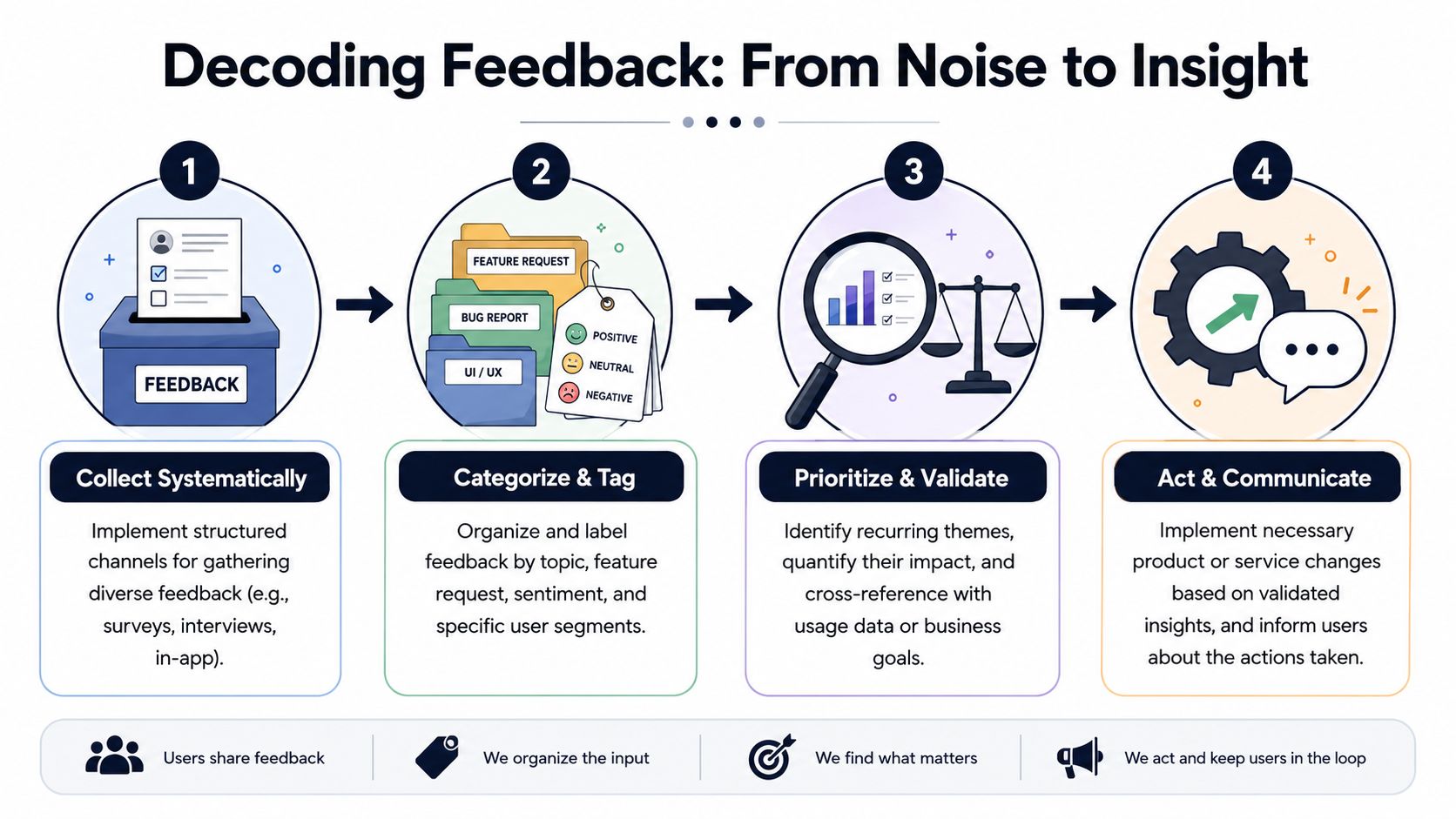
A practical workflow looks like this:
- Tag the feedback theme: Integration gap, onboarding friction, reporting limitation, reliability issue.
- Attach customer context: Segment, plan tier, lifecycle stage, renewal status.
- Check product behavior: Are affected users dropping off, avoiding the feature, or using workarounds?
- Estimate business consequence: Retention risk, support volume, sales friction, or expansion upside.
If your team needs a method for organizing comments before they reach prioritization, this guide to qualitative data analysis methods gives a useful foundation.
Build a review system that resists bias
Bias enters fast. An executive forwards one customer note. Sales escalates a prospect request tied to a large deal. Support highlights a painful bug because it generated ten tickets in one day. Each signal may matter, but none should bypass the same evaluation model.
A better decision rule is simple.
Decision lens: Ask, “What revenue outcome changes if we solve this, and what revenue outcome is at risk if we do not?”
That question forces teams to connect feedback to financial consequences. It also improves prioritization discussions across product, sales, and customer success because the debate shifts from opinion to expected business effect.
A stronger review cadence usually includes:
- A single system of record so feedback from Zendesk, Intercom, Gong, and surveys can be reviewed in one place.
- Consistent tagging so patterns can be sorted by theme, customer segment, and urgency.
- Joint review by business and product owners so commercial context and technical feasibility are assessed together.
- Validation before roadmap commitment using account history, usage patterns, and known retention risks.
Tooling helps when the goal is disciplined analysis rather than collection alone. Platforms such as Dovetail, Pendo, and SigOS support centralization and prioritization in different ways. SigOS, for example, can ingest support tickets, chat transcripts, sales calls, and usage metrics so teams can connect recurring feedback themes to churn risk and expansion opportunity.
Making Customer Feedback Your Competitive Advantage
Why customer feedback is important isn't that customers like being heard. It's that companies make better financial decisions when they can identify which customer signals matter. Generic advice stops at “collect more feedback.” Mature teams do something harder. They decide which patterns deserve action, which requests reflect edge cases, and which issues are subtly dragging retention down.
That distinction is what turns feedback from a listening exercise into a competitive advantage. Teams that act on representative signals improve the product where it changes customer behavior. Teams that chase noise build roadmaps that look responsive but don't improve the business.
Three non-negotiable moves
The strongest starting point is operational, not philosophical.
- Centralize feedback in one system of record: Survey comments, support tickets, sales transcripts, and cancellation reasons shouldn't live in separate departmental tools with separate interpretations.
- Assign clear ownership: Someone has to own classification, review cadence, and cross-functional follow-through. If everyone “cares” about feedback, no one is accountable for turning it into decisions.
- Enrich every item with business data: Account value, segment, adoption level, and lifecycle stage should sit next to the comment itself.
That final step matters most. As noted in the discussion earlier, modern product teams don't struggle to collect input. They struggle to separate representative patterns from vocal edge cases. The winning move is to fuse feedback with usage and prioritization so it becomes decision-grade rather than anecdotal.
Feedback is valuable not because it is always right. It's valuable because analyzing it correctly helps teams avoid expensive mistakes.
Companies rarely lose ground because they had no access to customer opinion. They lose ground because they couldn't tell the difference between a loud request and a meaningful signal.
SigOS helps SaaS teams turn scattered feedback into prioritized product intelligence. If you want a tighter system for connecting support tickets, sales calls, chat transcripts, and behavioral data to churn risk and expansion opportunities, explore SigOS.
Keep Reading
More insights from our blog


Ready to find your hidden revenue leaks?
Start analyzing your customer feedback and discover insights that drive revenue.
Start Free Trial →