Mastering SaaS Growth by Managing a Product Portfolio
Learn how managing a product portfolio drives SaaS growth. Our guide covers proven frameworks, AI tools, and workflows to reduce churn and boost ARR.
Managing a product portfolio is all about deciding where to place your bets. You have limited resources—only so much engineering time, so much marketing spend—and you need to spread them across all your products to get the biggest bang for your buck. It’s a strategic game of choosing what to build, what to keep running, and what to gracefully retire.
Get it right, and you’re fueling growth. Get it wrong, and you’re just wasting time and money on features nobody wants.
What Is Product Portfolio Management in SaaS
Think of yourself as the executive chef of a popular restaurant. You wouldn't try to offer 100 different dishes. That would be chaos for the kitchen and a nightmare for your diners. Instead, you'd curate a balanced menu.
You’d have your crowd-pleasing bestsellers (your cash cows), some exciting new specials to draw in adventurous foodies (growth bets), and the reliable classics that keep the regulars coming back (mature products). Every single dish has a job to do, all contributing to the restaurant's reputation and bottom line.

That’s exactly what managing a product portfolio is like in SaaS. It’s the art and science of looking at your entire lineup of products and features as one big, interconnected system. The real challenge isn't just about shipping more code; it's about building smarter.
Beyond Individual Product Roadmaps
A typical product manager lives and breathes their own product's roadmap. Portfolio management, on the other hand, is like zooming out to the 30,000-foot view. It forces you to ask the tough, big-picture questions that shape the whole business:
- Resource Allocation: Where will our limited development and marketing budget have the biggest impact?
- Strategic Alignment: Do all our products actually work together to get us closer to our long-term company goals?
- Risk Mitigation: Are we putting all our eggs in one basket, or is our portfolio diverse enough to handle unexpected market changes?
- Lifecycle Management: Which products need more investment to grow, which just need to be maintained, and which old-timers is it time to sunset?
Neglecting portfolio management is like letting every chef in the kitchen add whatever they feel like to the menu. Pretty soon, you’ve got a bloated, confusing mess that drains your resources and leaves customers scratching their heads. The cost of that chaos is huge: wasted development cycles, frustrated teams, and watching competitors seize opportunities you missed.
The Shift to Data-Driven Decisions
For a long time, these big portfolio decisions were made based on gut instinct or whoever argued most convincingly in a meeting. But that's changing. The modern way is to ground every choice in hard data.
It's about moving past subjective opinions and building a repeatable, quantifiable process for growth. By digging into performance metrics and customer feedback across your entire suite of products, you can start making truly informed decisions that make the whole portfolio stronger. This strategic oversight is what makes sure every dollar spent and every sprint completed actually pushes you toward market leadership and a healthier business.
Frameworks for Prioritizing Your Product Investments
Okay, you’ve got the big picture of your product portfolio. Now, how do you translate that high-level strategy into actual, on-the-ground execution? This is where the rubber meets the road, and it’s also where things can get messy with competing priorities and stakeholder opinions.
This is why we use prioritization frameworks. They’re not just business school jargon; they are practical tools that cut through the noise. Instead of just listening to the loudest voice in the room, these models give you a structured way to evaluate what’s on the table, ensuring your team’s precious time and energy go where they’ll make the biggest difference.
Quantifying Potential with RICE and ICE
One of the go-to frameworks for many product teams is RICE. It’s a simple but powerful scoring system that helps you quantify the potential value of a new feature or initiative. It stands for Reach, Impact, Confidence, and Effort.
Here’s how it breaks down:
- Reach: How many customers will this actually touch in a given timeframe? (e.g., 2,500 users per month)
- Impact: How much will this move the needle for them? (Think a simple scale: 3 for massive impact, 2 for high, 1 for medium)
- Confidence: How sure are you about your Reach and Impact numbers? Be honest. (This is a percentage, like 90% if you have solid data).
- Effort: What’s the real cost in team time? (Usually measured in person-months for product, design, and engineering).
You then plug these into a simple formula: (Reach x Impact x Confidence) / Effort. The initiatives with the highest scores bubble up to the top of your list.
For teams that need to move even faster, there’s the ICE model. It’s a stripped-down version that drops the 'Reach' variable, making it perfect for quick, back-of-the-napkin assessments when speed is everything.
Uncovering Customer Value with Opportunity Scoring
While RICE and ICE help you evaluate your own ideas, Opportunity Scoring is all about uncovering what your customers truly value. This framework comes straight from the Jobs-to-be-Done (JTBD) school of thought, which zeroes in on the real "job" a customer is trying to get done with your product. A good jobs-to-be-done template is a great place to start organizing these customer needs.
With Opportunity Scoring, you ask customers to rate two simple things for a specific task or outcome:
- On a scale of 1-5, how important is this to you?
- On a scale of 1-5, how satisfied are you with how you do it today?
The magic happens when you find a gap. The most exciting opportunities are hiding where importance is high, but satisfaction is low. These are the underserved needs just waiting for you to solve them.
Say your SaaS product has a reporting feature. Your customers might rate "generating a quarterly performance report" a 5 for importance, but their satisfaction with your clunky, slow tool is a measly 2. That gap is a giant, flashing sign telling you exactly where to focus your efforts.
Choosing the Right Tool for the Job
So, which framework should you use? It really depends on what you're trying to achieve. Each one has its own strengths and is suited for different situations.
Here’s a quick comparison to help you decide.
Comparing Product Prioritization Frameworks
| Framework | Best For | Key Variables | Primary Benefit |
|---|---|---|---|
| RICE | Prioritizing a backlog of well-defined feature ideas and projects. | Reach, Impact, Confidence, Effort | Provides a balanced, quantitative score to remove bias from decision-making. |
| ICE | Quick, high-level prioritization when speed is critical. | Impact, Confidence, Effort | Simple and fast to implement for rapid assessment. |
| Opportunity Scoring | Discovering unmet customer needs and identifying new product opportunities. | Importance vs. Satisfaction | Grounds prioritization in direct customer feedback and pain points. |
| BCG Matrix | High-level strategic planning and resource allocation across an entire product portfolio. | Market Growth, Market Share | Offers a clear, visual map for balancing investment across different product lifecycle stages. |
Ultimately, the best framework is the one your team will actually use consistently. Start with one, see how it feels, and don't be afraid to adapt it to fit your unique context.
Visualizing Your Portfolio with the BCG Matrix
When you need to zoom out and look at your entire portfolio from a 30,000-foot view, the classic Boston Consulting Group (BCG) Matrix is still one of the best tools around. It’s a simple visual that helps you categorize products based on their market growth rate and your relative market share. As you map out your portfolio, it's also smart to consider modern AI strategy and prioritization frameworks that can complement these classic models.
The matrix gives you four distinct quadrants:
- Stars: High growth, high share. These are your winners. They need steady investment to keep growing and stay ahead of the competition.
- Cash Cows: Low growth, high share. These are your stable, mature products. They don't need much investment and generate the cash you can use to fund your Stars and other ventures.
- Question Marks: High growth, low share. The wildcards. They're in an exciting market but haven't broken through yet. They need careful investment and a smart strategy to turn them into Stars.
- Dogs: Low growth, low share. These products are often just treading water or, worse, draining resources. The tough calls—like divesting, phasing out, or a major pivot—happen here.
Plotting your products on this matrix gives you an instant snapshot of your portfolio’s health. Do you have a good balance? Are you milking your Cash Cows to fund tomorrow's Stars? Or are too many Dogs weighing you down? It’s a simple tool that drives incredibly important strategic conversations.
Building a System for Portfolio Governance
Prioritization frameworks give you the blueprints, but they’re just paper without a real system to bring them to life. Solid product portfolio management isn't just about a scoring model; it’s about creating a repeatable process for governance and truly understanding a product's journey from launch to sunset.
Think of it this way: a framework is the map, but governance is the navigation system that tells you when to turn, when to speed up, and when to find a new route. This system ensures your big decisions aren't just one-off guesses but part of a continuous, strategic rhythm that guides your investments with clarity.
Mapping the Product Lifecycle
Every product has a natural lifecycle, and your strategy needs to evolve right along with it. The way you manage a brand-new product is completely different from how you handle a mature market leader. Getting this right is the foundation of good governance.
Let’s break down the typical stages and the key question you should be asking at each one:
- Introduction: The product is live! The goal is to get a foothold. The only question that matters is, "Are we solving the right problem for the right people?" All your energy should go into driving awareness, getting those first users, and absorbing their feedback.
- Growth: You’ve found product-market fit, and usage is climbing. Now the focus shifts to, "How do we pour gas on this fire?" This is the time to invest heavily in new features, performance upgrades, and expanding your market reach.
- Maturity: Your product is now a household name in its category. The game changes to defense and optimization. You should be asking, "How do we protect our market share and maximize profitability?" Efforts turn to customer retention, operational efficiency, and small, high-impact improvements.
- Decline: The world has changed—new tech, different customer needs—and usage is starting to drop. This is where the tough calls are made: "Should we pivot, sunset, or sell this product?" It demands a brutally honest look at its long-term place in your portfolio.
Establishing a Portfolio Review Board
To make these calls without bias, you need a dedicated, cross-functional team—think of it as a portfolio review board. This isn't just another status update meeting; it’s the central command center for your entire portfolio strategy.
Your board should have leaders who bring different perspectives to the table:
- Product: The voice of the customer and the keeper of the strategic vision.
- Engineering: The reality check on what’s possible, how long it will take, and how much it will cost.
- Sales & Marketing: The eyes and ears on the ground, with direct insight into market demand and what competitors are doing.
- Finance: The grounding force, ensuring every decision aligns with revenue goals and budget constraints.
The real job of this board is to enforce objectivity. It yanks decisions out of the realm of gut feelings and departmental politics and puts them squarely into a data-driven arena.
Setting a Cadence for Strategic Reviews
For this board to be effective, it needs a consistent rhythm. A quarterly strategic review is the sweet spot for most SaaS companies. It’s frequent enough to stay agile but gives teams enough time to make real progress and gather meaningful data between sessions. A great way to structure this is by applying some of the same principles found in essential data governance best practices, which emphasize clear rules and repeatable processes.
Let's be realistic. In a mature portfolio, you’re often allocating scarce resources across the products that already generate most of your ARR. Industry data consistently shows that a small fraction of your features—often around 20–30%—drive 70–80% of the total customer value. This reality forces you to prioritize based on real economic outcomes, not just cool ideas.
This kind of structured governance gives you the playbook to make the hard decisions with confidence—whether that means doubling down on a rising star, pivoting a struggling product, or giving a legacy tool a graceful retirement. It turns portfolio management from a chaotic guessing game into a predictable engine for growth.
Measuring the Health of Your Product Portfolio
You can’t manage what you don’t measure. It’s an old saying, but it’s the absolute truth in product portfolio management. To make smart, defensible decisions, you have to move past gut feelings and vanity metrics. The goal is to connect every product effort directly to a business outcome. This is how you build a compelling, data-backed story for stakeholders and prove your strategy is actually working.
Think of these metrics as your portfolio's vital signs. A doctor wouldn’t diagnose a patient without checking their heart rate or blood pressure. In the same way, you need hard data to understand the health of your products. Flying blind is a surefire way to burn resources and end up somewhere you never intended to go.
Key Metrics That Drive Business Outcomes
To get a real, unfiltered look at your portfolio’s health, you need to zero in on metrics that tie directly to financial impact, customer behavior, and operational efficiency. These are the KPIs that cut through the noise and show what’s truly creating value.
Here are three essential metrics every SaaS team should have on their radar:
- Annual Recurring Revenue (ARR) Impact: This is the big one. It directly links a new feature or product improvement to the bottom line. It answers the simple question, "Did this work actually make us money?" by tracking how new functionality influences upgrades, expansion revenue, or new customer deals.
- Churn Correlation: This metric goes a level deeper than just looking at your overall churn rate. It helps you pinpoint which product issues, bugs, or missing features are most often cited by customers who cancel. It’s a powerful way to identify the most expensive problems you have.
- Feature Adoption Rate: It sounds simple, but this metric is critical. Are people actually using what you build? A low adoption rate for a new feature can signal a dozen different problems—a clumsy user experience, a misunderstood customer need, or weak marketing. In any case, it points to wasted R&D effort.
Getting these numbers right is fundamental. For a closer look at the data that signals customer loyalty, check out this guide on key customer retention metrics.
Creating a Balanced Portfolio Scorecard
While these individual metrics are insightful, the real magic happens when you see them all together. A balanced portfolio scorecard pulls various data points—financial, customer, and operational—into a single, unified view. This dashboard gives you at-a-glance clarity on the health of your entire portfolio, not just one piece of it.
A scorecard tells a much richer story. For example, you might see that a product has sky-high adoption but also correlates with a high volume of support tickets. That tells you you've built something valuable but confusing, a powerful feature that’s just too hard to use.
This screenshot shows how a platform like SigOS can surface and quantify the financial cost of specific product issues.
The dashboard makes it crystal clear which user-reported problems are costing the most in at-risk ARR, allowing teams to prioritize fixes based on their actual monetary impact.
A balanced scorecard prevents you from making decisions in a vacuum. It forces a conversation about trade-offs, ensuring that you're not just chasing high adoption at the cost of profitability or sacrificing long-term customer satisfaction for short-term revenue goals.
By tracking the right KPIs and visualizing them on a scorecard, you shift portfolio management from a subjective art to an objective, data-driven science. That clarity is what empowers you to justify your roadmap and get the entire company aligned on what success really looks like.
Using AI to Make Smarter Portfolio Decisions
For years, product portfolio management has run on a predictable cycle of frameworks and quarterly reviews. These methods are solid, but they have a fundamental flaw: they’re slow. By the time you’ve gathered the data to make a decision, the market has already moved on. You're always looking in the rearview mirror.
But now, AI-driven product intelligence is flipping the script. It gives us the kind of real-time, quantifiable insights we used to only dream about.
Think about all the customer feedback your company gets in a single week. Support tickets, sales notes, survey responses, chat logs—it's a firehose of information. This is a goldmine, but it's unstructured and qualitative. It's mostly noise.
AI's real job here is to find the signal in that noise. Modern platforms can chew through mountains of text and voice data to find the hidden patterns. They connect the dots between a specific user complaint and churn risk, or they link a feature request directly to potential expansion revenue.
Turning Feedback into Financial Insights
The magic isn't just about sorting feedback faster. The real breakthrough is translating vague comments into hard financial metrics. An AI intelligence layer can spot a support ticket about a buggy integration and immediately tell you it’s related to the $50,000 in ARR from every other account hitting the same wall.
Suddenly, your prioritization meeting isn't a debate club anymore. It becomes a data-driven discussion. Instead of a product manager saying a bug is "really important," they can now walk in and state, "This bug is putting $50,000 in ARR at risk right now."
By connecting user feedback directly to revenue, AI allows teams to focus on the work that has a measurable financial impact. It moves the conversation from "what should we build?" to "what should we build to protect revenue and drive growth?"
We’re already seeing this approach pay off. Teams using AI-driven product intelligence are making quantifiably better portfolio decisions. By blending behavioral analytics with automated signal detection, some companies have boosted their prioritization accuracy into the high-80s percent range. You can explore more product management trends on Airtable.com to see just how big this shift is.
How AI Streamlines the Workflow
This technology doesn't just give you better data; it speeds up the entire product lifecycle. Here’s what a modern, AI-powered workflow actually looks like:
- Automated Signal Detection: The platform is always listening, pulling in data from tools like Zendesk, Intercom, and Salesforce. It automatically flags an emerging problem, like a sudden spike in complaints about login failures right after a new release.
- Revenue Impact Scoring: In seconds, the AI calculates the total ARR of all affected customers, putting a clear dollar value on the problem. It might also spot a high-value feature request mentioned in recent sales calls that’s tied to $250,000 in pipeline deals.
- Ticket Generation: With one click, a development ticket is pushed to Jira or Linear. But this isn't just a technical summary—it’s pre-filled with the revenue impact score, direct customer quotes, and links back to the original feedback.
This kind of seamless process guarantees that your engineering team is always working on what matters most to the business. It cuts through the ambiguity and lets developers see the direct customer and financial context behind their work. Our guide on AI-powered decision making gets into the nuts and bolts of how these systems work.
By automating the heavy lifting of analyzing feedback and quantifying its financial impact, AI gives product leaders the ability to make faster, smarter, and far more profitable portfolio decisions—all while keeping data privacy and security locked down.
Your Modern Product Portfolio Management Workflow
Alright, let's put it all together. The real magic happens when you weave your frameworks, governance, and metrics into a living, breathing system. This is how you stop treating portfolio management like a series of disconnected, static meetings and start running it like a dynamic, data-fueled engine for growth. The goal is an agile system built for continuous rebalancing and maximum impact.
It all starts with creating a single source of truth. Think about all the places customer feedback hides—support tickets, sales call notes, survey responses, even random chat logs. Your first job is to get all of that flowing into one centralized platform. This is non-negotiable. It’s how you break down data silos and ensure every decision is grounded in the full customer story, not just a few loud anecdotes.
From Raw Data to Actionable Insights
Once you have all your data in one place, you can bring in the secret weapon: an AI intelligence layer. This isn't just about buzzwords. This technology crunches through all those combined feedback streams to automatically score potential initiatives based on their likely revenue impact and churn risk. It’s what translates fuzzy, qualitative user sentiment into hard, quantifiable financial metrics. It finally gives you a data-backed answer to the question, "What should we build next?"
This flowchart breaks down how AI can turn a mountain of unstructured feedback into a clear, prioritized action plan.
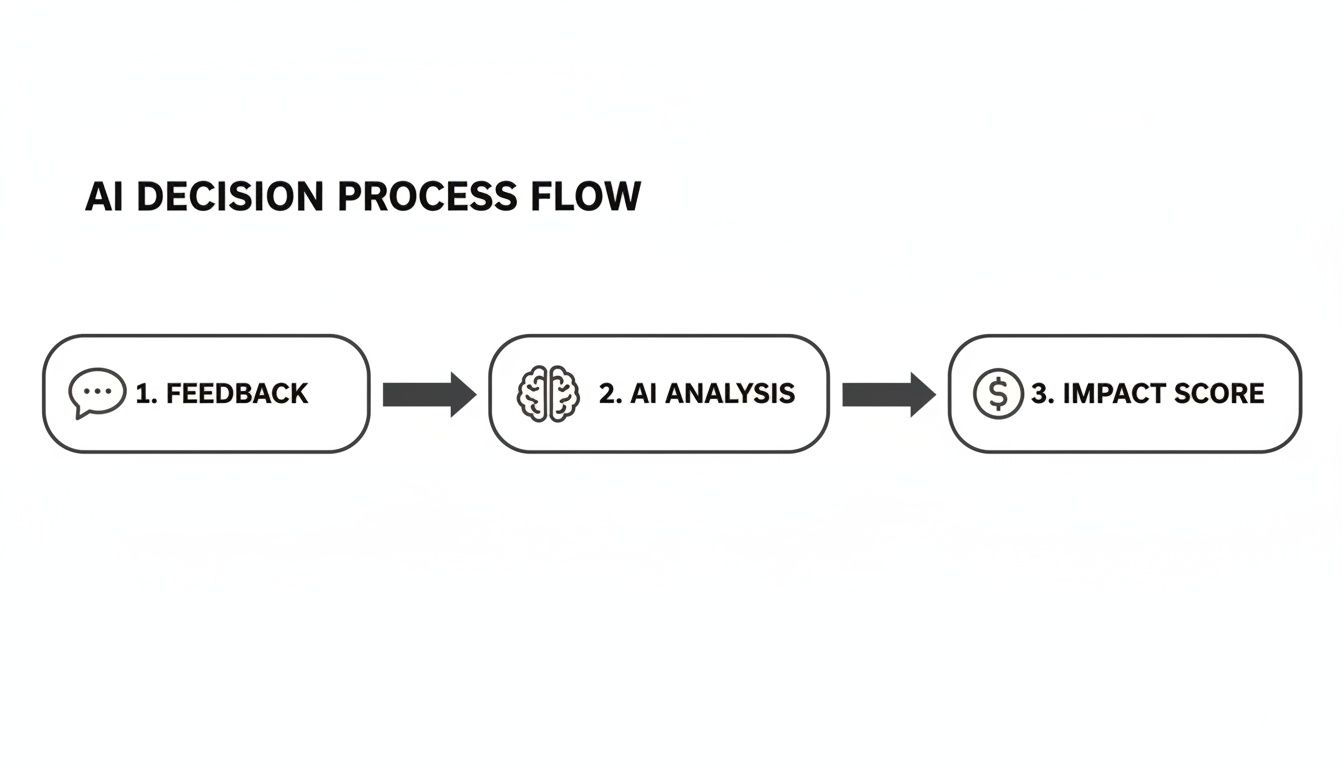
As you can see, the process flows directly from raw customer input through an AI analysis engine, spitting out a clear impact score that makes strategic choices much, much simpler.
Executing a Data-Driven Portfolio Review
Armed with these AI-powered insights, your portfolio review meetings will feel completely different. They become radically more effective. Instead of a room full of people debating opinions, your team can focus on a prioritized list of opportunities, each with a calculated dollar value attached to it. The entire conversation shifts from subjective arguments to strategic trade-offs, allowing you to make confident investment decisions.
This shift from subjective debate to objective analysis is the very heart of modern portfolio management. It gets your product, engineering, and revenue teams aligned around a shared, data-driven understanding of what actually moves the needle.
The right tooling makes a huge difference here. The market for project and portfolio software was on track to hit $7.24 billion by 2025, and for good reason. When teams can connect product usage metrics, support tickets, sales signals, and financial KPIs in one platform, the time it takes to make a decision collapses from months to days. You can finally score initiatives against tangible outcomes like projected ARR uplift or churn avoidance. If you want to dive deeper into these trends, some great project management statistics on monday.com can shed more light on their impact.
The last step is to execute and then obsessively monitor the results. As you launch initiatives, the system keeps tracking their real-world impact on adoption, revenue, and churn. This creates a powerful feedback loop, letting you constantly refine your strategy and rebalance the portfolio in near real-time. This is how you finally ditch the static annual roadmap for a responsive system that actually wins.
A Few Final Questions
Even with the best frameworks and AI tools in your corner, a few practical questions always pop up when you're in the trenches managing a product portfolio. Let's tackle some of the most common ones I hear from product leaders.
How Often Should We Review Our Product Portfolio?
For most SaaS companies, a quarterly portfolio review is the sweet spot. It's frequent enough to keep you nimble and responsive to market changes, but it's not so frequent that you give your product and engineering teams whiplash. This cadence gives everyone enough breathing room to make real progress between reviews.
That said, some events should force an immediate, unscheduled review. Don't wait for the end of the quarter if something big happens. These triggers include things like:
- A major competitor drops a game-changing new product.
- You see a sudden, alarming spike in customer churn.
- A massive enterprise deal hinges on building a specific new feature.
What Is the Biggest Mistake in Portfolio Management?
By far, the most common—and most expensive—mistake is running a "feature factory." This is what happens when teams get caught up in the motion of shipping, shipping, shipping, without any real strategy connecting their work to customer impact or a plan to retire things that aren't working. You end up with a bloated, confusing product that’s a nightmare to maintain and bleeds resources dry.
True portfolio management isn't just about building new things. It's just as much about having the discipline to say "no" and being ruthless about sunsetting what no longer serves the business or your customers. Success is born from focus, not volume.
How Do I Get Leadership Buy-In for These Tools?
If you want to get executives on board with new tools or processes, you have to speak their language. And that language is almost always financial impact. Don't frame it as a cost; frame it as a direct investment in growing revenue and making the business more efficient. Your job is to draw a straight line from the tool you want to the goals your C-suite obsesses over.
Build a business case that shows them exactly how data-driven prioritization takes the guesswork out of your roadmap. Show them how tying engineering work directly to ARR produces tangible results. For instance, use case studies or even internal data to show how AI-driven intelligence could cut customer churn by X% or speed up expansion revenue by Y%. When you do that, it's no longer a budget request—it's a strategic investment in the company's future.
Ready to turn all that qualitative feedback into insights that actually drive revenue? SigOS uses AI to put a dollar value on bugs and feature requests, helping you build a product portfolio that truly moves the needle. Learn how SigOS can de-risk your roadmap and accelerate growth.
Keep Reading
More insights from our blog
Ready to find your hidden revenue leaks?
Start analyzing your customer feedback and discover insights that drive revenue.
Start Free Trial →