Top Product Management AI Tools for 2026: Boost Your Strategy
Explore 12 best product management AI tools for 2026. Master feedback, roadmapping, and revenue-driven prioritization with top platforms.
In 2026, the question is no longer if AI will change product management, but how. The days of drowning in support tickets, endlessly debating roadmap priorities, and struggling to connect features to revenue are numbered. Modern product management AI tools are moving beyond simple summarization to offer autonomous analysis, revenue-driven prioritization, and predictive insights. These platforms don't just help you work faster; they fundamentally change how you discover opportunities and make decisions.
This guide cuts through the noise. It provides a comprehensive, in-depth look at the leading tools transforming the PM workflow, from analyzing qualitative feedback to building a data-backed roadmap. As we delve into the new era of AI-driven product management, it's crucial to understand the landscape of available solutions, including finding out about the top 12 AI tools for product management that are shaping the future.
Here, we'll go beyond marketing copy to give you a clear, honest assessment of the platforms that matter. For each tool, you will find:
- A breakdown of its core AI-driven features.
- Practical use cases and scenarios where it excels.
- An honest look at pros, cons, and limitations.
- Actionable checklists and evaluation criteria, including where solutions like SigOS fit.
This article is your resource for navigating the crowded market of product management AI tools. We provide the detailed analysis, screenshots, and direct links you need to find the right platform for your team's specific problems, helping you connect your development efforts directly to business impact.
1. SigOS
SigOS stands out as an autonomous product intelligence platform, designed to convert the noise of customer feedback into a clear, revenue-ranked priority list. It automates the arduous task of sifting through thousands of data points from support tickets, sales calls, and usage metrics. The platform connects directly to sources like Zendesk, Intercom, Salesforce, Mixpanel, and Jira, processing this disparate information to identify patterns that correlate with churn risk, expansion opportunities, and direct financial impact. For product teams buried in data, SigOS offers a direct line from raw feedback to strategic, ROI-driven decisions, often reducing weeks of manual analysis to under a minute.
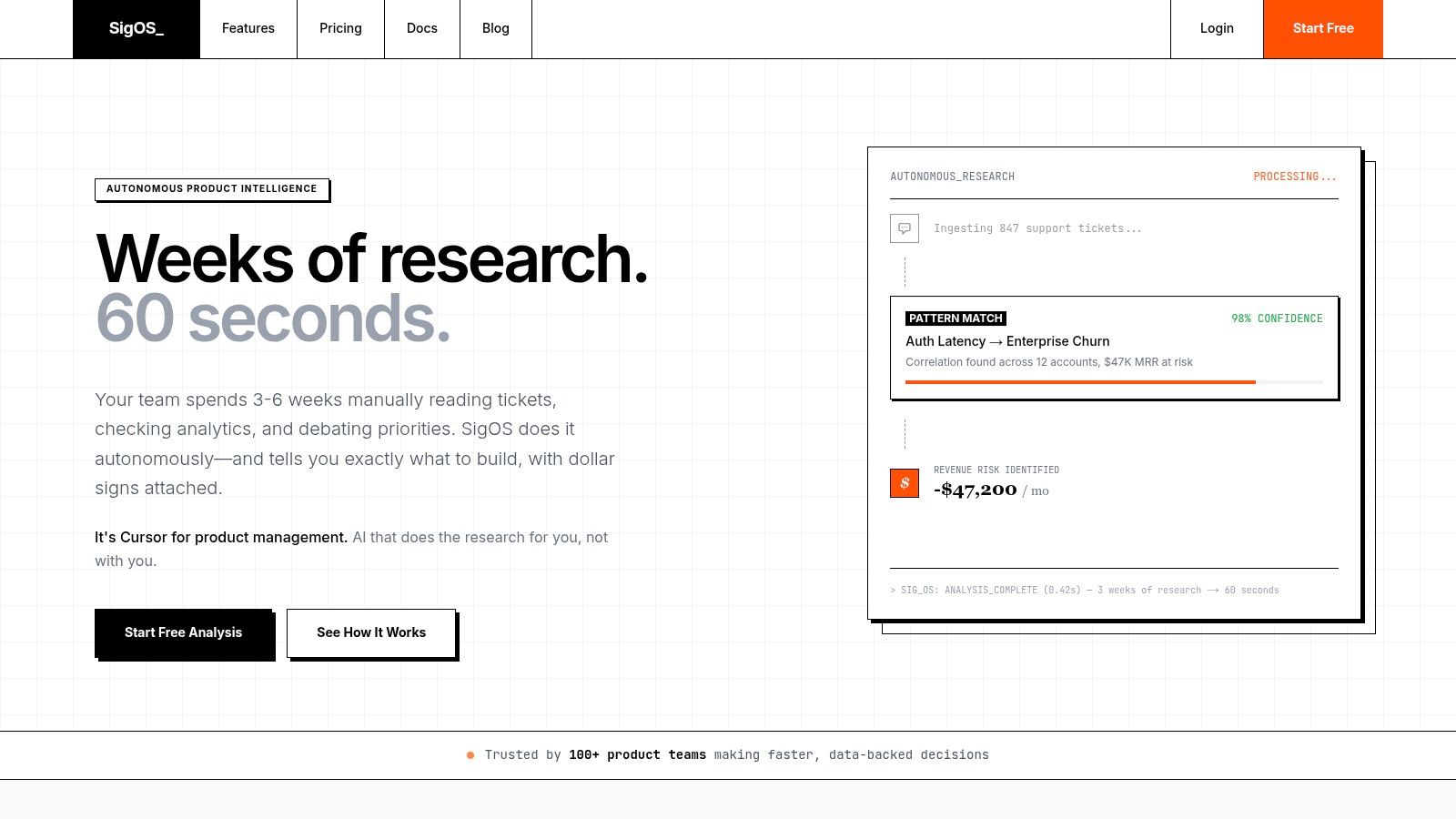
Its core strength lies in its ability to attach a dollar value to both bugs and feature requests. Instead of just flagging a popular request, SigOS determines its potential to unlock new deals or retain high-value customers, presenting a prioritized dashboard that highlights the most critical issues and opportunities. This makes it a powerful asset among product management AI tools for teams that need to justify their roadmap with concrete financial metrics.
Key Features & Use Cases
- Revenue-Ranked Prioritization: SigOS analyzes signals from CRM and billing systems (Stripe, Salesforce) to quantify the revenue impact of fixing a bug or building a feature. A PM can immediately see that a specific bug is costing the company $47K/month in at-risk contracts.
- Automated Issue & Opportunity Surfacing: The platform continuously monitors data streams and automatically creates Jira or Linear tickets for high-priority issues, complete with context and a calculated revenue-impact score.
- Churn & Expansion Alerts: Teams receive real-time notifications when the system detects patterns indicating a major customer is at risk of churning or when a feature request is blocking a significant expansion deal.
- Closed-Loop ROI Measurement: After a feature is shipped or a bug is fixed, SigOS helps teams measure whether the action produced the expected business outcome, closing the feedback loop.
Evaluation & Pricing
Pros:
- Autonomous Analysis: Drastically reduces manual research time from weeks to minutes.
- Revenue-Centric Insights: Directly ties product decisions to financial outcomes.
- Broad Integrations: Connects with a wide range of essential SaaS tools for a complete data picture.
- Security & Privacy: Models are not retrained on customer data, and all information is encrypted.
Cons:
- Opaque Pricing: Requires contacting sales for pricing, which can be a hurdle for teams needing quick budget estimates.
- Data Dependency: Best suited for companies with substantial feedback, usage, and revenue data; may offer limited value to early-stage startups.
SigOS provides a free initial analysis without a credit card, allowing teams to test its insights on their own data. Full pricing is available upon request from their sales team.
Choose SigOS if: You lead a mid-market or enterprise SaaS product and need to build a business case for every roadmap decision. Your primary goal is to prioritize work based on measurable revenue impact, churn reduction, and expansion potential.
Website: https://sigos.io
2. Productboard (with Productboard AI and Spark)
Productboard is a dedicated product management system designed to centralize feedback, structure prioritization, and build dynamic roadmaps. It stands out by embedding AI directly into established product management workflows, making it a natural fit for teams who want AI assistance without leaving their primary tool. Unlike platforms where AI is an add-on, Productboard’s AI is part of the core experience.
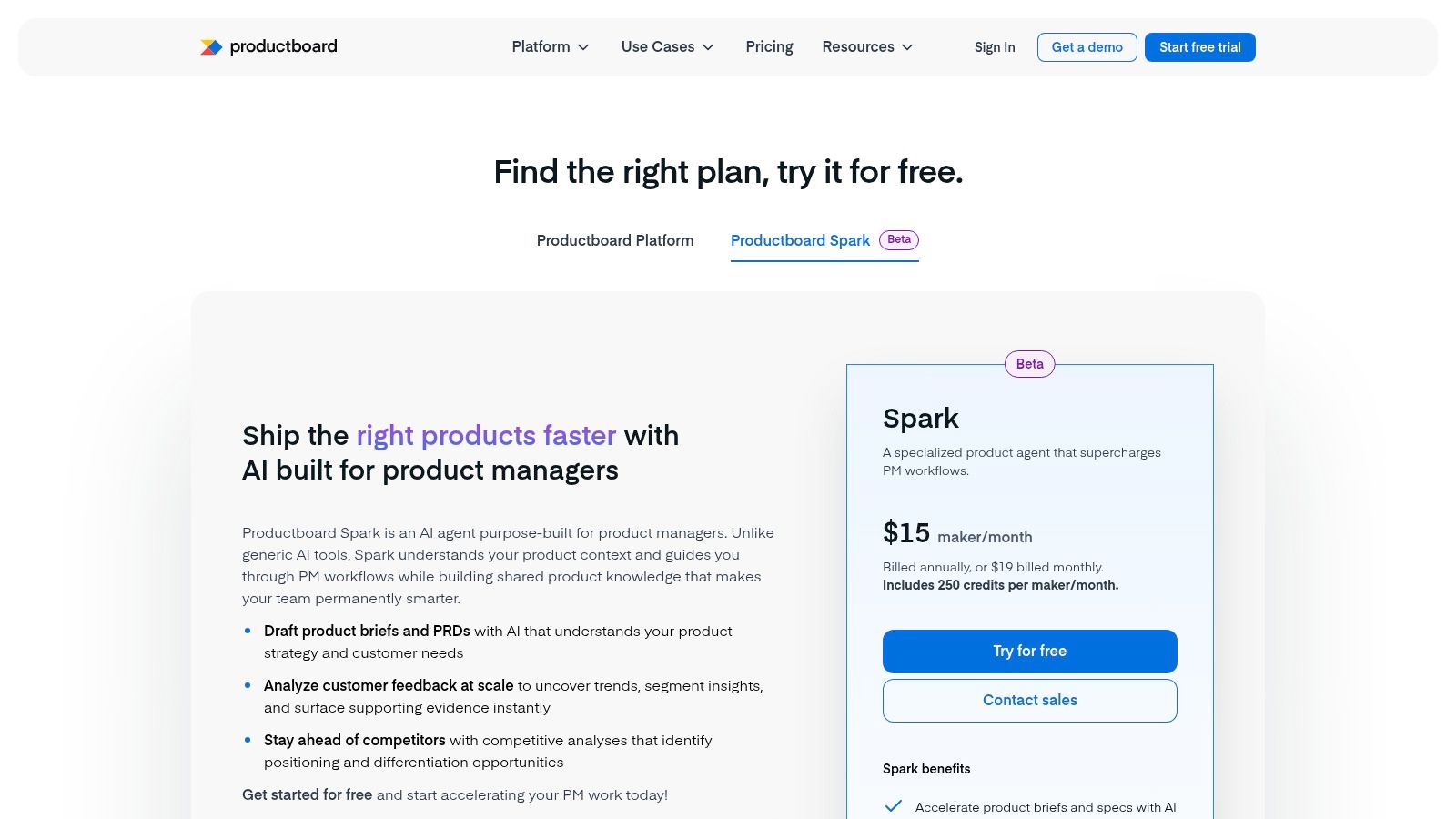
The platform offers two key AI components: Productboard AI, which helps summarize customer feedback and draft feature specs, and Spark, a PM agent for more complex tasks like creating first-draft PRDs or monitoring competitor activity. This combination makes it a powerful option among product management AI tools for teams aiming to accelerate their discovery and delivery cycles. The deep integration with systems like Zendesk and Slack ensures a continuous flow of feedback directly into the analysis engine. If you're looking for more context, exploring the role of AI for product development can provide a broader perspective on its strategic impact.
Evaluation Checklist
| Feature | Details |
|---|---|
| Key AI Capabilities | AI-driven summarization of feedback, PRD drafting with Spark agent, competitor monitoring. |
| Best For | PMs needing AI integrated into their daily system of record for roadmapping and prioritization. |
| Integrations | Strong native connections to Jira, Zendesk, Slack, Salesforce, and other feedback channels. |
| Pricing | Tiered plans (Pro, Enterprise) with AI features often gated to higher tiers or available as an add-on. Spark operates on a credit-based system. |
| Pros | Purpose-built PM workflows with AI baked in; excellent documentation on AI functionality. |
| Cons | Credit-based AI usage can be hard to budget; some key AI features are behind plan paywalls. |
Website: https://www.productboard.com/
3. Jira Product Discovery (Atlassian)
Jira Product Discovery is Atlassian’s answer for teams wanting to manage ideas, feedback, and prioritization directly within their existing development ecosystem. Its primary strength lies in creating a seamless bridge between product discovery and delivery. For teams already committed to Jira Software for engineering work, it removes the friction of handoffs by keeping everything on a single platform.
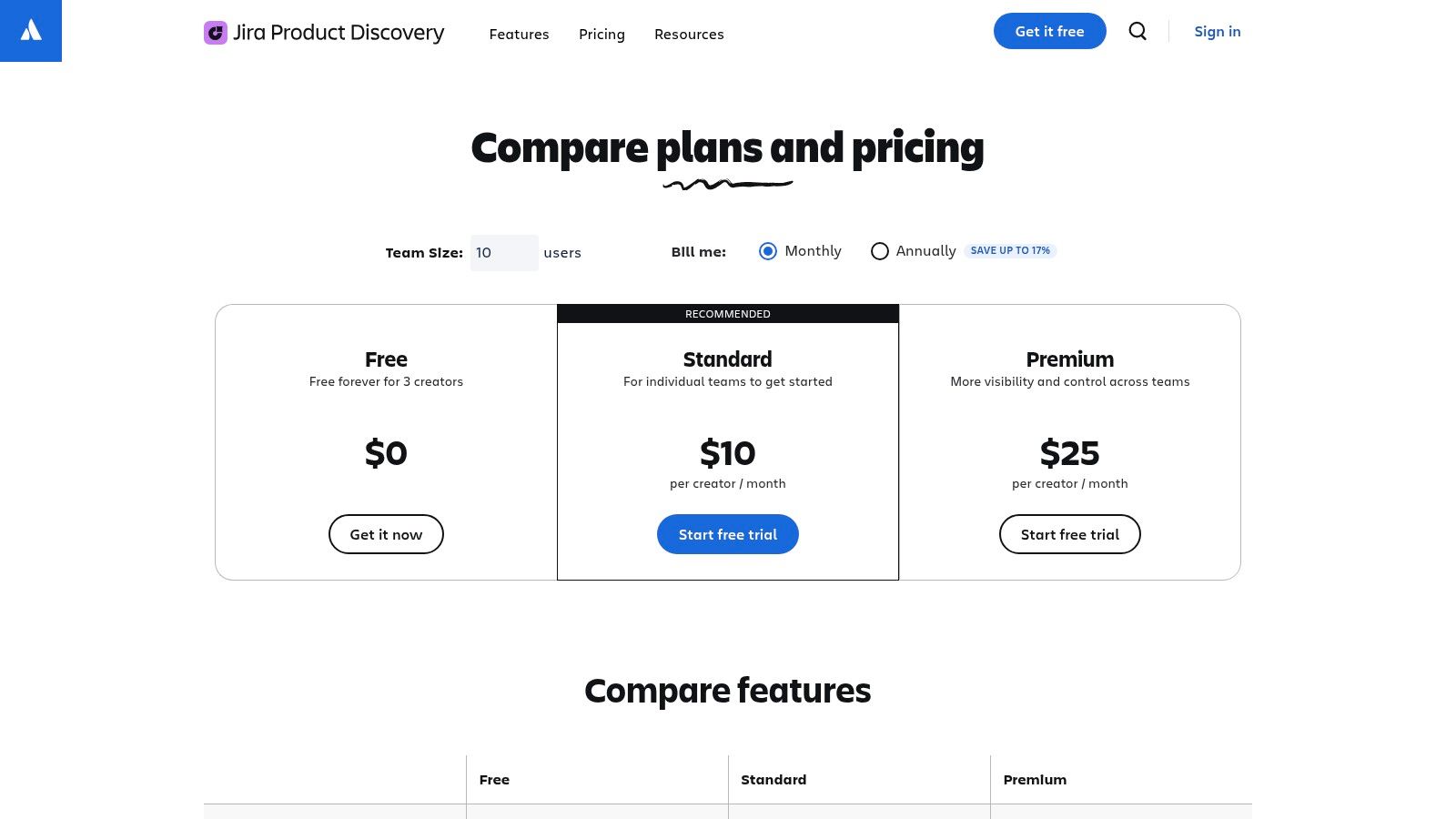
The platform integrates Atlassian Intelligence, which assists with summarizing long idea threads, refining descriptions, and performing natural language searches across all of Jira. This makes it a strong contender among product management AI tools for organizations aiming to centralize their entire product lifecycle. Instead of using a separate tool for roadmapping and then manually creating epics in Jira, product managers can directly convert prioritized ideas into actionable development work, maintaining context throughout.
Evaluation Checklist
| Feature | Details |
|---|---|
| Key AI Capabilities | AI-powered search across Jira, text summarization and editing for ideas and insights. |
| Best For | Teams deeply embedded in the Atlassian ecosystem that need a tight loop between discovery and delivery. |
| Integrations | Native and unparalleled integration with Jira Software, Confluence, and other Atlassian products. |
| Pricing | Free plan available with limits. Paid plans are billed per creator, which can become costly as the product team grows. AI features depend on the chosen plan. |
| Pros | Eliminates the gap between discovery and delivery; familiar interface for existing Jira users. |
| Cons | Per-creator pricing model can be expensive for larger teams; AI features are less extensive than some dedicated discovery platforms. |
Website: https://www.atlassian.com/software/jira/product-discovery
4. Aha! (Ideas and Roadmaps with AI)
Aha! is a well-established product management suite that excels in enterprise-level planning, from ideation to strategic roadmapping. Its AI capabilities are built into its mature workflows, focusing on helping large organizations manage and explore vast idea portals. This makes it a strong contender for companies that require robust governance, structured approval processes, and tight alignment between customer ideas and high-level business strategy.
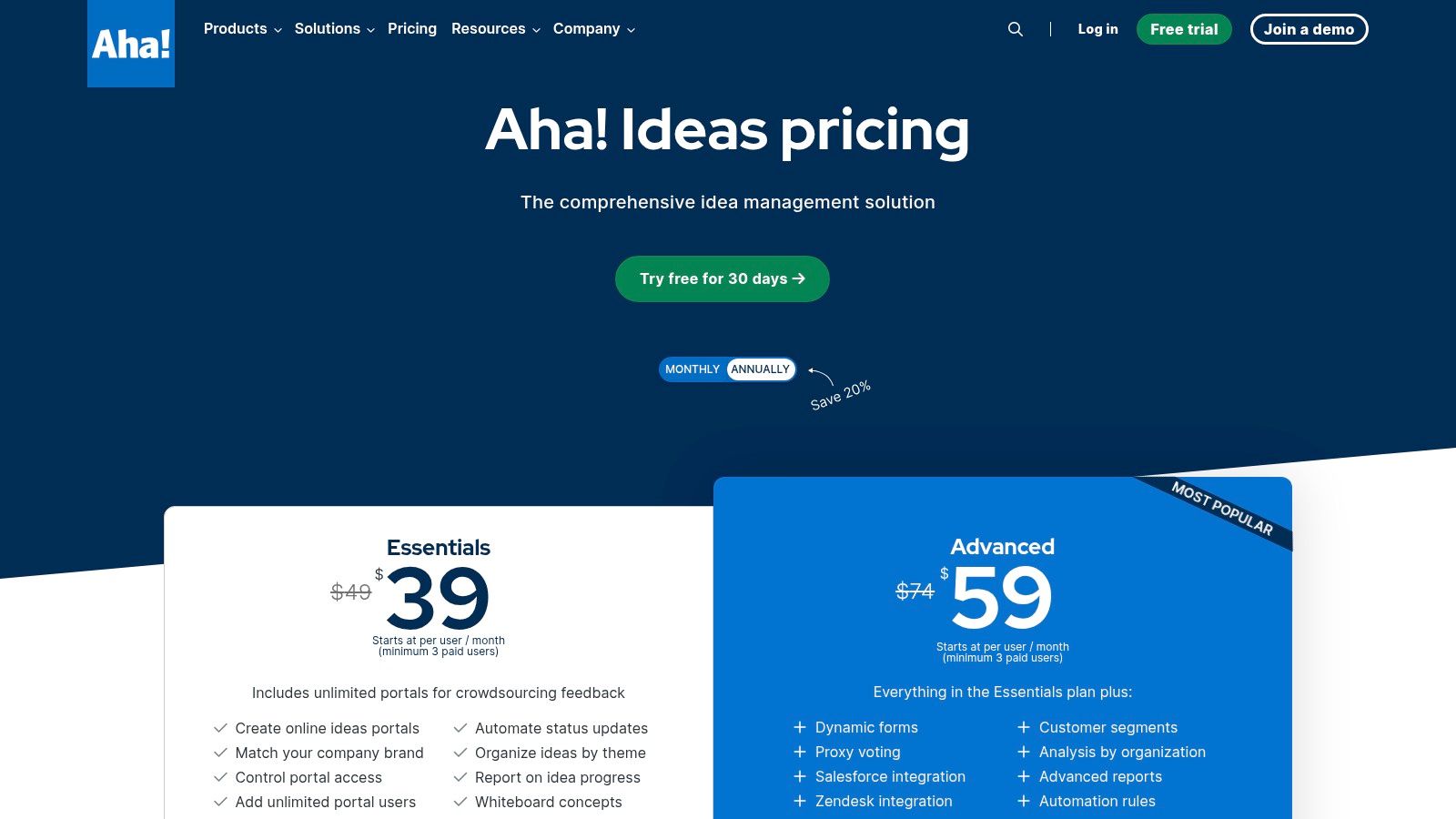
The platform’s AI features assist in the discovery phase by summarizing related ideas, identifying themes, and drafting requirements based on initial feedback. This focus on structured idea management makes it one of the more governance-oriented product management AI tools available. For organizations with complex hierarchies, Aha! provides the control needed to ensure new features align with strategic initiatives, and its approach to AI supports that mission. Understanding different methods for ranking features can be vital, and exploring various backlog prioritization techniques will help you make the most of the ideas generated.
Evaluation Checklist
| Feature | Details |
|---|---|
| Key AI Capabilities | AI-powered idea summarization and theme discovery, requirement drafting from initial ideas, workflow automation. |
| Best For | Enterprise PMOs and large product teams needing structured governance and AI-assisted ideation within a full suite. |
| Integrations | Extensive connections with Salesforce, Jira, Zendesk, Azure DevOps, and other enterprise systems. |
| Pricing | Module-based pricing (Ideas, Roadmaps, etc.) with AI features typically included in the Advanced Ideas plan. |
| Pros | Deep enterprise feature set covering ideation to roadmap; mature governance and approval workflows. |
| Cons | Pricing and tiers can be complex across modules; heavier admin overhead compared with lighter tools. |
Website: https://www.aha.io/ideas/pricing
5. airfocus (with AI Assist)
airfocus is a modern roadmapping and prioritization platform designed for flexibility. Its AI Assist feature helps teams write clearer descriptions, summarize complex topics, and generate inputs for prioritization frameworks. This makes it a great choice for lean PM teams that need a lightweight but powerful tool for creating visual roadmaps and portfolio views without the overhead of more monolithic systems.
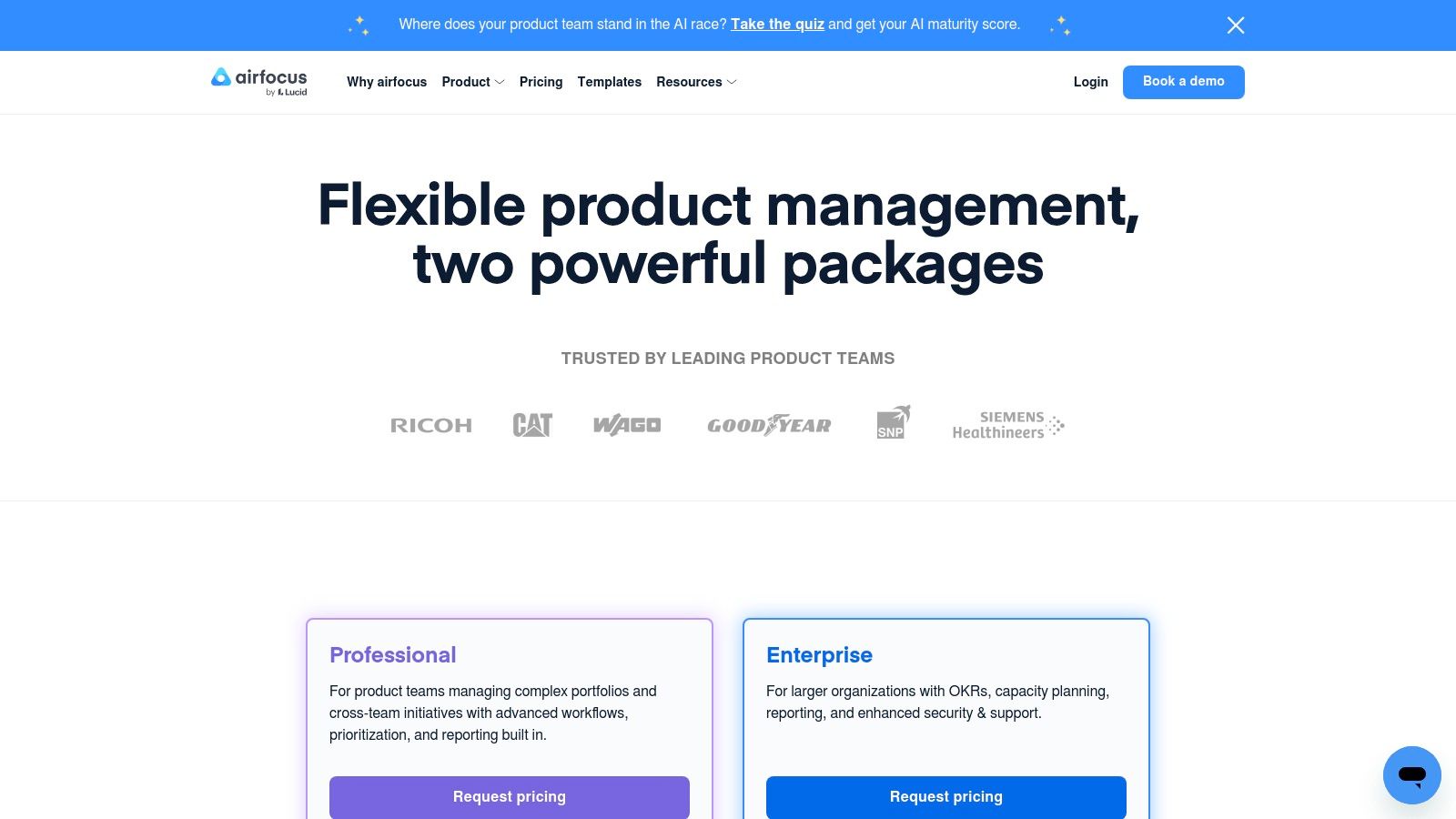
The platform’s strength lies in its customizable scoring frameworks (like RICE or custom models) that guide objective decision-making. AI Assist acts as a co-pilot within this process, helping you articulate the value of an initiative or quickly draft a user story. This approach is practical for teams who need AI help with the "what" and "why" before committing development resources. As one of the more accessible product management AI tools, its strong security posture (ISO/IEC 27001:2022 certified) also makes it a reliable option for mid-market companies handling sensitive data.
Evaluation Checklist
| Feature | Details |
|---|---|
| Key AI Capabilities | AI Assist for generating summaries, descriptions, and user stories; inputs for prioritization frameworks. |
| Best For | Lean PM teams needing a flexible, secure roadmapping tool with built-in AI writing assistance. |
| Integrations | Connects to key tools like Jira, Trello, Azure DevOps, and Slack, though many are on higher tiers. |
| Pricing | Multiple tiers (Pro, Business, Enterprise), with AI Assist and key integrations reserved for paid plans. |
| Pros | Quick to adopt with flexible prioritization models; solid security baseline for SMB to mid-market teams. |
| Cons | Advanced features and integrations are concentrated in higher tiers; smaller ecosystem compared with large platforms like Atlassian. |
Website: https://airfocus.com/pricing/
6. Canny (Autopilot AI)
Canny is a popular customer feedback management platform that excels at creating a direct line between users and the product team through public-facing portals and changelogs. Its AI component, Autopilot, is designed specifically to tackle the high volume of incoming feedback. Autopilot automates the tedious work of triaging, de-duplicating, and summarizing feedback from a wide array of sources, turning raw user input into actionable insights without constant manual intervention.
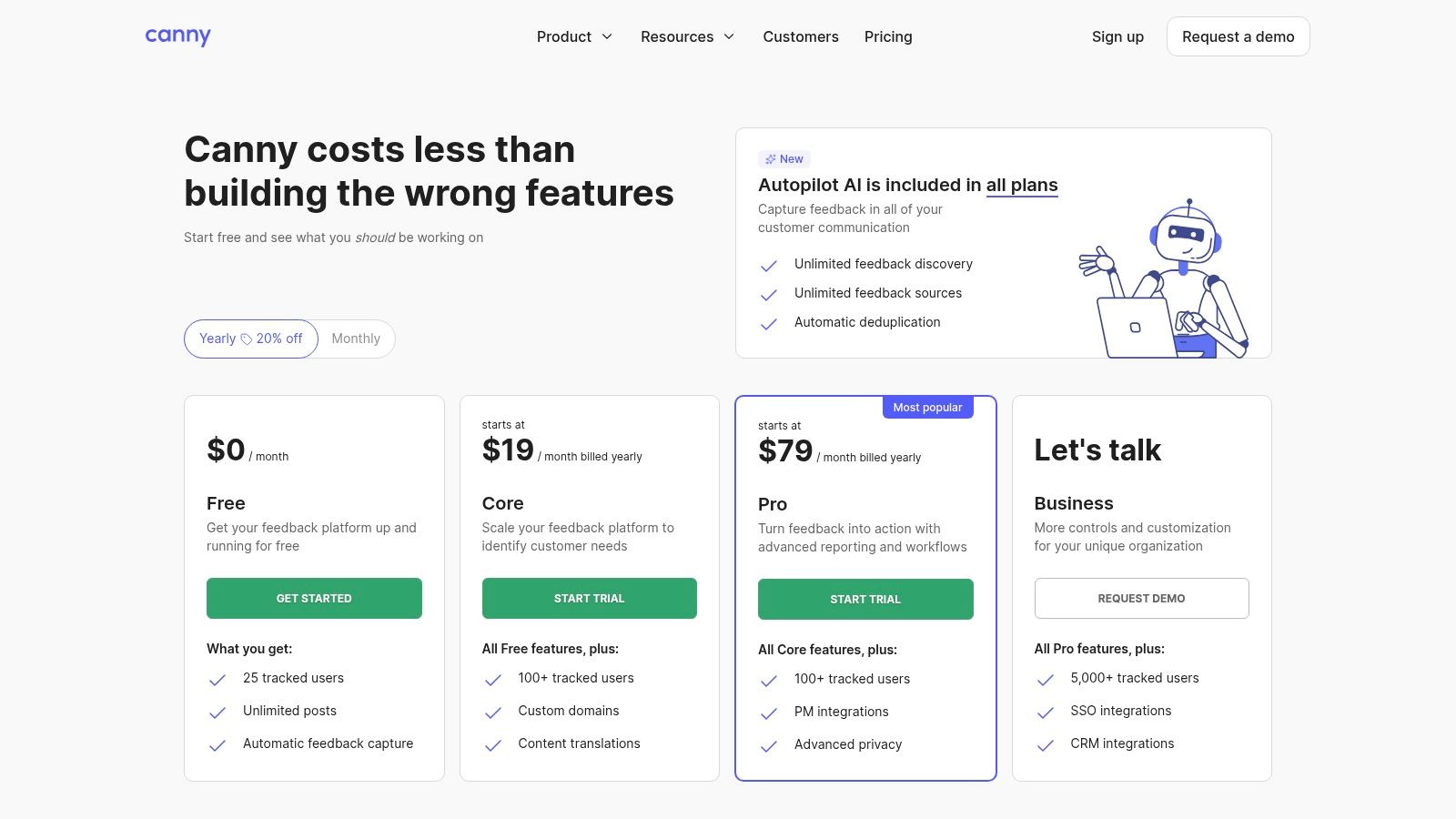
Unlike general-purpose AI tools, Autopilot is purpose-built for the feedback loop. It automatically extracts and organizes feedback from support tickets, app store reviews, sales calls, and more, merging duplicate requests and summarizing long comment threads. This makes Canny one of the most efficient product management AI tools for teams that want to manage a high-velocity feedback program. By cleaning and organizing the data at the point of ingestion, it ensures product managers spend their time on analysis and prioritization, not data entry.
Evaluation Checklist
| Feature | Details |
|---|---|
| Key AI Capabilities | Automatic feedback extraction from sources like Intercom and Zendesk, duplicate detection and merging, smart comment summaries. |
| Best For | Teams managing a public feedback portal who are overwhelmed with the volume of manual triage and want to streamline workflows. |
| Integrations | Connects with Intercom, Zendesk, Salesforce, Jira, Slack, and can ingest data from app stores and review sites. |
| Pricing | Autopilot AI is included in current plans (Starter, Growth, Business). Legacy plans may have different terms or credit-based usage. |
| Pros | Seamlessly combines public feedback collection with powerful private ingestion; AI features are included in standard plans. |
| Cons | Legacy plan users may face varied AI access terms; advanced PM integrations like two-way syncs often require higher-tier plans. |
Website: https://canny.io/pricing
7. Dovetail (AI customer intelligence)
Dovetail is a dedicated research and customer feedback repository that excels at turning qualitative data into actionable insights. It combines a central hub for housing user interviews, survey responses, and feedback with powerful AI features. This makes it a go-to platform for product teams who want to manage the entire discovery and voice-of-customer lifecycle in one place, from raw data ingestion to synthesized findings.
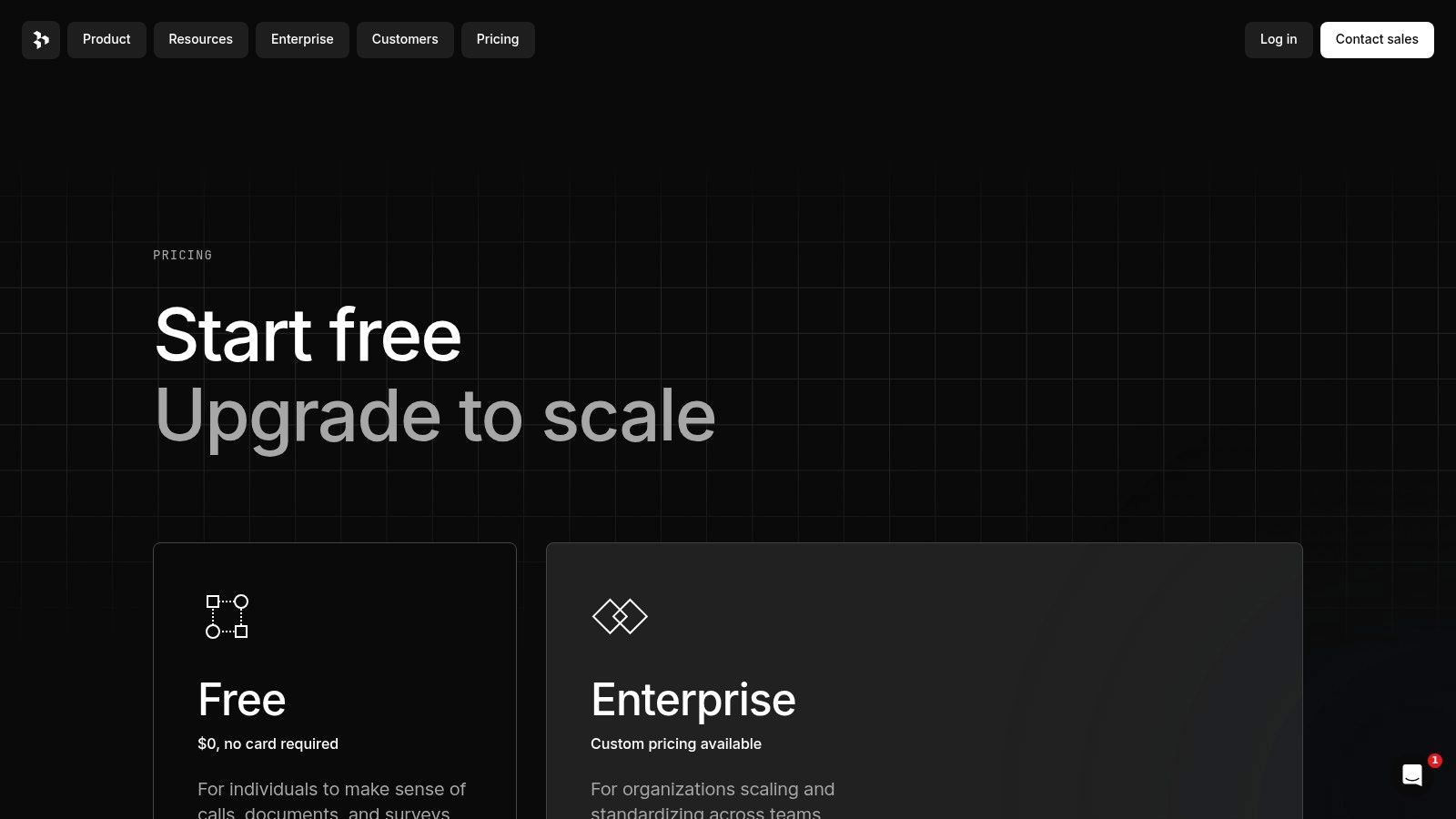
The platform’s AI is designed to augment the research process. It offers AI-generated summaries, automated thematic clustering, and a contextual chat to query entire research projects. For gathering and analyzing raw customer feedback, tools like Dovetail often depend on advanced capabilities such as AI transcription software for interviews to create the initial text data. As one of the more specialized product management AI tools, Dovetail's value lies in its ability to quickly surface patterns from thousands of unstructured data points. A deeper understanding of a great customer feedback analysis tool can highlight why this automation is so critical.
Evaluation Checklist
| Feature | Details |
|---|---|
| Key AI Capabilities | AI chat for querying research, automated summaries, cross-project semantic search, continuous feedback ingestion and classification via Channels. |
| Best For | Product managers and user researchers focused on deep discovery and continuous voice-of-customer analysis. |
| Integrations | Connects with Slack, Microsoft Teams, Zoom, Zendesk, and other sources to automatically pull in feedback and conversations. |
| Pricing | Tiered plans available, but enterprise-grade features and advanced AI capabilities often require a custom quote. |
| Pros | Rapid AI analysis at scale reduces manual tagging; recent product updates are heavily oriented toward AI-first use cases. |
| Cons | Legacy plans may not include the newest AI features; enterprise-level functionality can come with a significant cost. |
Website: https://dovetail.com/pricing/
8. Enterpret
Enterpret is an AI-native feedback intelligence platform built to manage and analyze high volumes of customer data. It moves beyond simple summarization by constructing a customer knowledge graph, which connects unstructured feedback from various sources directly to product features, customer segments, and business outcomes like churn. This unified model provides a clear, contextual view of the customer voice.
The platform's strength lies in its adaptive taxonomy, which automatically organizes feedback into relevant themes without manual setup. AI agents, such as Escalation Shield, proactively monitor for urgent issues and alert the right teams. This makes Enterpret a standout among product management AI tools for enterprise-scale companies that need to identify critical signals from a sea of data. By integrating with tools like Jira and Amplitude, it embeds actionable insights directly into development and analytics workflows.
Evaluation Checklist
| Feature | Details |
|---|---|
| Key AI Capabilities | Customer knowledge graph, adaptive taxonomy, proactive AI agents (Escalation Shield), thematic analysis. |
| Best For | Enterprise PMs and data teams managing massive feedback volumes who need deep, contextual insights. |
| Integrations | Connects with Amplitude, G2, Jira, Zendesk, Salesforce, Slack, and various customer data sources. |
| Pricing | Sales-led and quote-based, tailored for enterprise needs. Not suitable for small teams or startups. |
| Pros | Enterprise-grade data ingestion and analysis; connects feedback directly to business impact (e.g., churn). |
| Cons | Opaque pricing model; best value is realized only at a significant scale of feedback data. |
Website: https://www.enterpret.com/
9. Viable
Viable was an early mover in applying large language models to qualitative data, positioning itself as a powerful analysis engine for unstructured customer feedback. It specializes in ingesting data from sources like support tickets, app reviews, and call transcripts, then using AI to deliver narrative summaries, key themes, and sentiment analysis. This allows product teams to bypass the tedious manual work of tagging and sorting feedback, getting straight to actionable insights.
The platform’s strength lies in its focus on qualitative analysis, making it one of the most direct product management AI tools for understanding the "why" behind user behavior. Rather than offering a full suite of product management features, Viable concentrates on becoming the brain for customer voice data. It connects directly to common CX and product management systems like Zendesk, Intercom, and Gong, automatically pulling and analyzing new feedback to provide weekly digests. This continuous analysis helps PMs spot emerging trends and problems without constant manual monitoring.
Evaluation Checklist
| Feature | Details |
|---|---|
| Key AI Capabilities | AI-driven summaries, thematic clustering, and sentiment analysis of unstructured feedback. |
| Best For | Product teams looking to automate the analysis of qualitative feedback from multiple sources to inform roadmap decisions. |
| Integrations | Connects to major CX and feedback platforms like Zendesk, Intercom, Gong, Front, and Salesforce. |
| Pricing | Primarily sales-led enterprise pricing. Public self-serve plans are not consistently available, requiring a demo for a quote. |
| Pros | Strong, proven GPT-4 qualitative analysis; significantly reduces manual feedback triage and tagging for product managers. |
| Cons | Pricing is often opaque and sales-driven; lacks the broader project management features of an all-in-one PM platform. |
Website: https://www.viable.company/
10. unitQ
unitQ is an AI-driven product quality monitoring platform focused on translating user feedback into actionable engineering insights. It specializes in aggregating feedback from dozens of public and private sources, automatically classifying it into granular quality issues, and alerting teams to emerging problems. This allows product teams to move from reactive bug fixing to a proactive quality management strategy, directly connecting user pain points to the development backlog.
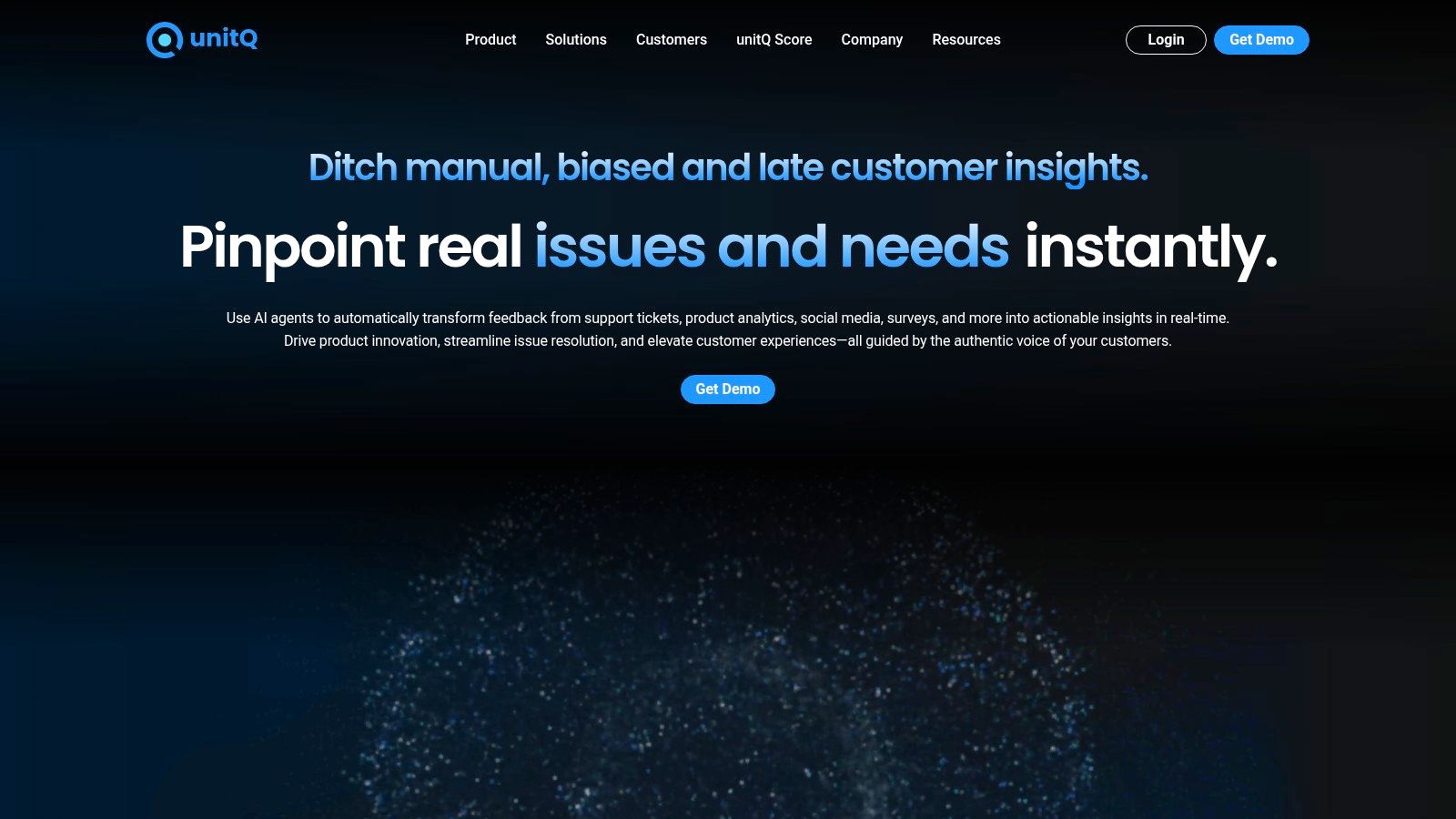
The platform’s strength lies in its ability to quantify the impact of product quality issues. By tracking the frequency and sentiment of specific complaints, unitQ helps PMs build a business case for prioritizing fixes over new features. It stands out among product management AI tools by bridging the gap between qualitative user signals and the incident management systems engineers use daily. The proprietary unitQ Score provides a clear metric to benchmark and track product quality over time, making it a critical tool for organizations focused on user retention and operational excellence.
Evaluation Checklist
| Feature | Details |
|---|---|
| Key AI Capabilities | AI-driven classification of feedback into granular quality monitors, Real-time issue detection and alerting, Quality trend analysis. |
| Best For | PMs and engineering leaders needing to quantify product quality debt and prioritize bug fixes with data. |
| Integrations | Connects to feedback sources like App Store/Play Store reviews, Zendesk, and social media, plus engineering tools like Jira, PagerDuty, and Slack. |
| Pricing | Enterprise-focused pricing, typically requiring a custom quote. Not suitable for small teams or startups on a tight budget. |
| Pros | Directly connects qualitative feedback to engineering workflows; Quantifies the business impact of bugs to aid prioritization. |
| Cons | Enterprise pricing can be a significant investment; Requires high volumes of user feedback to deliver maximum value. |
Website: https://www.unitq.com/
11. Gainsight PX (with Horizon AI)
Gainsight PX is a product experience platform that merges in-app user guidance with robust analytics and deep connections to the customer success ecosystem. Its distinction comes from linking product engagement directly to customer health and lifecycle programs. The platform is expanding its capabilities with Horizon AI, a suite of generative AI and agent-based features designed to automate insights and actions across the entire Gainsight suite.
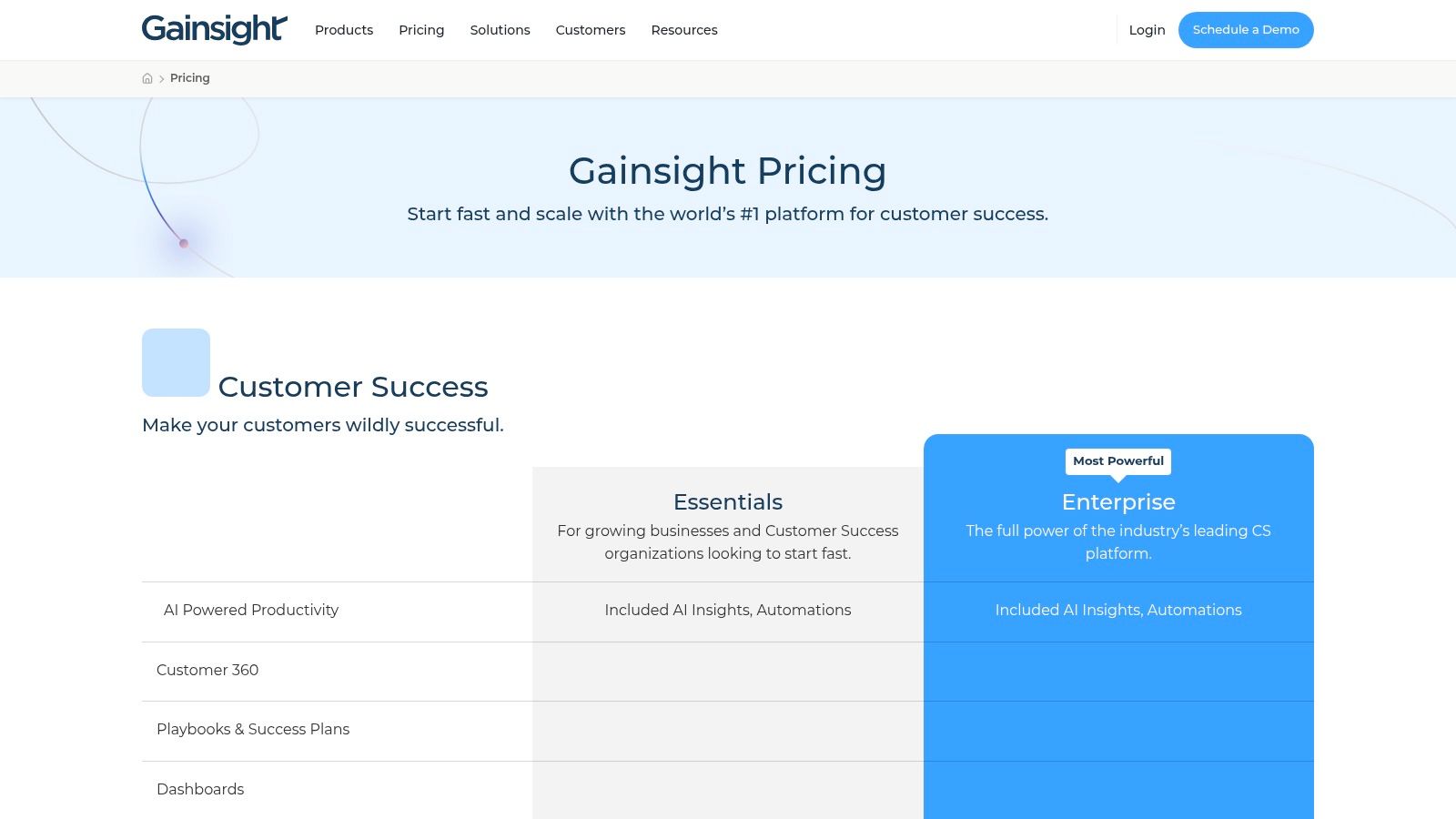
For product managers, this means Horizon AI can surface adoption risks, recommend in-app engagements for specific user segments, and help analyze feedback in the context of customer revenue or health scores. This makes it one of the more unique product management AI tools for B2B SaaS companies where product experience is tightly coupled with customer retention and expansion. If your team operates closely with customer success managers, Gainsight provides a shared language and data foundation. The platform’s analytics are powerful for tracking how in-app tours or guides impact user behavior and feature adoption over time.
Evaluation Checklist
| Feature | Details |
|---|---|
| Key AI Capabilities | AI enhancements under the Horizon AI umbrella, including generative insights and agent-based actions for user engagement and risk detection. |
| Best For | Enterprise B2B product teams who need to align product analytics and in-app guidance with broader customer success initiatives. |
| Integrations | Extensive ecosystem connections to Salesforce, Zendesk, and other Gainsight products like Gainsight CS and Community. |
| Pricing | Entirely custom quote-based pricing. Known to be at the higher end of the market, reflecting its enterprise focus. |
| Pros | Connects product experience data with the full customer lifecycle; strong enterprise-grade support and professional services are available. |
| Cons | Complex setup and operational overhead can be burdensome for smaller teams; pricing is not transparent and can be expensive. |
Website: https://www.gainsight.com/pricing/
12. Amplitude (AI Analytics and assistants)
Amplitude is a leading product analytics platform that has moved beyond just charts and dashboards. It provides PMs with a powerful suite of tools to understand user behavior, run experiments, and now, ask complex questions using natural language. Its AI capabilities are designed to lower the barrier to entry for deep data analysis, allowing product teams to self-serve insights without needing to become SQL experts.
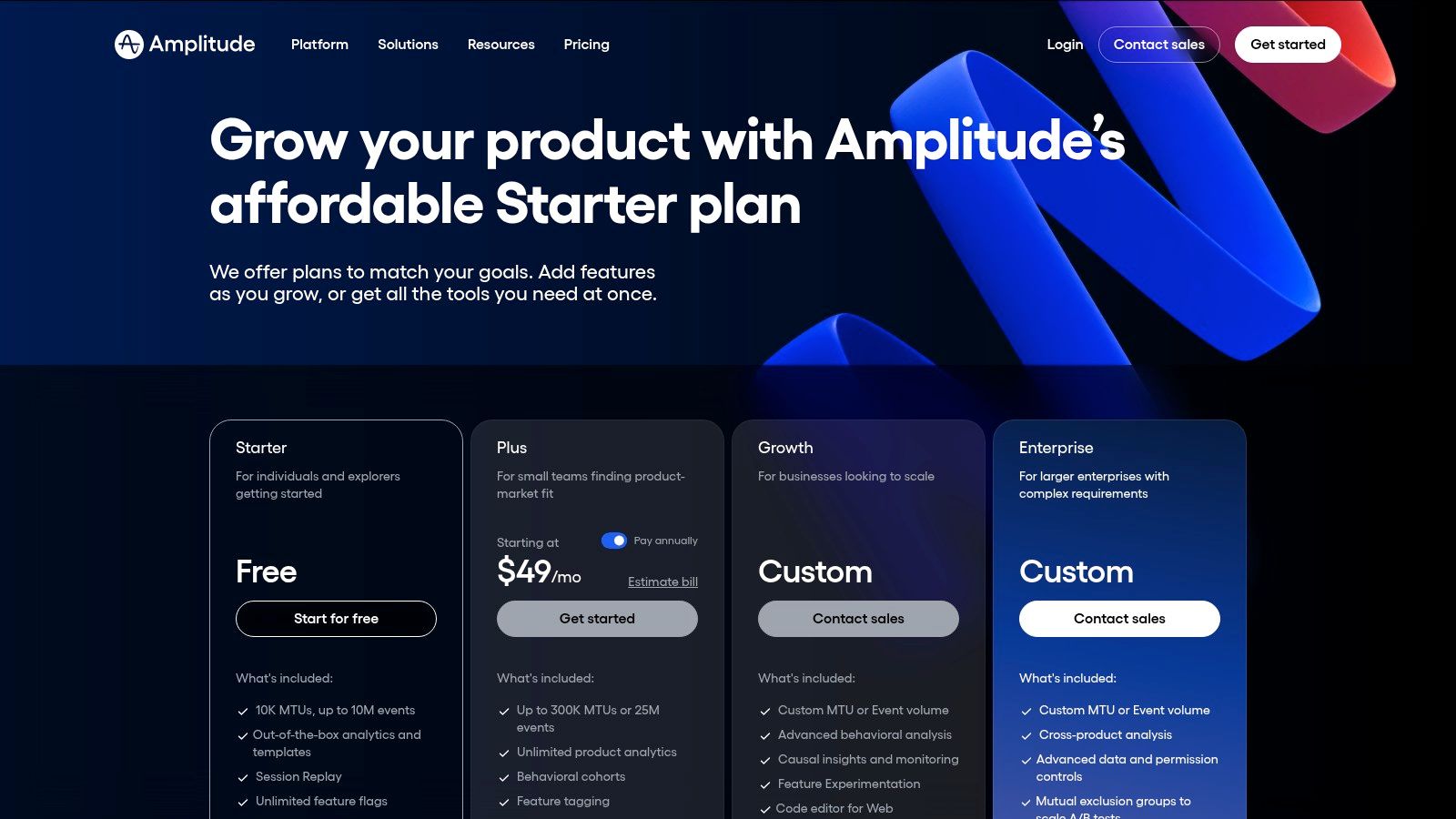
The platform’s AI assistant enables users to simply 'ask' for insights, like "which users are most likely to churn next month?" or "what behaviors correlate with conversion?". This functionality makes it one of the most accessible product management AI tools for data-driven decision-making. By combining this with integrated feature flagging, session replay, and data governance tools, Amplitude positions itself as an all-in-one system for understanding user actions and activating on those insights directly within the same platform. This tight loop between analysis and action is its key differentiator.
Evaluation Checklist
| Feature | Details |
|---|---|
| Key AI Capabilities | AI analytics assistant for natural-language queries, AI data assistant for quality checks and governance, anomaly detection. |
| Best For | Product teams who need to connect deep behavioral analytics with experimentation and activation in a single platform. |
| Integrations | Extensive ecosystem with connections to data warehouses (Snowflake, BigQuery), CDPs (Segment), and collaboration tools (Jira, Slack). |
| Pricing | Offers a free plan for startups. Paid plans (Plus, Growth, Enterprise) scale with monthly tracked users (MTUs) and feature access. |
| Pros | All-in-one analytics and activation; strong startup program and a robust free tier; natural-language queries democratize data analysis. |
| Cons | Costs can rise quickly on enterprise tiers as usage scales; may have feature overlap with existing dedicated experimentation tools. |
Website: https://www.amplitude.com/pricing
Top 12 Product Management AI Tools — Feature Comparison
| Product | Core capability ✨ | Quality & accuracy ★ | ROI / Pricing 💰 | Target audience 👥 | Standout strength 🏆 |
|---|---|---|---|---|---|
| 🏆 SigOS | Autonomous product intelligence — continuous feedback + behavioral telemetry ingestion | ★★★★☆ — 87% correlation, sub‑minute (~0.4s) analysis | 💰 Revenue-ranked priorities; free first analysis; sales‑led pricing | 👥 SaaS PMs, Support/Success, Growth, Technical leads | ✨ Revenue-impact scoring, real‑time alerts, instant issue creation; security‑first models |
| Productboard (AI & Spark) | PM system with AI drafting, PRD Spark agent and feedback ingestion | ★★★☆☆ — AI varies by feature/plan | 💰 Tiered plans; some AI gated, Spark uses credits | 👥 Product managers & PM teams | ✨ Purpose-built PM workflows with embedded AI |
| Jira Product Discovery | Idea & feedback capture with Atlassian Intelligence and Jira handoffs | ★★★☆☆ — AI availability depends on plan | 💰 Per‑creator pricing; plan-dependent AI | 👥 Teams already in Jira, delivery-focused PMs | ✨ Seamless handoff to Jira delivery and enterprise admin controls |
| Aha! (Ideas & Roadmaps) | Enterprise idea exploration to roadmap with AI assistance | ★★★★☆ — mature governance & controls | 💰 Module-based, complex tiers (quote‑based for some) | 👥 Enterprise PMs needing governance & approvals | ✨ Deep roadmap strategy and approval workflows |
| airfocus (AI Assist) | Roadmapping + customizable prioritization; AI Assist for summaries | ★★★☆☆ — flexible scoring models | 💰 Tiered; advanced features in higher tiers | 👥 Lean PM teams, SMBs/midmarket | ✨ Fast adoption, highly customizable scoring & views |
| Canny (Autopilot AI) | Feedback portal + Autopilot AI for extraction, de‑dup & summaries | ★★★☆☆ — Autopilot included in current plans | 💰 Public plans; legacy credit models may apply | 👥 SaaS teams using public feedback workflows | ✨ Public changelogs + automated de‑duplication and ingestion |
| Dovetail (AI VoC) | Research & VoC repository with AI chat, clustering and Channels | ★★★★☆ — strong semantic search & summaries | 💰 Recent AI‑first pricing; enterprise features custom | 👥 PMs and UX researchers focused on discovery | ✨ Continuous VoC Channels + contextual AI chat |
| Enterpret | AI-native feedback analysis with customer knowledge graph & agents | ★★★★☆ — enterprise-scale ingestion & alerts | 💰 Sales‑led / quote-based | 👥 Large feedback volumes, enterprise PMs | ✨ Knowledge graph + proactive AI agents (Escalation Shield) |
| Viable | GPT‑4 driven qualitative feedback analysis and themes | ★★★☆☆ — fast narrative insights (GPT‑4) | 💰 Often sales-led; self‑serve varies | 👥 PMs needing quick thematic analysis of feedback | ✨ GPT‑4 pedigree for narrative summaries |
| unitQ | Product quality monitoring: granular classification, score & alerts | ★★★★☆ — granular quality monitors & real‑time detection | 💰 Enterprise pricing; can be costly for small teams | 👥 Ops, Engineering, PMs focused on product quality | ✨ Bridges feedback to incident workflows and benchmarks |
| Gainsight PX (Horizon AI) | In‑app guidance + product analytics with emerging AI agents | ★★★★☆ — enterprise-ready with CS integration | 💰 Custom/quote-based; higher cost | 👥 Enterprise CS + Product teams | ✨ CS alignment, in‑app engagement + professional services |
| Amplitude (AI Analytics) | Product analytics with AI assistants, feature flags & session replay | ★★★★☆ — strong analytics & experimentation | 💰 Usage-based; scales with data/traffic | 👥 PMs focused on behavioral insights & experimentation | ✨ Natural‑language analytics + activation (flags, replay) |
Putting AI to Work: From Pilot to Profit
Adopting AI into your product management workflow is not about a single, magic-bullet solution. As we've explored through tools like Productboard, Gainsight PX, and Amplitude, the real power comes from creating a connected ecosystem where data-driven insights flow seamlessly from customer feedback channels directly into your development lifecycle. The journey begins by moving beyond the simple collection of features and focusing on the strategic integration of intelligence. The selection of product management AI tools you choose should act as a force multiplier for your team's judgment, not a replacement for it.
The key takeaway from our deep dive is that different tools solve different parts of the product puzzle. A platform like Dovetail or Enterpret excels at synthesizing qualitative data from user interviews, while Amplitude's AI brings predictive capabilities to your quantitative user analytics. Meanwhile, tools such as Canny and Aha! use AI to streamline the ideation and roadmap prioritization process. The goal is to build a "stack" that closes the loop, from identifying a customer need to shipping a solution and measuring its impact.
From Selection to Strategic Implementation
Choosing the right tool is just the first step. The true test is in the implementation and the cultural shift that follows. To avoid overwhelming your team or investing in shelfware, a phased approach is crucial.
- Start with a Focused Pilot: Don't try to boil the ocean. Select a single, high-impact pain point to address. Is your team drowning in uncategorized feedback from support tickets? A tool like Viable, unitQ, or SigOS could be your starting point. Are you struggling to connect roadmap initiatives to business goals? Look at airfocus or Jira Product Discovery.
- Define Clear Success Metrics: How will you know the tool is working? Your metrics should be specific and measurable. Examples include:
- Efficiency Gains: Reduction in weekly hours spent manually tagging feedback by 50%.
- Faster Insights: Decreased time-to-insight for critical bug reports from 48 hours to 4 hours.
- Revenue Impact: Dollar value of customer churn prevented by addressing AI-surfaced issues. A platform like SigOS is particularly strong here, as it can directly tie customer feedback and bug reports to revenue figures.
- Integrate and Iterate: Begin by connecting your chosen tool to one or two primary data sources, such as your CRM, helpdesk software, or analytics platform. Once you have a reliable flow of information and are seeing initial results, you can begin to expand. Integrate more data sources, introduce the tool to more team members, and socialize the insights across departments.
The Human Element in an AI-Powered World
Ultimately, the most successful product management AI tools are those that augment human expertise. They automate the tedious, surface the non-obvious, and provide the data to back up your intuition. They free up your product managers to spend less time on manual data processing and more time talking to customers, collaborating with engineers, and thinking strategically about the future of your product.
The shift is from reactive problem-solving to proactive, data-informed decision-making. By carefully selecting, piloting, and scaling these powerful tools, you can build a more responsive, customer-centric, and profitable product organization. The future of product management isn't about replacing the product manager with an algorithm; it's about creating a partnership between human insight and machine intelligence to build better products for everyone.
Ready to see exactly how much revenue is tied to your customer feedback and bug reports? SigOS connects directly to your support and CRM systems to quantify the financial impact of every issue, helping you prioritize the work that truly matters. See how much your customer feedback is worth with a SigOS demo today.
Keep Reading
More insights from our blog

Ready to find your hidden revenue leaks?
Start analyzing your customer feedback and discover insights that drive revenue.
Start Free Trial →