Agile Story Acceptance Criteria: Guide & Best Practices
Master agile story acceptance criteria. This guide covers writing, testing & integrating them with templates, examples, and anti-patterns.
A story gets marked done in Jira. Engineering says it works. QA says it passes. Then the product review starts, and the room gets awkward.
The workflow technically exists, but users can't recover from a common error state. The copy is unclear. Support immediately spots a case the team didn't think through. What shipped is functional, but it isn't acceptable.
That gap is where agile story acceptance criteria matter. They aren't admin overhead. They're the working agreement that tells product, engineering, and QA what must be true before anyone calls a story complete. Without them, every team member carries a slightly different definition of success. That's how rework starts, trust slips, and delivery becomes a negotiation after code already exists.
The bigger problem is that many teams still treat acceptance criteria like a one-time writing exercise. They fill in a few bullets during refinement, freeze them, and move on. In a SaaS product with constant discovery, support signals, usage shifts, and revenue pressure, that write-and-forget approach breaks fast.
Good acceptance criteria reduce ambiguity before development starts. Better acceptance criteria keep evolving when the product teaches you something new.
From 'Done' to 'Done Right'
On Monday, the onboarding story looks finished. By Thursday's review, it has turned into a negotiation.
The team shipped the new invite flow. The API returns the right response. The buttons work. Then sales points out that enterprise invitees hit a dead-end state after accepting. Support asks what should happen when someone opens an old invite after already joining. QA asks whether invite expiration was supposed to show an error, a resend option, or both. The PM can answer each question in the room, but that is the problem. The answers are arriving after the build.
Acceptance criteria fix that by turning a story from a rough intent into a working contract. They give product, engineering, and QA a shared test for what "acceptable" means before design tweaks, code decisions, and test cases start drifting apart. Good teams use that contract to reduce interpretation risk early. Great teams keep updating it when live behavior, support tickets, and conversion data show that the original definition of success was incomplete.
What this contract prevents in practice
The cost of weak criteria shows up fast, especially in flows like onboarding where edge cases affect activation and revenue.
- Rework after review: The ticket said users could accept an invite. It did not say a user who clicks the link twice should see "You're already set up" instead of an expired-link error. That sounds minor until design, frontend, QA, and support all have to revisit the flow after review.
- Testing gaps: QA can verify the happy path, but they cannot reliably test expiry, duplicate invites, role mismatches, or recovery paths if none of that is written down.
- Build drift: Engineers make reasonable choices to fill in blanks. Sometimes they solve for technical cleanliness while product needed a specific business outcome, such as preserving enterprise provisioning rules.
- Late stakeholder conflict: Everyone thinks they agreed in refinement. The disagreement only becomes visible once real screens and states exist.
Practical rule: If two smart people can read a story and imagine different outcomes, the story isn't ready.
I use one more test. If support can read the criteria and predict the customer complaint that will still happen, the criteria need another pass.
Tools can help teams start faster. An AI user story generator can produce a decent first draft. The value still comes from the review conversation around failure states, measurable user impact, and business constraints. Static bullets are not enough for high-stakes work.
The standard worth holding
A story is done when the agreed conditions are met, verified, and still make sense after the team learns something new. That last part gets missed.
For a low-risk internal admin tweak, static acceptance criteria may be enough. For signup, onboarding, checkout, permissions, and other flows tied to retention or expansion revenue, "done right" means the criteria can absorb new evidence. If analytics show invite acceptance drops on expired-link screens, or support sees repeated confusion around resend behavior, the contract should change. Teams that treat acceptance criteria as fixed paperwork miss that signal. Teams that treat them as living product agreements ship fewer surprises and get closer to outcomes that matter.
What Are Acceptance Criteria Really
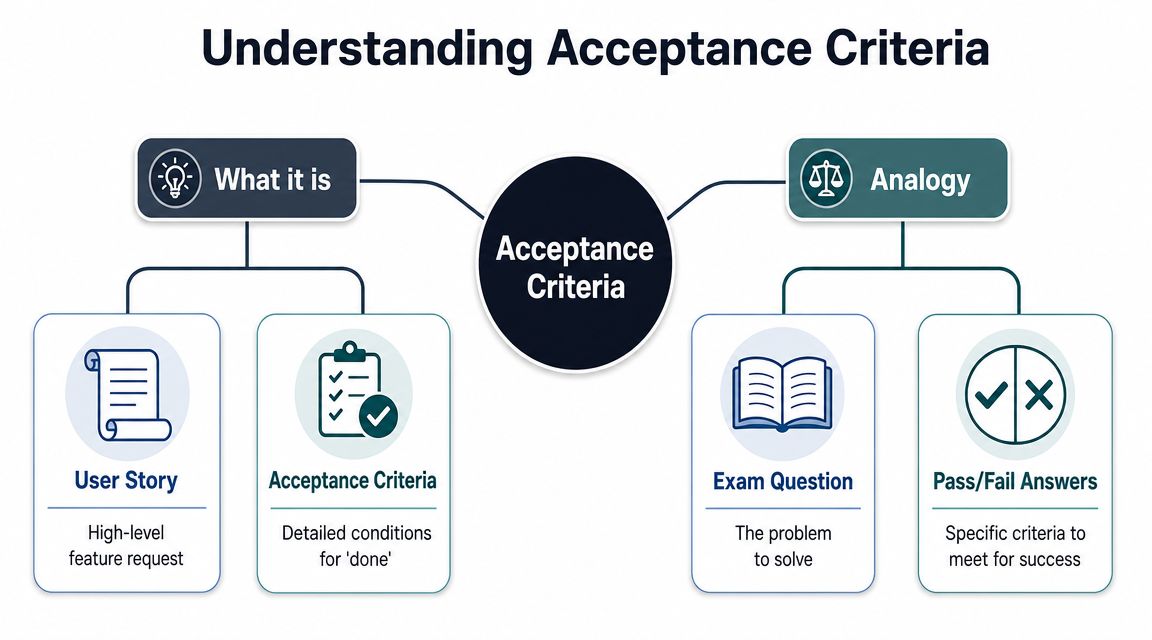
A user story is the prompt. Acceptance criteria are the grading rubric.
If the story says, “As an account admin, I want to invite a teammate so that I can set up access quickly,” the acceptance criteria define what must be true for that story to pass. They answer the question: what does success look like in observable terms?
The clean separation that helps teams
Most confusion comes from mixing three different things:
- User story: Why this matters to a user or business process.
- Acceptance criteria: What must be true for the story to be accepted.
- Implementation detail: How engineering chooses to build it.
That separation matters. When PMs write technical instructions into acceptance criteria, they lock the team into a solution too early. When they stay too vague, testers can't verify anything objectively.
A useful way to pressure-test your draft is to ask whether someone outside the original conversation could tell if the story passed or failed. If the answer is no, the criteria aren't ready.
What acceptance criteria are not
They are not a mini PRD. They are not design rationale. They are not a task list for developers.
They also shouldn't contain soft language like “easy,” “fast,” or “intuitive” unless those words are translated into something observable. A high-quality criterion should be independently testable and stated at the lowest functional level needed to verify the story, because acceptance criteria become the basis for acceptance testing and can be translated into automated tests, as explained in ThinkCloudly's guidance on agile acceptance criteria.
If a criterion can't produce a clear pass or fail result, it can't reliably gate completion.
A practical model to use
For most PMs, this simple framing works well:
- State the user outcome.
- List the conditions that must be true.
- Leave room for implementation choices.
Example:
User storyAs a user, I want to reset my password so that I can regain access to my account.
Acceptance criteria
- A user can request a password reset from the login screen.
- The reset link only works for a valid request.
- After setting a new password, the user can sign in with the new credentials.
- If the reset link is invalid, the user sees a clear recovery path.
If you need a fast first draft before refining with engineering and QA, tools like an AI user story generator can help produce starting points. The important part is what happens next. The team still needs to sharpen those drafts into testable conditions.
Key Formats and Real-World Examples
Agile story acceptance criteria often utilize one of two formats. The first is a simple checklist. The second is scenario-based Gherkin, usually written as Given, When, Then.
Neither is universally better. The right choice depends on the story, the team, and how precisely you need to describe behavior.
Checklist format for straightforward stories
A checklist works when the story is simple, the workflow is familiar, and the risk of interpretation is low.
Example for a SaaS billing page:
User storyAs an account owner, I want to update my billing contact so that invoices go to the right person.
Acceptance criteria
- The account owner can edit the billing contact from account settings.
- The form requires a valid email address.
- Saving the form updates the billing contact for future invoices.
- Users without billing permissions can't edit the billing contact.
This format is quick to read and easy to review in refinement. It also works well when QA can convert each bullet into a direct validation step.
Gherkin format for behavior-heavy stories
Use Gherkin when behavior changes based on context, roles, or state. It's especially useful when multiple edge cases matter.
Example for a trial upgrade flow:
Given a workspace is on a trial planWhen an admin selects a paid plan and confirms checkoutThen the workspace plan updates successfully
Given a workspace is on a trial planWhen a non-admin tries to upgradeThen the system prevents the action and explains that admin permissions are required
Given a workspace is on a trial planWhen checkout failsThen the workspace remains on the current plan and the admin sees the failure message
This format slows you down in a good way. It forces the team to think through state, trigger, and outcome.
Checklist vs. Gherkin decision guide
| Criterion | Checklist Format (Rule-Oriented) | Gherkin Format (Scenario-Oriented) |
|---|---|---|
| Best for | Simple validations and business rules | Multi-step flows and edge cases |
| Readability | Fast to scan in backlog tools like Jira or Linear | More verbose but more explicit |
| Team maturity needed | Lower | Moderate to high |
| QA handoff | Good for direct checks | Strong for scenario-based testing |
| Automation fit | Possible, depending on wording | Often easier to map to test scenarios |
| Risk of ambiguity | Higher if bullets are loosely written | Lower when scenarios are complete |
| PM effort | Faster to draft | Takes more thinking upfront |
Copy-ready templates
Use these as starting points.
Checklist template
- User can ___
- System prevents ___
- System displays ___
- Only ___ can perform ___
Gherkin template
- Given ___
- When ___
- Then ___
Use checklist format when the rules are stable. Use Gherkin when sequence and context change the expected result.
A practical mistake I see often is teams using Gherkin for everything because it looks more rigorous. That usually creates clutter. If a checklist already makes the behavior unambiguous, stop there.
A Checklist for Writing Great Acceptance Criteria
Knowing the format isn't the hard part. Writing criteria that survive real delivery pressure is where PMs separate themselves.
One practitioner account found that 40% of acceptance criteria drafted early needed significant revision by sprint planning, and some teams use a practical limit of no more than three criteria per story, while stories with six or more often need splitting, according to 6Sigma's discussion of agile acceptance criteria. That lines up with what many product teams experience. Criteria get weak when stories get bloated or when PMs try to finalize them too far in advance.
Make every criterion testable
Weak: “The login should be user-friendly.”Strong: “If login fails, the user sees an error message on the same screen.”
Weak criteria create opinion loops. Strong criteria create decisions.
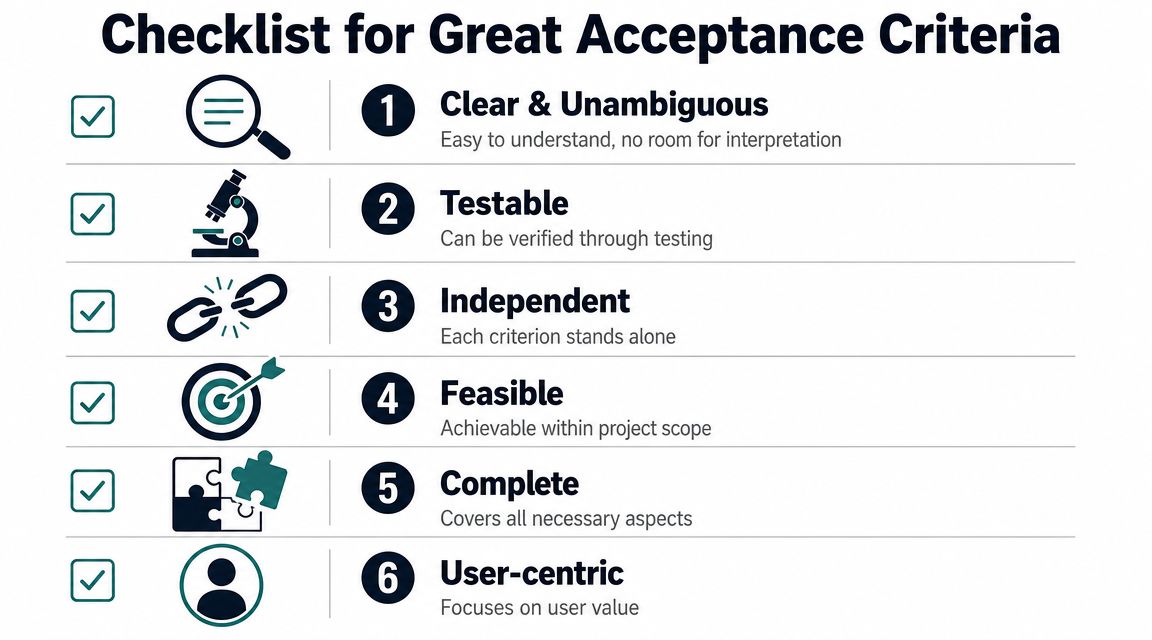
A useful litmus test is simple. Can QA verify it without asking what you meant?
Focus on outcomes, not implementation
Weak: “The system uses a modal with a red error state.”Strong: “If the entered email is invalid, the user sees an inline error and cannot submit the form.”
The first version dictates a design choice. The second version protects the user outcome while letting design and engineering do their job.
Keep criteria narrow enough to hold one idea
When a story has too many conditions, people stop seeing what's core and what's incidental. That's usually a sign the story is carrying multiple jobs.
Use this rule of thumb:
- If the story needs a long list of exceptions, split by user state or workflow.
- If the story mixes permissions, validation, and reporting, split by capability.
- If the team argues about which criterion matters most, the story is too broad.
Remove words that invite interpretation
Watch for terms like these:
- “Fast” unless you define a threshold
- “Secure” unless the requirement is concretely testable
- “Smooth” because nobody can verify it
- “Intuitive” because it's design feedback, not acceptance logic
Instead, describe the observable behavior.
Review habit: Read each criterion and ask, “What would fail?” If nobody can answer, the wording is too soft.
Write criteria collaboratively, then refine them
PMs should usually bring the initial draft. But the strongest criteria get shaped with engineering and QA before development starts.
If your team needs better structure upstream, it helps to align acceptance criteria with the broader requirements discipline in a product spec. This guide on how to write product requirements is a useful companion because it forces the same clarity at a larger level.
A short quality rubric
Before a story enters sprint planning, check whether its criteria are:
- Clear: A new team member could understand them.
- Testable: Each item has a pass or fail outcome.
- Relevant: Every item ties back to the user story.
- Non-prescriptive: They define success without dictating code.
- Manageable: The story still feels like one coherent unit.
If all five are true, the story is usually in good shape.
Common Acceptance Criteria Anti-Patterns
A story can look ready in Jira and still fail the team the moment work starts. The common failure mode is simple. The criteria read like process theater, not a working contract that helps product, engineering, QA, and analytics make the same decision.

The vague promise
This is the familiar ticket that says the product should feel better, faster, or easier.
Examples:
- Improve onboarding
- Make search easier
- Ensure the page is responsive
None of those gives the team a pass/fail decision. They push disagreement to QA, demo, or production. If the business goal is lower drop-off or higher conversion, the criteria should say what behavior changed and how the team will recognize success. That is the shift from static wording to a useful contract with real product impact attached.
The technical dictator
This pattern shows up when product specifies the implementation instead of the outcome.
Examples:
- Use a dropdown component for plan selection
- Save via this endpoint
- Add a caching layer before render
There are times when technical direction belongs in the story. Regulatory constraints, platform limits, and required integrations are real. But if the criterion dictates UI components or architecture without a business reason, product has crossed from defining success into solution design. That usually reduces engineering options and hides whether the user problem was solved.
The kitchen sink
One ticket collects every related behavior because the topic feels connected. Then the story includes validation, permissions, notifications, analytics, migration logic, and edge-case cleanup all at once.
The cost shows up fast. Estimation turns into guessing. QA tests the happy path and misses interactions. Review gets political because one stakeholder cares about the admin rule while another is focused on email behavior.
When this happens, map the workflow and cut the story at a user-visible boundary. A simple story mapping example for product teams usually exposes where one coherent slice ends and the next one starts.
The afterthought
Some teams start building and fill in acceptance criteria later so the ticket looks complete. At that point, the criteria are not guiding decisions. They are documenting what happened.
Late criteria do not reduce ambiguity. They record decisions after the expensive part is already done.
This is also where static acceptance criteria break down. If the team ships a feature intended to reduce checkout abandonment, the criteria should not stop at "user can submit payment." They should include the signals that tell you whether the change helped, hurt, or created a trade-off somewhere else. QA can still verify behavior, but product should also define what to watch after release.
The test-case dump
Another anti-pattern is turning acceptance criteria into a long list of test scripts. Product writes every permutation, QA copies it into test cases, and nobody can tell which lines define the business contract.
Acceptance criteria should stay focused on what must be true for the story to deliver value. Detailed coverage belongs in testing artifacts. If your team works on AI-enabled products or variable-output systems, separating those layers matters even more. This guide to defining test scenarios for AI development is a good reference for that distinction.
How to correct the pattern
The fix is usually operational, not philosophical:
- Rewrite vague language into observable behavior
- Remove implementation instructions unless they reflect a real constraint
- Split stories at a user outcome, not at a theme
- Write criteria before development starts
- Add post-release signals when the story is meant to change conversion, retention, adoption, or revenue
Teams that repeat these anti-patterns usually do not have a writing problem. They have a workflow problem, and the criteria expose it.
Integrating Acceptance Criteria into Your Workflow
Acceptance criteria work best when they move through the delivery cycle with the story. They shouldn't appear once in refinement and then sit untouched until demo day.
Teams that get value from agile story acceptance criteria treat them as a living artifact. The draft starts early, gets challenged before commitment, guides implementation, anchors testing, and closes the loop in review.
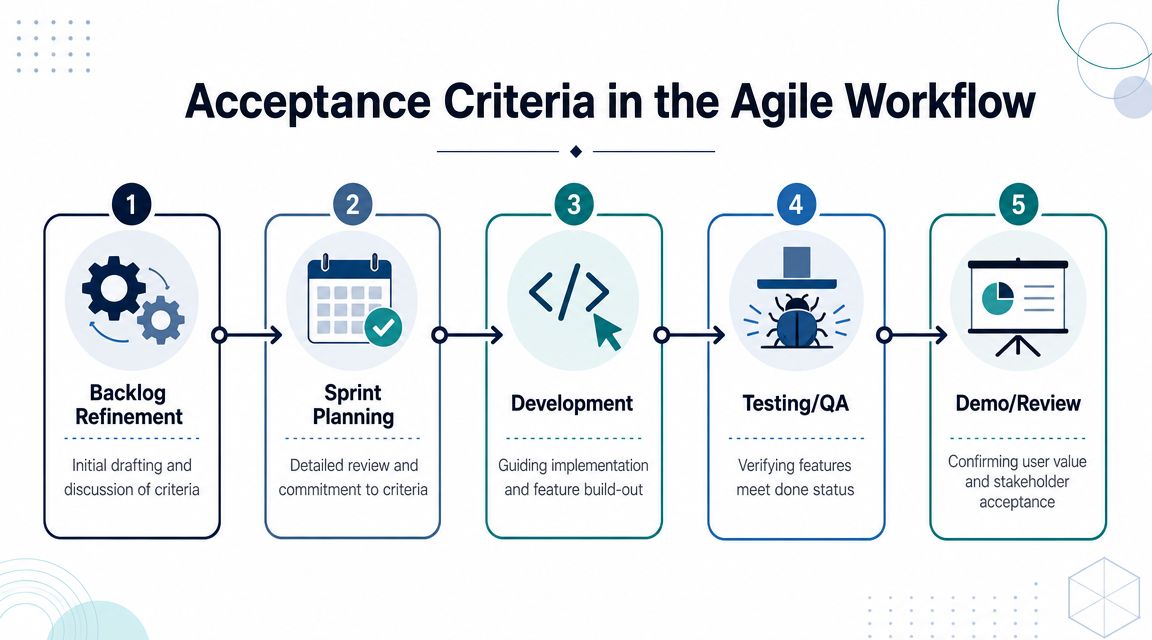
Backlog refinement is where the first draft belongs
A useful timing pattern is to draft initial acceptance criteria during backlog refinement roughly 2 to 3 sprints before implementation, as discussed in ArgonDigital's article on agile stories and technical stories. That timing gives the team something concrete to react to without locking the story too early.
Refinement is where the PM should surface intent, edge cases, and known constraints. It isn't the moment to wordsmith every line forever.
Sprint planning is where the team commits to the contract
By planning, the criteria should be sharp enough that engineering and QA know what they are signing up to deliver and verify.
Useful questions in planning:
- What user state is assumed here?
- What happens if the main action fails?
- What roles or permissions change behavior?
- Is anything in these criteria really a separate story?
For teams that need more rigor around behavior-focused validation, this guide on defining test scenarios for AI development is useful because it mirrors the same discipline of translating expectations into concrete scenarios.
Development and QA should use the same artifact
Acceptance criteria lose value when engineers treat them as product notes and QA treats them as optional context. The same set of conditions should guide both implementation and verification.
That works better when stories sit in a broader structure the team can trace. If your backlog gets fragmented, a story mapping habit helps connect criteria to a larger workflow. This story mapping example is a practical reference for that.
Good teams don't hand acceptance criteria from product to QA. They work from the same contract throughout delivery.
Review is the final acceptance point
At review time, product shouldn't be deciding from memory whether the work feels right. The team should check whether the agreed conditions were met.
That doesn't remove judgment. It puts judgment where it belongs. Product can still reject a story if new learning changes the requirement. But at least the conversation becomes explicit: did the team fail to meet the criteria, or did the criteria themselves need revision?
That distinction matters. It prevents blame from replacing process improvement.
The Next Level: Data-Driven Acceptance Criteria
Most advice about acceptance criteria stops too early. It teaches PMs how to write the initial contract, but not how to keep that contract useful once real customer evidence starts arriving.
That's a gap. Current guidance generally explains that criteria should be explicit, testable, and aligned to the story, but it often doesn't address governance for updating them in AI-assisted or continuous discovery environments, as noted in Intellisoft's overview of user story acceptance criteria.
Static criteria break in dynamic products
A PM writes acceptance criteria for a new self-serve upgrade flow. The team ships it. A week later, support conversations show that users with multi-workspace access are getting stuck during plan changes. Sales hears the same issue in expansion calls. Usage data shows repeated retries from high-value accounts.
The original criteria may have been well written. They just weren't complete enough for the actual conditions the product exposed.
That's why I think of acceptance criteria as dynamic contracts, not static tickets. The first version captures what the team knows before delivery. The next version should absorb what the product teaches after exposure to real behavior.
What dynamic acceptance criteria look like
This doesn't mean rewriting every story forever. It means defining clear moments when teams reopen acceptance logic.
Good triggers include:
- support tickets revealing a repeated edge case
- product usage showing drop-off in a critical flow
- sales or success teams identifying a blocker for an important account
- new behavioral signals changing the business impact of a known issue
When that happens, the PM has to make an explicit choice. Is this a bug against the existing criteria, or is it new learning that requires updated criteria and a follow-up story?
A lightweight governance model
Teams don't need a committee for this. They need a habit.
Use a simple approach:
- Keep the original accepted criteria in the ticket history.
- Log the new signal that challenged the original assumption.
- Decide who owns the update, usually PM with engineering and QA input.
- Create revised or additional criteria in a new story if the learning changes expected behavior.
- Preserve traceability so nobody loses the original decision context.
Criteria should be stable enough to guide delivery, but flexible enough to incorporate evidence that changes what “acceptable” means.
This is the broader product discipline behind data-driven decisions. If your team is trying to move beyond gut feel, acceptance criteria are one of the most practical places to start. They force you to convert signals into concrete product decisions.
The mindset shift that matters
Static acceptance criteria ask, “What do we think success looks like right now?” Data-driven acceptance criteria ask, “What conditions must be true for this to succeed in the product customers are currently using?”
That second question is harder. It's also the one that keeps teams from treating shipped code as the end of learning.
From Ambiguity to Alignment and Impact
Good agile story acceptance criteria do more than clean up tickets. They create a shared definition of success before delivery, give QA a real basis for verification, and protect engineering from building against assumptions nobody named.
The baseline matters. Clear, testable criteria reduce ambiguity. The workflow matters too. Criteria should be drafted early enough to shape the work, refined with the team, and used all the way through review. And the advanced move matters most in modern SaaS teams. The best criteria don't stay frozen when customer evidence says the original contract missed something.
That's the difference between process compliance and product discipline.
If you want stronger product execution, start by tightening the contract around every story. Then make sure the contract can evolve when the product teaches you something new. The result isn't just cleaner delivery. It's better alignment, less wasted effort, and a much better shot at shipping work that actually matters.
For teams that need the broader artifact around story-level requirements, this guide on how to write a PRD complements acceptance criteria well because it strengthens the thinking before stories ever hit the backlog.
If your team is drowning in support tickets, scattered feedback, and hard-to-rank product requests, SigOS helps you turn that noise into clear prioritization. It surfaces the issues and feature demands most tied to churn, expansion, and revenue impact, so you can update product decisions with real evidence instead of opinion alone.
Keep Reading
More insights from our blog


Ready to find your hidden revenue leaks?
Start analyzing your customer feedback and discover insights that drive revenue.
Start Free Trial →