Product Manager Responsibilities The Definitive Guide
Explore a complete guide to product manager responsibilities. Learn about daily tasks, KPIs, prioritization, and how AI tools help PMs drive revenue and growth.

Your Slack is full. Sales wants a feature for a deal that's “about to close.” Support has three angry threads about a bug. Engineering wants time for a refactor that nobody outside the team can see. Leadership asks for the roadmap by Friday.
That’s the job.
A lot of articles make product manager responsibilities sound neat and linear. Real work isn't neat. Most PMs spend their day translating competing demands into decisions the team can ship.
The role hasn't changed. You still need to understand customers, set direction, prioritize trade-offs, and align people who see the world differently. What has changed is how good PMs do that work. The best teams no longer rely on the loudest customer, the highest-paid stakeholder, or the most confident guess. They use product intelligence, behavioral data, and revenue context to make decisions with more precision.
Beyond the Backlog The Modern Product Manager's Dilemma
Monday at 9:12 a.m., a new request lands from sales tied to a late-stage deal. By 9:30, support has surfaced a churn risk. Before lunch, engineering asks for time to pay down technical debt that has already slowed the last two releases. The backlog reflects all three. It still does not tell you what to do first.
That is the primary job. The backlog is a record of demand, not a decision system.
Many new PMs treat prioritization as a sorting exercise. In practice, it is an arbitration problem across teams that measure success differently. Sales sees revenue at risk. Support sees customer pain. Engineering sees compounding delivery cost. Leadership sees portfolio bets. If you do not define a common frame for evaluating those inputs, the roadmap becomes a running transcript of whoever argued last.
Pragmatic Institute has reported that PMs spend large portions of their time in reactive work and far less time on strategy than they want. The exact percentages matter less than the pattern. Reactive intake consumes the calendar unless the team builds a better operating model.
A useful rule is simple. If priorities change because a stakeholder is loud, senior, or attached to a single account, you are not really prioritizing. You are accepting requests.
Modern product work has changed meaningfully in this regard. Strong PMs still make trade-offs, but they no longer need to make them from anecdotes alone. Product intelligence platforms let teams connect usage patterns, account fit, expansion potential, and retention risk to each request. That changes the conversation from “who asked for this?” to “which customers does this affect, what revenue does it influence, and what happens if we wait?”
The trade-offs get sharper, not easier. A request from your biggest prospect may still lose if usage data shows the problem barely affects your core accounts. A painful workflow issue may move up fast if it hits customers that match your Ideal Customer Profile and correlates with churn. A refactor may deserve priority when the data shows it blocks high-value adoption work for the next quarter.
Methods still matter. A clear intake process and strong backlog prioritization techniques reduce noise. But frameworks by themselves break down when every input arrives as a one-off opinion with no customer, behavioral, or revenue context attached.
Modern PM responsibility starts before the roadmap. It starts with building a system that turns scattered requests into comparable bets. That is the difference between managing a backlog and running a product.
The Four Core Pillars of Product Management
The cleanest way to understand product manager responsibilities is to think like an architect. An architect doesn't just sketch a building. They decide what it's for, study the site, sequence the build, and make sure the final structure works for the people using it.
Product management works the same way.
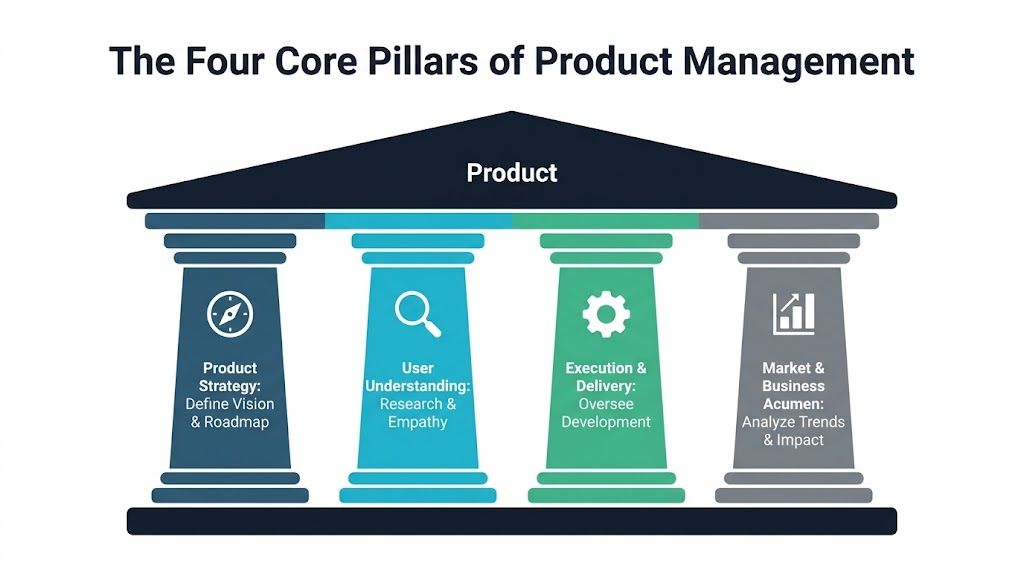
Vision and strategy
This is the blueprint.
A PM defines what problem the product should solve, for whom, and why that problem deserves the team's time. Good strategy isn't a slogan. It's a set of choices about target users, market position, sequencing, and trade-offs.
If the product serves multiple segments, strategy starts with knowing which customer you're really building for. That's why work like defining an Ideal Customer Profile matters. Without that clarity, teams over-serve edge cases and under-serve the buyers who shape retention and expansion.
A weak strategy usually sounds broad. “Improve onboarding.” “Increase engagement.” “Modernize the platform.” Those phrases aren't useless, but they don't help a team decide between three competing bets next Tuesday.
A usable strategy does.
Discovery and research
This is the site survey.
PMs are responsible for understanding customers thoroughly enough to separate symptoms from root causes. That means looking beyond feature requests and asking what's driving the request in the first place.
Useful discovery often includes:
- Customer conversations: Listen for repeated friction, not just direct asks.
- Behavior review: Check where users drop off, stall, or abandon high-value workflows.
- Support patterns: Read tickets for recurring failure points and language customers use.
- Market context: Track adjacent products, changing buyer expectations, and technical shifts.
Discovery is where modern tools have changed the job most. PMs no longer need to rely only on manually tagged notes, scattered call recordings, and memory from stakeholder meetings. Product intelligence platforms can cluster feedback, connect it to usage patterns, and show which problems appear across account types.
That doesn't replace judgment. It sharpens it.
Most feature requests are incomplete problem statements. Your job is to find the job underneath the ask.
Prioritization and roadmapping
This is the build sequence.
A roadmap is not a list of promises. It's a decision document. It reflects what the team believes will create the most value under real constraints.
PMs weigh:
- Customer value
- Business impact
- Technical complexity
- Dependencies and risk
- Timing
This is also where PMs get exposed. If priorities are weak, every stakeholder can see it. If the roadmap is overloaded, engineering feels it first. If the roadmap is vague, leadership notices next.
Execution and go-to-market
This is construction oversight.
PMs don't usually write production code or final UI, but they are responsible for making sure the team builds the right thing, understands the requirements, and knows how success will be judged after launch.
That includes work like:
- Clarifying scope so engineering and design aren't guessing.
- Making trade-offs visible when time, quality, and ambition collide.
- Partnering with GTM teams on positioning, enablement, and release timing.
- Closing the loop after launch by measuring adoption, friction, and business outcomes.
The best PMs treat these four pillars as a connected system. If discovery is weak, prioritization becomes political. If strategy is fuzzy, execution turns into motion without progress. If go-to-market is ignored, even a well-built feature underperforms.
A Product Manager's Timeline Daily Weekly and Monthly Tasks
One reason product manager responsibilities feel vague is that the role changes shape depending on the time horizon. The daily work is noisy. The monthly work is directional. Strong PMs learn to operate on both clocks without letting one consume the other.

Daily work
Most days start in triage mode, whether you intended that or not.
A PM's daily tasks often include checking product dashboards, reading overnight support escalations, answering engineering questions, reviewing progress against active work, and clarifying decisions that block delivery. If your team works in Jira, Linear, or GitHub, you’re probably moving between systems before you've had time to think.
The key is not avoiding tactical work. It's controlling how much of it earns your attention.
A healthy daily rhythm usually includes:
- Signal review: Check metrics, user behavior changes, and urgent issue patterns.
- Team support: Unblock design and engineering quickly when scope or intent is unclear.
- Decision hygiene: Document trade-offs so the same question doesn't get reopened in every meeting.
- Customer contact: Stay close enough to reality that strategy doesn't drift into abstraction.
Daily work is where many PMs become accidental project coordinators. That happens when every unresolved question, update request, and edge case lands on the PM's desk. The role starts to feel busy but oddly low impact.
If you're answering every question yourself, you're scaling your availability, not your product.
Weekly rhythm
Weekly responsibilities are where the operating system of the team becomes visible.
This is usually the cadence for backlog refinement, sprint planning, stakeholder syncs, user feedback review, and launch coordination. Weekly work is less about reacting and more about maintaining product momentum.
A strong weekly PM cadence often covers four areas.
| Weekly area | What the PM is doing | What good looks like |
|---|---|---|
| Delivery | Reviewing active work with engineering and design | Risks surface early, not at the end of the sprint |
| Prioritization | Refining backlog and sequencing upcoming work | High-value items are ready before planning starts |
| Feedback | Synthesizing support, sales, and research inputs | Repeated patterns become product decisions |
| Alignment | Updating leaders and partner teams | Stakeholders understand trade-offs, not just timelines |
This is also the right horizon for reviewing whether the current sprint still supports the roadmap. Teams often carry forward work that made sense two weeks ago but no longer deserves priority. Weekly review keeps that drift under control.
Monthly and quarterly responsibilities
Monthly work should look different from daily work. If it doesn't, the PM is stuck too far down in execution.
This is the level where product manager responsibilities move into portfolio thinking. You review roadmap assumptions, revisit business cases, analyze release performance, and prepare decisions for leadership. You also assess whether customer signals are changing in ways the current roadmap doesn't reflect.
At this horizon, good PMs spend time on:
- Roadmap review: Check whether the next set of bets still reflects current evidence.
- Outcome analysis: Look past shipment and ask whether adoption, retention, or expansion moved.
- Cross-functional planning: Prepare marketing, sales, and support for launches that need coordination.
- Strategic research: Study competitors, adjacent workflows, and unmet customer jobs.
Monthly work is where PMs earn trust with leadership. Not by sounding strategic, but by showing that the team's decisions connect to business outcomes and customer behavior.
The role gets easier when you stop expecting one calendar to hold all responsibilities equally. Daily work protects execution. Weekly work maintains coherence. Monthly work protects strategy.
How Responsibilities Evolve With Seniority
The biggest shift in product management isn't from one company to another. It's from one level of scope to another.
At junior levels, the work is concrete. You're close to tickets, requirements, and release details. As you move up, the ambiguity increases. You spend less time deciding what a button should do and more time deciding which problem space deserves a team at all.
That's why many PMs feel briefly disoriented after a promotion. The old habits that made them strong don't disappear, but they stop being enough.
What changes as you level up
An Associate PM usually works on a narrow surface area. The responsibility is to learn the mechanics of execution without losing sight of user value. That often means writing stories, validating edge cases, supporting backlog refinement, and building credibility with engineering and design.
A mid-level PM owns a fuller product area. They don't just support decisions. They make them. They define requirements, lead discovery, shape the roadmap for their area, and handle stakeholder conversations with less supervision.
Senior PMs are expected to operate well in ambiguity. They take on more consequential bets, sort through conflicting evidence, and make trade-offs with wider business implications. They also start mentoring newer PMs and helping teams improve decision quality, not just output quality.
At the Group or Lead level, the center of gravity shifts again. You're now managing across multiple teams, product lines, or PMs. The work is less about item-level prioritization and more about portfolio choices, organizational alignment, and team effectiveness.
Product Manager Responsibilities by Seniority Level
| Level | Primary Focus | Key Responsibilities | Key Metric of Success |
|---|---|---|---|
| Associate PM | Execution reliability | Write clear requirements, support backlog readiness, follow delivery details, learn user and product context | Team can ship with minimal rework in the owned area |
| Product Manager | Product area ownership | Lead discovery, prioritize work, define roadmap for a surface area, align cross-functional partners | Product area shows clear movement on agreed outcomes |
| Senior PM | Ambiguous problem solving | Own complex initiatives, shape strategy, mentor others, manage difficult trade-offs | High-confidence decisions in uncertain conditions |
| Group or Lead PM | Portfolio and people leadership | Coach PMs, align multiple teams, manage strategic bets, influence leadership decisions | Teams make better decisions consistently, not just faster |
Roadmapping gets harder, not easier
Much PM career advice becomes misleading in this context. People assume seniority means less tactical strain. In reality, the tactical work may decrease, but the decisions become heavier.
Roadmapping is the clearest example. A reported 65% of product managers say roadmapping is their most difficult task. As scope expands, the roadmap stops being a timeline of features and becomes an argument about sequencing, capacity, dependencies, and risk.
For an Associate PM, the question might be: should this capability ship in the next sprint or the one after?
For a Group PM, the question becomes: should the company invest in retention, platform resilience, or expansion workflow improvements this half, and what are we willing not to do as a result?
Senior PMs don't win by carrying more detail in their heads. They win by helping teams make better decisions without them in the room.
A lot of people also confuse seniority with certainty. That’s a mistake. Higher-level PMs don't have perfect answers. They usually have better framing, stronger judgment, and a cleaner way to expose trade-offs.
If you're mapping your own growth, this overview of the product manager career path is useful because it shows how expectations shift from shipping work to shaping systems.
The practical takeaway is simple. Promotions in product don't just increase responsibility. They change its nature. The job becomes less about owning artifacts and more about owning outcomes, decision quality, and the people who create both.
Data-Driven Prioritization with Product Intelligence
Classic prioritization frameworks still have value. RICE can help structure a conversation. MoSCoW can force clarity when everything is labeled urgent. A simple impact-versus-effort grid can quickly expose weak ideas.
But every PM who has used these frameworks in a real SaaS environment knows the same problem. The inputs are often subjective.
What counts as “impact”? Who decided the confidence score? Why is this request “must-have”? Too often, the scoring exercise just gives mathematical polish to political judgment.
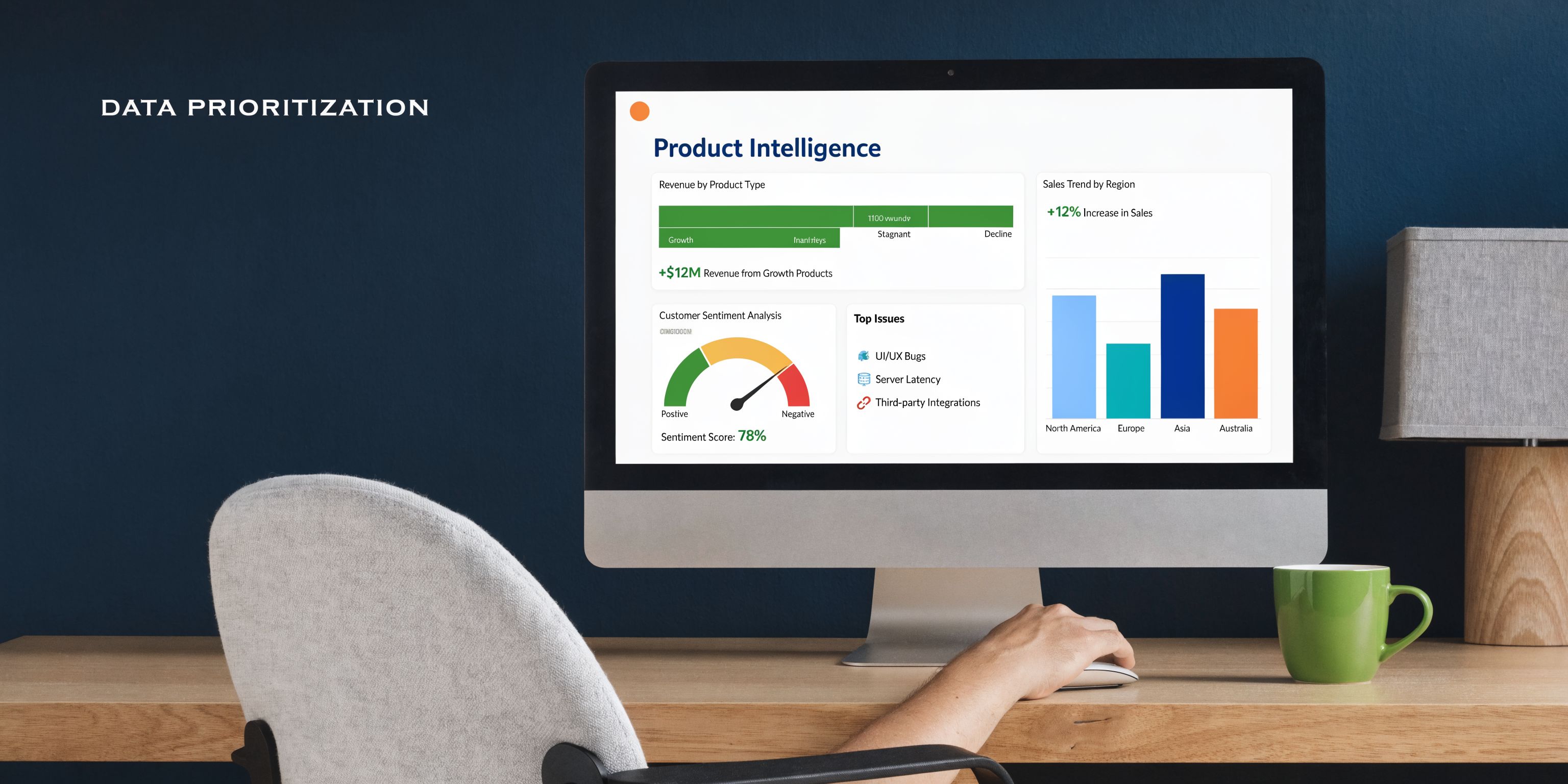
Why old frameworks break under pressure
The deeper issue isn't the framework. It's the evidence underneath it.
A support team logs frustration in Zendesk. Sales records objections in calls. Customer success sees expansion risk in renewals. Engineering sees latency, API fragility, and maintenance cost. A PM has to combine those signals into one decision system.
That’s hard when the signals live in different tools and arrive in different languages.
The execution-strategy boundary is also badly defined in many companies. PMs are told to define vision and also own the backlog. They’re expected to stay strategic while personally sorting tactical noise. As noted in gopractice's discussion of what product managers do not do, this creates tension between strategic ownership and execution detail.
Product intelligence changes the practical workflow because it reduces the manual work required to find meaningful patterns. Instead of reading every ticket, tagging every note, and debating anecdotal urgency, PMs can work from clustered signals tied to actual user behavior and business outcomes.
What quantitative prioritization looks like
In a modern setup, a PM isn't just asking, “How many customers asked for this?”
They're asking better questions:
- Which issue shows up repeatedly in high-value workflows
- Which friction points correlate with churn or failed activation
- Which requests come from the target customer segment
- Which engineering fixes enable future delivery speed or stability
- Which opportunities are tied to expansion conversations, not just complaints
That changes the quality of the roadmap.
A bug reported by five users might matter more than a feature requested by twenty if those five users represent your most important accounts or if the bug interrupts a critical path. A seemingly small usability fix might deserve top billing if it repeatedly shows up before account drop-off.
If you want to improve your own analysis discipline, this sample data analysis report is a useful reference because it shows how raw inputs can become a decision-ready artifact.
The PM's job doesn't disappear. It gets cleaner
Some PMs worry that AI-driven analysis will replace product judgment. In practice, it removes low-value work and makes judgment more valuable.
You still need to interpret context. You still need to decide whether a revenue-heavy request distorts the roadmap away from your strategy. You still need to balance short-term upside against long-term platform health.
What changes is the starting point.
Instead of beginning with opinions and trying to validate them later, the team starts with patterns that already connect feedback, behavior, and business impact. That gives the PM a stronger basis for saying yes, no, not now, or not this way.
A short demo helps make that shift more concrete.
The best use of product intelligence isn't to automate decision-making. It's to automate the scavenger hunt. Once the noise is reduced, PMs can spend more time on the work that requires them: framing trade-offs, aligning stakeholders, and choosing what matters.
Leading Without Authority Through Cross-Functional Collaboration
A PM can rarely force a decision through. That's why cross-functional collaboration isn't a soft skill sitting next to the core work. It is the essential work.
You need engineering to trust that the problem is worth solving. You need design to believe the user need is real. You need sales to understand why one customer request may not become roadmap priority. You need support to feel heard even when every ticket doesn't become a feature. You need leadership to back sequencing decisions that may delay visible asks in favor of deeper product health.

What each partner actually needs from you
Cross-functional work gets easier when you stop using one message for every audience.
Engineering usually wants clarity on problem framing, constraints, and trade-offs. They don't need inflated certainty. They need enough evidence to understand why this work should outrank other work.
Design needs the user context. Not just what users asked for, but where they struggle, what they expected, and what outcome the product should create.
Sales needs a story they can repeat. If a request isn't getting prioritized, they need a credible explanation that protects trust with the account team.
Support needs a feedback loop. If they keep escalating the same issue and hear nothing back, they'll assume the product team isn't listening.
Leadership needs confidence that product decisions tie back to business outcomes, not local optimizations.
Data creates better alignment than charisma
A lot of PM advice still treats stakeholder management as persuasion through presentation skills. That matters, but it doesn't carry much weight when functions are protecting different goals.
The stronger approach is shared evidence.
PMs are expected to align stakeholders around the vision, but many guides offer little practical advice on using data to overcome resistance. That gap becomes obvious when teams have access to quantified product signals and still don't know how to use them in alignment conversations (Atlassian).
Here’s what works better than broad appeals:
- Bring comparative impact: Show why one issue matters more than another in business terms.
- Name the trade-off explicitly: “If we do this now, this other initiative moves.”
- Separate signal from volume: A request heard often isn't always the most costly problem.
- Translate by function: The same decision should sound different to engineering, sales, and finance.
A PM's influence rises when debates move from "who asked the loudest" to "what outcome matters most."
Practical collaboration habits
The PMs who lead well without authority tend to do a few repeatable things.
- They pre-wire decisions. They don't surprise stakeholders in big meetings.
- They document reasoning. That reduces circular debates.
- They close loops fast. Even a “not now” earns trust if it's clear and timely.
- They make uncertainty visible. Teams can handle ambiguity better than hidden assumptions.
- They keep the conversation anchored to user and business outcomes. That prevents functional goals from taking over the roadmap.
Collaboration gets harder when the product grows because every function sees a larger surface area and more competing needs. Data won't remove disagreement, but it does improve the quality of disagreement. And that’s usually enough to make better decisions.
Measuring What Matters KPIs for Product Managers
Friday afternoon. The feature shipped on Tuesday, leadership wants an update, and the room goes quiet after one question: what changed?
That moment is where a PM’s measurement discipline shows up. Shipping starts the work. A product manager is still accountable for defining success, checking whether the change happened, and deciding what to do next.
Start with one value metric
Every product needs a primary value metric tied to real user behavior. Some teams call it a North Star Metric. The label matters less than whether the metric reflects value delivered, not activity completed.
A strong metric answers a practical question: what are users doing when the product is solving the problem well?
For a collaboration product, that might be weekly active teams completing a key workflow. For a fintech product, it might be funded accounts reaching a first successful transaction. For an infrastructure product, it could be accounts with sustained usage above a meaningful threshold.
The metric only matters if it changes decisions. If roadmap reviews, experiment design, and post-launch check-ins are not anchored to it, it becomes reporting theater.
A PM should be able to explain:
- What behavior represents delivered value
- Which product areas influence that behavior most
- Which leading indicators show movement early
- Which recent bets were intended to move the metric
Use supporting KPIs to read product health
One top-line metric is not enough to run a product well. PMs need a small KPI set that helps separate real progress from noise.
A practical set usually looks like this:
| KPI type | What it tells you | Why it matters to the PM |
|---|---|---|
| Adoption | Whether users begin using a feature or workflow | Confirms the problem was relevant enough to change behavior |
| Engagement | Whether usage continues in a meaningful pattern | Shows whether interest turns into habit |
| Retention and churn | Whether customers keep getting value over time | Connects product decisions to account health and revenue durability |
| Expansion signals | Whether usage spreads across seats, teams, or use cases | Shows where product work supports growth |
| Delivery health | Whether the team can ship with predictable quality and acceptable rework | Protects roadmap credibility and team capacity |
These KPIs need to be read together.
High adoption with weak retention usually means the launch message worked better than the product experience. Strong delivery throughput with flat engagement often means the team is executing cleanly against the wrong priority. Expansion without sustained usage can point to sales-led growth that product has not earned yet.
Modern product intelligence changes the job in this regard. Traditional PM reporting leaned heavily on surveys, stakeholder anecdotes, and feature request volume. Useful inputs, but incomplete. Platforms like SigOS let PMs connect support pain, sales friction, usage patterns, and account impact in one view, so KPI reviews become less about defending intuition and more about examining quantified trade-offs.
Tie product work to financial impact
A PM does not need to sound like a finance partner in every meeting. A PM does need to connect product work to commercial outcomes.
That means translating product movement into business terms leadership already uses: retention risk reduced, expansion path improved, support cost lowered, conversion improved, or time-to-value shortened. Those are not side metrics. They are how product earns investment.
In practice, the strongest KPI reviews answer questions like these:
- Did this work help customers reach value faster?
- Did it reduce a friction point that was blocking conversion or renewal?
- Did it improve adoption in a segment that matters financially?
- Did it create evidence strong enough to increase investment, or weak enough to stop?
Teams that still report “we shipped X” without those answers leave money on the table. A simple habit helps. Use a key performance indicator report template for product outcome reviews if current updates focus more on output than business effect.
What strong PM measurement looks like in practice
A weak review sounds like status reporting.
- We launched the feature
- We completed the sprint
- Early feedback seems positive
A strong review sounds like product management.
- We targeted a specific customer and business problem.
- We expected a measurable behavior change.
- We defined the KPI and leading indicators before launch.
- We reviewed actual performance against the expectation.
- We changed the roadmap based on what we learned.
That last step matters most. Measurement is not a reporting exercise. It is a prioritization system.
This is also where modern PMs have an advantage over the old backlog-first model. With product intelligence, you can see which requests are tied to churn risk, which friction points delay expansion, and which adoption problems are concentrated in high-value accounts. That changes KPI work from descriptive reporting to revenue-aware decision-making.
PMs who build this habit earn trust quickly. They do not just show that work shipped. They show whether it mattered, for whom, and whether the next dollar of effort should go into iteration, expansion, or a hard stop.
Keep Reading
More insights from our blog
Ready to find your hidden revenue leaks?
Start analyzing your customer feedback and discover insights that drive revenue.
Start Free Trial →