Sales Strategy Template Your SaaS Team Will Actually Use
Get our free sales strategy template for SaaS GTM teams. This guide covers setup, metrics, playbooks, and CRM integrations to drive revenue.

You probably have a sales plan somewhere right now. It's in a slide deck, a Notion doc, or a spreadsheet with careful assumptions about pipeline, headcount, segment focus, and quota.
The problem isn't that the plan is wrong. The problem is that by the time reps are deep into live deals, support is surfacing new objections, product is shipping unevenly, and customer success is hearing expansion signals your sellers never see, that “annual plan” starts aging fast.
A useful sales strategy template has to survive contact with reality. In SaaS, that means it can't just hold targets and territories. It has to connect revenue goals to daily rep behavior, and it has to absorb live customer and product intelligence without turning into chaos.
Why Most Sales Strategies Fail and How a Template Helps
Most sales strategies fail for a simple reason. They're written like planning documents, then treated like archives.
That used to be normal. But modern sales planning has shifted from lightweight planning docs into data-driven forecasting tools that use historical sales data, CRM records, rep performance, and pipeline math to set quotas, forecast capacity, and expose the gap between revenue goals and actual selling capacity, as described in Xactly's sales planning guidance.
Static plans break at the rep level
A static annual plan usually sounds good in leadership meetings. It says which segment matters, what the revenue target is, and which channels the team will lean into.
Then reps get back to work and run into questions the plan never answered:
- Deal qualification: Which accounts still fit the ICP after the last product change?
- Objection handling: What should a rep say when prospects ask about a missing feature that's showing up in every discovery call?
- Capacity trade-offs: Should managers push outbound harder, or protect rep time for deal progression in later stages?
- Expansion signals: Which customer behaviors should trigger account manager outreach before a renewal conversation starts?
If your template can't answer those questions, it isn't operating the business. It's documenting a past decision.
A sales strategy only matters when a front-line manager can use it to coach this week's pipeline.
A template should behave like an operating system
The best templates don't sit above execution. They shape it.
That means your sales strategy template should become the place where leadership decisions translate into rep actions, manager reviews, dashboard logic, and cross-functional handoffs. It should also connect to the broader growth model, not just the sales org in isolation. That's why teams building a stronger GTM foundation often benefit from a wider framework for growth that aligns sales, product, and customer-facing teams around the same signals.
A practical template does three jobs at once:
- It translates top-line goals into selling requirements.
- It exposes what the team can control.
- It gives you a structure for updating the motion when reality changes.
What works and what doesn't
What works is a template that's close enough to daily execution that managers reference it in forecast calls, QBR prep, and pipeline reviews.
What doesn't work is a document full of broad statements like “increase enterprise penetration” or “improve conversion quality” without any direct connection to territory design, stage definitions, qualification criteria, or enablement priorities.
A good sales strategy template won't remove uncertainty. It will make uncertainty manageable. That's the difference between a planning artifact and a working revenue system.
Anatomy of a Revenue-Driving Sales Strategy Template
A widely used modern sales strategy template is built around 6 core components: revenue goals, customer profiles, sales channels, team structure, budget, and metrics. That framework is designed to turn a high-level sales plan into an executable system, with quarterly reviews recommended to keep execution aligned with targets, according to monday.com's sales strategy template guide.
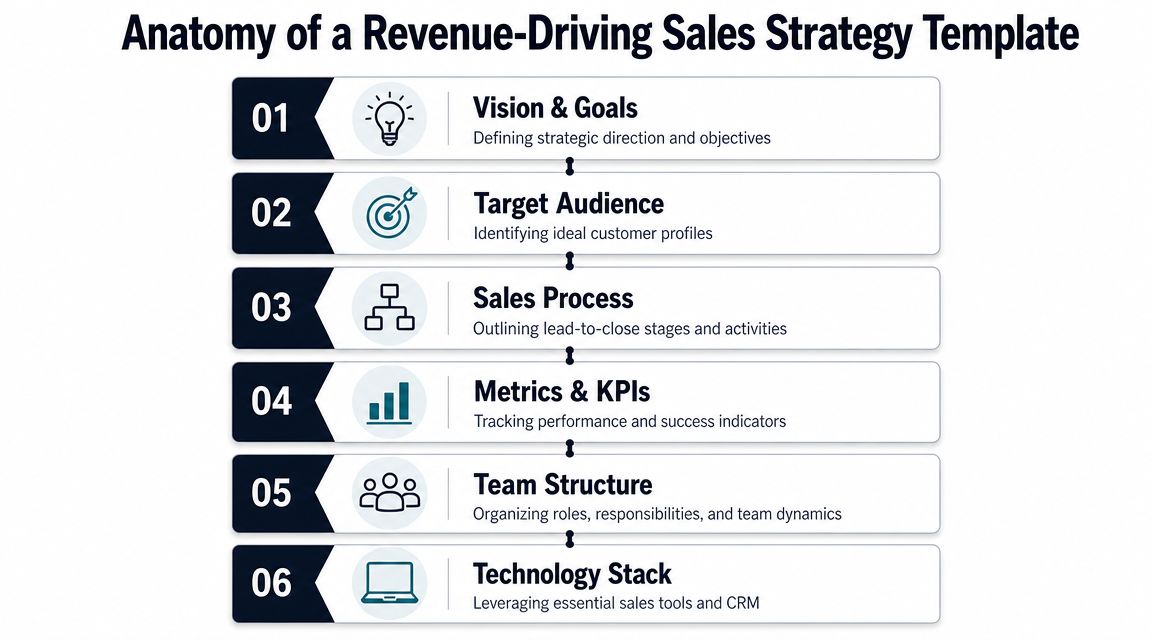
The six parts that matter
A lot of teams overcomplicate the structure. They add extra tabs, buried assumptions, and planning language nobody uses after kickoff. Keep the template tight.
Purpose of the template: Turn revenue intent into an execution model that sales, marketing, customer success, and RevOps can all operate from.
Here's a practical version of the core structure:
| Component | Purpose | Example Key Question |
|---|---|---|
| Revenue goals | Define the target the business must hit and how it cascades into team ownership | What revenue target must each segment and team carry? |
| Customer profiles | Focus the team on accounts most likely to buy, succeed, and expand | Which customer profile produces the best mix of win potential and retention quality? |
| Sales channels | Clarify how the team reaches buyers and where to invest effort | Which channels actually match how this ICP buys? |
| Team structure | Assign ownership, quotas, specialization, and coverage | Do we have the right role mix for our motion? |
| Budget | Fund the people, tools, programs, and support needed to execute | What are we willing to invest to support this plan? |
| Metrics | Track progress, bottlenecks, and controllable inputs | Which measures tell us early if the plan is working? |
How to fill each section correctly
Revenue goals
This section starts at the company level and rolls down. In practice, that means translating the overall revenue target into team targets and then into individual quota expectations.
The mistake I see most often is setting a corporate target without pressure-testing whether the team structure, territory design, and ramp assumptions can support it. If the goal can't be carried by real sellers in real segments, the number is decorative.
Practical rule: Revenue goals should force resource decisions. If they don't change hiring, channel mix, or rep activity expectations, they aren't specific enough.
Customer profiles
Your ICP section should be stricter than your marketing persona work. Sales needs exclusion criteria as much as inclusion criteria.
Document the accounts that close cleanly, adopt with less friction, and create fewer downstream surprises. For SaaS teams, that also means feeding in current customer language from support tickets, implementation calls, and renewal conversations, not just historical firmographics.
Sales channels
Listing every possible channel is not strategy. Instead, strategy involves deciding where the team will concentrate effort and what each channel is expected to produce.
For example, outbound may be best for net-new enterprise creation, partner motions may support credibility in a regulated market, and lifecycle motions may create expansion inside existing customers. Each channel should have a role, not just a mention.
Team structure, budget, and metrics
Team structure
Define who owns what. SDRs, AEs, account managers, sales engineers, and RevOps should each have a clear role in the motion. If responsibilities overlap without a handoff rule, pipeline slows down and attribution arguments start.
Budget
Budget is where strategy gets honest. Here, you decide whether the plan supports more headcount, better enablement, tighter tooling, or more coverage in specific segments.
Metrics
Metrics belong in the template because execution needs a scoreboard. But not every metric deserves executive attention. Use this section to identify the few measures that tell you whether the motion is healthy.
The right template isn't longer. It's sharper. Every field should help a leader decide where to deploy people, where to coach harder, and where the business is drifting off-plan.
Defining Metrics That Matter for Your SaaS Business
A technically sound sales strategy template should convert annual revenue targets into controllable activity metrics by pipeline stage and separate activities reps can control from lagging outcomes like bookings or closed deals, as outlined in Pipedrive's sales plan guidance.

Stop managing with lagging numbers alone
Closed revenue matters. Quota attainment matters. Forecast accuracy matters.
But none of those help a frontline manager coach a rep on Tuesday afternoon.
If your dashboard only shows lagging outcomes, you're running the team by rearview mirror. You'll know what happened. You won't know what to fix in time.
The stronger approach is to split metrics into two buckets:
- Lagging outcomes: bookings, closed-won deals, expansion revenue, attainment
- Leading controls: pipeline creation, stage progression, meeting quality, multi-threading depth, follow-up speed, next-step adherence
Build metrics by pipeline stage
The most useful scorecards track what a rep can influence at each stage of the motion.
Early funnel metrics
At the top of the funnel, you want measures that show whether the team is creating qualified momentum, not just activity volume.
That usually means looking at:
- Target account engagement quality
- Discovery meeting creation
- Qualification consistency
- Progression from first conversation to real opportunity
If conversion work is a weak point in your motion, resources like Fypion Marketing's conversion rate strategies can be useful because they push teams to examine where prospects stall, not just how many leads entered the funnel.
Mid-funnel metrics
Many SaaS teams lose control at this juncture: they celebrate pipeline creation, then deals sit in evaluation without a clear path to decision.
Track signals such as:
- Demo-to-next-step movement
- Stakeholder coverage inside the account
- Technical validation completion
- Open product objections attached to active deals
The middle of the funnel is where product reality catches up with sales messaging.
Late-stage metrics
Late-stage measurement should focus less on optimism and more on execution quality. Are legal, security, procurement, and executive approval moving? Are deal risks visible early enough to act on?
That's where disciplined KPI design matters. If your reporting is still too high-level, a structured KPI report template for revenue teams can help tighten how your team defines and reviews performance.
Add a new metric class that most teams ignore
SaaS teams should track more than sales-process metrics. They should also track customer and product intelligence signals that affect deal progression and expansion potential.
Examples include:
- Recurring feature requests in active enterprise deals
- Common implementation objections from prospects in one segment
- Bug-related friction that appears in renewal or upsell conversations
- Support themes that weaken trust during late-stage evaluation
These aren't vanity metrics. They're operating signals.
If five active deals are blocked by the same workflow gap, that belongs in the sales strategy review. If expansion conversations repeatedly surface a feature customers expected but haven't adopted, that belongs in the account plan. Revenue teams that ignore these signals force reps to fight the same battle account after account.
The best metrics don't just measure sales performance. They reveal where product, messaging, onboarding, and customer experience are either helping revenue or slowing it down.
Building Your Sales Playbooks and Enablement Plan
A strategy without a playbook creates inconsistency. Every rep improvises. Some will figure it out. Most won't do it the same way twice.
That's why the template has to produce field-ready plays. Not generic guidance. Actual plays your team can run in live opportunities.
A competitive deal example
An AE is working a mid-market opportunity. Discovery went well. The champion is engaged. Then procurement brings in a competitor late, and suddenly the deal shifts from value discussion to comparison shopping.
Without a playbook, the rep reacts emotionally. They start feature-dumping, discounting too early, or forwarding old battlecards that don't match the prospect's priorities.
With a real play in place, the response is cleaner.
The rep knows:
- which discovery gaps to reopen
- which proof points to use
- which stakeholders need to be re-engaged
- which product limitations require careful positioning
- which follow-up assets support the next conversation
What a usable playbook actually contains
The best sales playbooks are compact. Reps don't need a manifesto. They need something they can use five minutes before a call.
A strong play usually includes these elements:
Discovery prompts
These help the rep sharpen the issue behind the deal. In a competitive scenario, that means questions that expose switching risk, urgency, and operational constraints.
Examples:
- Decision criteria: What will the buying group use to choose between options?
- Risk lens: What would make this project fail internally, even if the vendor looked strong?
- Timeline pressure: What changes if the team delays this decision?
Talk tracks
Talk tracks aren't scripts to read verbatim. They're structured arguments reps can adapt.
For a competitor-heavy deal, the talk track should help the seller:
- re-anchor on business impact
- transparently position trade-offs
- handle product gaps without sounding evasive
- redirect feature comparison toward implementation fit and long-term value
Good enablement reduces rep improvisation in high-stakes moments.
Follow-up assets
Many enablement programs fall apart at this stage. They train the team, then leave reps hunting for the right deck, one-pager, objection note, or customer story.
Every core play should point to:
- Email follow-up templates
- Relevant case-study style proof
- Security or technical documentation
- Objection handling notes
- Demo variants for the use case
If your team is trying to improve this layer, tools built around sales call analysis software for coaching and pattern detection can help leaders see where reps are deviating from the play and where messaging breaks under pressure.
Enablement has to be operational, not ceremonial
Most enablement fails because it's event-based. A kickoff happens. A training happens. Everyone nods. Then reps go back to whatever they were doing before.
A better model is to tie enablement directly to active plays:
- Train on one priority play at a time
- Use real calls for examples
- Require managers to inspect usage in pipeline reviews
- Update the play when objections change
That last point matters. If support, success, and product teams keep hearing the same friction and sales enablement never changes, your playbooks are stale.
The point of a playbook isn't consistency for its own sake. It's to make the team faster, clearer, and more reliable when deal pressure rises.
Implementing and Integrating Your Sales Strategy
The failure point in most sales planning isn't strategy quality. It's operating cadence.
A common execution mistake is under-specifying review rhythm. Practical guidance recommends planning across at least a 12-month horizon with 30/60/90-day checkpoints, then using those reviews to refine quotas, workflows, and channel mix based on performance data, as described in Aircall's sales strategy planning guide.
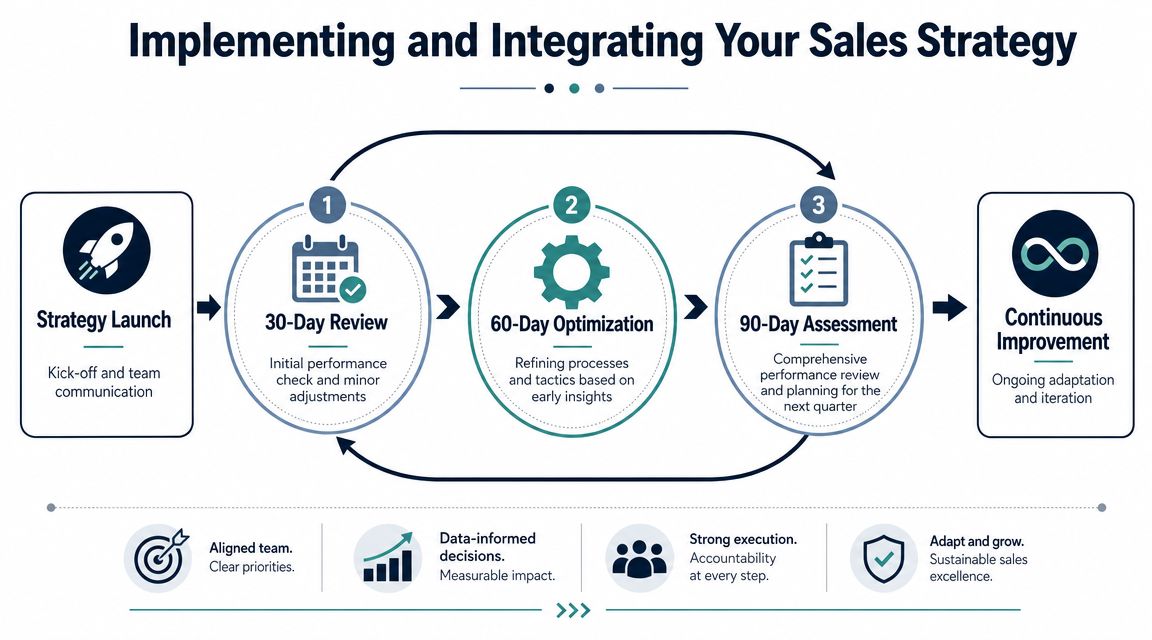
Make the template part of the operating rhythm
A sales strategy template becomes useful when it drives recurring decisions. That means attaching it to a calendar, not just a kickoff.
A practical cadence looks like this:
First 30 days
This period is about launch discipline. Confirm that dashboards, stage definitions, ownership rules, and rep expectations match the template.
Look for early friction:
- Are reps using the qualification criteria consistently?
- Are managers reviewing the same metrics leadership agreed on?
- Are channel assumptions holding up in live outreach and pipeline creation?
Next 60 days
Now you can start optimizing. Messaging issues, weak handoffs, and pipeline bottlenecks will be clearer by this point.
Use this window to adjust:
- Quota realism
- Territory coverage
- Channel emphasis
- Enablement priorities
- Forecast assumptions
A lot of teams need a shared walkthrough before this stage starts. This overview is a useful primer for teams aligning around a practical operating cadence:
At 90 days
This is the point for a full review. By now, you're not guessing anymore. You've seen enough execution to determine whether the motion is fundamentally sound or just being held together by heroic effort.
Connect CRM, process, and live intelligence
The implementation layer has three moving parts.
CRM configuration
Your CRM should mirror the logic of the template. If your strategy says stage progression quality matters, those fields need to exist. If the plan depends on segment-level visibility, your dashboards need to show it.
The CRM is where the template becomes inspectable.
Manager process
Managers operationalize the plan through forecast calls, deal reviews, one-on-ones, and coaching. If managers aren't using the same definitions and metrics the template introduced, the strategy will fragment team by team.
Customer and product feedback loops
This is the part most annual plans miss. Your review cycle should include structured input from support, success, product, and implementation.
Ask questions like:
- Which objections are appearing more often in active deals?
- Which product issues are delaying expansion conversations?
- Which customer requests are concentrated in high-value segments?
- Which promises are reps making that the product team can't support cleanly?
When those inputs feed into the 30/60/90 cadence, the strategy stops being static. It becomes an adaptive system.
What integration looks like in practice
A useful operating model connects four layers:
- Strategy layer: goals, ICPs, channels, quotas
- System layer: CRM fields, dashboards, workflows, alerts
- Execution layer: playbooks, coaching, meeting cadence
- Intelligence layer: customer objections, support themes, product friction, expansion signals
When those four layers stay connected, leaders don't have to choose between annual planning and real-time adaptation.
That's the shift most SaaS teams need. Keep the annual target. Keep the planning discipline. But run the strategy like a living system that learns from the market every week.
A Checklist for Activating Your New Sales Plan
Once the template is drafted, the primary work is activation. Organizations often don't fail because they missed a tab in the spreadsheet. They fail because the organization never fully adopts the plan.
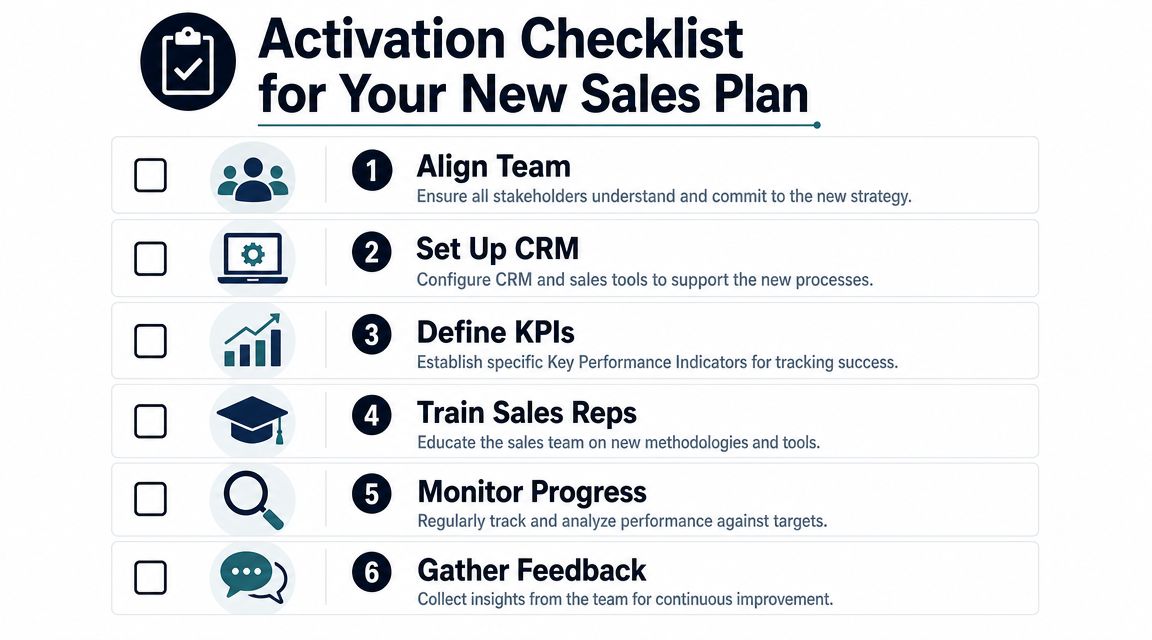
Use this checklist before launch
Run through these items before you treat the sales strategy template as live.
- Align the ICP with marketing and customer teams: Confirm the target account definition reflects who buys well, onboard cleanly, and has real expansion potential. Sales shouldn't be running one customer definition while marketing and customer success operate another.
- Translate revenue goals into team ownership: Every leader should know what the target means for their segment, manager pod, and rep book of business. If ownership is vague, accountability will be vague too.
- Configure the CRM to match the motion: Stage definitions, qualification fields, dashboards, and activity capture should all reflect the strategy. If the system can't measure the plan, the plan won't survive contact with execution.
- Finalize playbooks for your highest-value scenarios: Start with the motions that matter most, such as competitive deals, expansion opportunities, and objection-heavy product conversations. Don't wait to build perfect coverage for every edge case.
- Train managers before reps: Managers are the multiplier. If they can't inspect, coach, and reinforce the new model, rep training won't stick.
- Schedule your first review cadence immediately: Put the first 30-day review on the calendar before launch. Also define who brings sales, marketing, customer success, support, and product input into that session.
Signs your plan is actually activated
You'll know the plan is live when a few things start happening consistently.
Reps use common language
Qualification criteria, stage movement, and account prioritization sound the same across the team.
Managers inspect the same system
Pipeline reviews stop drifting into opinion-only debates because everyone is working from shared definitions and shared metrics.
Cross-functional inputs show up in strategy reviews
Customer-facing feedback no longer lives in side conversations. It influences enablement, product messaging, and pipeline decisions.
The template is active when the organization uses it to make trade-offs, not when leadership approves it.
A sales strategy template should reduce ambiguity. If it's doing that for reps, managers, and adjacent teams, you've moved from planning to execution.
If your team wants to make sales strategy more dynamic, SigOS helps connect revenue decisions to the customer and product signals that usually stay buried in support tickets, sales calls, chat transcripts, and usage data. Instead of treating feedback as anecdotal, teams can prioritize the issues and requests most likely to affect churn, expansion, and active deals, then bring that intelligence into quarterly planning, pipeline reviews, and cross-functional execution.
Keep Reading
More insights from our blog

Ready to find your hidden revenue leaks?
Start analyzing your customer feedback and discover insights that drive revenue.
Start Free Trial →