Product Roadmap Prioritization: A Data-Driven Guide
Stop guessing. Learn data-driven product roadmap prioritization. Discover frameworks, align stakeholders, & turn feedback into revenue.
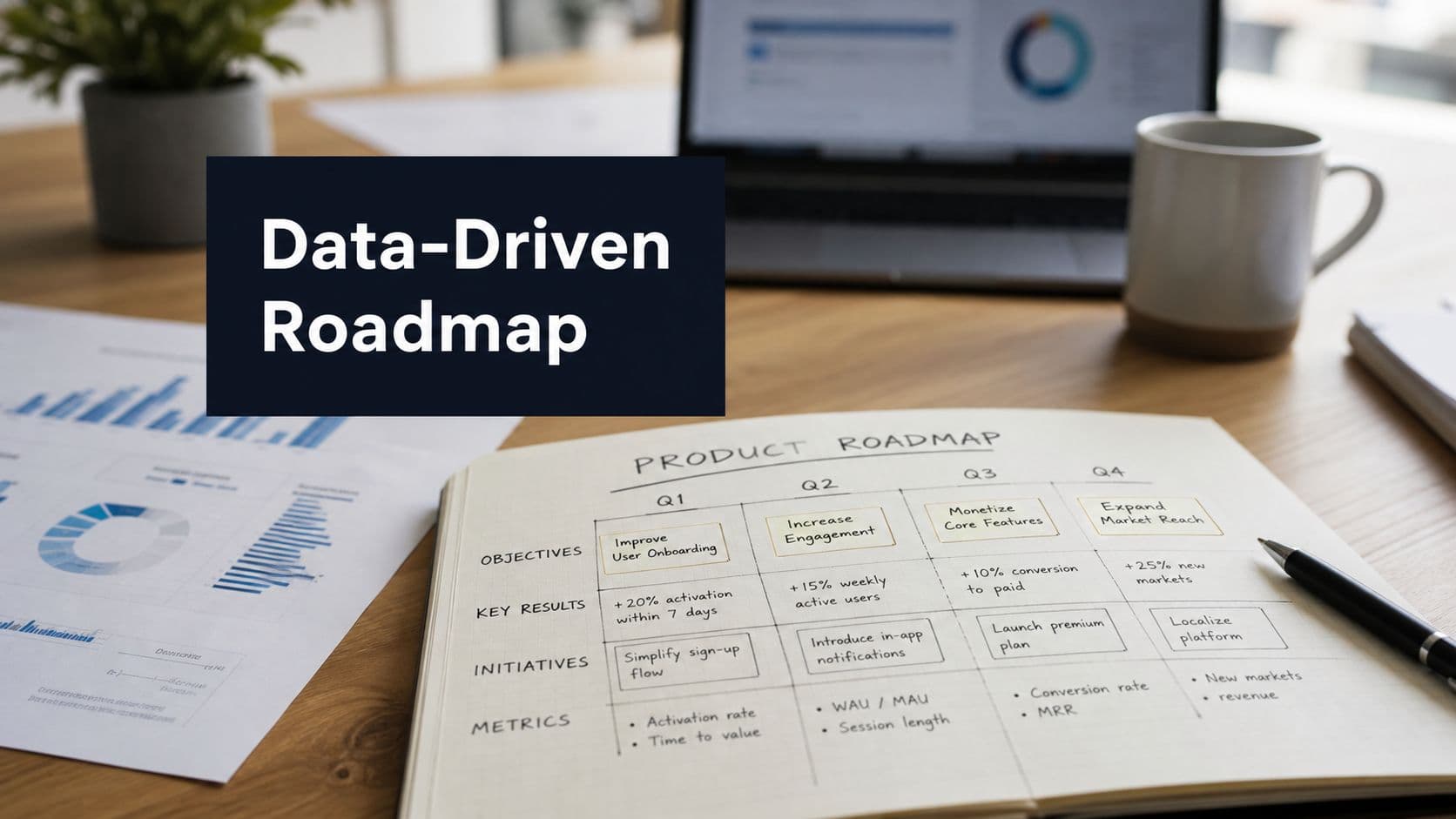
Your backlog probably looks familiar. Sales wants the feature that might unblock a deal. Support is escalating a bug that keeps hitting important accounts. Engineering wants time for infrastructure. Then a senior executive drops a new idea into the queue and expects momentum by next week.
That's where product roadmap prioritization usually breaks down. Teams say they use frameworks, but the actual decision often gets made by urgency, politics, or whoever tells the most vivid story in the meeting. The result is a roadmap that feels busy but doesn't hold together. Work ships, but nobody can clearly explain how it ties to retention, expansion, or revenue.
The fix isn't starting with a framework. It's building a system that converts messy, qualitative input into something you can compare, challenge, and defend. Once that system exists, frameworks become useful. Before that, they're just cleaner-looking guesswork.
Moving Beyond the Loudest Voice in the Room
Most roadmaps don't fail because teams lack ideas. They fail because teams can't distinguish between important, urgent, and strategic.
A customer request from a major account feels important. A spike in support complaints feels urgent. A founder idea may be strategically interesting. All three can be valid. The problem starts when they enter the same backlog with no common language for comparison.
What chaos looks like in practice
The pattern is easy to spot:
- Sales escalations dominate: Features tied to current deals jump ahead because revenue feels immediate.
- Support pain wins by volume: Repeated complaints look bigger than they are because they're visible every day.
- Executive ideas skip the line: Leadership sees market signals others don't, but those ideas often arrive without validation.
- Engineering debt gets deferred: The team knows what's slowing delivery, yet platform work keeps losing to customer-facing requests.
None of these inputs should be ignored. The mistake is treating all of them as equivalent backlog items before translating them into business impact.
The loudest voice is often carrying a real signal. It just isn't carrying enough context.
That context matters. Is the issue tied to churn risk? Is the request concentrated among high-value accounts? Does the bug affect activation, expansion, or renewal behavior? Without those answers, product roadmap prioritization becomes reactive.
What works instead
Strong product teams create a filter before they rank anything. That filter does three things:
- Normalizes inputs from tools like Zendesk, Intercom, Jira, Gong, Linear, and analytics platforms.
- Maps each input to a business outcome such as activation, retention, expansion, or deal progression.
- Creates a repeatable scoring layer so requests can be debated on evidence instead of narrative strength.
This shifts the conversation. Instead of “support says this is critical,” the discussion becomes “this issue is concentrated in accounts that are at risk, and it's blocking a strategic KPI.” That's a very different meeting.
A roadmap should absorb stakeholder input, not be controlled by it. Once teams build a system for translating noise into comparable signals, they stop operating like a feature factory and start making portfolio decisions.
Anchor Your Roadmap with Strategic Goals and Metrics
A backlog can't tell you what matters. Strategy does.
If the company hasn't defined what winning looks like, product roadmap prioritization turns into local optimization. Teams improve onboarding screens, add integrations, redesign reporting, and fix rough edges, but they still miss the core business problem because nobody established the target.
For a B2B SaaS company, that target usually sits in a short list of outcomes. Retain more customers. Expand existing accounts. Improve activation. Shorten time to value. Increase win rate in a segment the business cares about.
Start with the business objective
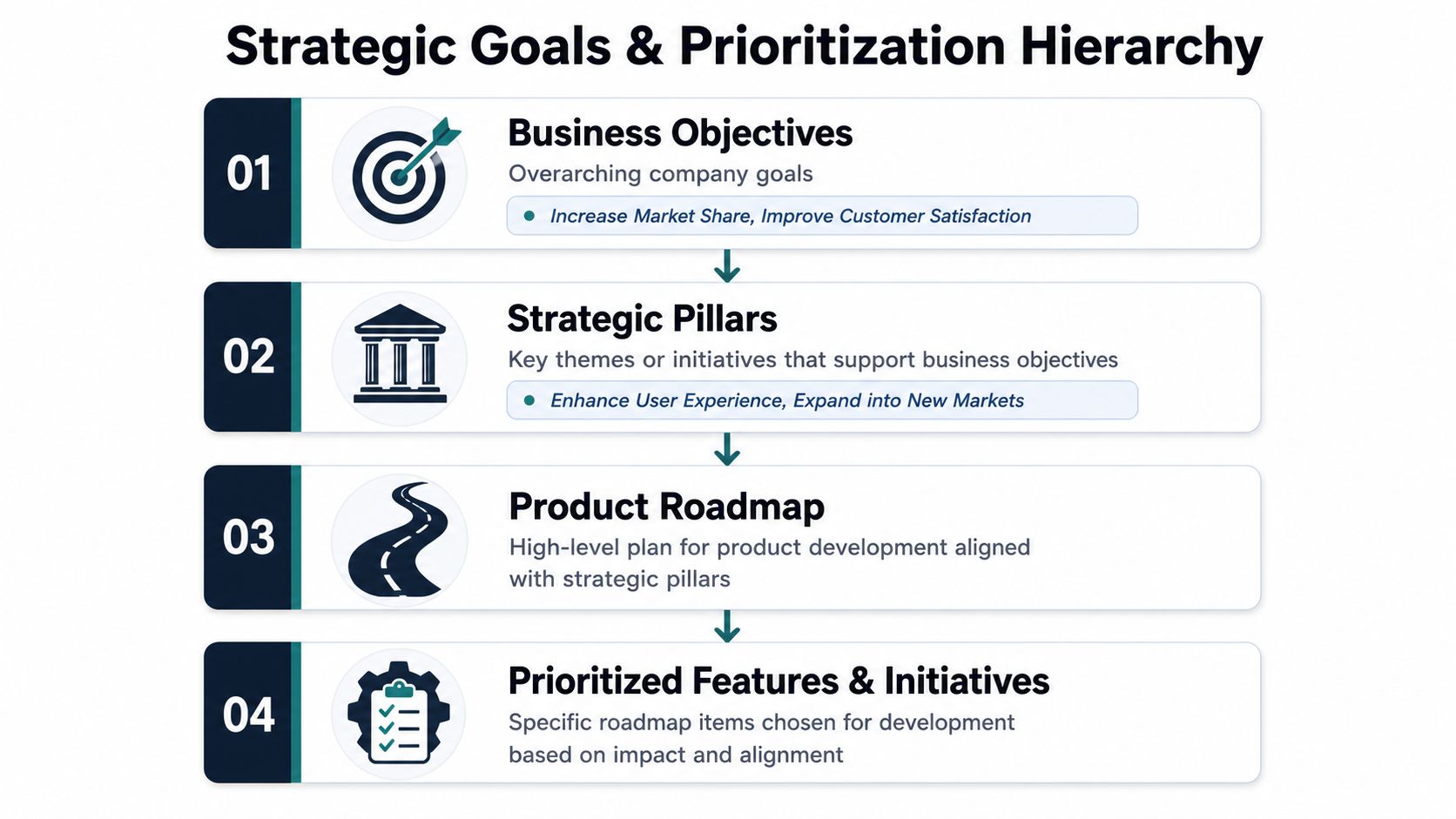
A useful roadmap starts at the top of a hierarchy, not the bottom.
- Business objective: The company-level outcome. Examples include improving retention, increasing expansion revenue, or strengthening adoption in a target segment.
- Strategic pillar: The theme that supports the objective, such as onboarding quality, reporting depth, reliability, or enterprise readiness.
- Product KPI: The measurable product outcome linked to that pillar.
- Initiative or feature: The work that may move the KPI.
That sequence sounds obvious, but many teams reverse it. They begin with a feature request, then try to justify it after the fact.
Here's the hierarchy in plain form:
| Level | Question to answer | Example for a B2B SaaS team |
|---|---|---|
| Business objective | What business result matters most right now? | Improve retention |
| Strategic pillar | What theme supports that result? | Faster time to value |
| Product KPI | What product behavior should change? | More users complete onboarding |
| Initiative | What might move that KPI? | Guided setup, templates, admin checklist |
One data point is worth keeping in mind here. Product teams that align their roadmaps with clearly defined business KPIs are 34% more likely to meet or exceed their revenue targets, according to a 2025 survey of 500 SaaS companies.
Define a North Star and a counter-metric
Teams often need one primary metric that expresses delivered value. If you don't already have one, it helps to think through a North Star metric framework before debating roadmap items.
But one metric alone can mislead. If you optimize only for activation, you may create a shallow onboarding flow that gets users through setup without creating durable retention. If you optimize only for expansion, you may overload the product for new customers.
That's why every major roadmap theme needs a counter-metric.
Practical rule: Every initiative should have a success metric and a “don't break this” metric.
Examples:
- Primary metric: onboarding completionCounter-metric: early retention
- Primary metric: feature adoptionCounter-metric: support burden
- Primary metric: expansion usageCounter-metric: core workflow performance
The video below gives a useful strategic lens on aligning product work with priorities.
Turn strategy into a decision lens
When roadmap debates get messy, ask three questions:
- Does this initiative support a current business objective?
- Which product KPI should it move?
- What counter-metric protects against unintended damage?
If a proposed item can't answer those questions, it might still be valuable. But it doesn't belong near the top of the roadmap.
Build a System to Quantify Your Inputs
The raw material for product roadmap prioritization already exists inside your company. It's just fragmented across support tickets, chat logs, CRM notes, sales calls, product analytics, issue trackers, and customer success updates.
Organizations often leave that material in qualitative form. That's why they end up with statements like “customers keep asking for dark mode” or “reporting is becoming a problem.” Those statements are directionally useful, but they're not decision-grade.
Pull signals from the systems teams already use
The right approach starts with collection, not scoring.
A typical input map looks like this:
- Zendesk or Freshdesk: recurring support issues, severity patterns, affected accounts
- Intercom or live chat: feature requests, friction language, repeated objections
- Sales call transcripts: objections in late-stage deals, missing enterprise requirements, procurement blockers
- Customer success notes: adoption risks, renewal concerns, implementation pain
- Product analytics: drop-off points, unused features, engagement shifts after release
- Jira, Linear, GitHub: delivery status, technical dependencies, repeated defect themes
On their own, these systems create noise. Together, they can reveal patterns. A backlog item becomes more credible when multiple systems point to the same underlying problem.
Translate language into standardized problem statements
Many teams stumble at this point. They collect requests, but they don't normalize them.
A good system turns free-form feedback into a small set of structured fields:
| Field | Why it matters |
|---|---|
| Problem theme | Prevents duplicate requests from spreading across the backlog |
| Affected segment | Distinguishes enterprise pain from edge-case feedback |
| Workflow impacted | Connects complaints to activation, reporting, collaboration, admin, or another journey |
| Business risk | Frames whether the issue relates to churn, expansion, deal progression, or support cost |
| Evidence strength | Shows whether the issue appears in one source or across several |
Once that structure exists, “we need better reporting” can split into more useful categories. Missing exports is not the same as weak executive dashboards. Permissioning gaps are not the same as slow report performance. Aggregated requests often hide very different jobs to be done.
Add quantitative context before you prioritize
This is the step that changes the quality of decisions.
You don't need to invent false precision. You do need to connect feedback to observable behavior and commercial context. That means asking questions like:
- Which customer segments mention this most often?
- Do affected accounts show signs of poor activation or weak adoption?
- Does the issue appear in open opportunities or renewal conversations?
- Is this a bug pattern, a usability gap, or a missing capability?
- How often does the theme recur across systems?
Teams that want a concrete model can use a lightweight scoring layer such as:
- Frequency score based on recurrence across support, chat, and calls
- Customer value score based on account importance or strategic fit
- Behavior score based on whether affected users also show risk or missed expansion signals
- Effort flag from engineering, kept separate from opportunity value
That creates a ranked opportunity list before any framework enters the picture.
When product teams skip this translation step, they don't really prioritize. They sort anecdotes.
A useful reference point is this sample data analysis report for product feedback, which shows the kind of structured output teams need before they score roadmap options.
What not to do
Three habits usually poison the input layer:
- Counting requests without weighting them: ten small requests from low-fit users can outweigh one strategically important pattern if you only use volume.
- Combining discovery and delivery in one pile: an unresolved problem statement should not compete directly with a build-ready initiative.
- Treating every request as a feature ask: customers often describe a solution, not the underlying problem.
The best product organizations don't just gather feedback. They convert feedback into decision-ready evidence tied to business outcomes.
Apply Prioritization Frameworks with Actionable Data
Frameworks are useful once the inputs are clean. Before that, they mostly create the illusion of rigor.
RICE, ICE, and Opportunity Scoring can all work. The difference isn't which framework is “best.” The difference is whether the team is feeding each framework with real signals from the system above, rather than intuition dressed up as a spreadsheet.
A simple comparison of the main options
| Framework | Components | Best For | Key Weakness |
|---|---|---|---|
| RICE | Reach, Impact, Confidence, Effort | Larger initiatives with enough evidence to estimate exposure and confidence | Can become false precision if inputs are weak |
| ICE | Impact, Confidence, Ease | Faster sorting when the team needs directional ranking | Reach is implicit, so broad and narrow opportunities can blur together |
| Opportunity Scoring | Importance and satisfaction gaps around customer needs | Identifying underserved problems before jumping to solutions | Requires disciplined customer need statements |
Use one example throughout. Say the team is evaluating role-based reporting permissions for a B2B SaaS product. Support has repeated complaints from admins, sales hears it in enterprise deals, and usage data shows teams abandon shared reporting workflows after setup.
When RICE works best
RICE is strong when initiatives are material enough to justify a more deliberate estimate.
Its advantage is balance. Reach keeps the team from overvaluing niche requests. Confidence forces discussion about evidence quality. Effort creates a cost check without dominating the whole decision.
RICE is especially useful when comparing roadmap candidates that are all plausible investments, but not all equally important.
A practical way to apply it:
- Reach: How broadly does the problem affect active accounts or strategic prospects?
- Impact: If solved, how much would it improve the target KPI?
- Confidence: Are multiple signals pointing to the same opportunity, or is the evidence thin?
- Effort: What does engineering believe it will take relative to alternatives?
If the permissions issue appears in support, sales, and analytics, confidence improves. If it affects a narrow slice of users, reach may be moderate even if the account importance is high.
Why ICE is better for quick triage
ICE strips the model down. That's useful when the team needs a shortlisting tool, not a final capital allocation model.
For the same reporting-permissions example, ICE can help answer a narrower question: should this move into discovery now, stay in the queue, or get dropped?
- Impact captures strategic upside.
- Confidence reflects evidence quality.
- Ease gives a rough delivery lens.
This is often enough for weekly or biweekly triage. It's also easier for cross-functional groups to understand quickly.
If your team is trying to improve how it visualizes these trade-offs, a practical overview of top AI tools for statistical analysis can help when you need support with clustering feedback themes, summarizing qualitative inputs, or structuring scoring work.
Opportunity Scoring helps before solutions harden
Opportunity Scoring is most useful earlier in the cycle, when the team wants to identify unmet needs instead of debating feature shapes.
The key move is to define the need clearly. For the reporting example, the need isn't “build permissions UI.” The need is closer to “admins need to control access to sensitive reporting views without breaking collaboration.”
Then ask two questions:
- How important is that need to the target user?
- How well does the current product satisfy it?
High importance and low satisfaction create the strongest signal.
That's often the best framework when sales and support keep proposing different solutions to the same underlying problem. Opportunity Scoring helps the team stay at the problem level long enough to avoid premature design decisions.
Pick the framework for the decision, not the company
A lot of teams standardize on one method and use it everywhere. That usually creates friction.
Try this instead:
- Use ICE for intake triage and fast backlog sorting.
- Use Opportunity Scoring in discovery, especially when requests are noisy or solution-biased.
- Use RICE when funding a significant initiative that will consume meaningful delivery capacity.
A structured feature prioritization matrix can help teams map those choices to the stage of decision-making rather than forcing every idea through the same lens.
A framework should reduce ambiguity. If scoring creates more debate than insight, the problem is usually the input quality, not the formula.
Establish Transparent Governance and Stakeholder Alignment
A good prioritization model can still fail if stakeholders don't trust the process.
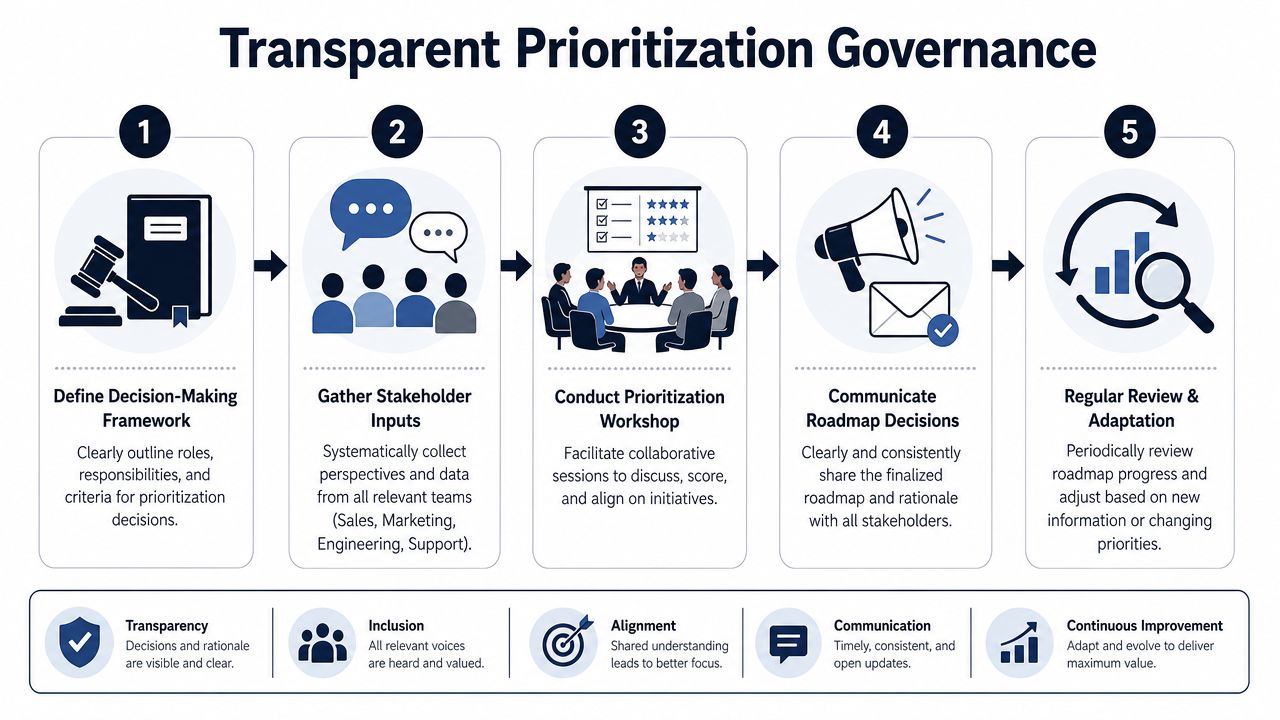
That's why governance matters. Not bureaucracy. Governance. People need to know how ideas enter the system, who evaluates them, when decisions get made, and how trade-offs are communicated. Without that structure, product roadmap prioritization falls back to escalation and side conversations.
Build a roadmap council with clear roles
One of the simplest operating models is a recurring roadmap council. It doesn't need to be large. It does need to be explicit.
A workable structure looks like this:
- Product leads decide: They own the final recommendation and maintain consistency across the roadmap.
- Engineering evaluates feasibility and sequencing: They should shape effort, dependencies, and technical risk, not get dragged in only after decisions are made.
- Go-to-market teams provide evidence: Sales, support, and customer success bring pattern-level input, not one-off anecdotes.
- Leadership sets strategic boundaries: Executives clarify goals and constraints, then avoid reranking individual items outside the agreed process.
That last point matters. Leadership should absolutely shape strategy. What breaks trust is jumping around the system after the rules are set.
Separate intake from commitment
Many roadmap conflicts happen because stakeholders hear “we captured your request” as “we plan to build this soon.”
The fix is procedural. Separate these stages:
| Stage | What it means |
|---|---|
| Intake | The idea is logged and categorized |
| Review | Evidence is checked and the opportunity is scored |
| Discovery | The team is validating the problem and possible solutions |
| Commitment | The item is funded on the roadmap |
| Reassessment | New evidence can move it up, down, or out |
This creates room for honest product management. You can acknowledge real demand without making a false promise.
The most useful “no” in product isn't rejection. It's a documented “not now” with a reason people can inspect.
Use data to make disagreement productive
Stakeholders won't stop pushing. They shouldn't. Sales should advocate for deals. Support should push on customer pain. Engineering should defend system health.
What changes is the quality of argument. Instead of debating whose request matters more, the team debates which opportunity is more aligned, better evidenced, and more valuable relative to current goals.
That's how you say no without creating damage:
- Name the business objective: “We're focused on retention in this planning cycle.”
- Show the evidence basis: “This initiative maps more directly to that KPI.”
- State what would change the decision: “If this request appears across more renewal-risk accounts, we'll rescore it.”
- Keep the item visible: “It remains in the opportunity queue. It's not lost.”
Governance doesn't remove tension. It makes tension useful.
Measure Impact and Close the Feedback Loop
Shipping isn't proof of prioritization quality. Outcome measurement is.
The ultimate test comes after release, when the team compares what changed against the reason the work was approved in the first place. If an initiative was prioritized to improve activation, then activation needs to be reviewed. If the roadmap funded a retention play, then retention-related product signals should be monitored, not replaced with vanity metrics about launch activity.
Measure against the original decision logic

A disciplined post-launch review asks:
- Did the target KPI move? If the initiative aimed to improve onboarding, did more users complete the onboarding path?
- Did the counter-metric stay healthy? If the team sped up activation, did support burden or early churn worsen?
- Did the intended segment respond? A release aimed at enterprise admins should be evaluated on enterprise behavior, not overall averages.
- Did the feedback pattern change? Support volume, sales objections, and customer success escalations should reflect whether the original problem softened.
Many teams need stronger reporting habits. If you want a clean example of KPI thinking in another operating context, Wispra's guide on optimizing SEO with key performance indicators is useful because it shows how metrics become meaningful only when they're tied to a clear objective and review cadence.
Close the loop internally and externally
The learning cycle isn't complete until people hear what happened.
Internally, that means showing stakeholders whether the bet paid off. Sales should know if a deal-blocking feature improved conversion conversations. Support should know if complaint themes dropped. Engineering should see whether the effort changed customer behavior in the way product expected.
Externally, it means telling customers their input mattered. That doesn't require a campaign. A direct follow-up to customers who raised the issue is usually enough. It builds trust, sharpens future feedback, and improves adoption because the team can explain the solved problem in the customer's language.
Teams get better at product roadmap prioritization when they treat each shipped item as a scored hypothesis, not a completed task.
When that loop is tight, roadmap quality compounds. The team learns which signals were predictive, which stakeholder inputs were overstated, and which types of work reliably move core business outcomes. That's when prioritization stops feeling like quarterly drama and starts operating like a system.
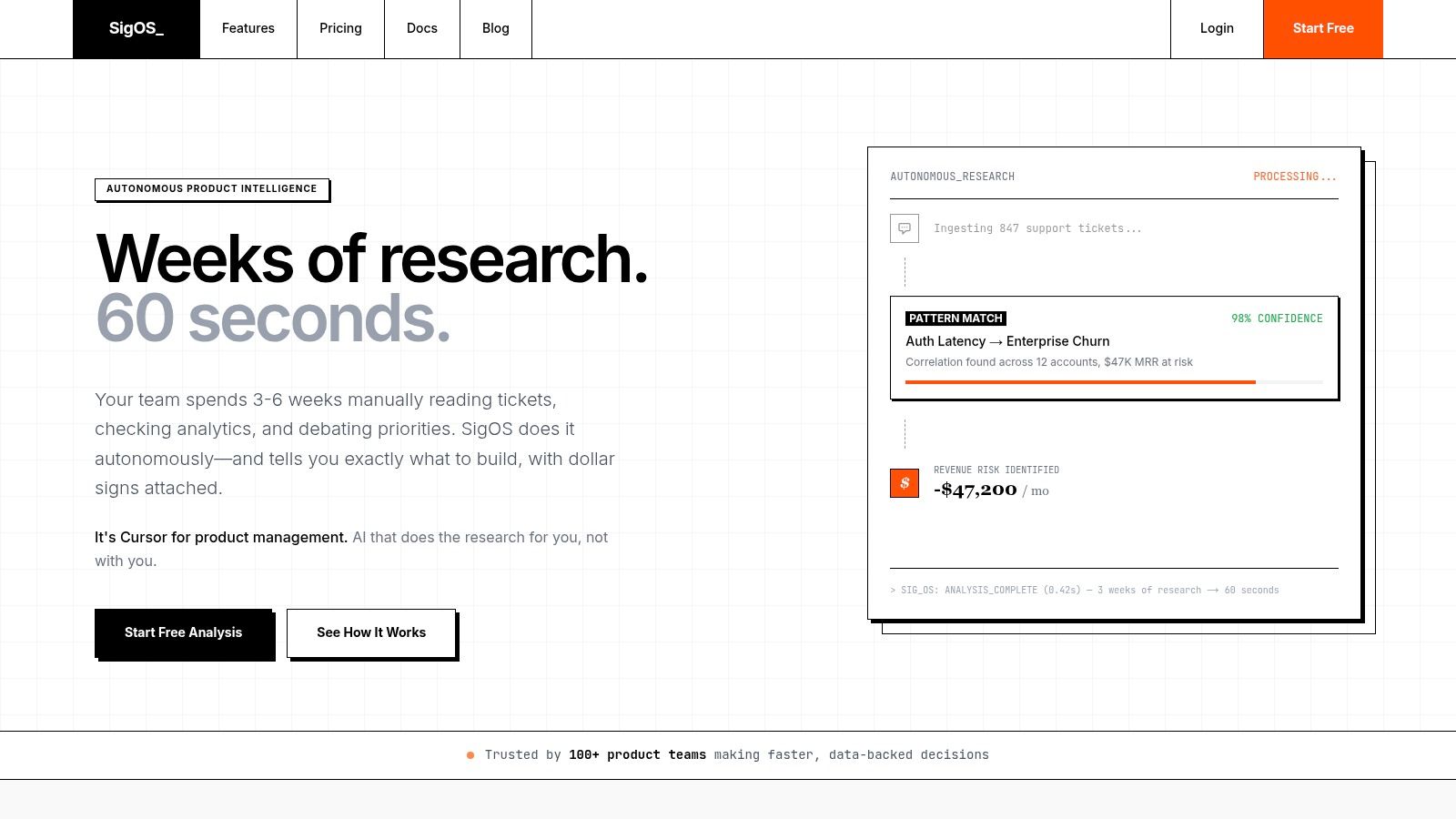
If your team is still prioritizing from scattered tickets, call notes, and opinion-heavy backlog debates, SigOS is worth a look. It helps product teams turn support conversations, sales feedback, and usage signals into a quantified view of what's affecting churn, expansion, and revenue, so roadmap decisions start with evidence instead of noise.
Keep Reading
More insights from our blog

Ready to find your hidden revenue leaks?
Start analyzing your customer feedback and discover insights that drive revenue.
Start Free Trial →