Feature Request Tracking: A 2026 Playbook for Product Teams
Build a feature request tracking system to drive revenue & reduce churn. This playbook guides product teams from ingestion to prioritization.

Your feedback is probably everywhere right now. A sales rep drops notes into Slack. Support logs requests in Zendesk. Customer success keeps a spreadsheet. Product managers bookmark call recordings they swear they'll revisit. Engineering hears a request secondhand and opens a Jira ticket with half the context missing.
That's not just messy. It's expensive.
When teams treat feature requests as scattered anecdotes, they build from memory, politics, and urgency instead of evidence. The result is familiar: low-impact features get shipped, important patterns stay hidden until renewals are at risk, and nobody can answer a simple leadership question: which roadmap items are tied to revenue or retention?
Good feature request tracking fixes that. Not because it makes the backlog cleaner, but because it gives the business a way to connect customer demand to product bets, then connect product bets to commercial outcomes. In one SaaS company study, over 37% of the total paying customer base actively used features built from systematically tracked feedback, and 31% of total MRR growth was attributed to those feedback-driven features according to Usersnap's SaaS feedback study.
That's the shift that matters. Feature request tracking isn't administrative overhead. It's operating discipline.
Why Your Scattered Feedback Is Costing You Money
Most product teams don't have a feedback problem. They have a fragmentation problem.
The requests are already coming in. Customers are telling support what blocks adoption. Sales is hearing what stalls deals. Success managers know which gaps keep showing up in QBRs. The problem is that each team captures those signals in a different place, with different wording, and with different levels of context.
By the time product reviews the input, the evidence is thin. Duplicate requests look like separate ideas. One strategic account and one free-tier user appear identical. A loud stakeholder can push an item up the roadmap because the underlying demand picture is invisible.
Chaos creates three costly failures
- Teams misread demand: Five versions of the same request across Slack, HubSpot, Intercom, and call notes often look smaller than they really are.
- Engineering works on weak signals: If nobody can tie the request to affected accounts, product usage, or renewal risk, prioritization becomes opinion-driven.
- Customers stop believing feedback matters: When requests disappear into private inboxes, follow-up gets inconsistent and trust erodes.
The most practical fix is boring, and that's why it works. Put everything in one place first.
The standard approach in SaaS is to consolidate incoming requests into a single centralized repository, because teams working from separate spreadsheets, boards, chat threads, and issue trackers struggle to group similar requests and prioritize based on actual demand rather than stakeholder opinion, as described in UserEcho's guide to managing SaaS feature requests.
Practical rule: If a request can't be found, compared, and linked to a customer record in under a minute, it doesn't really exist in your decision system.
That's why centralization comes before scoring, roadmaps, or AI. If the raw material is scattered, every downstream decision is weaker than it should be.
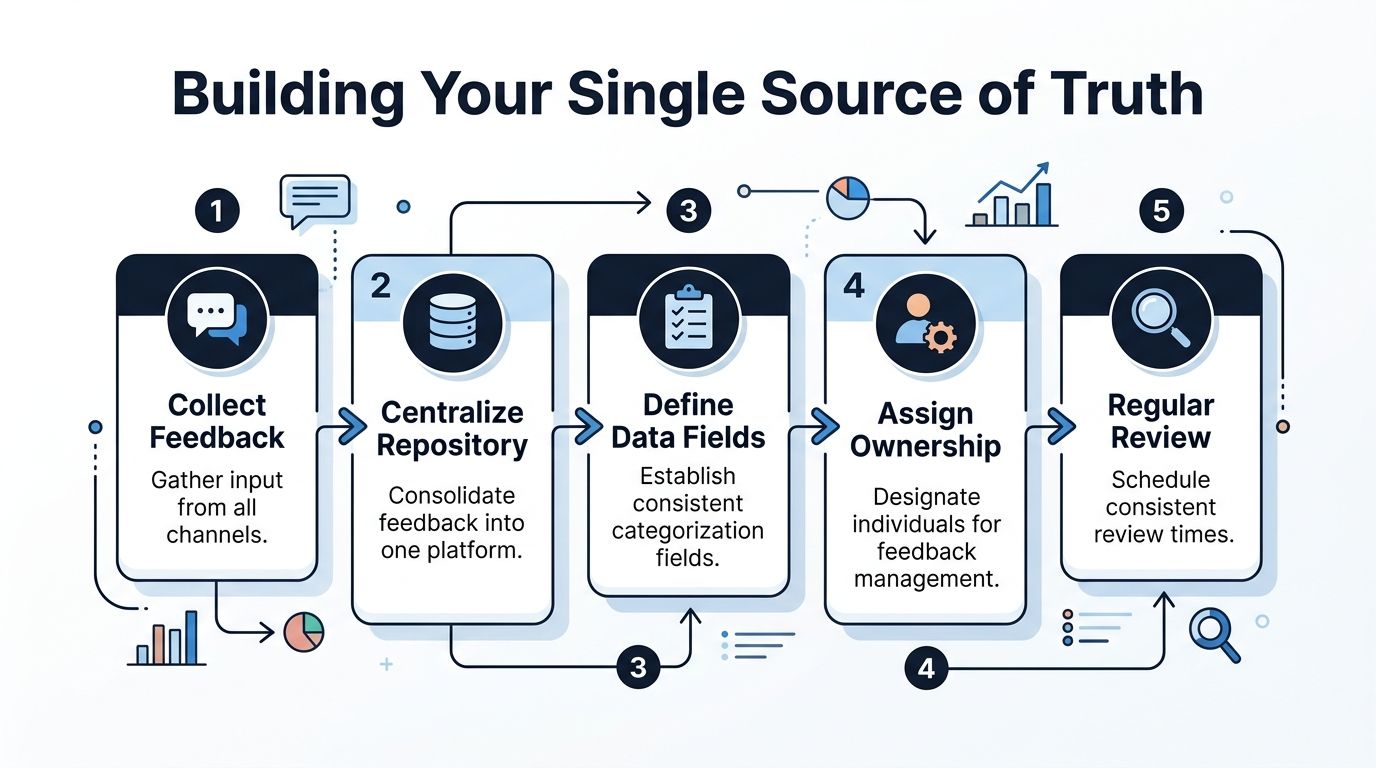
Building Your Single Source of Truth
A usable feature request tracking system starts with one commitment: every request enters the same repository, no matter where it originated.
That means email threads, sales call notes, Gong snippets, support tickets, NPS comments, CRM fields, community posts, and in-app feedback all flow into one system. You can use a dedicated feedback tool, a structured Airtable base, Notion with strict schemas, or a product ops stack tied to Jira or Linear. The tool matters less than the workflow.
Capture the request and the business context
It's common to store the request text and stop there. That's not enough. A raw sentence like “Need better export controls” has almost no value on its own.
Your repository should capture these fields at intake:
- Customer identity: Account name, segment, plan, or owner.
- Source channel: Zendesk, Slack, call note, CRM, community board, and so on.
- Problem statement: What the customer is trying to do, not just the feature they named.
- Product area: Billing, reporting, onboarding, permissions, integrations.
- Evidence link: Ticket URL, transcript excerpt, recording timestamp, screenshot.
- Commercial context: Whether the request is tied to expansion, retention, deal progression, or onboarding friction.
- Status: New, merged, under review, planned, shipped, declined.
If you're still figuring out how to gather structured input at the source, this guide on how to collect feedback from customers is a useful starting point.
Build ingestion before you build dashboards
The common failure is buying a tool and assuming people will use it correctly. They won't, at least not consistently. You need simple ingestion rules.
Use automation where possible:
- Email forwarding: Route feature-related support tags into the repository automatically.
- CRM workflows: Push closed-lost reasons or product gap fields from HubSpot or Salesforce into the same queue.
- Support integrations: Sync Intercom or Zendesk conversations with account metadata attached.
- Meeting workflows: Require sales and success to log product-gap notes into a standard form right after calls.
- Community capture: Pull public feedback posts into the same system instead of reviewing them separately.
This is manual at the beginning. It should be. Manual review forces the team to decide what good intake looks like before automating bad habits at scale.
Clean intake beats clever reporting. If the first record is vague, every report built on top of it stays vague.
Assign ownership so nothing goes stale
A single source of truth fails when everyone assumes someone else is maintaining it.
Give ownership to named roles:
| Role | Responsibility |
|---|---|
| Product ops or PM | Maintains taxonomy, merges duplicates, monitors intake quality |
| Support lead | Flags recurring requests from tickets and escalations |
| Sales or CS lead | Adds commercial context and account priority |
| Engineering counterpart | Adds rough feasibility or dependency notes when needed |
A centralized repository only works if it becomes the default place people trust. Once that happens, feature request tracking stops being a scavenger hunt and starts becoming decision infrastructure.
From Raw Feedback to Actionable Insights
A repository gives product teams a place to store feedback. Revenue decisions require more than storage.
The gap shows up in a familiar weekly review. Sales says a missing integration is blocking deals. Support says reporting is the main problem. Customer success escalates admin controls for a renewal. All three sound unrelated until someone reads the source material closely and realizes they point to the same underlying workflow gap. If that synthesis does not happen, the team spreads effort across disconnected fixes and misses the bigger retention and expansion opportunity.

Normalize before you prioritize
Raw feedback arrives in the language of frustration, urgency, and incomplete context. Customers describe symptoms. Internal teams summarize too quickly. Good feature request tracking turns that mess into a form the business can use.
A strong triage pass usually includes five moves:
- Rewrite the request in plain languageTurn “Need audit logs ASAP” into “Admins cannot review account-level changes for compliance workflows.” That version is easier to evaluate for deal impact, retention risk, and scope.
- Merge duplicatesConsolidate variations like “export to CSV,” “report download,” and “save reports externally” when they reflect the same job. This prevents loud channels from inflating demand and gives a truer picture of market pull.
- Apply a limited taxonomyTag by product area, customer segment, strategic theme, and request type. Keep the taxonomy tight enough that the team applies it consistently and reports stay useful.
- Attach evidenceKeep ticket links, transcript snippets, screenshots, and account context. When a feature request is tied to renewal risk, expansion potential, or repeated implementation friction, prioritization gets sharper.
- Add first-pass effort and dependency notesExact estimates can wait. A rough read is enough to separate a contained fix from platform work that may consume a quarter.
For teams dealing with video-heavy customer education or demo libraries, extracting feature requests from videos can help surface feedback that never makes it into tickets or forms.
Pattern recognition matters more than perfect tagging
Manual triage is worth the effort early on. I have seen teams learn more from reading fifty messy requests carefully than from importing thousands of records into a polished dashboard. That hands-on pass teaches the team which signals matter commercially and which ones are noise.
Then volume rises.
At that point, tag-based systems start to strain. The repository fills up, but synthesis slows down. Similar requests get split across slightly different labels. Important trends hide behind channel differences. A retention risk raised in support may never get connected to a lost-deal note from sales because the wording is different.
Tags still matter. They just stop being sufficient on their own.
The best repositories don't just store requests. They surface patterns humans would miss because the wording, channels, or timing don't line up neatly.
What AI should do and what humans should keep doing
The next step beyond spreadsheets and basic tags is AI-assisted analysis. Used well, it improves throughput and exposes demand patterns earlier. Used badly, it produces polished summaries that hide weak judgment.
The practical split is straightforward:
- Use AI for clustering: Group semantically similar requests even when customers describe the same need in different language.
- Use AI for trend detection: Spot themes rising across support conversations, sales notes, call transcripts, and product usage context.
- Use AI for summarization: Condense long threads into a reusable problem statement with supporting evidence attached.
- Use people for judgment: Decide whether the pattern supports strategy, protects retention, or opens meaningful revenue.
- Use people for edge cases: Strategic accounts, compliance needs, contractual commitments, and market timing still need context.
Teams that want a stronger method for analyzing customer feedback across channels should build AI into the analysis layer, not treat it as a replacement for product thinking.
Visual walkthroughs can also help teams see how clustering and review work in practice.
How to Prioritize Features Without Guesswork
A quarter ends, revenue is behind plan, and the roadmap review turns into a lobbying session. Sales wants the feature blocking two late-stage deals. Support wants relief from a spike in ticket volume. Customer success wants the gaps driving churn risk fixed first. If the team cannot show how each request ties to revenue, retention, or delivery cost, the loudest argument usually wins.
Good prioritization makes trade-offs visible. It gives product leaders a clear reason to fund one request, defer another, and reject a third without pretending the decision was purely mathematical.
Pick a framework that matches the business decision
Use one default framework so the team is not reinventing the rules every planning cycle. Then document the small number of cases where strategy overrides the score.
Here's a practical comparison.
| Framework | Best For | Pros | Cons |
|---|---|---|---|
| RICE | Growth-stage teams with many competing bets | Brings structure through reach, impact, confidence, and effort. Good for comparing unlike items. | Inputs can look more precise than they are. Weak assumptions can still produce a high score. |
| Value vs. Effort | Smaller teams or fast-moving product groups | Fast, visual, and useful in live prioritization sessions. | Misses strategic nuance and customer segment differences. |
| Kano Model | Teams balancing delight, hygiene, and expectations | Helps separate baseline expectations from differentiators. | Harder to use in backlog grooming. Less useful for day-to-day queue management. |
If your team needs a repeatable model, a feature prioritization matrix is a practical way to standardize discussion before it turns political.
I have found that the framework matters less than the discipline around inputs. A neat scorecard built on weak evidence still produces weak roadmap decisions. The scoring system has to start with validated demand, clear segment data, and a business outcome the company cares about.
Weight requests by customer value, not by volume alone
Raw request counts distort the roadmap. Ten requests from free users can matter less than one request tied to a renewal, a compliance blocker, or a high-expansion account.
As noted earlier, a large share of feature requests are one-off asks. That is why segment weighting matters. Product teams need to separate broad market demand from isolated customer preferences.
A practical scorecard usually includes:
- Customer value: Strategic account, expansion account, self-serve segment, or low-fit edge case
- Business outcome: Retention protection, revenue expansion, win rate improvement, adoption lift, or support cost reduction
- Pattern strength: Repeated evidence across support, sales calls, onboarding, and usage data
- Strategic fit: Alignment with product direction, market positioning, and technical constraints
- Delivery reality: Effort, dependencies, and opportunity cost
This is also where AI starts to improve on spreadsheets and basic tag systems. AI can cluster similar requests, pull patterns across channels, and summarize the evidence faster than a manual review process. Product leaders still need to set the weights, challenge weak assumptions, and decide whether the opportunity is large enough to deserve roadmap space.
For teams that like structured, repeatable scoring templates, scoring AI workflows in Obsidian is a useful example of how to make evaluation criteria visible instead of tribal.
How to say no without damaging trust
Customers usually handle a clear no better than a vague maybe.
What breaks trust is soft language that sounds positive but hides inaction. If the team says “great idea” to every request and never explains the threshold for action, customers and internal stakeholders stop believing the process.
Use language that states the decision, the reason, and the condition for reconsideration:
We understand the workflow you're trying to support. We reviewed this request against current priorities and are not planning it right now. We are tracking the need, including your use case, and we will revisit it if demand broadens or strategy changes.
That response works because it respects the problem without making a false promise. It also protects the roadmap from being reshaped by whoever asked last.
Connecting Feedback to Your Development Workflow
A customer asks for a capability on Monday. Sales logs the same gap on Wednesday because a deal stalled. Support sees a workaround thread on Friday. If those signals stay in a request tracker instead of entering delivery with the business case attached, the team loses time twice. First in analysis, then again in execution.
A request system earns its keep when approved demand becomes build-ready work without another round of archaeology in Slack, email, and call notes.
Move validated requests with context intact
Once product decides a request should enter delivery, the handoff needs to preserve the commercial context, not just the feature description. Engineering should see what problem needs solving, which customers are affected, and why the work matters now. That cuts rework and protects roadmap intent.
A good synced ticket includes:
- Problem summary: A plain-language statement of the blocked workflow or unmet need
- Affected accounts or segments: The customers, plan tiers, or industries seeing the issue
- Evidence links: Support threads, call notes, screenshots, and transcript excerpts
- Priority rationale: The retention, expansion, adoption, or strategic reason it made the cut
- Known constraints: Dependencies, design considerations, technical debt, or compliance concerns
- Customer notification list: The people who should hear about progress or launch
This handoff still takes manual effort. Product managers have to write the summary, support has to attach the right evidence, and engineering leads often need to challenge fuzzy requests before accepting them into a sprint. That work is worth doing because it prevents a far more expensive pattern. Teams build the wrong interpretation of the problem, ship late, or release something sales and success cannot confidently take back to customers.
AI improves this step if it is used with restraint. It can summarize repeated feedback, group similar requests across channels, and draft issue context from notes and transcripts. Product still has to verify the summary, remove noise, and decide whether the signal justifies roadmap space. AI speeds up translation. It does not replace judgment.
Build the delivery link, not another copy of the backlog
The cleanest setup is a one-way promotion model. Feedback stays in the request system until it meets the bar for prioritization. Then the team creates a Jira issue, Linear project, or GitHub item tied back to the original evidence. That avoids two common failures. A giant mirrored backlog in the delivery tool, or a disconnected request database that nobody checks after planning.
I prefer a small set of required fields at the point of sync. If every promoted item includes business impact, source evidence, owner, and success criteria, planning conversations get sharper. Engineers can question scope. Designers can test assumptions. Customer-facing teams can see why the work is in motion.
If your team is still tightening delivery mechanics around product work, these notes on effective software project workflows are a useful complement to the feedback side of the system.
As noted earlier, centralized tracking helps teams avoid the delays and confusion that come from scattered request intake. The practical gain here is simpler. Fewer handoff errors, less re-explanation, and a clearer line from customer demand to shipped work.
Closing the loop is part of the workflow
Shipping is not the finish line if the people who asked never hear about it.
The notification step should be triggered by the delivery system, not left to memory. When status changes to shipped, the team should be able to pull the requester list, draft a message, and route it through product, support, or customer success. That is how shipped work turns into retained trust and, in many cases, expansion conversations.
A simple shipped update usually includes:
| Message element | What to include |
|---|---|
| Acknowledge the request | Reference the problem the customer raised |
| State what changed | Explain the released capability in plain language |
| Give a next step | Link to docs, release notes, or setup guidance |
| Invite follow-up | Ask whether the release solves the original workflow |
Teams that run this well create a closed operating loop. Feedback informs prioritization. Prioritized work enters delivery with context. Released work goes back to the right customers. Their response becomes new evidence for what to build, improve, or retire next.
Quantifying the Business Impact of Your Feedback System
A feedback system earns budget when it can show one thing clearly. Better product decisions lead to better commercial results.
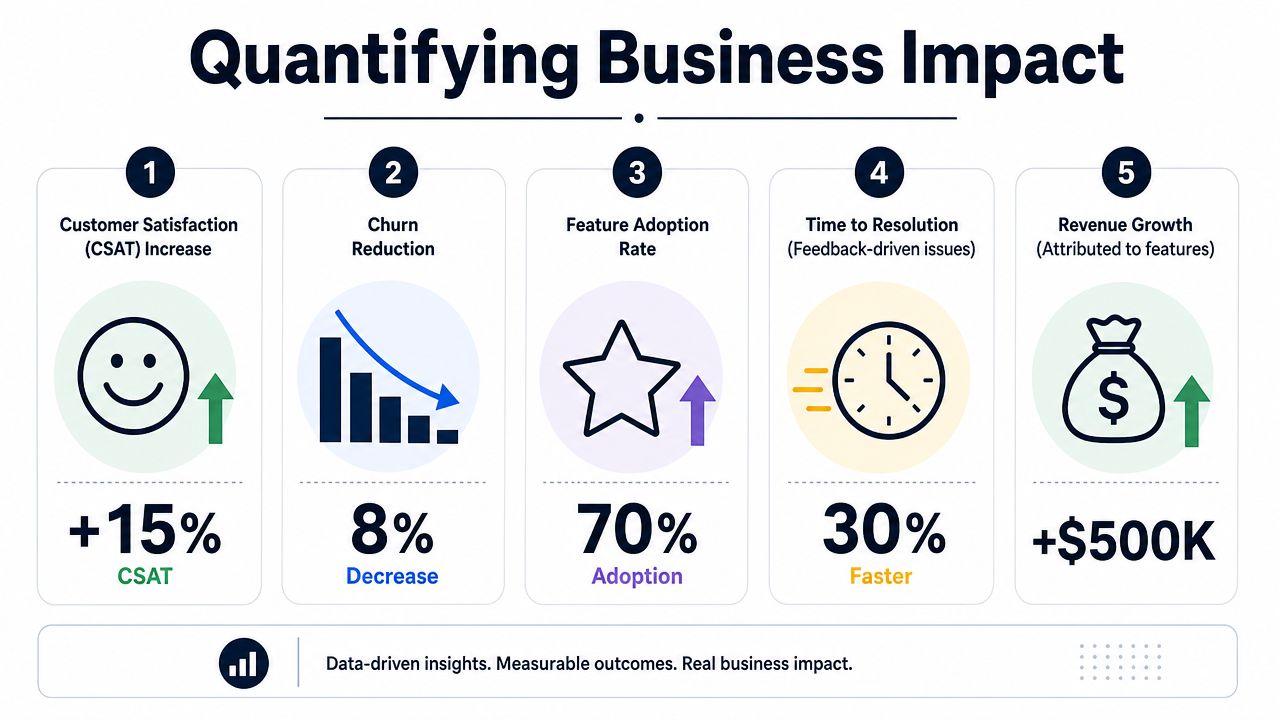
If leadership sees only request volume, they will treat feature request tracking as admin work. The reporting has to connect customer input to retention risk, expansion opportunity, adoption after launch, and the speed of decision-making. That is the shift from a request inbox to a revenue tool.
Measure the full chain, not one isolated metric
A useful dashboard follows the full path from signal to shipped outcome.
That means tracking three layers together:
- Demand metrics: Request volume, trend direction, affected segments, and source channel
- Commercial metrics: Revenue at risk, expansion potential, sales impact, and account concentration
- Delivery and outcome metrics: What shipped, who adopted it, and what changed after release
Monetizely's guide to feature request and feedback metrics makes the same point from a different angle. Teams get better forecasting when requests are tied to specific accounts and segments instead of treated as a flat vote count. In practice, that is the difference between a roadmap that looks tidy in a spreadsheet and one that can stand up to finance and go-to-market scrutiny.
This is also where manual systems start to break down. Spreadsheets and tag rules can capture volume, but they struggle to detect theme changes across calls, tickets, emails, and sales notes at scale. AI analysis is the next step because it can cluster similar requests, surface patterns earlier, and connect feedback to account context without requiring the product team to recode every line by hand.
The metrics leadership responds to
I would put five views in front of an executive team:
- Adoption of shipped feedback-driven featuresWhich accounts and segments use what was built, and how often?
- Revenue influenced by shipped requestsWhich releases correlate with renewals, expansion, reduced churn risk, or faster sales cycles?
- Segment impactDid the work address a broad market need, a high-value segment problem, or one loud customer?
- Support volume after launchDid the release reduce repeat friction, or did it create a different class of confusion?
- Time from signal to decisionHow long does it take to detect a meaningful pattern, validate it, and make a roadmap call?
Those five views give leadership a way to judge product operations on business performance, not output alone.
Answer the hard questions directly
Leaders usually ask for proof, not process.
Are we building what customers want, or reacting to whoever asks the loudest?
Use segment-weighted demand, contract value, churn exposure, and post-launch adoption. Raw request count is too easy to distort.
Can we show that this system improves retention?
Yes, if requests are tied to accounts before prioritization and measured against outcomes after release. If the team stops tracking at shipment, there is no retention story to tell.
How much manual work does this take?
A lot at the start. Someone has to clean data, merge duplicates, define taxonomy, and review ambiguous requests. The payoff comes later. Once the structure is stable, AI can handle more of the clustering and pattern detection, and the team spends less time sorting feedback and more time making decisions.
A good feedback system does not just document what customers said. It helps product leaders explain why a roadmap choice mattered in revenue terms, which bets reduced risk, and which shipped features earned their cost.
If your team is still stitching together Zendesk tags, Slack threads, call notes, and Jira tickets by hand, SigOS is built for the next step. It helps product and growth teams detect the signal inside scattered feedback, connect requests to churn and expansion patterns, and turn customer chaos into a clearer, revenue-aware roadmap.
Keep Reading
More insights from our blog


Ready to find your hidden revenue leaks?
Start analyzing your customer feedback and discover insights that drive revenue.
Start Free Trial →