Maximize Impact: Feature Request Prioritization 2026
Master feature request prioritization with our revenue-driven playbook. Quantify feedback, select frameworks, & align your roadmap for business impact.

Most advice on feature request prioritization starts in the wrong place. It starts with a backlog, a voting board, or a framework debate about RICE versus ICE. That's useful, but it misses the harder question: which requests map to retention risk, expansion potential, or wasted engineering time?
Teams get flooded with requests and still ship the wrong things. Research shows the average product team receives about 1,200 feature requests annually and implements only 18% of them, which means 82% are deprioritized or rejected. It also shows that 42% of SaaS customers cancel because a critical requested feature was never built or was delayed significantly. Those aren't planning problems. They're revenue problems.
The common failure is simple. Teams prioritize what is loud, recent, or politically inconvenient to ignore. The better system scores what is expensive to ignore.
Why Your Feature Prioritization Is Probably Wrong
The most popular advice says to rank requests by volume. Count votes. Listen to the biggest customer. Balance that against effort. Move on.
That approach breaks because customers don't always file the request that matters most. In fact, 87% of SaaS churn is driven by unaddressed silent pain points that never surface as formal requests, according to QuestionPro's analysis of product feature prioritization. A team can have a healthy request board and still miss the workflow friction that causes high-value accounts to disengage.

The loudest request is often the wrong unit of analysis
A request isn't a priority. It's a clue.
If a sales prospect asks for SSO, that may signal enterprise readiness. If support sees repeated complaints around export failures, that may signal workflow breakage. If usage drops at a specific step, that may matter more than either of those, even if nobody asked for a feature at all.
Product teams also skew toward bad input weighting. Research shows 68% of product managers report that over 50% of incoming feature requests originate from less than 10% of their customer base, often enterprise clients, yet 74% of teams still prioritize based on raw request volume rather than segmented customer value. That's how teams end up building for noise instead of business impact.
Practical rule: Treat every request as evidence of a problem, not proof of a solution.
Silent churn changes the job
Once you accept that silent pain drives more churn than explicit requests, feature request prioritization stops being a backlog grooming exercise. It becomes a signal-detection system.
That changes what good teams measure:
- Behavior before opinion: Usage drop-offs, repeated workarounds, failed attempts, and abandonment often reveal more than a feature board.
- Segment before count: Ten requests from strategic accounts can matter more than a hundred from low-fit users. Sometimes the reverse is true. The point is to score segments, not crowds.
- Cost of inaction before delivery effort: The question isn't “How hard is this to build?” It's “What happens if we leave this unfixed for another quarter?”
Why framework-only thinking falls short
Frameworks are helpful, but they don't rescue bad inputs. A clean RICE sheet built on weak assumptions still produces a polished mistake.
That's one reason feature request prioritization failures hit roadmaps so hard. The data provided here shows companies without a formal prioritization framework experience 3.5 times more missed roadmap deadlines and an average revenue delay of $120,000 per quarter for mid-sized SaaS firms. Structure matters. But structure without behavioral evidence still leaves teams arguing over anecdotes with nicer spreadsheets.
The fix isn't to throw out scoring. It's to score the right thing.
Choosing Your Prioritization Compass Not Just a Score
Most mature teams already know they need a framework. The question isn't whether to use one. It's which one to use for which decision. A 2024 survey of 1,500 product managers found that 79% of mature product teams use at least one scoring model to rank feature requests.
That number matters less than the implication. Feature request prioritization has become a systems problem, not an intuition problem.
Use frameworks as tools, not ideology
A framework should match the decision you're making.
If you're triaging a messy backlog, a simple model can be enough. If you're sequencing strategic bets across product lines, you need something stricter. If you're deciding what makes a release, you need a delivery-scoping method, not a portfolio method.
Teams that are refining roadmap discipline often benefit from pairing these methods with a broader AI product development strategy, especially when they're mixing customer feedback, usage analytics, and emerging AI workflows in the same planning cycle.
Prioritization Framework Comparison
| Framework | Scoring Components | Best For | Potential Drawback |
|---|---|---|---|
| RICE | Reach, Impact, Confidence, Effort | Sequencing comparable opportunities in an established product area | Easy to distort if reach or impact is guessed loosely |
| ICE | Impact, Confidence, Ease | Fast triage when data is thin | Too subjective for high-stakes roadmap calls |
| Value vs Effort | Perceived value against implementation effort | Early-stage teams and quick backlog sorting | Often ignores retention risk and strategic fit |
| Kano | Basic needs, performance needs, delighters | Understanding satisfaction dynamics | Doesn't produce a clean operating score by itself |
| MoSCoW | Must have, Should have, Could have, Won't have | Release scoping and delivery trade-offs | Teams over-label work as “Must” |
| Cost of Delay | Relative urgency of delay against duration or effort | Time-sensitive bets, platform work, revenue-critical requests | Requires disciplined business context |
| Revenue impact scoring | Current revenue, churn risk, expansion potential, strategic influence | B2B SaaS teams tying roadmap decisions to commercial outcomes | Can over-favor paying accounts if strategic influence isn't included |
A useful companion for teams building their own hybrid model is this guide to a feature prioritization matrix, which is helpful when you want a visual way to pressure-test trade-offs before they become roadmap commitments.
What works in practice
RICE is strong when the candidate set is already narrowed and the variables are reasonably comparable. It works poorly when one item is a retention fix, another is a strategic platform capability, and a third is a feature that only matters to one segment.
Value versus effort is still effective for first-pass triage. It's fast. It aligns people quickly. It also hides too much if the team treats “value” as a vibe.
MoSCoW helps only after strategy is set. It's not a good first filter. It becomes useful when engineering and product need to protect a release from scope inflation.
Good feature request prioritization doesn't start with choosing the smartest framework. It starts with choosing the framework that fits the business decision in front of you.
Build a compass, not a formula
A practical system usually combines methods:
- For intake: Use lightweight triage so the team can sort duplicates, bugs, requests, and workflow failures quickly.
- For strategy: Use weighted scoring tied to retention, expansion, and segment importance.
- For sequencing: Use RICE or a similar model once the strategic layer has narrowed the field.
- For release planning: Use MoSCoW to decide what ships now.
That's the difference between a score and a compass. A score ranks items. A compass points the team toward business value.
From Noise to Numbers Quantifying Qualitative Feedback
Most product feedback is messy. Support tickets are vague. Sales notes are biased toward deals in flight. Interview transcripts contain useful nuance buried inside long conversations. NPS comments mix praise, confusion, and feature demands in the same paragraph.
If your team can't convert that mess into structured input, feature request prioritization becomes an exercise in selective memory.
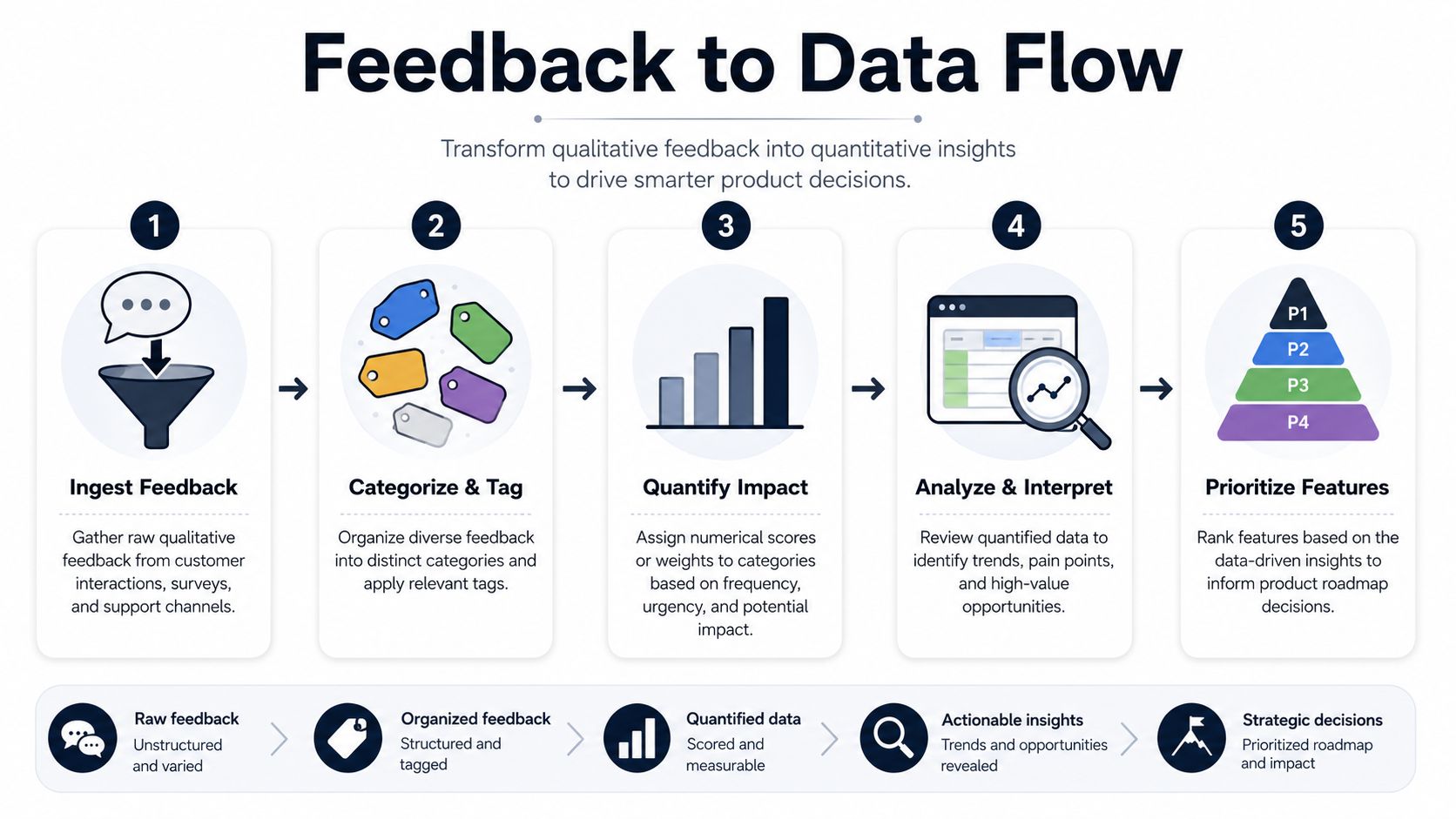
Start with normalized intake
Pull feedback from the places customers already speak:
- Support systems: Zendesk, Intercom, Help Scout, chat transcripts.
- Commercial conversations: Gong calls, CRM notes, sales objections, lost-deal reasons.
- Customer success records: QBR notes, escalation summaries, onboarding friction.
- Self-serve inputs: NPS verbatims, in-app surveys, public boards, beta feedback.
- Behavioral evidence: Product analytics, failed actions, adoption gaps, cohort-level drop-off.
The rule is simple. Don't let any one channel dominate by default.
Teams working through design and feedback handoff often improve the quality of these raw signals when they optimize Vercel review processes, because cleaner annotation and review context reduces the number of vague “something feels off” comments that pollute prioritization.
Tag for problem, not just feature
Most systems collapse by creating tags that mirror requested solutions. “Need dashboard.” “Need API.” “Need export.” That's useful for backlog management and weak for prioritization.
Tag by problem shape instead:
- Workflow blocked
- Time-consuming workaround
- Missing enterprise requirement
- Adoption friction
- Integration gap
- Reliability issue
- Reporting blind spot
- Expansion blocker
Then add qualifiers such as segment, plan tier, lifecycle stage, and urgency. A request from a new trial user and the same request from a mature enterprise account are not the same signal.
For teams building this discipline, a practical reference is this guide on how to analyse customer feedback in a way that connects text feedback to actual product decisions.
Dollarize the impact
This is the step most articles skip. Qualitative feedback becomes useful when it can be tied to commercial outcomes.
A workable scoring model uses four layers:
| Signal layer | What to capture | Why it matters |
|---|---|---|
| Request weight | Frequency, urgency, repeated mentions across channels | Distinguishes isolated asks from recurring problems |
| Account value | Current contract value, fit, strategic importance, renewal stage | Prevents raw volume from overpowering customer value |
| Behavioral risk | Usage decline, failed actions, disengagement, support burden | Detects issues customers don't explicitly describe |
| Expansion potential | Likelihood the fix unlocks growth in adjacent segments | Captures upside beyond current revenue |
Recent trends show 45% of SaaS companies now use attempted revenue impact scoring, which includes not just current deal size but potential expansion from non-paying segments that influence ecosystem growth, as described in Savio's guide to prioritizing feature requests.
That matters because not every important request comes from a paying account. Some come from implementation partners, developers, community leaders, or power users who influence future demand.
A request from a non-paying user isn't low value by default. It's unproven value until you score its influence.
A simple practitioner model
A useful model is to give every request cluster a composite score built from:
- Commercial weight
- Churn relevance
- Behavioral evidence
- Strategic adjacency
- Delivery confidence
You don't need artificial precision. You do need consistency. The goal is to compare unlike inputs without pretending they're identical.
What works is clustering feedback into themes, attaching those themes to segments and usage patterns, and then asking one question: if we fix this, where will the money show up first? In retention, expansion, activation, or reduced support drag?
That's when feature request prioritization stops being subjective sorting and starts behaving like portfolio management.
Building Your Automated Prioritization Engine
Manual prioritization work is expensive in a way often underestimated. It doesn't just burn PM time. It delays the moment when the team can see patterns clearly enough to act.
Research in the verified data shows the average time to prioritize a feature request dropped from 14 days to 4.2 days after implementing automated feedback aggregation tools, yet 61% of teams still spend more than 8 hours weekly manually categorizing and scoring requests. That's exactly the kind of operational drag that keeps roadmaps reactive.
Place the system where people already work.
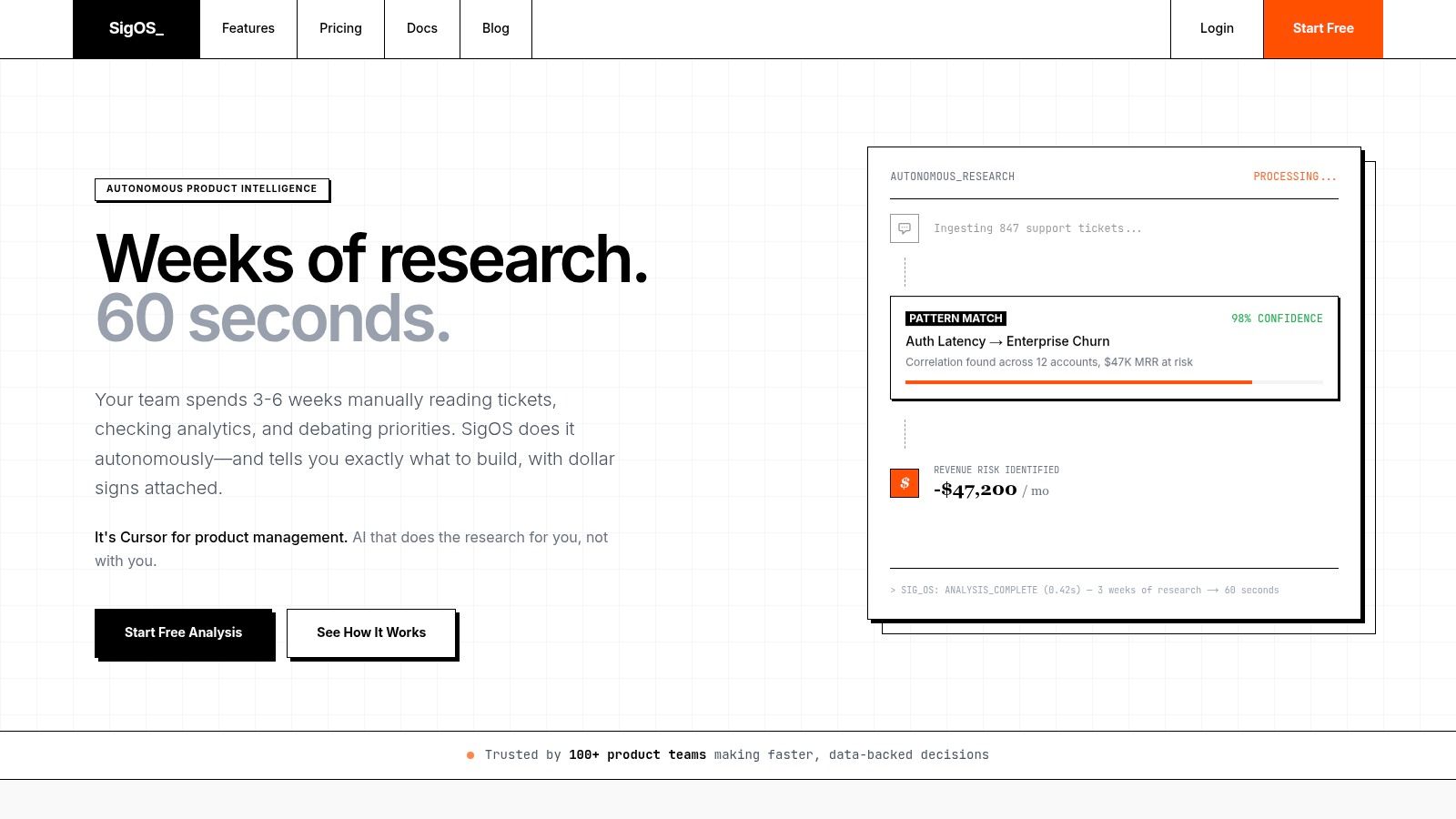
The workflow that actually scales
A practical engine has four layers.
Intake
Connect the customer-facing tools first. Zendesk, Intercom, Gong, HubSpot, Salesforce, and your product analytics stack are usually enough to start. Don't wait for perfect coverage.
Enrichment
Every incoming item should be enriched with customer segment, account status, lifecycle stage, plan type, and usage context. Without enrichment, every request looks equally important on paper.
Scoring
The engine should cluster similar feedback, attach behavioral evidence, and assign a prioritization score that reflects business impact rather than just count volume.
Delivery
Push the scored output into Jira, Linear, GitHub, or the planning tool your team already uses. If prioritization lives in a separate dashboard nobody checks during sprint planning, it won't change decisions.
Keep the human review where it matters
Automation should remove categorization work, not executive judgment.
A good system automates these tasks:
- Deduplication: Merge repeated requests that describe the same underlying problem.
- Theme detection: Group “export is broken,” “CSV failed,” and “download doesn't complete” into one issue cluster.
- Segment weighting: Recognize whether the pain sits inside enterprise onboarding, self-serve retention, or partner adoption.
- Routing: Send validated issues to the right product area with enough context to act.
For teams evaluating tooling options, this roundup of AI tools for product feature prioritization is useful because it shows how different products handle clustering, scoring, and decision support.
One thing matters more than the model itself. The output has to be operational. If it doesn't create a ticket, annotate a roadmap item, or trigger a review, it's still analysis theater.
A more detailed look at what these systems should ingest and score is covered in this guide to a customer feedback analysis tool.
Design the handoff into execution
Once an issue earns priority, engineering needs the reasoning with it. Don't send over “build advanced reporting.” Send over:
- the problem cluster
- affected segment
- observed behavior
- revenue or retention rationale
- confidence level
- validation plan
That handoff is where weak prioritization systems lose trust. Engineers see feature requests with no evidence. Product sees delivery pushback. Sales hears “not this quarter.”
This video gives a useful visual for what a tighter workflow can look like in practice.
De-Risking Your Roadmap with Validation and Communication
A prioritized backlog is still a set of assumptions. Some assumptions are strong. Many aren't. Teams get in trouble when they treat a score as proof.
That's dangerous, with serious implications for customer retention. 42% of SaaS customers cancel when a critical requested feature is never built or is significantly delayed. But the opposite mistake also hurts. Teams rush to build what looks important and then discover they solved the wrong problem, over-scoped the solution, or rolled out something customers don't adopt.
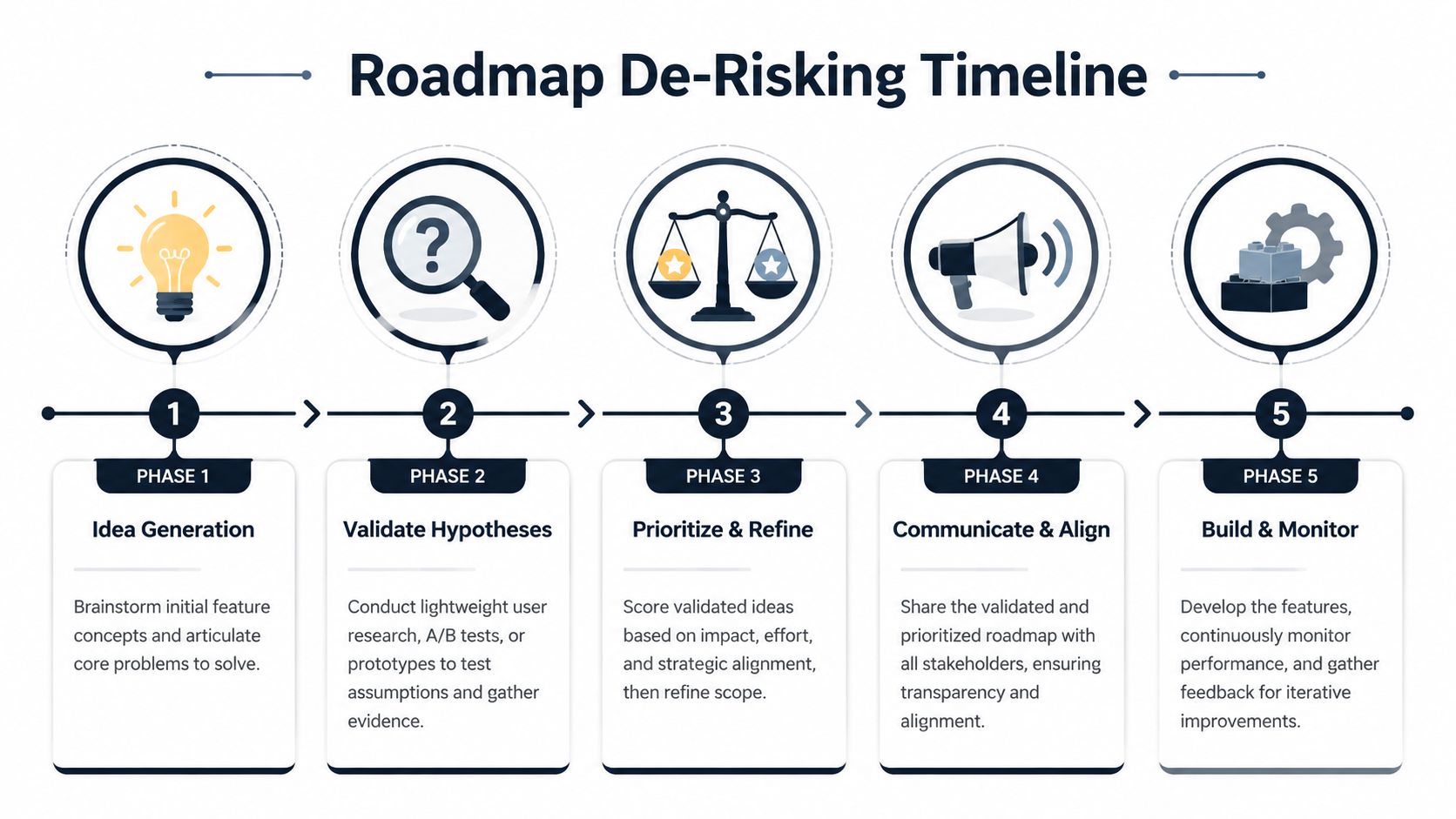
Validate the problem before the feature
The cheapest way to improve feature request prioritization is to validate assumptions before engineering commits significantly.
Three low-friction tests work well:
- Fake door tests: Put the button, CTA, or menu item in front of users and measure interest before building the capability behind it.
- Prototype reviews: Show a narrow flow to affected users and ask them to complete a real task, not react to a concept.
- Beta cohorts: Release to a specific segment where the pain is concentrated and watch usage, completion, and support burden.
The key is specificity. Don't ask, “Would you use this?” Ask users to show whether the workflow solves the problem they have.
Define what success and failure look like
A roadmap gets safer when each major item has both a success condition and a kill condition.
Success should describe the expected behavior change. Kill conditions should define what would make the team stop, re-scope, or repackage the feature. Without that pre-commitment, weak ideas linger because nobody wants to admit they were overrated.
If a feature can't fail on paper, it usually won't be managed honestly after launch.
This is especially important for features justified by qualitative feedback. If the original case depended on pain severity, the post-launch review should check whether that pain dropped.
Close the loop with customers and internal teams
Prioritization isn't just a decision process. It's a trust process.
The verified data shows 43% of teams still fail to close the feedback loop with requesters, and when features are rejected without explanation, teams see a 29% decline in customer trust scores. Silence makes customers assume their input disappeared. It also makes internal stakeholders think product decisions happen in a black box.
Use simple communication templates:
| Decision type | What to communicate |
|---|---|
| Building now | Problem being solved, who it serves, what success looks like |
| Not now | Why it isn't prioritized yet, what evidence would change that |
| Rejected | Why the request won't move forward and what alternative exists |
| In validation | What the team is testing before a build commitment |
The goal isn't over-explaining every decision. It's showing that the team applied a consistent method and that feedback affected the outcome, even when the answer is no.
Establishing Governance and Avoiding Common Pitfalls
Bad prioritization is usually a systems failure, not a talent failure. Smart teams still get pulled into HiPPO decisions, roadmap thrash, and endless “must-have” inflation when governance is weak.
One of the clearest failure modes is already well known. HelloPM's explanation of feature prioritization calls out the HiPPO effect, where the highest paid person's opinion overrides evidence. It also notes that features built on subjective feedback rather than behavioral data carry a 30 to 40% higher churn risk when cross-functional validation is missing.
Put decision rights in the system
A durable feature request prioritization process needs named owners for different inputs.
Use a recurring council with product, engineering, customer success, support, and sales. Not because consensus is always good, but because each function sees a different risk:
- Engineering estimates implementation complexity and reversibility.
- Customer success sees adoption friction and renewal risk.
- Sales understands value-capture probability and deal impact.
- Support knows which requests hide operational pain or cost.
- Product integrates the evidence into strategy.
That structure matters because it converts opinion into inspectable inputs.
Add non-negotiable rules
Governance gets stronger when a few rules are explicit.
Cap Must-have inflation
The verified guidance from the Userpilot reference is useful here. Cap Must-have work at 60% of total development effort, reserve roughly 20% for Could-have items, and require evidence for every Must classification, such as legal requirements, security gates, named product-market-fit dependencies, or evaluation blockers.
Review the scoring model on a cadence
The same HelloPM reference recommends reviewing and adjusting the prioritization matrix quarterly. That's the right instinct. The weights that made sense when the company was pushing expansion may not fit a quarter focused on retention or platform reliability.
Set kill conditions before launch
This one changes behavior fast. Define the condition that would trigger a rollback, sunset, or repackaging before the feature ships. Teams that wait until after launch rarely make hard calls cleanly.
Governance works when it removes improvisation from the moments with the most political pressure.
Watch for the common traps
Some mistakes show up in nearly every product org:
- Request count masquerading as demand: High volume can still describe low strategic value.
- Enterprise distortion: Important accounts matter, but they shouldn't unilaterally control the roadmap.
- Framework theater: Teams fill out scorecards after the decision is already made.
- No post-launch review: Features stay “in progress” forever because nobody measures the outcome with accuracy.
Strong governance doesn't make feature request prioritization rigid. It makes it survivable. The team can adapt, but it can't pretend.
If your team is still sorting feedback by hand, scoring requests in spreadsheets, and debating roadmap priorities without a clean link to revenue or churn risk, SigOS is worth a look. It helps product teams turn support tickets, sales calls, chat transcripts, and usage signals into prioritized issues tied to business impact, so you can spend less time managing noise and more time shipping the work that moves retention and growth.
Keep Reading
More insights from our blog

Ready to find your hidden revenue leaks?
Start analyzing your customer feedback and discover insights that drive revenue.
Start Free Trial →