10 Best Customer Data Integration Tools for SaaS in 2026
Discover the top 10 customer data integration tools. Our guide helps SaaS teams compare CDPs, ETL, and Reverse ETL solutions to unify data and drive revenue.

A PM reviews churn-risk accounts before the weekly product meeting. Support has one story in Zendesk. Sales has another in Salesforce. Product usage points somewhere else in Mixpanel, and billing data in Stripe changes the priority again. The hard part is not collecting more customer data. It is connecting those signals fast enough to decide what to fix, who to save, and where expansion is still possible.
That is the job of customer data integration tools. For SaaS teams, the true value is not a cleaner pipeline diagram. It is turning scattered records from Zendesk, Intercom, Salesforce, Stripe, and product analytics into decisions tied to revenue. The best teams use these systems to spot which support themes show up before contraction, which feature requests cluster around expansion accounts, and which onboarding behaviors deserve immediate intervention. Teams that pair integration with behavior analytics tied to account outcomes usually get more value than teams that stop at centralizing data.
The category keeps expanding because the business need is clear. SaaS companies need one view that product, growth, support, and revenue teams can trust enough to act on. Without that, prioritization slips back into whoever has the loudest anecdote or the freshest screenshot from a customer call.
The trade-offs matter. Segment and mParticle are strong choices for event collection and downstream routing. Hightouch fits teams that already trust the warehouse as the source of truth. Fivetran, Airbyte, and Hevo help move operational data reliably, but they do not answer product questions on their own. SigOS represents a more opinionated approach, focused on connecting customer conversations and usage patterns to churn risk, expansion potential, and product priority.
That difference is what this list is built to examine. Not just which tool moves data, but which one helps a SaaS team connect customer signals to retention, expansion, and roadmap decisions.
1. SigOS
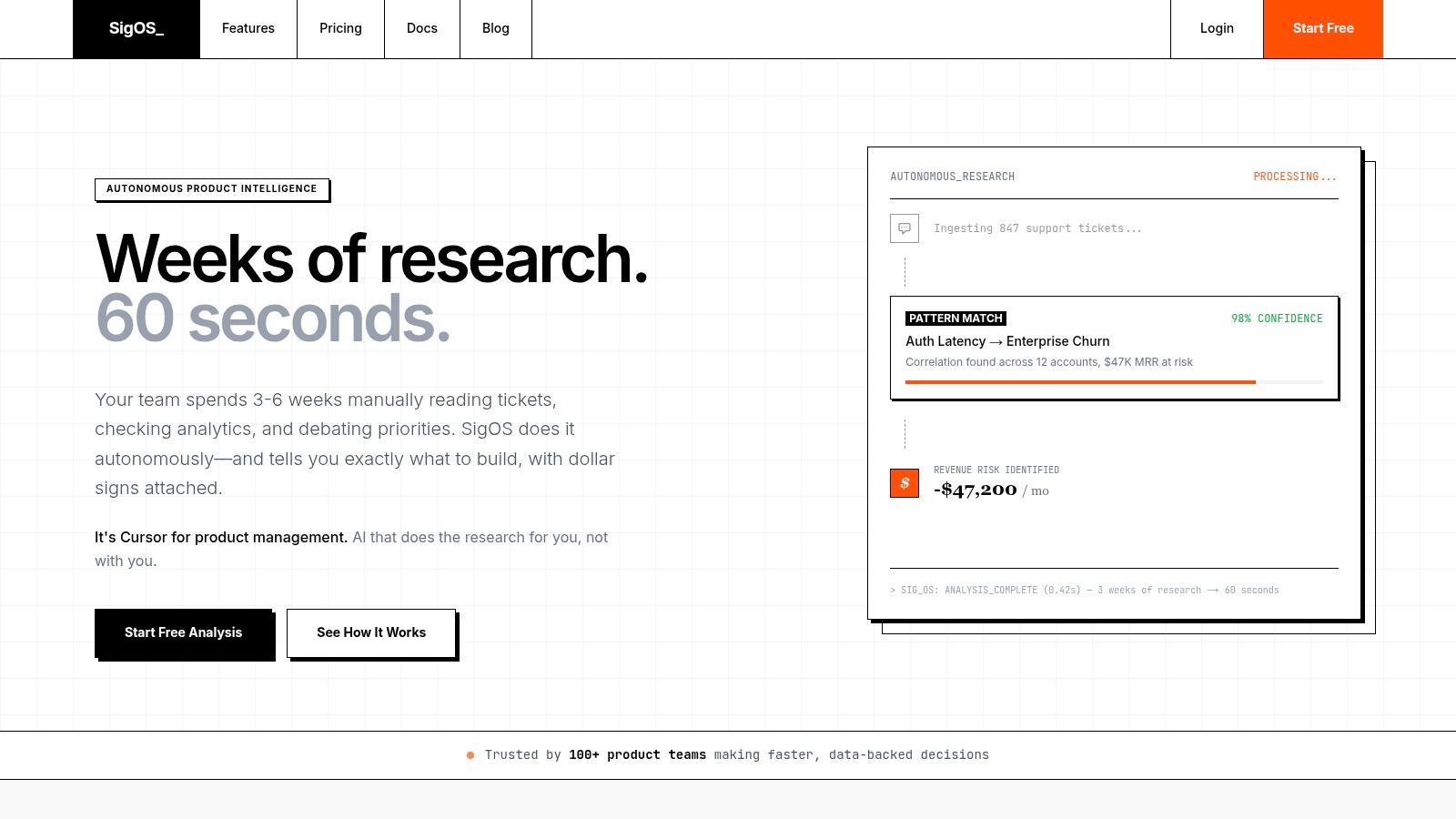
A product lead opens Monday planning and sees the usual pile of inputs: Zendesk tickets, Intercom chats, sales notes, Stripe data, Jira issues, and a dashboard full of usage events. The hard part is not collecting those records. The hard part is deciding which customer problem is tied to churn risk, which request shows up in expansion accounts, and which issue can wait.
SigOS is built for that decision layer. It connects customer conversations, product behavior, billing signals, and delivery context so teams can rank issues by business impact instead of volume alone. For SaaS teams, that distinction is critical. Plenty of tools can move data between systems. Fewer help a PM, growth lead, or CS leader decide what deserves attention this week because it affects retention or revenue.
Why it works for product and growth teams
SigOS pulls together support tickets, chat transcripts, sales conversations, usage metrics, and shipping data, then turns them into prioritized issues and feature requests with account context attached. The practical value is speed to action. Teams can see whether a complaint is concentrated in high-value accounts, whether the affected users are dropping engagement, and whether the pattern points to churn risk or expansion potential.
That is a different job from generic integration.
CMSWire makes the broader point in its analysis of what customer data integration really means. Data quality and operationalization still break down in many organizations before anyone gets to insight. In practice, SaaS teams need more than synced records. They need a way to reduce noise and connect customer feedback to decisions across product, support, and revenue teams.
Practical rule: If your team is still circulating “top themes from support” without showing account impact, usage change, or revenue exposure, the integration work is incomplete.
SigOS works best when there is already enough signal in the stack. If your team has meaningful support volume, decent product instrumentation, and billing data that can be tied back to accounts, the platform can help surface what matters faster. If event tracking is inconsistent or account mapping is messy, implementation will expose those gaps quickly.
Teams trying to make that connection usually benefit from a clear model for behavioral segmentation across customer journeys. The reason is simple. A feature request from an expanding account should not be treated the same way as the same request from an inactive account with low product depth.
Best fit and real trade-offs
SigOS fits SaaS teams that want customer data integration to drive prioritization, not just reporting. It is especially useful when product, growth, and CS all need a shared view of what customers are saying, what they are doing, and what that means for retention and expansion.
The trade-off is focus. Teams looking for a broad, neutral event-routing layer may find SigOS more opinionated than they want. Pricing is not public, so buyers should expect a sales process, and setup quality will depend on how cleanly support, product, billing, and account data can be connected. That work is worth it when the goal is better product and growth decisions, but it is still work.
2. Twilio Segment
Twilio Segment usually enters the picture when a SaaS team has a familiar problem. Product events live in one system, lifecycle messaging in another, support context in Zendesk or Intercom, and nobody trusts that the same customer is being measured the same way across all of them. Segment solves that first-mile collection problem well.
Its core value is speed with breadth. One instrumentation layer can feed analytics tools, ad platforms, marketing automation, support systems, and the warehouse without asking engineering to maintain a pile of one-off connectors. For teams trying to get product usage, messaging, and support data into the same operating model, that can remove months of integration drag.
Where Segment earns budget is not just event routing. It is the reduction in coordination cost across teams. Product can define events once, growth can use those events for campaigns, and CS can pull customer context into support workflows. If a spike in Zendesk tickets follows a failed onboarding step, or Intercom conversations rise right before a downgrade, Segment helps get that signal into the systems where teams can act on it.
That matters because the business question is usually not "did the event fire?" It is "which accounts are showing churn risk or expansion intent, and can we do something about it this week?" Teams working through that problem usually need a clearer approach to behavioral segmentation across the customer journey, not just more pipelines.
Segment still requires discipline.
I have seen teams buy it for a clean customer data foundation, then create a mess with inconsistent naming, duplicate traits, and no owner for the tracking plan. Segment makes distribution easier. It does not fix weak event design, unclear account mapping, or the common SaaS problem where support data and product data are technically connected but still not usable for prioritizing retention work.
The main trade-off is economics versus convenience. Segment is attractive early because implementation is relatively straightforward and the destination catalog is broad. As volume grows, pricing and tier limits become more visible, especially if the team expects advanced identity resolution, profile management, and audience capabilities rather than basic collection and forwarding.
Best fit is a SaaS team that wants to centralize event collection fast and activate that data across product, growth, and support without building the plumbing internally. If the goal is deeper account-level insight from billing, usage, and support signals, Segment can be part of the stack. It just works best when someone is actively governing what gets tracked, where it goes, and which downstream actions are tied to retention or expansion.
3. mParticle
mParticle tends to make the most sense when governance and identity resolution matter as much as collection. It has long been a serious enterprise CDP, particularly for organizations that care about strict schema controls, deterministic identity, and operational guardrails across teams.
That makes it appealing for mobile-heavy products, B2C apps, streaming businesses, and larger SaaS companies that can't afford loose customer identity stitching. If multiple teams touch customer data and compliance scrutiny is high, mParticle's structure becomes an advantage.
Where it shines
mParticle is less about “ship it quickly and clean it up later” and more about controlled rollout. The platform supports robust data collection, audience building, profiles, and governance workflows. That's useful when product, marketing, and support all consume customer data differently and need consistency.
The practical benefit is fewer messy downstream debates. If a growth team, product analyst, and CS leader are all using different IDs or event definitions, your churn analysis gets shaky fast. mParticle helps prevent that, but it usually asks for stronger upfront planning than lighter-weight tools.
A few trade-offs stand out:
- Governance first: Strong controls help large organizations avoid schema sprawl and identity confusion.
- Engineering required: Teams usually need technical ownership to implement it properly.
- Sales-led buying: You'll model event volume, environments, and use cases before you get a realistic commercial picture.
For mid-market SaaS teams, that can feel heavy. For larger companies with many stakeholders and stricter governance needs, that heaviness is often the point.
4. RudderStack
RudderStack is one of the better options for teams that want customer data integration tools without surrendering control of the data model. Its warehouse-native approach fits organizations that already treat Snowflake, BigQuery, or Databricks as the source of truth.
That design choice matters. Instead of pushing teams toward a fully managed black box, RudderStack lets them collect events, enforce schemas, build profiles in the warehouse, and then activate data back into business systems.
Best use case
RudderStack works well when analytics and engineering already have warehouse discipline, but the business still needs operational activation. Product teams can keep event and identity logic close to the warehouse, while growth and lifecycle teams use synced audiences downstream.
That's often the better setup for SaaS teams with strong internal data practices. They don't need another closed customer record living outside the warehouse. They need a clean way to collect, standardize, and activate first-party data.
If your warehouse is already trusted, a warehouse-native CDP usually creates less duplication and fewer reconciliation fights.
The trade-off is ecosystem breadth. RudderStack is commercially mature, but it still doesn't feel as broad as Segment in destination mindshare. Some advanced features also require higher tiers, so teams should confirm what's included before assuming the warehouse-native story covers every need out of the box.
For privacy-conscious organizations, though, RudderStack's control model is often more attractive than a traditional packaged CDP.
5. Hightouch
A common SaaS problem looks like this. The churn model exists in the warehouse, support risk signals sit in Zendesk, product usage trends are already modeled, and none of it reaches the teams trying to save an account before renewal.
Hightouch is a strong fit for that stage. It helps teams push trusted warehouse data into the systems where sales, success, support, and lifecycle marketing already work. If your biggest gap is activation, not collection, Hightouch usually solves the right problem faster than buying another system of record.
That matters for product and growth teams because the highest-value signals often live across tools, not inside one app. A SaaS company might combine Intercom conversations, Zendesk ticket volume, feature adoption, and billing history to identify accounts drifting toward churn or ready for expansion. Hightouch makes those modeled signals usable in Salesforce, customer success platforms, ad audiences, and messaging tools without forcing teams to rebuild the logic somewhere else.
The practical upside is speed. Analysts define the model once in the warehouse. Business teams act on the output in the tools they already use.
Where Hightouch fits best
Hightouch is strongest when the warehouse is already credible and the business needs operational follow-through. Teams can sync health scores, product-qualified lead flags, renewal risk indicators, or support-heavy account segments into downstream systems on a schedule that matches the use case.
That setup is especially useful when bad handoffs, stale traits, or inconsistent IDs are blocking execution. If customer data quality is shaky, activation will expose it quickly, which is why teams should clean up identity logic and warehouse data quality issues before scaling syncs across go-to-market systems.
There is also a real scope decision here. Hightouch can stay narrowly focused on reverse ETL, or it can grow into audience management, identity resolution, and personalization. That flexibility is useful, but it raises ownership questions. Data teams usually want control over models and definitions. Marketing, sales ops, and lifecycle teams want faster audience creation and campaign execution. If those boundaries are unclear, the tool becomes a mirror for process problems.
Another trade-off is freshness versus complexity. For many SaaS workflows, scheduled syncs are enough. For others, such as routing expansion signals after a pricing-page spike or reacting to high-risk support behavior, teams may compare scheduled warehouse activation with more immediate pipelines and CDC options. That is where evaluations like Fivetran and Streamkap features become relevant.
Used well, Hightouch turns warehouse models into action. Used too early, it can expose that the company still lacks stable definitions for customer health, account identity, or lifecycle ownership.
6. Fivetran
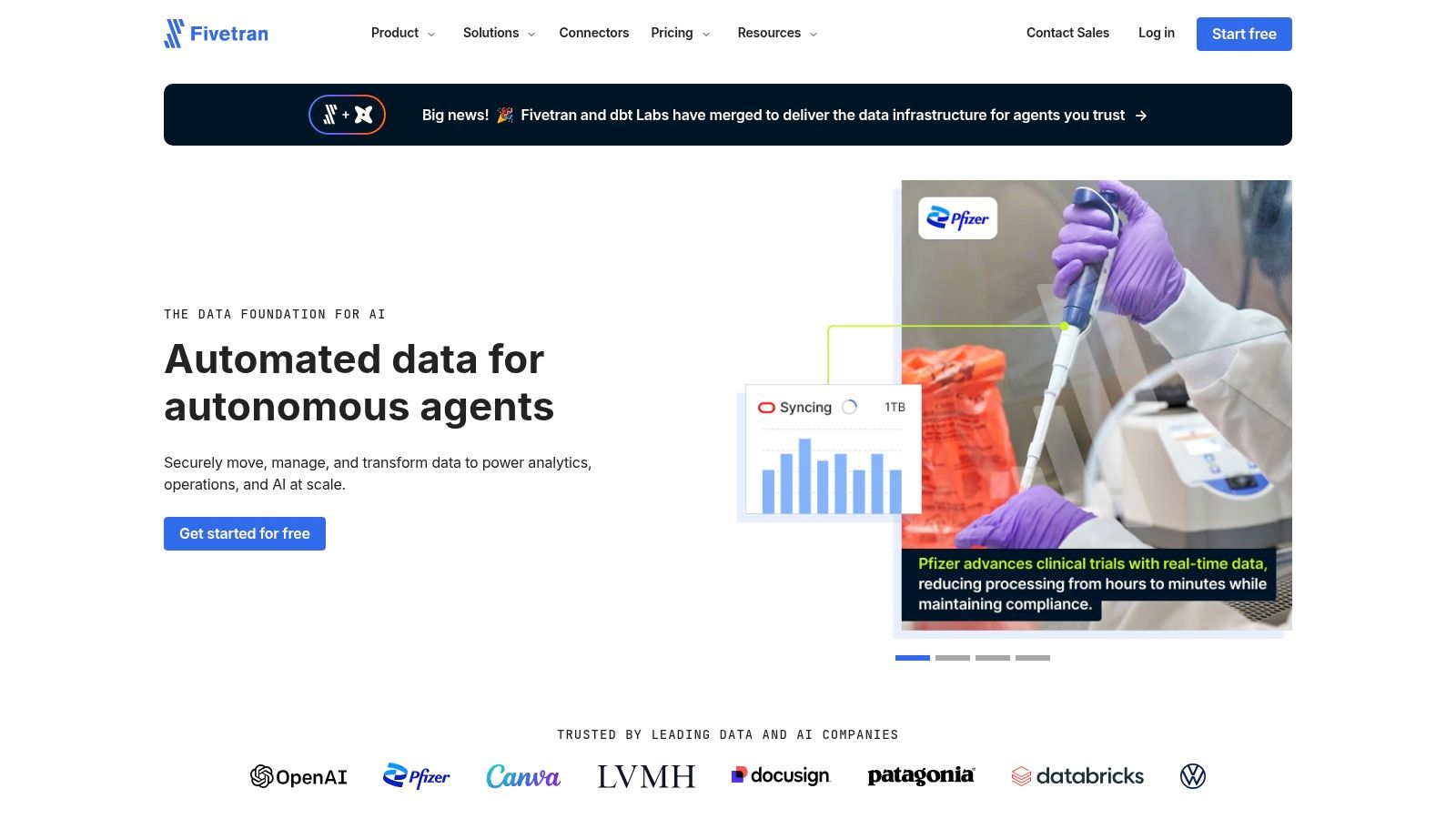
A common SaaS problem starts with a simple question from CS or growth: which accounts are showing churn risk in support conversations, and which ones are expanding in product usage? If Zendesk, Intercom, billing, and CRM data all live in different systems, the first job is getting that data into the warehouse reliably. Fivetran is often the tool teams pick for that layer.
Its value is operational more than flashy. The connector catalog is broad, schema drift is handled well, and the setup burden is lower than with more hands-on pipeline tools. That matters when the business goal is not "ingestion" but getting trustworthy account-level models that combine support volume, NPS, contract data, product activity, and lifecycle stage.
For SaaS product and growth teams, that translates into practical use cases. A team can pull Zendesk ticket trends and Intercom conversation data into the warehouse, join them with usage and billing records, then identify accounts with rising support pressure before renewal. The same foundation can surface expansion signals, such as high feature adoption paired with plan limits or increased seat demand. Fivetran does not create those insights on its own, but it removes a lot of pipeline maintenance that would otherwise slow the work down.
Fivetran's Activations product also changes the discussion. Once the warehouse model is stable, teams can send health scores, churn flags, or expansion segments back into the tools where CSMs, sales, and lifecycle marketers already work. That closes part of the loop between analysis and action, even if Fivetran is still stronger on ingestion than on orchestration-heavy activation workflows.
The trade-off is cost and latency. Fivetran is a strong fit for teams that want managed reliability and are willing to pay for it. It is less attractive when engineering wants tighter control over connectors, lower-cost customization, or near real-time movement for event-heavy workflows. Those architecture questions matter if the business needs to react quickly to support spikes or product behavior changes. Teams weighing batch syncs against faster CDC patterns often review Fivetran and Streamkap features before committing.
One caution from experience. Fivetran can move bad source data very reliably. If account IDs are inconsistent across Zendesk, Salesforce, Stripe, and the product database, the warehouse will fill up with conflicting customer records and misleading health models. Teams should address customer data quality issues that break warehouse trust before they assume the connector layer solved the problem.
7. Airbyte
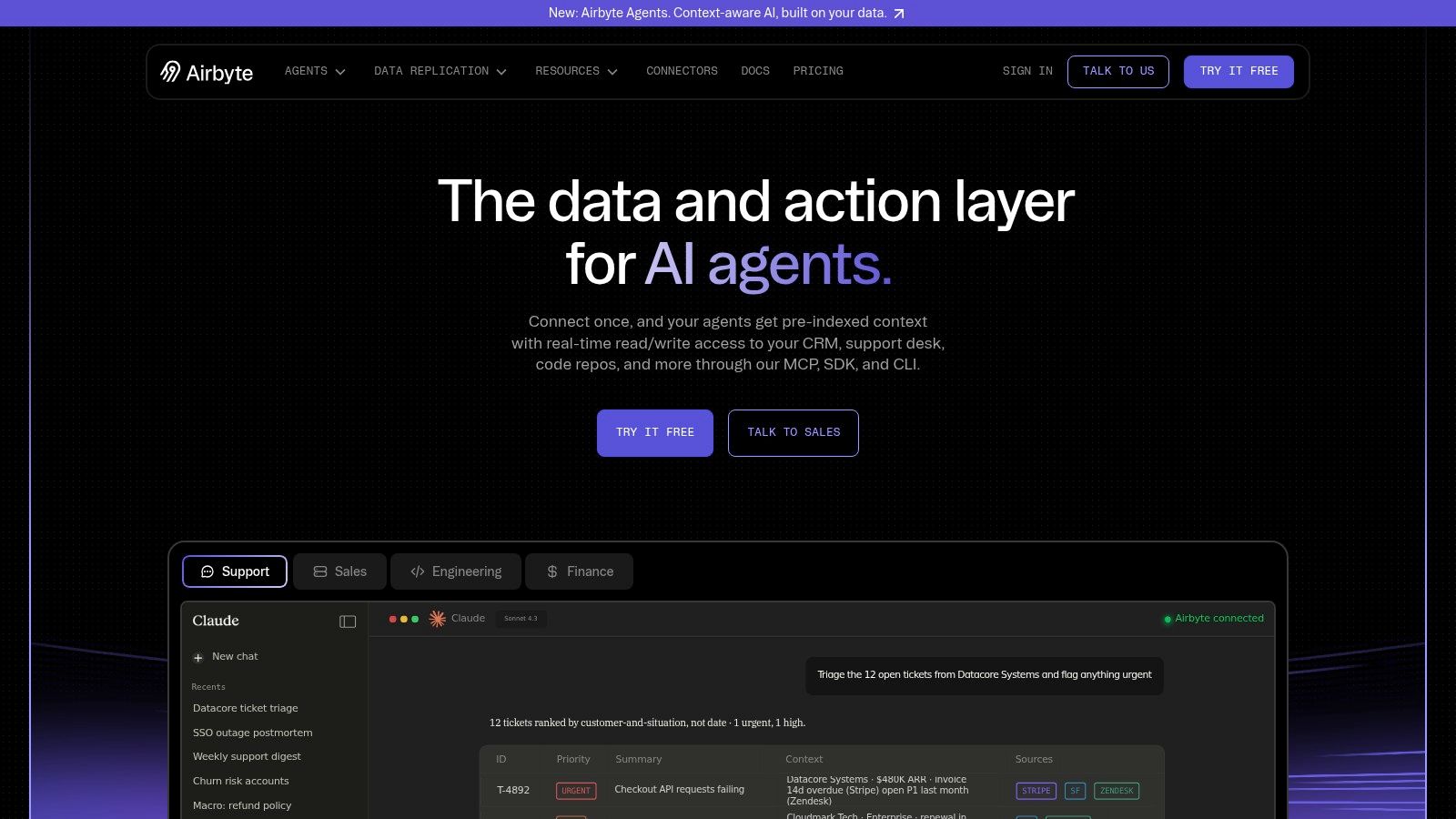
Airbyte is for teams that want flexibility more than polish. It has become a serious option because it gives engineering-led organizations a large connector catalog, open-source roots, and several deployment paths.
That combination is appealing if you care about controlling your own stack or avoiding the pricing dynamics of more managed vendors.
Where Airbyte fits
Airbyte makes sense when you have technical ownership and a clear warehouse plan. If you're integrating customer support, billing, CRM, and product systems into a unified warehouse model, Airbyte can get the data there without forcing you into a fully managed commercial box.
It's especially attractive for teams that need unusual connectors or expect to customize pipeline behavior over time. The Connector Development Kit is part of the appeal. You're buying optionality as much as product.
That said, optionality has a cost.
- Engineering advantage: Strong fit for teams comfortable operating parts of the data stack.
- Connector breadth: Useful when your SaaS stack includes less common systems.
- Operational overhead: Self-hosting and connector tuning can become real work for small teams.
Airbyte is less ideal if your company wants “set it and forget it” reliability with minimal technical care. It can absolutely support customer data integration, but it rewards teams that treat pipelines as a product, not as an afterthought.
8. Hevo Data
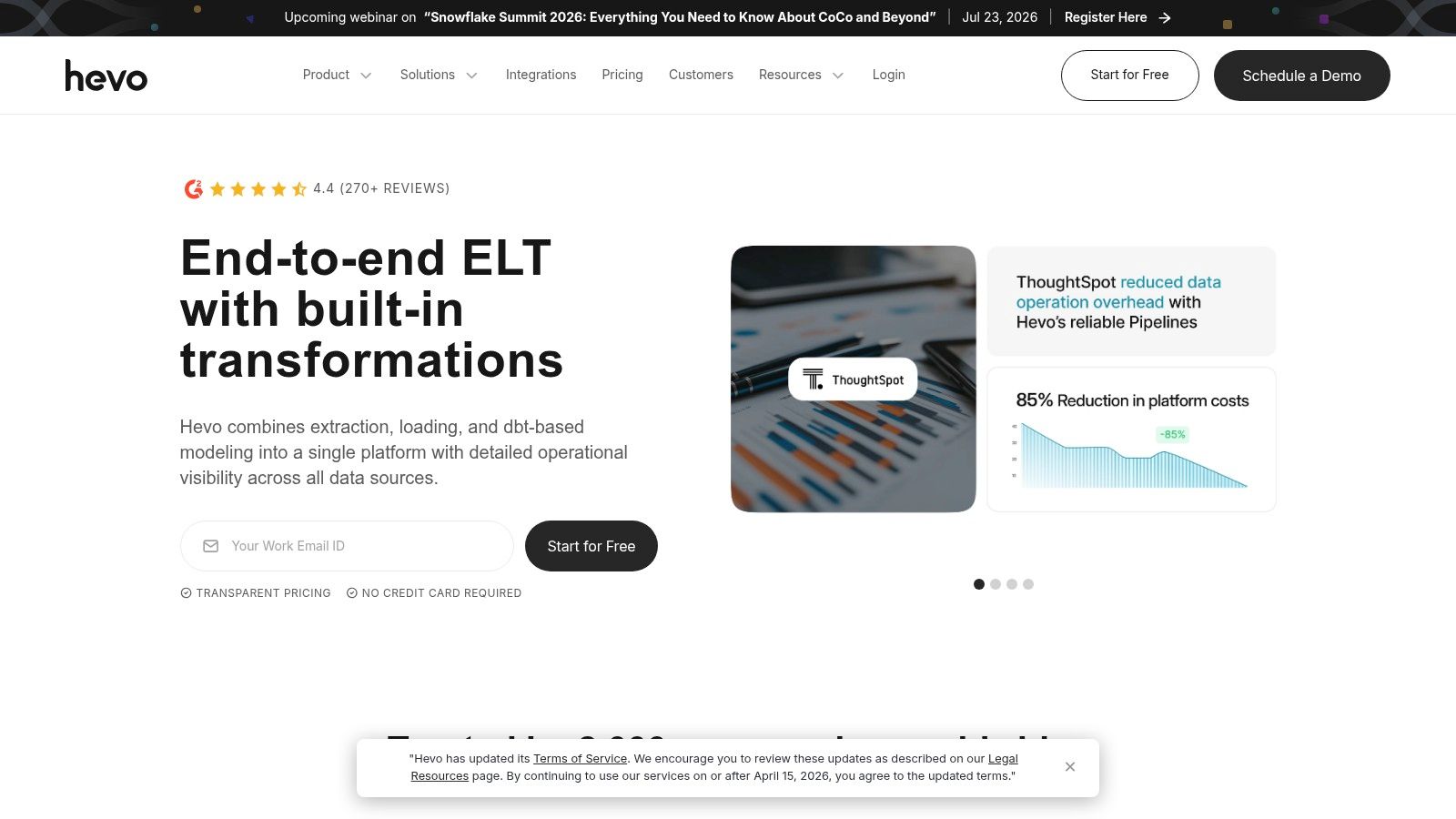
A common SaaS problem looks like this: support data lives in Zendesk, sales context sits in the CRM, billing is elsewhere, and product usage data reaches the warehouse late or not at all. The team does not need a highly customized data platform yet. It needs dependable pipelines quickly, so product, success, and growth can spot churn risk and expansion signals before the quarter closes.
Hevo Data is a practical fit for that stage. It focuses on getting common SaaS data sources into a warehouse or lake with low setup effort, which matters for teams that want answers from customer data without building a large data engineering motion first.
Where Hevo fits
Hevo works well when the job is clear. Centralize data from support, CRM, payments, and product tools. Apply light transformations. Keep the pipeline managed enough that a small team can operate it.
That makes it useful for SaaS companies trying to answer business questions, not just move tables around. If Intercom conversations spike before downgrade requests, or Zendesk ticket volume rises after a failed onboarding step, Hevo can help get those signals into one place fast enough for analysis and action. For product and growth teams, that is the key value.
The trade-off is scope. Hevo is better at reliable ingestion and basic pipeline management than at advanced governance, warehouse-native activation, or extensively customized orchestration. Teams with strict data control requirements or complex multi-step workflows may outgrow it.
For smaller and mid-market SaaS companies, that constraint is often acceptable. If the immediate goal is to unify customer data, reduce manual pipeline work, and give teams a cleaner view of retention and expansion drivers, Hevo can be the right level of tool.
9. Snowplow
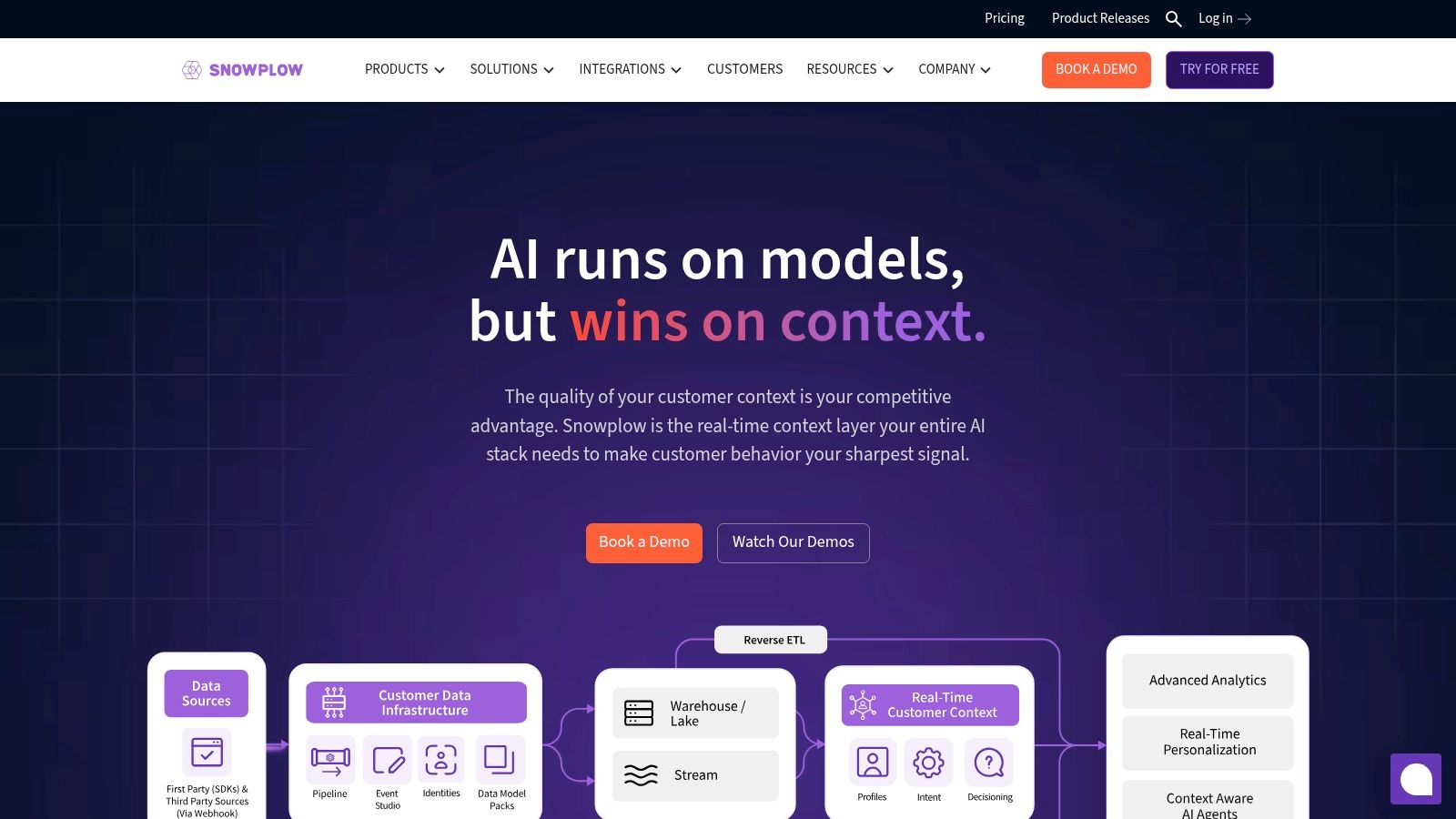
A SaaS team sees churn creeping up, but Zendesk tickets only show the complaint after the account is already unhappy. Intercom conversations add context, yet they still do not explain which in-product behaviors led there. Snowplow fits teams that need that missing layer. It is built for high-quality behavioral data collection with schema control, privacy oversight, and warehouse-ready event pipelines.
That focus makes Snowplow different from connector-heavy customer data tools.
For SaaS product, growth, and data teams, the value is not just cleaner event tracking. It is the ability to connect product behavior to revenue outcomes. If accounts that stop using a core workflow also start opening more support conversations, Snowplow gives you a cleaner way to capture the product side of that pattern. When that event stream sits next to Zendesk, Intercom, billing, and CRM data in the warehouse, teams can build churn models, health scores, and expansion triggers with more confidence.
Snowplow is especially strong when event quality matters more than speed to setup. Teams can define schemas up front, enforce consistency, and reduce the mess that often shows up later in analytics projects. That discipline pays off when the business asks harder questions, such as which onboarding actions correlate with conversion, or which usage drop-offs tend to precede downgrades in a specific customer segment.
The trade-off is real. Snowplow usually asks for more engineering involvement than a destination-first CDP or a lighter ingestion tool. Implementation takes clearer tracking design, ongoing governance, and a team willing to treat data collection as a product surface, not a side task. If the near-term goal is pushing audiences into ad networks or lifecycle tools as fast as possible, other platforms are easier to operationalize.
If the goal is a trustworthy first-party behavioral foundation that helps product and growth teams spot revenue-impacting signals earlier, Snowplow is a strong choice. It works best for companies willing to invest in data quality now so retention analysis, experimentation, and customer health modeling hold up later.
10. Customer.io Data Pipelines
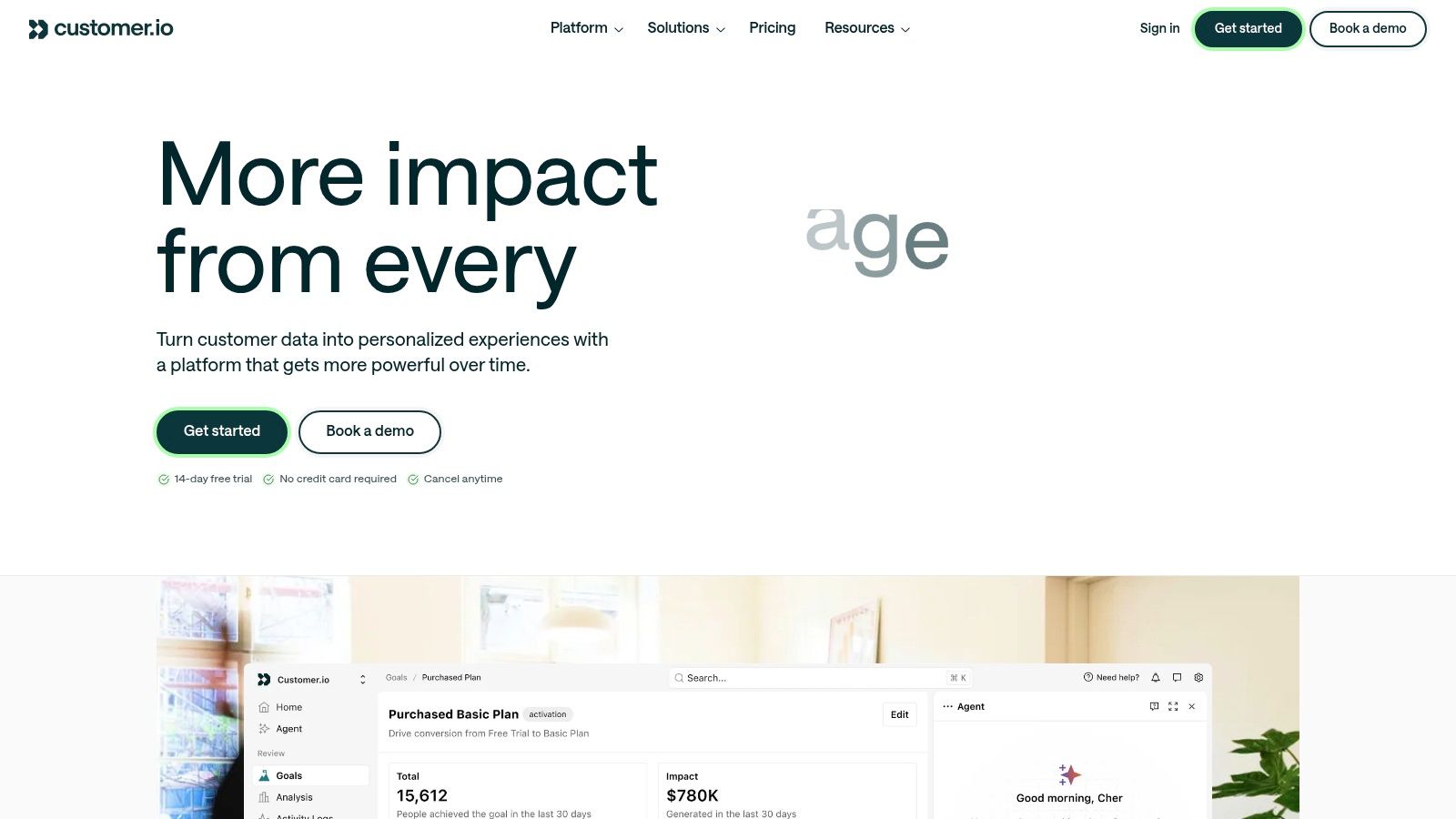
A common SaaS scenario looks like this. Product data lives in the warehouse, support signals sit in Zendesk or Intercom, and lifecycle messaging runs in Customer.io. The team wants to trigger the right email or in-app campaign when usage drops, a ticket spikes, or an account shows expansion intent. Customer.io Data Pipelines is most useful when the goal is to shorten that path from signal to action inside one operating environment.
For teams already committed to Customer.io, that matters. Data Pipelines lets them ingest event data, connect warehouse models, and push customer attributes or custom objects back into messaging workflows without adding another activation layer. In practice, that can mean fewer handoffs between data and lifecycle teams, faster campaign setup, and less time spent stitching tools together.
The business value shows up in specific use cases, not in the pipeline itself.
A SaaS company can send onboarding nudges based on product adoption milestones from the warehouse. It can suppress generic renewal messaging when Zendesk activity suggests an account is in trouble. It can route expansion plays when Intercom conversations, feature usage, and plan data point to growing demand. This is the primary appeal for product and growth teams. Customer data integration becomes a way to act on revenue signals earlier, not just move events from one system to another.
The trade-off is platform gravity. Customer.io Data Pipelines is strongest when Customer.io is already central to lifecycle execution. If the stack is more warehouse-native, or if the team wants broad activation across many business systems with less dependence on one engagement platform, tools like Hightouch or RudderStack may offer more flexibility.
Customer.io Data Pipelines works best for SaaS teams that want tighter coordination between customer data and messaging execution. If retention, reactivation, and expansion programs already run through Customer.io, the bundled approach can reduce operational drag and help teams respond faster to the signals that affect revenue.
Top 10 Customer Data Integration Tools: Feature Comparison
| Product | Core capability | ✨ Unique selling points | 👥 Target audience | 💰 Pricing / Value | ★ Quality / Accuracy |
|---|---|---|---|---|---|
| SigOS 🏆 | AI product intelligence: auto-prioritizes feedback & telemetry into revenue-backed issues (sub-minute) | ✨ Revenue-tagged insights, 4-layer behavior→revenue model, automated issue creation (Zendesk/Intercom/Jira/GitHub) | 👥 PMs, CSMs, growth/revenue teams, CTOs | 💰 Free first analysis; enterprise (sales-led) | ★★★★☆ (87% corr; real-time analysis) |
| Twilio Segment | CDP: ingest, unify identities, route to 400+ destinations | ✨ Massive integrations, mature SDKs & governance | 👥 Analytics/eng teams, large enterprises | 💰 MTU-based; can scale costly | ★★★★☆ (enterprise-proven) |
| mParticle | Enterprise CDP: collection, governance, deterministic identity | ✨ Profiles, schema controls, IDSync for identity resolution | 👥 Mobile/media, consumer-product & privacy teams | 💰 Sales-led; event/credit modeling | ★★★★☆ (strong governance) |
| RudderStack | Warehouse-native CDP & event pipeline with Reverse ETL | ✨ Open-source roots, warehouse-first control & privacy | 👥 Data teams wanting warehouse ownership | 💰 Free/Growth tiers; enterprise upgrades | ★★★☆☆ (good control; smaller ecosystem) |
| Hightouch | Reverse ETL + activation, audiences & real-time personalization | ✨ Customer Studio, Adaptive Identity, AI decisioning | 👥 Marketers, growth teams using Snowflake/BigQuery | 💰 Quote-based; cost by records/dests | ★★★★☆ (activation-focused) |
| Fivetran (Activations) | Managed ELT: 700+ connectors + Activations to operational tools | ✨ Low-maintenance connectors, dbt integration, Activations module | 👥 Analytics teams, enterprises needing reliable ingestion | 💰 Usage-based MAR; can be pricey at scale | ★★★★☆ (very reliable) |
| Airbyte | Open-source data integration (self-host or cloud) with 600+ connectors | ✨ Connector Development Kit, open flexibility | 👥 Engineering-led, cost-conscious teams | 💰 Capacity-based cloud or self-host to lower TCO | ★★★☆☆ (flexible; ops overhead) |
| Hevo Data | No-code managed pipelines to warehouses & lakes | ✨ No-code setup, pay-as-you-go options via marketplaces | 👥 SMBs & mid-market teams needing simple ETL | 💰 Generally more affordable; straightforward tiers | ★★★☆☆ (easy onboarding) |
| Snowplow | Behavioral Data Platform: high-fidelity, schema-validated event collection | ✨ Analytics/ML-ready datasets, SaaS or private‑SaaS for data residency | 👥 Product analytics & ML teams, privacy-conscious orgs | 💰 SaaS/private pricing; implementation costs | ★★★★☆ (high-fidelity) |
| Customer.io Data Pipelines | Embedded pipelines in messaging platform + Reverse ETL | ✨ Tight messaging + data movement; custom objects support | 👥 Teams already using Customer.io for lifecycle messaging | 💰 Pipelines gated by Premium/Enterprise plans | ★★★☆☆ (convenient if on platform) |
Beyond Integration and Activating Your Customer Data
A SaaS team gets the warehouse in place, syncs Zendesk, Intercom, Stripe, and product events, and still ends up arguing in the Monday meeting. Support says enterprise churn risk is rising. Product says the requests are too anecdotal. Growth wants a cleaner expansion list. The integration work is done, but the operating model is still broken.
The gap is usually not data collection. It is getting the right signal in front of the team that can act on it. A tool that pipes events into a warehouse helps analytics. A tool that pushes account-level risk, feature demand, or support friction into Salesforce, Slack, Jira, or a CS workflow changes decisions.
For SaaS companies, the practical starting point is narrower than a broad customer 360 program. Pick one outcome and build backward from it.
- Start with a revenue question: Which accounts show early churn risk? Which customers have expansion potential? Where does onboarding break for high-value segments?
- Bring in the sources that carry signal: Zendesk, Intercom, product usage, billing data, and CRM data usually matter more than syncing every app in the stack.
- Design for the destination system: If account managers act in Salesforce, product managers work in Jira, and executives live in Slack, route the output there from the start.
- Match the tool to team ownership: Segment and mParticle fit teams that want a packaged CDP. RudderStack and Hightouch fit warehouse-first setups. Fivetran and Airbyte fit central data ingestion. SigOS fits teams that want prioritized revenue and customer intelligence layered onto those inputs.
Speed matters, but not every use case needs full real-time replication. IBM's discussion of data integration tools and CDC architecture makes the more useful point for operators: change data capture can cut waste by syncing only what changed. For product, support, and revenue teams, that often beats constantly reprocessing entire datasets.
The most expensive integration project is the one that moves a lot of data and changes no behavior.
A good evaluation question is simple. Which platform helps your team spot revenue-impacting signals from support and product data, trust the output, and act in the systems they already use? That is what turns Zendesk tickets, Intercom conversations, and event streams into lower churn, better prioritization, and clearer expansion plays.
If your team is tired of reading scattered tickets, guessing at roadmap priorities, and debating which customer problems affect revenue, SigOS is worth a close look. It pulls support feedback, usage data, and account context into one prioritized view so product, growth, and customer teams can focus on issues tied to churn reduction and expansion.
Keep Reading
More insights from our blog

Ready to find your hidden revenue leaks?
Start analyzing your customer feedback and discover insights that drive revenue.
Start Free Trial →