Quarterly Planning Template Your Team Will Actually Use
Get our free quarterly planning template and guide for product & growth teams. Learn to prep, prioritize with revenue impact, and integrate AI insights.

You're probably staring at a half-filled doc, a backlog that grew faster than your team expected, and a calendar invite for “quarterly planning” that already feels like a fight.
Teams often claim to prioritize strategy. In reality, the process frequently becomes a negotiation between subjective opinions, personal pet projects, and the most vocal customer anecdotes. Although the final document appears polished, it lacks collective trust. Engineering views the result as wishful thinking. Product perceives it as a series of compromises. Leadership recognizes a plan that will become obsolete the moment a major account escalates a significant issue.
A good quarterly planning template fixes that only if it forces the right conversation. The template itself isn't the hard part. The hard part is making sure the plan reflects what customers are signaling through support tickets, sales calls, usage patterns, churn behavior, and expansion opportunities, instead of what people in the room happen to remember.
Why Most Quarterly Planning Fails
The standard failure mode is familiar. A PM opens a template with goals, initiatives, owners, and dates. The team adds roadmap items, a few platform investments, a slide on company priorities, and a short retrospective nobody really uses. Then the meeting drifts into debate.
One person argues for a strategic bet. Another argues for reliability work. Customer success brings three urgent requests from big accounts. Sales pushes for one integration. Engineering warns that the current system is already fragile. Everyone is making a reasonable point, but the team still lacks one thing: a shared way to convert customer noise into evidence.

Static templates create false confidence
Most templates look complete because they capture decisions after the fact. They rarely help teams make better decisions in the first place.
That gap is significant. According to Atlassian's quarterly planning guidance, existing quarterly planning templates from major sources emphasize static goals but fail to address how to systematically ingest and quantify qualitative feedback. The same source notes that 68% of SaaS PMs struggle with feedback overload, 22% use AI analytics for planning, and tools that bridge that gap can enable up to 87% more accurate prioritization over manual methods.
Those numbers explain why so many planning sessions feel tense. The team isn't short on input. It's drowning in it.
The usual signs your plan is weak
If any of these show up in your process, the template isn't doing its job:
- Anecdote-led prioritization: One memorable enterprise request outranks a repeated pattern across support and usage data.
- Task-heavy goals: The doc lists launches and deliverables, but nobody can explain the customer or revenue outcome.
- No link between feedback and roadmap: Customer pain appears in separate systems like Zendesk, Intercom, Gong, Linear, and Jira, but never reaches planning in a structured way.
- Late surprises: The team discovers mid-quarter that the “top priority” wasn't the biggest driver of churn risk or expansion potential.
- Owner confusion: Several stakeholders care, but no single person is accountable for outcome, trade-offs, and escalation.
Quarterly planning breaks when teams confuse collecting opinions with identifying patterns.
What better planning looks like
A stronger process starts before the meeting. The team comes in with a pre-read that connects business goals to actual customer evidence. Instead of asking, “What feels important next quarter?” the room asks, “Which patterns are costing us retention, blocking expansion, or creating operational drag, and what are we going to do about them?”
That shift matters.
It turns planning from a subjective exercise into a data-informed, revenue-focused working session. It also changes the role of the PM. You're no longer a referee between departments. You're the person who translates signals into priorities, priorities into commitments, and commitments into learning.
The Pre-Planning Playbook for Success
A planning meeting goes well when very little of the substantive thinking happens live.
The best prep work creates a shared brief that makes the discussion narrower, sharper, and more honest. A team should walk into planning already aligned on what happened last quarter, what changed in the business, and what customers are clearly telling you now.
Start with the review, not the brainstorm
Many new PMs jump straight into next-quarter initiatives. That's backward.
Databox's quarterly planning best practices show that effective quarterly plans balance looking backward and forward. The most important components are outcome goals at 17% emphasis, upcoming quarter initiatives at 16%, and recaps of the last quarter at 16%. That pattern is useful because it keeps the team from treating planning like a blank slate.
If last quarter's plan missed, changed, or partially landed, you need to know why before you commit again.
Build a pre-read people will actually read
Keep the doc tight. A bloated planning brief gets skimmed, and skimmed briefs create bad decisions. A useful version usually includes these parts:
- Last quarter outcomesShow what moved and what didn't. Focus on outcomes, not a shipped-features scrapbook.
- Company and team constraintsNote hiring changes, platform risk, contractual commitments, launches, and any known delivery constraints.
- Customer signal summaryPull themes from support tickets, chat transcripts, sales objections, churn notes, onboarding friction, and usage behavior.
- Opportunity and risk listSeparate likely growth bets from reliability or retention threats. Don't mash them together.
- Recommendation setEnd with a proposed short list. Planning is not just synthesis. It's judgment.
What customer data belongs in the doc
Most quarterly planning templates remain too abstract. “Voice of customer” often becomes a soft summary with no operational value.
A better approach is to organize customer evidence into buckets that matter during prioritization:
- Retention risk signals: Bugs, workflow breaks, missing integrations, or reliability issues tied to churn conversations
- Expansion signals: Feature requests and capability gaps that repeatedly appear in late-stage deals, renewals, or upsell motions
- Adoption friction: Areas where customers stall, need support intervention, or abandon setup
- Cross-functional burden: Problems that repeatedly consume support, success, and engineering time
Practical rule: If a feedback theme can't influence priority, ownership, or sequencing, it doesn't belong in the planning pre-read.
Use themes, not raw feedback dumps
Don't paste dozens of customer quotes into a planning doc and call it research. Raw feedback creates empathy, but it doesn't create a plan.
Summarize the signal. Group related issues. Flag where multiple channels point to the same problem. If support, success, and sales all surface the same friction point, that deserves planning attention even if no single ticket sounds dramatic on its own.
A strong pre-read also distinguishes between:
- Loud requests that come from a few visible accounts
- Broad patterns that show up repeatedly across customers
- Strategic bets that align to company direction even if signal volume is still emerging
Prep questions that sharpen the meeting
Before the session, ask each function to answer a few hard questions in writing:
- Product: Which problems are recurring enough to deserve a quarterly bet?
- Engineering: Which commitments are predictable, and which are discovery-heavy?
- Customer success: Which issues keep resurfacing in renewal risk conversations?
- Sales: Which gaps block expansion or procurement momentum?
- Leadership: Which outcomes matter most if trade-offs get painful?
Those written answers prevent live re-litigation. They also expose disagreement early, when it's still cheap to resolve.
The Quarterly Planning Template and Example
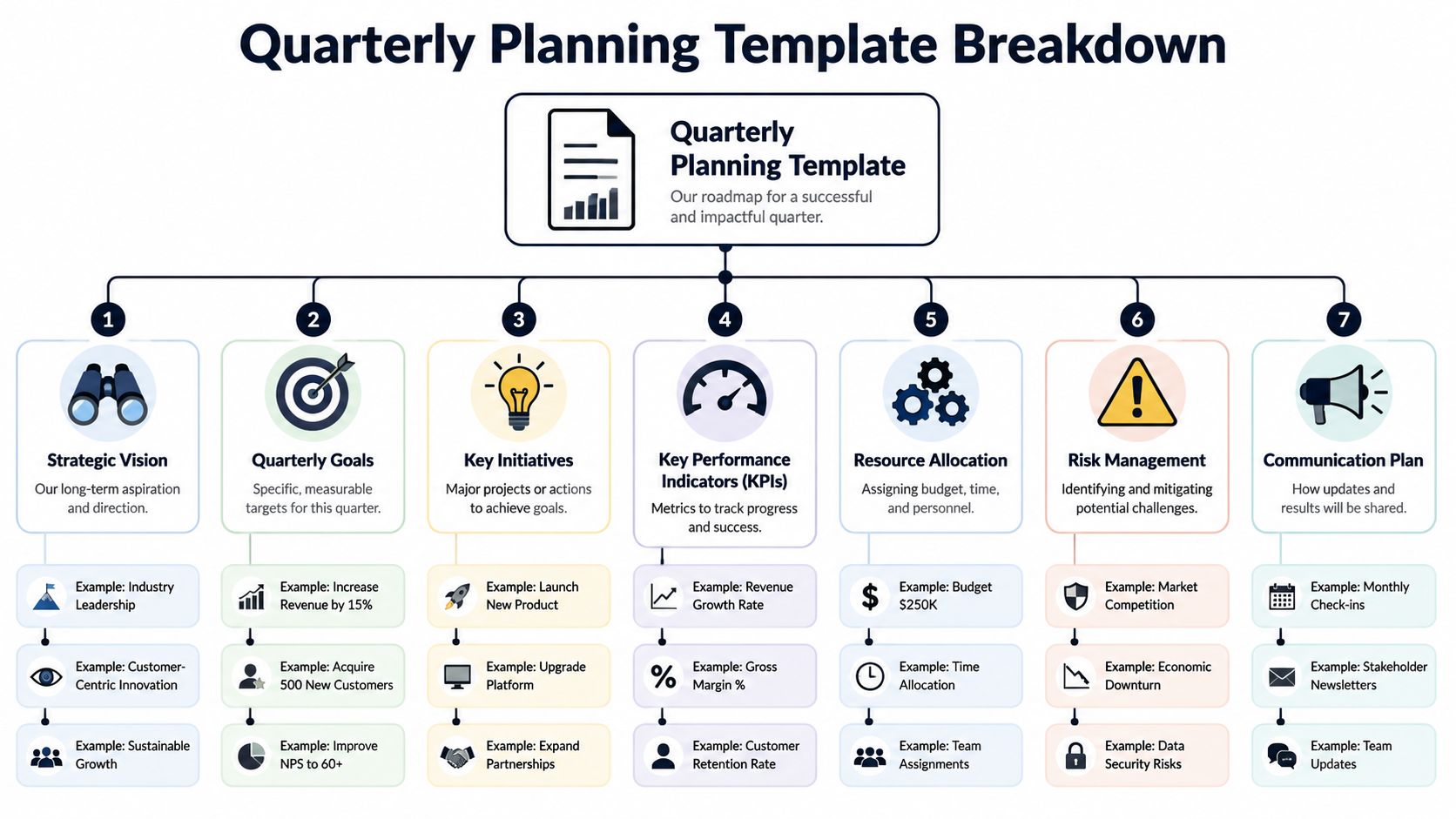
A quarterly planning template should be simple enough that a team can keep using it, but opinionated enough that weak plans become obvious.
The structure below works because it forces each initiative to earn its place. If an item doesn't connect to strategy, customer evidence, capacity, and ownership, it doesn't belong in the quarter.
The template fields that matter
Use one shared planning document with these sections:
| Section | What goes here | What to avoid |
|---|---|---|
| Quarterly theme | The main strategic story for the quarter | Generic slogans |
| Company OKRs | The business outcomes your team supports | A long list of every company metric |
| Team goals | A short set of measurable outcomes | Activity-based goals |
| Key initiatives | The major bets and projects tied to those goals | Backlog dumps |
| Dependencies | Cross-team asks, approvals, integrations, platform needs | Hidden assumptions |
| Resource allocation | Capacity split across roadmap, maintenance, discovery, and buffer | “We'll figure it out later” |
| Anti-goals | Explicit work you will not do this quarter | Vague non-commitments |
That last field matters more than many PMs expect.
According to PostHog's planning approach, high-velocity engineering teams work better when they specify 3 to 5 goals and explicit anti-goals. The same source says teams using anti-goals report 35% better focus. That tracks with practice. When a team writes down what it will not do, scope creep gets harder to disguise as responsiveness.
A filled-out example for a fictional SaaS team
Assume a B2B workflow SaaS company is planning the quarter.
Quarterly themeImprove retention in core accounts by reducing setup friction and fixing the most costly workflow failures.
Company OKR alignmentSupport the company objective to improve net revenue retention and reduce avoidable churn risk in the core segment.
Team goals
- Reduce onboarding friction in the first-run workflow
- Resolve the top recurring failure in reporting exports
- Improve activation for customers using the Slack integration
- Validate a discovery bet around admin controls for multi-team accounts
Key initiatives
- Rework onboarding checklist and in-app guidance
- Fix export job failures and improve error visibility
- Simplify Slack integration setup path
- Run discovery on admin permission controls with success probes and clear decision criteria
Dependencies
- Data team for instrumentation updates
- Design for onboarding flow revisions
- Support for tagging recurring export complaints
- Success for identifying at-risk multi-team customers
Resource allocation
- Core delivery work
- Reliability and tech debt
- Discovery work
- Buffer for emergent customer signals
Anti-goals
- No redesign of the entire settings architecture
- No one-off enterprise customizations
- No low-signal feature requests without repeat evidence
What makes this template usable
This format works because it's close to execution. You can carry it into sprint planning, stakeholder reviews, and weekly check-ins without rewriting the whole story each time.
If you need a companion artifact for your review rhythm, WeekBlast's QBR guide for engineering teams is useful because it gives teams a cleaner way to tie quarterly planning to what they'll review later. And if your organization still mixes product, delivery, and reporting in one messy doc, this product management template guide can help separate planning from ongoing execution artifacts.
A quarterly planning template should make trade-offs visible. If every initiative sounds equally important, the template failed.
Prioritizing Initiatives with Data Not Feelings
Prioritization gets political when criteria stay vague.
Many organizations claim to follow a structured framework. In practice, they rely on that framework only until a senior stakeholder introduces a strong opinion. At that point, the framework is often discarded. This typically occurs because the scoring inputs lack sufficient objectivity. “Impact” then becomes whatever an individual can most convincingly argue.
The fix isn't a fancier acronym. It's making sure the score includes customer evidence and business relevance, not just estimated reach and effort.
A practical scoring model
For quarterly planning, use a short scoring matrix with five inputs:
- Revenue Impact from product intelligence and customer economics
- Customer Signal based on repeated evidence across channels
- Strategic Alignment to company and team goals
- Effort (Inverse) so lower effort can improve the score
- Final Score as a working ranking, not a substitute for judgment
Here's a simple example:
| Initiative | Revenue Impact (SigOS) | Customer Signal (SigOS) | Strategic Alignment | Effort (Inverse) | Final Score |
|---|---|---|---|---|---|
| Fix onboarding drop-off issue | High | High | High | Medium | Very high |
| Build niche export format | Low | Low | Medium | Low | Medium |
| Improve Slack integration setup | Medium | High | High | Medium | High |
| Explore admin controls discovery | Medium | Medium | High | Low | Medium-high |
This format does two things. First, it forces the room to separate signal strength from executive enthusiasm. Second, it gives product and engineering a common language for discussing trade-offs.
If your team also tracks customer health and post-sale patterns closely, resources like SupportGPT customer relationship tracking can help sharpen what good success signals look like across the account lifecycle. For the product side of the equation, these backlog prioritization techniques are a useful complement when you need to translate quarterly priorities into a ranked delivery queue.
Don't score all work the same way
Many teams stumble at this stage. Some work is predictable. Some isn't.
A reporting reliability fix might be well understood and easy to commit to. A discovery project on churn drivers or workflow behavior might require learning before delivery estimates mean anything. Treating both categories with the same planning model creates fake certainty.
Humanizing Work's CAPED framework is useful here. It separates more predictable analytical work from active, discovery-oriented work. That matters because teams using this approach report 2.5 times fewer mid-quarter plan renegotiations than teams using a uniform planning model.
How to apply CAPED in real planning
Use a split model inside the same quarterly plan:
For predictable work
- Define scope clearly
- Map dependencies early
- Commit to output and timing with more confidence
For discovery work
- Define the question, not the feature
- Set success probes instead of pretending you already know the solution
- Review learning milestones before green-lighting full build work
That lets the team be disciplined without becoming brittle.
Don't force certainty onto discovery work. You'll either miss the insight or fake the commitment.
A good prioritization conversation sounds different
You'll know the team is doing this well when the language changes.
Instead of saying, “Sales really wants this,” someone says, “This request appears in a narrow segment, but the broader signal is weak.”Instead of, “This seems strategic,” someone says, “It aligns with the company objective, but the evidence says reliability work is more urgent this quarter.”
That's the point. A mature planning process doesn't remove judgment. It gives judgment better inputs.
From Plan to Action with OKRs and Owners
A ranked initiative list is not a plan. It's just a cleaner argument.
Execution starts when each top initiative becomes an outcome, an owner, and a realistic commitment. That translation step is where many quarterly plans collapse. The doc says the right things, but nobody has turned those things into measurable movement.
Write OKRs around outcomes, not activity
A weak quarterly planning template says:
- Launch onboarding refresh
- Improve reporting
- Ship Slack enhancements
A better one says:
- Improve activation through onboarding changes
- Reduce customer pain from export failures
- Increase successful Slack setup completion
The distinction matters. Teams ship activity all the time. Leadership and customers feel outcomes.
When you write key results, avoid turning the quarter into a checklist. A key result should tell the team whether the initiative changed something meaningful, not whether work merely reached production.
Assign one accountable owner
Every major initiative needs one directly accountable owner.
That doesn't mean one person does the work. It means one person owns the trade-offs, dependency follow-up, status clarity, and escalation path. If ownership is shared across product, engineering, and design without a clear lead, nobody really owns it when delivery gets messy.
Use a simple owner model:
- Directly accountable owner: usually the PM or engineering lead for the initiative
- Core partners: design, data, support, success, GTM
- Decision approver: the person who resolves priority conflicts quickly
Plan for reality, not ideal conditions
Capacity planning is where optimistic quarterly plans go to die.
According to Spinach's quarterly planning meeting guidance, 74% of PMs miss quarterly goals due to poor capacity forecasting, and SaaS firms average 35% unplanned work from emergent issues. The same source suggests allocating a signal-responsive buffer of up to 40% capacity, and notes that this can double delivery speed compared to rigid plans.
That sounds aggressive until you've run a quarter in a live SaaS environment. Support escalations happen. Incidents happen. A key integration breaks. A previously hidden churn pattern surfaces. If the plan assumes perfect stability, it's not a serious plan.
A sane resource split
Your exact split will vary, but the principles are steady:
- Committed delivery: The work you're confident you can complete
- Reliability and debt: The maintenance and stability work that protects customer experience
- Discovery: Research, validation, and ambiguous bets that need learning
- Responsive buffer: Capacity reserved for emerging issues and urgent signal-driven work
If your org needs a clearer operational model for this kind of execution discipline, streamlining operations with agile processes is a useful read because it grounds planning in how teams work week to week. For teams that struggle to define whether a goal is moving, a practical key performance indicator report template can help tighten measurement before the quarter begins.
Manager's check: If every engineer looks fully allocated on day one, your quarterly plan is already late.
The handoff from plan to weekly execution
Once initiatives have OKRs and owners, push them into the operating cadence quickly:
- add them to team rituals
- connect each one to a milestone or review point
- define what would trigger escalation
- identify which signals would cause a mid-quarter reprioritization
That last point matters. Good teams don't pretend the quarter is static. They decide in advance what kind of new information is strong enough to change the plan.
Closing the Loop with Quarterly Reviews
Treating the quarterly review as a presentation is a mistake.
The review is where you decide whether your planning system is getting smarter. It should tell you not just what shipped, but whether the quarter's bets addressed the customer problems you thought they would.

Review outcomes, misses, and signal changes
A useful review covers three layers.
First, look at outcomes. Did the initiative improve the target condition, or did it just complete delivery?
Second, examine misses and partial wins. Some work was directionally right but poorly sequenced. Some work solved the wrong layer of the problem. Those are different lessons.
Third, check signal changes. If the team fixed a recurring issue, did the customer pattern decline in support, success, or product behavior? If not, the team may have addressed the symptom instead of the cause.
According to Greg Faxon's quarterly plan guidance, successful quarterly plans include six critical elements, including a thorough review of the previous quarter's performance and an analysis of customer feedback from that period. The same guidance says the review meeting itself should be a 2 to 3 hour process with dedicated time slots for each major component.
That's enough time to think clearly without turning the retrospective into theater.
Use a simple lessons-learned format
Keep the review document lean. A practical version includes:
- What we expected to happen
- What happened
- What customer evidence changed
- What we misunderstood
- What belongs in next quarter's plan
- What should not roll forward
This is also a good point to bring the team back to the original plan and compare intent against reality.
For teams that want a quick walkthrough format before running their own review, this short video is a useful prompt for the discussion:
The review should feed the next quarter immediately
A good quarterly planning template doesn't end with status colors. It creates a loop.
The output of the review should become the first draft of your next pre-read. Patterns that persisted need a stronger response. Initiatives that worked should inform future bets. Discovery projects should either graduate into commitments or get cut cleanly.
If you do this well, quarterly planning stops feeling like a ceremony. It becomes a repeatable operating system for making better decisions with better evidence.
If your team is still planning around scattered anecdotes, SigOS helps turn support tickets, sales calls, chat transcripts, and usage behavior into prioritized customer signals tied to churn, expansion, and revenue impact, so your next quarterly plan starts with evidence instead of guesswork.
Keep Reading
More insights from our blog



Ready to find your hidden revenue leaks?
Start analyzing your customer feedback and discover insights that drive revenue.
Start Free Trial →