Email Marketing for Customer Acquisition: A SaaS Playbook
A step-by-step guide to email marketing for customer acquisition. Learn to build lists, segment leads, and use product intelligence to drive SaaS growth.
Most email advice gets one thing wrong. It treats list growth as the main objective, when in SaaS the actual objective is finding people with a problem, enough urgency to act, and a path to value inside your product.
That's why a lot of email marketing for customer acquisition underperforms. Teams collect broad lists, send polished campaigns, and then wonder why reply quality is weak, trials stall, and pipeline attribution gets fuzzy. The issue usually isn't email as a channel. It's that the list was built without intent data, the segments were too blunt, and the messaging had no connection to real product friction or buying signals.
Email still matters. 81% of SMBs rely on email as their primary customer acquisition channel, and welcome emails generate 320% more revenue per email than promotional blasts while averaging a 50% open rate, according to EmailMonday's email marketing ROI statistics. But those results don't come from sending more. They come from sending the right message when the buyer has already shown meaningful interest.
For SaaS teams, the strongest signals rarely live inside the email platform alone. They show up in support tickets, CRM notes, onboarding milestones, failed integrations, sales call themes, and usage analytics. If a prospect asked about SSO during a demo, hit a setup blocker in trial, or repeatedly viewed an integration page, that's acquisition context. It should shape the email they get next.
The better model is simple. Build a smaller list with clearer intent. Use product intelligence to decide who gets what. Measure success by downstream revenue quality, not just top-of-funnel activity. That mindset also aligns acquisition with customer acquisition and customer retention, which is where most SaaS growth compounds.
Rethinking Email Acquisition From Volume to Value
The old playbook says bigger list, bigger results. That logic breaks fast in B2B SaaS.
A large list filled with low-intent contacts creates noise. Sales follows up on people who were never serious. Marketing celebrates opens that never turn into product activation. Lifecycle teams inherit subscribers who don't resemble the accounts you want to close.
Why broad list growth breaks in SaaS
SaaS buyers rarely convert because a brand stayed top of inbox. They convert because an email arrives when a problem is active and the message reflects what's happening in their evaluation.
That's why generic acquisition tactics often miss. A newsletter popup can collect addresses. It won't tell you whether the lead is a product manager trying to prioritize feedback, a support leader buried in ticket volume, or a CTO evaluating tooling across the stack. Those are different buyers with different urgency.
Practical rule: If your form captures an email but not context, your team will pay for that missing context later with weaker segmentation, softer copy, and noisier pipeline.
Useful startup-focused examples of this shift show up in effective email strategies for startups, especially when email is tied to buyer stage instead of sent as a general broadcast.
What value-based acquisition looks like
Value-based acquisition starts with one question. Which leads are most likely to become healthy customers, not just customers?
In practice, that means weighting signals such as:
- Problem intensitySomeone who asks detailed implementation questions usually has more urgency than someone who downloads a general guide.
- Product-fit behaviorTrial activity, integration interest, repeat visits to feature pages, and support interactions all reveal fit faster than profile data alone.
- Revenue relevanceSome prospects map directly to your strongest customer segment. Others don't, even if they engage with content.
Email becomes more useful than many teams give it credit for in these situations. Email is flexible enough to respond to those signals quickly. It can educate, qualify, recover, and route high-intent demand without forcing everything through paid retargeting or immediate sales outreach.
A smaller, sharper list usually beats a large passive one because it lets you write emails that sound like they were sent for a reason. In SaaS acquisition, that reason matters more than reach.
Building Your High-Intent Email List Organically
Bought lists promise speed. They usually create cleanup.
The better path is organic acquisition built around a concrete problem your ideal buyer already wants to solve. That doesn't mean “subscribe for updates.” It means offering something useful enough that the right person is willing to exchange context, not just an address.

Organic list acquisition outperforms purchased lists by achieving 5-10x higher engagement rates, with open rates averaging 25-35% vs. <5% for bought lists. A major risk is deliverability. 47% of marketers using purchased lists face sender reputation damage, based on VerticalResponse's review of email marketing mistakes.
Start with a value-first offer
The strongest opt-ins are tied to painful jobs buyers already have. In SaaS, that usually means one of four things:
- Diagnostic contentA benchmark report, readiness checklist, or teardown that helps a team assess a live issue.
- Operational templatesScorecards, planning docs, and workflow kits that help a buyer move faster internally.
- Event-driven educationWebinars or short workshops that address a known friction point, like onboarding gaps or support escalation patterns.
- Interactive toolsAssessments or calculators that return a useful output, not just gated content for its own sake.
A weak offer says, “Join our newsletter.” A strong offer says, “Get a framework for prioritizing customer feedback from support, sales, and usage data.”
Design forms for future segmentation
Most capture forms stop too early. They ask for email and company name, then force the team to guess everything else later.
Capture just enough zero-party data to make follow-up relevant:
- RoleProduct, support, success, growth, engineering, or executive.
- Primary challengeChurn risk, onboarding friction, backlog prioritization, low activation, weak expansion visibility.
- Current stackZendesk, Intercom, HubSpot, Salesforce, Jira, product analytics tools.
- Timing signalResearching, actively evaluating, or solving this quarter.
This is the foundation of behavioral segmentation in SaaS. Without it, most email nurture turns into generic education because the team has no clean way to separate curiosity from intent.
Build the handoff before you launch
A lot of forms collect leads successfully and still fail the acquisition test. The breakdown happens after submission.
Before publishing any asset, decide:
- Where the lead record livesCRM, marketing automation platform, or both.
- Which fields map across systemsEspecially role, pain point, and source asset.
- What happens nextWelcome email, SDR follow-up, nurture path, or invite to demo.
- How you flag high-intent activityFor example, multiple visits to pricing or repeated interaction with product-specific content.
This walkthrough is a useful primer before implementation:
Keep the list clean from day one
Acquisition quality drops when old contacts pile up and automation keeps treating stale subscribers like active demand. Hygiene isn't glamorous, but it protects the channel.
Don't wait until deliverability is slipping to clean the database. Remove ambiguity early. Suppress bad-fit contacts, duplicate records, and subscribers whose behavior no longer matches active buying intent.
The practical test is simple. If you wouldn't want a sales rep spending time on this lead, don't keep pushing it through acquisition email flows.
Organic acquisition takes more discipline than importing a list. It also gives you something bought data can't. Context you can trust.
Segmenting Leads with Product Intelligence Signals
Demographic segmentation is fine for reporting. It's weak for conversion.
Knowing that a lead works in product at a mid-market SaaS company tells you very little about why they might buy now. Product intelligence closes that gap. It turns behavior into usable acquisition signals.
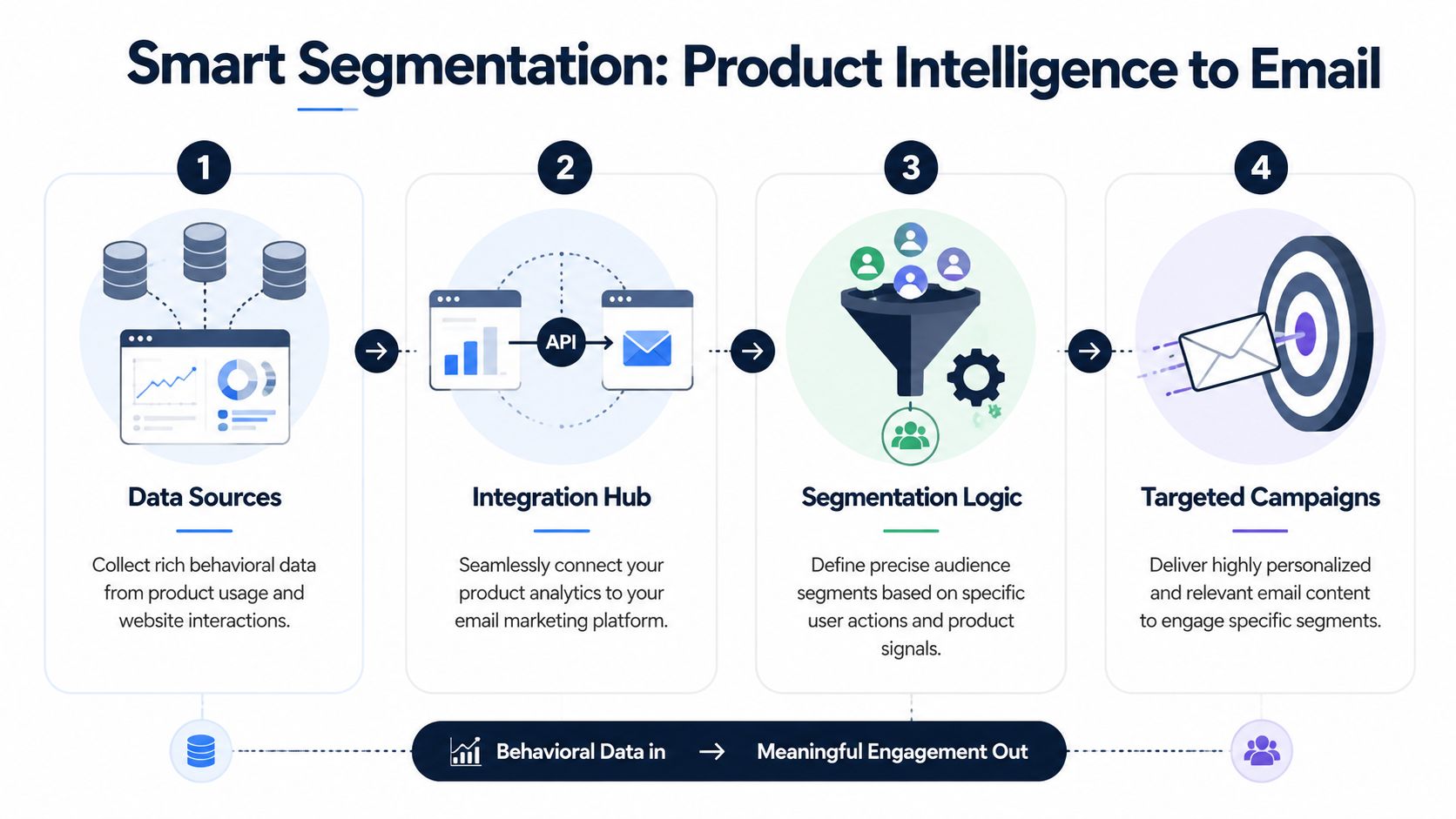
Segmented campaigns generate 760% more revenue than non-segmented ones. For SaaS, hyper-segmenting based on behavioral data can outperform broad segments by 3.4x on conversion rates, according to Wix's email marketing statistics roundup.
The signals that matter most
For SaaS acquisition, the best segments usually come from systems outside the email tool. Useful sources include:
| Data source | What to look for | Email implication |
|---|---|---|
| Support tools like Zendesk or Intercom | Repeated questions, escalation themes, integration confusion | Send role-specific education that removes friction |
| CRM activity | Demo notes, lost-deal reasons, champion role, buying objections | Nurture based on objection handling, not generic awareness |
| Product analytics | Trial milestones, stalled setup, feature exploration, repeated return visits | Trigger activation or recovery emails tied to exact behavior |
| Sales calls and transcripts | Pain language, urgency, internal blockers | Mirror the buyer's words in follow-up copy |
A lead who opened three emails isn't necessarily qualified. A lead who asked about migration effort, reviewed integration docs, and stalled at setup is telling you exactly what needs to happen next.
Build segments around intent, not identity
Useful SaaS acquisition segments often look like this:
- Activated evaluatorsTrial users who reached an early success milestone and need help expanding usage or getting internal buy-in.
- Stalled implementersProspects who started setup but got blocked on imports, permissions, integrations, or team coordination.
- Problem-aware non-trial leadsContacts who consumed deep educational content and repeatedly engaged with solution-level pages but haven't requested a trial.
- Support-heavy prospectsAccounts asking detailed pre-sale questions that signal urgency and a high need for confidence before purchase.
Each segment should answer one operational question. What must this person believe, do, or resolve to move forward?
The more specific that answer, the better the email.
Connect systems before you write campaigns
Teams often reverse this process. They draft sequences first, then look for data to personalize them. It works better the other way around.
Use your integration layer to route relevant fields and events into your ESP or marketing automation platform. HubSpot, Braze, Customer.io, and similar tools can all support dynamic audiences if the upstream data is structured well.
A practical setup often includes:
- Behavioral event mappingDefine which actions count as meaningful. Trial started, invite sent, help doc viewed, support ticket opened, pricing revisited.
- Event-to-segment rulesTranslate behavior into audiences. Not all events deserve their own segment.
- Campaign priority logicDecide what wins when a lead qualifies for multiple flows.
- Sales visibilityMake sure reps can see what content and trigger path a lead is receiving.
For teams doing deeper analysis, product and lifecycle work gets stronger when segmentation reflects how to use behavior analytics across the entire buyer journey, not just the inbox.
A segment of five high-intent trial users with the same implementation blocker is often worth more than a list of hundreds who merely downloaded a report.
That's the shift. Stop grouping people by who they are on paper. Start grouping them by what they're trying to accomplish, where they're getting stuck, and how close they are to value.
Designing Conversion-Focused Email Sequences
Once the segments are right, sequence design gets easier. You're no longer writing one-size-fits-all campaigns. You're building paths for specific buyer situations.
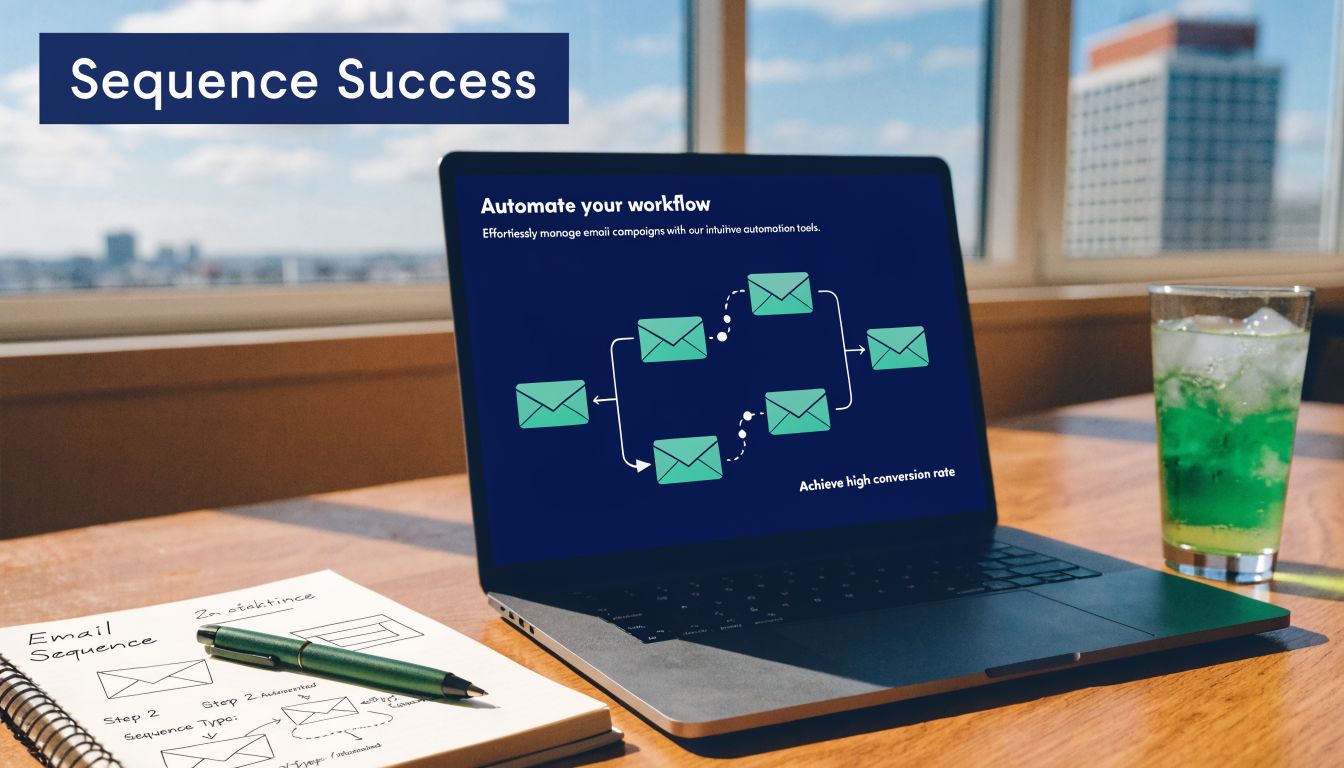
The most reliable acquisition sequences in SaaS usually fall into three buckets. Welcome, nurture, and conversion. They should feel connected, but each has a different job.
The welcome sequence for new opt-ins
A welcome sequence should orient the lead fast. Not with a company history, but with relevance.
Earlier, we covered why welcome emails outperform generic blasts. The practical reason is straightforward. They land at the moment of highest attention.
A strong welcome sequence usually does three things well:
- Confirms the exchangeDeliver the report, toolkit, or webinar access immediately.
- Frames the problemShow the lead you understand the operational issue behind their opt-in.
- Routes to the next best stepThat might be a product walkthrough, a deeper guide, or a short qualification path.
Example opening:
You downloaded the guide because prioritizing customer feedback gets messy fast. Support hears one thing, sales hears another, and product has to decide what matters. This email gives you the fastest path to sorting signal from noise.
That kind of copy works because it acknowledges the workflow, not just the asset.
The nurture sequence for problem-aware leads
Nurture is where many teams get too soft. They send educational content that's technically useful but disconnected from the buying decision.
A better nurture sequence follows the buyer's friction. If the segment is support-heavy prospects, talk about recurring themes, response burden, and escalation patterns. If the segment is stalled implementers, address setup blockers directly.
Try this structure:
| Purpose | Strong CTA | |
|---|---|---|
| Email 1 | Reframe the core problem | Read the focused guide |
| Email 2 | Address a common objection | See how the workflow fits your stack |
| Email 3 | Show operational use case | Book a tailored walkthrough |
| Email 4 | Create decision clarity | Reply with your current blocker |
Notice the CTA changes with intent. High-fit prospects should get a path to conversation. Lower-touch leads may need a resource, template, or help doc first.
The trial-to-paid sequence for active evaluators
Product signals matter most at this stage. Generic “your trial is ending” emails waste the richest part of the funnel.
Build the sequence around what the user has or hasn't done.
If they activated a key workflow, the email should help them socialize value internally. If they stalled at setup, the email should remove implementation friction. If they invited teammates, lean into use-case expansion. If they kept returning to one feature area, anchor the message around that use case.
A practical sequence often includes:
- Activation confirmationAcknowledge what's already working and point to the next action.
- Blocker removalOffer setup help, migration support, or a direct answer to the sticking point.
- Outcome framingTranslate activity into business relevance for the buyer's team.
- Decision pathInvite a demo, procurement call, or targeted follow-up based on deal complexity.
Write emails as if they're part of an ongoing evaluation, because they are. Buyers don't experience your sequence as “campaigns.” They experience it as help or noise.
The common thread across all three sequence types is restraint. One email, one job. One CTA. One reason to send it.
That's what makes email marketing for customer acquisition feel less like broadcasting and more like guided momentum.
Measuring and Optimizing Your Acquisition Engine
More email volume rarely fixes acquisition. Better measurement does.
Teams that report opens, clicks, and unsubscribes without tying them to pipeline quality usually end up scaling the wrong campaigns. The right question is not “did this email perform?” It is “did this sequence bring in accounts that activated, converted, and stuck?”
That shift matters even more when email is informed by product data. If a segment built from support conversations, CRM stage changes, or usage patterns creates fewer leads but more qualified pipeline, that is the segment worth funding.
The KPIs that deserve attention
Keep the scorecard tight enough that sales, finance, and lifecycle can all use it. I want inbox metrics, conversion metrics, and business metrics in the same view.
| KPI | Definition | How to use it |
|---|---|---|
| Open rate | Percentage of delivered emails that are opened | Treat it as a subject line and deliverability signal, not a revenue metric |
| Click-through rate | Percentage of delivered emails that generate clicks | Useful for judging message-to-offer fit, especially in early evaluation sequences |
| Conversion rate | Percentage of recipients who complete the target action | Track the action that matters: demo booked, trial started, or sales conversation created |
| Unsubscribe rate | Percentage of recipients who opt out | A fast warning that targeting, frequency, or message relevance is off |
| CAC recovery period | Time required to recover customer acquisition cost | Helps expose whether an email-sourced customer is actually efficient to acquire |
| Revenue per email | Revenue attributed per email sent | Good for comparing programs over time, especially once attribution rules are stable |
Benchmarks are fine for orientation, but they are weak decision tools on their own. A lower-open campaign can still beat a high-open campaign if it pulls in better-fit accounts, shortens time to first value, or improves payback.
For leadership reporting, it helps to connect email to a broader essential marketing metric so channel efficiency is judged against revenue, not inbox activity.
Run tests that survive contact with real buying cycles
A lot of email testing fails for a simple reason. Teams test what is easy to change instead of what affects conversion.
Subject lines matter. So do CTAs and send times. But for acquisition, the bigger wins often come from audience logic, offer framing, and signal timing. An email sent after a high-intent product event will often outperform a polished message sent to a generic segment, even if the copy is only marginally better.
Use a stricter testing discipline:
- Test one decision at a timeSeparate creative tests from audience tests. If both change, the result is hard to trust.
- Hold the segment constantComparing trial users who invited teammates against top-of-funnel leads is not an A/B test. It is two different buying contexts.
- Choose the metric before launchUse opens for subject line tests. Use reply rate, meeting rate, trial start, or opportunity creation for acquisition tests.
- Wait for downstream outcomesEnterprise and mid-market deals do not close on email platform timing. Let CRM and product data catch up before calling a winner.
The practical trade-off is speed versus confidence. Fast tests help teams learn, but premature conclusions create false winners that waste months of send volume.
Stop over-crediting the visible click
Email acquisition rarely works as a clean last-click path. A prospect may download a resource, return from branded search, talk to sales, trigger product-usage events during trial, and only then respond to a lifecycle email. If attribution only rewards the click you can see in the email platform, you will understate email's role in qualified demand. If email gets full credit because it happened to be the last touch, you will overstate it.
Review performance by cohort and by downstream quality instead.
| Analysis lens | What it tells you |
|---|---|
| Segment-level conversion | Which audience definitions produce real opportunities, not just replies or clicks |
| Time-to-activation | Whether email is speeding up the path from signup to product value |
| Opportunity quality | Whether sourced or influenced leads match ICP and move through pipeline cleanly |
| Retention signal | Whether customers acquired through a sequence become healthy accounts after the sale |
Product intelligence earns its place here. If leads from a generic newsletter convert at a decent rate but churn early, while leads flagged by support pain points or in-app intent signals convert slightly slower and retain better, the second group is the better acquisition engine.
That is the standard. Measure email by the revenue path it creates, not by the activity it produces.
Closing the Loop From Acquisition to Retention
The acquisition email that looks best in the dashboard is often the one doing the most damage later.
I have seen sequences drive strong conversion rates, hand sales a full pipeline, and still produce weak revenue because those accounts stalled in onboarding or churned inside the first few months. If retention data never makes it back into acquisition decisions, marketing keeps scaling the wrong audience and the wrong promise.
That is why this final step matters. Email acquisition should feed retention, and retention should reshape acquisition. The loop gets tighter when growth teams pull in product usage, support themes, CRM stage movement, and early success signals instead of grading campaigns on form fills and trial starts alone.
Why downstream health changes acquisition strategy
A fast-converting lead is only valuable if that account reaches value and stays. If new customers repeatedly hit the same setup issue, ignore the core feature, or generate high-friction support tickets in week one, the problem often started before the sale. The copy attracted the wrong use case, the sequence oversold a capability, or the lead score missed clear signs of poor fit.
That changes how strong teams judge acquisition. They compare segments by activation rate, expansion potential, support burden, and churn risk, not just by cost per lead or trial conversion. A smaller segment built from product-intelligence signals often wins on revenue even when it looks less efficient at the top of the funnel.
The practical trade-off is straightforward. Broad acquisition usually lowers cost per signup. High-intent acquisition usually improves payback quality. In SaaS, the second outcome matters more.
What mature teams do differently
Teams that close this loop share operating signals across functions, and they do it often enough to change campaigns before bad patterns spread.
- Marketing reviews support tickets and sales call notesThat sharpens acquisition copy around real pain points and removes claims that attract poor-fit buyers.
- Product shares activation milestones and drop-off pointsThat helps growth trigger emails from real behavior, such as incomplete setup, unused integrations, or repeated visits to a key feature page.
- Customer success flags early churn patternsThat gives marketing a way to suppress low-fit segments, tighten qualification, or build a pre-sale sequence that sets better expectations.
- Revenue teams compare source quality by account outcomesThat keeps the budget pointed at segments that become healthy customers, not just cheap leads.
Email sits in a useful position here. It reaches prospects before purchase, guides behavior during onboarding, and gives teams a controlled way to test whether message, audience, and product reality match.
The payoff is larger than campaign performance. The same signals used to prioritize high-value leads can expose onboarding gaps, misleading positioning, and friction that drags down retention. That makes acquisition email a revenue input, not just a distribution channel.
Email marketing for customer acquisition works better when the finish line is customer health. Build lists around intent. Use product and support signals to prioritize who enters each sequence. Judge success by activation, retention, and expansion, not inbox activity alone.
If your team wants to connect support tickets, chat transcripts, sales calls, and usage data to real revenue impact, SigOS helps you turn noisy customer signals into prioritized action. It gives product and growth teams a clearer view of which issues drive churn risk, which requests enable expansion, and which customer patterns should shape the next email, campaign, or roadmap decision.
Keep Reading
More insights from our blog
Ready to find your hidden revenue leaks?
Start analyzing your customer feedback and discover insights that drive revenue.
Start Free Trial →