Agile for Product Managers: A Practical Guide for 2026
Master Agile for product managers with this guide. Learn to adapt Scrum/Kanban, use data for prioritization, avoid anti-patterns, and drive real impact.
You're probably living some version of this right now.
Sales wants a prospect-specific feature added this sprint. Support is escalating a bug that “everyone is hitting.” Engineering wants cleaner requirements before they commit to anything. Leadership still expects the roadmap you presented last quarter to hold together. Meanwhile, you're standing in backlog refinement trying to turn a pile of opinions into work a team can ship.
That's why agile for product managers often feels less like gaining agency and more like administrative overload.
The problem usually isn't Agile itself. The problem is that many teams adopt the ceremonies, keep the old decision habits, and leave the product manager stuck in the middle. You end up running standups, grooming tickets, and updating boards without getting the authority, evidence, or operating rhythm needed to make good product decisions. Agile becomes a delivery wrapper around unclear strategy.
Used well, Agile can do the opposite. It can turn product management into a tighter loop between customer signals, team execution, and business outcomes. But that only happens when you stop treating Agile as a process to follow and start using it as a system for learning what matters, deciding faster, and shipping with intent.
Why Agile Often Fails Product Managers
A new PM usually gets told the same thing: “Be strategic.” Then the calendar fills with sprint planning, backlog refinement, standups, stakeholder check-ins, bug triage, and release coordination. By the end of the week, strategy has been reduced to reordering tickets.
That disconnect explains why Agile frustrates so many product managers. On paper, it promises adaptability and customer focus. In practice, many teams use it to create a constant stream of work without improving how decisions get made.
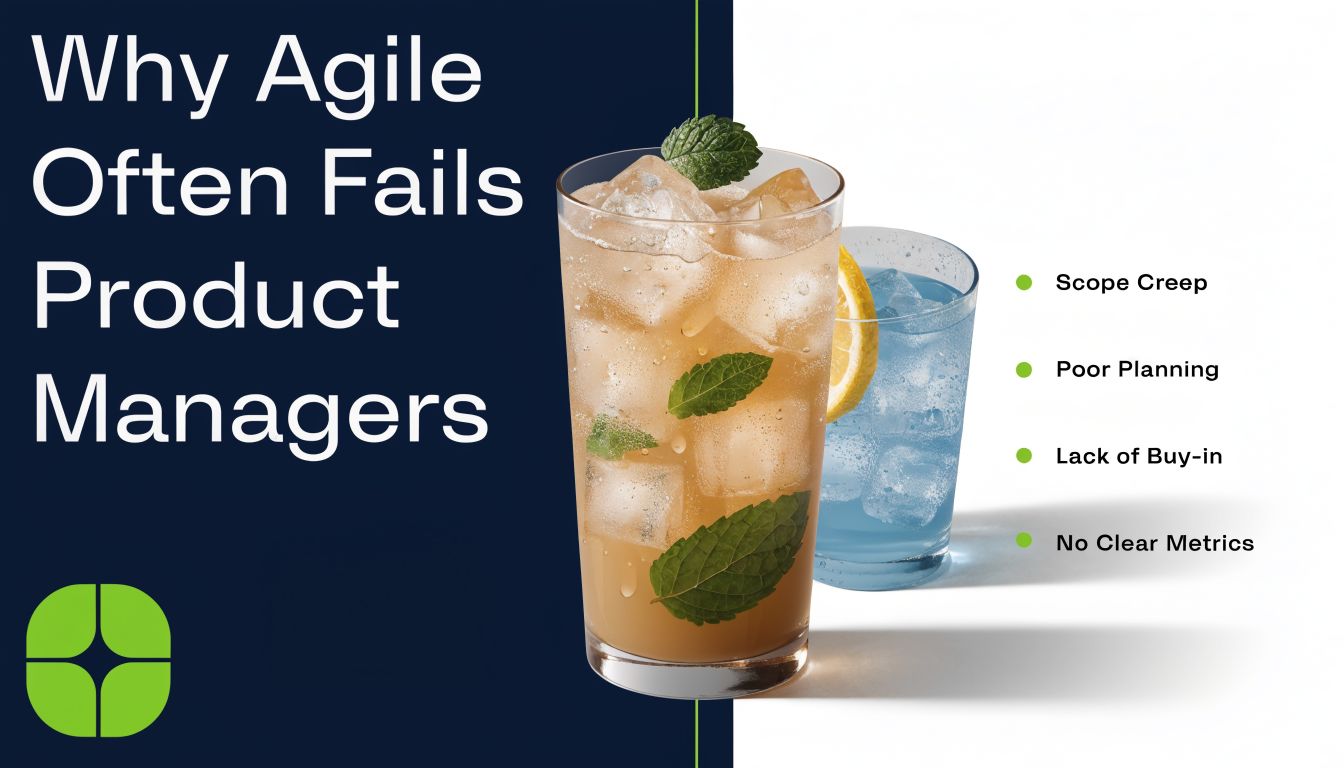
The real failure is role design
Agile breaks down for PMs when the organization wants two conflicting things at once. It wants a responsive team, but it also wants certainty. It says “iterate based on learning,” then punishes roadmap changes. It says “customer value first,” then prioritizes the loudest internal stakeholder.
That leaves the PM acting as a translator, not a product leader.
Here's the context that matters. By 2022 Agile had become the dominant project management approach for software and product teams, with 39% of organizations reporting that Agile practices delivered the highest average project performance rate and a 75.4% project success rate. By the 2020s, more than half of product or application owners and engineering/R&D teams globally reported using Agile frameworks according to Businessmap's Agile statistics summary. So this isn't a niche skill anymore. If you manage software products, Agile is the environment you're operating in whether your company is good at it or not.
Practical rule: If Agile makes you spend more time formatting work than understanding customer problems, your team hasn't become agile. It has become bureaucratic in smaller batches.
What product managers actually get stuck with
The failure modes are predictable:
- Roadmaps treated as contracts: Leadership wants fixed commitments while teams are asked to be adaptive.
- Backlogs filled with untested requests: Sales notes, support tickets, and executive asks all enter the same queue with no common evaluation method.
- Ceremonies replacing judgment: Teams hold every ritual but still don't know why an item is important.
- Delivery metrics without product metrics: Velocity is tracked, but customer behavior and business impact are not.
When this happens, PMs start serving the system instead of using it.
What works instead
The PM has to recenter Agile around decisions, not rituals. That means each sprint should answer a product question, not just complete a set of tasks. Which problem is urgent enough to solve now? Which customer signal is strong enough to change the backlog? Which piece of work is likely to create value, reduce churn risk, or unblock adoption?
Once Agile becomes the operating system for answering those questions, it starts helping instead of hurting.
The Four Agile Principles That Actually Drive Product Value
The Agile Manifesto has twelve principles, but most product managers don't need twelve mental models in the middle of a sprint. They need a small set of practical filters for making better calls under pressure.
Customer collaboration beats internal interpretation
Most backlog problems start long before sprint planning. They start when teams rely on secondhand summaries of what users need. A PM hears from sales, support, or leadership and turns that into requirements without enough direct contact with customer behavior.
Agile works better when customer collaboration isn't occasional research. It's a continuous input into the product loop. That means pairing qualitative signals, such as support conversations and sales objections, with behavioral evidence from the product.
What this means for you: Don't accept “customers are asking for this” as sufficient. Ask which customers, what behavior supports it, and what outcome would improve if you shipped it.
Responding to change means changing for evidence
A lot of teams misuse this principle. They hear “respond to change” and translate it into “constantly reshuffle priorities.” That creates chaos, not agility.
For product managers, responding to change means updating direction when the evidence changes. The trigger shouldn't be executive anxiety or whichever request arrived last. It should be something real: a usage drop after onboarding, a support pattern around a broken workflow, or a repeated sales blocker tied to a missing capability.
Working software is a decision tool
Shipping matters because it closes the loop between assumption and reality. A released feature, even a narrow one, tells you more than weeks of internal debate.
That doesn't mean shipping for the sake of activity. It means scoping work so the team can learn quickly. Product managers who thrive in Agile ask, “What's the smallest release that will produce a meaningful signal?” That keeps the team out of the feature factory trap.
“If we can't explain what we expect to learn from this release, we probably haven't scoped the right release.”
Sustainable pace protects product judgment
Teams make worse product decisions when every sprint is overloaded. Discovery gets skipped. Technical debt grows. Bugs remain open because “the roadmap is full.” PMs then compensate by over-specifying work up front, hoping precision can solve the problems caused by overload.
It can't.
Sustainable pace matters because product management needs time for discovery, validation, and prioritization. Without that space, the team becomes reactive. The PM becomes a queue manager.
A simple filter for daily decisions
Use these four principles as a quick screen before pulling work into a sprint:
- Customer truth: Do we have direct evidence behind this item?
- Change trigger: Are we changing direction because of evidence or pressure?
- Learning value: Will shipping this teach us something meaningful?
- Team capacity: Can we do this without starving discovery or ignoring product quality?
That's the version of agile for product managers that holds up in real teams. Not doctrine. Good operating judgment.
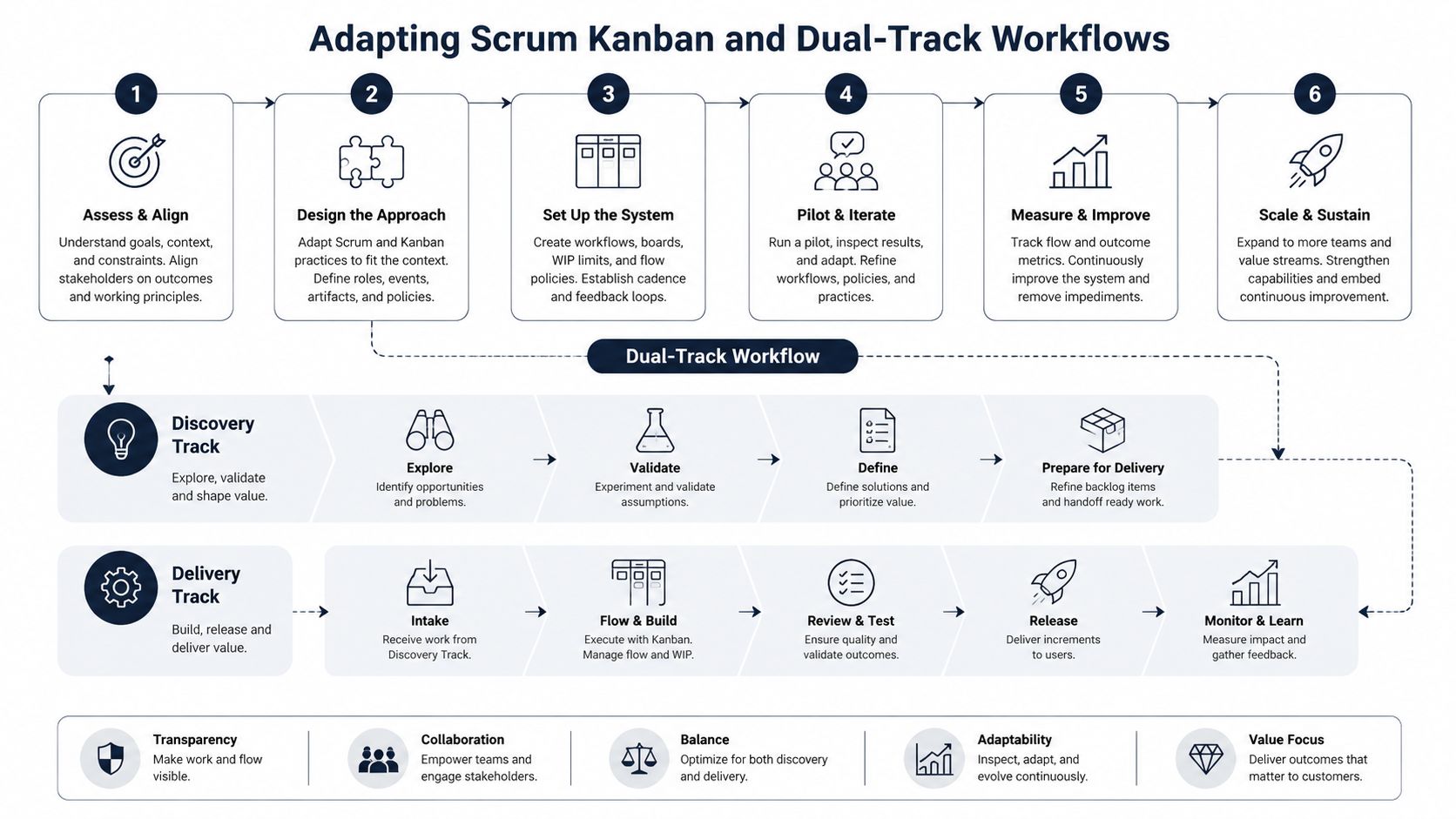
Adapting Scrum Kanban and Dual-Track Workflows
Most PMs don't struggle because they picked the “wrong” framework. They struggle because their framework doesn't match how decisions are made, how work arrives, or how much uncertainty exists in the product.
Scrum, Kanban, and Dual-Track workflows each shape your job differently. The best choice depends on whether you're managing planned feature work, continuous operational inflow, or a product that needs constant discovery alongside delivery.
Scrum vs Kanban for product managers
| Aspect | Scrum | Kanban |
|---|---|---|
| Planning rhythm | Fixed sprint cadence with planning, review, and retrospective | Continuous flow with work pulled as capacity opens |
| Backlog management | PM needs sprint-ready stories before planning | PM manages prioritization continuously |
| Best fit | Teams shipping toward shared sprint goals | Teams handling mixed inflow, bugs, ops, and requests |
| Stakeholder communication | Easier to communicate changes at sprint boundaries | Requires stronger expectation setting because priorities can shift anytime |
| Discovery fit | Can work well if discovery happens before sprint commitment | Useful when discovery and execution happen in smaller, frequent slices |
| Common failure mode | Sprint gets overloaded with unclear work | Board becomes a dumping ground with weak strategic focus |
Scrum gives structure. That's helpful for newer teams or products with coordinated releases. It forces moments of commitment and review. But it can also tempt PMs into over-preparing every detail before the sprint starts, especially when engineering wants “everything defined.”
Kanban is more fluid. It works well when requests arrive continuously and the team needs to manage throughput, interruptions, and service levels. The trade-off is that weak prioritization gets exposed fast. Without strong product judgment, “continuous flow” becomes “constant context switching.”
What changes in the PM role
In Scrum, the PM spends more energy preparing decisions ahead of planning. Backlog refinement matters because the team is about to commit to a bounded set of work. You need clean stories, sharp acceptance criteria, and a clear reason each item belongs in the sprint.
In Kanban, the PM spends more energy maintaining order in an always-moving system. Priorities need to be visible and current. Work-in-progress limits only help if someone protects them.
If your team keeps arguing about where time goes, it helps to analyze time spent across different tasks so planning debates are grounded in observed work patterns instead of memory.
Why Dual-Track is often the better product model
Many SaaS teams eventually hit the same problem. Scrum or Kanban may help manage delivery, but neither automatically protects discovery. The team gets efficient at building whatever enters the queue, even when the underlying problem hasn't been validated.
That's where Dual-Track works better. Discovery and delivery happen in parallel. Designers, PMs, and engineers learn while the team continues to ship. Ideas get shaped before they become expensive.
Dual-Track Agile reduces handover waste by 40 to 50 percent and leads to 35 percent higher feature adoption and 20 percent churn reduction, according to Product School's guide to Agile product management. Those outcomes make sense because the team is no longer waiting for work to bounce from one function to another in sequence.
The strongest Agile teams don't separate “thinking” from “building.” They involve engineers early enough that discovery changes what gets built, not just how fast it gets built.
A workable setup
A practical operating pattern looks like this:
- Discovery track: PM, design, and at least one engineer explore problems, review customer evidence, and test assumptions.
- Delivery track: The broader team builds validated work already shaped enough to enter execution.
- Shared review points: Insights from discovery update backlog order, scope, and release expectations.
- Story mapping: Use a visual structure to break broad initiatives into thin slices. A good story mapping example for agile teams helps teams separate must-have flow from nice-to-have detail.
The goal isn't to be pure to a framework. It's to create a system where the team can learn quickly and build deliberately.
From Gut Feel to Revenue-Driven Prioritization
The hardest part of agile for product managers isn't writing stories. It's deciding which problems deserve the team's attention in the first place.
Prioritization efforts often rely on a blend of intuition, stakeholder pressure, and lightweight scoring models. RICE can help. So can impact versus effort. But those methods break down when the underlying inputs are weak. If the evidence is fuzzy, the score just gives the opinion a cleaner spreadsheet.
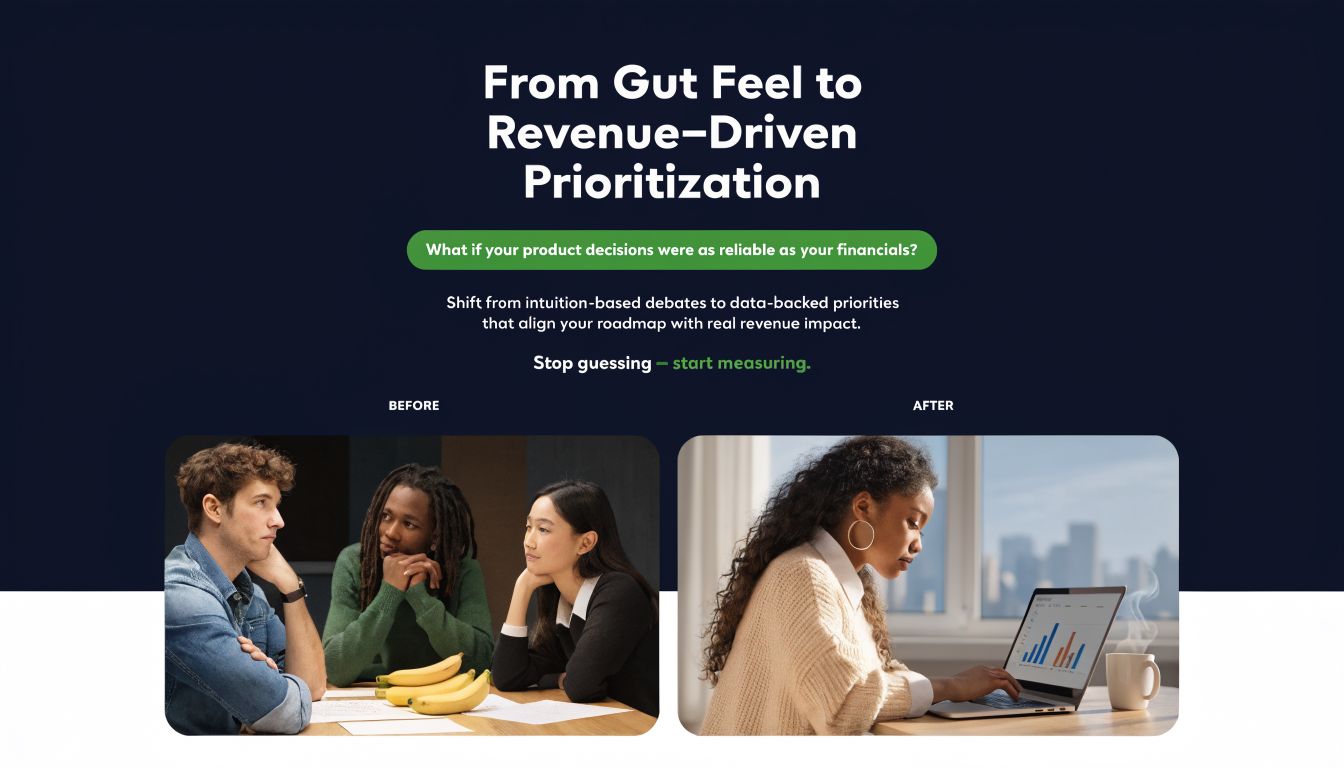
Why intuition stops scaling
A critical gap in Agile guidance is feedback prioritization. An estimated 70 to 80 percent of features are rarely or never used, and AI platforms now show 87 percent correlation accuracy in predicting revenue impact from behavioral patterns, which gives PMs a way to move from anecdotal debate to quantified prioritization, as discussed in Roman Pichler's article on how Agile changed product management.
That matters because most incoming requests don't arrive in a useful format. Support logs pain. Sales logs objections. Customer success flags risk. Product analytics shows symptoms but not always causes. The PM has to turn all of that into a ranked set of decisions.
A better way to prioritize
The shift is simple in concept and hard in practice. Stop asking only, “How important does this feel?” Start asking, “What customer behavior is this tied to, and what business outcome is likely attached to it?”
That changes the discussion in sprint planning.
Instead of saying:
- customers keep asking for export improvements
- onboarding seems confusing
- this bug is annoying but maybe not urgent
You can frame work as:
- repeated friction appears in a workflow tied to activation
- this support issue clusters around accounts showing expansion potential
- this defect affects a path used by high-value customers
You don't always need a precise dollar figure to improve prioritization. But you do need stronger evidence than volume alone. Ten feature requests can matter less than one issue tied to churn risk in the wrong account segment.
Decision test: If two backlog items have similar effort, pull the one connected to a measurable customer behavior change, not the one with the strongest internal advocate.
How this fits into the sprint rhythm
A revenue-driven model doesn't replace PM judgment. It sharpens it.
Use the sprint cadence like this:
- Before refinement: Cluster incoming feedback by problem theme, affected workflow, and customer segment.
- Before planning: Match themes against usage patterns, retention risk, sales blockers, or adoption signals.
- During planning: Present the top items with a short evidence summary, not a long narrative.
- After release: Watch behavior, not just ticket completion.
For teams that need a stronger structure, these backlog prioritization techniques for product teams are useful because they force a clearer link between signal, value, and sequencing.
What not to do
Three habits consistently weaken prioritization:
- Counting requests without context: Frequency matters, but customer type and workflow importance matter more.
- Treating all bugs as technical issues: Some defects are product-critical because they hit activation, retention, or trust.
- Promising roadmap slots too early: Once a request gets socialized as “planned,” evidence has a harder time changing the decision.
The PM's job isn't to sound certain. It's to help the team place better bets.
Navigating Common Agile Anti-Patterns for PMs
A lot of Agile dysfunction hides behind normal-looking rituals. The board is active. Ceremonies are happening. Tickets are moving. From the outside, the team looks healthy. Inside, the PM is losing strategic ground.
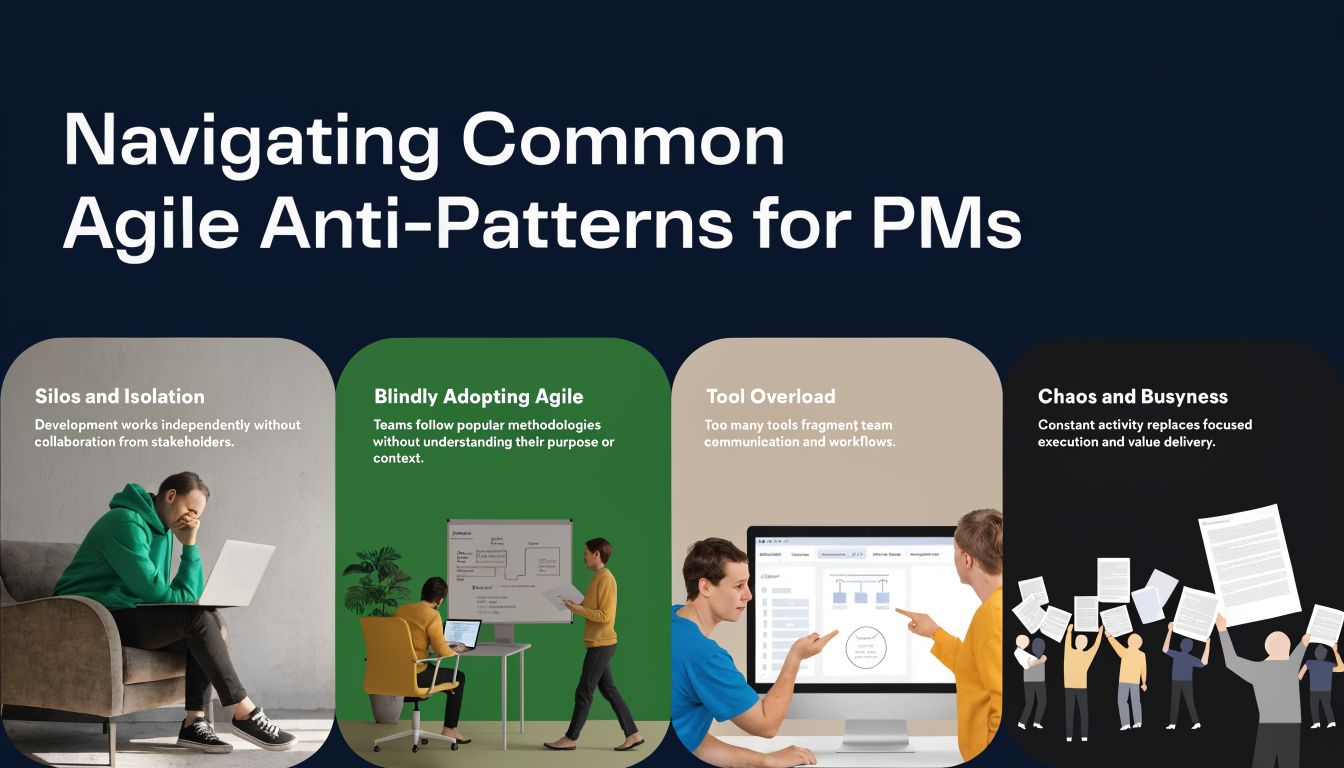
Anti-pattern one being the backlog admin
SymptomYou spend most of your time rewriting tickets, clarifying edge cases, and updating priorities after stakeholder conversations.
Root causeThe company has confused product management with work intake. Nobody is protecting strategic time, and nobody expects evidence before requests enter the queue.
The fixCreate a visible intake standard. Not every request deserves backlog space. Ask for the problem, affected customer, expected outcome, and why now. If those fields are weak, the request stays in discovery.
This does two things. It reduces noise, and it retrains stakeholders to bring better inputs.
Anti-pattern two running a feature factory
SymptomThe team ships continuously, but nobody can say which releases changed customer behavior or improved business outcomes.
Root causeAgile delivery got separated from product learning. Velocity became the success metric because it's easy to observe.
The fixAttach each meaningful item to a post-release question. Did activation improve? Did support demand drop? Did a risky workflow become more usable? You don't need a giant analytics stack to do this well. You need discipline. Every sprint should include at least a few items whose impact the team intends to check.
Shipping without an expected outcome turns Agile into inventory management for features.
Anti-pattern three PM and PO role confusion
This one gets sharper in scaled environments. The PM is told to own strategy, but the Product Owner duties consume the week. The result is shallow roadmap ownership and fragmented decisions across teams.
A 2025 Scrum.org survey found that 62 percent of PMs report tension in Product Owner duties conflicting with strategic ownership, leading to 25 percent higher misalignment in multi-team setups versus teams with dedicated POs, according to Scrum.org's discussion of product ownership and product management tension.
How to respond when the roles blur
If you're carrying both PM and PO work, you need explicit operating rules.
- Own decision layers, not every artifact: Make clear which choices are strategic, which are sequencing decisions, and which belong to the team.
- Delegate detail where possible: Engineers and designers can help shape stories, assumptions, and acceptance criteria.
- Protect recurring strategy time: If every open hour gets filled with ceremonies, strategy will never happen accidentally.
- Use one product narrative across teams: Multi-team products break when each squad optimizes its own backlog without a shared problem framing.
A healthier pattern
The best Agile PMs aren't the ones who touch every ticket. They're the ones who keep the team aligned on why the work matters, what evidence supports it, and what the team should learn after shipping.
That's how you stay strategic without becoming abstract. Close enough to delivery to guide it. Far enough above ticket flow to make real product decisions.
Your First 90 Days to a True Agile Product Mindset
If you want to get better at agile for product managers, don't try to overhaul your whole organization in a month. Start by changing how decisions enter the system, then improve one ceremony, then widen the habit.
Days 1 to 30 build your evidence base
Your first job is to understand how work currently gets prioritized and where the evidence is weak.
Review the last few sprints. Look at what was shipped, what was interrupted, what was deferred, and which items had clear customer or business reasoning behind them. You're not auditing for blame. You're finding patterns.
Then tighten the inputs:
- Map feedback sources: Support, sales, success, analytics, and engineering all produce product signals. Put them in one view.
- Tag by problem, not requester: Organize incoming noise around workflows and customer pain.
- Start reading cycle time closely: High-performing Agile teams that balance feature work with technical debt through value-based scoring achieve 30 percent faster time-to-market and 2x higher feature adoption rates, and teams that keep cycle time under 2 weeks see a 25 percent uplift in NPS, according to Canny's guide to Agile product management skills.
A solid analytics setup for product managers helps here because it turns “we think this matters” into “we can see where friction and value concentrate.”
Days 31 to 60 change one ceremony
Don't try to fix every meeting. Improve sprint planning or backlog refinement first.
Bring a shorter list of candidate items. For each one, show the problem, the affected user behavior, and the expected outcome. If an item lacks that context, say so plainly. PMs gain credibility when they make uncertainty visible instead of hiding it behind polished wording.
Bring fewer items into planning, but make each one easier to defend.
Also watch whether technical debt is getting squeezed out. Teams that ignore it usually pay later through slower delivery and noisier planning.
Days 61 to 90 scale the behavior
By this point, you want stakeholders to notice that prioritization is becoming more disciplined. Use that momentum.
Share examples where evidence changed a backlog call. Show when the team chose a smaller slice to learn faster. Highlight where a release solved a real customer problem, not just closed a ticket. This is how you shift the conversation from output to outcomes without sounding theoretical.
A mature Agile mindset isn't about loving ceremonies. It's about building a repeatable loop: gather evidence, decide clearly, ship intentionally, learn quickly, and revise without drama.
If your team is drowning in feedback, support noise, and roadmap pressure, SigOS helps turn raw customer signals into prioritized product decisions. It connects support conversations, usage patterns, and revenue impact so product teams can walk into planning with evidence instead of guesswork.
Keep Reading
More insights from our blog
Ready to find your hidden revenue leaks?
Start analyzing your customer feedback and discover insights that drive revenue.
Start Free Trial →