Understanding Data Privacy: A 2026 Guide for SaaS Teams
Master understanding data privacy with practical frameworks for SaaS teams. Learn GDPR, CCPA, and privacy-by-design strategies.

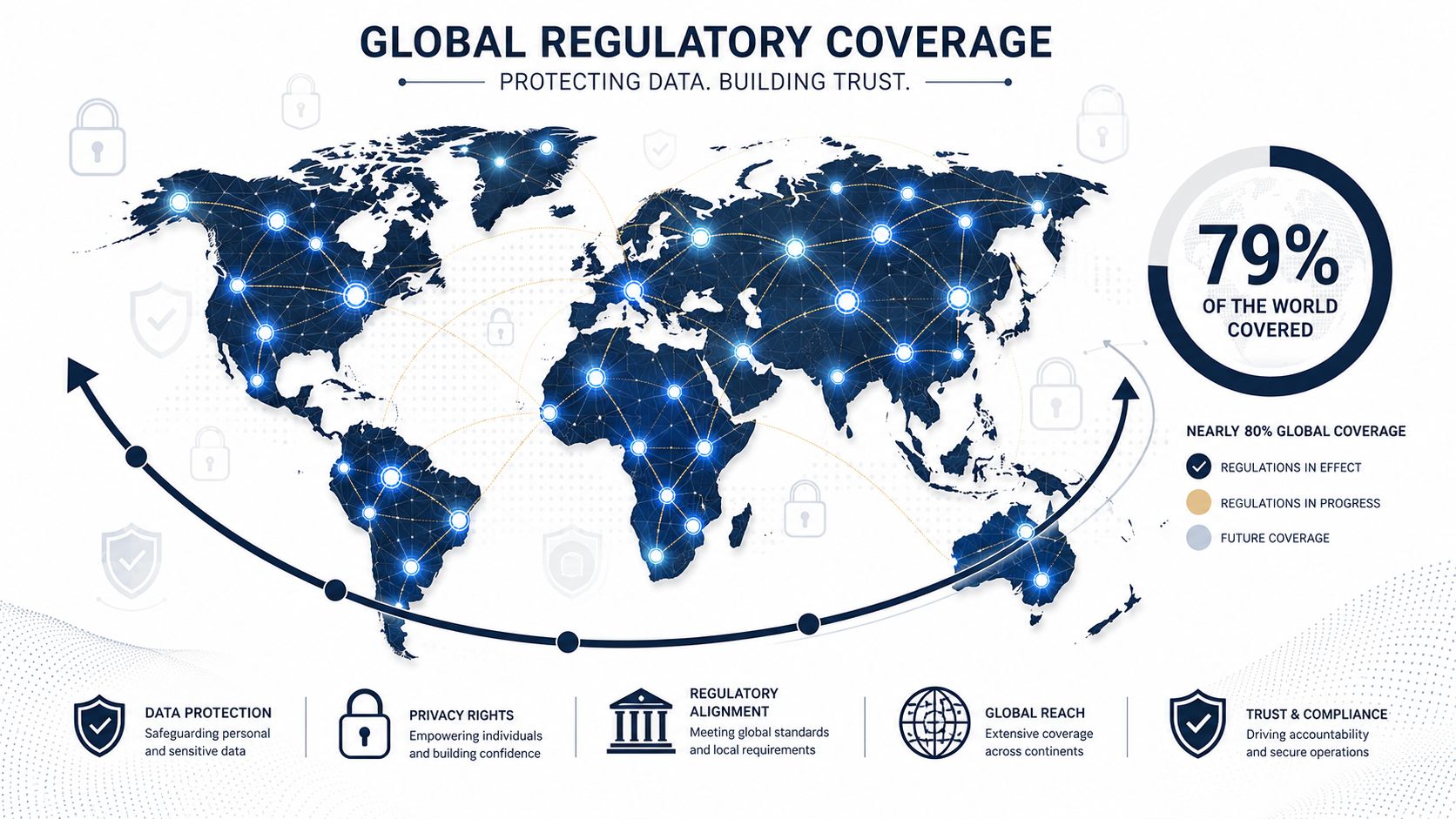
By the end of 2024, data protection laws covered about 6.3 billion people, or 79% of the global population (global privacy statistics). That scale changes the question for SaaS teams. Understanding data privacy is no longer about checking a compliance box after launch, it's about designing products that can survive regulation, customer scrutiny, and operational reality across markets.
For product intelligence platforms, the hard part isn't recognizing that privacy matters. The hard part is making privacy controls work while support tickets, chat transcripts, sales calls, and usage data keep flowing through the stack. Teams that treat privacy as a one-time policy exercise usually end up rebuilding data flows later, after legal, engineering, and customer trust have all taken a hit.
The Global Privacy Environment Has Shifted
A SaaS team that treats privacy as a regional legal issue is already behind. By the end of 2024, over 140 countries had data protection laws in force, and those laws covered 79% of the global population (2024 global privacy regulation coverage data). That changes the operating model for product intelligence platforms. Privacy expectations are now built into the environments where products collect support tickets, chat transcripts, sales calls, and usage data, instead of being negotiated after launch.
Enforcement also shapes day-to-day product decisions. GDPR fines have exceeded €4 billion since May 2018 (2024 global privacy regulation coverage data). Independent 2026 summaries put cumulative GDPR fines even higher, at €7.1 billion, with more than 400 breach notifications per day as a GDPR record, although those figures vary by source and methodology (2024 global privacy regulation coverage data). The practical takeaway is straightforward. Regulators are influencing how teams design collection, retention, sharing, and deletion flows through direct financial pressure, not symbolic warnings.
What that means for product teams
If your platform touches customer data, privacy cannot sit only in legal review or procurement questionnaires. Product managers have to make collection, retention, sharing, deletion, and downstream analytics part of the product spec. Engineers have to know which data can move freely, which fields need masking, and which records should stay in a restricted layer.
Practical rule: if a customer cannot explain to its own security or legal team what your product stores, why it stores it, and when it leaves the system, the design is already too loose.
The strongest teams do not ask whether privacy compliance exists somewhere in the company. They ask where privacy constrains architecture, product analytics, and customer workflows. That shift matters because privacy now affects product quality every time a team decides what to collect, what to keep, and what to make available for analysis.
Core Privacy Principles Every Product Team Must Know
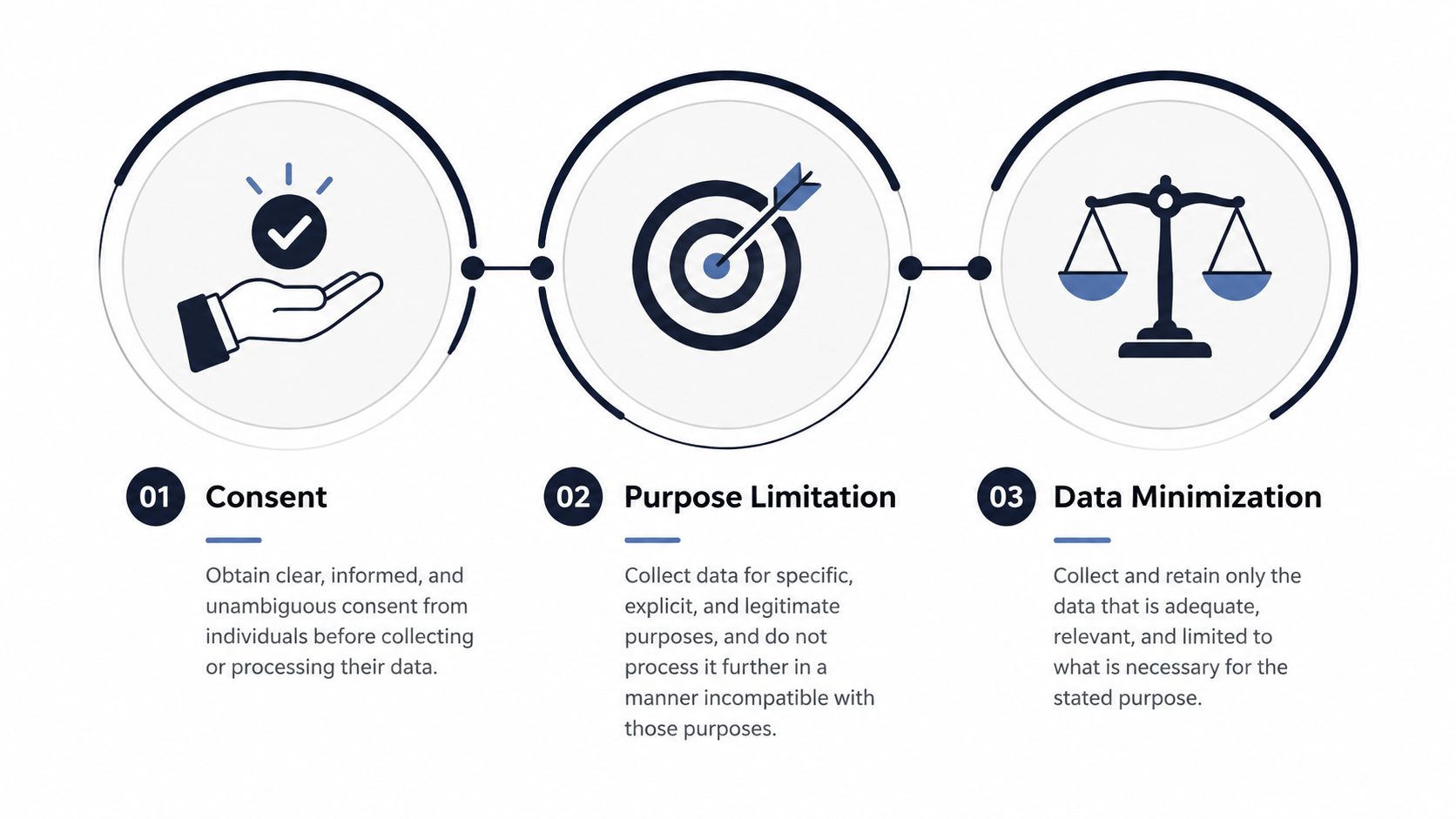
The core principles sound familiar because they show up everywhere, but the operational version is where teams usually slip. Consent, purpose limitation, and data minimization are not abstract legal phrases. They're design constraints that decide what fields you collect, how you route events, and whether your analytics product can safely evolve later.
Consent has to match the actual data use
Consent is only meaningful when it's tied to the specific use case. An opt-in flow makes sense when the processing isn't necessary to deliver the core service, while a default-on flow demands stronger justification and clearer disclosure. In practice, product teams need to separate essential service data from optional analytics, marketing, or enrichment data.
That separation should show up in the product itself. Don't bury consent inside a long preferences panel that no customer ever revisits. Make collection choices visible at setup, document what each data type supports, and keep the language plain enough for a non-lawyer to understand.
Purpose limitation needs enforcement, not just documentation
Purpose limitation means data collected for one reason shouldn't become fuel for a different workflow without review. If a customer shared support transcripts to resolve tickets, that doesn't automatically mean the same data can be repurposed for training, profiling, or customer benchmarking. Product teams need a written purpose for each data class, then technical controls that block drift.
A practical way to do this is to attach purpose metadata to datasets and events, then require review before any new use case is enabled. That sounds bureaucratic until you've had to unwind a feature that accidentally extended data use beyond the original customer agreement.
Data minimization removes risk before it starts
Minimization is the cleanest privacy control because it reduces exposure at the source. Audit every input field, event property, and uploaded artifact. If a field doesn't support a user-facing outcome, an operational need, or a compliance obligation, it probably doesn't belong.
Collect less, keep less, expose less. That sequence reduces legal risk and usually makes analytics cleaner, because noisy fields disappear before they pollute the pipeline.
Major Privacy Regulations and What They Mean for SaaS
Privacy regulation is now part of product design, not a legal appendix. SaaS teams that treat it as a one-time review usually end up reworking consent flows, retention rules, and deletion processes after customers ask hard questions or regulators do. The practical job is to know which rules apply, where they differ, and which parts of the product need to change so analytics still work without exposing more data than the business can justify.
The practical difference between the big frameworks
GDPR is the model many teams meet first because it pushes on lawful processing, user rights, and accountability for how personal data is collected and used. CCPA puts more weight on transparency, access, deletion, and consumer control over sharing and sale. Other privacy laws borrow from both, but the operational impact depends on where your users are, where your customers are located, and how your product routes data through support, analytics, and customer success systems.
That difference matters in production. A SaaS platform that serves multiple regions cannot rely on one consent screen or one request workflow and call it done. It needs separate handling for deletion, access, opt-out, and disclosure obligations, with policy rules that can change by market without breaking the product intelligence layer.
Privacy Regulation Comparison for SaaS Teams
| Regulation | Applies When | Consent Model | Key User Rights | Max Penalty |
|---|---|---|---|---|
| GDPR | When personal data of people in the EU or EEA is processed | Strong consent options in some cases, plus other lawful bases | Access, rectification, erasure, restriction, portability, objection | Fines have exceeded €4 billion since May 2018, with 2026 summaries reporting €7.1 billion cumulative (GDPR fine totals and breach notification statistics) |
| CCPA | When covered businesses handle California consumer data | Disclosure-heavy, with rights tied to collection and sharing choices | Access, deletion, correction, opt-out of sale or sharing | Penalties vary by enforcement outcome and violation type |
| Other national privacy laws | When local data protection statutes apply in the customer's jurisdiction | Often mixes consent, notice, and legitimate processing concepts | Usually access, deletion, correction, and complaint rights | Depends on local regulator and statute |
For teams that sell into mixed markets, a resource like workplace data privacy with Logical Commander can help translate CCPA-oriented duties into workflows that product, security, and operations teams can keep up to date. The practical value is not legal theory. It is turning regulatory duties into request handling, retention settings, and approval paths that survive day-to-day use.
The most common failure mode is forcing every region through the same consent experience. That usually creates over-collection, thin documentation, or both. Strong SaaS teams build a flexible policy layer, then map it to product flows by region and customer type. When the data model and the policy model stay in sync, analytics teams can still measure product behavior without treating privacy as a checkbox that gets revisited only after a complaint.
Technical Controls That Actually Protect User Data
Policies don't protect data on their own. Production systems do. The controls that matter most are the ones that reduce who can see raw data, limit where data can move, and make analytics possible without exposing identifiable records.
Start with layered access, not broad visibility
The core technical controls are straightforward: least-privilege access, encryption, and deletion workflows. In layered analytics architectures, raw data should stay tightly restricted in the bronze layer, masked or anonymized data should move into the silver layer, and only aggregated data should reach the gold layer so privacy risk drops as data moves farther from the source (engineering privacy overview).
That pattern works because it separates operational needs from analytical needs. Product analysts can still study behavior, but they don't need unfettered access to raw support transcripts or identifiers. Engineers can debug with controlled access, while broader product reporting stays on sanitized data.
Use PETs when analysis still needs sensitivity
Privacy-enhancing technologies are the right answer when teams need computation without full disclosure. ENISA and ISACA describe tools such as differential privacy, synthetic data, homomorphic encryption, zero-knowledge proofs, secure multiparty computation, trusted execution environments, and federated learning as ways to reduce identifiability or shield data while still enabling useful analysis (ENISA state of the art).
That doesn't mean every platform should use all of them. Teams should begin with the simplest effective control. Mask sensitive fields, restrict raw access, and aggregate early. Use advanced PETs where the business case is strong enough to justify the complexity.
Pick controls that match the workflow
Encryption at rest and in transit protects data from basic exposure, but it won't solve overbroad access or bad retention. Role-based and attribute-based access control help when different teams need different views of the same system. Deletion workflows matter because privacy obligations don't end once data has been collected.
If your team can't delete data cleanly, you don't really control that data. You're just storing it longer.
For teams documenting their architecture, the data flow diagrams in SaaS data architecture examples can help clarify where controls belong in a real pipeline.
Building Privacy Into Your Product Development Process
Privacy becomes manageable only when it sits inside scope, design, and release readiness. Teams that treat it as a separate compliance lane usually discover too late that product decisions already locked in risky data flows. Teams that build it into the process avoid that rework and spend less time undoing choices that should have been questioned earlier.
Insert privacy review where decisions are made
The strongest checkpoint is early, during intake and design. When a new feature proposes collecting personal data, ask what problem the data solves, how long it stays, who can see it, and how a customer can delete it later. If those answers are weak, the feature probably needs redesign before engineering writes a line of code.
Privacy impact assessments belong in the normal release path, not only in emergencies or enterprise deals. They should run for features that introduce new data types, new vendors, new inference logic, or new sharing behavior. That keeps the review tied to actual product risk instead of turning it into a one-time approval exercise.
Write privacy like product requirements
Privacy user stories should read like product work, not legal memo fragments. For example, a story might require that customer transcripts used for issue detection are stored with a defined retention rule, accessible only to approved roles, and deletable on request through a documented path. Acceptance criteria should include the data purpose, the deletion path, and the DSAR or erasure flow.
Write privacy requirements like product requirements, as outlined in our guide to writing PRDs. The strongest teams keep this visible in the roadmap itself. One practical pattern is to make every roadmap item pass a privacy review before it is marked ready. SigOS publishes a Data Privacy Compliance guide that uses this kind of approach, including a privacy review on every roadmap item, with checks for purpose, retention, deletion, and DSAR or erasure flows.
Practical rule: if privacy requirements are only in legal comments at the end of a ticket, they will be missed in implementation.
Reduce friction by making privacy predictable
Product velocity slows when every team improvises privacy decisions from scratch. It speeds up when there is a shared checklist, a standard data flow template, and clear ownership between product, engineering, and legal. The goal is not to make every feature identical. The goal is to make privacy review routine enough that teams stop treating it as an interruption.
Privacy and AI Analytics Without Compromising Either
AI changed privacy from a one-time approval problem into a lifecycle problem. Data doesn't just sit in a database anymore. It gets copied into prompts, passed through vendors, cached in logs, used for inference, and sometimes reused later for training. Traditional consent language often doesn't describe that reality well enough.
Why old consent models break down
A customer may agree to share data for one product workflow, then later find that the same data appears in model training or automated recommendations. That's where the tension gets sharp. Once personal data enters AI workflows, it can be copied, retained, inferred, or combined in ways that are hard to reverse, so privacy protection has to shift toward provider responsibility and continuous governance (data equity principles).
That doesn't mean AI and privacy are incompatible. It means the governance model has to follow the data through its full lifecycle, not just at collection time.
What works in production
For product intelligence platforms, a few patterns hold up well. Don't retrain models on customer data unless the customer has explicitly agreed to that use and the retention path is clear. Use aggregated patterns wherever possible instead of individual records. Set retention limits so training inputs, prompts, and intermediate artifacts don't linger indefinitely.
The operational benefit is real. You reduce the surface area for accidental disclosure, vendor leakage, and repurposed use cases that customers never intended. You also make your product story easier to explain to privacy-conscious buyers, because the rules are simple and consistent.
AI features need tighter vendor discipline
If a vendor API touches customer data, treat that as a separate privacy event. Document what leaves your system, whether it's stored, and whether it can be used to improve the vendor's service. Product leaders often miss this step because the feature feels internal, but the privacy exposure sits in the data flow, not the user interface.
For teams building AI-assisted analytics, AI for product development is a useful reference point for how to keep the product value while setting stricter boundaries around data use. The most durable pattern is to make customers trust the system because it is intentionally limited, not because they have to assume the best.
Implementation Checklist and Risk Assessment Framework
Privacy work gets easier when every team knows what to inspect and who owns it. A lightweight framework beats an abstract policy document because product, engineering, and legal can execute it during planning and review.
Start with the data inventory
Use a simple inventory before a feature ships. Identify what personal data you collect, where it enters the system, where it is stored, who can access it, and which third parties receive it. Include support tools, analytics tools, and logging systems, not just the main application database.
Then check the control surface
- Encryption coverage: Confirm data is protected at rest and in transit.
- Access management: Verify the right people can view only the data they need.
- Deletion workflows: Test how data gets removed from active systems, backups, and downstream tools.
- Retention rules: Confirm old data doesn't stay around by default.
- Vendor handling: Review whether outside processors receive personal data and under what terms.
Prioritize by risk, not by inbox noise
A useful risk score starts with three questions. How sensitive is the data. How broad is regulatory exposure. How much business damage would follow if the data were misused or exposed. The higher the sensitivity and exposure, the earlier the work should land in the roadmap.
Ownership matters too. Product owns the data purpose and customer-facing disclosure. Engineering owns the controls, deletion logic, and access boundaries. Legal owns the regulatory interpretation and review of higher-risk uses. Security should be involved whenever systems expand the attack surface or sensitive data moves to a new processor.
If you want privacy to stick, assign it to named people, attach it to release criteria, and review it as part of normal product governance. That's the difference between a program that exists on paper and a program that survives the next roadmap change.
SigOS helps product and growth teams turn noisy customer feedback and usage signals into prioritized work without turning privacy into an afterthought. If your team needs a product intelligence workflow that respects data boundaries while still surfacing revenue-impacting issues, visit SigOS and see how it fits into a privacy-aware product process.
Keep Reading
More insights from our blog
Ready to find your hidden revenue leaks?
Start analyzing your customer feedback and discover insights that drive revenue.
Start Free Trial →