Voice of Customer Tools: 10 Platforms Compared for 2026
Compare the best voice of customer tools for SaaS product and growth teams: features, integrations, pricing, use cases and how to choose in 2026.
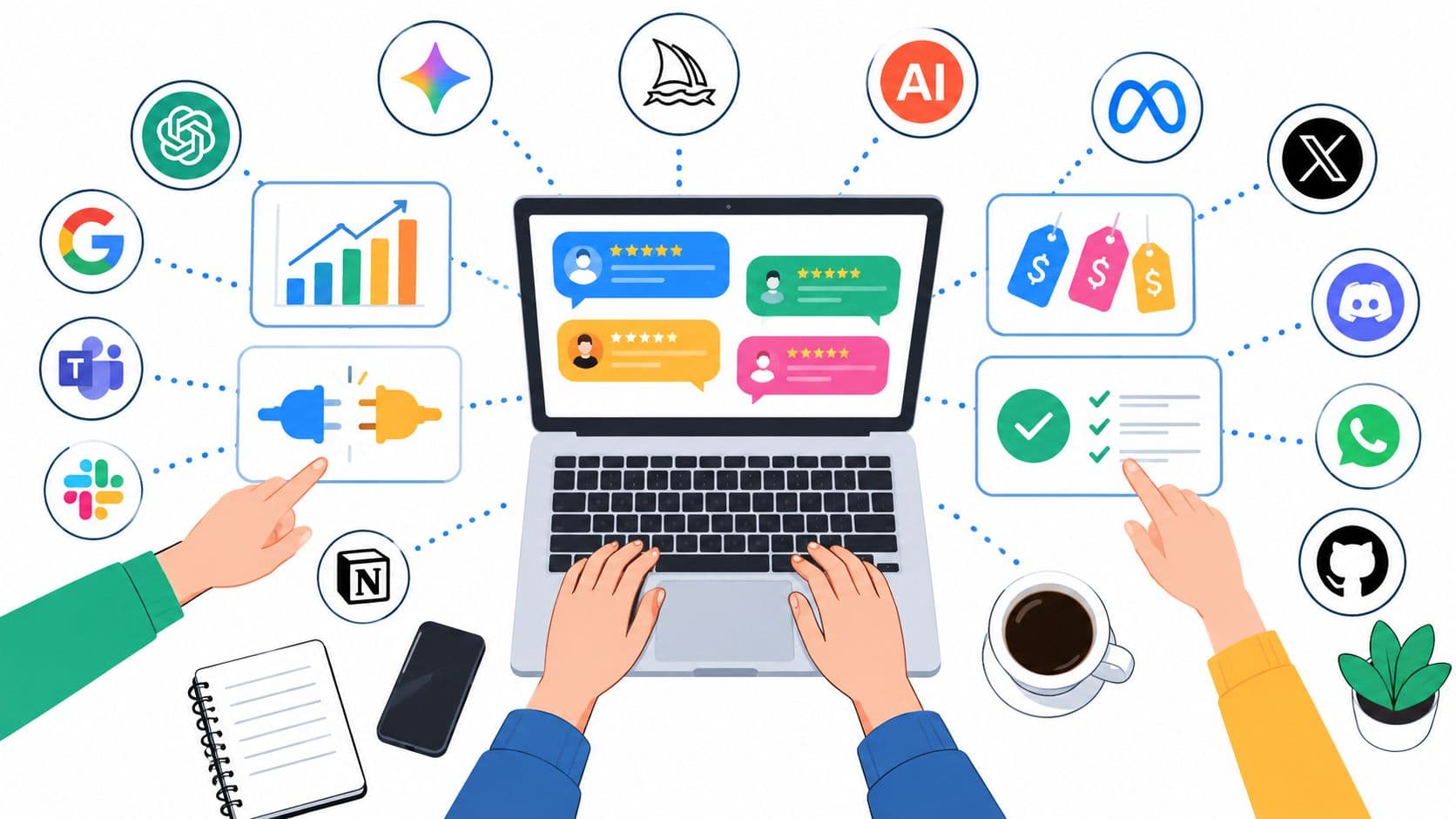
Most product and growth teams already collect customer feedback from support tickets, chats, surveys, sales calls, reviews, and product analytics. The backlog still grows because collection isn't the same as prioritization. A feature request can be repeated by vocal customers while a quieter usage pattern points to a more serious churn risk. The practical question is which signals deserve action, who owns the decision, and whether the tool can connect evidence to shipped work.
This list compares 10 voice of customer tools by the teams and data sources they directly serve. You'll see where enterprise CX suites make sense, where in-product research platforms are faster, and where revenue-linked product feedback tools fit better for SaaS. I've focused on ingestion, integrations, workflow, pricing visibility, and the limitations that tend to appear after implementation.
Before you evaluate any platform, check whether your outbound email infrastructure can support feedback requests and customer research. A free email deliverability test can identify sending problems before they distort response rates.
1. SigOS
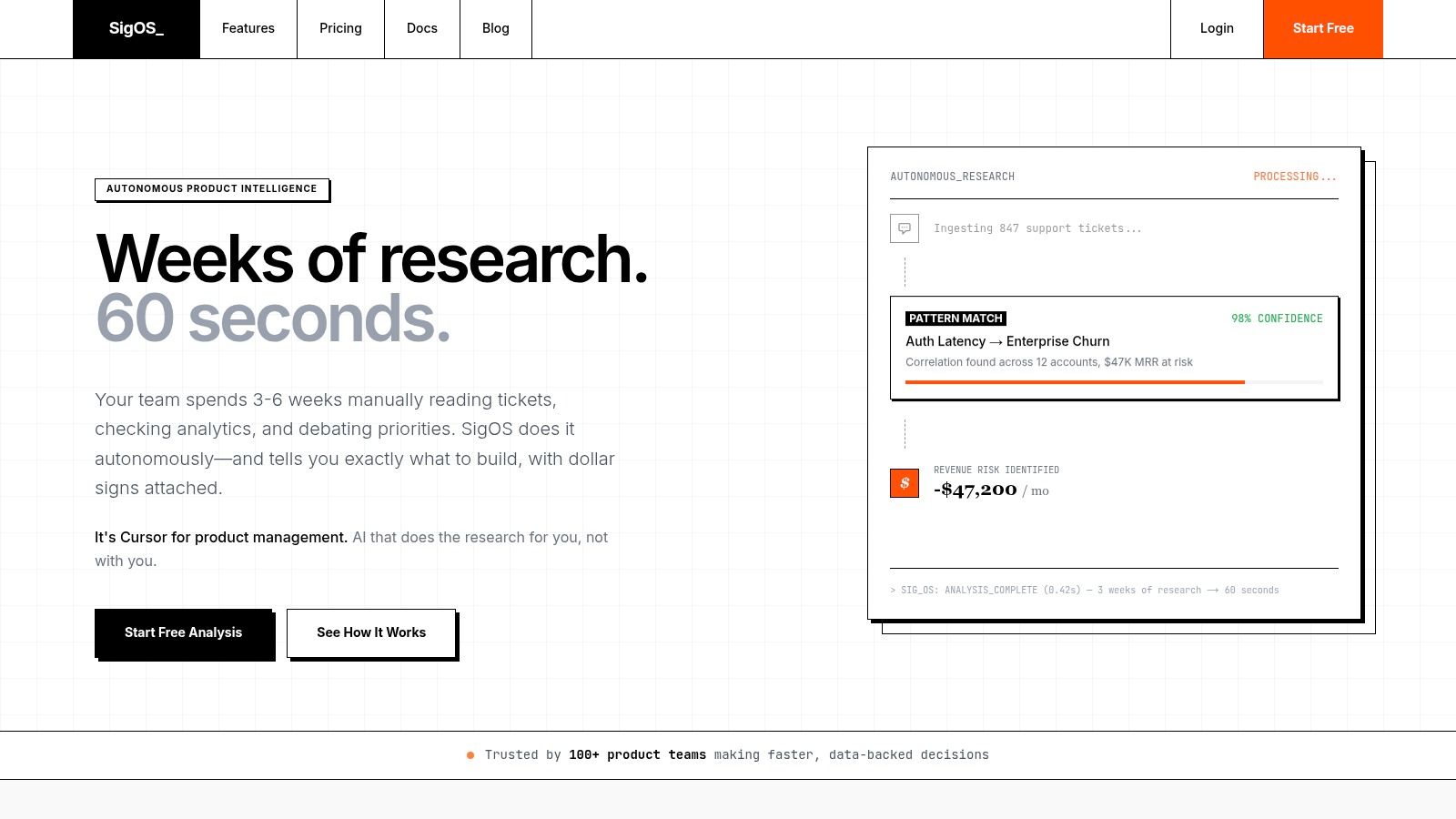
A SaaS team can have support tickets, call transcripts, usage events, revenue records, and shipping history in separate systems. SigOS brings those sources together to connect what customers say with what they do, pay for, and receive. It then turns the combined evidence into product issues that product, growth, support, success, and technical leaders can evaluate against business impact.
Its four-layer model covers customer statements, observed behavior, commercial value, and shipped changes. That structure supports decisions rather than another feedback queue. Teams can examine whether an issue relates to churn risk, expansion potential, or revenue exposure instead of ranking requests by mention count alone. One illustrative example is a price-tagged authentication bug with $47K in monthly recurring revenue at risk.
Practical rule: A feedback theme becomes more useful when the system can show who is affected, what they do next, and what the issue is worth.
SigOS connects with tools including Zendesk, Intercom, Jira, GitHub, Segment, Mixpanel, Stripe, and Salesforce. It can send issues into existing engineering workflows with revenue-impact scores and alert teams to patterns linked to rising churn risk or a high-value opportunity. The platform states that its models are not retrained on customer data and that encryption forms part of its security approach.
Where SigOS fits and where it doesn't
SigOS fits SaaS organizations that need revenue-linked product feedback rather than a survey-first research platform or a broad enterprise CX suite. It can reduce the manual work involved in reading tickets, reconciling analytics, deduplicating requests, and defending priorities with incomplete evidence. Its guide to voice of customer describes the operating model for turning customer language into product requirements.
The trade-off is data readiness. SigOS needs connected feedback, product, revenue, and delivery data to produce its strongest recommendations. A small team with limited instrumentation may need to improve event tracking and data hygiene before the analysis becomes dependable. Pricing is not published beyond a free first analysis, so budget planning requires a sales conversation.
Recommendations still need product and commercial judgment. The platform reports 87% correlation accuracy, but correlation does not prove that a proposed fix will create a particular business result.
Best fit: SaaS teams prioritizing roadmap work by churn, expansion, and revenue impact.
Main limitation: Value falls when product usage, account value, or shipping data is inaccessible or unreliable.
2. Qualtrics XM
Qualtrics XM suits organizations running formal, enterprise-scale experience programs across business units. Its VoC capabilities combine surveys, operational data, and unstructured feedback. Text iQ supports topic modeling, sentiment analysis, multilingual analysis, and recommended topics, while XM Discover, based on Clarabridge technology, analyzes conversational feedback across channels.
The strength is breadth and governance. CX leaders can create role-based dashboards for executives, analysts, and operational teams. Qualtrics also provides tools such as Stats iQ and Insight Explorer for teams that need to move from raw responses to structured analysis. The platform can bring survey results and unsolicited feedback into the same operating environment, which reduces the need to report from disconnected systems.
Its main weakness is operational weight. Smaller product teams may find the administration, configuration, and packaging difficult to justify when their immediate need is to analyze support tickets and prioritize product fixes. Advanced capabilities often sit behind additional modules, and pricing is quote-based. That makes it harder to compare the platform with focused product feedback tools before procurement begins.
Qualtrics is a reasonable choice when research quality, governance, complex survey design, and cross-functional reporting matter more than rapid deployment. It's less compelling when a SaaS product manager needs a lightweight way to connect feedback to Jira or a revenue-backed roadmap.
For teams comparing analysis approaches, this overview of customer feedback analysis tools provides useful context on the difference between collecting responses and operationalizing themes.
Best fit: Enterprise CX, research, and insights teams with formal governance requirements.
Main limitation: Implementation and administration can overwhelm lean product organizations.
Qualtrics XM is powerful, but it should be bought as an enterprise operating system for experience data, not as an advanced survey widget.
3. Medallia Experience Cloud
A contact-center leader reviewing recurring call problems needs more than a post-interaction score. Medallia Experience Cloud combines surveys, speech, digital interactions, video, and social feedback, then applies text and speech analytics to surface themes and experience failures. Acoustic emotion and over-talk analysis add context to service interactions.
Its strongest use case is coordinated action across operational teams. Role-based reporting, alerts, mobile applications, and closed-loop workflows can route the same customer signal to managers and frontline staff. Speech analytics can expose recurring interaction problems, while executives can track broader experience patterns.
The trade-off is operational weight. Medallia is built for enterprise programs, and configuration may require experienced or certified resources. Pricing is quote-only and tied to its Experience Data Record approach, so buyers need to define channels, data volume, governance, and workflow scope before assessing the commercial commitment.
Medallia works best when customer experience is a coordinated operational program, not a side project owned by one product manager.
A SaaS company with a large support operation may value its speech and contact-center depth. A smaller team focused on tickets, calls, and product usage may spend too much time configuring capabilities it will not use. The platform supports a mature closed-loop process, but teams still need clear ownership and follow-up rules.
For teams comparing measurement approaches, this overview of customer experience measurement tools explains how speech, survey, and operational signals are weighted in a mature program.
Best fit: Large organizations with contact-center data, distributed operations, and strict reporting requirements.
Main limitation: Certified implementation and enterprise governance can slow time to value.
Choose Medallia when speech analytics and frontline actioning are central to the program. Skip it when feedback lives mainly in tickets, calls, and product usage.
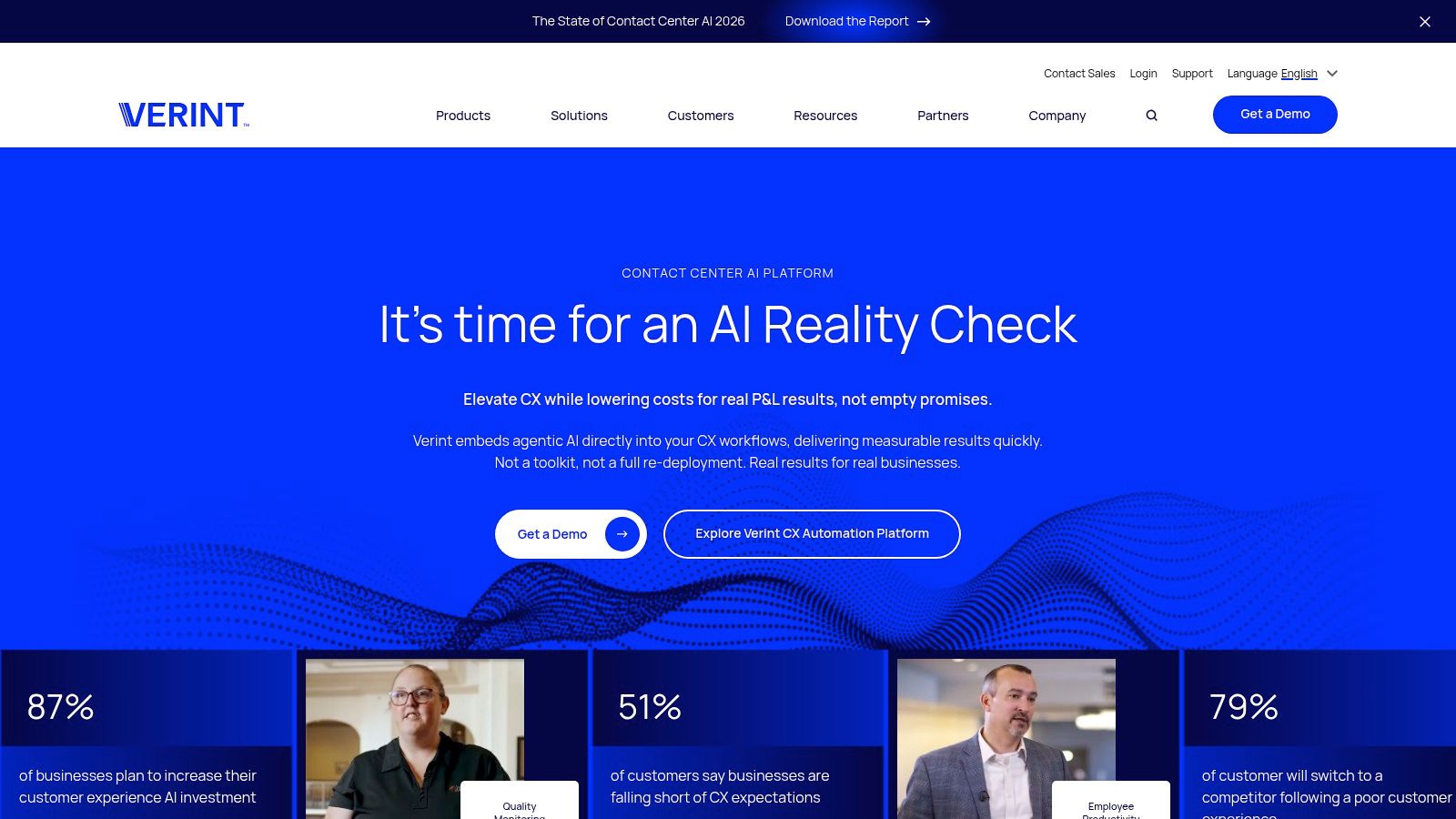
4. Verint Experience Management
Verint Experience Management brings together direct feedback, indirect feedback, and inferred behavioral signals. It supports surveys through web, mobile, IVR, SMS, and email, alongside text and speech analytics. Its digital struggle detection is useful for teams that need to identify friction during an online journey rather than wait for a customer to describe the problem.
The important distinction is actioning. Verint is designed to trigger responses from experience signals in real time, especially across digital and contact-center environments. Survey session link-back can connect a stated response to the digital behavior that preceded it, which helps teams separate a general complaint from a specific workflow failure.
Verint also offers compliance options such as FedRAMP and StateRAMP for public sector use. Those capabilities matter for organizations with strict security requirements, but they add little value to a small SaaS team choosing a product feedback platform.
The commercial model is custom quoted, with usage-based elements varying by deployment. That makes the evaluation less about a simple seat count and more about interaction volume, channels, analytics scope, security, and action workflows. A lean product organization may find the platform unnecessarily broad. A regulated enterprise with complex digital and voice journeys may consider that breadth necessary.
Best fit: Enterprise CX and contact-center teams that need real-time detection and response.
Main limitation: Its enterprise scope and custom pricing are difficult to justify for narrow product feedback use cases.
Verint Experience Management belongs on a shortlist when digital struggle detection, speech analytics, and compliance are all material requirements. It shouldn't be selected on the strength of a long feature list alone.
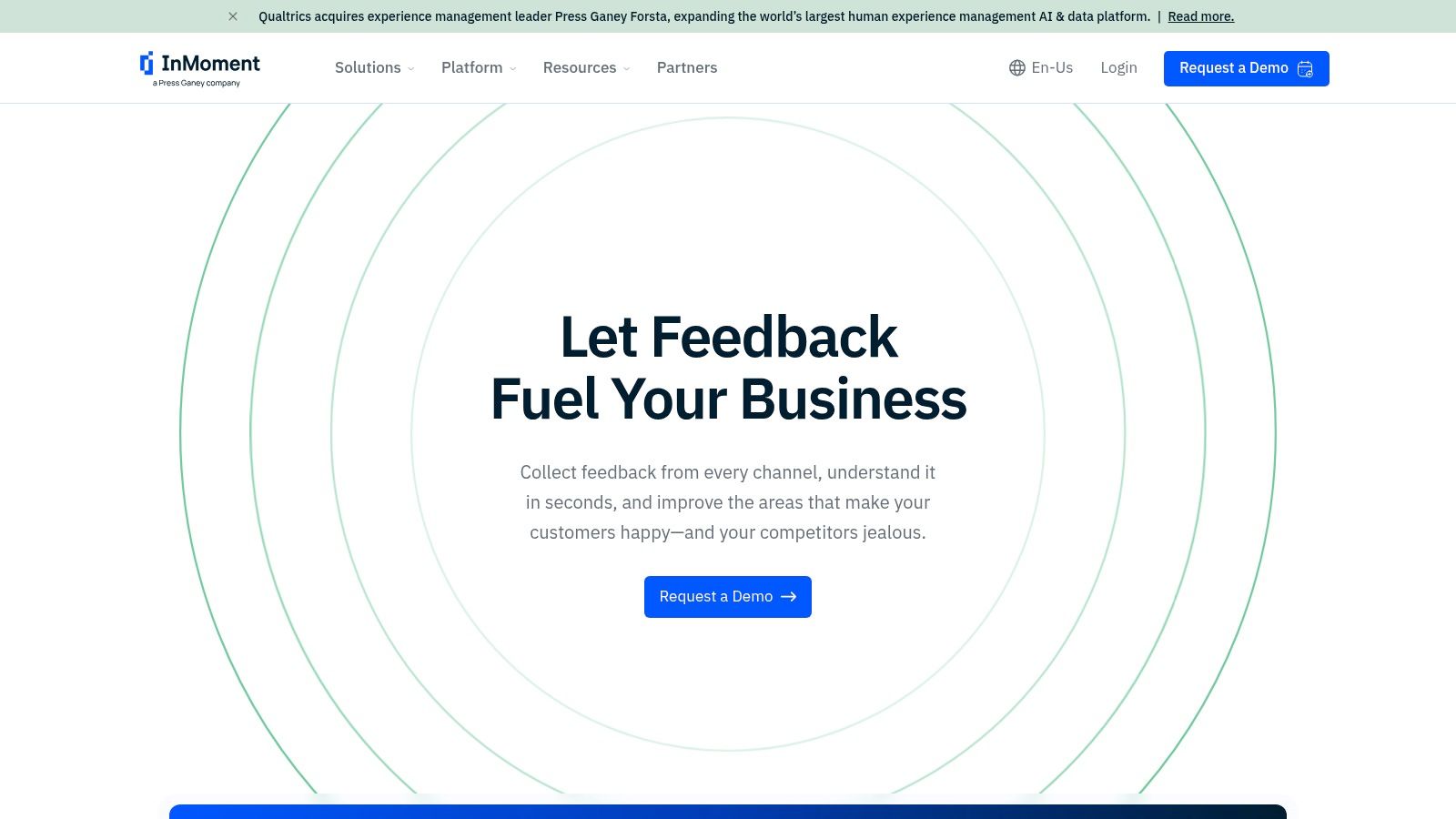
5. InMoment XI Platform
InMoment XI combines surveys, reviews, social data, and other unstructured feedback with AI-powered text analytics and predictive models. The platform also supports reputation and review workflows, giving CX teams a way to bring unsolicited public feedback into a broader experience view.
That mix is useful for organizations that don't want their VoC program to depend entirely on survey participation. Surveys provide structured measures, while reviews and social comments show what customers choose to discuss without being prompted. InMoment can analyze those sources, identify themes and drivers, and route findings into closed-loop action.
The platform is more consultative than lightweight. Pricing isn't publicly listed, and enterprise onboarding is typical. Teams already using marketing or social suites should also check for feature overlap before buying. A second platform may duplicate review monitoring, sentiment analysis, or reputation workflows without improving the decisions product and service leaders make.
InMoment makes sense when a dedicated CX function needs to combine solicited and unsolicited feedback and has the resources to govern the system. It is less suitable for a product team that wants to connect support themes directly to feature usage, revenue, and engineering delivery.
A practical evaluation should ask whether InMoment can ingest the sources your team uses, not just the channels shown in a demo. Confirm who owns taxonomy changes, how analysts validate themes, and how insights reach the systems where work is assigned.
Best fit: Enterprise CX teams combining surveys, reviews, social feedback, and operational action.
Main limitation: Its broad feature set and onboarding model may overlap with existing tools and create unnecessary administration.
Visit InMoment XI Platform if unstructured experience data and reputation management are both priorities.
6. Sprinklr Insights
Sprinklr Insights is built for organizations that need broad digital and social listening. It analyzes signals across 30+ digital and social channels and 1M+ sites, with topic, sentiment, and emotion analysis in 100+ languages. Those figures come from Sprinklr's product description, and they indicate the platform's intended scale, not a reason for every SaaS team to buy it.
The platform is strongest when public conversation is a major part of the customer picture. Brand, marketing, care, and product teams can use shared intelligence to identify emerging issues, monitor sentiment, and connect insights to action plans. Conversational analytics extends the scope into contact-center interactions, while anomaly detection helps teams find changes that may warrant investigation.
Its limitation is focus. Sprinklr is less centered on structured survey programs than classic VoC suites, and it can be a poor match when the valuable feedback lives mainly in private sources such as support tickets, sales calls, and account reviews. Enterprise pricing, data governance, and implementation also require planning.
For SaaS, the question is whether public conversation changes product decisions. If customers rarely discuss your product on social channels but regularly explain problems to support and sales, a revenue-linked feedback tool will probably produce more useful prioritization. If reputation, competitive listening, multilingual coverage, and customer care all share one operating model, Sprinklr becomes more defensible.
Best fit: Large brands with substantial social, digital, media, and contact-center data.
Main limitation: It may be too broad for private, product-led feedback programs.
Sprinklr Insights is a listening and action platform first. Treat it as a product feedback tool only if its public and conversational coverage matches how your customers communicate.
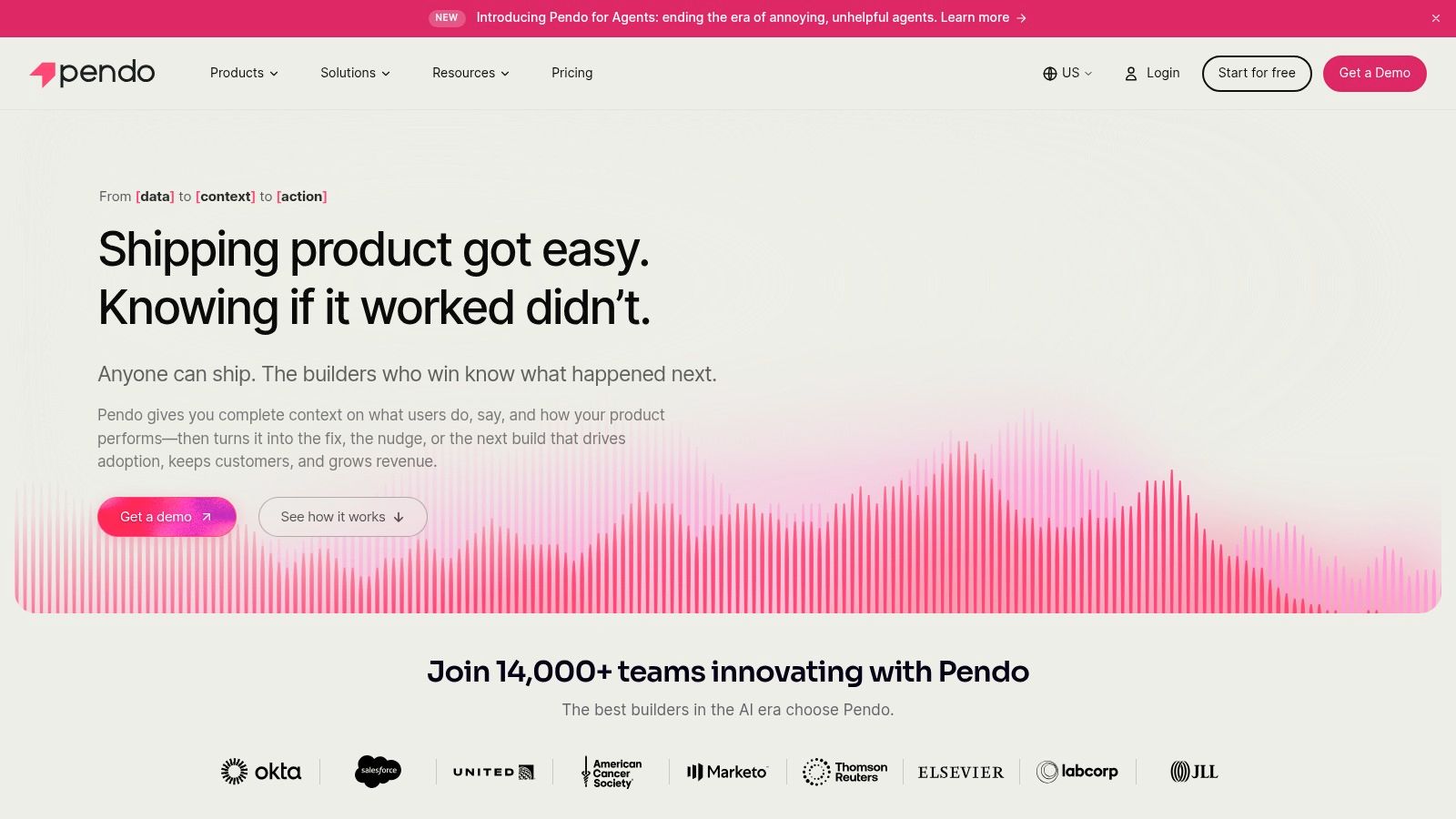
7. Pendo
Pendo is a strong fit for product-led teams that want to collect feedback inside the application and connect it to usage behavior. Its product experience capabilities include in-app surveys, NPS, CSAT, product-market-fit and lightweight UX research, alongside guides, walkthroughs, and contextual targeting.
The key advantage is proximity. A prompt can appear after a customer uses a feature, encounters a workflow, or reaches a specific point in the product. Product managers can then compare feedback with behavioral analytics instead of treating a response as an isolated opinion. That connection is more useful than a generic quarterly survey when the decision concerns onboarding, feature adoption, or workflow friction.
Pendo's feedback model has changed over time, and teams should confirm the current packaging before procurement. The full survey capability requires the Sentiment add-on, and some features are paid separately. Pendo also isn't a replacement for contact-center VoC, speech analytics, or broad social listening.
In-product feedback is valuable because it captures context, but context doesn't remove response bias. Customers who answer still may not represent customers who never engage with the prompt.
Pendo works best when the product team owns both instrumentation and feedback design. It can help test a hypothesis quickly, but it won't automatically explain why silent accounts reduce usage or fail to renew unless behavioral and commercial data are analyzed alongside the responses.
Best fit: Product-led SaaS teams running in-app feedback loops tied to usage.
Main limitation: It is not a full enterprise VoC suite, and the broader survey capability requires additional packaging.
See Pendo when your main questions are about product behavior, adoption, and contextual user experience.
8. Sprig
Sprig is designed for product and research teams that run continuous studies inside digital products. Its AI workflow supports study design, fielding, and synthesis. Teams can use templates for product-market fit, journeys, concepts, and pricing, then distribute research through panels, email, or in-product prompts.
The product is particularly useful when the team has a clear research question. A product manager can test a new workflow with contextual prompts, combine responses with session replays, and use AI analysis to group open text into themes. That shortens the path from study launch to an initial interpretation, especially for teams that don't have a large research function.
Sprig's trade-off is scope. It isn't a contact-center platform, and it doesn't replace speech analytics or a system that continuously ingests every support conversation. Its pricing is sales-led and not published, so teams need to clarify study limits, audience coverage, integrations, and analysis access early.
The quality of the result still depends on study design. Fast synthesis can make weak questions look more authoritative than they are. Product teams should validate important findings against usage data, support themes, account context, and renewal behavior before changing the roadmap.
Best fit: Product-led teams running frequent in-product research and experience studies.
Main limitation: It's a research platform, not a full operational VoC system.
Sprig is a good choice when you need to learn why users struggle at a particular product moment. It's a weaker choice when your primary data sits in service conversations and CRM records.
9. GetFeedback
GetFeedback, delivered through SurveyMonkey Enterprise, is a practical option for teams whose customer data already lives in Salesforce. It can trigger surveys from Service Cloud, send NPS, CSAT, and CES results back into CRM records, and support workflows based on the response.
The Salesforce connection is the main reason to consider it. Customer success and support teams can see feedback in account context instead of exporting survey results into a separate spreadsheet. Website and in-app surveys, targeting, open-text sentiment analysis, onboarding resources, and integrations support a familiar feedback program without requiring a large analytics deployment.
GetFeedback is less suited to unsolicited listening at scale. It won't provide the same social coverage as Sprinklr or the same contact-center depth as Medallia and Verint. Teams should also understand how delivery through SurveyMonkey Enterprise affects procurement, packaging, integrations, and migration.
This tool works when the program centers on structured surveys and CRM action. It becomes less useful when product leaders need to mine sales calls, support conversations, usage data, and engineering history for revenue-linked priorities. In that situation, Salesforce context helps, but it doesn't replace cross-source product intelligence.
Best fit: Salesforce-centered support, success, and CX teams running NPS or CSAT workflows.
Main limitation: It focuses more on solicited feedback and CRM action than on broad unsolicited listening.
Choose GetFeedback when fast CRM-linked survey workflows matter more than deep product intelligence.
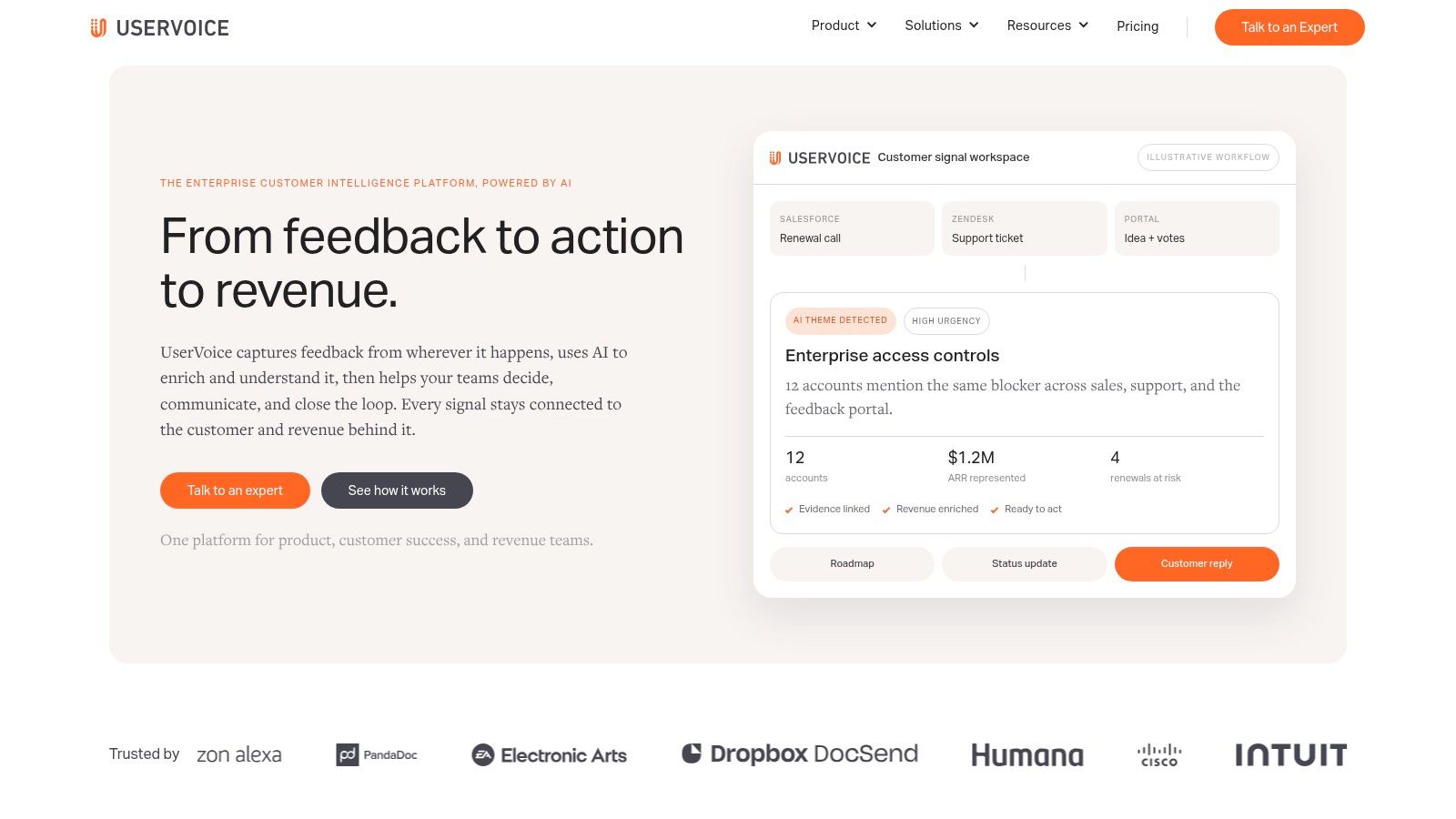
10. UserVoice
A product manager reviewing a strategic account's request needs more than a vote count. UserVoice helps B2B SaaS teams centralize public, customer-success-submitted, and internally captured feature requests, then connect them to account context from Salesforce or Gainsight. Links to Jira and Azure DevOps keep prioritization connected to delivery work.
Its strongest use case is revenue-aware prioritization. Teams can assess which accounts, revenue tiers, or commercial opportunities relate to each request instead of treating every vote as equivalent. That distinction matters in enterprise SaaS, where one strategic account may justify different action from a popular request among lower-value users.
UserVoice is a product feedback system, not a full cross-channel VoC suite. It lacks native contact-center speech analytics, so teams need another system to examine calls, tickets, or social conversations in depth. Pricing is opaque and typically enterprise-oriented, with published UserVoice pricing benchmarks placing annual contracts at approximately **10.8K to **16K or more per year depending on volume and integrations. Request a quote based on your account and integration scope.
A feature-request system can improve prioritization, but it shouldn't become the only representation of customer need.
UserVoice works well alongside broader listening and product-intelligence tools. It is a weaker fit when the primary task is finding unprompted themes before customers submit requests.
Best fit: B2B product and customer-success teams managing enterprise feature requests with account context.
Main limitation: It organizes known requests effectively but does not replace cross-channel conversation and behavior analysis.
Visit UserVoice when your roadmap process needs structured requests, revenue context, and links to engineering workflows.
Top 10 Voice of Customer Tools Comparison
| Solution | ✨ Key differentiator | 👥 Best for | 💰 Pricing / Value | ★ UX / Accuracy |
|---|---|---|---|---|
| 🏆 SigOS | ✨ Autonomous, revenue‑tagged issue prioritization; 4‑layer intelligence | 👥 SaaS PMs, Growth, CS, CTOs | 💰 Start Free Analysis; custom tiers; price‑tagged ROI (e.g., $47K/mo examples) | ★★★★★ (87% churn corr.; sub‑minute analysis) |
| Qualtrics XM (Text iQ & XM Discover) | ✨ Mature text/topic modeling + omnichannel conversational analytics | 👥 Large enterprises, CX programs | 💰 Quote-based enterprise pricing | ★★★★☆ (robust analytics & governance) |
| Medallia Experience Cloud | ✨ Native speech & acoustic emotion analysis; contact‑center ops | 👥 Contact centers, enterprise CX teams | 💰 Quote-based; enterprise onboarding | ★★★★☆ (deep contact‑center insights) |
| Verint Experience Management | ✨ Digital struggle detection + FedRAMP/StateRAMP options | 👥 Contact centers, public sector, CX ops | 💰 Quote/usage-based; enterprise | ★★★★☆ (real‑time actioning & compliance) |
| InMoment XI Platform | ✨ AI text analytics + reputation/review integration | 👥 Brands, CX & Ops teams | 💰 Quote-based; enterprise onboarding typical | ★★★★☆ (strong unstructured analytics) |
| Sprinklr Insights (Unified‑CXM) | ✨ Massive social/digital listening (100+ langs, 1M+ sites) | 👥 Global brands, Marketing, Care, Product | 💰 Enterprise pricing; high scale value | ★★★★☆ (best‑in‑class breadth) |
| Pendo (Guides + Sentiment + Feedback) | ✨ In‑app guides + native linkage of usage → feedback | 👥 Product‑led SaaS teams, PMs | 💰 Mid‑market to enterprise; Sentiment add‑on paid | ★★★★☆ (fast in‑product VoC) |
| Sprig | ✨ AI agents for study design, fielding & rapid synthesis | 👥 Product research teams, PLG researchers | 💰 Quote-based; research‑focused ROI | ★★★★☆ (very fast time‑to‑insight) |
| GetFeedback (via SurveyMonkey Enterprise) | ✨ Deep Salesforce triggers & CRM‑centric survey workflows | 👥 Salesforce‑centric Support & CS teams | 💰 Via SurveyMonkey Enterprise; trial available | ★★★☆☆ (strong CRM integration) |
| UserVoice | ✨ Revenue‑aware feedback & ARR‑enriched prioritization | 👥 B2B SaaS PMs, CSMs, Product ops | 💰 Enterprise; reported low‑to‑mid five‑figures/year typical | ★★★☆☆ (clear roadmap focus) |
Turning Your Shortlist Into a Two-Week Trial Plan
A shortlist should reflect the decision your team needs to improve. If the problem is contact-center quality, compare Medallia, Verint, Qualtrics, and InMoment on speech coverage, governance, alerting, and closed-loop workflows. If the problem is product research, compare Pendo and Sprig on contextual targeting, study speed, behavioral linkage, and how easily product managers can act on findings. If the problem is revenue-backed roadmap prioritization, compare SigOS and UserVoice on source coverage, account context, delivery integration, and commercial impact.
Keep the first trial narrow. Select two or three finalists and give each the same month of support tickets, sales call notes, product-usage data, churn information, and shipped-work history where available. Don't let each vendor choose a different sample or define success using a different output. The comparison should show which platform finds the issues your team already knows matter and which one uncovers useful patterns that the existing process missed.
Use a small set of concrete questions:
- Signal quality: Does the tool distinguish a repeated wording difference from a true recurring customer problem?
- Representativeness: Are themes concentrated among vocal users, or do behavioral signals show the same issue among silent accounts?
- Commercial relevance: Can the platform connect a theme to churn, expansion, account value, or adoption without manual spreadsheet work?
- Workflow fit: Can the team route an insight to Jira, Linear, Salesforce, Zendesk, or the system where ownership already exists?
- Decision speed: Does the output reduce analysis and prioritization work, or create another dashboard someone must maintain?
Response volume alone isn't a reliable success measure. Typical SaaS survey response rates are reported around 8% to 20%, while in-app surveys commonly reach approximately 20% to 30%, according to SurveySparrow's survey response benchmarks. One benchmark reports a 27.52% average for in-app surveys and a 5.41% median for Intercom-delivered surveys, but those figures should guide channel testing, not replace sample-quality checks.
The silent-customer problem makes this trial more important. Qualtrics reports that consumers are 7 percentage points less likely to comment after a good experience and 8 points less likely to say anything after a bad experience than in 2021, with fewer than one-third providing feedback directly to a company. That finding appears in Qualtrics' 2025 consumer experience trends announcement. A tool that only ranks submitted requests may reinforce sampling bias.
Set an owner before the trial begins. Product should validate roadmap implications, customer success should check account context, support should verify operational patterns, and data or revenue teams should test the relationship with churn and expansion. Ask each finalist to produce the same decision brief, including the top issues, affected segments, evidence sources, recommended action, confidence level, and unresolved questions.
Only request final quotes after this comparison. Pricing discussions are more useful when you know which sources you need, how many teams will use the system, what integrations are mandatory, and which outputs justify the investment. A lower-cost tool that produces a survey dashboard may be expensive in analyst time if your real problem is cross-source prioritization. A larger platform may be justified for enterprise governance, but not if your team only needs a faster way to turn product conversations into shipped work.
The right voice of customer tool is the one your team can operate every week and connect to real decisions. Collection is the beginning. The value appears when customer evidence changes what gets fixed, who owns it, and how the company measures the result.
SigOS connects support tickets, chats, sales calls, usage data, revenue, and shipping history to identify customer issues linked to churn and expansion. If your team needs to prioritize product work by measurable business impact instead of feedback volume, visit SigOS and run a first analysis.


Ready to find your hidden revenue leaks?
Start analyzing your customer feedback and discover insights that drive revenue.
Start Free Trial →