What Is Voice of Customer? Find Signal in Noise
Discover what is voice of customer. Learn its true meaning and how to analyze VoC data to prioritize features, reduce churn, and drive revenue.

Most advice on Voice of Customer starts in the wrong place. It tells teams to collect more feedback, send more surveys, transcribe more calls, and open more channels.
That sounds disciplined. In practice, it often creates a larger pile of opinions with no better way to decide what matters.
If you're asking what is Voice of Customer, the useful answer isn't "a process for gathering feedback." That's too shallow to help a product team ship better decisions. A real VoC program should tell you which complaints map to churn risk, which requests point to expansion, and which loud themes are just noise. If it can't do that, it's reporting activity, not improving revenue.
Your VoC Program Is Probably a Waste of Time
A lot of teams confuse volume with insight. They build Slack channels for customer quotes, export support tags into spreadsheets, run NPS surveys, and call it a strategy. Then product managers spend hours debating whether ten requests for one feature outweigh three angry escalations about something else.
That workflow feels customer-centric. It isn't. It's a popularity contest with better branding.
The issue is more significant than commonly recognized. A 2025 Forrester Wave study on Product Intelligence found that 72% of SaaS product managers waste over 20 hours weekly analyzing feedback that doesn't correlate with churn or expansion (Forrester Wave study summary). That's what happens when a VoC program amplifies noise instead of filtering it.
More feedback usually creates more confusion
The loudest customers rarely represent the most important signal. Enterprise accounts may submit fewer tickets but carry more revenue risk. New users may generate lots of onboarding noise that matters less than a subtle drop in adoption among established accounts. A support queue doesn't tell you that by itself.
Manual review makes this worse because humans overweight what is recent, emotional, or repeated. Teams end up shipping the feature request that appears in every call note while missing the bug that blocks renewal conversations.
Practical rule: If your VoC process can't separate high-volume feedback from high-impact feedback, it will push your roadmap off course.
What a useful VoC program actually does
A modern program doesn't ask, "What are customers saying?" It asks harder questions:
- Which themes correlate with churn risk
- Which issues affect expansion conversations
- Which customer segments are experiencing the problem
- Which requests are loud but low value
- Which weak signals deserve action before customers complain explicitly
That shift matters. Once product, support, success, and growth teams start weighting feedback by business impact, VoC stops being a reporting exercise. It becomes a decision system.
What Voice of Customer Actually Means
Voice of Customer, or VoC, is best understood as a structured system for turning customer input into product and business decisions. The term was formalized in a 1993 MIT Marketing Science paper by Abbie Griffin and John R. Hauser, which established VoC as a decision system combining quantitative and qualitative inputs into a common language for product development (historical VoC overview).
That original idea still holds up. The difference is that modern teams need a broader input model than surveys and interviews alone.
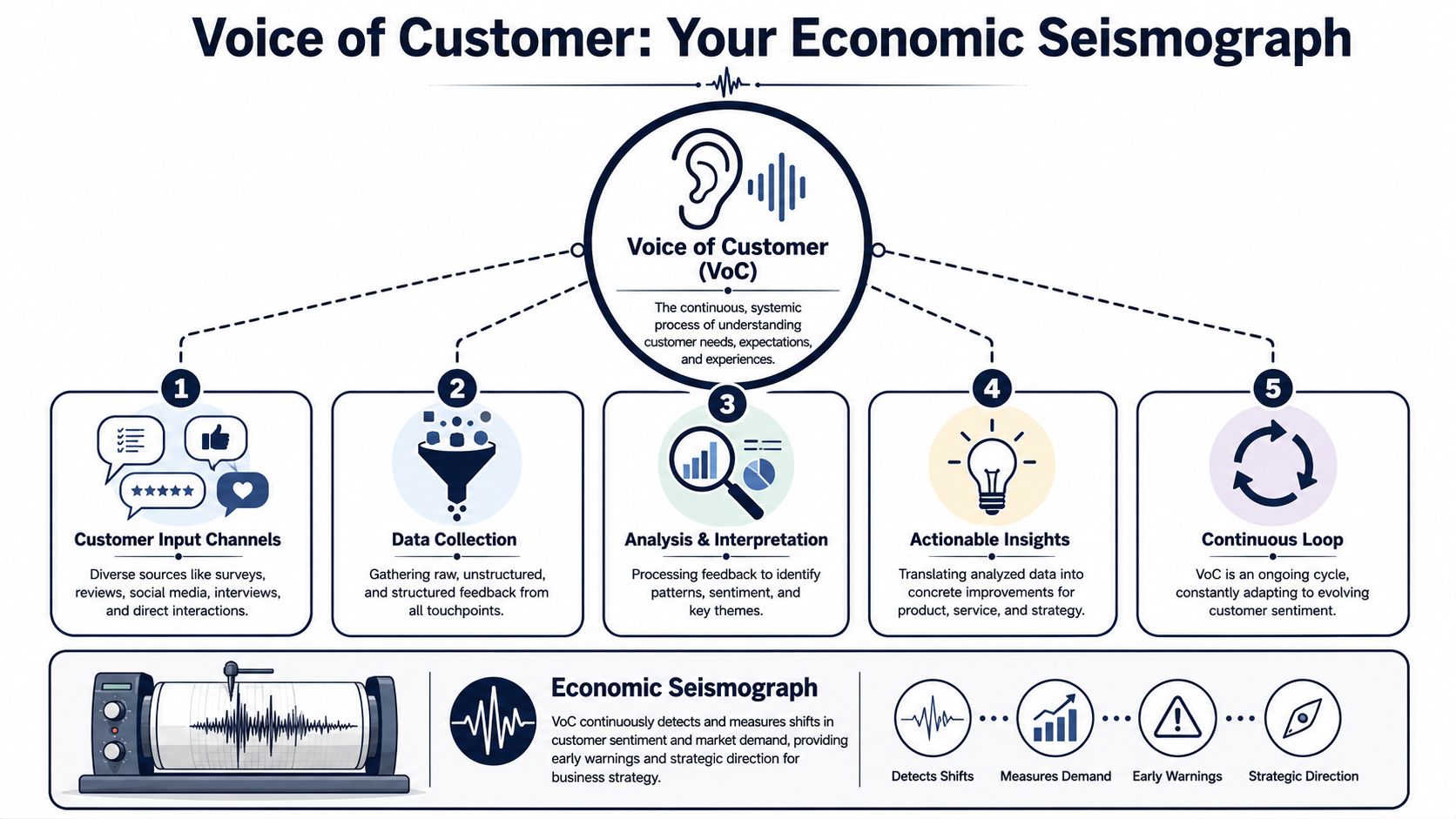
Think of VoC as an economic seismograph
A suggestion box records noise after the fact. An economic seismograph detects movement early.
That is the most useful mental model for VoC. It continuously reads changes in what customers say, what they experience, and what they do inside the product. The point isn't to admire the data. The point is to catch meaningful movement before it turns into churn, stalled deals, or wasted development cycles.
The three streams that matter
A practical VoC system combines multiple inputs because no single source is reliable enough on its own.
- Direct feedback includes surveys, interviews, call transcripts, and open-text responses. Customers use these channels to express what they think they want.
- Indirect feedback includes reviews, community posts, sales notes, and support conversations. Sharper language often emerges from these sources because the customer isn't answering your structured question.
- Behavioral data includes usage patterns, engagement drops, failed actions, and feature adoption signals. This data reveals what customers do, not just what they say.
When teams only collect direct feedback, they miss the silent majority. When they only watch behavioral analytics, they lose context. When they only mine support tickets, they mistake service pain for the whole product story.
Good VoC programs don't choose between qualitative and quantitative inputs. They force them to validate each other.
Why the definition matters in practice
The biggest misunderstanding in "what is voice of customer" content is treating VoC as a research project. It isn't. It's an operating layer across product, support, success, and revenue teams.
If you're looking at tooling examples and market framing, this overview of Yellow.ai named strong performer by Gartner is useful because it shows how VoC increasingly sits inside larger customer interaction systems rather than as a standalone survey function.
A strong VoC program creates one shared view of customer friction. Without that, every team builds its own narrative. Support sees ticket volume. Sales sees deal objections. Product sees requests. Success sees renewal risk. None of those views is wrong. They're just incomplete.
Why VoC Is a Revenue Engine Not a Cost Center
Plenty of VoC programs consume time, budget, and attention without changing a single roadmap decision. That happens when feedback is treated as customer listening, not revenue intelligence.
The useful framing is tighter. VoC helps teams identify which customer problems put retention, expansion, and new revenue at risk, then assign product effort where the financial return is highest.
A high-volume complaint is not automatically the highest-value problem. Ten small accounts asking for the same convenience feature can generate more noise than one enterprise customer hitting a workflow blocker that threatens a seven-figure renewal. Revenue-focused VoC exists to separate those two cases.
Revenue impact shows up in three places
First, VoC protects revenue already on the books. When repeated friction appears in churn interviews, support logs, and usage drop-offs for a valuable segment, the team has a clear signal that a fix may reduce renewal risk.
Second, VoC improves expansion decisions. Some requests are early indicators of willingness to buy more. Others are expensive distractions that sound important but rarely show up in accounts with strong adoption or expansion potential.
Third, VoC improves capital allocation inside the product org. Engineering capacity is finite. If a team cannot connect customer pain to account value, retention risk, deal influence, or adoption lift, prioritization turns into internal lobbying.
For teams trying to make that link more concrete, this guide on analyzing customer feedback is useful because it shows how raw inputs become patterns a business can act on. For tooling context, Samuel Woods on sentiment analysis offers a practical overview of how teams process large volumes of feedback.
What changes when teams quantify revenue impact
Roadmap conversations become more disciplined.
Instead of saying, "customers mention this a lot," teams start asking better questions:
- Which accounts mention this, and what is their revenue profile?
- Does this issue show up before churn, downgrade, or stalled expansion?
- Is the complaint widespread, or concentrated in a segment we need to retain?
- Does behavior confirm the pain, or are we reacting to loud but low-impact feedback?
That shift matters. Volume alone is a weak prioritization model. The stronger model combines what customers say, what they do, and what those accounts are worth.
AI analysis earns its place. Manual tagging can summarize themes, but it rarely catches the difference between frequent low-stakes annoyance and infrequent high-stakes friction. Behavioral analysis tied to account value makes that distinction visible. A complaint mentioned by 3 percent of customers may deserve urgent action if those customers drive a meaningful share of revenue.
Feedback starts shaping growth when teams connect it to retention risk, expansion potential, and account value.
What fails in practice
A few patterns keep producing low-value VoC programs:
- Survey-only VoC: It skews toward customers willing to respond and misses silent churn risk.
- Ticket-count prioritization: It favors operational volume over commercial importance.
- Feature request ranking by frequency: It overweights popular asks from low-value segments.
- Monthly reporting without decision rights: It creates visibility, but no one changes roadmap, messaging, or service design.
VoC earns budget when it changes where the company invests. If it stops at collection and reporting, finance will treat it like overhead, and they will have a point.
How to Collect High-Quality VoC Data
Collection is where teams often spend too much time and too little thought. They add more channels without deciding what each channel is good for.
The fix isn't to collect less. It's to collect deliberately. Every source has bias. The job is to combine sources whose biases cancel each other out.
Start with three buckets
Use a portfolio approach.
Direct sources give you explicit language. These include NPS comments, CSAT responses, user interviews, churn interviews, onboarding surveys, and research calls.
Indirect sources capture naturally occurring friction. Think support tickets, chat transcripts, community threads, call recordings, demo notes, lost-deal notes, and public reviews.
Behavioral sources show actual usage. Product analytics, session trends, feature engagement, activation flow drop-offs, and account-level adoption patterns belong here.
A practical collection stack usually mixes all three. If one bucket dominates, your picture gets distorted.
VoC data source comparison
| Source | Type | Pros | Cons |
|---|---|---|---|
| Surveys and NPS comments | Direct | Scalable, structured, good for trend spotting | Response bias, shallow context if questions are weak |
| User interviews | Direct | Rich detail, nuance, strong for motivation and unmet needs | Time-intensive, small sample, moderator bias |
| Support tickets and chat logs | Indirect | Continuous stream of real problems, useful for operational pain | Overrepresents active complainers and urgent issues |
| Sales call notes and loss reasons | Indirect | Strong commercial context, reveals buying friction | Notes quality varies, can reflect seller interpretation |
| Reviews and community posts | Indirect | Unprompted language, useful for reputation and expectation gaps | Skewed toward extreme sentiment |
| Product usage analytics | Behavioral | Shows actual behavior, helps validate whether complaints affect adoption | Lacks the "why" without qualitative context |
| CRM and account history | Behavioral | Helps tie feedback to segment, contract stage, and renewal context | Often fragmented across teams |
Match the source to the question
Teams get into trouble when they expect one channel to answer every question.
- Use interviews when you need to understand why users struggle.
- Use support and chat data when you need recurring friction at scale.
- Use behavioral analytics when you need to confirm whether a stated problem changes product use.
- Use CRM context when you need to understand commercial importance.
- Use public reviews when you want language customers use without your prompting.
If you're evaluating tooling for text-heavy inputs, Samuel Woods has a practical roundup on sentiment analysis tools that helps frame what to look for in categorization and interpretation layers.
Collection discipline matters more than volume
High-quality VoC collection depends on operating rules, not just software.
- Define taxonomy early: Decide how you'll classify bugs, feature requests, onboarding issues, pricing friction, support experience, and success blockers before the backlog gets messy.
- Preserve account context: A complaint without segment, plan, ARR context, or lifecycle stage is much harder to prioritize well.
- Avoid over-cleaning language: Raw phrasing often contains the emotional signal that structured forms strip out.
- Review channel blind spots: If support owns most intake, you'll undercount friction that surfaces in sales or success.
- Build a repeatable intake path: This guide on how to collect feedback from customers is useful for turning scattered collection into a consistent operating habit.
Most weak VoC programs don't fail because they lacked data. They fail because they collected data with no model for how the sources complement each other.
From Raw Feedback to Revenue-Driven Priorities
Most VoC programs produce a well-organized pile of evidence and very little change in revenue outcomes.
The failure point is rarely collection. It is prioritization. Teams can summarize themes, count mentions, and still miss the issue that threatens renewals in a high-value segment. A hundred low-stakes complaints can drown out five signals from accounts that fund the business.
That is the shift that matters in this section. Stop asking which theme is loudest. Start asking which theme changes retention, expansion, win rate, or time to value.
Manual tagging breaks the moment revenue context matters
Manual review can work in an early-stage product with limited volume and a narrow customer base. A PM or researcher reads tickets, tags patterns, and brings a summary into planning. That process builds intuition.
It also hides expensive mistakes.
A spreadsheet treats every comment as one row. Revenue does not work that way. Friction reported by a trial user should not carry the same weight as the same friction reported by three enterprise accounts in renewal conversations. Manual analysis also slows down once feedback is spread across support, sales calls, CRM notes, and usage logs. By the time a team agrees on the pattern, the commercial impact may already be visible in stalled adoption or churn risk.
Manual systems usually fail in four predictable ways:
- They flatten account value: A low-intent request and a blocker from a strategic account can end up in the same bucket.
- They lose timing: Review happens after the pattern has spread.
- They reflect reviewer bias: Different operators tag the same complaint in different ways.
- They disconnect language from behavior: The team records what customers said, but not what those customers did next.
The real job is signal detection
Revenue-driven VoC analysis works more like risk detection than inbox triage. The goal is to find combinations of theme, sentiment, account type, and product behavior that point to money at risk or money available.
A recurring complaint matters more when it appears in accounts with open renewals, active expansion potential, or a sharp decline in feature usage after the complaint surfaced. A niche request matters more when it comes from customers with outsized contract value. High volume is useful. High value is better.
Conversation data is often the missing layer because it contains objections, hesitations, and workarounds long before they appear in churn reports. If you need a practical primer on how teams structure that signal, Typist has a thoughtful conversation analytics guide.
What a revenue-driven workflow looks like
Useful VoC analysis does not end at theme detection. It turns feedback into ranked commercial decisions.
- Ingest raw inputs from support tickets, sales calls, interviews, CRM notes, and product analytics.
- Cluster similar language so “confusing setup,” “hard to implement,” and “onboarding took too long” land in the same pattern.
- Map themes to accounts and segments so the team can see where the issue is concentrated.
- Check behavioral change such as lower activation, reduced usage, slower expansion, or rising support load after the feedback appears.
- Add commercial weight using plan tier, ARR, renewal timing, deal stage, or expansion potential.
- Rank actions by dollar impact so roadmap, onboarding, support, and pricing decisions reflect business value, not comment volume.
AI earns its place not by replacing product judgment, but by handling the pattern-matching work humans do poorly at scale. Models can classify sentiment, group adjacent complaints, detect changes across channels, and surface patterns tied to churn or expansion risk much faster than a manual review cycle.
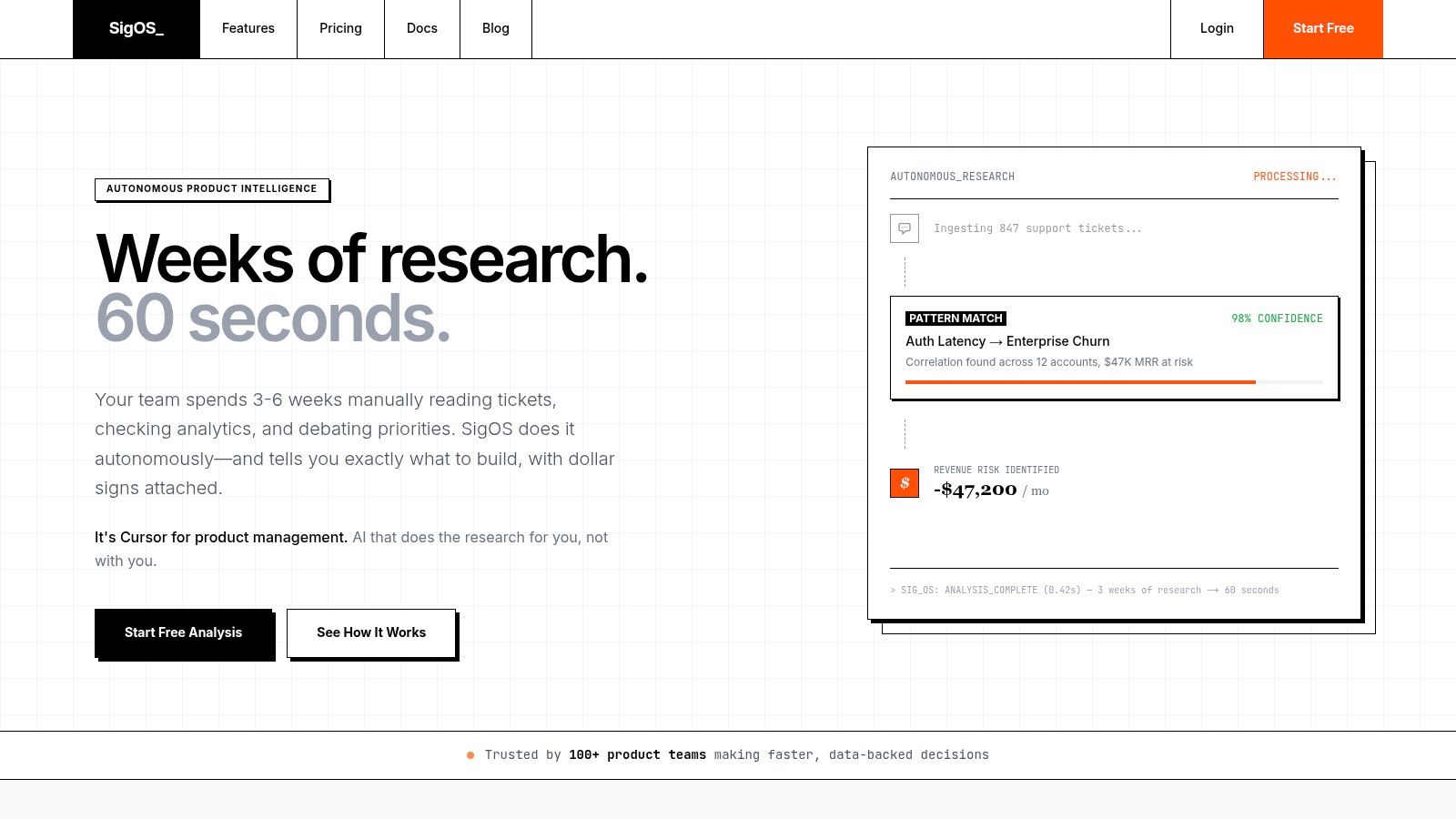
Tools such as SigOS can ingest support tickets, chat transcripts, sales calls, and usage data to highlight which issues correlate with churn, expansion, and revenue impact. The point is not the vendor. The point is the model. Feedback becomes an input to financial prioritization.
Teams that want a stronger foundation before automating should tighten how they code and interpret text first. This explainer on qualitative data analysis methods for customer feedback is a useful starting point.
Do not ask whether a request is common. Ask whether it changes retention, expansion, or product adoption in the accounts that matter most.
The trade-off leaders need to manage
AI reduces analysis time and increases consistency. It can also create false confidence if teams accept every cluster or sentiment label at face value.
The right split is simple. Let systems find patterns across messy, multi-channel inputs. Let product, success, and commercial leaders decide whether the right response is a roadmap change, a service fix, a pricing adjustment, or targeted outreach. Good VoC programs do not remove judgment. They move judgment to the stage where it creates value.
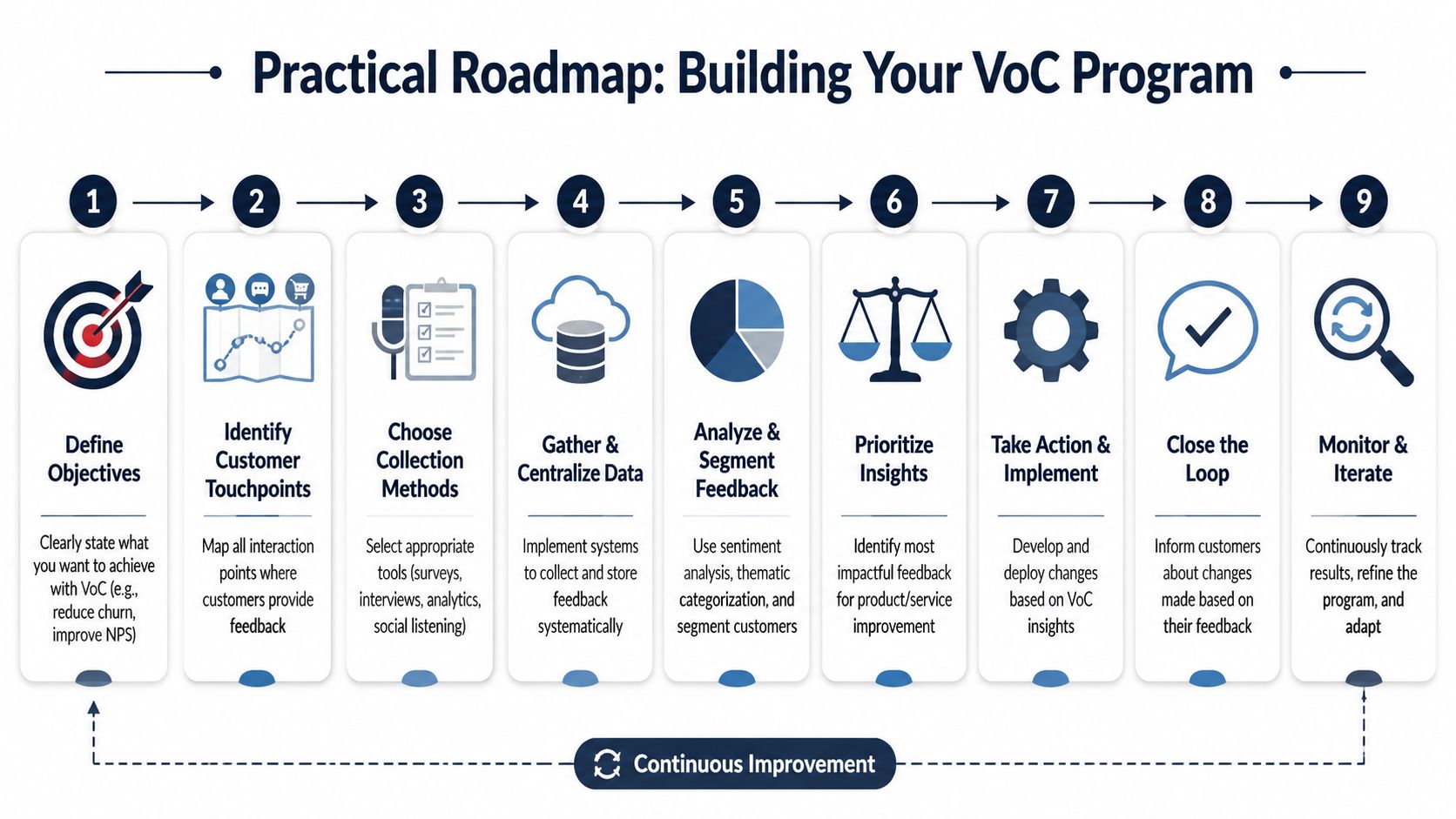
Building Your VoC Program A Practical Roadmap
Build the program around a decision cycle. Start with one business question, connect the right evidence, route validated issues into execution, and review whether those actions changed revenue outcomes.
That sequence matters because VoC fails in predictable ways. Teams collect comments from every channel, create a dashboard, and stop there. Nothing gets tied to retention, expansion, onboarding conversion, or support cost, so the program produces reporting instead of decisions.
Start with one hard business question
Begin with a narrow objective the business already values.
Good starting points include churn in a specific segment, stalled onboarding for trial-to-paid accounts, or product friction that keeps showing up in expansion deals. “Listen to customers better” is too broad to manage and too vague to measure.
Once the question is clear, identify the systems that contain evidence. That usually includes some mix of Zendesk, Intercom, Gong, Salesforce, Jira, Linear, and product analytics. The point is not to ingest everything on day one. The point is to collect enough context to explain why a problem matters commercially.
Build the data path before the dashboard
Dashboards are useful after the inputs are clean.
First, centralize direct feedback, indirect signals, and behavioral data in one analysis layer. Then standardize the metadata attached to each record, including account value, segment, lifecycle stage, renewal timing, and commercial status. Without that context, a ten-ticket complaint from low-value accounts can outrank a quieter issue that threatens a strategic renewal.
A shared issue taxonomy matters here too. Product, support, and success need to classify the same problem the same way, or every function ends up reporting a different version of reality. Assign ownership early. Support and success usually own source quality. Product usually owns prioritization. Revenue leaders should review the output when themes affect renewals, expansion, or deal risk.
Here is a useful walkthrough on the operational side of building feedback programs:
Route validated insights into execution
A VoC program starts creating value when an insight becomes work with an owner, a deadline, and account context attached.
Send validated issues into Jira or Linear. Include the affected segment, examples from customer conversations, and the revenue exposure if the issue is unresolved. Keep the threshold high. Every complaint does not deserve a ticket. Patterns that affect adoption, retention, expansion, or service cost do.
This step is where teams separate noise from signal. High-volume requests often look urgent. Low-volume issues tied to high-value accounts often matter more.
A good VoC program ends in a ticket, an owner, and a customer-facing change.
Measure whether the system changes business outcomes
Sentiment trends are not enough. The review cadence should show whether the program improves decisions and results.
Track operating measures such as time to detect a meaningful pattern, time to assign an owner, and the share of validated insights that led to a product, service, or process change. Then tie those actions to business outcomes where possible: reduced churn risk in a named segment, faster onboarding, fewer support escalations, better expansion conversion, or lower service cost for a recurring issue.
Keep the first version simple. A monthly review with product, support, success, and a revenue leader is enough for many teams. If the program cannot show which actions were taken and what commercial risk they addressed, it is still in collection mode.
Common VoC Pitfalls and How to Avoid Them
Most VoC failures are predictable.
- Listening only to the loudest customers: Fix this by weighting feedback with account context, segment importance, and observed behavior.
- Treating every request as equal: Fix this by ranking themes based on business impact, not raw frequency.
- Using one source as the truth: Fix this by combining direct feedback, indirect signals, and behavioral evidence.
- Collecting comments with no action path: Fix this by routing validated insights into product and operational workflows.
- Letting manual review become the system: Fix this by automating classification and pattern detection where possible.
- Forgetting to close the loop: Fix this by telling customers when their input led to a change, a workaround, or a clear decision.
If you remember one thing, remember this: the right answer to what is Voice of Customer is not "collect feedback." It's "build a system that identifies which customer signals deserve action because they affect revenue, retention, and growth."
If you're trying to operationalize that kind of system, SigOS is built for teams that need to connect support conversations, sales calls, and product usage to churn, expansion, and roadmap decisions.
Keep Reading
More insights from our blog

Ready to find your hidden revenue leaks?
Start analyzing your customer feedback and discover insights that drive revenue.
Start Free Trial →