What Is a Product Roadmap: A Practical Guide for SaaS Teams
Learn what is a product roadmap and how to build one that drives outcomes. Covers types, components, and best practices for aligning your SaaS product.
A product roadmap is a strategic communication tool connecting product vision to major initiatives, not a fixed list of features or a delivery schedule. ProductPlan's 2023 survey found that 54% of roadmaps focused on outputs, while only 44% communicated outcomes, which shows why the distinction matters for SaaS teams.
What is a product roadmap if it can't help people make better decisions when priorities change? Many teams answer with a timeline, a list of features, or a sequence of releases. Those descriptions aren't entirely wrong, but they miss the operating purpose. A useful roadmap gives product, engineering, sales, marketing, support, and leadership a shared explanation of why work matters, which problem deserves investment, what broad initiative addresses it, and when progress may happen.
The strongest roadmaps don't pretend uncertainty has disappeared. They make assumptions visible, connect initiatives to evidence, and leave room for new information. That shift moves a roadmap away from a fragile promise and toward an adaptive decision system.
Understanding the Core Purpose of a Product Roadmap
A common failure starts with a familiar request: “Can you add this feature to the roadmap?” The request sounds simple, but it often hides several unanswered questions. Which customer problem does the feature solve? How important is that problem compared with churn risk, activation friction, technical debt, or an expansion opportunity? What evidence supports the priority, and what would make the team change its mind?
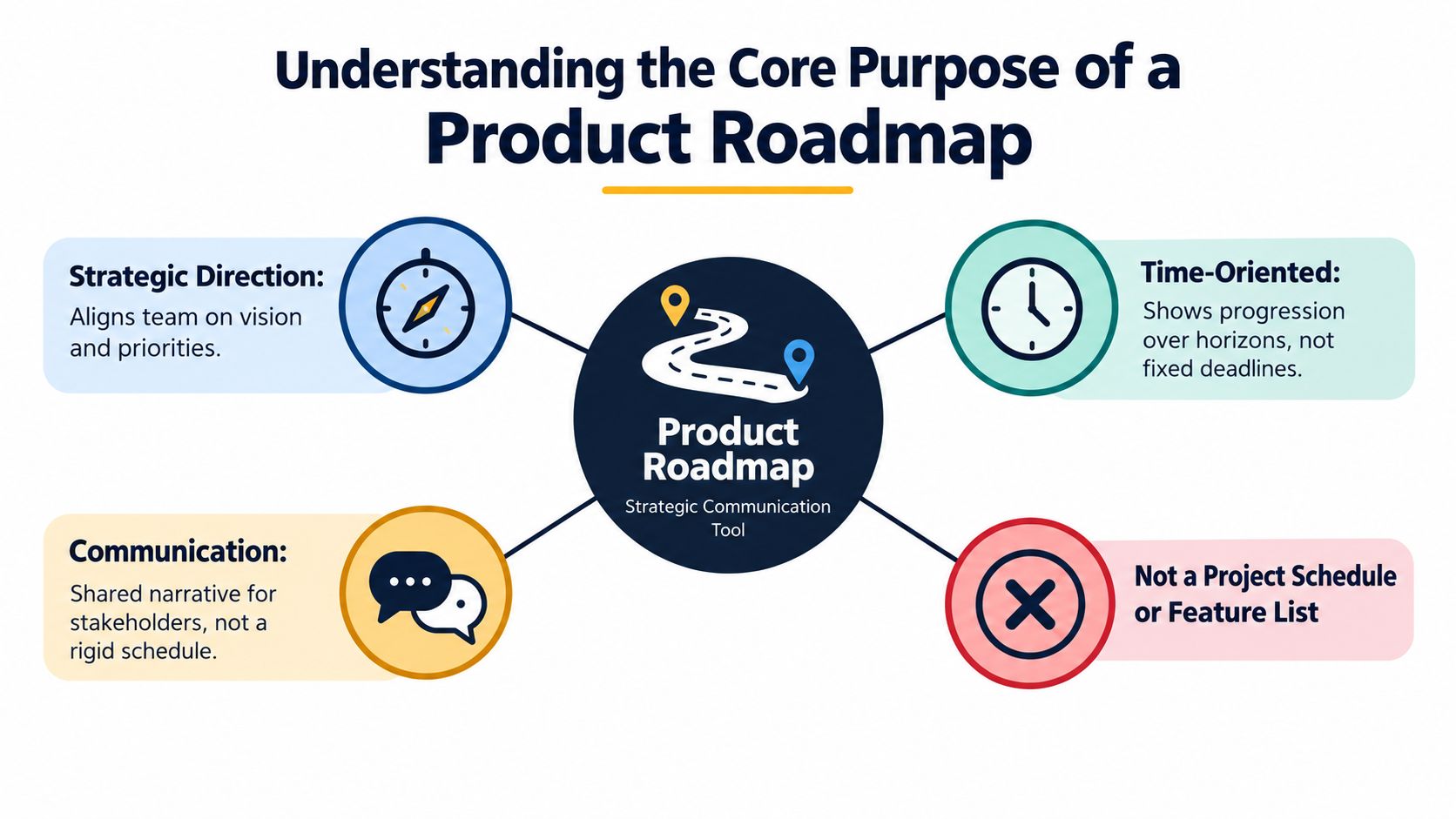
A product roadmap should make those questions easier to answer. Academic roadmapping literature describes it as a cross-functional plan spanning business strategy, engineering, and marketing, not an engineering schedule in presentation form. It offers a time-oriented view of how a product is expected to evolve while remaining flexible as market conditions, evidence, and priorities change. The research on design roadmapping traces this broader tradition from technology planning toward integrated product strategy.
A map, not turn-by-turn instructions
Think of the roadmap as a highway map rather than a turn-by-turn GPS instruction. The map shows the destination, major routes, constraints, and approximate journey windows. A delivery plan provides the detailed turns, owners, tickets, testing steps, and status updates.
That distinction matters because a feature list tells stakeholders what someone wants to build, but not why the organization should fund it. A strategic roadmap might describe an initiative as “reduce onboarding friction for new workspace administrators,” with evidence from support themes and activation behavior. The delivery plan can later contain the interface changes, API work, research tasks, and release checklist.
Practical rule: If an item can't be connected to a customer problem, business objective, or measurable outcome, it probably belongs in an idea backlog rather than on the roadmap.
Roadmaps also create a shared language across functions. Marketing needs strategic context to shape positioning, sales needs honest guidance for customer conversations, and support needs enough visibility to prepare customers without making promises the product team can't keep. Teams working on product marketing for SaaS teams can use that context to connect product direction with audience needs and market communication.
A roadmap doesn't replace product strategy. It expresses selected parts of that strategy in a form people can use to prioritize and coordinate work. Teams that want to connect direction, customer problems, and business objectives can also use the SigOS guide to product strategy as a complementary reference.
Essential Components That Build a Strategic Plan
A useful roadmap has enough structure to support decisions without pretending that every detail is known. Start with the product vision and the business objective it serves. Then translate that direction into a small set of strategic themes, such as activation, reliability, expansion, workflow depth, or platform scalability.
Build from themes and outcomes
Themes keep the roadmap readable. Instead of displaying separate cards for every small enhancement, group related work under a broader initiative. “Improve administrator onboarding” can contain guided setup, clearer permissions, import assistance, and better empty states. Stakeholders can understand the intended change without sorting through engineering terminology.
Each initiative should carry a compact set of fields:
- Target outcome: State the customer or business change the team expects to create.
- Problem and audience: Identify who experiences the problem and in what context.
- Evidence: Capture usage signals, support themes, research findings, revenue exposure, or expansion opportunities.
- Strategic connection: Show which product or company objective the work supports.
- Dependencies and risks: Record platform constraints, compliance needs, capacity limits, and work that must happen first.
- Horizon: Use a range such as now, next, or later when exact timing isn't reliable.
The timeline should communicate progression, not false certainty. A roadmap can show broad horizons, release windows, or milestones, while a delivery system such as Linear, Jira, or GitHub tracks implementation details. Guidance on building a roadmap follows this separation because it preserves the strategic view while keeping execution accountable.
Make prioritization visible
A roadmap becomes more credible when stakeholders can see why one initiative outranks another. Include capacity assumptions, technical risk, and dependencies rather than presenting the order as a product manager's personal preference. When an initiative moves, explain which evidence changed.
A launch also needs more than a product card. Positioning, enablement, support readiness, documentation, and customer communication can all affect whether delivered work creates value. Teams planning those cross-functional requirements can consult this practical guide on how to plan a product launch.
The right test is simple: can an executive understand the investment logic, can an engineer see the strategic context, and can a customer-facing team describe the expected value without turning an uncertain plan into a promise?
Output-Based Versus Outcome-Based Roadmapping
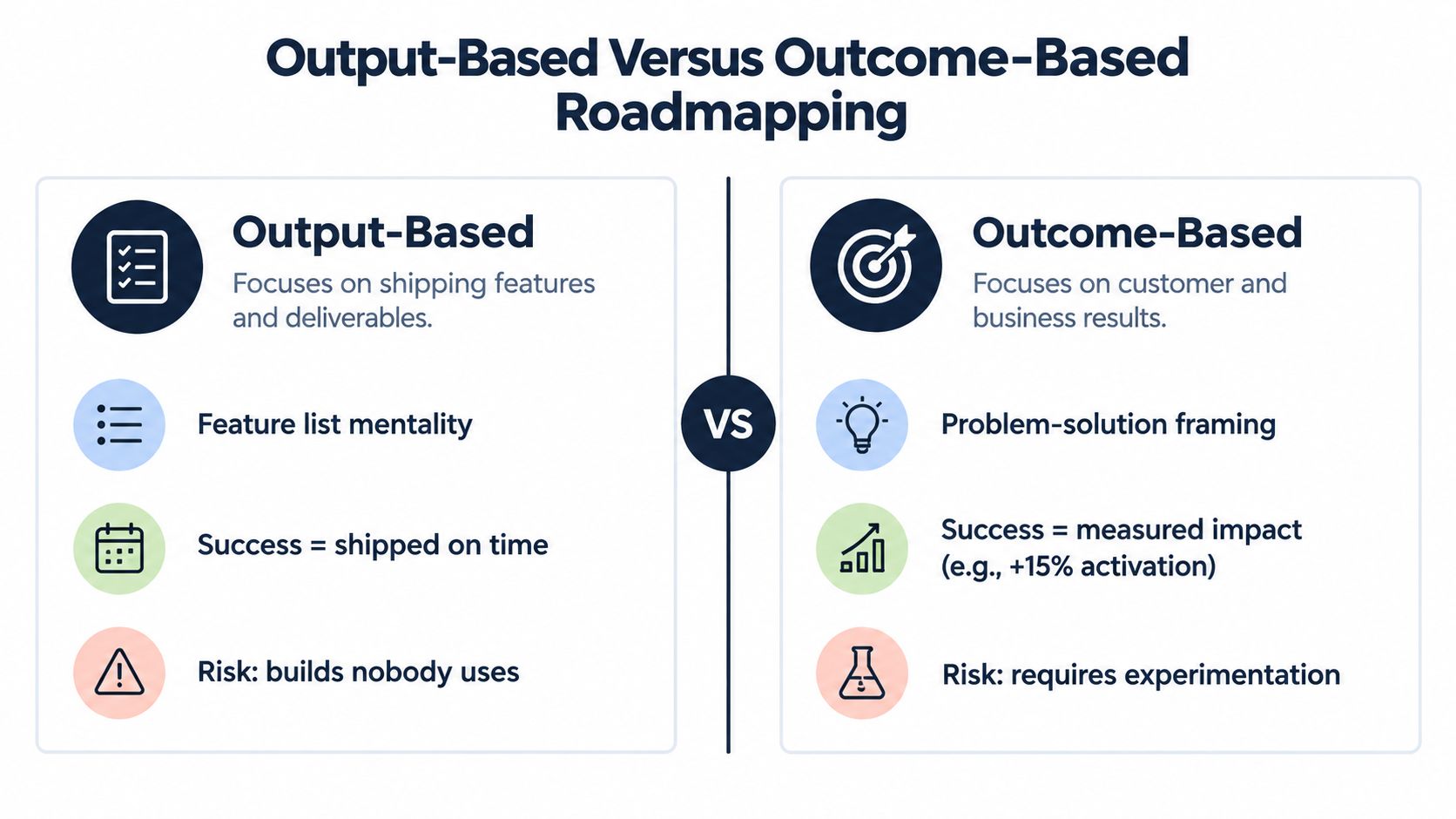
An output is what the team ships. An outcome is what changes because the team shipped it. “Release bulk editing” is an output. “Reduce the time administrators spend correcting repetitive setup work” is an outcome. The first is easy to mark complete, while the second gives the team a reason to measure whether the work helped.
ProductPlan's 2023 survey of more than 1,500 product managers worldwide found that 54% of roadmaps were designed around outputs, while 44% communicated outcomes such as adoption, retention, revenue, or customer impact. The survey report also found that approximately 52% of product managers said strategy was mainly influenced by senior-executive requests or direct customer feedback. Those findings describe a common operating risk: teams can collect plenty of input and still lack a disciplined way to connect requests with results.
The difference in practice
| Output-based roadmap | Outcome-based roadmap |
|---|---|
| Lists features, releases, or deliverables | Names the customer or business change sought |
| Treats completion as the main success signal | Defines evidence that would indicate progress |
| Encourages teams to protect scope | Allows teams to change the solution if the outcome remains important |
| Makes stakeholder requests easy to add | Requires a rationale, audience, and priority case |
Output-based planning isn't useless. Engineering still needs deliverables, marketing still needs launch information, and customers may need to know which capability is being developed. The problem appears when the output becomes the objective. A team can ship a workflow that nobody adopts, satisfy a vocal account while neglecting broader retention risk, or complete an initiative whose original business rationale no longer holds.
Outcome-based roadmapping changes the review conversation. Instead of asking only whether a feature shipped, ask whether activation improved, support demand fell, expansion opportunities increased, or a workflow became more reliable. The exact metric depends on the initiative, and not every outcome will be known before discovery begins.
Use OKRs for product managers to connect roadmap outcomes with measurable objectives without turning every roadmap item into a rigid promise. The roadmap should preserve the strategic intent, while the delivery team can test different solutions and learn whether they work.
The Case for Avoiding Hard Dates
A date on a roadmap is rarely interpreted as neutral information. Sales may repeat it to a prospect, executives may treat it as a commitment, and customers may plan around it. Even when the product team intended the date as a rough forecast, other people can reasonably hear a promise.

The problem isn't that dates are always bad. Dates become harmful when they express more confidence than the evidence supports. A dependency may remain unresolved, discovery may change the scope, or new churn and security evidence may make another initiative more valuable. A hard date can pressure a team to deliver the original output even after the underlying customer problem has changed.
ProductPlan's guidance on product roadmaps makes the distinction clearly: date-heavy roadmaps can turn uncertain assumptions into perceived promises, while target windows work better when dependencies and evidence are still developing.
Forecasts and commitments need different homes
Use the roadmap to communicate outcomes, themes, and approximate horizons. Use the delivery plan to track committed milestones once the team understands the work, dependencies, and capacity well enough to support that commitment.
A practical model might look like this:
- Now: The team has strong evidence, clear ownership, and active work.
- Next: The initiative is prioritized, but discovery or dependencies still affect timing.
- Later: The problem matters, but evidence, capacity, or strategic fit needs further validation.
- Uncommitted: The idea is recorded for evaluation, not promised for delivery.
Accountability doesn't require a fixed date for every item. It requires a visible rationale, an owner for the decision, a review point, and explicit conditions for reprioritization. State what would change the plan, such as a material shift in churn risk, adoption, revenue opportunity, security requirements, or engineering capacity.
A roadmap can therefore be honest about uncertainty while remaining useful. Stakeholders learn what the team is pursuing, why it matters, how confident the timing is, and which evidence would cause a change. That is more actionable than a calendar full of dates that nobody can safely interpret.
Prioritizing Conflicting Evidence and Signals
SaaS teams rarely lack requests. They struggle to compare requests that arrive in different forms. Sales may bring a feature tied to a major expansion opportunity. Support may report a recurring workflow problem. Product analytics may show that an apparently popular capability is barely used. Leadership may want platform work that customers don't directly request but that reduces strategic risk.
The loudest request shouldn't automatically win. Neither should the request with the cleanest data. Product management needs a transparent way to make trade-offs without pretending that unlike signals can be reduced to perfect precision.
Start with the evidence record
For each opportunity, capture the source and the implication:
- Commercial value: What revenue is exposed, protected, or potentially expanded?
- User breadth: How many customer segments or workflows experience the problem?
- Behavioral impact: Does usage indicate friction in activation, retention, adoption, or expansion?
- Customer evidence: What do support conversations, interviews, and success teams report?
- Strategic fit: Does the initiative strengthen the product direction or an important platform capability?
- Confidence: How direct and reliable is the evidence?
- Effort and risk: What delivery complexity, technical uncertainty, and dependency cost should the team expect?
This structure prevents a customer request from becoming a feature by default. It also stops analytics from becoming a substitute for judgment. A low-frequency problem can still matter if it blocks a strategically important account, while a frequently requested enhancement may deserve less attention if it affects low-value workflows and has weak retention implications.
Use scoring to expose trade-offs
A practical starting model is expected business value multiplied by confidence, divided by estimated effort, with explicit adjustments for strategic fit, technical risk, and dependency cost. The score isn't a magical answer. Its value comes from making assumptions discussable.
Record the underlying evidence next to the score. If sales estimates commercial upside but product analytics shows little affected usage, both facts should remain visible. If support volume is high but the issue reflects a temporary incident, the team can lower confidence rather than treating ticket count as durable demand.
Recent product-management discussion about AI-assisted development has raised a related concern: as teams build and release faster, decision quality becomes a more important bottleneck. That makes roadmap evidence more valuable, not less. Faster delivery of the wrong problem still creates waste.
Review the ranking when new evidence arrives. A roadmap that allows an initiative to move between horizons without political drama gives teams a healthier way to respond to reality.
Best Practices for Maintaining an Adaptive Roadmap
A roadmap loses value when someone creates it during annual planning and nobody updates the assumptions afterward. Treat it as a maintained decision record. The team should know which evidence supports each initiative, when the priority will be reviewed, and how changes will be communicated.
Keep the roadmap connected to signals
Use evidence fields that reflect how SaaS products create value:
- Revenue-impact signals: Note expansion opportunities, exposed accounts, and commercial risk.
- Support themes: Group recurring problems rather than counting every ticket as an independent request.
- Behavioral metrics: Connect initiatives to activation, adoption, retention, or workflow usage where relevant.
- Expansion opportunities: Record product gaps that affect broader account growth.
- Confidence and risk: Distinguish strong evidence from an attractive but untested assumption.
A roadmap should communicate why work matters and what outcome is expected. A separate execution system should handle tickets, owners, implementation status, and delivery detail. The academic discussion of product roadmaps in this research article supports that separation between strategic coordination and detailed execution.
Establish a review rhythm
Don't review every item with the same intensity. Active initiatives need outcome checks and dependency updates. Near-term initiatives need validation of scope and capacity. Later initiatives need evidence review rather than detailed planning.
Use a short decision record when something changes:
- What changed: Identify the new signal or assumption.
- Why it matters: Explain the effect on customer value, revenue, risk, or strategy.
- What moves: State which initiative changes horizon, scope, or priority.
- Who needs to know: Update the stakeholder view that may contain the old expectation.
- What happens next: Name the next validation or decision point.
The product roadmap best practices guide from RapidNative offers another useful reference for keeping roadmap communication clear and adaptable. Tools such as Productboard, Aha!, Linear, Jira, and SigOS can support different parts of the workflow. SigOS, for example, connects customer feedback, usage data, revenue impact, and shipped work to surface roadmap-ready product insights.
Operating principle: A roadmap earns trust by showing how decisions change, not by pretending the original plan was always correct.
Review outcomes after release instead of archiving the initiative as soon as delivery ends. If adoption remains weak, investigate the problem, audience, positioning, or solution rather than counting completion as success. That habit turns the roadmap into a learning system and gives future prioritization better evidence.
SigOS helps SaaS teams connect support conversations, sales signals, usage behavior, revenue impact, and shipped work so product leaders can identify which problems deserve roadmap priority. Visit SigOS to see how product intelligence can replace subjective request queues with evidence-based decisions.
Ready to find your hidden revenue leaks?
Start analyzing your customer feedback and discover insights that drive revenue.
Start Free Trial →