What Does a Product Manager Do? A SaaS Team Guide
What does a product manager do in SaaS? Our guide covers core PM responsibilities, skills, KPIs, and how AI tools are changing the role for modern tech teams.
You open Slack at 9:02 a.m. Sales wants a feature for a renewal call this week. Support says the latest bug is hitting important accounts. Engineering wants a decision on scope before sprint planning. Design needs clarity on the workflow. Leadership asks a simple question that never has a simple answer: what should we build next, and why?
That tension is the product manager’s job.
If you want the clean slogan, people often call the PM the “CEO of the product.” In practice, that phrase hides the hard part. A product manager rarely has the authority of a CEO. What they do is turn scattered inputs into decisions. They define problems, choose trade-offs, align teams, and keep the product moving toward outcomes that matter.
In SaaS, that job has changed. The old version of product management leaned heavily on intuition, stakeholder persuasion, and manual customer research. Those still matter. But modern PMs also work as revenue-driven signal detectors. They sort through support tickets, sales calls, churn patterns, usage data, and feature requests to figure out which problems are merely loud and which ones affect retention, expansion, and product adoption.
So, what does a product manager do? They reduce uncertainty for the business. They help the company build the right thing, in the right order, for the right reason.
The Modern Product Manager A Balancing Act
A PM’s day usually starts with conflict, not clarity.
A support lead sends over three customer escalations. An AE forwards a note from a prospect asking for one missing integration. Engineering raises concern that the proposed fix touches a fragile part of the system. None of these inputs are wrong. They just point in different directions.
That’s why the role exists.
The PM sits in the middle of messy reality
Product management is the function that connects customer needs, business goals, and technical execution. The PM translates between groups that speak different languages.
Sales speaks in deals and objections. Support speaks in pain and urgency. Engineering speaks in constraints and sequencing. Leadership speaks in strategy, revenue, and risk. Users, when you can hear them clearly, speak in workarounds, confusion, and unmet expectations.
The PM’s work is turning that into a roadmap the team can execute.
A good PM doesn’t collect requests and pass them through. They interpret what those requests mean.
That’s why the role feels ambiguous from the outside. The PM isn’t always the person writing code, designing flows, closing deals, or answering tickets. But they’re often the person deciding which of those problems deserves attention first.
Decision-making under uncertainty defines the role
Most product decisions happen with incomplete information. You rarely get perfect user research, perfect analytics, and perfect stakeholder alignment at the same time.
You get partial evidence. Then you decide anyway.
That’s also why generic definitions of “what does a product manager do” often miss the point. The role isn’t a checklist. It’s judgment.
Common PM decisions look like this:
- Feature trade-off: Should the team ship a narrow fix now or wait for a broader redesign?
- Customer trade-off: Is this request a one-off enterprise ask or a market-wide need?
- Technical trade-off: Does speed matter more right now, or is this the moment to clean up architecture?
- Business trade-off: Will this work improve retention, enable expansion, or just create activity that looks productive?
The strongest SaaS PMs don’t pretend uncertainty goes away. They build systems that make it easier to see the truth inside the noise.
The role is changing fastest here. New product intelligence workflows let PMs move beyond “I heard this from three customers” and toward more grounded questions: Which patterns keep showing up? Which accounts are affected? Which issues correlate with churn risk or expansion opportunity? Which backlog items are expensive to ignore?
The Three Hats of a SaaS Product Manager
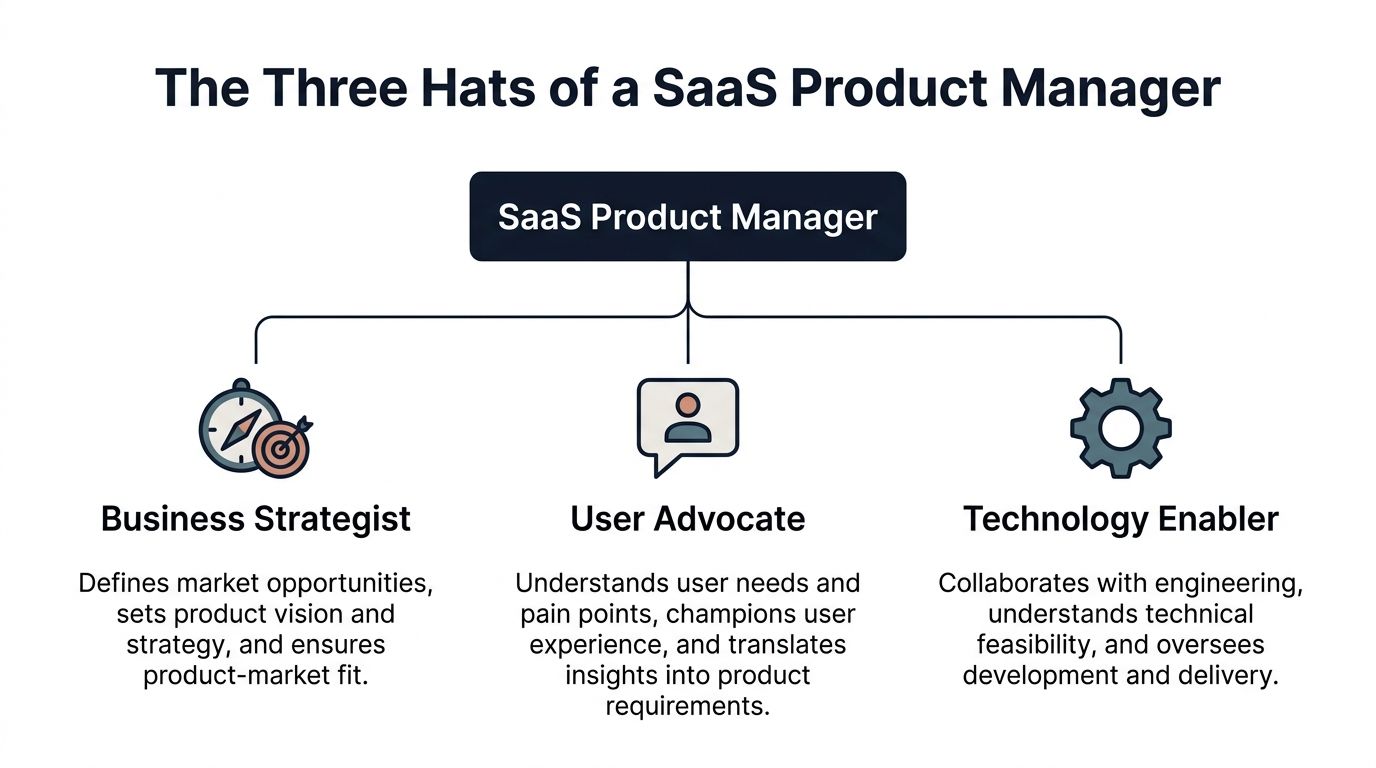
If you want a practical way to understand what a product manager does, use this model: a PM wears three hats at the same time. They act as a business strategist, a user advocate, and a technology enabler.
Business strategist
The business hat asks one question: should this product or feature exist at all?
That means looking at market demand, competitive pressure, pricing implications, retention risk, and revenue potential. A PM has to understand what the company is trying to achieve and how the product contributes to that goal.
This part of the role gets ignored when teams reduce product management to backlog grooming. Backlogs matter, but product decisions need business context.
A PM wearing the business hat will ask:
- What market problem are we solving? Is it painful enough that customers care?
- What commercial outcome matters? Retention, expansion, activation, or win rate?
- What should we not build? Good PMs reject more ideas than they approve.
User advocate
The user hat asks a different question: is this useful and understandable?
PMs don’t replace design or research, but they must keep the team anchored in real user problems. That means listening carefully, spotting patterns in qualitative feedback, and making sure the product solves a workflow instead of just adding another feature.
In SaaS, this often means separating stated requests from underlying pain. A customer may ask for an export button when the underlying issue is lack of trust in the dashboard. They may ask for notifications when the actual problem is poor visibility into risk.
Practical rule: Don’t take requests at face value. Translate them into jobs, friction, and outcomes.
Technology enabler
The tech hat asks: can we build this well, and can we support it?
A PM doesn’t need to be the strongest engineer in the room. But they do need enough technical understanding to discuss feasibility, sequence work sensibly, and avoid promising things that collapse under implementation detail.
That includes architecture constraints, dependencies, data quality, integration complexity, and release risk.
The role’s split between strategy and delivery is visible in how PMs spend their time. A 2021 Product Focus survey found that PMs spend 33% of their time determining “what the right product is” and 42% delivering the product, including execution and team alignment, as summarized by Airfocus’s product manager career stats.
That ratio explains why the role feels so demanding. A PM has to keep switching hats, often in the same hour.
Navigating the Product Lifecycle from Discovery to Launch
The easiest way to understand what does a product manager do is to follow the work from the first signal to the final release.
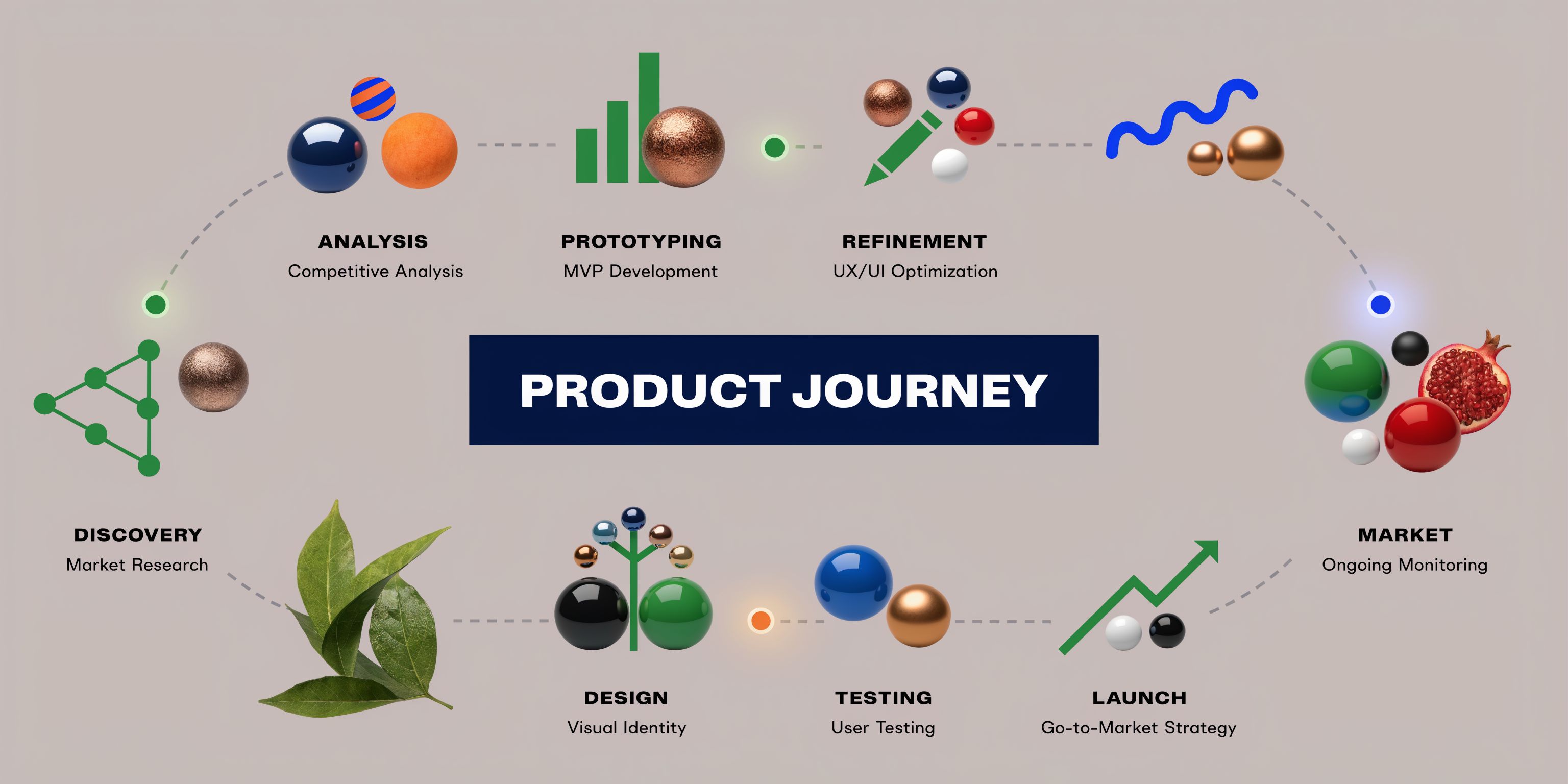
A product manager doesn’t own every task in the lifecycle. They own the continuity. They make sure the original problem, the delivery plan, and the launch outcome still connect.
Discovery
Discovery is where a PM decides whether a problem is worth solving.
This can include customer interviews, support review, sales feedback, usage analysis, and market scanning. Good discovery work prevents teams from building polished answers to weak problems.
A PM in discovery is usually trying to answer a small set of hard questions:
- Is this pain frequent enough to matter?
- Who feels it most acutely?
- What behavior tells us it’s real?
- What happens if we ignore it?
For teams that want a cleaner mental model, this breakdown of product development lifecycle stages is a useful reference because it shows how product work changes across phases instead of treating it as one continuous blur.
Planning
Planning is where ambiguity gets compressed into choices.
The PM prioritizes problems, shapes a roadmap, defines scope, and writes the artifacts the team needs. Sometimes that’s a PRD. Sometimes it’s a short problem statement plus acceptance criteria. The format matters less than the clarity.
Roadmapping is hard partly because every option has an opportunity cost. According to the PM job outlook summary at Noble Desktop, product manager demand grew 33% from 2017 to 2019 and was projected to grow another 10% by 2024, yet 65% of PMs say roadmapping is the hardest part of the job and 45% spend less time on strategy than they want.
That tracks with real work. Planning is where strategy meets calendar reality.
If you’re trying to improve how your team documents product decisions, this guide on writing a PRD is a practical starting point: https://www.sigos.io/blog/how-to-write-a-prd
Execution
Execution is less glamorous than strategy talk, but it’s where PM credibility is earned.
Once engineering starts building, the PM clarifies edge cases, resolves scope disputes, answers questions fast, and keeps everyone aligned on the original intent. They also protect the team from random additions that creep in after development starts.
Execution work often includes:
- Sprint support: clarifying stories, trade-offs, and release criteria
- Stakeholder management: explaining what changed and why
- Quality review: checking whether the shipped experience solves the problem
A PM who disappears after planning leaves the team to guess. That usually shows up later as rework.
A quick visual explainer helps here:
Launch and iteration
Launch isn’t the finish line. It’s where product management becomes honest again.
After release, the PM looks at adoption, user confusion, support volume, sales feedback, and behavioral change. Sometimes a feature “ships” but doesn’t land. That usually means one of three things: the problem was weak, the workflow is clumsy, or the rollout failed.
The PM’s job after launch is to decide whether to double down, fix friction, reposition the feature, or move on.
The best launch review question isn’t “Did we ship?” It’s “Did customer behavior change in the way we expected?”
A Day in the Life The PMs Daily Grind
A normal PM day doesn’t feel linear. It feels like controlled interruption.
You start with a stand-up. Engineering flags an API dependency that may affect release timing. Right after that, support shares a thread of customer complaints that all sound slightly different but may point to the same issue. Then sales asks whether a requested feature is on the roadmap because an enterprise account wants an answer before procurement moves forward.
By lunch, you’ve switched contexts half a dozen times.
The calendar is only half the job
A lot of product management work happens in recurring meetings, but the true value comes from what the PM does between them.
A typical day can include:
- Morning review: checking product dashboards, open incidents, and customer escalations
- Backlog triage: sorting bugs, requests, and follow-up questions in Jira, Linear, or GitHub
- Customer input review: reading Intercom chats, Zendesk tickets, call notes, or CS summaries
- Spec work: tightening a PRD, acceptance criteria, or release notes
- Alignment meetings: talking with engineering, design, sales, support, and leadership
The hard part isn’t any one task. It’s the constant need to reassemble context.
Manual feedback analysis is still a huge time sink The job gets deceptively expensive here.
A lot of PMs still rely on spreadsheets, tag reviews, scattered Slack messages, and anecdotal recaps from support and sales. That works for a while. Then ticket volume grows, customer segments diverge, and every team starts bringing “top requests” backed by different evidence.
A 2025 Gartner report, cited in Product School’s article on the PM role, says 68% of PMs in tech firms spend over 30% of their time manually analyzing support tickets, chat transcripts, and usage metrics, while only 22% use AI platforms that effectively link patterns to churn or revenue in this Product School write-up on what product managers do.
That gap matters because raw feedback is noisy. Volume alone doesn’t tell you what deserves priority.
Teams often don’t suffer from lack of feedback; instead, they struggle with an abundance of unranked feedback.
What good PMs do with the noise
Strong PMs develop a repeatable filtering habit.
They don’t ask only, “How many customers mentioned this?” They also ask:
- Which customers? Strategic accounts, new users, long-term power users?
- What behavior accompanies the complaint? Drop-off, churn risk, low adoption, blocked workflows?
- Is this recurring across channels? Support, sales, usage data, and onboarding notes?
- What’s the root cause? Broken functionality, missing capability, unclear UX, or poor onboarding?
That’s the daily grind in plain terms. Product management is a lot of conversations, but the point of those conversations is sharper decisions.
The Art of Influence Leading Without Authority
One of the strangest parts of product management is that the PM is often accountable for outcomes they can’t command into existence.
They don’t manage engineering. They usually don’t manage design, support, or sales either. Still, they need all of those teams moving in the same direction.
That’s why influence is a core PM skill, not a soft extra.
Working with engineering
Engineering teams need clarity, not slogans.
A PM helps most when they define the problem well, explain why it matters, and protect the team from unstable scope. Engineers usually don’t need product theater. They need clean requirements, sensible sequencing, and fast answers when details get messy.

This is especially important in technical product work. Product School’s TPM overview notes that effective Technical Product Managers can reduce technical debt by 25% to 40% through rigorous risk assessment and engineering alignment, helping avoid implementation mismatches that can double development costs in agile sprints, as described in their article on the technical product manager role.
That statistic points to a practical truth. Clear product thinking saves engineering time.
Working with sales and support
Sales brings market pressure. Support brings lived pain.
A weak PM treats both groups defensively. A strong PM listens carefully, then filters for repeatable product truth. Sales should shape prioritization, but not through one-off promises. Support should shape prioritization, but not through raw ticket volume alone.
Different partners need different communication.
| Team | What they need from the PM | What the PM needs from them |
|---|---|---|
| Sales | roadmap clarity, objection handling, realistic commitments | signal on deal blockers and recurring market asks |
| Support | status on bugs, expected fixes, product context | sharp examples of friction and workflow breakdowns |
| Engineering | problem framing, priority order, scope discipline | feasibility input, risk visibility, implementation detail |
Influence comes from trust, not force
PMs earn influence when teams believe three things:
- You understand their constraints
- You make decisions consistently
- You won’t bend to the loudest voice in the room
If a PM can explain a priority decision in a way engineering, sales, and support all recognize as fair, they’re doing the job well.
This is why communication is inseparable from strategy. A roadmap nobody believes in won’t survive contact with real stakeholders.
Prioritizing with Purpose From Gut Feel to Revenue Impact
Prioritization is where product management gets exposed.
Every PM says prioritization matters. The core question is what drives it. In weaker teams, the answer is familiar: the loudest customer, the most senior executive, the newest idea, or the issue that generated the most heat in Slack.
That approach creates busy roadmaps and weak outcomes.
Why old prioritization breaks down
Qualitative feedback matters, but raw feedback is deceptive. A request can appear urgent because it’s repeated often, because one strategic account keeps raising it, or because the underlying issue is painful in a very narrow corner of the product.
Those are not the same thing.
According to the summary citing Amplitude’s 2025 State of Product report, 74% of PMs struggle with noisy qualitative feedback, and teams that quantify feedback by revenue impact can reduce churn 27% faster than peers, as noted in Pragmatic Institute’s discussion of what a product manager does.
That’s the practical shift happening in SaaS. PMs can’t just sort requests. They need to identify which patterns affect business outcomes.
The revenue-driven signal detector model
A modern PM looks at a bug report or feature request and asks more than “Do customers want this?”
They ask:
- Does this correlate with churn risk?
- Does it block expansion or upsell conversations?
- Does it affect a strategic segment?
- Is the problem persistent across channels and behaviors?
- What is the development cost relative to business impact?
AI-assisted product intelligence can change the workflow here. Some teams now use tools that ingest support tickets, sales conversations, chat transcripts, and usage data, then surface recurring patterns tied to revenue risk and expansion potential. One example is SigOS, which analyzes those inputs and pushes prioritized issues into systems like Jira or Linear with revenue impact context.
If you want a broader view of scoring methods and decision frameworks, this overview of backlog prioritization techniques is useful: https://www.sigos.io/blog/backlog-prioritization-techniques
A simple prioritization checklist
Here’s a lightweight template that works better than gut feel because it forces trade-offs into the open.
| Feature/Initiative | Churn Reduction Score (1-5) | Expansion Revenue Score (1-5) | Strategic Alignment (1-5) | Dev Effort (T-Shirt Size) | Final Priority Score |
|---|---|---|---|---|---|
| Improve onboarding handoff | 4 | 3 | 5 | M | |
| Fix reporting export failures | 5 | 2 | 4 | S | |
| Build requested niche integration | 2 | 4 | 2 | L | |
| Redesign admin permissions flow | 4 | 4 | 5 | L |
The exact formula matters less than the discipline.
A good PM uses a table like this to make debates concrete. If an item has weak strategic alignment and high effort, it shouldn’t jump the queue because one stakeholder is pushing hard. If a bug has modest visibility but repeatedly appears in churn conversations, it may deserve immediate attention.
Decision lens: Prioritize the work that changes customer behavior and business outcomes, not the work that creates the most internal noise.
Becoming a Product Manager Skills KPIs and Career Path
If you’re trying to become a PM, or hire one, focus on the role itself, rather than the title.
The job sits at the intersection of product judgment, communication, and operating discipline. You need enough business sense to evaluate value, enough technical fluency to work with engineers, and enough customer empathy to understand what users are trying to get done.
Skills that matter
The strongest PMs usually build a mix of hard and soft skills:
- Data literacy: reading product analytics, spotting behavioral patterns, and asking better questions
- Customer research: interviews, feedback synthesis, and root-cause thinking
- Product communication: writing PRDs, release notes, decision docs, and roadmap narratives
- Execution discipline: keeping work moving across design, engineering, and GTM partners
- Influence: negotiating priorities without relying on formal authority
For anyone preparing for PM interviews, it helps to practice structured thinking instead of memorized answers. This guide on how to prepare for job interviews is useful for tightening that habit.
For the analytics side of the role, this resource is also worth reviewing: https://www.sigos.io/blog/analytics-for-product-managers
What PMs are measured on
KPIs vary by product and company stage, but common measures include adoption, retention, churn, activation, feature usage, customer satisfaction, and revenue contribution tied to product changes.
The important point is this: PMs aren’t measured by how many features they ship. They’re measured by whether the product gets stronger.
Sample SaaS Product Manager job description snippet Own product discovery, prioritization, and delivery for a core SaaS workflow. Partner with engineering, design, support, sales, and leadership to define roadmap priorities. Translate customer feedback, usage data, and business goals into clear requirements. Track launch outcomes, retention signals, and adoption patterns. Strong communication, analytical thinking, and comfort with cross-functional decision-making required.
If you’re still asking what does a product manager do, the shortest honest answer is this: they help a company make better product decisions. In modern SaaS, the best PMs do that by finding the signal in the noise and tying product choices to real business impact.
SigOS helps SaaS product teams do that kind of work faster. It analyzes support tickets, chat transcripts, sales calls, and usage data to surface patterns tied to churn, expansion, and revenue impact, then pushes those insights into existing workflows. If your team is trying to prioritize beyond gut feel, you can learn more at SigOS.
Keep Reading
More insights from our blog
Ready to find your hidden revenue leaks?
Start analyzing your customer feedback and discover insights that drive revenue.
Start Free Trial →