Discover what is behavioral segmentation and boost your marketing insights
Discover what is behavioral segmentation and learn how to map customer actions to tailored strategies that drive engagement and growth.
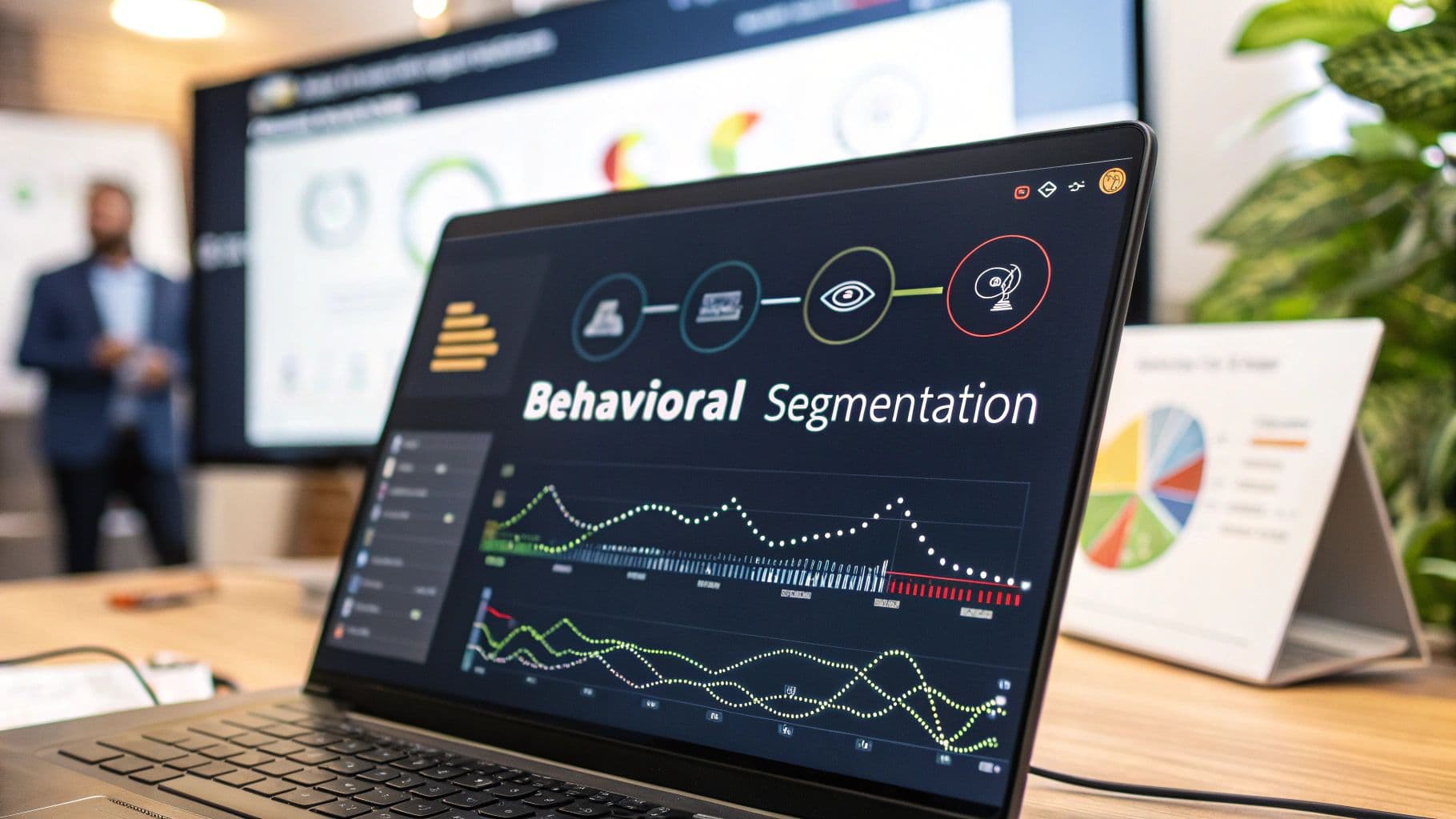
Think of behavioral segmentation as grouping your customers based on what they do, not just who they are. It’s the difference between knowing someone’s job title and knowing they log into your app every single morning to use a specific feature. This approach zeroes in on actions, habits, and interactions, giving you a much clearer window into what your users actually need and what they might do next.
Moving Beyond Who to Understand Why

Trying to understand your users with only demographic data is like looking at a static map of a city. You can see where people live, but you have no idea about their daily commute, which roads get jammed at 5 PM, or where they stop for coffee. Behavioral segmentation is the live traffic feed; it shows you the movement, the patterns, and the real-world activity that actually matters.
This is where you get past surface-level details like age or location and start to uncover the why behind customer choices. For any SaaS business, this is a game-changer. Knowing a user is a "Marketing Director" is one thing. But knowing they're a "Power User" who lives in your advanced analytics dashboard is infinitely more valuable. That’s the kind of insight that lets you engage with them in a way that’s genuinely helpful and relevant.
The Power of Action-Based Insights
When you focus on what people do, you get a much sharper picture of their intent. It's no surprise that when marketing is tuned to behavioral patterns, purchases can jump by as much as 50%. Why? Because you're speaking to their actual needs and habits—like their purchase history or product usage—not just guessing based on broad categories.
Before you can segment effectively, of course, you need to know who you're talking to in the first place. A great first step is learning how to identify a target audience, as this provides the foundation for any deeper analysis.
Once you start focusing on user activity, you unlock some serious advantages:
- Real Personalization: You can shape messaging and product tips based on what a user actually does, not what you assume they might do.
- Smarter Predictions: Past behavior is one of the best predictors of future behavior. By tracking usage patterns, you can get much better at spotting who is ready to upgrade, who might be at risk of churning, or who would benefit from a new feature.
- Focused Resources: Forget casting a wide net. You can direct your marketing spend and development time toward the user segments that are most engaged or have the highest growth potential.
Comparing The Four Main Types Of Market Segmentation
To really see why behavioral segmentation is so different, it helps to put it side-by-side with the other common methods. Each approach answers a different fundamental question about your customer.
| Segmentation Type | What It Answers | Example Data Points | Primary Benefit |
|---|---|---|---|
| Behavioral | How do they act? | Purchase history, feature usage, login frequency, session duration. | Predicts future actions and identifies high-intent users. |
| Demographic | Who are they? | Age, gender, income, occupation, education level. | Easy to gather and provides a basic customer profile. |
| Geographic | Where are they? | Country, city, zip code, climate, population density. | Useful for location-based marketing and regional targeting. |
| Psychographic | Why do they act that way? | Lifestyle, values, interests, personality traits, opinions. | Explains the motivations and emotional drivers behind choices. |
As you can see, while demographic and geographic data tell you the "who" and "where," behavioral data gets straight to the "how." It provides the dynamic context that the other types lack.
From Static Labels to Dynamic Understanding
So, what is behavioral segmentation at its core? It's about moving from static, unchanging labels to a fluid, dynamic understanding of your customers. It acknowledges that people's needs and habits change over time, and the only way to keep up is to watch what they do.
This is how you build a product that doesn’t just meet customer needs but actively anticipates them, creating a foundation for real loyalty and growth. For a closer look at the data that fuels this process, our guide on what is behavioral analytics is a great next step.
The Four Main Types Of Behavioral Segments
To really get what behavioral segmentation is all about, you have to break it down. While you can slice and dice user actions in a million different ways, nearly every method boils down to one of four core types.
Think of these as the fundamental building blocks for understanding who your customers are and what makes them tick. Each one answers a different question about their journey with your product, helping you move from seeing what they do to understanding why they do it.
Segmenting By Purchase Behavior
Let's start with the most obvious one: how people spend money. This isn't just about looking at transaction logs; it’s about digging into the habits and patterns behind their purchasing decisions. For any SaaS business, this is ground zero for spotting your best customers and finding new ways to grow revenue.
This approach usually zeros in on a few key things:
- How often they buy: Are they making small, frequent add-on purchases, or do they lock in a big annual contract and you don't hear from them until renewal?
- How much they spend: What's their typical transaction size? This is what separates your single-seat startups from your enterprise clients buying hundreds of licenses.
- Where they are in their journey: Is this their first time swiping a card after a free trial? Are they a newly converted customer, or a long-time subscriber who just upgraded?
For example, a customer who consistently buys new feature modules every quarter is telling a very different story than one who just renews their basic plan once a year. Recognizing that difference is key to sending them upsell offers that actually feel helpful, not just salesy.
Segmenting By Occasion And Timing
This is all about the when. This method groups users based on the specific moments or triggers that drive them to act. People's needs aren't static; they change based on holidays, seasons, project deadlines, or personal milestones. Understanding these timing-based triggers lets you show up with the right solution at the perfect moment.
This type of segmentation answers one simple question: "What event just happened that made this user log in or buy something?"
Think about a project management tool. They probably see a massive spike in usage at the end of every quarter as teams scramble to finalize reports. This "End-of-Quarter Power User" segment is primed for proactive tips on reporting features or templates designed to make their lives easier.
A few other real-world examples:
- Seasonal spikes: A graphic design tool seeing a jump in usage for holiday card templates every December.
- Recurring events: A payroll platform that knows its peak usage will always be on the 14th and 29th of the month.
- One-off personal moments: A user upgrading to an enterprise plan right after their company announces a new round of funding.
Segmenting By Benefits Sought
This one gets to the core motivation: why are people really using your product? It's a critical question because two customers can use the exact same feature for completely different reasons. This type of segmentation looks past the action itself to group users by the specific value they're trying to get.
Imagine a data analytics platform. They might have two key benefit-driven segments:
- The Efficiency Seekers: These users just want to automate their daily reports and get on with their day. They live in the pre-built dashboards and value speed and simplicity above all else.
- The Deep Divers: This group uses the same platform to hunt for complex market trends and shape long-term business strategy. They love advanced filters, custom queries, and export options. Their sessions are fewer, but way more intense.
If you send both groups an email about a new time-saving dashboard widget, you'll only connect with one of them. The Efficiency Seekers will love it, but the Deep Divers need to hear about your upcoming webinar on advanced data modeling.
Segmenting By Loyalty Status
Last but not least, not all customers are created equal when it comes to their relationship with you. Segmenting by loyalty is crucial for knowing who to nurture, who to reward, and who to save before they churn.
This isn't black and white, but you can generally group users into a few key categories:
- Champions: Your die-hard fans. They log in daily, use your most advanced features, and probably tell their friends about you.
- Loyal Customers: These are your steady, long-term users. They get value from your product and renew without a fuss, but they aren't necessarily power users.
- At-Risk Customers: The red flags. Their usage has dropped off, they haven't logged in for a while, or they just had a frustrating support ticket.
- New Users: They're in that make-or-break onboarding phase. Their first few experiences will decide if they stick around for the long haul.
You wouldn't talk to each of these groups the same way. Champions are perfect candidates for a beta program, while at-risk customers need a proactive "Hey, how can we help?" message before it's too late.
How To Gather Actionable Behavioral Data
Great behavioral segmentation isn't about guesswork; it's built on a foundation of high-quality data. Think of yourself as a detective trying to solve the mystery of "what do my customers really want?" To crack the case, you need to collect clues from every single interaction they have with your product and company.
These clues come in two flavors: quantitative data, which tells you what people did, and qualitative data, which helps you understand why they did it. The real magic happens when you combine both to get the full picture.
Start With Quantitative Data Sources
Quantitative data is your bedrock. It's the hard evidence—the raw numbers and metrics that track what users are doing at scale. This information is objective, measurable, and absolutely essential for spotting widespread patterns and trends.
Here are the most important sources you'll want to tap into:
- Product Analytics: This is ground zero for understanding in-app behavior. It captures every click, scroll, and feature interaction, giving you metrics like session length, feature adoption rates, and common user workflows.
- Transaction History: Follow the money. Data on upgrades, downgrades, plan renewals, and add-on purchases is a crystal-clear signal of how much value a customer sees in your product.
- CRM Records: Your Customer Relationship Management platform is packed with context. It holds crucial information like deal sizes, company details, and the entire history of a customer's relationship with your sales and success teams.
The behavior analytics market is exploding for a reason—it's projected to hit as much as $24.84 billion by 2032. This isn't just a trend; it shows how vital this data has become for businesses everywhere. Companies are investing heavily in this tech because they know these signals lead directly to smarter, more profitable decisions. You can see the full behavior analytics research here to get a sense of the market trends.
Uncover The "Why" With Qualitative Data
While the numbers tell you what users are doing, qualitative data tells you the story behind their actions. This is where you find the human context—the motivations, frustrations, and goals that drive their behavior.
Don't sleep on these qualitative goldmines:
- Support Tickets and Chat Transcripts: These are raw, unfiltered pleas for help. Diving into support conversations will quickly reveal recurring bugs, confusing UI elements, and features your customers desperately wish you had.
- Customer Feedback Surveys (NPS, CSAT): Sometimes, the easiest way to know what people think is to just ask them. Surveys give you a direct line to user sentiment, helping you connect the dots between low satisfaction scores and specific product friction points.
- Sales Call Transcripts: What features are prospects constantly asking about? What objections derail deals? Sales calls are a treasure trove of insights into what the market truly wants and the language people use to describe their problems.
Breaking Down The Data Silos
One of the biggest roadblocks to effective segmentation is that this data rarely lives in one place. Your product analytics are in one tool, your support tickets in another, and your CRM data is off in its own world. This is the classic data silo problem.
When your data is fragmented, you can never see the full customer journey. You might see a user's activity plummet in your analytics, but you're missing the support ticket that explains they're stuck on a critical bug.
This is exactly the problem modern data platforms are built to solve. By integrating these different data streams, you can stitch together a single, cohesive view of each user. This unified profile is the launchpad for creating the kind of accurate, powerful behavioral segments that actually move the needle for your business. For a more technical look at this, check out our guide on how to build data pipelines that bring all your customer information together.
Putting Behavioral Segmentation Into Practice
Theory is great, but seeing behavioral segmentation in the wild is where its power really clicks. These examples show how real SaaS teams can translate user actions—or inactions—into smarter strategies that actually move the needle on revenue and retention.
Let's ditch the abstract concepts and dive into a few scenarios you can probably relate to.
The Project Management Tool
Think about a popular project management tool. A quick glance might show thousands of daily active users, which sounds great. But behavioral segmentation tells a much more useful story by revealing who those users really are based on what they do inside the product.
The product team could easily identify two key segments:
- The Power Planners: These folks are in the app all day, every day. They're masters of the advanced features—Gantt charts, resource allocation, custom dashboards. You'll see them creating new projects and tasks constantly, with long, focused sessions.
- The Casual Collaborators: This group pops in a few times a week, mostly to react. They check notifications, comment on tasks someone else assigned them, and mark things as complete. They live in the basic task list and rarely venture out.
With this knowledge, generic "new feature" blasts are off the table. The company can now communicate with users in a way that actually helps them.
Power Planners get a personal invite to a webinar on advanced workflow automation. Meanwhile, Casual Collaborators get a quick, two-sentence tip showing them how to set up email notifications, so they can stay in the loop without even logging in.
This approach respects how each user actually engages with the tool, making every communication feel relevant instead of like spam.
The Fintech App
Next, let's look at a fintech app designed for personal finance. For a business like this, catching churn before it happens is everything. They can use behavioral segmentation to build an early warning system for users who are starting to drift away.
They create a "High Churn Risk" segment by looking for a specific combination of red flags:
- Transaction Drop-off: The user’s monthly transactions have fallen by 50% over the last two months.
- Bad Support Experience: They recently had a support ticket that closed with a poor customer satisfaction (CSAT) score.
- Quick "In-and-Outs": Their average session time has plummeted from several minutes to just a few seconds.
The moment a user's behavior trips these wires, an automated workflow kicks in. Maybe they get a proactive email from a customer success manager just to "check in," or an in-app survey pops up offering a small gift card for their feedback. This shifts the team from reactive problem-solving to proactive relationship-saving, giving them a real shot at keeping a customer they might have otherwise lost for good.
The Marketing Automation Platform
Finally, picture a marketing automation platform. Their growth depends on customers growing with them. Behavioral segmentation is their secret weapon for spotting expansion opportunities and boosting customer lifetime value.
They build an "Expansion Ready" segment based on clear signals that a user is hitting the limits of their current plan.
The key indicators are:
- Hitting Plan Limits: The user has maxed out their contact or email send limit for three months in a row.
- Window Shopping for Features: They've recently clicked on features that are gated behind a higher-tier plan.
- Team is Growing: The account just added the maximum number of team members allowed on their subscription.
Instead of letting that customer get frustrated, the sales team gets an automated alert. This lets them make a perfectly timed call, framing an upgrade not as a pitch, but as a solution to the user's obvious growing pains. It’s a perfect example of how behavioral segmentation can draw a straight line from user actions to expansion revenue.
To make this even clearer, here's a table summarizing how different SaaS businesses can apply these ideas to hit specific goals.
Behavioral Segmentation Use Cases In SaaS
| Business Goal | Behavioral Segment | Key Data Signals | Actionable Strategy |
|---|---|---|---|
| Reduce Churn | "At-Risk Users" | Decreased login frequency, feature disengagement, low CSAT scores, multiple support tickets. | Trigger a proactive outreach from the Customer Success team, offer a discount, or launch an in-app feedback survey. |
| Increase Activation | "Unactivated New Users" | Signed up but haven't completed a key "aha moment" action (e.g., creating a project, sending an email). | Launch a targeted in-app onboarding tour, send a sequence of educational emails, or offer a 1-on-1 demo. |
| Drive Expansion Revenue | "Power Users Hitting Limits" | Repeatedly hitting plan limits (e.g., contacts, storage), frequently using advanced features. | Notify the sales team to offer a consultative upgrade and a personalized demo of higher-tier features. |
| Improve Feature Adoption | "Feature Ignorers" | Active users who have never engaged with a specific high-value feature that correlates with retention. | Create an in-app notification highlighting the feature's benefit, or send a case study showing how similar users succeed with it. |
As you can see, the strategy always comes back to understanding what users are doing and then responding in a helpful, relevant way. This is the core of effective, behavior-driven growth.
Using AI for Continuous Segmentation
The biggest problem with traditional behavioral segmentation? It’s a snapshot in time. The segments you painstakingly create on a Monday are often obsolete by Friday. Manual analysis is slow, and it just can't keep up with the constant, messy reality of user behavior. That segment of "at-risk users" you defined last week is already missing the critical signals from this morning’s activity.
This is where AI completely changes the game. It shifts segmentation from a static, periodic report into a live, continuous feed of customer understanding. Instead of waiting for a quarterly review, AI-driven platforms work 24/7, pulling together countless data streams to build dynamic segments that show you what’s happening right now.
Moving Beyond Identification to Financial Impact
The real magic of using AI here isn’t just about making segments faster or a bit more accurate. The true breakthrough is its ability to connect user behavior directly to financial outcomes. It finally lets you draw a straight line from a specific user action—or inaction—to a tangible revenue number.
For instance, a manual approach might flag users who haven't logged in for 14 days. That’s a good start. But an AI-powered system digs deeper. It correlates that drop-off with preceding events, like a user hitting a nasty bug in your new checkout flow or getting a poor CSAT score after a support interaction.
AI doesn't just tell you who is churning; it tells you why they're churning and exactly how much revenue you stand to lose. This elevates segmentation from a simple marketing tactic to a core driver of your entire business strategy.
This is the kind of insight every modern product team dreams of. When you know the dollar value attached to fixing a specific bug or addressing a common feature request, you can finally prioritize your roadmap with total confidence. You're no longer guessing—you're working on the issues that will genuinely protect and grow revenue. You can read more about this in our article on AI-powered decision making.
This diagram shows how this modern, AI-driven process works, turning a flood of behavioral signals into profitable, targeted actions.
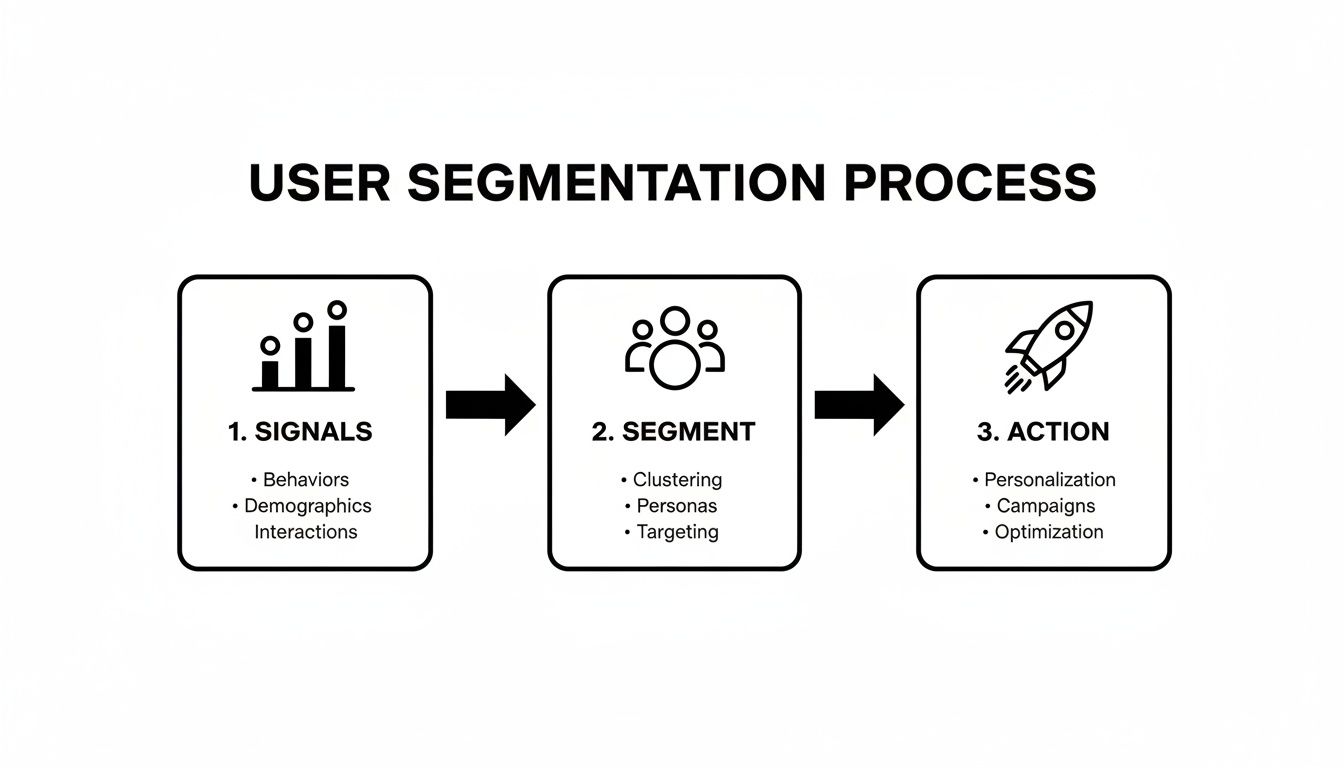
As you can see, it’s a clear flow from raw data signals to neatly defined segments and, ultimately, to smart, automated responses.
How AI Automates and Quantifies Insights
An AI-driven product intelligence platform like SigOS puts this continuous analysis into practice by automating the heavy lifting that’s simply impossible to do manually at scale.
- Ingesting Disparate Data: It pulls everything together—quantitative data like product analytics and CRM records, plus qualitative data from support tickets and sales calls—into one unified view.
- Identifying Hidden Patterns: AI algorithms are brilliant at spotting subtle connections a human analyst might never see. Think of it finding a link between a certain negative keyword in a support chat and a 30% higher churn risk.
- Assigning Revenue Impact: Every bug, issue, or feature request gets a price tag. The system automatically assigns a dollar value based on the revenue tied to the customer segments it affects.
- Triggering Real-Time Alerts: As soon as a pattern emerges that points to a major churn risk or a big expansion opportunity, the right people get notified immediately.
This isn’t just a niche strategy anymore; it's becoming foundational to customer intelligence. Studies show that 80% of companies using market segmentation see increased sales, and 70% of marketers now rely on it for strategic planning. By grounding your strategy in real-world behaviors, you can predict what customers will do next far more accurately than with older methods.
At the end of the day, AI turns behavioral segmentation into an automated revenue-protection system. For those looking to take it a step further, exploring advanced AI actions can help fully automate and personalize the journey in response to these identified behaviors. It gives product teams the power to stop making educated guesses and start making data-backed decisions that directly impact the bottom line.
Your Blueprint For Smarter Growth
We've covered a lot of ground, from the nuts and bolts of behavioral segmentation to how it plays out in the real world. So, what's the big takeaway? Simply put, this isn't just another buzzword to add to your marketing lexicon. It’s a completely different way of thinking about how you understand and connect with your customers.
The real shift happens when you stop asking, “Who are our customers?” and start asking the more meaningful question, “How do our most valuable customers behave?” That single change in focus is the secret to unlocking smarter, more durable growth. You’re no longer guessing based on static profiles; you're making confident moves based on what people actually do.
From Insights To Action
The next step is to weave this idea into the very fabric of your business strategy. This means tearing down the silos that often separate product, marketing, and customer success teams. When everyone speaks the same language—the language of user behavior—you create a unified front. Every product update, every marketing email, and every customer check-in is now perfectly aligned with what your users need and how they act.
The real objective is to build a system where you can draw a straight line from specific customer actions to clear revenue outcomes. When you know exactly which behaviors flag an upsell opportunity or a potential churn risk, you’re not just watching things happen—you’re anticipating them.
This predictive ability is what truly sets the market leaders apart. Building this blueprint boils down to a few key steps:
- Unify your data to get that single, reliable view of every customer touchpoint.
- Analyze user actions to pinpoint the patterns that define your most critical segments.
- Use AI-driven tools like SigOS to automate the analysis and, crucially, put a dollar value on the impact of every user behavior.
At the end of the day, the blueprint for smarter growth is already there, hiding in plain sight within the signals your users give you every single day. By learning to tune into these actions, you can stop churn in its tracks, find new revenue streams, and build a product that people don't just use, but genuinely can't live without.
Frequently Asked Questions
Even when the concept of behavioral segmentation makes sense, a few practical questions always pop up. Let's tackle the most common ones to help you move from theory to action.
How Is Behavioral Segmentation Different From Psychographic Segmentation?
This is a great question, and it's easy to see why people get them mixed up. Both try to get at the "why" behind a customer's decision, but they approach it from completely different angles.
The easiest way to remember the difference is actions vs. attitudes.
Behavioral segmentation is all about what your users actually do. It’s about tracking tangible, observable interactions with your product. For example, you can see that a user logs in every morning at 9 AM and immediately opens the "advanced reporting" feature for 30 minutes. The data is black and white.
Psychographic segmentation, on the other hand, tries to understand who they are as people. It deals with their personality, values, interests, and lifestyles. That same user might be categorized as an "Ambitious Go-Getter" who values efficiency. It’s an interpretation of their internal motivations, not just a log of their clicks.
To put it simply: Behavioral data tells you that a user abandoned their cart. Psychographic data might suggest why they did it—perhaps they're a "cautious buyer" who needs more social proof before pulling the trigger. Both are valuable, but behavioral segmentation is grounded in hard evidence.
What Are The Biggest Challenges Of Implementation?
Diving into behavioral segmentation is incredibly rewarding, but it’s not always a walk in the park. Knowing the common hurdles ahead of time is the best way to prepare for them.
Here are the roadblocks we see most often:
- Scattered Data: This is the big one. Your product usage data is in one place, your customer support tickets are in another, and your CRM lives on its own island. Without bringing them together, you’re only seeing small pieces of the user's story, not the whole picture.
- Analysis Paralysis: Once you finally have all the data, the sheer amount of it can be intimidating. It's easy to get stuck trying to find the "perfect" segment instead of starting small with an obvious, actionable group and building from there.
- Technical Hurdles: Getting the right infrastructure in place to track, collect, and analyze user behavior in real-time can be a heavy lift. It often requires engineers to set up tracking and build the data pipelines needed to make it all work.
- Keeping Segments Relevant: User behavior changes. The segment you create today might be outdated in a month. The real challenge isn’t just defining segments once; it’s building a process to continuously refresh and validate them so they stay accurate.
Can Small Startups Use This Effectively?
Absolutely. It used to be that only huge companies with dedicated data science teams could pull this off. Not anymore. Modern tools have leveled the playing field, making powerful segmentation totally achievable for businesses of any size.
The key for a startup is to stay focused. You don't need to track every single click. Instead, start by identifying the few key actions—the "aha moments"—that signal a user is getting real value and is on the path to becoming a paying customer.
For instance, a new SaaS startup could build simple yet powerful segments like:
- Users who finished the onboarding tour.
- Users who invited a colleague.
- Users who used a core feature more than 5 times in their first week.
By zeroing in on these make-or-break behaviors, even a small team can start personalizing the user journey, improving onboarding, and spotting their most valuable users—all without a massive budget or a data department.
Ready to stop guessing and start quantifying the impact of user behavior? SigOS is an AI-driven platform that connects user actions directly to revenue, helping you prioritize the bugs and features that truly matter. Discover how SigOS can transform your product strategy.


Ready to find your hidden revenue leaks?
Start analyzing your customer feedback and discover insights that drive revenue.
Start Free Trial →