Agile sprint plan: Accelerate Delivery and Drive Growth
Master the agile sprint plan to maximize value: prioritize, estimate, and deliver sprints with measurable impact.

An agile sprint plan is far more than a to-do list. It’s a pact—a promise from your team to deliver something specific and valuable within a short, defined window. It’s the blueprint that turns big-picture product goals into the actual work that gets done day-to-day.
Turn Your Agile Sprint Plan From Ritual to Revenue
For too many SaaS teams, sprint planning has become a hollow ritual. It’s just that recurring meeting on the calendar where everyone gets together to fill the next two weeks with tasks. This completely misses the point. An effective agile sprint plan isn't about keeping busy; it’s a powerful engine for business growth.
The critical shift is moving from, "How much can we get done?" to asking, "What's the most valuable thing we can deliver right now?"
This simple change in perspective is what separates high-performing teams from those just spinning their wheels. Instead of treating planning like an isolated engineering exercise, the best teams tie every single sprint directly to tangible business outcomes—revenue, retention, and market share.
This shift transforms a routine process into a strategic advantage, moving teams from simply completing tasks to actively driving value.
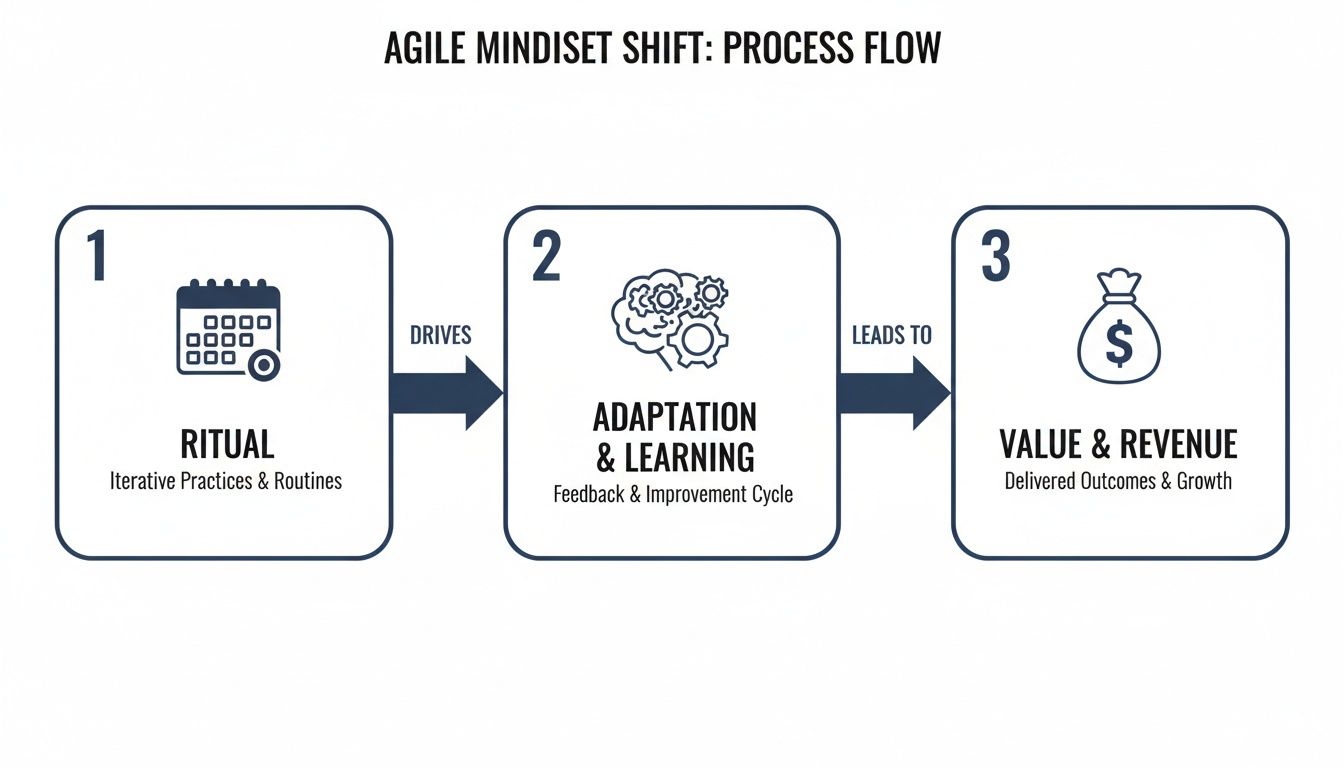
When the rituals of agile create a feedback loop of learning and adapting, you start seeing real, measurable results.
Connecting Sprints to Business Success
The numbers tell the same story. Projects managed with agile methods have a 75% success rate, which is a huge jump from the 56% seen in traditional project management. This success is often powered by focused planning, with 46% of agile teams aiming for full team utilization to maximize their output during a sprint.
This distinction becomes crystal clear when comparing the old way of thinking with a modern, revenue-focused approach.
Traditional vs Revenue-Driven Sprint Planning
| Aspect | Traditional Sprint Planning | Revenue-Driven Sprint Planning |
|---|---|---|
| Primary Goal | Complete as many story points/tasks as possible. | Deliver a specific, measurable business outcome (e.g., reduce churn by X%). |
| Backlog Focus | Often driven by "loudest voice" or technical debt. | Prioritized by revenue impact, customer signals, and strategic goals. |
| Team Motivation | "Get the work done." | "Solve this customer problem to prevent revenue loss." |
| Success Metric | Velocity, burndown charts. | Impact on key business metrics (MRR, LTV, churn). |
Ultimately, a revenue-driven mindset re-frames the entire purpose of the sprint, aligning the team's daily work with the company's financial health.
The goal is to make every sprint a strategic investment. When your team sees that their work on a bug fix directly prevents a $10,000/month account from churning, their motivation and focus sharpen immediately.
This guide will show you how to build a plan that achieves exactly that. For a deeper dive into the fundamental concepts, you can explore the principles of Agile Development Sprint Planning.
We'll get straight to the practical steps you can take to:
- Define sprint goals that are directly tied to business metrics.
- Prioritize your backlog based on real customer signals and revenue impact.
- Create realistic plans that protect your team’s capacity and prevent burnout.
By putting these ideas into action, your sprint planning will stop being a simple scheduling task and become the central nervous system of your product’s growth engine.
Craft Sprint Goals That Actually Drive Impact

I’ve seen too many sprints derail before they even begin, all because of a fuzzy sprint goal. Teams often fall into the trap of setting vague objectives like "Improve the dashboard" or "Work on performance." These goals might sound productive, but they lack the focus needed to rally the team and deliver something truly meaningful.
A great sprint goal is your team's north star for the next two weeks. It's the filter for every decision. When a last-minute request pops up, the team can simply ask: "Does this get us closer to our goal?" If the answer is no, it’s easy to say "not right now."
The secret is to shift from vague ideas to specific, measurable outcomes that are clearly tied to the business. This isn't just a formality; it's the foundation of a solid agile sprint plan.
From Vague Objectives to Measurable Outcomes
Let's get practical. How do you turn a weak goal into one that gets your team fired up and impresses stakeholders? The key is to explain why the work matters, not just what the work is.
Here’s how that transformation looks:
- Weak Goal: Fix bugs from the backlog.
- Strong Goal: Reduce churn risk by 5% by resolving the top three user-reported bugs that are causing support ticket escalations.
- Weak Goal: Improve the signup process.
- Strong Goal: Increase new user activation by 10% by redesigning the signup flow to require two fewer fields and adding social login options.
See the difference? The strong goals aren't just a to-do list; they're about hitting a quantifiable business result. This directly connects your development team's day-to-day work to the company's bottom line.
A well-crafted sprint goal is a mini-business case for the sprint. It answers not just "what" the team is building, but "why" it's the most important thing to build right now.
This shift in framing is incredibly empowering. Your engineers are no longer just closing tickets—they're actively reducing churn or boosting activation. This context gives them a sense of ownership and purpose that a simple task list never could.
The Role of Data in Goal Setting
The best sprint goals aren't pulled out of thin air; they're born from data. Instead of guessing what's important, dig into your customer feedback, product analytics, and revenue data to find the most painful—and valuable—problems to solve.
For example, if your support data shows a particular bug is tied to $20,000 in monthly churn risk, prioritizing a fix becomes a no-brainer.
Connecting work to data is a core part of building an agile sprint plan that works. To make this process even more structured, check out our guide on creating a feature prioritization matrix for more techniques on making these data-informed decisions. When you ground your goals in hard evidence, you create a plan that’s not just focused but also easy to defend to anyone who asks.
Prioritize Your Backlog Using Customer Data

This is where great sprint planning truly sets itself apart. It's time to stop letting the loudest voice or the highest-paid person's opinion (the "HiPPO") dictate your roadmap. The most impactful plans are built on a foundation of cold, hard data from your customers.
By connecting your product backlog to the rich data streams you already own, you can completely change how your team plans. This means piping in insights from customer support tickets, sales call notes, and user behavior analytics directly into your backlog.
Translate Customer Pain into Revenue Impact
Let's get specific. Imagine your product manager gets an automated alert: one particular bug, flagged in 30 different support tickets, is directly tied to $20,000 per month in potential churn from at-risk accounts.
Suddenly, prioritizing that bug fix isn't a gut feeling—it's an obvious, data-backed business decision. That’s the power of tying customer feedback directly to revenue.
This approach gives you a clear, defensible business case for every item you pull into a sprint. When a stakeholder inevitably asks why their pet feature isn't being built, you can show them exactly what is being worked on—and how much value it's protecting or generating. In our experience, that kind of transparency is the key to getting everyone aligned.
An agile sprint plan backed by customer data shifts the conversation from "What should we build?" to "Which customer problem will generate the most value if we solve it?" This is the core of a product-led growth strategy.
To get even more strategic, you can use frameworks like the Opportunity Solution Tree to map customer problems to potential solutions. It's a fantastic way to keep your team focused on outcomes, not just output.
Integrating Data from Multiple Sources
Creating a single source of truth for customer signals is the biggest hurdle, but it's also where you'll find the biggest wins. The goal is to centralize all that feedback and link it directly to your development work.
Here’s how top SaaS teams are pulling this off:
- Zendesk & Intercom Integration: They automatically tag and categorize support tickets. When an issue hits a certain threshold—say, 10 tickets about the same problem—an alert is triggered, or better yet, a draft ticket is created in their development tool.
- Sales Call Analysis: Using software that transcribes and analyzes sales calls, they can flag mentions of key competitors, specific feature requests from high-value prospects, or deal-breaking issues that are costing them new business.
- Jira & Linear Workflows: The real magic happens when these signals flow right into your team's daily tools. An issue created from a Zendesk ticket should automatically populate with key data: the number of affected users, the associated MRR, and a direct link back to the original conversations. This gives engineers the context they need to understand the why behind the work.
Building these integrations might seem daunting, but even simple connections can have a huge impact. For more ideas, check out our guide on other powerful backlog prioritization techniques that work well alongside a data-driven approach.
Ultimately, when you treat customer feedback as a quantifiable data asset, your sprint plan becomes more than just a to-do list. It becomes a reliable engine for driving revenue and keeping customers happy.
Estimate Work Realistically and Protect Your Capacity
Overcommitting is the number one killer of a good sprint. A plan based on wishful thinking instead of actual team capacity just sets everyone up for a stressful sprint and missed deadlines. The first step to a successful sprint is getting brutally honest about how much time your team really has.
This goes way beyond just blocking out holidays and PTO. Think about all the time sinks that eat into every single sprint: company all-hands, daily stand-ups, backlog grooming, and the inevitable context switching. When you add it all up, a developer's "40-hour" week is often closer to 25-30 hours of actual, focused time to work on sprint tasks.
There's a reason so many teams operate this way. Today, nearly 97% of organizations have adopted agile methods, and a whopping 87% of them use Scrum. This isn't just a trend; it's a testament to how crucial realistic planning is for delivering work consistently. You can see the full research on agile adoption rates to get the bigger picture.
Use Story Points for Forecasting, Not Judging
Let's get one thing straight: story points are not hours. They should never, ever be used to measure or compare individual developer productivity. Their real magic lies in forecasting.
Story points are a quick, relative way to gauge the effort, complexity, and risk of a task. By tracking your team's velocity—the average number of points they complete sprint over sprint—you get a reliable forecast of what they can handle next. It’s often called the "Yesterday's Weather" method. If your team has consistently finished between 25 and 30 points for the last few sprints, committing them to 45 is just asking for trouble.
Your team's historical velocity is the most honest predictor of its future capacity. Don't ignore it in favor of ambition. A realistic sprint plan is grounded in data, not hope.
How to Plan for the Unknowns
So, what do you do with those tasks that are impossible to point? I'm talking about a hairy bug investigation or a research spike for a new API. You can’t just ignore them.
Here are a couple of practical ways I've seen teams handle these unknowns:
- Timebox the Task: Instead of trying to estimate the entire investigation, agree to dedicate a fixed amount of time to it—say, 8 hours. The goal isn't necessarily to solve the problem within the timebox, but to come out with a better understanding and a clear next step.
- Create a Capacity Buffer: This is my personal favorite. Intentionally leave a portion of your sprint capacity unplanned. A buffer of 10-15% gives your team the breathing room to tackle unexpected issues or urgent requests from other departments without having to derail the entire sprint.
Building this kind of flexibility directly into your sprint plan makes it far more resilient. When the inevitable surprises pop up, they become manageable hiccups instead of sprint-breaking emergencies. It’s all about planning for the reality of product development, not some idealized version of it.
Run a Sprint Planning Meeting That Actually Works

Let's be honest: a lot of sprint planning meetings are a slog. They often feel like the product manager is just reading a list of tickets to a silent audience. A great meeting is the polar opposite. It's a dynamic, collaborative workshop where the entire team actively builds the plan together.
Your job as the facilitator—whether you're the PM or Scrum Master—is to steer this session. The end goal is a sprint backlog that everyone understands, believes in, and is genuinely fired up to execute.
This all starts before the meeting even begins. If you’ve done the prep work we already covered—defining a sharp, data-backed sprint goal and curating a prioritized backlog—you've already won half the battle. Your meeting instantly transforms from a tense negotiation into a strategic huddle focused on how to win the sprint.
A Battle-Tested Meeting Flow
A productive meeting needs a clear agenda. Without one, you’ll get lost in rabbit holes and leave without a committed plan. I’ve run countless planning sessions, and this simple flow keeps the team focused and ensures you walk out with a solid agile sprint plan.
- Ground Everyone in the "Why" (first 15 minutes): Kick things off by re-stating the sprint goal. Don't just read it; sell it. Show the customer support tickets, the revenue data, or the user feedback that makes this the most important thing to tackle right now. This context is everything—it gets everyone rowing in the same direction.
- Walk Through the "What" (about 45 minutes): Next, review the top-priority stories that directly support the goal. This isn’t a monologue. It’s a Q&A. Pull up the designs, clarify requirements, and field those initial questions to make sure the work is understood.
- Let the Team Define the "How" (around 60 minutes): Now, you step back. The engineering team takes the lead, breaking down each story into the specific technical tasks needed to get it done. This is where the real planning happens—they'll spot hidden complexities, surface dependencies, and debate the best approach.
- Solidify the Commitment (final 30 minutes): As the team refines and discusses each story, they’ll estimate it and officially pull it into the sprint. You do this until the team’s capacity is full. The meeting ends with a simple but powerful act: a verbal "go" from the entire team, confirming they believe in the goal and the plan to achieve it.
This structure naturally pushes ownership to the development team. The discussion during the task breakdown is pure gold; it’s where a vague idea becomes a concrete plan. A fantastic way to visualize this part of the conversation is with story mapping, which you can explore in our detailed guide.
The best planning sessions I’ve ever been a part of were the ones where engineers asked the most challenging questions. When a developer feels safe enough to say, "I'm not sure we can actually get this done in two weeks," that's not a roadblock. It's a sign of a healthy, mature team.
Tips for Better Facilitation
Your role here is more of a guide than a director. You're creating a space where people feel safe to contribute, question, and even disagree. That means actively listening, encouraging questions, and making sure the quieter voices in the room are heard.
When someone raises a flag about complexity or risk, lean into it. Don’t get defensive. Instead, ask good questions: "What feels riskiest about this to you?" or "What's one piece of information that would make this feel clearer?"
This approach turns potential conflict into collaborative problem-solving. It builds trust and, ultimately, leads to a much more realistic sprint plan that the team genuinely owns.
Answering Your Team's Toughest Sprint Planning Questions
Even the most well-documented process runs into trouble when it meets the real world. When you start putting your agile sprint plan into practice, you'll inevitably hit some common roadblocks. Let's walk through a few of the trickiest situations I see teams struggle with all the time.
Getting these details right is what separates a plan that just looks good on paper from one that actually works. The key is tackling these problems head-on with clear, practical principles.
How Long Should a Sprint Planning Meeting Really Be?
You've probably heard the standard advice: two hours of planning for every week of your sprint. So, for a two-week sprint, block out four hours. But let's be clear—that's the absolute maximum time you should ever need, not the goal. If you're consistently using all four hours, something is broken.
With solid preparation, you can easily cut that time in half.
When the product owner arrives with a well-defined sprint goal backed by data and a backlog that’s already been refined and prioritized, the meeting flows. If your planning sessions feel like a marathon, it’s a huge red flag. It almost always means you need to invest more time in backlog refinement before the main event.
What Do We Do About Urgent Requests Mid-Sprint?
The first rule of a healthy sprint is to protect the sprint goal. When an "urgent" request lands in your lap, your immediate job is to work with stakeholders to figure out what "urgent" really means. Is the entire system down for all customers, or is a single (but very loud) client having an issue?
For a true P0 crisis, the team might need to swarm and fix it immediately. But this doesn't happen in a vacuum. The product owner must step in and officially pull a lower-priority item from the sprint to create the capacity. For anything less critical, it belongs on the product backlog, where it can be properly prioritized for a future sprint.
Here’s a pro tip: build a small capacity buffer into your sprint—around 10% is a good starting point. This gives you a little breathing room to handle small, unplanned tasks without derailing your commitments and breaking the trust you’ve built with the business.
Our Story Point Estimates Are Always Wrong. Should We Just Stop?
Not so fast. When estimates feel consistently "wrong," the problem usually isn't the points themselves, but how you're using them. Story points were never meant to track hours or serve as a performance metric for individual developers.
Their real value is in two key areas:
- They force a conversation. The simple act of estimating pushes the team to talk through complexity, uncover hidden risks, and ask the right questions. A big point disagreement is a signal to dig deeper.
- They help you forecast. By tracking your team's velocity (the average number of points you complete per sprint), you get an honest, data-driven look at what you can realistically accomplish.
If your velocity is all over the map from one sprint to the next, that’s your cue to investigate. Are your stories too large and unpredictable? Is the team constantly being derailed by unplanned work? Instead of ditching estimates, use them as a tool for better conversations and lean on your historical velocity as a guide for what your team can actually deliver.
Turn your customer feedback from noise into a clear signal. SigOS uses AI to connect support tickets, sales calls, and user behavior to real revenue impact, helping you build an agile sprint plan that truly drives growth. Discover how to prioritize with confidence at SigOS.
Keep Reading
More insights from our blog



Ready to find your hidden revenue leaks?
Start analyzing your customer feedback and discover insights that drive revenue.
Start Free Trial →