AI for Customer Retention: A Practical Guide for SaaS Teams
Learn how AI for customer retention works, from churn prediction and behavioral signals to automated interventions, key metrics, and real ROI for SaaS teams.
The popular advice is simple: build a more accurate churn model and retention will improve. That advice fails in production. A churn score doesn't save an account, and an AI feature doesn't automatically create loyalty. The hard part is deciding which account needs help, what intervention it needs, who owns that action, and how quickly the team can respond.
A 2026 study of subscription applications found that AI apps retained users worse than non-AI apps, with annual retention of 21.1% versus 30.7% and monthly retention of 6.1% versus 9.5% (Springer research). The lesson isn't that AI can't support retention. It's that AI for customer retention only works when lifecycle design, product value, and operational follow-through work together.
Why Most Retention AI Fails Before It Starts
The first mistake is treating retention as a classification problem. Teams define churn, assemble historical data, compare algorithms, celebrate a strong validation score, and place a risk ranking in a customer success dashboard. Then the system becomes another tab that nobody checks consistently.
A model can identify an account that looks fragile. It can't, by itself, repair an onboarding gap, resolve a billing issue, teach a neglected workflow, or persuade an executive sponsor to renew. Those actions require an operating design around the prediction.
The contrarian signal
The finding that AI applications retained worse than non-AI applications is especially useful because it challenges the assumption that adding intelligence creates product value. The 2026 subscription-app analysis reported 21.1% annual retention for AI apps compared with 30.7% for non-AI apps, and 6.1% monthly retention compared with 9.5%. Those results suggest that AI adoption can't compensate for weak activation, unclear value, poor habit formation, or a neglected customer journey.
The practical implication is uncomfortable: a better model won't rescue a product that hasn't earned continued use. Before modeling, identify the behaviors that indicate value realization and the moments when customers can still change course.
Practical rule: Treat a churn score as a request for an action, not as a conclusion.
The operational failure
Retention projects usually fail in one of three places:
- Ownership: No person or system is responsible for responding to a high-risk account.
- Timing: The alert arrives after the renewal decision has effectively been made.
- Relevance: The model identifies risk without explaining the likely cause or recommending a plausible next step.
The model may be technically sound while the retention program remains ineffective. Product, support, billing, customer success, and revenue operations need a shared workflow that turns signals into decisions. Without that workflow, accuracy becomes a vanity metric with no reliable connection to saved accounts.
What AI-Driven Customer Retention Means
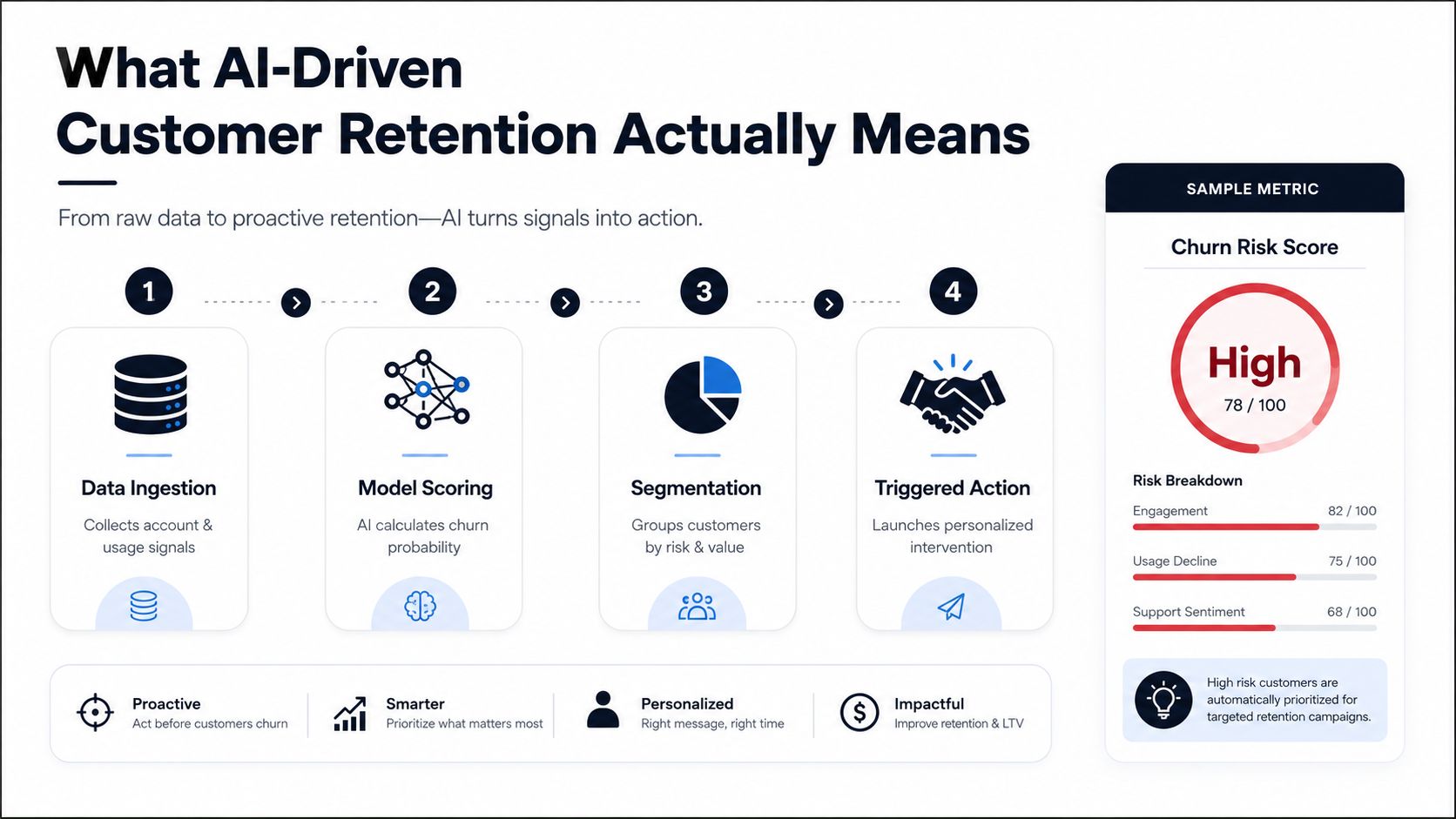
AI-driven customer retention connects account data, product behavior, service interactions, sentiment, billing context, and relationship history. Its job is to identify changing risk and trigger a useful response before disengagement or renewal. Retention AI works like a triage nurse reviewing several vitals at once. A login, support ticket, or survey response can be ambiguous alone, while their combination may show that an account is drifting.
The multi-signal approach matters because patterns across several signals can predict attrition more reliably than one metric. Integrated CRM applications may reduce attrition by up to 15% and improve prediction accuracy, according to G2's analysis of AI in churn reduction. That score is only the first handoff. The operating question is what happens next, who owns it, and whether the response fits the account.
Four connected techniques
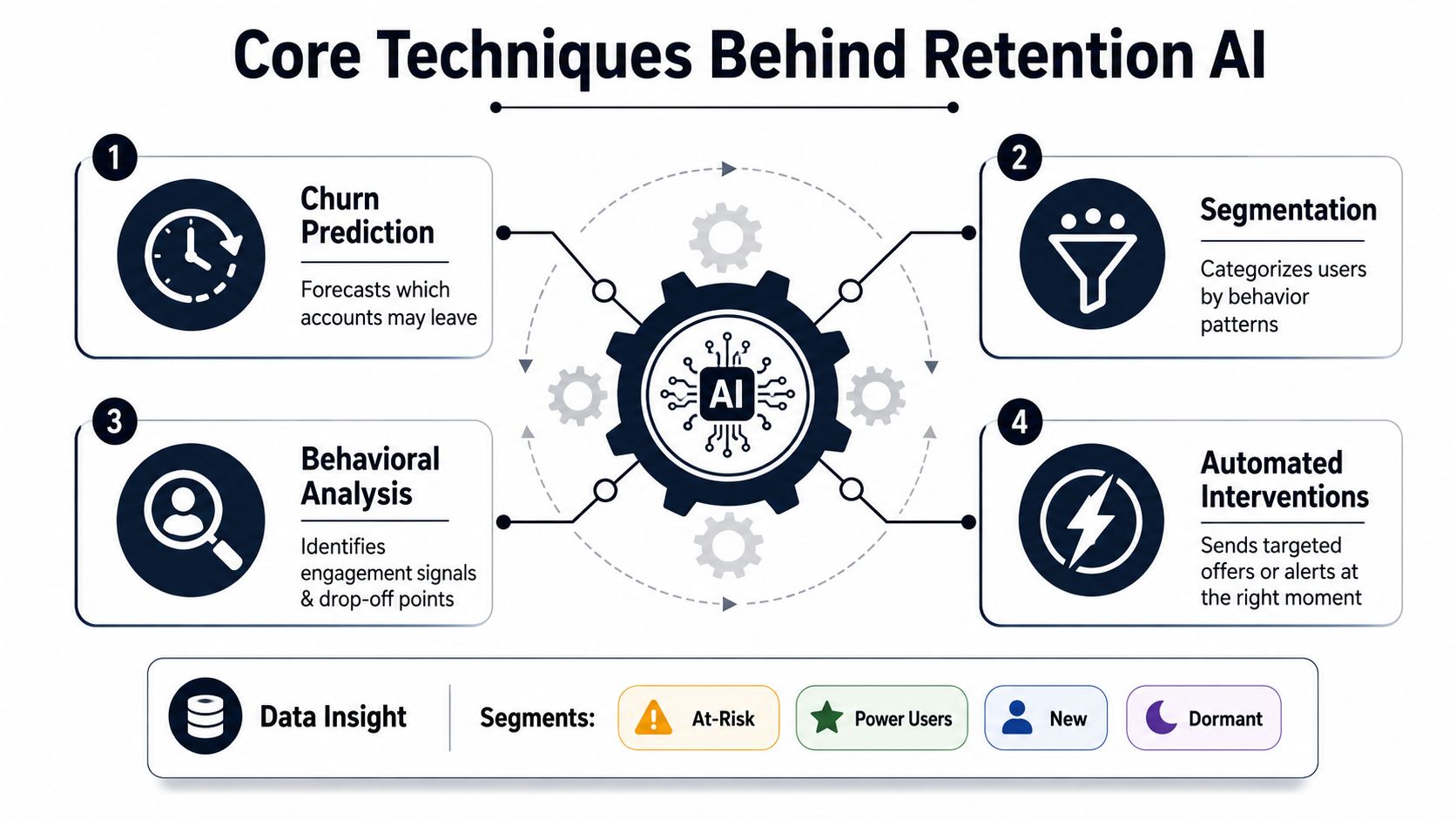
- Churn prediction assigns an account a probability or risk category from observed signals. A model might flag a customer whose core workflow usage has declined while unresolved support issues increase.
- Behavioral segmentation groups customers by actions, rather than relying only on company size, industry, or plan. A dormant account, a new account struggling with setup, and a power user approaching renewal require different responses even when their firmographics match.
- Behavioral analysis identifies meaningful changes, including feature abandonment, shallower usage, stalled invitations, or a shift in support language. This layer supplies context for the risk change.
- Automated intervention sends the signal into a defined action. Options include an in-app prompt, educational message, support escalation, CSM task, or product conversation. Each option has a trade-off: automation scales, while human involvement can address ambiguous or high-value situations more precisely.
A system earns the label retention AI when its prediction changes company behavior and creates a measurable chance to save the account. Teams comparing software categories can use SupportGPT's retention software guide to examine how customer data, workflows, and engagement tools fit together.
Which Accounts Deserve Attention First
Retention capacity is limited. Customer success managers cannot investigate every account, and automated messages should not treat every customer as equally urgent. Prioritize relationship windows and account conditions where an intervention can still change the outcome.
A 2026 telecom study shows how concentrated churn risk can become. It reported churn of 60% for month-to-month customers, compared with 25% for one-year contracts and 10% for two-year contracts. The study also found 55% churn during the first 12 months, 45% churn among electronic check users, and 67% lower average churn risk for customers with three or more premium services (Frontiers and PMC study).
These findings describe telecom customers, not SaaS benchmarks. For SaaS teams, they point to four useful risk patterns: weak commitment, early lifecycle friction, payment behavior, and limited adoption of the product's broader value. The practical question is whether the team can identify the pattern early enough to act.
A practical prioritization model
Start with segments where risk, value, and actionability overlap:
- New customers still in onboarding: A weak first experience can stop the customer from reaching meaningful value.
- Accounts near renewal: The response window is narrow, so a late signal may not leave enough time for a useful intervention.
- High-value accounts with declining core usage: The commercial stakes are significant, but the cause still needs investigation before escalation.
- Customers with unresolved service friction: Support interactions may reveal obstacles that product usage cannot explain.
- Low-commitment or weakly adopted accounts: These customers may need education, a product fix, or a commercial conversation instead of a generic reminder.
AI applications can retain worse than non-AI applications when lifecycle design is neglected. A high churn score does not save an account by itself. The team must connect each segment to a different owner, threshold, and response.
A new account with incomplete setup needs activation help. A mature account with declining usage may need an executive review or a feature-specific recovery plan. Segmenting before alerting prevents the team from spreading attention across the entire customer base and makes it possible to judge whether the intervention changed the account's trajectory.
Core Techniques Behind Retention AI
The four techniques work as a chain. Behavioral analysis finds the change, segmentation gives it context, churn prediction prioritizes it, and intervention execution turns the signal into a customer experience. Breaking that chain creates the familiar dashboard problem.
Start with behavioral analysis
Suppose a SaaS account stops using a workflow that previously indicated regular product value. At the same time, administrators open support tickets about configuration, and the billing record shows an upcoming renewal. A usage drop alone may be normal. The combined pattern deserves investigation.
Behavioral analysis should look for change over time, not just static status. Useful inputs can include feature adoption, usage frequency, workflow completion, seat activity, support themes, sentiment, payment events, and relationship signals. The model needs a history that distinguishes ordinary variation from a meaningful decline.
Add segmentation and prediction
The account can then enter a low-engagement cohort, where its behavior is compared with similar customers. A churn model scores the account, while an explanation identifies the strongest contributing signals. That explanation matters because a CSM needs a credible starting point for the conversation.
One explainable-AI study using the Telco Customer Churn dataset reported 0.84 accuracy, precision, recall, and F1 for gradient-boosting models, while XGBoost reached an AUC-ROC of 0.932. After threshold optimization at 0.528, precision reached 0.90, recall reached 0.91, and false negatives fell by 15% (Taylor & Francis study). The operational lesson is more important than the algorithm choice. Teams should tune the decision boundary to the cost of missing a real churner.
For product teams evaluating adjacent applications of machine learning, AI for product development provides useful context on connecting signals to product decisions.
Design the intervention
The usage drop might trigger an in-app message that points the user to the neglected workflow. If the account remains inactive, the system can create a CSM task containing the usage change, relevant support themes, and a recommended play. A high-value account may receive human outreach, while a lower-complexity account may enter a product education sequence.
Prometheus Agency's discussion of reducing churn with CRM integration is relevant here because CRM integration is what moves a prediction into a repeatable operating process. The intervention must have an owner, a response window, a clear purpose, and an outcome field. Without those handoffs, teams over-invest in model selection and under-invest in the mechanism that can save the account.
Metrics That Predict Saved Accounts
Raw model accuracy is easy to present and easy to misunderstand. It can look impressive when churn is uncommon, while still creating more alerts than a customer success team can handle. A model that spots risk well but overwhelms its users will weaken trust in the retention program.
Separate model metrics from operating metrics:
| Metric | What it answers | Why it matters |
|---|---|---|
| Precision | How many flagged accounts are at risk? | Measures alert quality |
| Recall | How many true churn risks did the system find? | Measures missed opportunities |
| Intervention window | How much time exists to act? | Tests whether the signal arrives early enough |
| Save rate | How many flagged accounts renew or recover? | Connects the workflow to retention |
| Attribution lift | Did intervention outperform a comparable control? | Tests causal impact |
Measure precision and recall at the threshold the team uses in production. A model may perform well in a notebook but fail when every moderate-risk account becomes a task. The right threshold reflects the cost of missing a churner, generating a false alarm, and assigning human follow-up.
Measure the action, not just the alert
Track whether the CSM opened the alert, accepted the recommended play, contacted the customer, and recorded an outcome. Then separate renewed without intervention, renewed after intervention, downgraded, expanded, and churned outcomes. A renewal after flagging may reflect timing rather than model impact.
Cohort analysis helps prevent misleading aggregate results. Teams can use cohort analysis for user loyalty to compare retention by onboarding period, plan, adoption pattern, and intervention exposure. The comparison needs enough context to distinguish an AI-assisted save from a renewal that was already likely.
The operational test is simple: Did the signal arrive in time? Did the team act? Did the customer change behavior? Did the account renew because of the intervention? Reporting that stops at accuracy cannot answer those questions. AI applications can also retain worse than non-AI applications when lifecycle design, timing, and follow-through are neglected. A churn score becomes valuable only when it changes what happens to the right account.
Implementation Decisions You Cannot Skip
Implementation is where many retention projects die. The first ninety days should be treated as a series of decisions about data, ownership, workflow, and measurement, not as a generic march toward a production model.
Data and identity checklist
- Define the outcome: Decide what counts as churn, renewal, downgrade, recovery, and expansion. Historical renewal outcomes must connect to the same account identity used by product and support systems.
- Unify account IDs: Zendesk, Intercom, billing, product analytics, and the CRM need a reliable way to refer to the same customer. A model can't reconcile fragmented identities after the fact.
- Audit event schemas: Confirm that product events have stable names, useful timestamps, and consistent account or user associations. Teams should review common data quality issues before adding more model complexity.
- Check population bias: Training data may overrepresent customers with mature telemetry, active CSM coverage, or particular plan types. That can make the model less reliable for accounts that matter but generate fewer observable signals.
Contract type and plan tier shouldn't be treated as optional context. The telecom evidence cited earlier shows why relationship structure can materially change risk patterns. SaaS teams should test whether their own contract and adoption structures alter the intervention strategy rather than assuming one threshold fits everyone.
Connect the score to existing work
A score should create a task, route an escalation, populate a customer record, or trigger a carefully designed message. Connect the workflow to tools such as Zendesk, Intercom, and the CRM, then make the action visible where the team already works. If a CSM must copy data between systems, adoption will deteriorate.
Explainability is equally practical. Show the behavior changes behind a flag, the comparison period, the affected workflow, and the recommended next step. A CSM who can't answer “why was this account flagged?” won't confidently act on it.
Before activating alerts, run an offline backtest using historical data. Test thresholds against the team's real capacity, inspect false positives and false negatives, and review whether the recommended plays would have been feasible at the time. For outbound follow-up, the workflow should also align with a disciplined high-performance email system, not just generate more messages.
Proving ROI Beyond Model Accuracy
Practitioner reports cited earlier describe meaningful churn reductions in high-performing AI retention deployments. Those figures are a benchmark, not a prediction. Real results depend on whether the team can act on the signal before the account reaches an irreversible decision.
Two models can share a similar AUC and still save different numbers of accounts. One may produce precise alerts that CSMs can handle. The other may distribute borderline accounts across the team, create alert fatigue, and cause reps to ignore the queue. The difference lies in the operating threshold and intervention design, not the evaluation report alone.
An AI score creates ROI only when it changes an account outcome.
Thresholds change economics
The explainable-AI research cited earlier found that threshold optimization improved precision and recall while reducing false negatives. That finding supports a practical principle: the best threshold isn't the statistical default. It reflects the cost of a missed churner, the cost of a false alarm, available CSM capacity, and the likely value of a successful intervention.
A defensible ROI model starts with the intervention population. Count flagged accounts, completed actions, time to action, renewal outcomes, and the cost of each play. Compare those outcomes with a control group or carefully matched historical cohort. Without that comparison, “saved revenue” remains an assumption rather than a measured result.
Operationally, the bottleneck is often timely action at scale. A score that arrives after the renewal decision has little practical value, even if its predictions are accurate. AI applications can also retain customers worse than non-AI applications when lifecycle design is weak, because automated prompts may arrive at the wrong moment, repeat irrelevant advice, or replace useful human contact with noise.
ROI reviews should include follow-through rate, response time, intervention cost, and attributed save rate, alongside precision, recall, and AUC. A model earns budget when it helps the team make better decisions repeatedly and produces measurable account outcomes.
A Short Playbook to Start This Week
A SaaS team doesn't need to buy a new platform before testing the operating model. Start with a narrow slice of customers and make every handoff observable.
- Choose one high-impact segment. Select a cohort where customer value, contract context, adoption risk, and expansion potential intersect. A focused first use case makes it easier to define the intervention and inspect false alerts.
- Assign the intervention before training. Decide what happens when the system flags an account. Name the owner, response window, channel, and recommended play. If nobody owns the action, don't ship the score yet.
- Assemble a minimal signal set. Pull product usage, core-feature activity, support themes, billing events, and account context from the warehouse. A baseline logistic or XGBoost model is usually more useful than waiting for a perfect feature store.
- Tune the threshold to capacity. Ask how many alerts the team can investigate well, then select an operating point that balances missed churners against false alarms. Review performance by segment instead of trusting one aggregate threshold.
- Instrument the outcome. Record whether the team acted, what intervention occurred, whether behavior changed, and whether the account renewed. The next review should answer how many flagged accounts were saved and what the intervention cost.
The central takeaway is straightforward: start with the highest-impact segment, tune decisions to business cost, and treat intervention workflows as the product. Prediction creates an opportunity. Execution determines whether retention changes.
SigOS helps SaaS teams connect support tickets, chat transcripts, sales calls, and usage data to patterns associated with churn and expansion, then prioritize issues with revenue impact scores. Visit SigOS to turn scattered customer feedback into targeted retention actions your product, support, and growth teams can act on.
Keep Reading
More insights from our blog

Ready to find your hidden revenue leaks?
Start analyzing your customer feedback and discover insights that drive revenue.
Start Free Trial →